After Analyzing 231 Prediction Markets, We Uncovered the Harsh Truth About ICOs

比推Pubblicato 2026-01-29Pubblicato ultima volta 2026-01-29

Introduzione

Analyzing 231 prediction markets on Polymarket for 29 token launches reveals that these markets are not reliable predictive tools but rather contrarian indicators of market sentiment. Despite claims of near-perfect accuracy, the true predictive accuracy one week before market close is only 66.7%, with systematic over-optimism bias. Markets consistently overestimated fundraising amounts and valuations, with FDV predictions averaging a +35% overestimation. High trading volume on Polymarket (>$50M) is a strong bearish signal, often correlating with significant post-ICO price declines. In contrast, conservative predictions and lower trading volume (<$5M) are relatively bullish signals, though most tokens still underperform. Overall, 75% of tokens fell in the first 24 hours, and the average return since ICO is -32.2%, indicating that extreme optimism in prediction markets often precedes poor performance.

Source: LEGION (@legiondotcc)

Original Title: What prediction markets reveal about ICOs

Compiled and Edited by: BitpushNews


Prediction Markets in the Token World

Polymarket's token launch prediction markets have cumulatively processed nearly $2.5 billion in trading volume, with the platform claiming an astonishing prediction accuracy rate—100% for fundraising size predictions and over 90% for valuation predictions. However, in-depth analysis reveals that these figures are severely misleading: the true market signal lies not in "what was predicted correctly" but in "how much was predicted incorrectly."

By analyzing data from 231 prediction markets across 29 token launch events and comparing it with actual token performance from CoinGecko, we found that these markets are not reliable prediction tools but rather contrarian indicators reflecting market sentiment.

Key Findings:

One week before the prediction markets closed, the true prediction accuracy rate was only 66.7%. At critical moments, the crowd was wrong one out of every three times, and the errors systematically showed excessive optimism.

24-Hour Volatility Issue: Using CoinGecko's hourly data, we found that PM's "FDV exceeding X 24 hours after listing" markets were betting on extreme volatility.

Average 24-hour change: ±23% | Best Case: Monad +54.8% | Worst Case: Trove -38.7%.

75% of tokens saw their prices drop within the first 24 hours of listing. PM's 24-hour FDV prediction accuracy rate: only 62.5%.

The Fallacy of Accuracy

When we track how market probabilities change over time, rather than just looking at the final outcome, a different picture emerges. The promise markets appear "100% accurate" because the final data leaks as the sale progresses. Insiders and observers update prices accordingly; this is merely price discovery after the fact.

Key Finding:

Both promise markets and FDV markets tend to approach ~100% accuracy at closing because they settle after the outcome is known. Promise markets close after the sale ends; FDV markets close after the 24-hour post-listing period ends. The only meaningful predictive metric is the accuracy rate one week before closing, when genuine uncertainty still exists. The 66.7% promise accuracy rate indicates that, at critical moments, the market was wrong one-third of the time.

Where User Judgment Went Wrong

We examined every market where users had over 60% confidence in an unrealized outcome. In every case, the error was consistently in the same direction: excessive optimism. The crowd consistently believed the fundraising size would be larger and the valuation higher than they actually were.
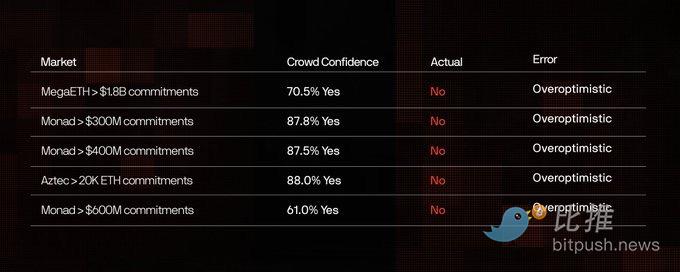
This systematic bias suggests that the participants in these markets are optimistic speculators who are drawn there precisely because they are bullish on the token sales.

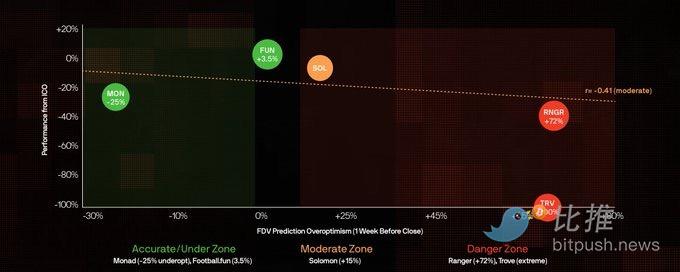
Excessive Optimism vs. Token Performance (Since ICO)

Methodology: This analysis only includes markets that had a public ICO and have issued tokens, using PM odds from one week before closing. Degree of Excessive Optimism = (PM Predicted FDV – Actual 24h FDV) / Actual 24h FDV. The Y-axis shows performance (return) since the ICO.

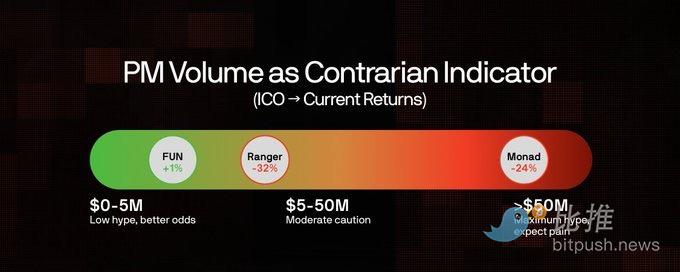
The data shows a moderate negative correlation (r=-0.41) between the degree of excessive optimism and ICO returns. Monad was undervalued (-25%) but has still fallen -24% since its ICO. Ranger was the most over-optimistically predicted (+72%) and has fallen -32% since its ICO. Only Football.fun remains above its ICO price (+1%).
Token Performance Ranking

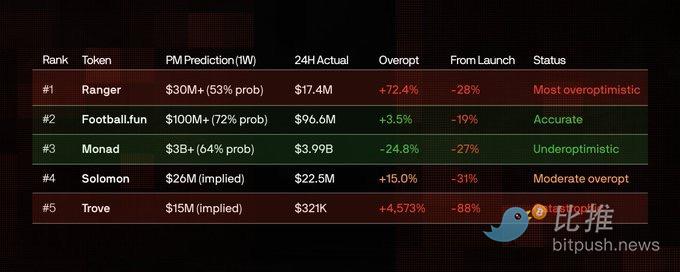
The table below uses historical PM odds from one week before closing, revealing the true prediction accuracy.

The pattern is clear: extreme excessive optimism foretells disaster, and high PM trading volume is a contrarian indicator even when its predictions are accurate.
ICO FDV vs. Listing Performance

Key Finding: Among tokens with ICO data, 40% listed at a price below their ICO valuation. Average return since ICO: -32.2%. Only Football.fun is trading above its ICO price.
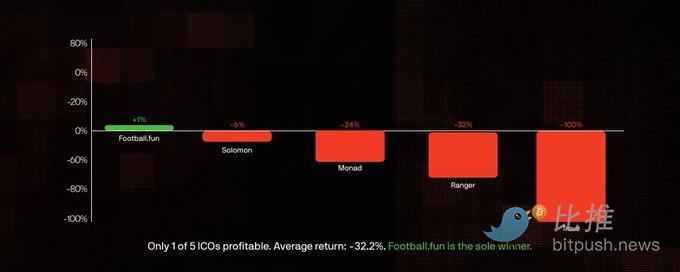
The pattern is starkly clear: Even tokens that listed above their ICO valuation (Monad, Solomon) eventually fell below the ICO price. Among the 5 ICO tokens in this dataset, only Football.fun is currently trading above its ICO price (+1%), making it the sole winner.

Key Conclusions

After analyzing 231 markets, $241.5 million in trading volume, and 8 listed tokens with verified 24-hour FDV data, several conclusions clearly emerge:

1. "100% accuracy" is meaningless. Markets close after the outcome is known (promise markets after the sale, FDV markets after 24 hours), so late-stage accuracy is trivially close to ~100%. One week before closing, the true prediction accuracy of promise markets was only 66.7%. At critical moments, the crowd was wrong one-third of the time.

2. Systematic excessive optimism. Among the top 15 markets, 5 markets showed over 60% confidence in thresholds that were not met. Average FDV overestimation: +35%.

3. High PM trading volume is a contrarian indicator. Monad ($89M) and MegaETH ($67M) had the highest degrees of excessive optimism. The more money the crowd pours in, the more confident they become, and the more wrong they tend to be.

4. Conservative predictions = Better outcomes. Tokens where PM predictions were accurate (Monad, Football.fun) fell less. Low hype and accurate predictions appear to be bullish signals.

Trading Signals

Based on the analysis, we can extract actionable signals for evaluating future token sales. These are not absolutely precise, but they represent patterns that appeared repeatedly in our dataset.
Bearish Signals

  • PM Trading Volume > $50 Million

  • FDV Excessive Optimism > 50%

  • All FDV thresholds likely won't be met

  • Promise Amount Excessive Optimism > 30%

Bullish Signals (Relatively)

  • PM Trading Volume < $5 Million

  • FDV Prediction Error within 20%

  • Multiple FDV thresholds will be met

  • Crowd expectations are conservative

This asymmetry is crucial. Bearish signals are strong indicators of poor outcomes, while bullish signals are relatively weaker—only suggesting that a token might "fall less" than its hyped counterparts. In a market where token prices have generally fallen from their highs, "falling less" is already the best-case scenario.

Ultimately: Polymarket's token sale markets are essentially hype gauges. The true signal lies not in the prediction itself, but in the deviation between the predicted outcome and the actual performance. When public money floods in, betting that valuations will continue to climb, it is wise to be cautious.

History repeatedly proves: when market consensus peaks, it is often the moment when investors experience the most pain.

Data sources in the article: Polymarket CLOB API, CoinGecko, CMC (cross-verified), price data as of January 27, 2026.


Twitter:https://twitter.com/BitpushNewsCN

Bitpush TG Discussion Group:https://t.me/BitPushCommunity

Bitpush TG Subscription: https://t.me/bitpush

Original article link:https://www.bitpush.news/articles/7607105

Domande pertinenti

QWhat is the main finding regarding the accuracy of prediction markets for ICOs one week before closing?

AThe true prediction accuracy of commitment markets one week before closing is only 66.7%, meaning the crowd was wrong one out of every three times during critical periods of uncertainty.

QWhat systematic bias did the analysis discover in the prediction markets?

AThe analysis found a systematic bias of excessive optimism, where participants consistently predicted higher fundraising amounts and higher valuations than what actually occurred.

QAccording to the article, what does high trading volume on Polymarket indicate for an ICO?

AHigh Polymarket trading volume (e.g., over $50 million) is a bearish signal and acts as a reverse indicator, suggesting that the more money the crowd invests, the more confidently wrong they tend to be.

QWhat percentage of tokens in the dataset traded below their ICO valuation at listing?

A40% of the tokens with ICO data in the dataset listed at a price below their ICO valuation.

QWhat is the key takeaway about the relationship between prediction market forecasts and actual ICO performance?

AThe key takeaway is that prediction markets are not reliable forecasting tools but rather gauges of hype. The true signal lies not in the predictions themselves, but in the deviation between those predictions and actual performance.

Letture associate

Must-Watch Events Next Week|CLARITY Act Could Face Senate Vote; SpaceX, Circle to Report Earnings (8.3-8.9)

**Summary: Key Events and Developments to Watch (August 3-9)** The upcoming week is marked by significant financial disclosures, key legislative deadlines, and notable product updates. **Major Financial Events:** Several companies are scheduled to release their Q2 2026 earnings. American Bitcoin (ABTC) will report on August 3, followed by SpaceX and Hut 8 Mining Corp. on August 4, and Circle on August 5. Notably, a significant portion of SpaceX shares (up to 12% of total shares) will be unlocked on August 6 following their earnings release. **Key Legislative Deadline:** The U.S. Senate faces an August 7 deadline to secure 60 votes for the CLARITY Act, a bipartisan bill aiming to establish a federal regulatory framework for cryptocurrencies. The Senate may hold a full vote on the bill during the week. **Economic Data:** The U.S. July Non-Farm Payrolls report will be released on August 7, providing crucial labor market data. **Technology & Product Updates:** * **Shutdowns:** DeFi portfolio tracker Zapper and wallet app Ctrl Wallet will cease operations on August 3. * **Upgrades:** LayerZero will deprecate its v1 relayers on August 3. XRP Ledger's new version 3.3.0, featuring five new functions, is expected next week. * **AI:** Elon Musk announced that the advanced Grok 4.6 AI model is set for release around August 7. * **Bitcoin:** The BIP-110 forced signaling for a potential Bitcoin network change is scheduled to begin around August 8. **Other Notable Events:** Chinese robotics firm Unitree Tech has set its preliminary price inquiry for its IPO for August 5. South Korean exchange Upbit will delist AQT and AERGO tokens on August 3.

marsbit1 h fa

Must-Watch Events Next Week|CLARITY Act Could Face Senate Vote; SpaceX, Circle to Report Earnings (8.3-8.9)

marsbit1 h fa

Stocks Are Plummeting More Sharply Than Cryptocurrencies. Where Has the Money Gone?

Stock Markets Plunge Deeper Than Cryptocurrencies: Where Did the Money Go? In late July, Seoul's Kospi index triggered circuit breakers for two consecutive days, plummeting over 40% from its June high. The collapse was led by heavyweight stocks like SK Hynix, whose record profits still disappointed investors, and devastating leveraged ETFs, with one major product losing over 83% of its value. This signaled a global, forced deleveraging targeting the most crowded trades. Interestingly, while stocks exhibited extreme volatility akin to crypto markets, Bitcoin rose nearly 15% in July after a prior steep drop. Analysis shows the money fleeing equities did not flow into Bitcoin. Instead, Bitcoin had already absorbed its sell-off in May-June, when U.S. spot Bitcoin ETFs saw historic outflows. The true safe-haven beneficiary was gold, whose price rose over 20% year-on-year, highlighting a decoupling between Bitcoin and gold as "digital gold." The sell-off was a targeted unwinding of leveraged positions in tech and semiconductors, accelerated by broker-dealer risk management and shifts in the AI narrative, including new competition from Chinese memory chipmakers. The retreat path was clear: from high-valuation tech stocks to cash and U.S. Treasuries, then to gold. For Bitcoin to attract sustained institutional inflows, conditions like eased global liquidity pressure, a "soft-landing" Fed rate cut, and U.S. regulatory clarity via legislation like the stalled CLARITY Act are needed. Currently, Bitcoin is not a safe haven but an already-cleared asset. Its low correlation with tech stocks, however, makes it a potential diversification play for institutional portfolios once the storm passes. The money isn't here yet, but the positioning is underway.

marsbit1 h fa

Stocks Are Plummeting More Sharply Than Cryptocurrencies. Where Has the Money Gone?

marsbit1 h fa

In Conversation with Ray Dalio: We Are Currently in an AI Bubble, with 1% of My Portfolio in Bitcoin

Ray Dalio, founder of Bridgewater Associates, warns in an interview that the current AI boom shows classic bubble characteristics, which could lead to significant economic downturns as seen in past cycles like 1929 or 2000. He explains that speculative enthusiasm, fueled by debt and overvaluation, often precedes a crash when rising rates or taxation force asset sales, causing widespread losses and recession. Dalio also outlines his "Big Cycle" theory, describing an approximate 80-year pattern where widening wealth gaps, massive government deficits, and shifting geopolitical power (like China's rise) create internal conflict and global instability. He emphasizes that we are in a late-cycle, transitional phase where traditional powers like the US and UK face decline. For personal wealth protection, Dalio advises diversification beyond cash into assets like stocks, bonds, real estate, and particularly gold, which he prefers over Bitcoin. While he holds about 1% of his portfolio in Bitcoin as a non-printable hard asset, he views gold as more secure from technological or governmental threats. Regarding AI's impact, Dalio believes it will disproportionately benefit capital owners, worsening inequality by replacing both physical and cognitive labor. He suggests that human intuition and emotional intelligence, combined with AI, will be key for future workers. On taxation, Dalio argues that wealth taxes are impractical and risk triggering asset sell-offs, reducing productive investment. He points to the UK as a cautionary example of debt, low productivity, and political strife. Geopolitically, Dalio foresees a more regionalized world, with the US showing weakness in prolonged conflicts like with Iran, akin to past imperial declines. The ideal outcome, he suggests, is coexisting powerful blocs (e.g., Americas, China-Asia Pacific) without major war.

marsbit5 h fa

In Conversation with Ray Dalio: We Are Currently in an AI Bubble, with 1% of My Portfolio in Bitcoin

marsbit5 h fa

Trading

Spot
活动图片





