
After AAVE Was Hit, What Did Spark Do Right to Attract $1.3 Billion Against the Trend?

marsbitPubblicato 2026-04-22Pubblicato ultima volta 2026-04-22

Introduzione

Amid a $15.1 billion liquidity crisis at Aave triggered by a cross-chain vulnerability involving rsETH, which led to $200 million in bad debt, Spark Protocol emerged as a safe haven, attracting $1.3 billion in inflows. Spark’s TVL surged to $4.74 billion, with ETH deposit rates spiking to 130% due to high demand and scarce liquidity. Spark’s resilience stemmed from its conservative governance and multi-layered risk framework. Unlike Aave, which aggressively listed rsETH to boost capital efficiency, Spark had proactively delisted the asset months earlier, avoiding exposure. The protocol employs strict rate-limited caps, higher interest rate buffers, and a modular isolation architecture to mitigate risks. These measures prevent over-concentration, ensure liquidity during stress, and attract arbitrage capital during high utilization. The shift from Aave to Spark signals a market preference for security over yield, underscoring the importance of disciplined risk management in DeFi.

Author: Jae, PANews

When Aave faced a massive withdrawal of hundreds of billions of dollars, Spark caught the overflowing liquidity.

The on-chain disaster triggered by cross-chain vulnerabilities in Kelp DAO and LayzerZero split the DeFi lending market into two distinct worlds.

The influx of "toxic" asset rsETH into Aave resulted in approximately $200 million in bad debt, causing a complete liquidity drain and a panicked exodus of hundreds of billions in funds.

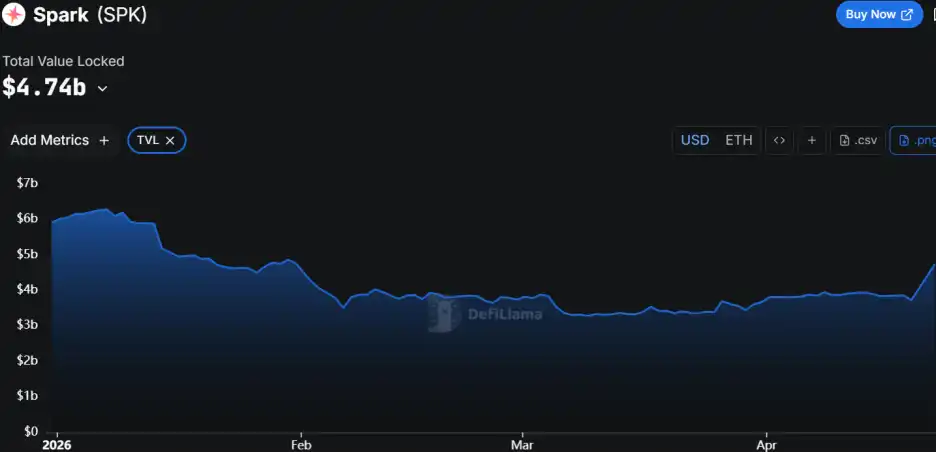
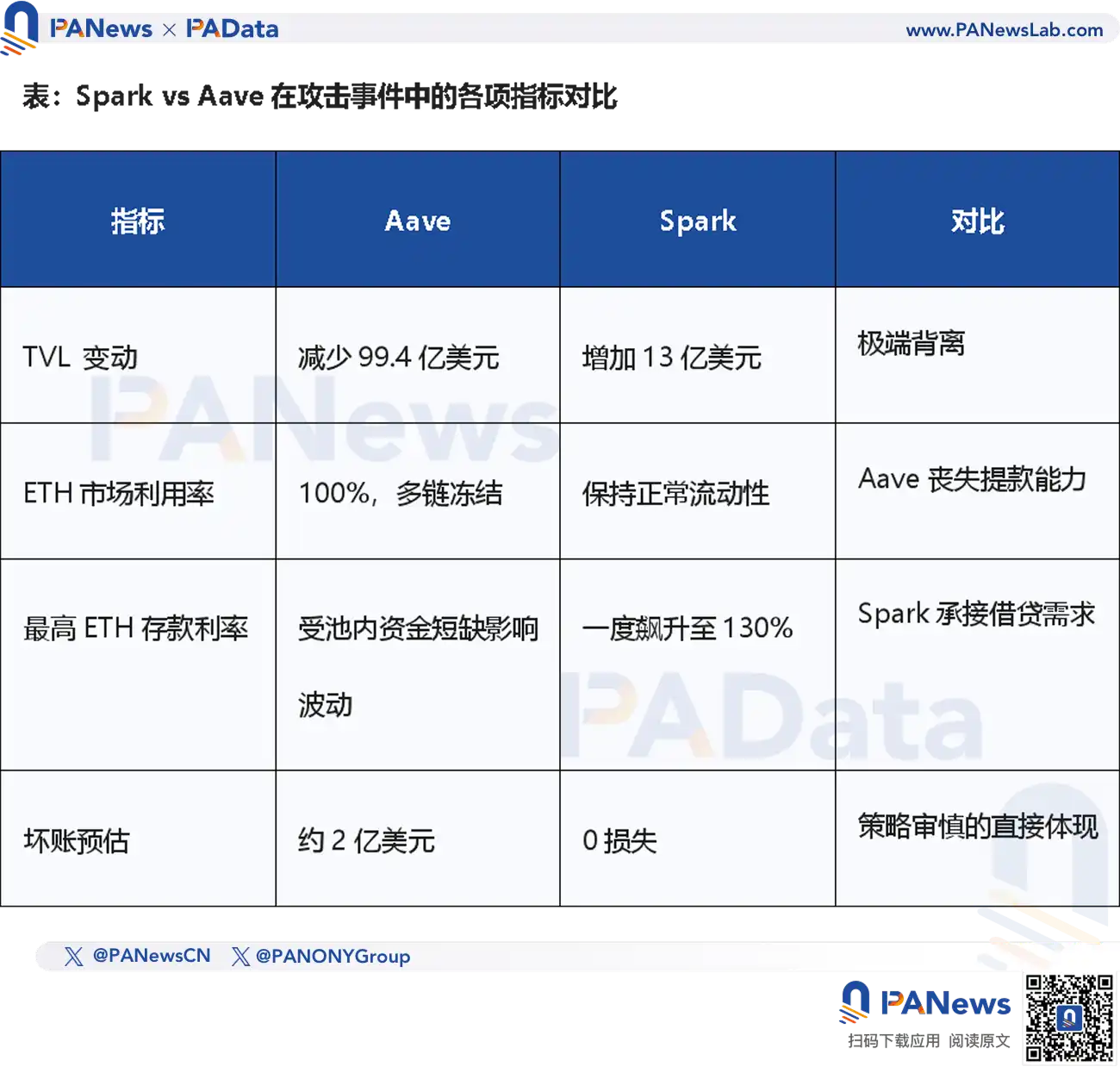
However, amid the widespread fear, another lending protocol giant, Spark, had its moment of glory. Its TVL (Total Value Locked) rapidly increased by $1.3 billion, and the ETH deposit rate once surged to 130%, making it the safe harbor of choice for whales transferring assets.

A black swan event has revalidated the true ruler of the DeFi iron throne.

Aave's Bloodbath of a Bank Run, Spark Seizes the Opportunity to Attract $1.3 Billion

The breach of rsETH's cross-chain bridge effectively pressed the pause button on Aave's entire lending market.

Hackers used fraudulently minted rsETH as collateral on Aave to borrow large amounts of WETH, draining the pool of clean assets and leaving behind a pool of bad debt.

Related reading: KelpDAO Cross-Chain Explosion, AAVE Becomes the "Patsy," Industry Calls for Risk Repricing

Panic spread like a virus: Over the past three and a half days, $151 billion has fled Aave, with total deposits dropping from $485 billion to $307 billion—about one-third of the funds have exited; WETH utilization rates on multiple chains hit 100% directly; depositors couldn't withdraw, and liquidators had no funds to borrow.

The most notable move came from Justin Sun, who quickly withdrew 65,584 ETH from Aave, worth approximately $154 million.

This "withdraw first" behavior created a herd effect in the market. For investors, no annualized yield could offset the panic of being unable to withdraw their principal.

Just as Aave became the hackers' liquidity exit, Spark became the users' escape route.

Spark's TVL反而 increased by $1.3 billion, with its total scale reaching $4.74 billion. This money is a vote of confidence cast by the market with real capital.
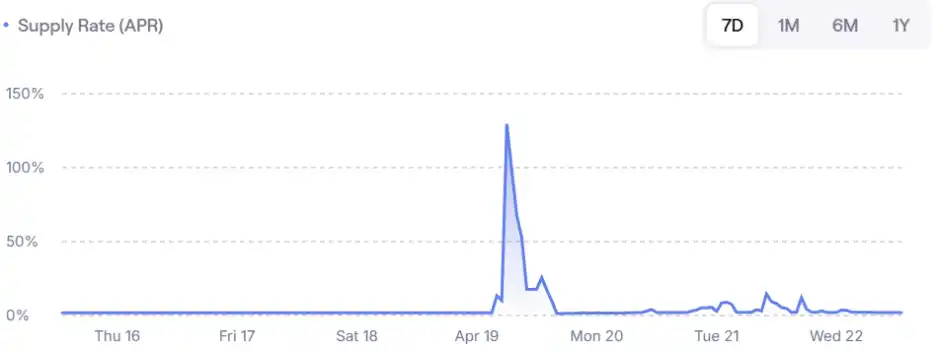
Due to the massive influx of borrowing demand into Spark, coupled with highly scarce liquidity, Spark's ETH deposit rate experienced a spectacular surge, once reaching an annualized level of 130%. This directly reflects the extremely high premium for safe assets.
Spark's ability to meet this demand is thanks to its unique ecosystem structure. Unlike Aave, it is the lending engine of the Sky ecosystem, backed by the vast USDS reserves. As Sky's liquidity outpost, Spark not only relies on external deposits but can also directly obtain stablecoin supplies through Sky's credit lines.

This "central bank-level" liquidity backing allows it to keep withdrawal channels open even during market turmoil.
Abandoning TVL Vanity, Spark Defies Trend to Delist rsETH

Spark avoided the rsETH pitfall due to a counter-trend decision made three months ago.

Same day, different fate. On January 29th, the two major lending platforms took opposite approaches in handling Liquid Restaking Tokens (LRTs).

Aave went full throttle. The protocol officially launched rsETH E-Mode, allowing users to conduct leveraged borrowing with a high collateral ratio (LTV) of 93%. Aave's goal was to attract an anticipated $1 billion inflow of rsETH, restore WETH utilization, and boost TVL and revenue.

Spark prudently retreated. The protocol passed a governance Spell to completely halt new supply of rsETH and gradually remove it from the asset list.

This move by Spark caused strong dissatisfaction among ETH循环杠杆 users, who often use repeated抵押 of stETH or rsETH and similar staking assets to arbitrage interest rate differentials. Spark's delisting forced them to migrate their positions, with most flowing to Aave, which had more lenient policies and lower interest rates.

At the time, the community questioned Spark's team for being "too conservative" or "abandoning growth." No one expected that this step might have saved the entire protocol later.

After the fact, Spark's Strategy Lead, monetsupply.eth, pointed out in a review that the decision to delist rsETH was based on a security-oriented tightening mechanism.

  1. Marginal Cost vs. Marginal Benefit: If the cost of maintaining a certain asset exceeds its risk-adjusted return to the protocol, such assets will be purged;
  2. Risk Exposure: rsETH had extremely low utilization on Spark, almost monopolized by the same wallet address, making risk difficult to disperse;
  3. User Preference Research: The sole whale user of rsETH expressed a willingness to actively migrate to more mature collateral like wstETH or weETH, providing an opportunity for the protocol to smoothly clean up the asset.

It was this decision-making discipline and transparency, which "does not blindly pursue TVL," that allowed Spark to avoid all potential losses that could have been caused by hackers exploiting rsETH.

Multi-Layered Risk Control System: Rate Limits + Interest Rate Buffer + Isolated Architecture

PANews believes that even if rsETH had not been delisted, Spark's architecture would have been sufficient to withstand such risks. Compared to Aave's pursuit of capital efficiency at the expense of safety redundancy, Spark has established a multi-tiered, in-depth defense system.

Spark implements strict deposit and borrowing rate limits (Rate-Limited Caps), meaning the amount of funds that can be deposited and borrowed within a fixed time increases gradually. Even if rsETH were still listed, an attacker could not deposit $290 million in collateral all at once as they did on Aave. This design forcibly limits the maximum risk exposure scale of a single event, hard-capping losses within an acceptable range.

Spark has long maintained relatively high interest rate ceilings. Under stable market conditions, higher borrowing rates, while deterring over-borrowing (if it's expensive to borrow, people borrow less), on the other hand attract more people to deposit (depositors earn more). The result is that the pool always retains liquidity, avoiding a situation where funds are "all borrowed out," preventing people from being unable to withdraw their money. Especially during market crashes, it avoids bank runs due to liquidity枯竭.

When pool utilization rises, Spark's interest rate curve slope becomes steeper than Aave's, which has two significant consequences:

  • Forced Deleveraging: High interest costs force borrowers to actively seek liquidity to repay loans.

  • Attracting Supplementary Liquidity: High deposit APY quickly attracts external arbitrage capital, thus resolving the deadlock of 100% utilization.

Spark's modular isolated architecture offers strong controllability in risk management. When handling high-risk synthetic assets like USDe, Spark has also adopted a prudent approach, isolating them in specific primary risk pools. This ensures that even if a specific asset encounters problems, it will not affect the main lending pools on the platform.
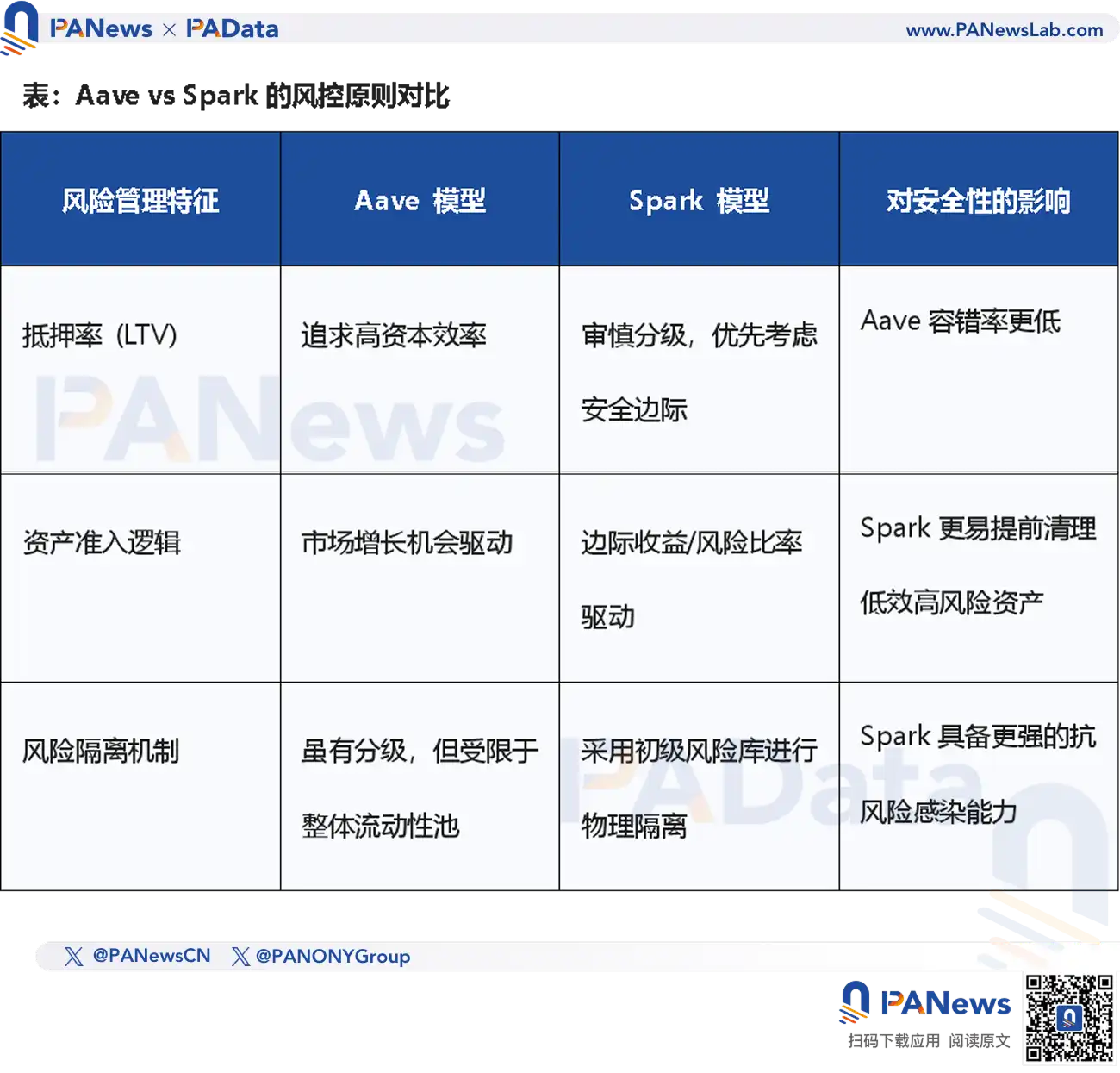
The great liquidity migration from Aave to Spark signifies a shift in risk preference from yield chasing to safety and stability.

Aave's hundred-billion-dollar outflow is a wake-up call for all protocols pursuing high capital efficiency. When safety margins are sacrificed, any minor external关联 risk can evolve into a global crisis for the protocol.

Spark's rise proves that in an uncertain market environment, prudent risk governance decisions and the implementation of a "risk-first" strategy are the moats with greater long-term value.


Domande pertinenti

QWhat was the main reason behind Spark's significant increase in TVL (Total Value Locked) during the Aave crisis?

ASpark's TVL increased by $1.3 billion because it was perceived as a safe haven for users fleeing the rsETH-related instability on Aave. Its unique ecosystem, backed by the substantial USDS reserves of the Sky ecosystem, provided a reliable liquidity backstop, ensuring withdrawal channels remained open during the market turmoil.

QHow did Spark's decision regarding rsETH months before the incident contribute to its stability?

AThree months prior to the incident, Spark made a proactive governance decision to halt new supplies of rsETH and gradually remove it from its asset list. This risk-averse move, based on a cost-benefit analysis, low utilization, and concentrated risk exposure, prevented Spark protocol from being exposed to the rsETH exploit that caused significant bad debt on Aave.

QWhat are the key risk management features of its protocol that the article highlights as reasons for Spark's resilience?

AThe article highlights Spark's multi-layered risk management system, which includes strict Rate-Limited Caps to restrict large, sudden deposits/borrows, a higher interest rate curve that discourages over-leverage and attracts liquidity during stress, and a modular, isolated architecture that contains problems from risky assets in separate silos to protect the main lending pools.

QWhat specific event triggered the massive withdrawal of funds from Aave and the subsequent liquidity crisis?

AThe specific event was a cross-chain bridge exploit involving Kelp DAO's rsETH. A hacker used fraudulently minted rsETH as collateral on Aave to borrow a large amount of WETH, draining the pool of 'clean' assets and leaving behind approximately $200 million in bad debt, which triggered panic and a bank run.

QWhat does the shift of liquidity from Aave to Spark signify in terms of market risk preference according to the article?

AThe shift signifies a change in market risk preference from pursuing high capital efficiency to prioritizing safety and stability. It served as a warning to protocols that sacrifice security margins for efficiency, demonstrating that prudent risk governance and a 'risk-first' strategy are more valuable long-term moats in an uncertain market environment.

Letture associate

Where the AI Bubble Really Is: Which Layer of Players Are Naked

AI Bubble: Where It Really Is and Who's Swimming Naked This analysis dissects the AI industry not as a single entity but as a five-layer pyramid, arguing that bubbles are concentrated in specific tiers, not uniformly distributed. **Key Distinction from the 2000 Dot-com Bubble:** Unlike 2000, where companies had stock prices before revenue, today's leading AI players have massive, contract-backed revenue driving their valuations. Core infrastructure demand is real, with every GPU running at full capacity for paying customers. **The Five-Layer Pyramid & Bubble Assessment:** * **L0 (Fab/Manufacturing) & Top L4 (Leading AI Apps): NO BUBBLE.** Companies like TSMC, NVIDIA, major cloud providers (Microsoft, Google, Meta, Amazon), and top AI labs have real revenues and orders. Supply is tightly constrained by TSMC's disciplined capacity control and physical limits like power/land for data centers, preventing a supply glut. * **L1 (Memory): BATTLEGROUND.** Sky-high HBM margins could signal a new structural cycle or a classic "boom before bust." The oligopoly of three major players may enforce supply discipline, making this a high-stakes bet. * **L2 (Interconnect/Optical Modules): BUBBLE TERRITORY.** Companies like Lumentum and AAOI have seen stock surges (4-10x) far outpacing revenue growth. This hardware segment has lower physical barriers to expansion than fabs, allowing speculation. It mirrors the 2000 bubble's epicenter—optics. * **L3 (Infrastructure/"GPU Landlords"): VULNERABLE.** GPU leasing companies profit from the current compute shortage but own no long-term moat. Their business model relies on a temporary bottleneck that will ease as big tech expands and new tech (e.g., potential space-based data centers) emerges. * **L4 Long Tail (VC-backed Startups): STRONG BUBBLE SIGNALS.** VC funding concentration in AI is twice that of the 1999 peak. Many startups with little revenue use the valuation logic of successful giants to justify their own, creating high risk of a "valuation crunch" when funding dries up. **Critical Risks to Monitor:** 1. **GPU Depreciation & Accounting:** Companies extending the assumed useful life of GPUs artificially boost profits. The true economic life depends on future generational leaps from NVIDIA. 2. **"GPU Credit" & Off-Balance-Sheet Leverage:** Emerging structures where shell companies borrow to buy GPUs and lease them out (with chipmakers sometimes investing) move debt off major balance sheets. This echoes the "vendor financing" of 2000 and the securitization risks of 2008, though currently small-scale. 3. **TSMC Abandoning Caution:** If the primary supply bottleneck (TSMC's conservative capacity planning) breaks, runaway supply could trigger a bust. 4. **Algorithmic Efficiency Breakthrough:** A major leap in software efficiency could drastically reduce the need for raw compute hardware, undermining the investment thesis. **Conclusion:** The AI boom is expensive and has frothy areas, but its core is underpinned by real demand and physical supply constraints. The bubble risk is layered: most present in optical components, GPU leasing, and the long-tail startup ecosystem, while the foundational chip manufacturing and leading application layers remain relatively solid—for now.

marsbit15 min fa

Where the AI Bubble Really Is: Which Layer of Players Are Naked

marsbit15 min fa

Standing in the Light: A Comprehensive Guide to the Optical Module and CPO Supply Chain

"Standing in the Light: Understanding the Optical Module and CPO Industry Chain" This article analyzes the critical role of optical communication technology, specifically optical modules and Co-Packaged Optics (CPO), as the "nervous system" for modern AI data centers. With exponential growth in AI computational demands (e.g., NVIDIA's Vera Rubin architecture), traditional electrical interconnects using copper cables face severe bottlenecks in bandwidth, power consumption, and signal integrity over distance. The core function of an optical module is to act as a "translator," converting electrical signals from chips into optical signals for transmission over fiber (and vice-versa). Key internal components include lasers, modulators, photodetectors, drivers, and DSP chips. The industry is currently transitioning from 800G to 1.6T modules. However, the future lies in CPO. This next-generation technology integrates the optical engine directly with the switch ASIC/XPU on the same package substrate, drastically reducing power consumption (by ~3.5x according to NVIDIA), overcoming bandwidth density limits, and minimizing signal attenuation compared to traditional pluggable modules. Key challenges for CPO include advanced packaging capacity (dominated by TSMC), thermal management, repairability, and standardization. The article details the broader technology landscape, including Near-Packaged Optics (NPO, a pragmatic intermediate step), Linear-drive Pluggable Optics (LPO), Optical I/O (OIO for chip-level integration), and Optical Circuit Switches (OCS). A comprehensive CPO industry chain is mapped, highlighting shifting power dynamics: * **Architecture Definers:** NVIDIA, Broadcom, and Marvell now hold greater influence. * **Advanced Packaging & Manufacturing:** TSMC is central; Fabrinet is a key EMS player. * **Lasers ("The Heart"):** A strategic bottleneck. EML lasers are led by Lumentum and Coherent (both receiving major NVIDIA investments). CW lasers, favored for CPO/silicon photonics, see strong Chinese players like Source Photonics and Sicoya. * **Silicon Photonics Chips:** The mainstream path for CPO engines, with key players like Broadcom, Intel, Marvell, and China's Accelink. * **Fiber Connectivity Components:** A major new, high-growth market created by CPO, including Fiber Array Units (FAU), Polarization-Maintaining Fiber (PMF), and MPO connectors. Companies like Tianfu Communication and US Conec are leaders. * **Fiber & Cable:** Experiencing a super-cycle (e.g., Corning, Yangtze Optical Fiber). * **PCB/Substrates:** Requiring advanced materials (e.g., Shengyi Tech). * **DSP & SerDes:** Functions are integrated into switch ASICs in the CPO era (e.g., Broadcom, Astera Labs). * **Optical Module Makers:** Transitioning from standalone module suppliers to providers of optical engines and NPO/LPO solutions while riding the current pluggable boom (e.g., Zhongji Innolight, Eoptolink). The investment timeline is segmented: Short-term (2026-2027) features the "last feast" for pluggable modules and CPO's initial rollout. Medium-term (2027-2029) will see CPO expand and NPO peak. Long-term (2029-2032+) involves CPO/OIO penetration into intra-rack scaling. In conclusion, optical interconnects are fundamental to AI infrastructure. The competitive landscape sees US firms leading in architecture and high-end chips, TSMC in advanced packaging, and Chinese firms holding strong positions in modules, connectivity components, CW lasers, and fiber/cable. The future belongs to companies that can navigate the technological shift from "selling shovels" (modules) to "building highways" (CPO/OIO infrastructure).

marsbit25 min fa

Standing in the Light: A Comprehensive Guide to the Optical Module and CPO Supply Chain

marsbit25 min fa

Trading

Spot
Futures

Articoli Popolari

Come comprare AAVE

Benvenuto in HTX.com! Abbiamo reso l'acquisto di Aave Protocol (AAVE) semplice e conveniente. Segui la nostra guida passo passo per intraprendere il tuo viaggio nel mondo delle criptovalute.Step 1: Crea il tuo Account HTXUsa la tua email o numero di telefono per registrarti il tuo account gratuito su HTX. Vivi un'esperienza facile e sblocca tutte le funzionalità,Crea il mio accountStep 2: Vai in Acquista crypto e seleziona il tuo metodo di pagamentoCarta di credito/debito: utilizza la tua Visa o Mastercard per acquistare immediatamente Aave ProtocolAAVE.Bilancio: Usa i fondi dal bilancio del tuo account HTX per fare trading senza problemi.Terze parti: abbiamo aggiunto metodi di pagamento molto utilizzati come Google Pay e Apple Pay per maggiore comodità.P2P: Fai trading direttamente con altri utenti HTX.Over-the-Counter (OTC): Offriamo servizi su misura e tassi di cambio competitivi per i trader.Step 3: Conserva Aave Protocol (AAVE)Dopo aver acquistato Aave Protocol (AAVE), conserva nel tuo account HTX. In alternativa, puoi inviare tramite trasferimento blockchain o scambiare per altre criptovalute.Step 4: Scambia Aave Protocol (AAVE)Scambia facilmente Aave Protocol (AAVE) nel mercato spot di HTX. Accedi al tuo account, seleziona la tua coppia di trading, esegui le tue operazioni e monitora in tempo reale. Offriamo un'esperienza user-friendly sia per chi ha appena iniziato che per i trader più esperti.

329 Totale visualizzazioniPubblicato il 2024.12.11Aggiornato il 2026.06.02

Come comprare AAVE

Discussioni

Benvenuto nella Community HTX. Qui puoi rimanere informato sugli ultimi sviluppi della piattaforma e accedere ad approfondimenti esperti sul mercato. Le opinioni degli utenti sul prezzo di AAVE AAVE sono presentate come di seguito.

活动图片