After a 30x Surge and Then a Collapse, Who Set Up the RIVER Scheme Promoted by Hayes?

marsbitPubblicato 2026-02-03Pubblicato ultima volta 2026-02-03

Introduzione

The native token RIVER of the chain-abstract stablecoin system River experienced an extreme price surge and crash in January 2026, rising over 2700% from around $2 to over $87 in four weeks, before plummeting 87% to around $11 in just six days. The volatility drew scrutiny from analysts, with Bubblemaps identifying a cluster of over 2,000 wallets linked to RIVER’s creators, which allegedly profited around $10 million through coordinated selling on Bitget. The token had gained attention after Arthur Hayes publicly endorsed it and the project raised $12 million in strategic funding. Analysis by CoinGlass highlighted how negative funding rates were exploited to manipulate leverage and liquidity, triggering cascading liquidations. The event underscores risks associated with low-float, high-volatility tokens where concentrated ownership and derivative structures can amplify both gains and losses.

In the first month of 2026, the native token RIVER of the chain-abstracted stablecoin system River experienced an extreme inverted V-shaped reversal within just four weeks. Starting from around $2 in late December 2025, it surged to a historical high of over $87, marking an increase of more than 2700%, only to plummet rapidly within six days to a low of around $11, a drop of 87%.
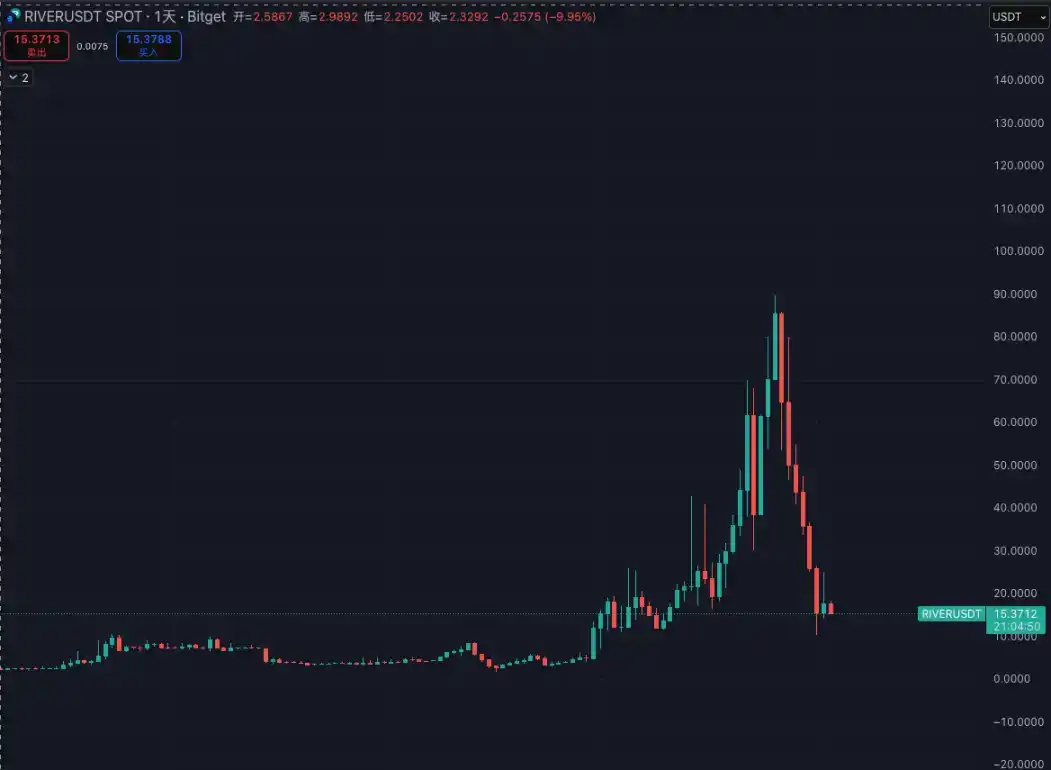
This abnormal market volatility has drawn significant attention from industry observers and on-chain data analysis institutions. As third-party data agencies like Bubblemaps disclosed key evidence on January 27, suspicions surrounding RIVER token price manipulation, highly concentrated early holdings, and profits by associated addresses are growing.

New Funding of $12 Million, Promoted by Arthur Hayes

The River project is developed by the RiverdotInc team, with its main focus on building a chain-abstracted stablecoin system for the multi-chain ecosystem. The system aims to connect assets, liquidity, and yields across different blockchains, enabling seamless cross-chain interactions without relying on traditional bridging or wrapping mechanisms.

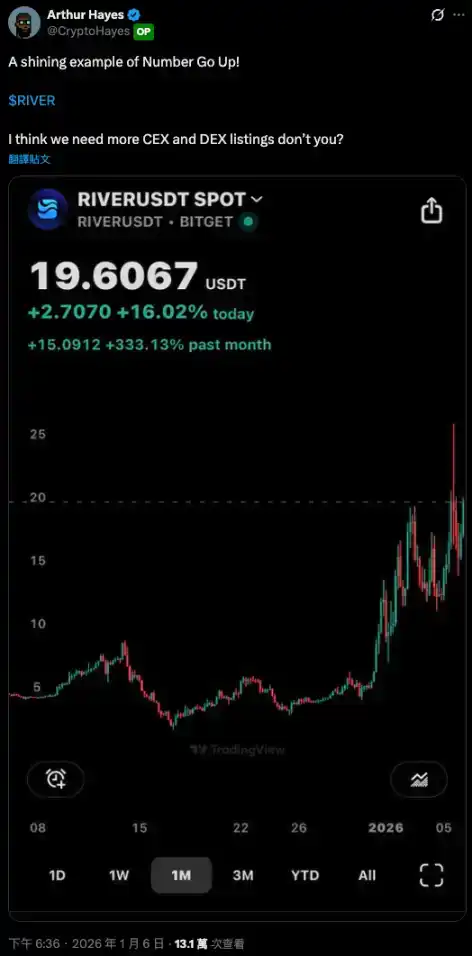
On January 6, BitMEX founder Arthur Hayes publicly called for CEXs to list the token and predicted it would explode. Hayes' endorsement provided the first boost for RIVER. Despite most mainstream crypto assets being in a downward trend at the time, RIVER began a unilateral upward trend, with its market cap more than quadrupling in just a few weeks.
On January 23, River announced the completion of a $12 million strategic funding round. In addition to previously reported participation from Justin Sun and TRON DAO, this round of investors also included Maelstrom Fund (founded by Arthur Hayes), The Spartan Group, and Nasdaq-listed companies and institutions from the United States and Europe.

Officially, the funding will be used to support River's expansion into EVM and non-EVM ecosystems (including TRON, Sui, and major EVM networks) and to continue building on-chain liquidity infrastructure. The funds will accelerate ecosystem deployment, deepen stablecoin liquidity, and promote the integration of satUSD in trading, lending, staking, and yield scenarios. Additionally, River will launch yield products Smart Vault and Prime Vault, providing a unified interface for users and institutions to access cross-ecosystem yields through protocol-native and institutional-grade strategies.

Interestingly, just a couple of days after announcing the large funding round, RIVER's price hit its peak and began to decline.

Funding Rate-Driven Price Manipulation Tactics

CoinGlass once used RIVER as an example to discuss how funding rates can be used in conjunction with leverage structures to drive price volatility, emphasizing that this pattern has appeared in multiple tokens over the past two years, with RIVER being just one case. It stressed that many traders misunderstand funding rates. Funding rates do not provide directional predictive signals; they provide information on the imbalance between long and short positions, indicating which side of the market is more crowded.

Step 1: Suppress the price while pushing the funding rate into deeply negative territory. First, keep the price low or suppressed while pushing the funding rate into a significantly negative range. The result is that short positions become increasingly concentrated, and the market begins to form a consensus expectation that a rebound is imminent due to the negative funding rate.

Step 2: Lure some traders to go long. During the phase of deeply negative funding rates, some traders will open long positions, motivated by the expectation of a rebound and the hope of receiving funding rate payments. The thread refers to this expectation as part of the trap.

Step 3: Price pushes upward can also occur during negative funding rate phases. CoinGlass's key argument is that when funding rates are extremely negative, prices do not need to enter a trend reversal. The market only needs a controlled upward push to trigger a chain reaction among shorts, including liquidations, stop-losses, and passive covering.
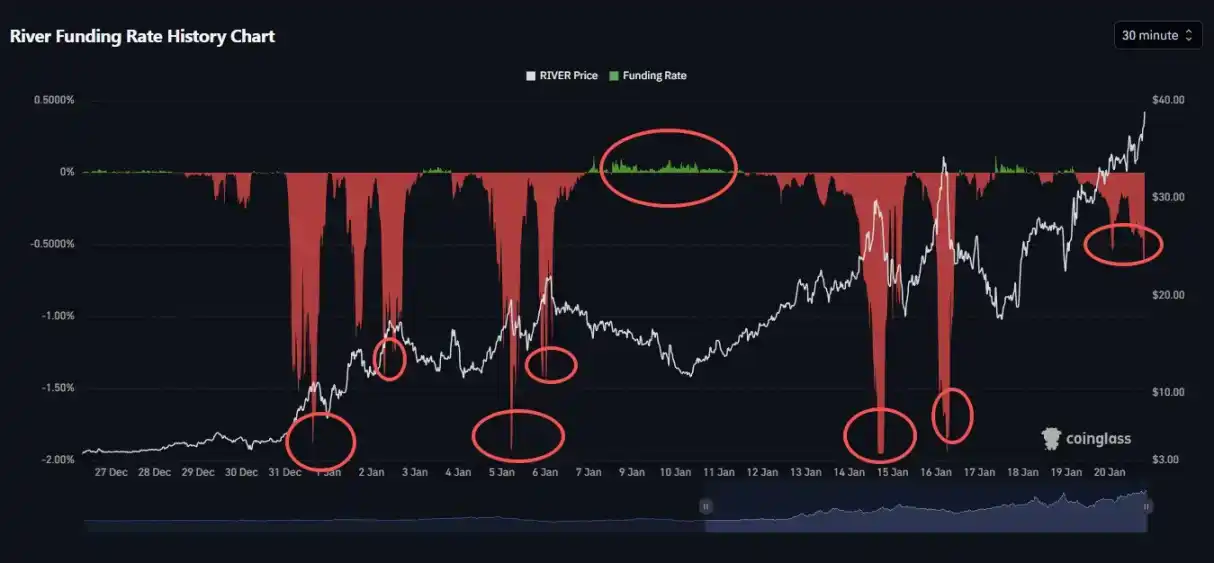
Why does the rally happen when the funding rate is still negative? Many sharp rallies start when funding rates are still negative. The driving force behind the price push comes from the unwinding of leveraged positions, and passive buying in the market amplifies the gains. After the crowded shorts are cleared, funding rates quickly return to more neutral levels. Some traders interpret the normalization of funding rates as a signal of market recovery.

CoinGlass warns that this is actually just the "reset" process of the trap, and manipulators can repeatedly execute the cycle of "creating extreme rates, attracting consistent positions, forcing liquidations, and resetting."

Analysis: RIVER Creators Suspected to Be Directly Related to a Large Cluster of Addresses, Selling RIVER for $10 Million in Profits

According to Bubblemaps monitoring, a large cluster containing over 2,000 wallet addresses is directly related to RIVER.
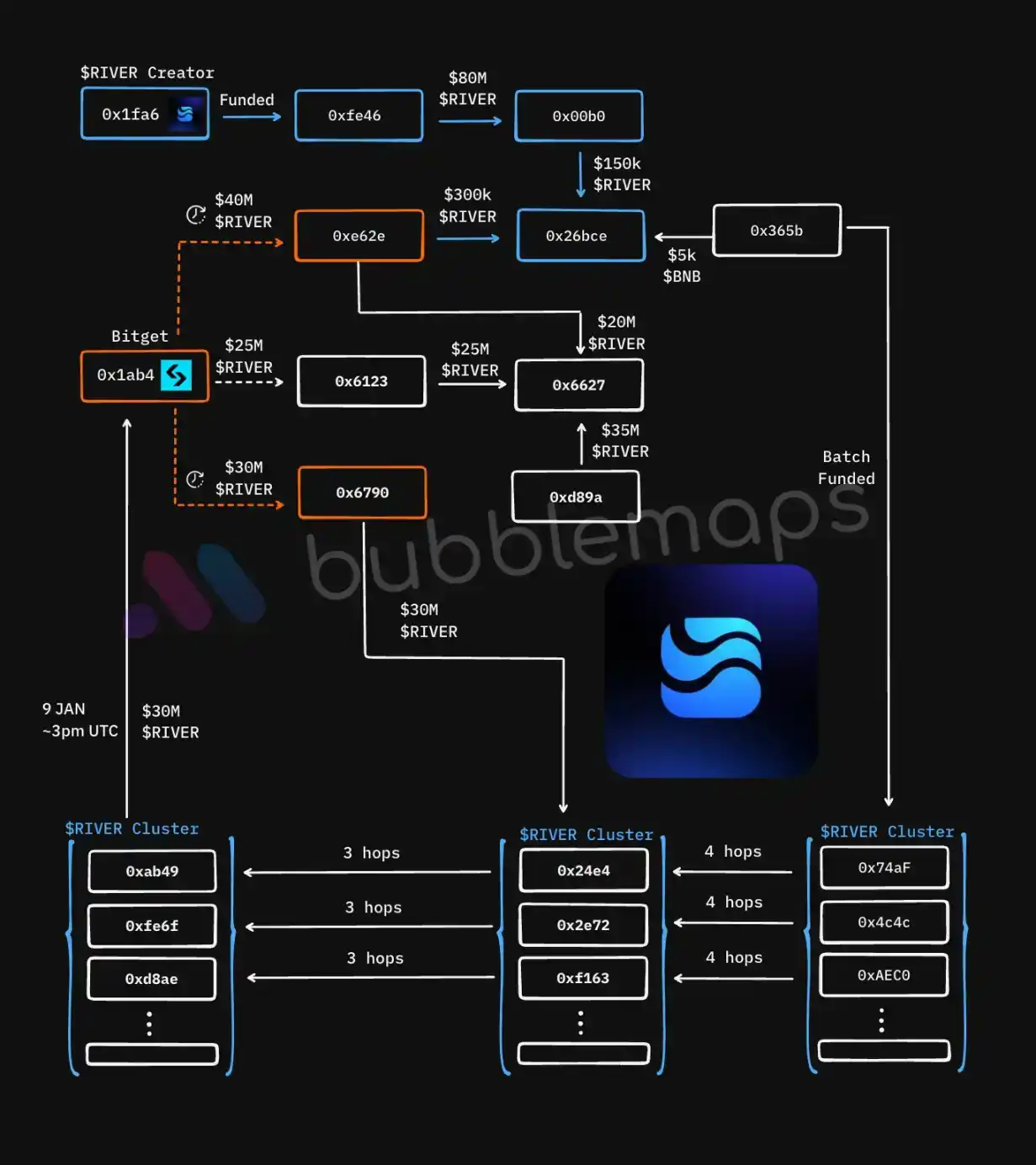
It pointed out that one month after RIVER's launch, seven addresses withdrew 230 million RIVER tokens from Bitget. These wallets had no prior activity and received the tokens within a tight time window on December 3 and 29.

One wallet, 0x6790, distributed 400,000 RIVER across hundreds of wallets. All these receiving wallets showed similar patterns: no prior activity, receiving similar amounts of RIVER, sending tokens to Bitget on January 9 likely for sale, funded by a single source, and经过四层跳转 (after four layers of hopping).

Bubblemaps noted that the wallet funding this cluster is address 0x365b, which is directly connected to the RIVER creator. Additionally, the wallet 0x6790, which distributed RIVER to the cluster, shows links pointing to the RIVER creator. It estimates the cluster's profits at $10 million.
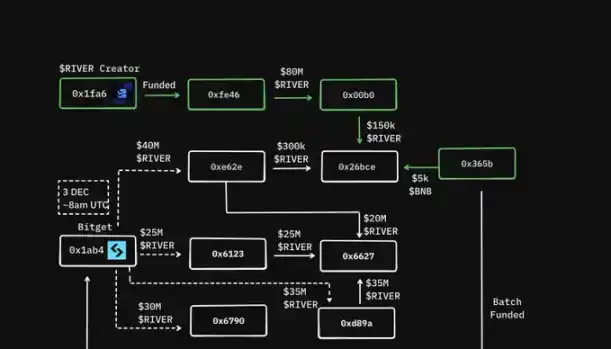
What is certain now is that RIVER completed a drastic repricing from rapid rise to rapid retreat in an extremely short time. Market focus has shifted from narrative and growth expectations to whether there are abnormalities in token distribution and fund flows. The address cluster and associated clues raised by Bubblemaps have amplified suspicions of early concentration of holdings, profits by associated addresses, and selling through exchanges; the funding rate and position crowding mechanism mentioned by CoinGlass provide another explanatory framework, suggesting that derivative structures may have amplified the price swings.

For the market, the RIVER incident once again serves as a reminder that tokens with low circulation and high volatility are prone to extreme price movements when sentiment and structure resonate, and when negative signals emerge in holdings and trading structures, price adjustments often come faster and deeper.


Domande pertinenti

QWhat was the extreme price movement of RIVER token in the first month of 2026?

AThe RIVER token experienced an extreme inverted V-shaped reversal, surging from around $2 in late December 2025 to a high of over $87, a gain of more than 2700%, before crashing down to around $11 in just six days, a drop of 87%.

QWho is a prominent figure that publicly endorsed the RIVER token and what was his prediction?

ABitMEX founder Arthur Hayes publicly called for CEXs to list the token and predicted it would experience a massive breakout.

QAccording to the analysis from Bubblemaps, what was the suspected link between a large cluster of wallets and the RIVER token creators?

ABubblemaps identified a cluster of over 2000 wallet addresses directly linked to RIVER's creators, with evidence showing these wallets received tokens from the creators and later sold them on Bitget, netting an estimated profit of $10 million.

QHow did CoinGlass describe the mechanism of price manipulation involving funding rates, as exemplified by RIVER?

ACoinGlass described a套路 where manipulators first suppress the price to create deeply negative funding rates, lure in long positions expecting a rebound, and then trigger a short squeeze by pushing the price up, forcing liquidations and stop-losses. This cycle of creating extreme rates, attracting one-sided positions, forcing liquidations, and resetting can be repeated.

QWhat was the purpose of the $12 million strategic funding round announced by River, and who were some of the investors?

AThe $12 million strategic funding round was intended to support River's expansion into EVM and non-EVM ecosystems (including TRON, Sui, and major EVM networks), build on-chain liquidity infrastructure, accelerate ecosystem deployment, and launch yield products like Smart Vault and Prime Vault. Investors included Maelstrom Fund (Arthur Hayes), The Spartan Group, Justin Sun, TRON DAO, and Nasdaq-listed companies from the US and Europe.

Letture associate

Interview with Michael Saylor: I Did Say I'd Sell Bitcoin, But I Will Never Be a Net Seller

**Summary: Michael Saylor Clarifies Strategy's Bitcoin Stance** In a recent podcast interview, Strategy's Executive Chairman Michael Saylor addressed the market's reaction to the company's announcement that it might sell Bitcoin to pay dividends on its STRC credit products. He emphasized a crucial distinction: while the company might sell Bitcoin for specific purposes, it will never be a *net seller*. Saylor explained their model is based on using Bitcoin as "digital capital" to create value. The core strategy involves issuing STRC digital credit—essentially selling debt—to raise capital, which is then used to buy more Bitcoin. He estimates Bitcoin appreciates at roughly 40% annually. A small portion of these capital gains (e.g., ~2.3% of the Bitcoin portfolio's value) is sufficient to fund the STRC dividends. Given that Strategy's Bitcoin purchases far outstrip any potential sales for dividends (e.g., buying $3.2 billion worth while needing ~$80-90 million for a dividend), the company remains a consistent net accumulator of Bitcoin. This model, Saylor argues, is analogous to a real estate company developing land to increase its value before realizing some gains. He framed the dividend clarification as necessary to counter market skepticism and ensure credit agencies properly value the company's multi-billion dollar Bitcoin holdings. Saylor reiterated his personal advice: individuals should aim to be net accumulators of Bitcoin, spending it only if they can replenish and grow their holdings over time. Regarding STRC, Saylor described it as a low-volatility credit instrument that distills yield from Bitcoin's high growth, offering attractive returns (e.g., ~11-12% yield) for risk-averse investors. He noted that Strategy's STRC issuance now constitutes about 60% of the U.S. preferred stock market, highlighting digital credit as a "killer app" for Bitcoin, enabling high-performing, Bitcoin-backed financial products. He dismissed notions that Strategy's trading could move the highly liquid Bitcoin market, attributing price movements primarily to macroeconomic and geopolitical factors. Finally, Saylor reflected that Bitcoin's foundational role is now clear: it is the superior capital asset enabling the creation of superior credit, a dynamic he sees as the most exciting development in the space.

marsbit2 min fa

Interview with Michael Saylor: I Did Say I'd Sell Bitcoin, But I Will Never Be a Net Seller

marsbit2 min fa

380,000 Apps Exposed, 2,000+ Apps Leaked Secrets: AI Programming Turns 'Intranet' into Public Internet

Israeli cybersecurity firm RedAccess uncovered a severe data exposure trend linked to "vibe coding" or AI-powered software development tools. Their research found approximately 38,000 publicly accessible web applications built with platforms like Lovable, Base44, Netlify, and Replit. Of these, an estimated 2,000 apps exposed sensitive corporate and personal data, including medical records, financial information, internal strategic documents, and customer chat logs. In some cases, access even granted administrative privileges. The core issue stems from default privacy settings that make applications public by default, combined with a lack of built-in security controls (like authentication) in the AI-generated code. This allows employees without security expertise—"citizen developers"—to easily create and deploy applications that bypass standard corporate security reviews. The exposed apps, often indexed by search engines, are trivially discoverable. While some platform providers (Replit, Lovable, Wix/Base44) argue that security configuration is the user's responsibility and question the validity of some findings, security researchers confirm the widespread reality of such exposures. This pattern, also noted in prior studies, highlights a critical security gap as AI democratizes app creation, potentially leading to massive, unintentional data leaks.

marsbit1 h fa

380,000 Apps Exposed, 2,000+ Apps Leaked Secrets: AI Programming Turns 'Intranet' into Public Internet

marsbit1 h fa

Attracting Global Capital, Asia's New 'Super Cycle' Is Unfolding

Investors are turning to Asia as the next frontier for global equity growth, with a new "super cycle" unfolding across the region. Driven by the AI revolution, Asian markets, particularly South Korea, have seen significant rallies. According to Morgan Stanley analysis, the underlying drivers of Asia's industrial cycle are shifting from traditional sectors like real estate and manufacturing to massive investments in AI infrastructure, energy security and transition, and supply chain resilience. Fixed asset investment in Asia is projected to grow from around $11 trillion in 2025 to $16 trillion by 2030, with a 7% annual growth rate from 2026-2030. The AI wave is a primary catalyst, driving immense capital expenditure for chips, servers, data centers, and power systems. Asia is central to this hardware supply chain. In China, AI investment is focused on building a full-system domestic capability, with the local AI chip market potentially reaching $86 billion by 2030. Beyond AI, China's export story is expanding from EVs and batteries to robotics. The country already captures about half of new global industrial robot demand and over 90% of humanoid robot shipments. This growth phase mirrors the early stages of China's EV export boom. Simultaneously, energy security investments, spurred by AI's massive power needs, are rising, with China benefiting from its leadership in solar, batteries, and EVs. Regional defense spending is also increasing structurally, supporting demand for advanced manufacturing. The main beneficiaries are China, South Korea, and Japan, positioned in core supply chain areas. However, risks remain, including potential overcapacity, profit margin pressures from competition, persistent technological restrictions, geopolitical friction, and workforce displacement due to AI-driven automation. Market volatility is also expected to increase as investor expectations diverge on the realization of these capital investment and export themes.

marsbit1 h fa

Attracting Global Capital, Asia's New 'Super Cycle' Is Unfolding

marsbit1 h fa

Trading

Spot
Futures

Articoli Popolari

Come comprare RIVER

Benvenuto in HTX.com! Abbiamo reso l'acquisto di River (RIVER) semplice e conveniente. Segui la nostra guida passo passo per intraprendere il tuo viaggio nel mondo delle criptovalute.Step 1: Crea il tuo Account HTXUsa la tua email o numero di telefono per registrarti il tuo account gratuito su HTX. Vivi un'esperienza facile e sblocca tutte le funzionalità,Crea il mio accountStep 2: Vai in Acquista crypto e seleziona il tuo metodo di pagamentoCarta di credito/debito: utilizza la tua Visa o Mastercard per acquistare immediatamente RiverRIVER.Bilancio: Usa i fondi dal bilancio del tuo account HTX per fare trading senza problemi.Terze parti: abbiamo aggiunto metodi di pagamento molto utilizzati come Google Pay e Apple Pay per maggiore comodità.P2P: Fai trading direttamente con altri utenti HTX.Over-the-Counter (OTC): Offriamo servizi su misura e tassi di cambio competitivi per i trader.Step 3: Conserva River (RIVER)Dopo aver acquistato River (RIVER), conserva nel tuo account HTX. In alternativa, puoi inviare tramite trasferimento blockchain o scambiare per altre criptovalute.Step 4: Scambia River (RIVER)Scambia facilmente River (RIVER) nel mercato spot di HTX. Accedi al tuo account, seleziona la tua coppia di trading, esegui le tue operazioni e monitora in tempo reale. Offriamo un'esperienza user-friendly sia per chi ha appena iniziato che per i trader più esperti.

530 Totale visualizzazioniPubblicato il 2026.01.16Aggiornato il 2026.01.16

Come comprare RIVER

Discussioni

Benvenuto nella Community HTX. Qui puoi rimanere informato sugli ultimi sviluppi della piattaforma e accedere ad approfondimenti esperti sul mercato. Le opinioni degli utenti sul prezzo di RIVER RIVER sono presentate come di seguito.

活动图片