AERO nears breakout zone – Can strong accumulation push it to $0.50?

ambcryptoPubblicato 2026-03-25Pubblicato ultima volta 2026-03-25

Introduzione

Aerodrome Finance (AERO) surged 11.65% to $0.3391 with trading volume up 631%, indicating strong buyer interest. On-chain data shows $2.6M in AERO within two hours, suggesting informed accumulation. Price is consolidating between key support at $0.302 and resistance at $0.389, with buyers actively defending the lower level. Technical indicators like MACD show a potential bullish crossover, and Parabolic SAR suggests weakening downward momentum. Spot market data confirms aggressive buying, while liquidation clusters above $0.36 may fuel upward volatility if breached. Sustained demand could push AERO toward $0.50, though failure to break resistance may lead to a pullback.

Aerodrome Finance [AERO] has climbed 11.65% to $0.3391 over the past 24 hours, at press time, while trading volume has surged by over 631%, signaling aggressive market participation. This expansion in activity reflects a sudden influx of buyers rather than gradual positioning.

Furthermore, on-chain data shows wallets accumulating over $2.6 million worth of AERO within just two hours, reinforcing the strength behind this move. Such concentrated buying suggests deliberate positioning from informed participants.

As demand accelerates alongside rising participation, the current structure reflects accumulation rather than exhaustion. Buyers continue to step in at key levels despite recent AERO price consolidation.

Can AERO hold above key support levels?

AERO price continues to stabilize above the $0.302 support zone, which has held firmly through recent pullbacks. This level aligns closely with the lower boundary near $0.299, where buyers repeatedly defend downside attempts. However, price remains capped below the $0.389 resistance, creating a tight consolidation range.

This structure shows compression rather than weakness, as sellers fail to push price below support. As a result, the range between $0.302 and $0.389 defines the current battlefield. If price maintains acceptance above support, pressure could build toward the upper boundary, where a break may shift structure toward the higher $0.500 level.

At the time of writing, the MACD has approached a bullish crossover as the histogram continues to contract, showing that selling pressure has weakened significantly. At the same time, the signal and MACD lines have begun to converge, indicating a shift toward recovery.

Parabolic SAR has flipped below price, reinforcing the idea that downside control has started to fade. This combination reflects early stabilization rather than a fully developed trend shift. However, the indicators now align with price holding above support, which strengthens the broader structure.
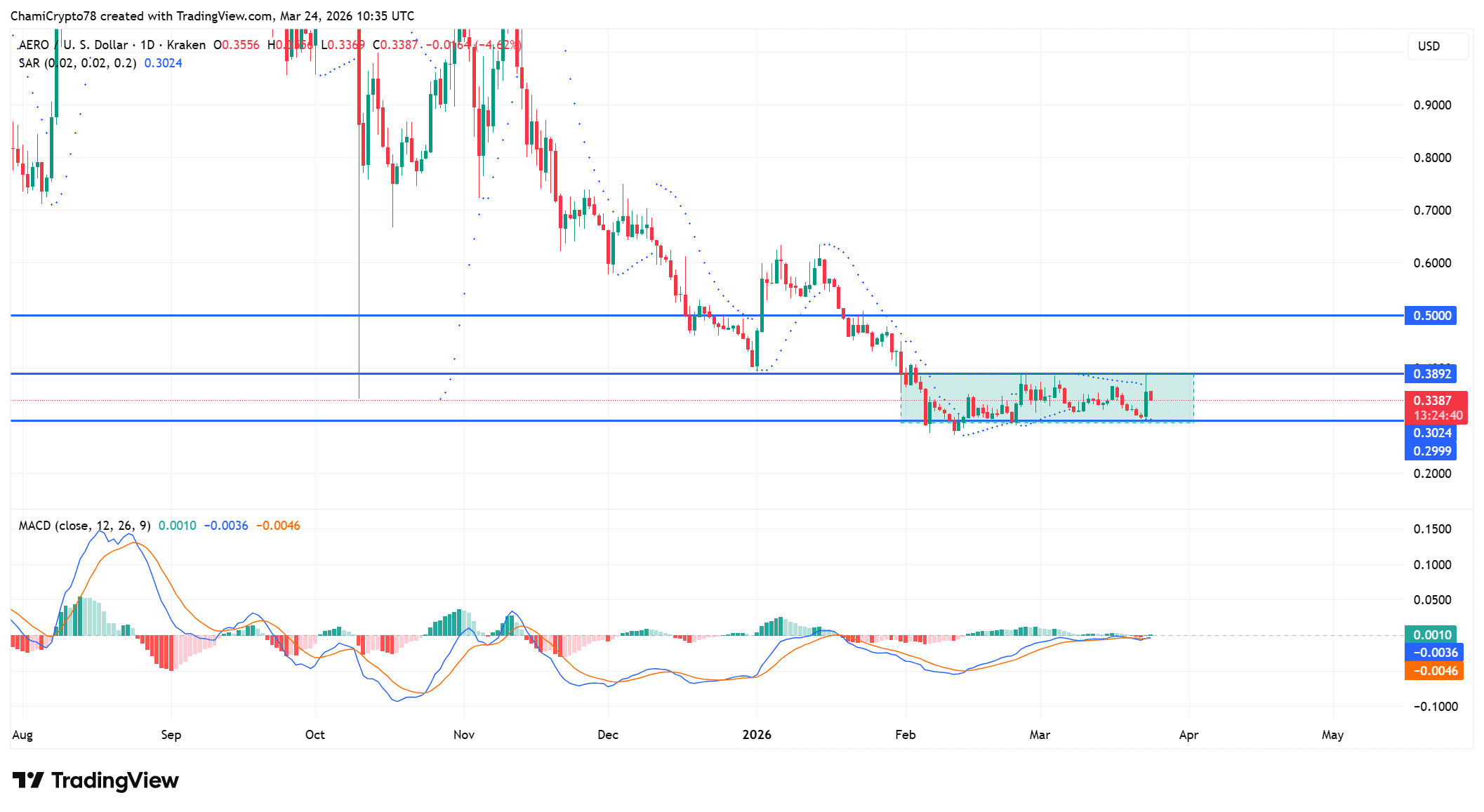
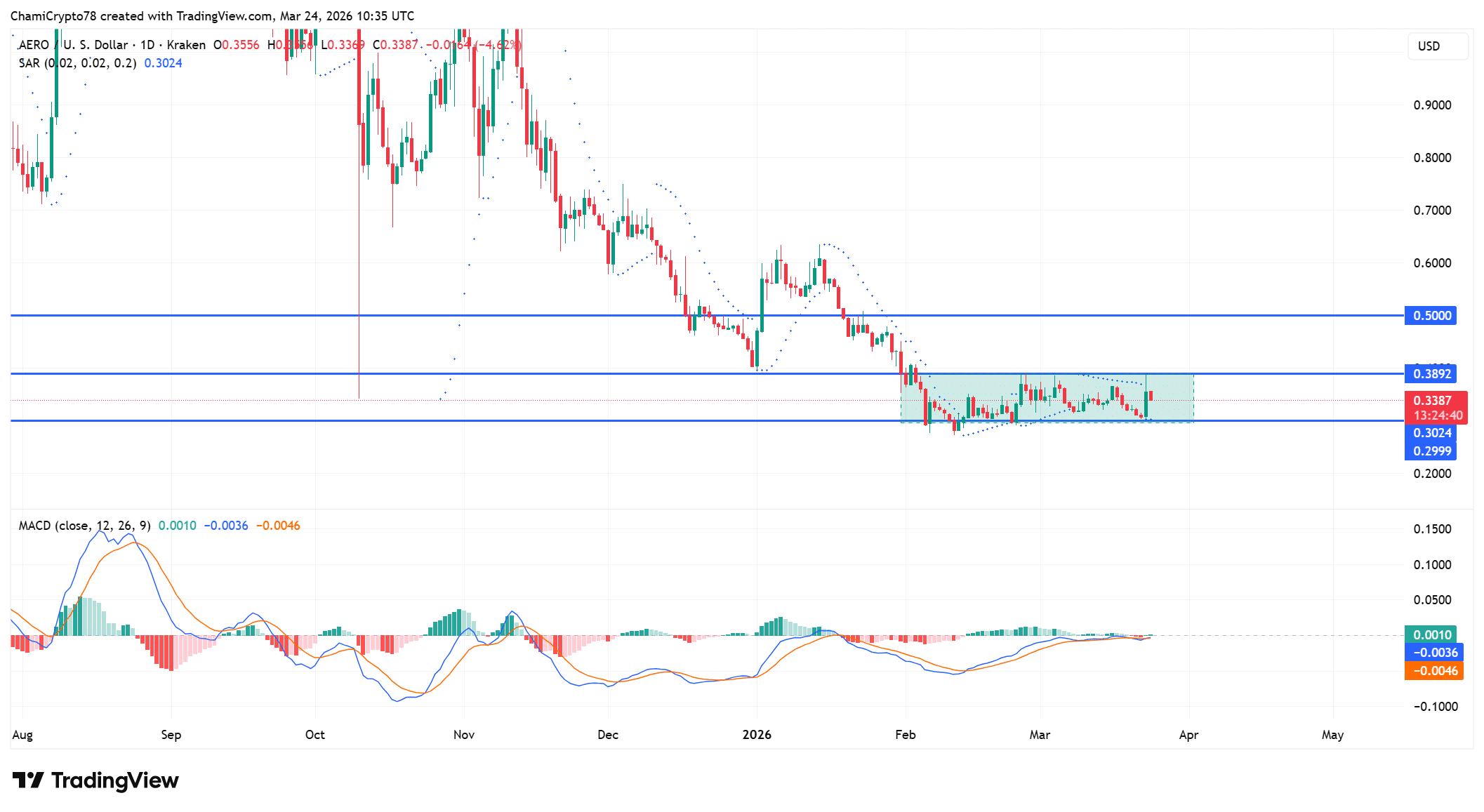
Source: TradingView

AERO buyers dominate despite consolidation

Spot Taker CVD remained buyer-dominant at press time, indicating that aggressive market orders continue to favor buying activity rather than selling pressure.

Such behavior confirms that demand does not rely on passive bids but instead comes from active participation. Even as price consolidates within a narrow range, buyers continue to absorb available supply. This aligns closely with the observed on-chain accumulation, where wallets have deployed significant capital within a short time.

As a result, the underlying structure reflects absorption rather than distribution. While price has not yet broken higher, demand continues to build beneath resistance, keeping upward pressure intact.
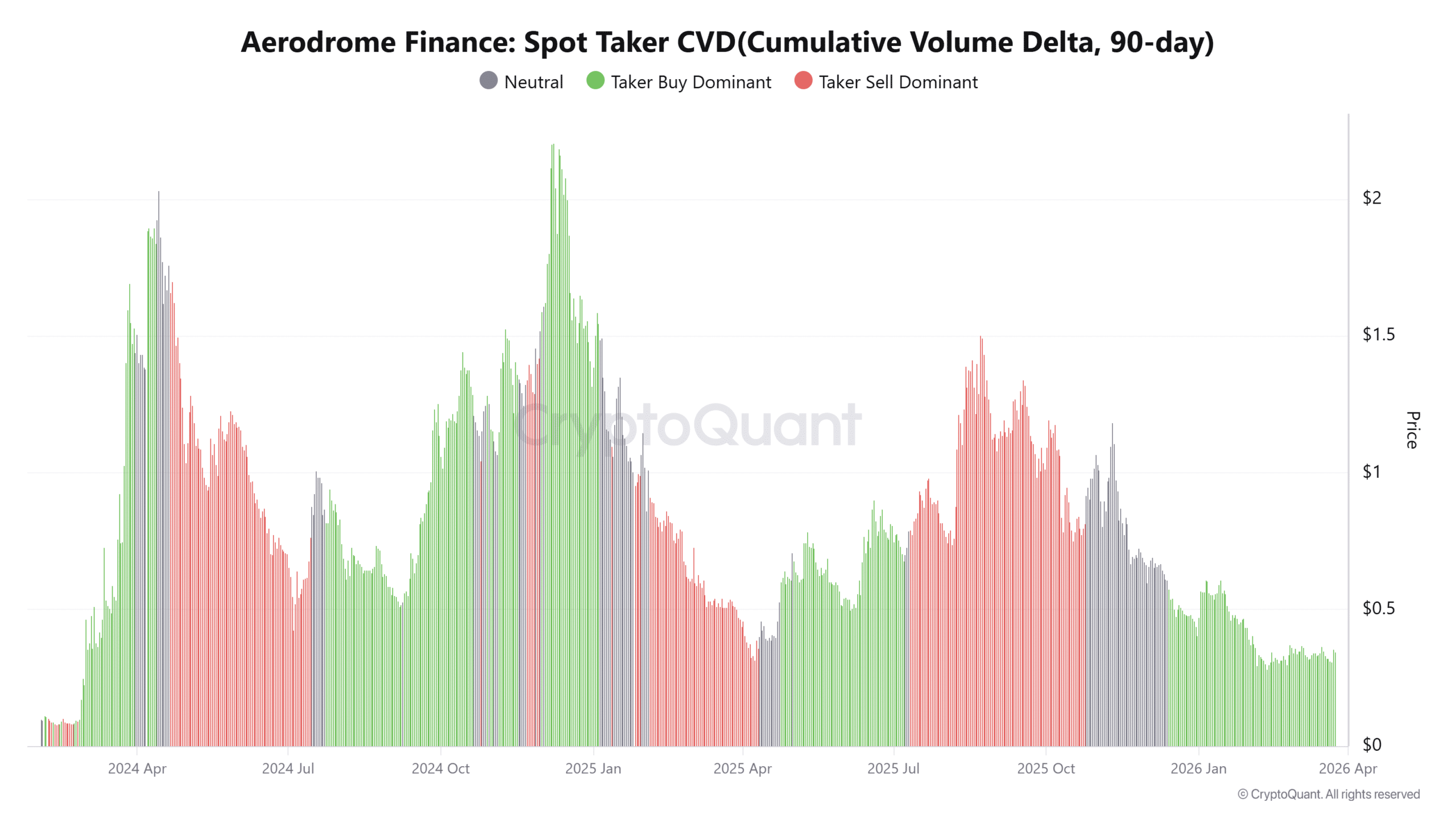
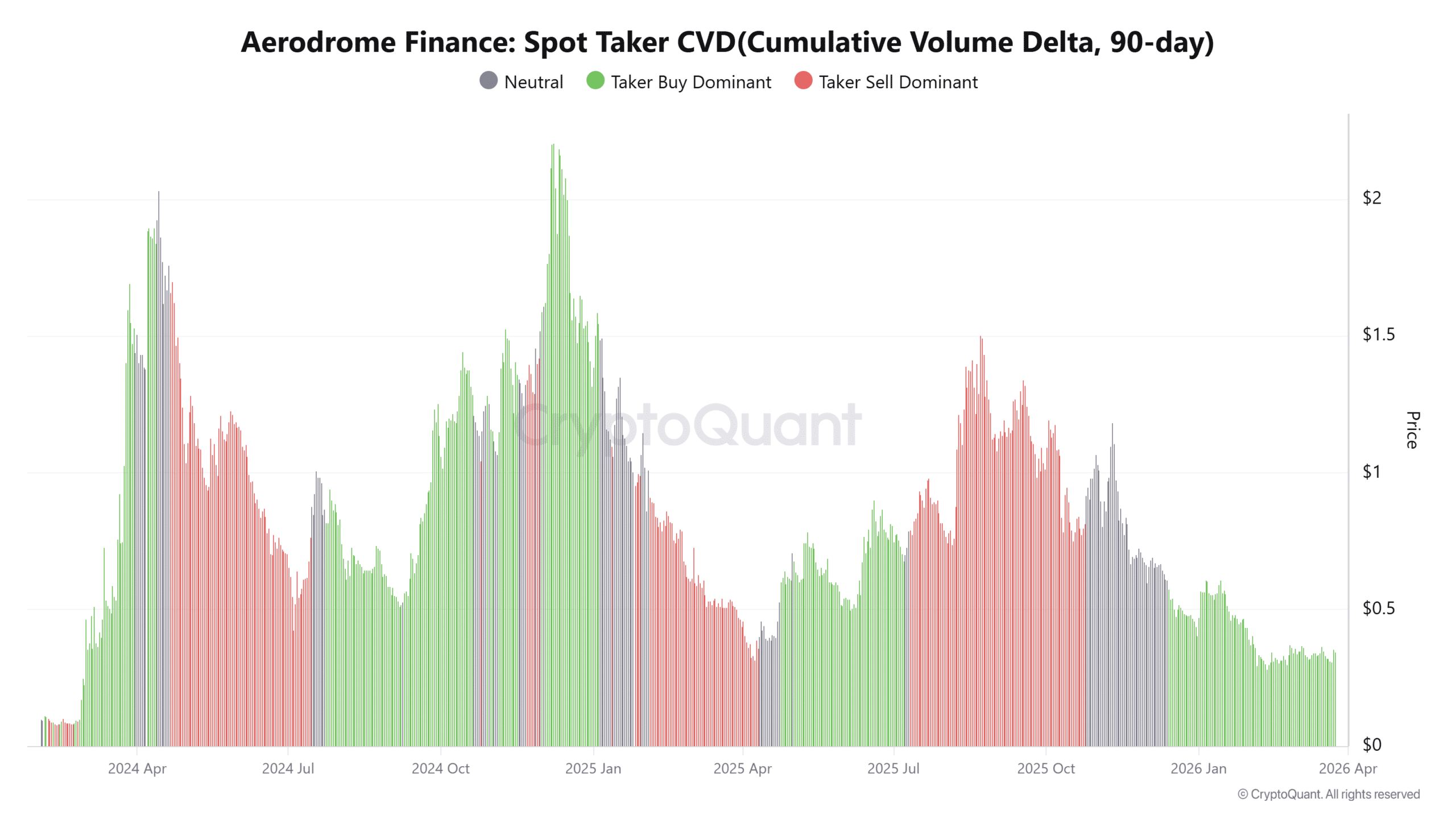
Source: CryptoQuant

Short liquidations cluster above price

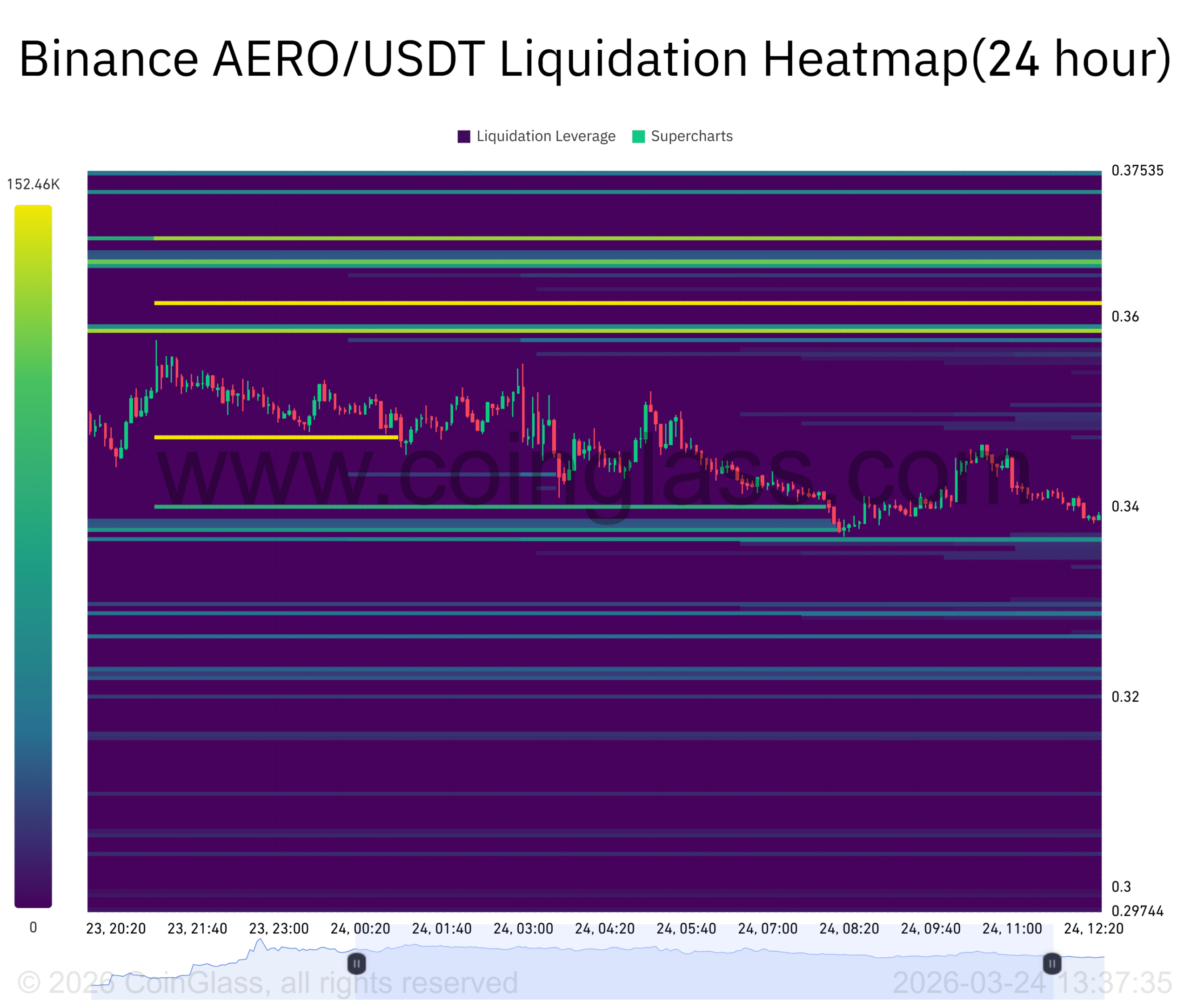
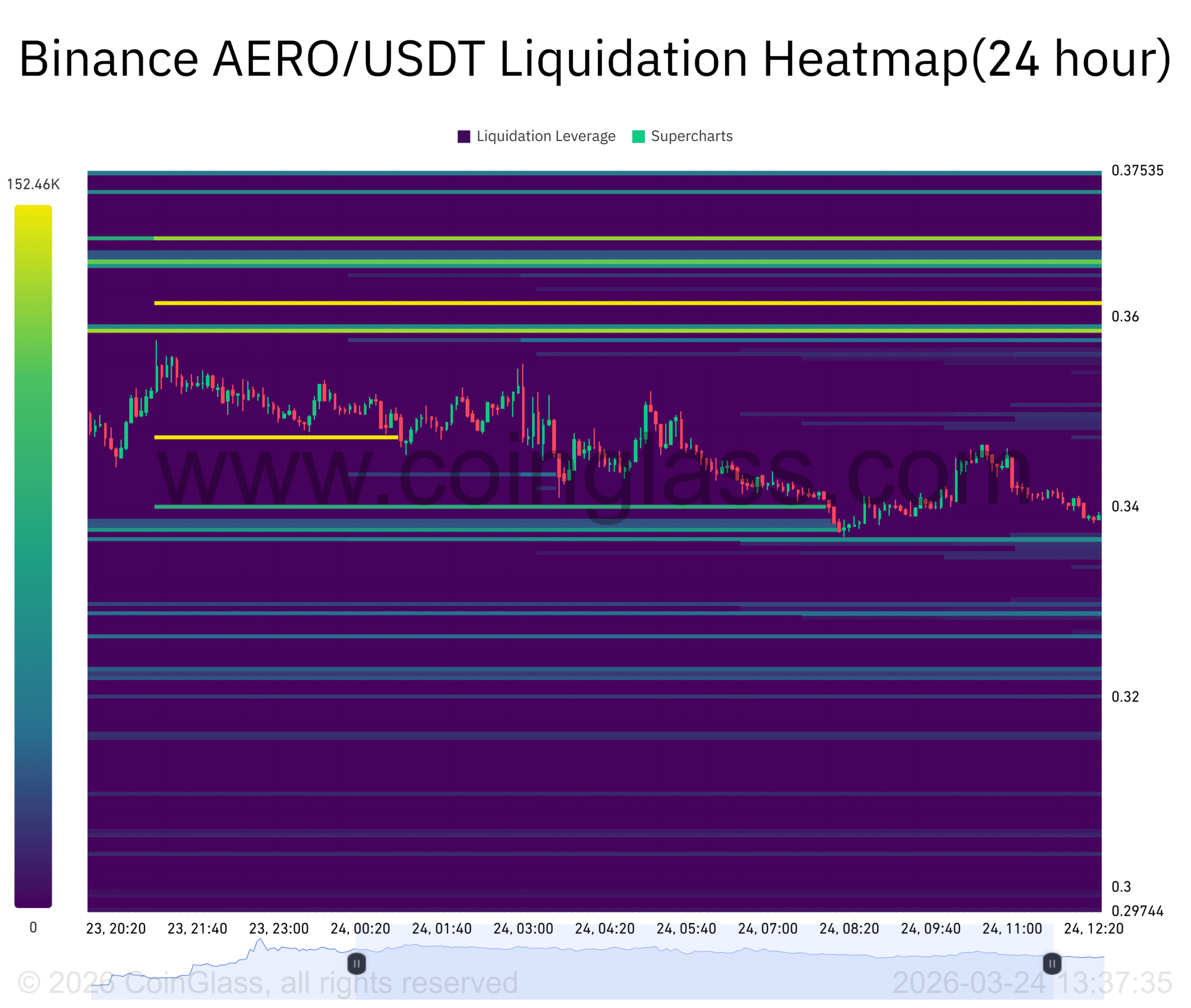
Liquidation data shows dense clusters forming above the current price, particularly around the $0.36 to $0.375 region.

These zones represent areas where short positions could face forced closure if the price moves higher. As a result, they act as potential targets for upward price movement.

Meanwhile, liquidity below price appears relatively thin, reducing the likelihood of aggressive downside sweeps. This imbalance creates an asymmetric setup where upward movement could accelerate quickly. If price approaches these clusters, forced liquidations may amplify the move, pushing price through resistance with increased volatility and rapid expansion.
Source: CoinGlass

Ultimately, AERO currently holds a structurally supportive position above $0.302, while strong demand continues to build across spot and on-chain activity. Buyers remain active, and liquidation clusters above price create a clear upside target.

If accumulation persists, price would likely push into higher liquidity zones rather than break lower, sustaining the ongoing rally structure.


Final Summary

  • Sustained demand above support would drive price toward liquidity clusters, forcing shorts into rapid covering under pressure.
  • Failure to break resistance could trap late buyers, allowing sellers to regain control and push price back toward support.


Domande pertinenti

QWhat is the current price of AERO and by how much has it increased in the last 24 hours?

AAERO is currently priced at $0.3391, representing a 24-hour increase of 11.65%.

QWhat does the significant surge in trading volume (over 631%) and the $2.6M on-chain accumulation indicate?

AIt signals aggressive market participation and a sudden influx of buyers, suggesting deliberate positioning from informed participants rather than gradual accumulation.

QWhat are the key support and resistance levels for AERO's price according to the article?

AThe key support level is $0.302, and the major resistance level is $0.389.

QWhat do technical indicators like the MACD and Parabolic SAR suggest about AERO's price action?

AThe MACD is approaching a bullish crossover, indicating weakening selling pressure and a shift toward recovery. The Parabolic SAR has flipped below the price, suggesting that downside control is fading.

QHow do the liquidation clusters above the current price influence potential price movement?

ADense liquidation clusters between $0.36 and $0.375 represent areas where short positions could be forced to close. If the price moves higher, these forced liquidations could amplify upward movement, pushing the price through resistance with increased volatility.

Letture associate

Agents Take Over Traffic Distribution Power: What Are Tencent, ByteDance, and Alibaba Competing For?

In the race to dominate the AI era's entry point, China's tech giants—Tencent, ByteDance, and Alibaba—are aggressively deploying AI Agents to control the future of traffic distribution. Alibaba is pursuing a dual-track "closed loop + openness" strategy. Its Qianwen app is evolving into a super-Agent integrated across its ecosystem (Taobao, Alipay, etc.) to handle complex tasks like travel planning. Concurrently, it is opening its platform to external brands (Luckin Coffee, KFC) and has launched a B2B Agent platform, "Wukong," targeting enterprise automation. Its other flagship, Quark, aims to be an "AI super search box" for information and tasks. ByteDance is executing an omnipresent "sprawl strategy." Its Doubao app boasts over 300 million monthly active users and is evolving into a default AI entry point for daily life, with plans for paid versions and e-commerce integration. Its core weapon is the Kouzi platform, a visual "AI assembly factory" for developers to build custom Agents. ByteDance is also pushing hardware integration, collaborating on AI phones and developing smart glasses to embed Doubao everywhere. Tencent is playing its long-held "ultimate card" by quietly embedding an AI Agent directly into WeChat. This Agent, accessible via a swipe, can understand user commands and automatically execute tasks by calling upon WeChat's millions of mini-programs (e.g., finding and ordering coffee). This leverages WeChat's unparalleled 1.4-billion-user ecosystem to position the app as an AI-powered "service operating system," a move that could dramatically reshape the competitive landscape. The core battleground is shifting from competing for "user screen time" to competing to be the "default execution layer" for user intent. The business model is evolving from an "attention economy" to an "intent economy," where the Agent that can most efficiently fulfill a user's need gains control over service access and token flow. This represents a fundamental change in how users connect with digital services, making the fight for the Agent入口 (entry point) a pivotal moment for redefining industry leadership in the AI age.

marsbit11 min fa

Agents Take Over Traffic Distribution Power: What Are Tencent, ByteDance, and Alibaba Competing For?

marsbit11 min fa

From Banning Doubao to Embracing Honor: Why Did WeChat Suddenly 'Change Its Face'?

The article explores the sudden shift in WeChat's strategy towards AI assistants from mobile phone manufacturers, transitioning from strict opposition to active collaboration. For over a year, WeChat fiercely resisted attempts by phone AI assistants (like ByteDance's Doubao in late 2025) to control its features via GUI automation ("simulated clicking"), citing security and data control concerns. This stance created a significant barrier for system-level AI integration. Now, Tencent has initiated A2A (Agent-to-Agent) partnerships with major phone brands like Honor, Xiaomi, OPPO, and vivo. This model allows a phone's system AI (e.g., Honor's YOYO) to parse a user's voice command and send a structured request directly to WeChat's own internal AI agent via secure APIs. WeChat then executes the action (e.g., sending a message) and returns the result. The article attributes Tencent's "change of face" to strategic pressure. While leading in social app usage, Tencent trails rivals like ByteDance and Alibaba in standalone AI app popularity. WeChat, with its vast mini-program ecosystem, is Tencent's key asset for an AI comeback. The upcoming WeChat AI agent aims to handle tasks like booking and payments within the app. However, phone system assistants remain the primary AI entry point for most users. The A2A collaboration allows Tencent to extend WeChat's AI reach to this crucial system layer while maintaining control over its core functions and data. For phone manufacturers, embracing A2A is a pragmatic move. The GUI route proved unviable due to WeChat's blocks. A2A offers a compliant path to integrate a vital service, enhancing their AI assistants' usefulness. It allows them to focus on developing their own AI ecosystems for other services while cooperating on WeChat access. The collaboration is framed as a mutual, strategic necessity: Tencent gains a distribution channel, and manufacturers gain a key functionality. The partnership relies on a "dual authorization" mechanism for security, requiring both user and app consent for each action. While questions about long-term data privacy practices remain, experts note A2A is more secure and compliant than GUI automation. Ultimately, this cooperation is seen as a tentative, calculated truce. Tencent's long-term goal is to make WeChat an AI-powered "service OS." Phone manufacturers aim to make their system AI the central user interface. Their paths may converge or clash in the future, but for now, the A2A deal represents the opening chapter in the battle for the AI-era user入口, driven by necessity and strategic calculus on both sides.

marsbit1 h fa

From Banning Doubao to Embracing Honor: Why Did WeChat Suddenly 'Change Its Face'?

marsbit1 h fa

On-Chain Figures on the Eve of Kickoff: 1.6 Billion Traded Before the World Cup Even Begins

"On-Chain Numbers on the Eve of the World Cup: $1.6 Billion Traded Before Kick-off" Analysis of on-chain markets before the 2026 FIFA World Cup reveals significant crypto integration into football. The most striking figure is the approximately **$1.6 billion** in total trading volume on the single "World Cup Winner" contract on the Polymarket prediction market platform, accumulated before a single match was played. This represents explosive growth for a sector whose annual volume surged from ~$16B in 2024 to ~$64B in 2025. The ecosystem is maturing beyond speculation. Key developments include: 1) **Infrastructure upgrades** like Polymarket's migration to native, regulated USDC stablecoin for settlements; 2) **Reliable data oracles**, such as Chainlink, being used to resolve real-world match outcomes on-chain; and 3) **Official recognition**, with FIFA appointing its first-ever "Prediction Markets" partner. Over 100 contracts now cover everything from the outright winner to individual match results and even non-sporting risks like venue relocation. This evolution marks a fundamental shift. While crypto firms are absent from FIFA's top-tier sponsor list, the technology has deeply penetrated the tournament's financial and predictive infrastructure through regulated stablecoin settlements, decentralized oracles, and new official partnership categories. The regulatory landscape remains complex and varies by jurisdiction, but on-chain markets for the World Cup are already a multi-billion-dollar reality.

marsbit2 h fa

On-Chain Figures on the Eve of Kickoff: 1.6 Billion Traded Before the World Cup Even Begins

marsbit2 h fa

Trading

Spot
Futures

Articoli Popolari

Come comprare PUSH

Benvenuto in HTX.com! Abbiamo reso l'acquisto di Push Protocol (PUSH) semplice e conveniente. Segui la nostra guida passo passo per intraprendere il tuo viaggio nel mondo delle criptovalute.Step 1: Crea il tuo Account HTXUsa la tua email o numero di telefono per registrarti il tuo account gratuito su HTX. Vivi un'esperienza facile e sblocca tutte le funzionalità,Crea il mio accountStep 2: Vai in Acquista crypto e seleziona il tuo metodo di pagamentoCarta di credito/debito: utilizza la tua Visa o Mastercard per acquistare immediatamente Push ProtocolPUSH.Bilancio: Usa i fondi dal bilancio del tuo account HTX per fare trading senza problemi.Terze parti: abbiamo aggiunto metodi di pagamento molto utilizzati come Google Pay e Apple Pay per maggiore comodità.P2P: Fai trading direttamente con altri utenti HTX.Over-the-Counter (OTC): Offriamo servizi su misura e tassi di cambio competitivi per i trader.Step 3: Conserva Push Protocol (PUSH)Dopo aver acquistato Push Protocol (PUSH), conserva nel tuo account HTX. In alternativa, puoi inviare tramite trasferimento blockchain o scambiare per altre criptovalute.Step 4: Scambia Push Protocol (PUSH)Scambia facilmente Push Protocol (PUSH) nel mercato spot di HTX. Accedi al tuo account, seleziona la tua coppia di trading, esegui le tue operazioni e monitora in tempo reale. Offriamo un'esperienza user-friendly sia per chi ha appena iniziato che per i trader più esperti.

533 Totale visualizzazioniPubblicato il 2024.12.13Aggiornato il 2026.06.02

Come comprare PUSH

Discussioni

Benvenuto nella Community HTX. Qui puoi rimanere informato sugli ultimi sviluppi della piattaforma e accedere ad approfondimenti esperti sul mercato. Le opinioni degli utenti sul prezzo di PUSH PUSH sono presentate come di seguito.

活动图片








