Ads During the American Super Bowl Look Like Scams

marsbitPubblicato 2026-02-12Pubblicato ultima volta 2026-02-12

Introduzione

The 2026 Super Bowl, often called the "American Super Bowl," was a spectacle of sports, entertainment, and high-stakes marketing. This year’s event featured three notable incidents that highlight the intersection of prediction markets, insider information, and viral marketing. First, a newly created account on the prediction market Polymarket placed nearly $80,000 in bets—with 17 out of 19 wagers correctly predicting details of the halftime show, including appearances by Lady Gaga and the absence of Travis Scott. The account’s near-perfect accuracy led to suspicions of insider trading, possibly linked to the event’s production team. Second, a trader named Alex Gonzalez ran onto the field during the game with promotional messages painted on his body. Reports indicate he had previously bet on such a field invasion occurring, after accounting for legal fees and bail, netted around $70,000. His actions blurred the line between predicting and creating events for profit. Finally, a viral “leaked” video showed influencer Logan Paul apparently betting $1 million on Polymarket during the game. It was later revealed to be a marketing stunt orchestrated by Polymarket itself, in which Paul has investment ties. Together, these events illustrate how prediction markets can be manipulated through insider knowledge, performative acts, and staged publicity—raising questions about authenticity in high-profile events.

This year's "American Super Bowl" once again captured the world's attention, much like previous years. The game itself, Mr. Beast's one-million-dollar bounty puzzle game, the halftime show... A sports event that was originally popular only in the United States has attracted global attention thanks to numerous entertainment and cultural elements.

Before we begin, let's experience just how lively the American Super Bowl is from a first-person perspective:

Amidst this density of attention, three viral events perfectly illustrate our expectations for prediction markets: an insider with a perfect winning rate betting on the halftime show performers on the prediction market Polymarket, a "fanatic fan" arrested on the spot, and a viral video of a major influencer secretly filmed using a prediction market that was later revealed to be a marketing stunt.

The "Perfect Win Rate" of Prediction Markets: New Account Achieves Extremely High Win Rate Betting on Halftime Show Lineup

Approximately 48 hours before the Super Bowl kickoff, nearly $80,000 was deposited into a newly registered account on the prediction market Polymarket. Subsequently, this account concentrated all its funds on bets related to the halftime show performers and setlist events, covering multiple specific predictions such as Lady Gaga performing and Travis Scott not performing, totaling 19 prediction bets.

After the halftime show concluded, 17 of these 19 bets hit, yielding a profit of $17,600. A new account, heavily concentrated on a single event, with a near-perfect hit rate. This goes far beyond just good luck.
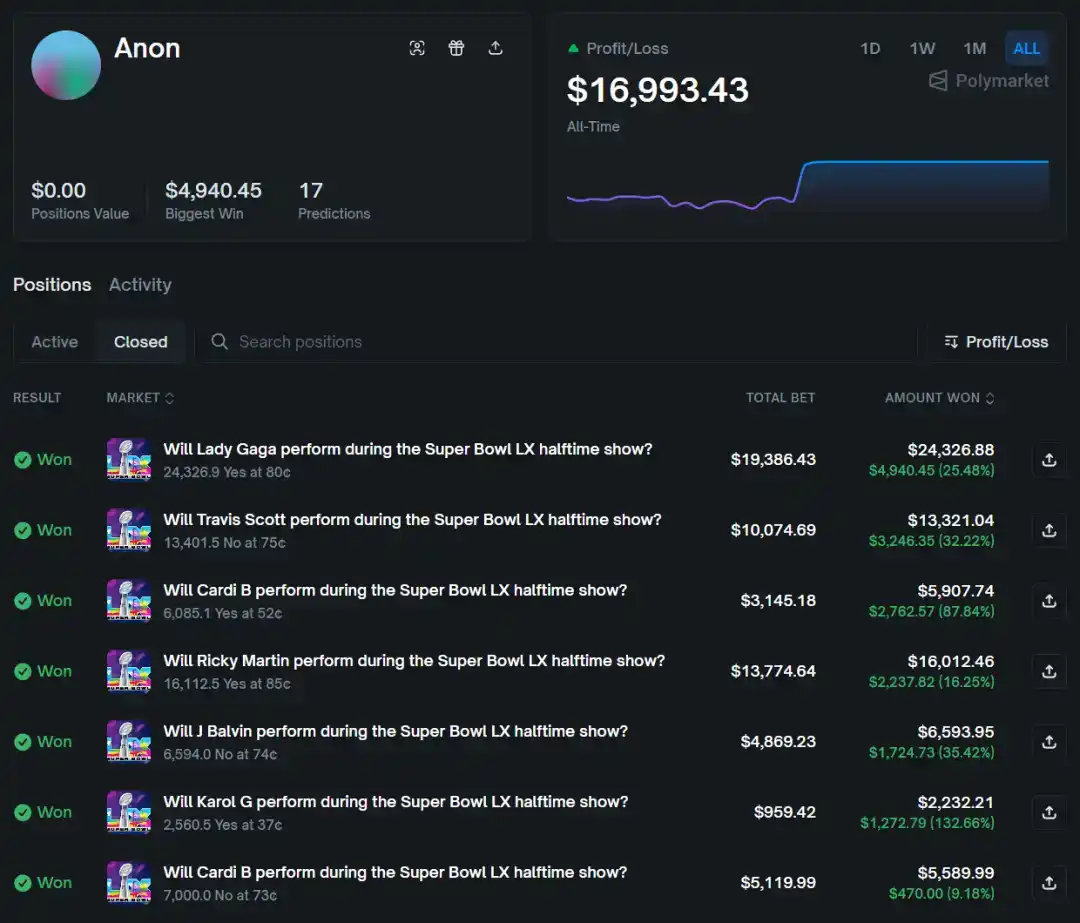
Since the Super Bowl halftime show has long been planned and produced by the company Roc Nation, the community quickly began to speculate that the account holder likely had access to insider information, or was even connected to the production team. In an event with trading volume exceeding ten million dollars, while ordinary traders were placing blind bets, this insider was perhaps holding the setlist in their left hand and locking in profits with their phone in their right.

However, the anonymous nature of blockchain also means this remains merely speculation. This transaction has become another classic case study defining prediction markets as a means for insiders to monetize information asymmetry.

Trader Bets "Someone Will Rush the Field" and Then Rushes the Field

If the insider trader was profiting from information asymmetry in the shadows, then the move by a "fan" during the game was an open stratagem. He is also the protagonist in the video at the beginning of our article.

In the fourth quarter of the game, a shirtless fan climbed over the barrier and rushed onto the Super Bowl field. Instantly, all cameras and the television broadcast focused on this intruder. His bare chest was painted with body paint, his front reading "Trade in the blind spot," and his back displaying his account ID "@fxalexg" and the advertisement "Trade with Athena."
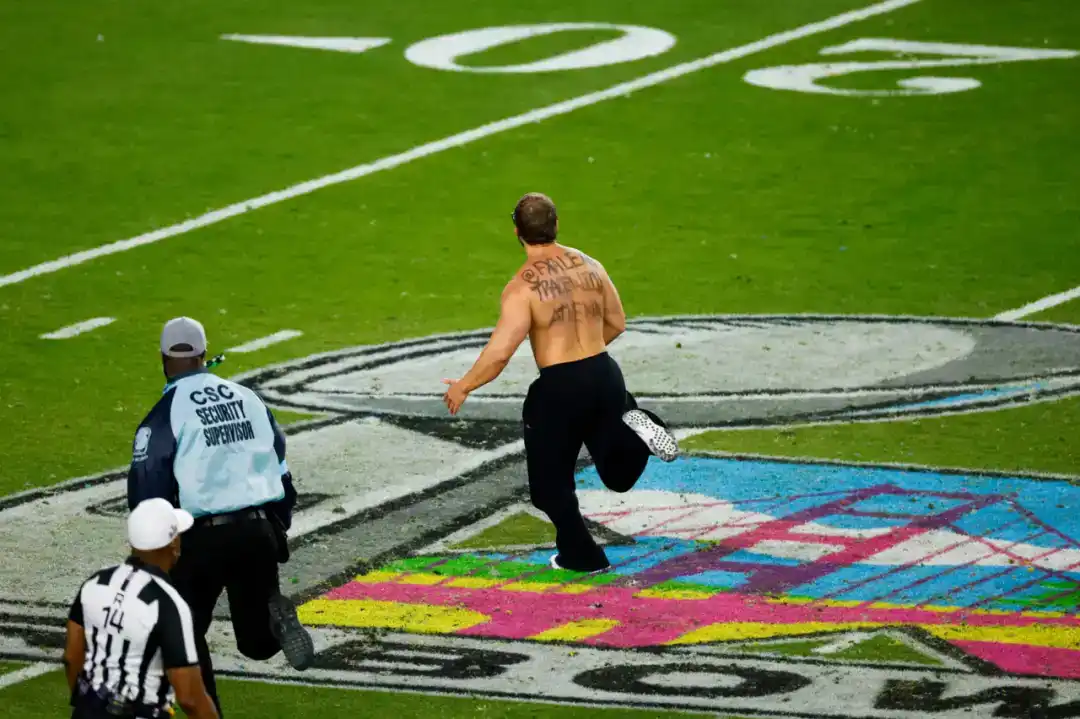
From the moment he stepped onto the field until he was tackled by security, he ran for 30 seconds. The going rate for a 30-second ad spot during the Super Bowl is $7 million.

When viewers took out their phones to search for his account, they discovered this "fan" was not an ordinary spectator but a trader—Alex Gonzalez. The slogans on his body were essentially a moving advertisement.

Even more intriguingly, according to Sportscasting, Gonzalez had performed a similar stunt back in 2024. He reportedly bet $5,000 that "someone would rush the field during the Super Bowl," then rushed the field himself during the game, ultimately profiting about $110,000; after deducting bail and legal fees, his net gain was still around $70,000.

In other words, he not only creating the event on the field but potentially also betting on the event he himself would create in the prediction market.

When the odds are high enough, some people stop predicting the future and instead create it themselves. This is also our most extreme, and most ironic, expectation for prediction markets.

The "Secretly Filmed" Video of an Influencer Betting a Million Dollars Was Actually a Marketing Stunt

Another video from this Super Bowl that went viral across the internet came from top influencer Logan Paul—in the footage, his phone screen is lit up with the Polymarket betting interface, showing him placing a one-million-dollar bet on which team would win. The image is blurry, the angle is tilted, very much like a casual shot taken by a spectator in the back seat.

Soon after this 12-second "secretly filmed" video spread, it was reposted by the official Polymarket account, and the heat and traffic came as expected. However, this transaction never appeared in the information flow of PolyBeats, which focuses on monitoring prediction market trades.

After in-depth research, it was found that the so-called "million-dollar bet" never actually occurred. This seemingly explosive "behind-the-scenes moment," which satisfied the public's voyeuristic desires, was nothing more than a carefully packaged marketing performance: as early as December 2025, Logan Paul joined the venture capital firm Anti Fund as a partner, and this firm was one of the investors in Polymarket's Series B round in 2025.

When a globally watched sporting event simultaneously overlaps with probability markets, advertising markets, and attention markets, the boundaries of the game are no longer confined to just the two teams on the field. Beyond the odds, there's the pricing of exposure; beyond the betting lines, there's narrative design.

Driven by money and attention, the "viral moments" we scroll past on social media might not be spontaneous but the result of months of planning.


Crypto di tendenza

Domande pertinenti

QWhat was the 'American Super Bowl' event mentioned in the article, and why is it attract global attention?

AThe 'American Super Bowl' refers to the annual championship game of the National Football League (NFL). It attracts global attention not just for the sport itself, but due to its heavy integration of entertainment culture, such as the high-profile halftime show, celebrity appearances, and major advertising events, which collectively draw a worldwide audience.

QHow did a new Polymarket account achieve a near-perfect prediction rate for the Super Bowl halftime show, and what does this suggest?

AA new Polymarket account deposited nearly $80,000 and placed 19 concentrated bets on specific halftime show details, like Lady Gaga appearing and Travis Scott not appearing, with 17 of them being correct. This near-perfect success rate, far beyond luck, strongly suggests the account owner had insider information, likely connected to the show's production company Roc Nation, exploiting information asymmetry for profit on the prediction market.

QWho was Alex Gonzalez, and how did he allegedly profit from the Super Bowl event according to the article?

AAlex Gonzalez was a trader who ran onto the field during the Super Bowl with painted advertisements on his body. The article suggests he had previously placed a $5,000 bet on the prediction market that 'someone would rush onto the field during the Super Bowl' and then created the event himself by doing so. He reportedly profited approximately $110,000 from that bet, with a net gain of around $70,000 after legal fees and bail.

QWhat was revealed about the viral 'secretly recorded video' of Logan Paul placing a million-dollar bet on Polymarket?

AThe viral 12-second 'secretly recorded' video of Logan Paul apparently placing a million-dollar bet on Polymarket was revealed to be a staged marketing campaign. The bet never actually placed on the market, and the video was a carefully orchestrated promotion. This was because Logan Paul is a partner in Anti Fund, a venture capital firm that was an investor in Polymarket's Series B funding round.

QWhat overarching point does the article make about prediction markets, advertising, and major events like the Super Bowl?

AThe article argues that during globally watched events like the Super Bowl, prediction markets, advertising markets, and attention economies converge. This creates an environment where what appears to be spontaneous moments—such as an insider making profitable trades, a fan rushing the field, or a viral video—are often the result of months of planning and manipulation for financial gain and exposure, blurring the lines between gambling, advertising, and narrative creation.

Letture associate

Claude's Major New Feature: Screen Recording + Voice, Distilling Your Skills into AI Tasks in One Click

Claude has introduced a major new feature called "Record a Skill," available for Pro, Max, and Team users. This function, found in the Claude desktop app's CoWork menu, allows users to create reusable AI skills simply by recording their screen and providing voice narration while performing a task. Claude then automatically analyzes the recording and generates a functional Skill. A hands-on test confirmed the feature works seamlessly. Users start recording via the Skills manager, perform their workflow while verbally explaining the steps and logic, and avoid including sensitive information. After recording, Claude processes the content and creates the Skill, which can be saved and later invoked with a slash command (/). This eliminates the need for manual adjustments or writing complex instruction files. The innovation goes beyond mere efficiency. Previously, creating a Skill required writing a detailed SKILL.md file in Markdown—a significant barrier for non-technical users. "Record a Skill" bypasses this by directly capturing both actions and the implicit reasoning shared in the narration. This lowers the barrier to knowledge transfer and automation, addressing a core challenge in corporate knowledge management: the difficulty of getting experts to write and maintain documentation. However, the feature also highlights a shift in the nature of work. A case study from March 2026 showed a freelancer whose five-year client relationship was effectively replaced by a hand-coded Claude Skill automating their content workflow. With the even lower barrier of screen recording, the ability to distill personal expertise into automatable skills accelerates this trend. The "moat" for work is moving from simply knowing how to do a task to mastering tasks that are difficult or impossible to automate.

marsbit6 min fa

Claude's Major New Feature: Screen Recording + Voice, Distilling Your Skills into AI Tasks in One Click

marsbit6 min fa

Feeding AI "Noise" Can Also Boost Scores, This Work Enables Positive Transfer with Noise

Feeding "Noise" to AI Can Improve Performance: A Method Enables Positive Transfer from Noise This work, Semi-Supervised Noise Adaptation (SSNA), introduces a Noise Adaptation Framework (NAF) that challenges traditional transfer learning. Instead of requiring a labeled source domain of real data (e.g., images, text), NAF uses randomly generated Gaussian noise as the source. For a target task with C classes, it constructs C noise clusters by sampling from Gaussian distributions. Although this synthetic noise contains no semantic meaning, NAF trains it to form a discriminative class structure in a shared representation space—clustering same-class noise and separating different classes. The key is aligning this learned structure from the noise domain to the real, sparsely labeled target domain. A small number of target labels are still essential to establish the correspondence between noise clusters and actual classes. The training objective combines: 1) supervised loss on the few labeled target samples, 2) classification loss for the noise to build its structure, and 3) a distribution alignment loss (using Negative Domain Similarity) to minimize the gap between the noise and target domains in the shared space. Experiments show significant gains in few-label settings. With just 4 labels per class, NAF with a ResNet-18 backbone improves accuracy over a standard supervised baseline (ERM) by +12.35% on CIFAR-10, +7.61% on CIFAR-100, +4.38% on DTD-47, and +2.74% on Caltech-101. It also benefits fine-grained datasets and scales to ImageNet-1K (with 100 labels/class) and text classification (AG News). NAF can be integrated into existing semi-supervised methods like FixMatch for further gains. Ablation studies confirm the transferred benefit comes from the discriminative structure of the noise, not randomness itself. Collapsing all noise into a single point causes negative transfer, while increasing separation between noise cluster centers improves performance. The amount of noise per class is less critical once a basic structure forms. In conclusion, this work demonstrates that for positive transfer, the semantic content of source data may not be necessary. What can be effectively transferred is the *organizational structure* of categories within a representation space. This offers a promising alternative for scenarios where real source data is unavailable due to privacy, copyright, or procurement constraints.

marsbit7 min fa

Feeding AI "Noise" Can Also Boost Scores, This Work Enables Positive Transfer with Noise

marsbit7 min fa

Trading

Spot

Articoli Popolari

Come comprare SUPER

Benvenuto in HTX.com! Abbiamo reso l'acquisto di SuperFarm (SUPER) semplice e conveniente. Segui la nostra guida passo passo per intraprendere il tuo viaggio nel mondo delle criptovalute.Step 1: Crea il tuo Account HTXUsa la tua email o numero di telefono per registrarti il tuo account gratuito su HTX. Vivi un'esperienza facile e sblocca tutte le funzionalità,Crea il mio accountStep 2: Vai in Acquista crypto e seleziona il tuo metodo di pagamentoCarta di credito/debito: utilizza la tua Visa o Mastercard per acquistare immediatamente SuperFarmSUPER.Bilancio: Usa i fondi dal bilancio del tuo account HTX per fare trading senza problemi.Terze parti: abbiamo aggiunto metodi di pagamento molto utilizzati come Google Pay e Apple Pay per maggiore comodità.P2P: Fai trading direttamente con altri utenti HTX.Over-the-Counter (OTC): Offriamo servizi su misura e tassi di cambio competitivi per i trader.Step 3: Conserva SuperFarm (SUPER)Dopo aver acquistato SuperFarm (SUPER), conserva nel tuo account HTX. In alternativa, puoi inviare tramite trasferimento blockchain o scambiare per altre criptovalute.Step 4: Scambia SuperFarm (SUPER)Scambia facilmente SuperFarm (SUPER) nel mercato spot di HTX. Accedi al tuo account, seleziona la tua coppia di trading, esegui le tue operazioni e monitora in tempo reale. Offriamo un'esperienza user-friendly sia per chi ha appena iniziato che per i trader più esperti.

216 Totale visualizzazioniPubblicato il 2024.12.11Aggiornato il 2026.06.02

Come comprare SUPER

Discussioni

Benvenuto nella Community HTX. Qui puoi rimanere informato sugli ultimi sviluppi della piattaforma e accedere ad approfondimenti esperti sul mercato. Le opinioni degli utenti sul prezzo di SUPER SUPER sono presentate come di seguito.

活动图片