Ads Blast Crypto Bill, Rally Public To Lobby Senators Against DeFi

bitcoinistPubblicato 2026-01-11Pubblicato ultima volta 2026-01-11

Introduzione

A new political ad campaign by the group "Investors For Transparency" is airing on Fox News, urging viewers to contact their senators and oppose the inclusion of decentralized finance (DeFi) provisions in the upcoming CLARITY Act. The ads warn of broad risks to the traditional banking system, citing a potential $6.6 trillion impact on bank deposits if stablecoins with interest-like features gain adoption. They specifically call for the removal of DeFi-related language ahead of a Senate Banking Committee markup scheduled for January 15, 2026. The campaign has drawn criticism from crypto industry leaders, such as Uniswap Labs CEO Hayden Adams, who question the group's funding and misleading name. Critics argue the deposit risk figures are overstated and speculative. Supporters of excluding DeFi believe it protects banks, while opponents warn it would create regulatory uncertainty and harm US competitiveness. The scale of the ad buy has raised questions about its undisclosed financial backers.

A new wave of political ads is pushing a sharp message into living rooms and phone banks: tell your senator to back crypto legislation only if decentralized finance, or DeFi, is left out.

According to broadcast logs and industry reports, the spots have been running on Fox News and include a call line for viewers to contact senators directly. The group behind the campaign identifies itself as “Investors For Transparency.”

Ad Campaign Targets Lawmakers With Hotlines And Numbers

According to reports, the ads warn of broad risks if DeFi is folded into federal law. They cite a figure — $6.6 trillion — that has been used in public discussion about how much in bank deposits might be affected if stablecoins gain wide acceptance with interest-like features.

The ads urge people to call Senate offices and push senators to strip DeFi provisions from the CLARITY Act ahead of a scheduled markup on January 15, 2026. Phone numbers and a web address are shown in the ads, encouraging immediate contact.

Senate Timetable And Political Pressure

Based on reports, the CLARITY Act is set for consideration by the Senate Banking Committee, and committee members are getting calls from both sides. Senate Banking Committee Chair Tim Scott has said he expects the committee to move on crypto legislation, and senators are weighing how to balance investor protections with innovation.

Outside groups and industry players have ramped up outreach. Some hope the bill moves quickly, while others see the political heat as likely to slow progress.

Total crypto market cap currently at $3.07 trillion. Chart: TradingView

Crypto: Industry Response And Questions About Funding

Crypto firms and DeFi supporters have pushed back. Hayden Adams, CEO of Uniswap Labs, publicly criticized the group’s name as misleading and questioned who is funding the ads.

Based on public filings and media reporting, no clear single donor has been identified that explains the scale of the TV buy. Industry leaders say that a campaign attacking DeFi while claiming to speak for investors should disclose its backers.

The ads’ emphasis on bank-deposit risk has been called overstated by some market watchers, who argue that the figures are speculative and depend on many assumptions.

What The Campaign Wants And What It Means

Reports say that the ads want senators to approve a version of the CLARITY Act without language covering decentralized finance platforms or new stablecoin rules that could allow interest-like yields.

Supporters of that view say the rules would protect the traditional banking system from a sudden outflow of deposits. Opponents say excluding DeFi would lock in regulatory uncertainty and hurt US competitiveness in an area where developers and users already operate globally.

Featured image from Unsplash, chart from TradingView

Domande pertinenti

QWhat is the main message of the political ads described in the article?

AThe main message is to urge the public to tell their senators to support crypto legislation only if decentralized finance (DeFi) is excluded from it.

QWhich news network is running the ads from the group 'Investors For Transparency'?

AThe ads are running on Fox News.

QWhat specific legislative act and deadline are the ads targeting?

AThe ads are targeting the CLARITY Act, urging senators to strip DeFi provisions from it ahead of a scheduled committee markup on January 15, 2026.

QWho publicly criticized the ad campaign and questioned its funding?

AHayden Adams, the CEO of Uniswap Labs, criticized the group's name as misleading and questioned who is funding the ads.

QWhat is the primary argument used in the ads to oppose including DeFi in the legislation?

AThe ads argue that including DeFi poses a broad risk, citing a speculative figure of $6.6 trillion in bank deposits that might be affected if stablecoins with interest-like features gain wide acceptance.

Letture associate

Circle CEO's Seoul Visit: No Korean Won Stablecoin Issuance, But Met All Major Korean Banks

Circle CEO Jeremy Allaire's recent activities in Seoul indicate a strategic shift for the company, moving away from issuing a Korean won-backed stablecoin and instead focusing on embedding itself as a key infrastructure provider within Korea’s financial and crypto ecosystem. Despite Korea accounting for nearly 30% of global crypto trading volume—with a market characterized by high retail participation and altcoin dominance—Circle has chosen not to compete for the role of stablecoin issuer. Instead, Allaire met with major Korean banks (including Shinhan, KB, and Woori), financial groups, leading exchanges (Upbit, Bithumb, Coinone), and tech firms like Kakao. This approach reflects a broader industry transition: the core of stablecoin competition is shifting from issuance rights to systemic positioning. With Korean regulators still debating whether banks or tech companies should issue stablecoins, Circle is avoiding regulatory uncertainty by strengthening its role as a service and technology partner. The company is deepening integration with trading platforms, building connections, and promoting stablecoin infrastructure. This positions Circle to benefit regardless of which entity eventually issues a won stablecoin. Allaire also noted the potential for a Chinese yuan stablecoin in the next 3–5 years, underscoring a regional trend of stablecoins becoming more regulated and integrated with traditional finance. Ultimately, Circle’s strategy highlights that future influence in the stablecoin market will belong not necessarily to the issuers, but to the foundational infrastructure layers that enable cross-system transactions.

marsbit4 min fa

Circle CEO's Seoul Visit: No Korean Won Stablecoin Issuance, But Met All Major Korean Banks

marsbit4 min fa

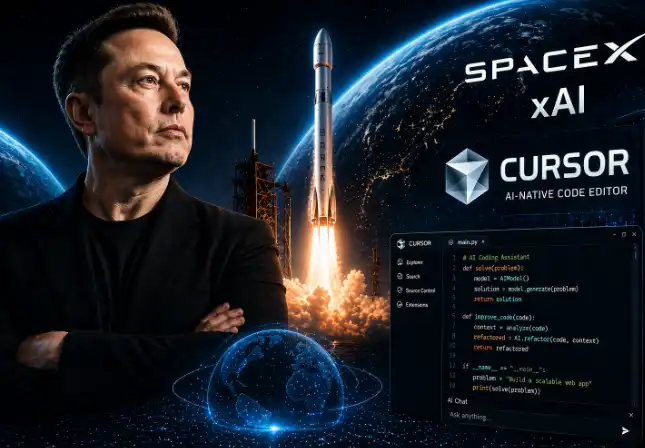
SpaceX Ties Up with Cursor: A High-Stakes AI Gambit of 'Lock First, Acquire Later'

SpaceX has secured an option to acquire AI programming company Cursor for $60 billion, with an alternative clause requiring a $10 billion collaboration fee if the acquisition does not proceed. This structure is not merely a potential acquisition but a strategic move to control core access points in the AI era. The deal is designed as a flexible, dual-path arrangement, allowing SpaceX to either fully acquire Cursor or maintain a binding partnership through high-cost collaboration. This "option-style" approach minimizes immediate regulatory and integration risks while ensuring long-term alignment between the two companies. At its core, the transaction exchanges critical AI-era resources: SpaceX provides its Colossus supercomputing cluster—one of the world’s most powerful AI training infrastructures—while Cursor contributes its AI-native developer environment and strong product adoption. This synergy connects compute power, models, and application layers, forming a closed-loop AI capability stack. Cursor, founded in 2022, has achieved rapid growth with over $1 billion in annual revenue and widespread enterprise adoption. Its value lies in transforming software development through AI agents capable of coding, debugging, and system design—positioning it as a gateway to future software production. For SpaceX, this move is part of a broader strategy to evolve from a aerospace company into an AI infrastructure empire, integrating xAI, supercomputing, and chip manufacturing. Controlling Cursor fills a gap in its developer tooling layer, strengthening its AI narrative ahead of a potential IPO. The deal reflects a shift in AI competition from model superiority to ecosystem and entry-point control. With programming tools as a key battleground, securing developer loyalty becomes crucial for dominating the software production landscape. Risks include questions around Cursor’s valuation, technical integration challenges, and potential regulatory scrutiny. Nevertheless, the deal underscores a strategic bet: controlling both compute and software development access may redefine power dynamics in the AI-driven future.

marsbit44 min fa

SpaceX Ties Up with Cursor: A High-Stakes AI Gambit of 'Lock First, Acquire Later'

marsbit44 min fa

Trading

Spot
Futures
活动图片