Adam Back slams Bitcoiner VC for ‘uninformed noise’ about quantum risk

cointelegraphPubblicato 2025-12-20Pubblicato ultima volta 2025-12-20

Introduzione

Blockstream CEO Adam Back criticized Castle Island Ventures' Nic Carter for amplifying concerns about quantum computing threats to Bitcoin, calling it "uninformed noise." Carter defended his firm's investment in quantum-resistant startup Project Eleven, stating he was "quantum pilled" and believes Bitcoin is vulnerable. He argues governments are preparing for quantum risks and Bitcoin is a "bug bounty" for quantum attacks. While some, like Capriole Investments' Charles Edwards, warn the threat could emerge in 2-9 years, Back contends quantum technology is still decades away from being a real threat. Others, like Kevin O’Leary, doubt attacking Bitcoin would be a practical use of quantum computing.

Blockstream CEO Adam Back has criticized Castle Island Ventures founding partner Nic Carter for amplifying concerns about quantum computing threats to Bitcoin.

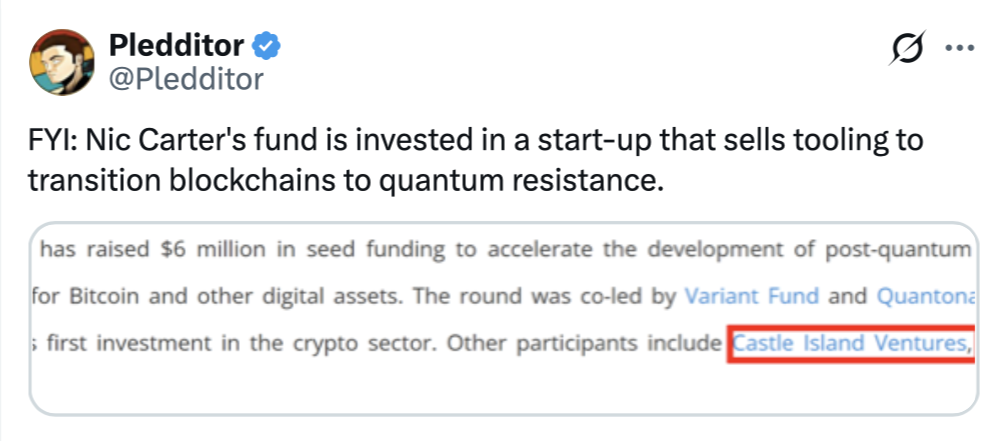
“You make uninformed noise and try to move the market or something. You’re not helping,” Back said in an X post on Friday, after Carter explained in an X post why Castle Island Ventures invested in Project Eleven, a startup focused on protecting Bitcoin and other crypto assets from the threat of quantum computing.

Back said the Bitcoin community is not in denial about the need to research and develop protections against potential quantum computing threats, but is instead doing that work “quietly.” However, Carter refuted Back’s comment, arguing that many Bitcoin developers are still in “total denial” about the risk of quantum computing to Bitcoin.
Source: Pledditor

While Castle Island Ventures’ investment only recently resurfaced on social media within the Bitcoin community, Carter first disclosed it in a Substack post on Oct. 20. “I disclosed this in the first sentence of my main article on quantum. Can’t get more transparent than that,” Carter said.

Carter says he was “quantum pilled”

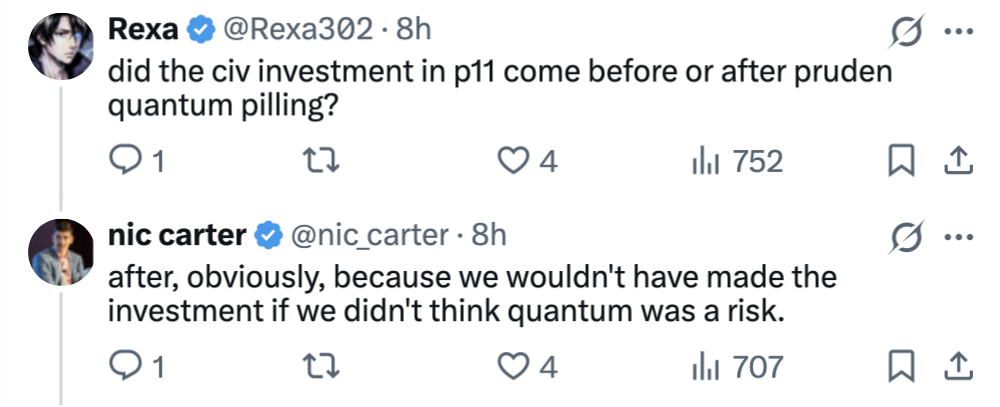
Carter said that he invested in the project because Project Eleven CEO Alex Pruden “quantum pilled” him. “I became extremely concerned about quantum threats to blockchains. I put capital behind my convictions, always have,” he said.
Source: Nic Carter

“I knew the bad faith criticisms would come, so I made absolutely sure to be crystal clear about my financial exposure here,” Carter added.

Carter raised several points why quantum computing poses a risk to Bitcoin, including governments planning for a post-quantum world, Bitcoin itself being “a bug bounty” for quantum supremacy, and the increasing amount of investment in quantum firms.

Carter isn’t the only prominent Bitcoin figure to have recently stepped up public warnings about the potential quantum computing threat to Bitcoin.

Some warn the threat could emerge in as little as two years

Capriole Investments founder Charles Edwards warned in a post on X on Thursday that quantum computing could pose a genuine threat to Bitcoin within the next two to nine years unless the network upgrades to quantum-resistant cryptography.

However, others are less concerned.

Related: Anxiety of quantum risk to Bitcoin is weighing on its price: Execs

Multimillionaire entrepreneur Kevin O’Leary recently told Cointelegraph Magazine that using quantum computing to break Bitcoin’s security wouldn’t be the most effective use of the technology, arguing it would be far more valuable in areas like AI-driven medical research.

Meanwhile, Back recently said it is good for Bitcoin to be “quantum ready,” but it won’t be a threat for the next few decades, as the technology is still “ridiculously early,” and has research and development issues.

Magazine: Big questions: Would Bitcoin survive a 10-year power outage?

Domande pertinenti

QWhat is Adam Back's criticism of Nic Carter regarding quantum computing threats to Bitcoin?

AAdam Back criticized Nic Carter for making 'uninformed noise' and trying to move the market, arguing that the Bitcoin community is already working 'quietly' on quantum protections rather than being in denial.

QWhy did Nic Carter invest in Project Eleven?

ANic Carter invested in Project Eleven because its CEO Alex Pruden 'quantum pilled' him, making him extremely concerned about quantum threats to blockchains, and he wanted to put capital behind his convictions.

QWhat are some reasons Carter believes quantum computing poses a risk to Bitcoin?

ACarter cited governments planning for a post-quantum world, Bitcoin being 'a bug bounty' for quantum supremacy, and increasing investments in quantum firms as reasons for the risk.

QHow soon does Charles Edwards believe quantum computing could threaten Bitcoin?

ACharles Edwards warned that quantum computing could pose a genuine threat to Bitcoin within the next two to nine years unless the network upgrades to quantum-resistant cryptography.

QWhat is Adam Back's timeline for when quantum computing might become a threat to Bitcoin?

AAdam Back stated that quantum computing won't be a threat to Bitcoin for the next few decades, as the technology is still 'ridiculously early' and has research and development issues.

Letture associate

Within Strategy's Framework, STRC's Dividend Yield Remains at 12% as Share Price Stays Below Par Value

Michael Saylor, Executive Chairman of Strategy (MSTR), confirmed that the dividend rate for its STRC perpetual preferred shares will remain at 12.00% through August 2026. The rate has increased from 9% at its July 2025 launch to the current high via a "ratchet" mechanism, which permanently raises the rate by 0.5% whenever the share price falls below $95. This mechanism is intended to push the price back toward its $100 par value and support Strategy's "at-the-market" (ATM) program for issuing new shares to fund Bitcoin purchases. However, the mechanism has not worked as intended. STRC shares closed at $89.46 on July 31, remaining about 10-11% below par value despite the record-high dividend. Competition from rival Strive's higher-yielding SATA securities has pressured demand. The persistent discount has forced Strategy to suspend new STRC issuances via its ATM program, limiting this funding channel for Bitcoin acquisitions. STRC's struggles reflect Bitcoin's own volatility, as the preferred shares historically move in tandem. Analysts have warned the ratchet structure carries long-term, one-way risk. A law firm is investigating Strategy's ability to maintain dividend payments if Bitcoin's price stays low. Retail investors own roughly 83% of outstanding STRC shares, a group seen as prone to panic selling during downturns. In response, Strategy has established financial reserves, including a liquidity cushion covering about 26 months of dividend/interest obligations, and a $2 billion share buyback program alongside a Bitcoin monetization framework, though the company emphasized it is not obligated to sell any Bitcoin.

cryptonews.ru14 min fa

Within Strategy's Framework, STRC's Dividend Yield Remains at 12% as Share Price Stays Below Par Value

cryptonews.ru14 min fa

Analyst: Bitcoin's Price Will Drop to $60k in August, Then Rebound to $70k

Financial analyst Andrey Poroshin has provided a new forecast for Bitcoin's price dynamics in August. Poroshin, an analyst at the Bitbanker exchange, expects the cryptocurrency market to experience a downturn this month, with prices retesting the $60,000 level due to a lack of supportive macroeconomic catalysts. He noted that the recent US Federal Reserve decision to hold interest rates did not significantly impact the market, while inflation remains above the 2% target. Poroshin stated that Bitcoin is ending July under pressure from moderate volatility and a lack of new macroeconomic stimuli, leading to continued market caution. According to his base scenario, Bitcoin will drop to a range of $60,000 to $62,000 before recovering to $70,000. He pointed out that even $70,000 remains below the cost of mining in the US, which has prompted some miners to shift towards AI data center operations. Poroshin cited the winding down of BitMEX's operations as a potential catalyst for a price rebound, suggesting the exit of weaker players often coincides with market reversals and reduced short-term selling pressure. He believes Bitcoin is currently less susceptible to geopolitical shocks, such as the Iran-US conflict, and does not expect significant market changes in August related to the pending CLARITY Act. Looking ahead, Poroshin forecasts that September will bring more active price fluctuations driven by potential Fed rate decisions and possible discussions or approval of the CLARITY Act.

cryptonews.ru15 min fa

Analyst: Bitcoin's Price Will Drop to $60k in August, Then Rebound to $70k

cryptonews.ru15 min fa

Trading

Spot
活动图片





