Author: Tanay Ved, Coin Metrics Analyst
Compiled by: Chopper, Foresight News
With the official launch of Robinhood Chain, a leading global retail brokerage has officially entered the race to become a financial "super app," aiming to bridge traditional financial markets, crypto assets, and tokenized real-world assets (RWA). A core element of this strategy is the on-chain settlement layer built upon Robinhood's global user network. At Robinhood's "The World is Flat" conference, the company unveiled multiple products, including its self-developed Layer 2 blockchain, Robinhood Chain. With Coinbase launching Base and Kraken introducing Ink, exchanges developing their own Layer 2 chains have become a mainstream industry choice.
Early user behavior and on-chain data indicate that Robinhood Chain's popularity is rapidly rising. As of July 20th, over $200 million worth of ETH has been bridged into Robinhood Chain, with a total transaction count of approximately 130 million, generating nearly $1.9 million in transaction fee revenue. As Robinhood retains the vast majority of the network's revenue, the launch of this public chain has reignited industry discussions on how Ethereum Layer 2 economic models distribute profits and how much value the underlying L1 can ultimately capture.
This article will outline the full picture of Robinhood Chain, compare its early on-chain data with other Layer 2 networks, and analyze the economic relationship between Robinhood Chain and Ethereum.
Overview of Robinhood Chain
Robinhood Chain is an Ethereum Layer 2 network built using the Arbitrum Orbit technology stack and operated by Robinhood. Its focus is on tokenized real-world assets (stock tokens, ETFs, etc.) and on-chain financial services, supporting 24/7 trading and lending, with a block time of about 100 milliseconds, approaching sub-second confirmation. The network is compatible with EVM tools and various applications, relying on Ethereum for data availability and security. Its native Gas token is ETH.
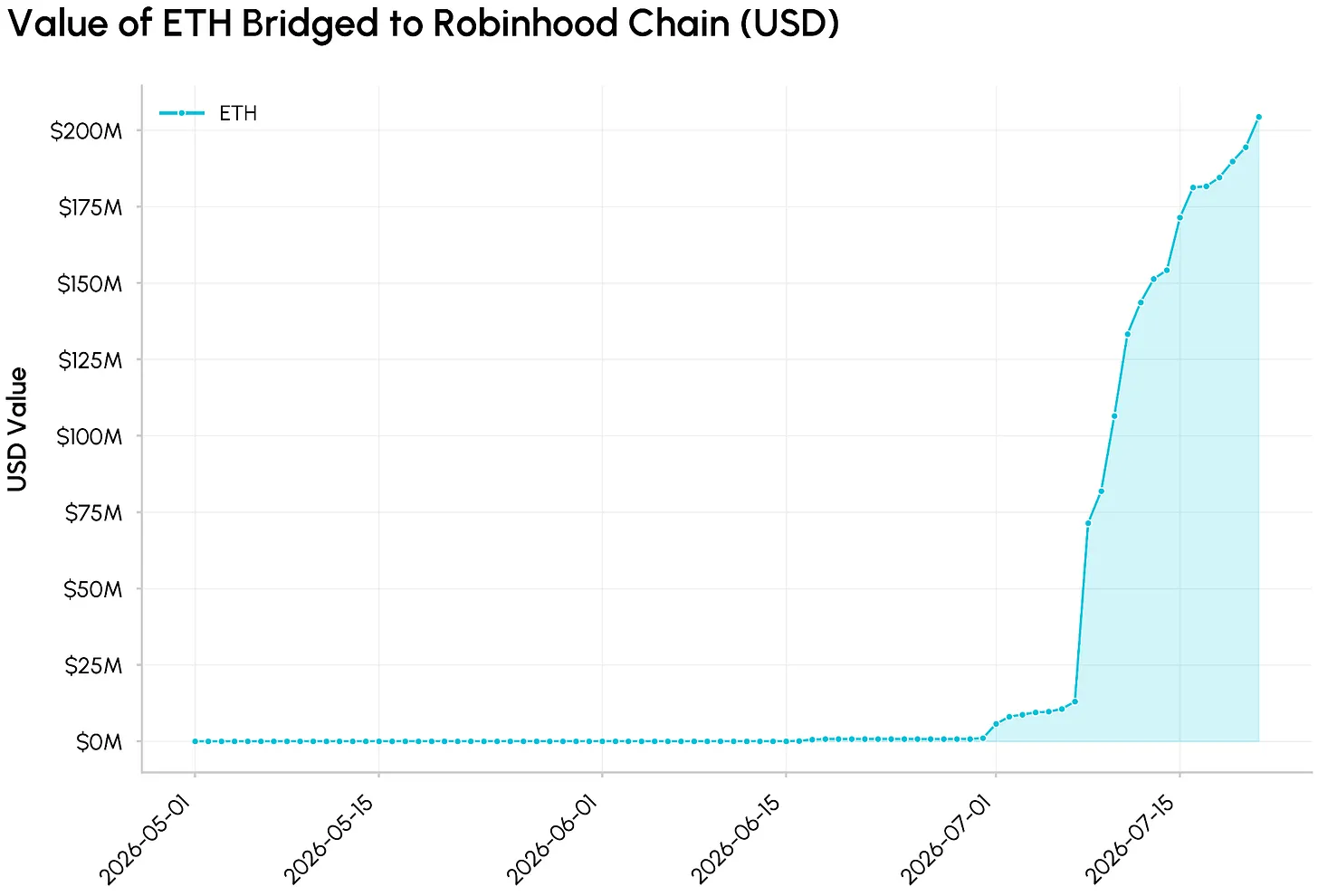
Since its mainnet launch on July 1st, Robinhood Chain has quickly attracted liquidity and achieved early user adoption. Over $200 million in ETH has been transferred via bridges (assets are custodied on the Ethereum mainnet, with corresponding wrapped assets issued on Layer 2) for trading, paying Gas, or serving as collateral. The continuous capital inflow and rising market demand for ETH as a Gas and collateral asset validate the network's early appeal.
Meme Coins, Stablecoins, and Tokenized Stocks
The overall liquidity on Robinhood Chain is approximately $700 million, with ETH accounting for 28% ($205 million). However, the initial buzz was primarily driven by speculative trading of the natively issued Meme coin Cash Cat, whose market cap once surpassed $200 million, providing the network with initial liquidity and user cold start.
On-chain stablecoin holdings amount to $430 million, including the natively issued Global Dollar (USDG) and externally bridged assets like Ethena USDe. These stablecoins form the basis for the Robinhood Earn product, built upon Morpho vaults managed by Steakhouse Financial, with total deposits already reaching $163 million.
USDG is a consortium-type stablecoin initiated by Paxos, where interest generated from reserves is proportionally distributed among partners within the Global Dollar network, with an incentive mechanism similar to OpenUSD (OUSD). This model not only provides on-chain liquidity but also allows distribution partners like Robinhood to gain sustained revenue by scaling stablecoin operations, opening up new income streams.
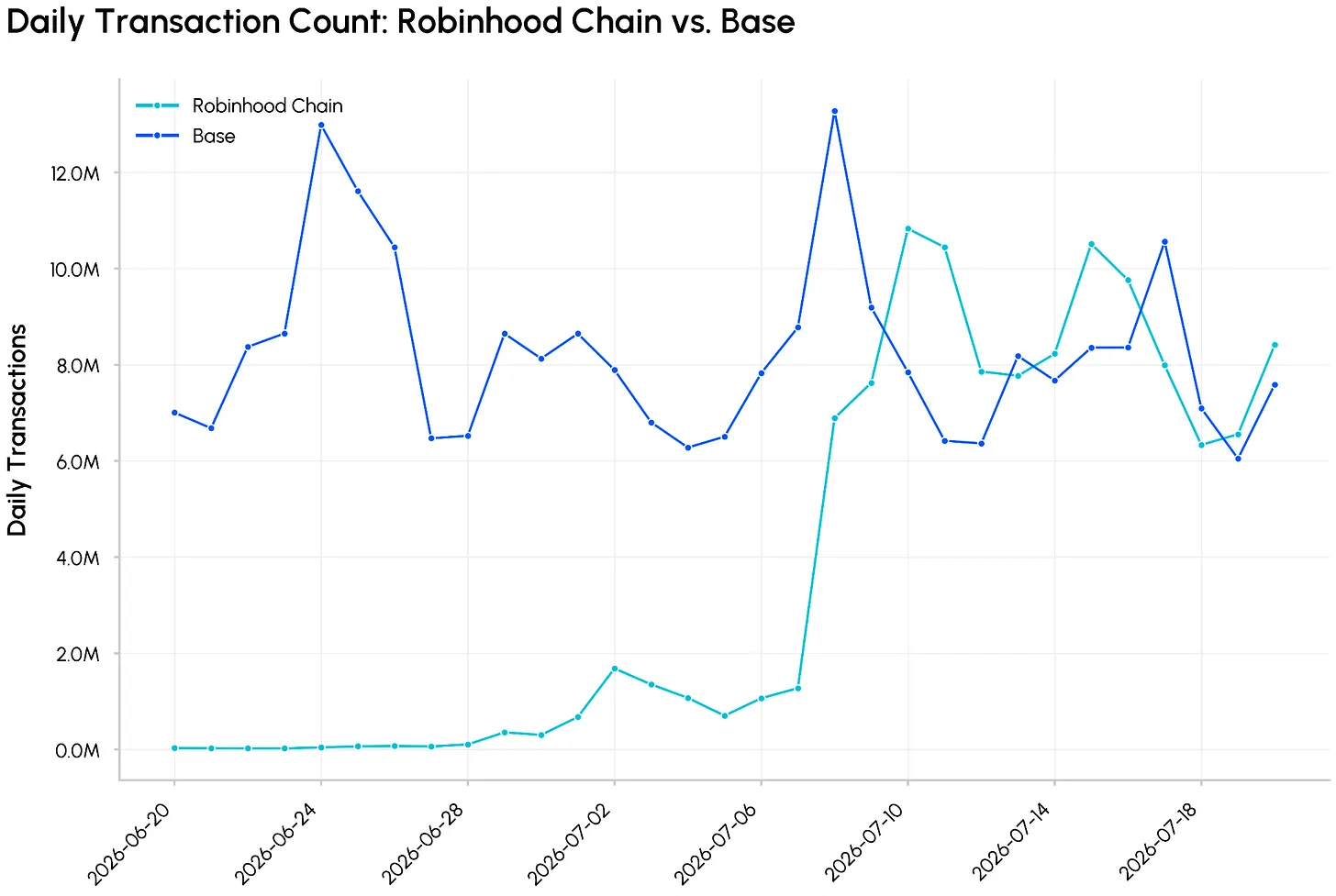
This liquidity has translated into robust on-chain activity. Robinhood Chain's daily transaction volume already rivals Coinbase's Layer 2 network Base, with approximately 270,000 unique active addresses and a cumulative total of about 3.4 million addresses.
Current on-chain transaction activity is primarily driven by: users trading Meme coins on spot and perpetual DEXs like Uniswap and Lighter, Morpho lending vault operations, and steady growth in tokenized equity driven by Robinhood's stock tokens. Robinhood's tokenized stocks are ERC-20 standard tokens, similar in model to Backed xStocks, representing tokenized debt securities where investors gain economic benefits corresponding to the underlying custodied assets.
A core question that remains under market scrutiny is whether short-term hype can transform into long-term, stable demand, especially in the officially planned key areas like RWA and various on-chain financial products.
Robinhood Chain Economic Model: Fee Revenue and Operating Costs
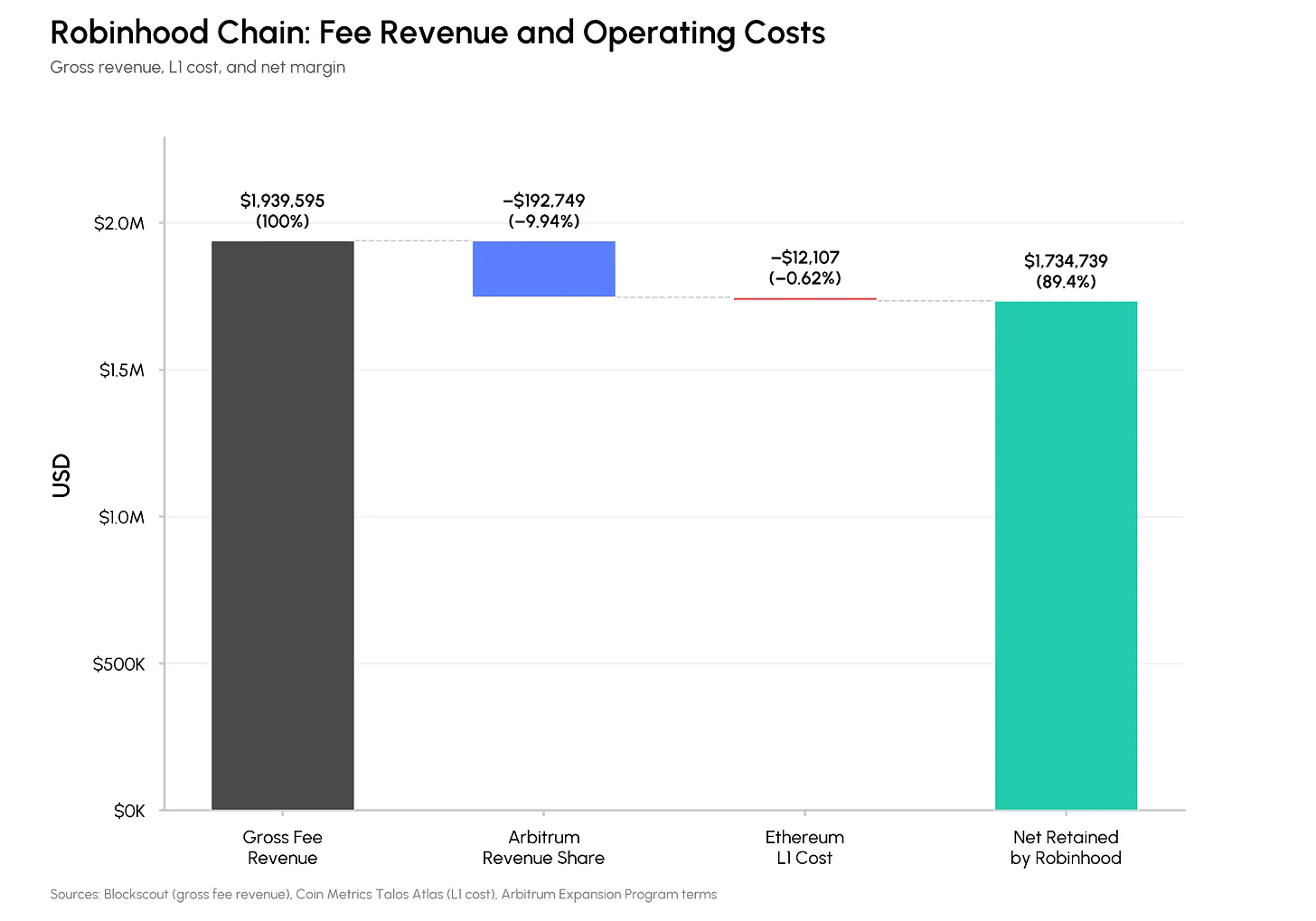
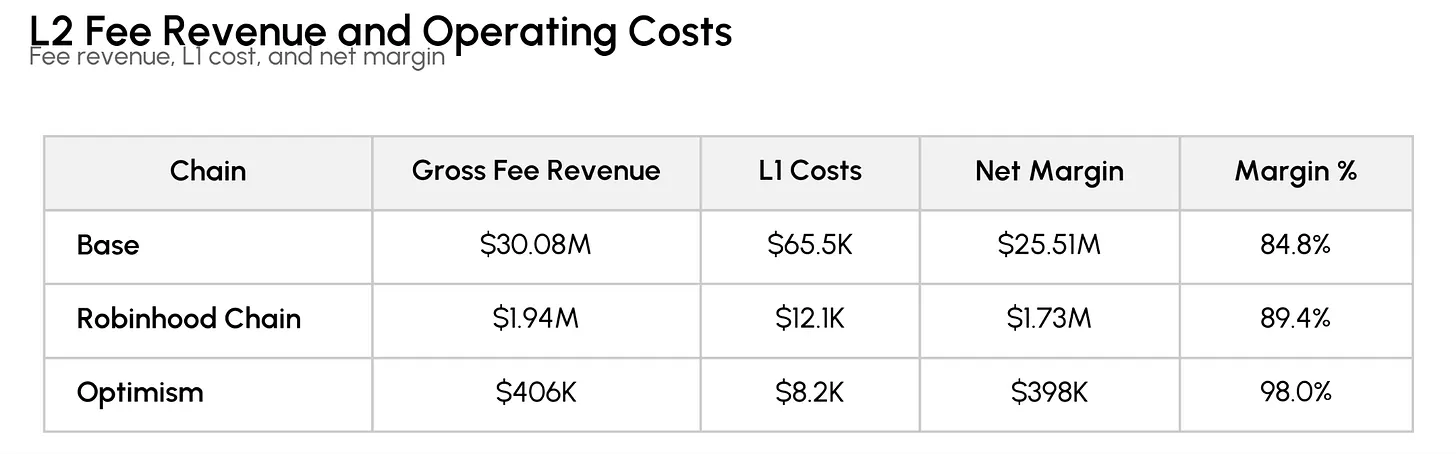
Revenue generated from on-chain transactions is distributed among different participants across the technology stack. Since launch, Robinhood Chain's total transaction fee revenue is approximately $1.94 million (all Gas fees paid by users on Layer 2). About 10% of this (around $193,000) is paid to Arbitrum for Rollup infrastructure and execution environment; less than 1% (about $12,000) goes to Ethereum to cover data availability and security settlement costs; and the remaining approximately 89% ($1.73 million) is retained by Robinhood. This clearly illustrates that Layer 2 network operators capture the vast majority of the value generated by application activity.
Robinhood Chain currently employs a first-come, first-served transaction ordering mechanism, where order is determined by arrival time, not through auction-based sequencing. Therefore, the network cannot extract additional MEV revenue from transaction ordering priority like some Layer 2 sequencers.
This distribution structure is not unique to Robinhood. Among major mainstream Layer 2 networks, the cost paid to Ethereum L1 for data availability and settlement constitutes a very small percentage of the total fees. Even during demand surges, the fee revenue generated by Layer 2 networks continues to significantly outpace the costs paid to Ethereum.
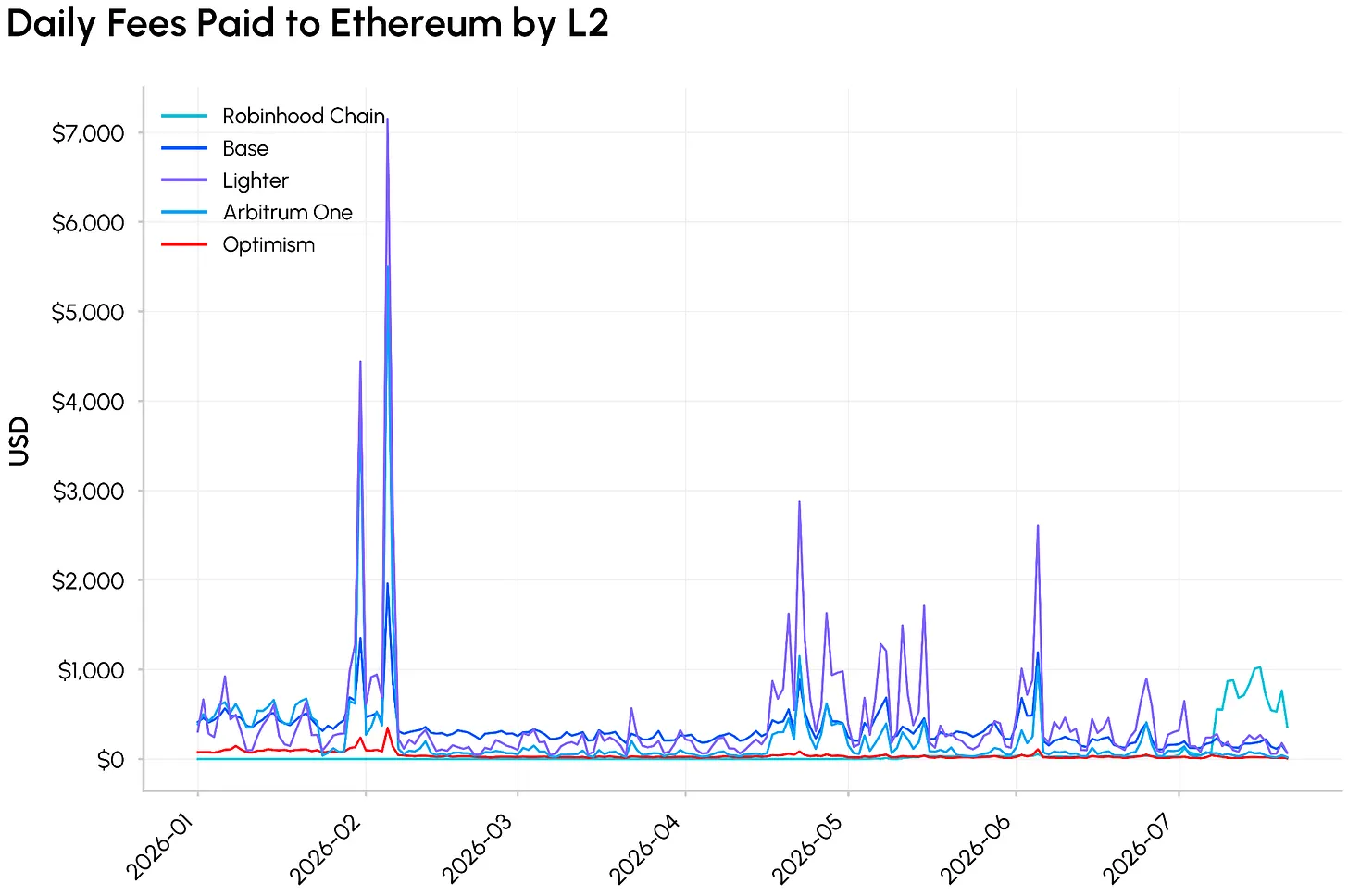
From the beginning of 2026 to date, Base's total fee revenue is $30.08 million, with $655,000 paid to Ethereum and approximately $4.5 million shared with the Optimism Foundation, resulting in a net retention of about $25.5 million and a profit margin of around 85%. Robinhood Chain, operational for less than a month, has total fee revenue of $1.94 million, retaining $1.73 million (an 89% share); it paid only $12,000 to Ethereum and, according to the sharing agreement, allocated 10% ($193,000) to Arbitrum.
This landscape once again highlights a long-standing dilemma for Ethereum: Layer 2 networks and their technology stacks capture the vast majority of direct fee revenue. However, the expansion of the Layer 2 ecosystem creates network effects, driving up demand for ETH as a Gas asset. Ethereum, as a neutral settlement layer, continues to provide the security foundation for these high-revenue application chains.
Conclusion
Leveraging Meme coins, stablecoin liquidity, and growing tokenized equity assets, Robinhood Chain has rapidly evolved into a high-activity, high-profit-margin Layer 2 network. Its economic model underscores how Robinhood relies on Ethereum for security and settlement while capturing the vast majority of fees generated by user activity.
As the integration of traditional finance and crypto markets continues to accelerate, future focus will be on whether the current short-term hype can transform into sustainable business demand, especially in the RWA sector, which the network prioritizes, and in various on-chain financial infrastructure built upon 24/7 trading markets and Robinhood's global distribution network.