【Introduction】Submissions surge 45% to 12,148! ACL 2026 overrun by LLM papers. First authors of all three best papers are Chinese, Chinese scholars nearly sweep outstanding papers.
The best papers of ACL 2026 are out!
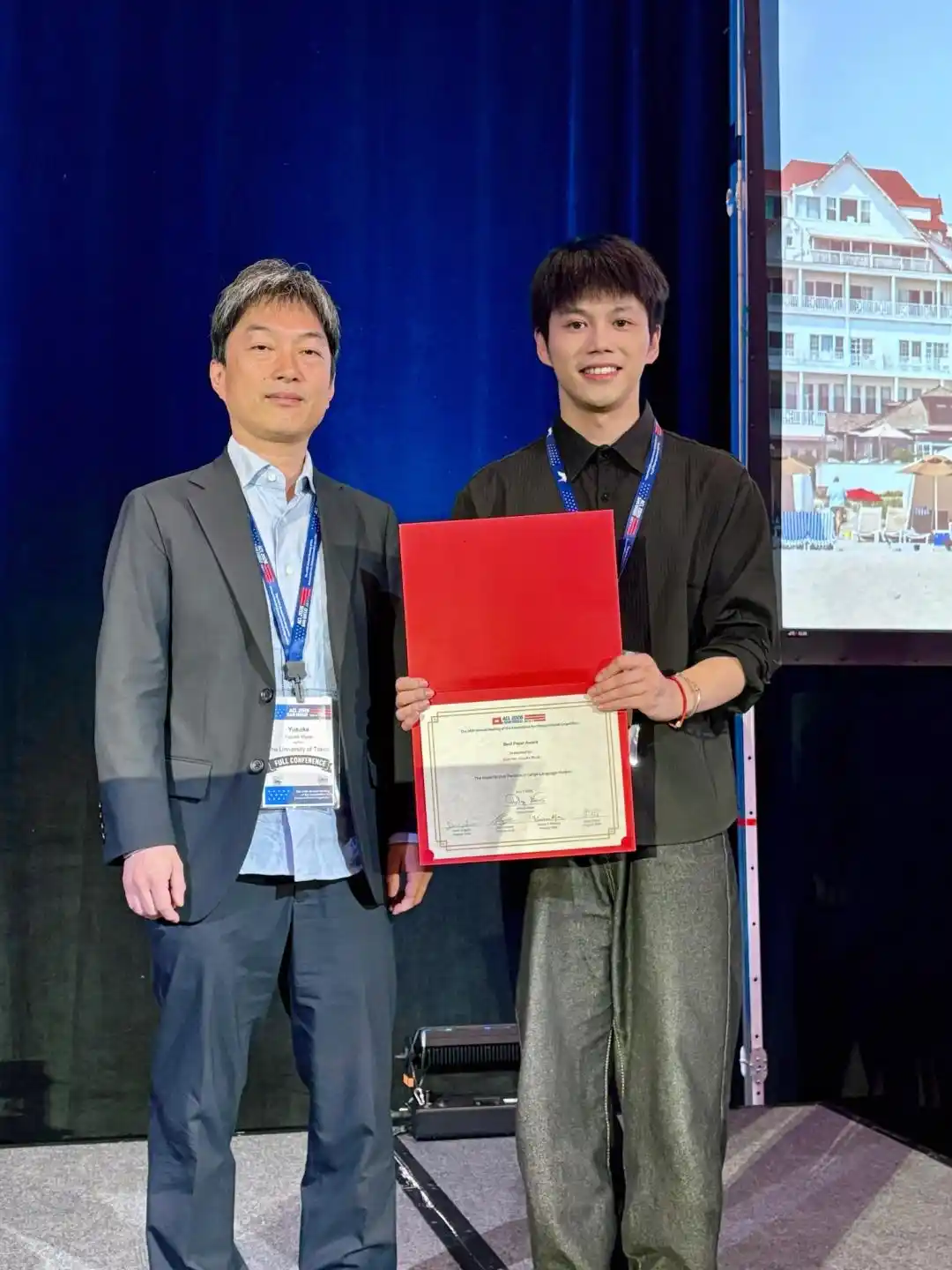
As the premier annual conference in computational linguistics, ACL this year selected three Best Paper Awards, with all first authors being Chinese.
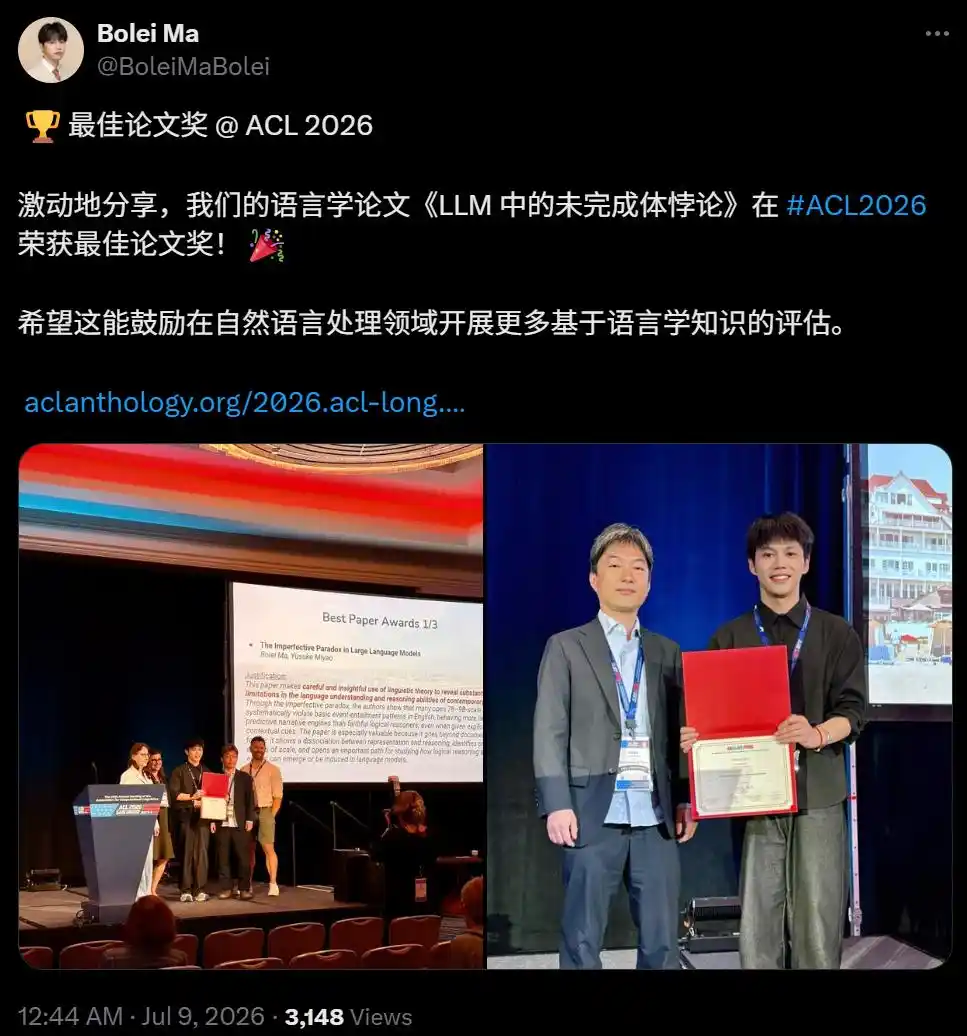
"The Imperfective Paradox in Large Language Models", authors are Bolei Ma from Ludwig Maximilian University of Munich and Yusuke Miyao from the University of Tokyo.
It tests seven open-source large models with a grammar question even elementary school students can answer correctly, revealing their fundamental flaws.
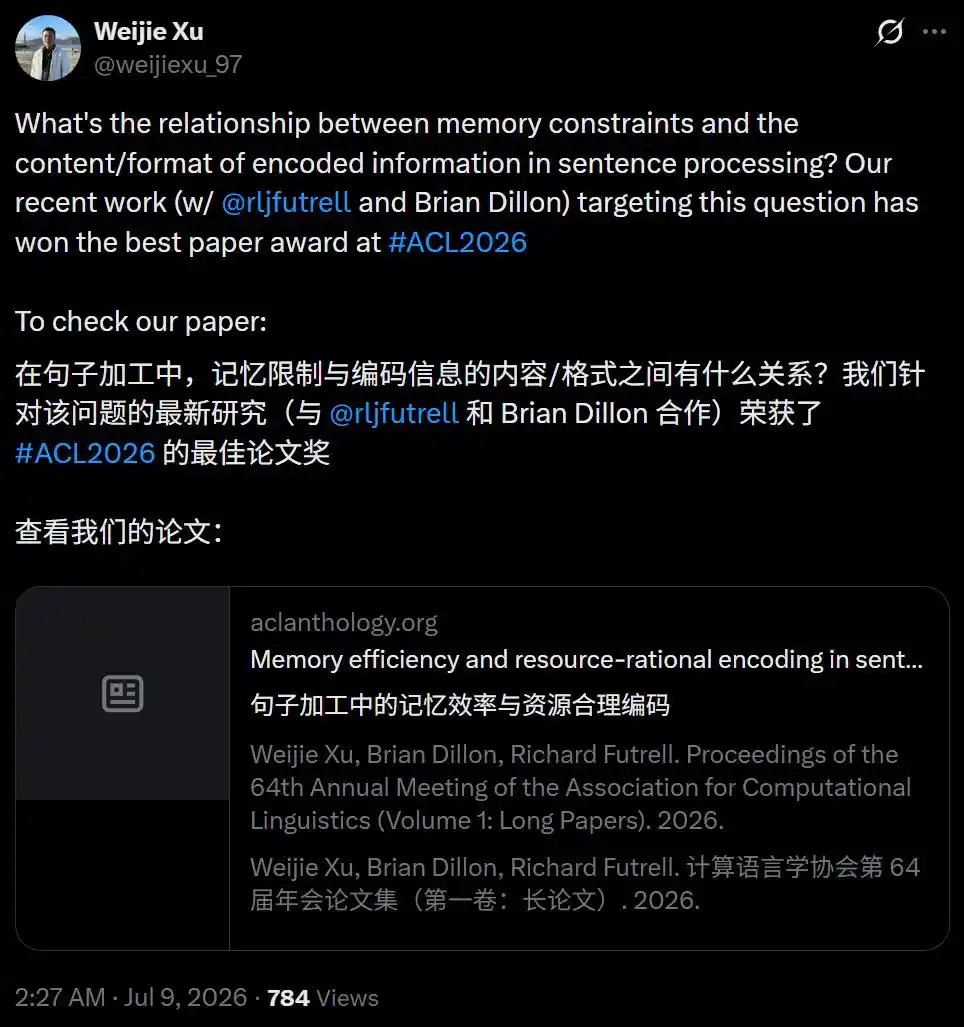
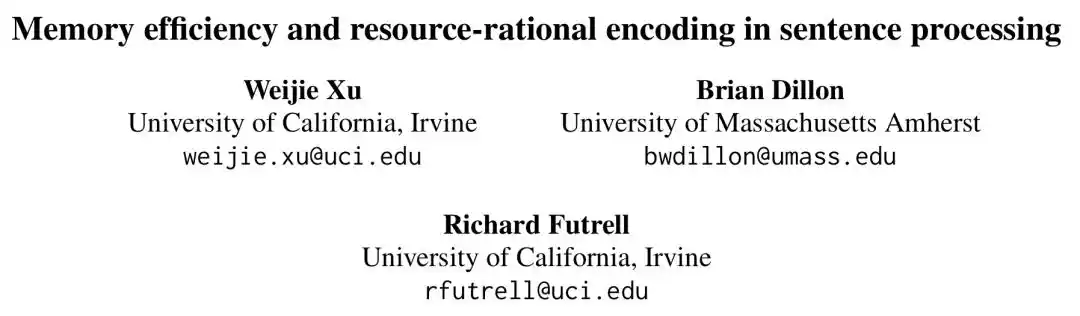
"Memory efficiency and resource-rational encoding in sentence processing", authors are Weijie Xu from University of California, Irvine, Brian Dillon from University of Massachusetts Amherst, and Richard Futrell from University of California, Irvine.
It takes the opposite approach, forcing a "forgetful" human brain onto large models, and finds the models actually become more human-like.
"Characterizing the Expressivity of Local Attention in Transformers", authors are Jiaoda Li and Ryan Cotterell from ETH Zurich.
Using formal language theory, it clearly explains a long-used but poorly understood question: why "local-only" attention is actually more powerful.
The Most Competitive ACL in History
ACL 2026 was held this July in San Diego, USA, setting a new record in scale.
The main conference received 12,148 submissions, a 45% surge compared to 2025.
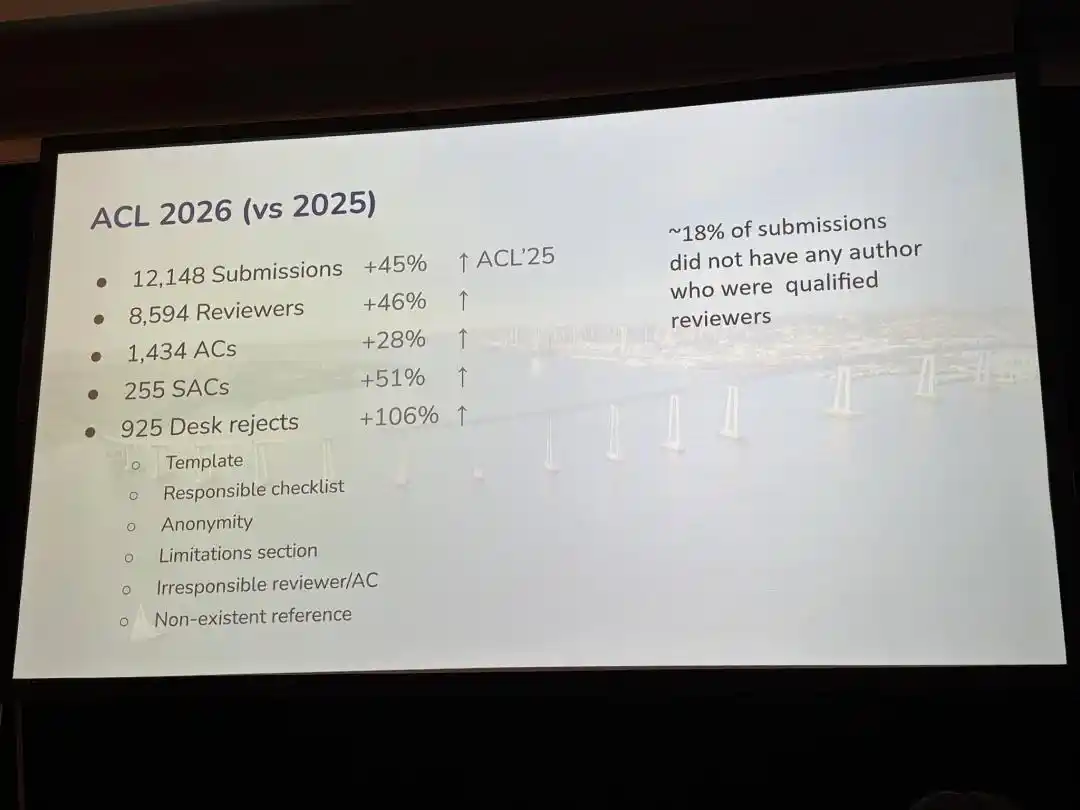
Ultimately, the main conference accepted 2,297 papers (acceptance rate 18.9%), Findings accepted 2,164 papers (17.8%), totaling over 4,462 accepted papers.
On average, each paper has 6.25 authors; one paper had a staggering 102 names. In contrast, only 39 papers were single-authored, accounting for less than 1%.
Among them, 83 authors had more than 10 papers accepted each (66% more than last year); one author even submitted 65 papers in the January batch alone, with 36 accepted.
67% (13,563) of all authors are connected through co-authorship.
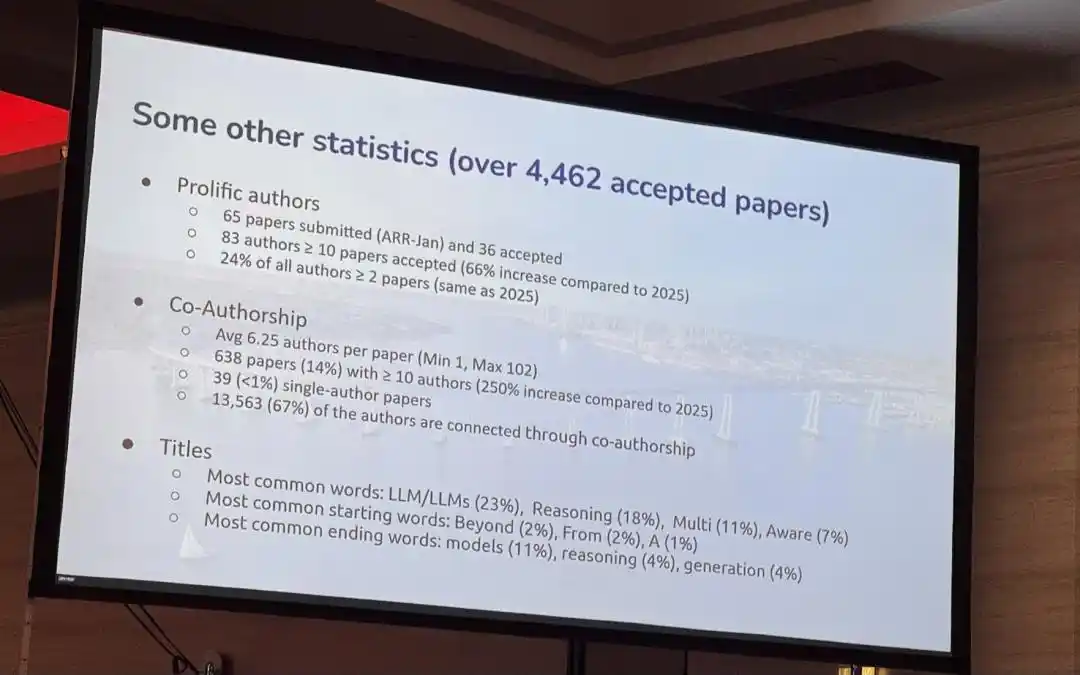
Supporting this review process were 8,594 reviewers (+46%), 1,434 area chairs (+28%), and 255 senior area chairs (+51%).
Desk rejections more than doubled to 925 (+106%), for various reasons: non-compliant templates, missing Limitations sections, anonymity violations, even citing non-existent literature.
Approximately 26,000 authors attended, another increase from last year's 20,000.
By country/region, authors from Mainland China accounted for 54.0%, firmly ranking first; the US at 18.4% second; followed by South Korea 3.8%, Singapore 2.3%, UK 2.0%, Germany 1.9%, India 1.7%, Japan 1.5%.
If there's a "sign of the times" for this conference, it's written in the paper titles: "LLM/LLMs" appears in 23% of all titles, "Reasoning" 18%, "Multi" 11%.
This year also introduced new tracks—AI/LLM Agents, LLM Safety & Alignment, Mathematical & Symbolic Reasoning, Code Models, LLM Efficiency, Clinical & Biomedical Applications—almost all revolving around large models.
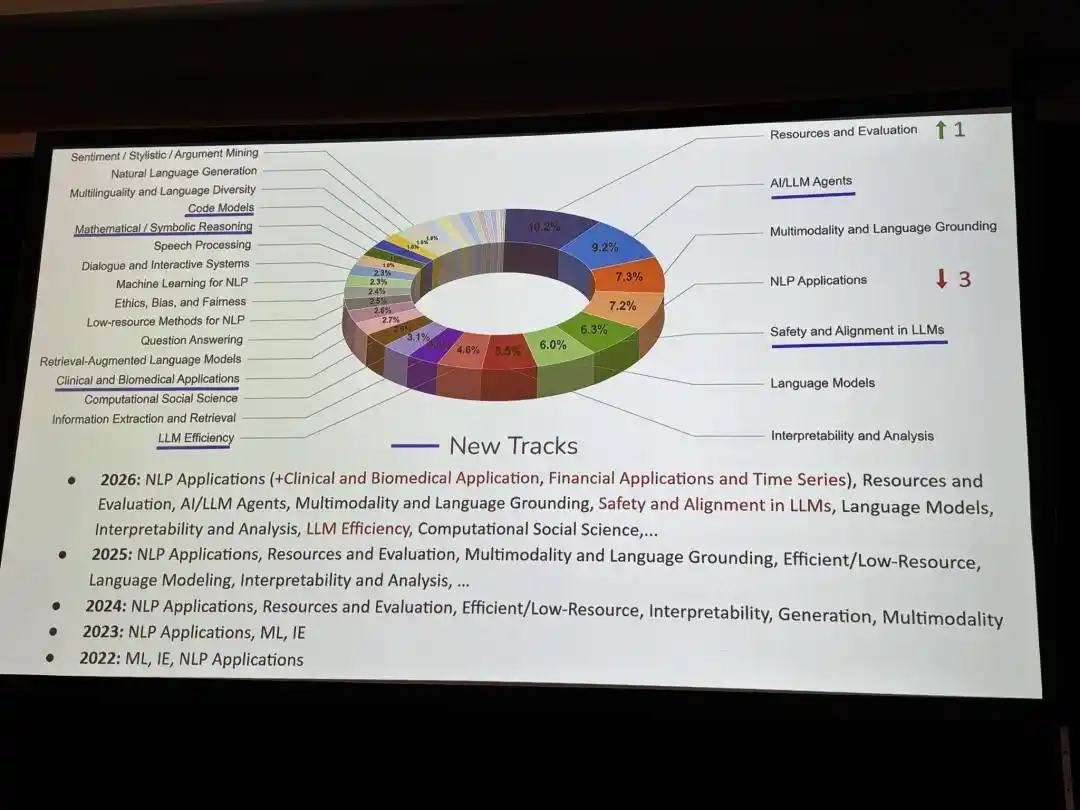
In other words, this was an ACL completely dominated by large language models.
Yet, the highest honors went to two papers that are "not so LLM".
Best Paper I: A Grammar Question Stumps 7 Large Models
Paper: The Imperfective Paradox in Large Language Models
Authors: Bolei Ma, Yusuke Miyao
Institutions: Ludwig Maximilian University of Munich, University of Tokyo
Paper Link:https://aclanthology.org/2026.acl-long.689/
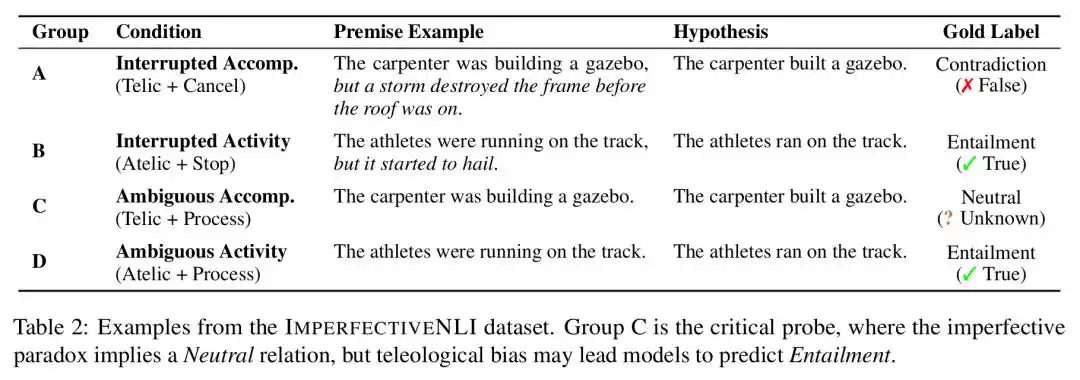
The core of this paper is a classic linguistic phenomenon: the Imperfective Paradox.
In Chinese, "He is running" generally implies "He ran," because "activity" verbs have no inherent endpoint; being halfway counts as having occurred.
But "The carpenter is building a gazebo" does not imply "The gazebo is built," because "accomplishment" verbs have a clear endpoint; construction might be halted halfway by a storm.
The progressive form implies "realized" for the former but not for the latter—this is the Imperfective Paradox, something anyone with basic language training hardly gets wrong.
What about large models?
The authors constructed a diagnostic dataset ImperfectiveNLI with 400 English samples, using 2x2 minimal pairs of accomplishment/activity verbs to isolate semantic reasoning ability, then tested seven open-source models from 7B to 90B parameters. The result was a near "total rout."
Faced with ambiguous sentences like "The carpenter is building a gazebo," models almost uniformly judged it as "built."
The authors named this flaw of "assuming success upon seeing a goal" the "teleological bias."
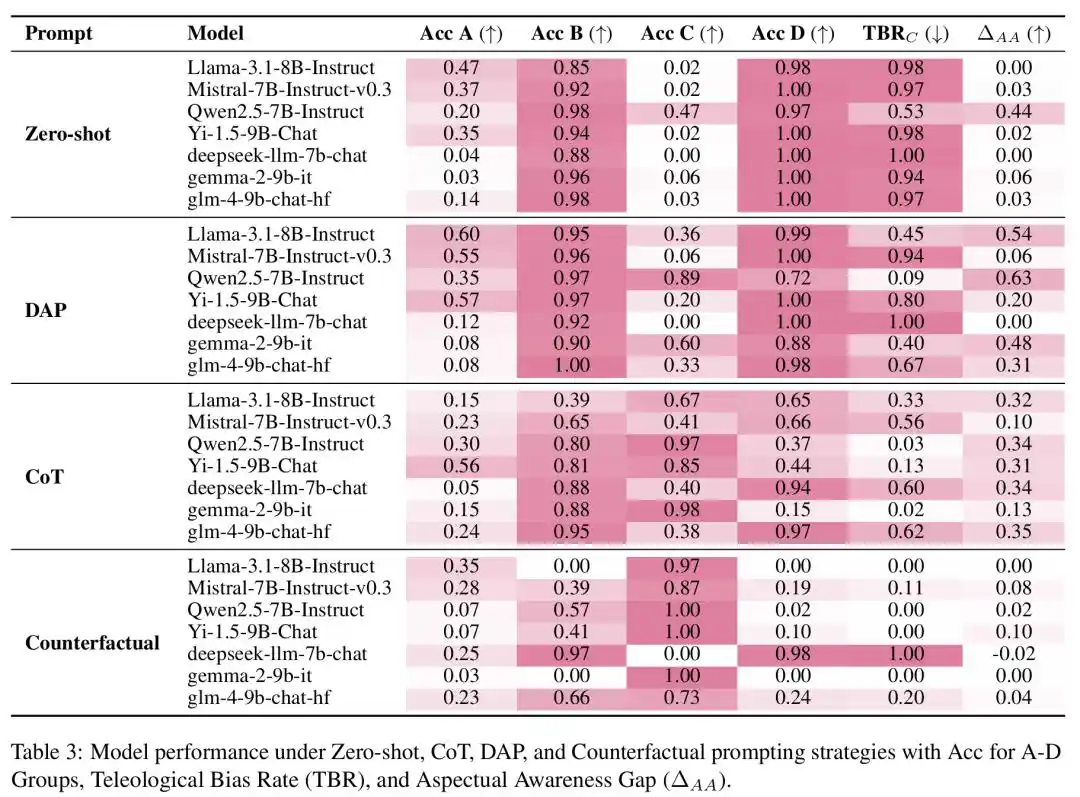
Under zero-shot conditions, Llama-3.1's bias rate was as high as 0.98, Mistral 0.97, DeepSeek even 1.00: any action with a goal was deemed completed.
More absurdly, even when sentences explicitly stated "a storm destroyed the frame before the roof was installed," many models still insisted it was done. Gemma-2's accuracy on such questions was only 3%; it didn't read the context, just guessed based on the inertia that "construction always succeeds."
Thus, the authors gave the paper's key conclusion—
These open-source large models "operate more like predictive narrative engines rather than faithful logical reasoners."
In other words, they are not reasoning, just guessing the most likely story ending.
A deeper finding is the separation between representation and reasoning.
From a near-perfect inverse correlation (correlation coefficient -0.97), it's evident the encoding layers actually "know" that was building and built are not the same, but during decoding, they are swayed by world knowledge priors.
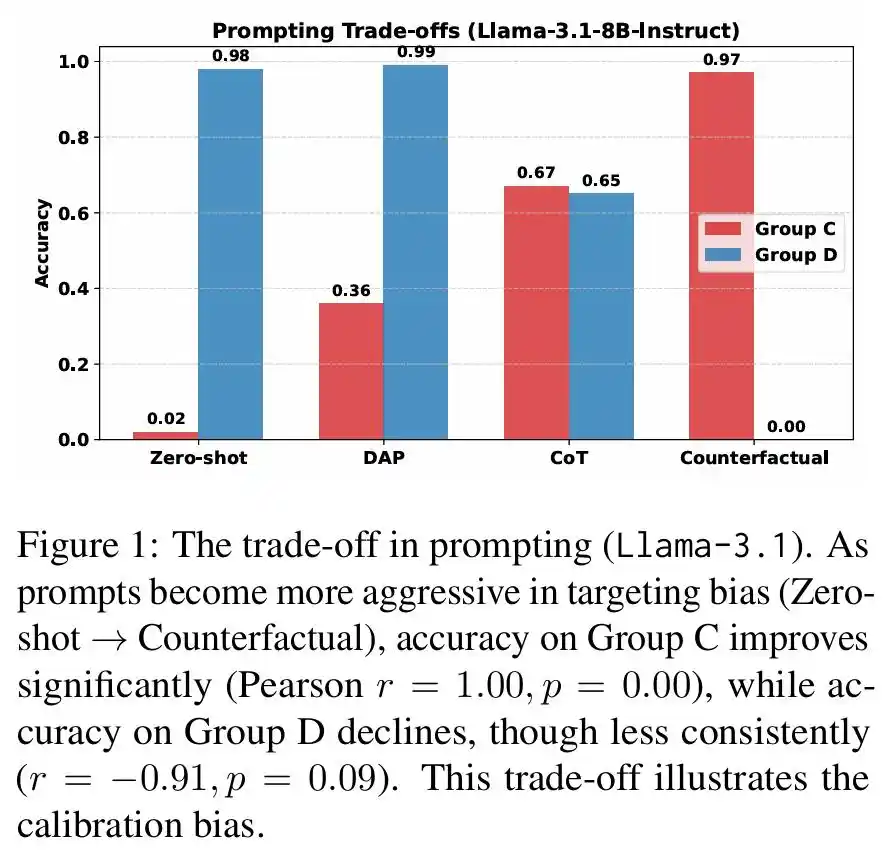
At this point, prompt engineering is just robbing Peter to pay Paul.
Counterfactual prompts can fix the bias but make models overly suspicious of simple activity sentences, denying them all, oscillating between "naive optimism" and "paranoid suspicion."
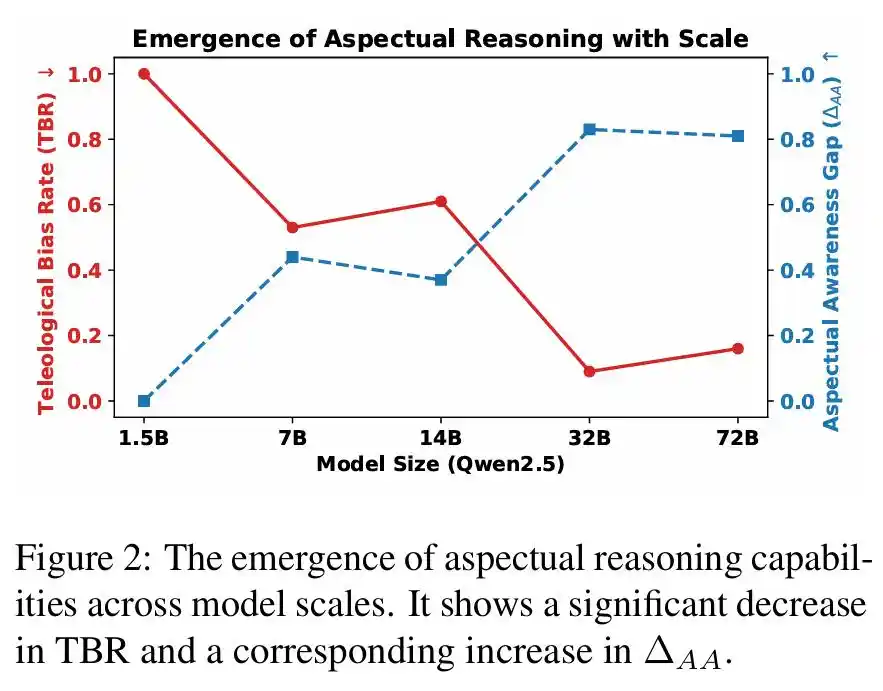
Fortunately, Scaling seems helpful: from 1.5B scaling to 720B parameters, bias rates dropped significantly, with a "phase transition" around 320B where accuracy soared to 0.91.
The Young Scholar "Grilling" Large Models with Linguistics
The first author, Bolei Ma, is a PhD candidate at Ludwig Maximilian University of Munich.
He belongs to the Social Data Science and AI Lab (SODA Lab, advisor Frauke Kreuter) in the Department of Statistics, is a junior member of the Munich Center for Machine Learning (MCML), and an external PhD candidate at the MaiNLP Lab (advisor Barbara Plank).
Bolei Ma's research long focuses on "Human-Centered NLP," computational social science, and computational semantics & pragmatics—exactly the foundation of this paper: using solid linguistic theory to examine trendy large models.
Best Paper II: Giving Large Models a Forgetful Human Brain
Paper: Memory efficiency and resource-rational encoding in sentence processing
Authors: Weijie Xu, Brian Dillon, Richard Futrell
Institutions: University of California, Irvine, University of Massachusetts Amherst
Paper Link:
This paper aims to solve: For language models to truly model "human language processing," they must, like humans, carefully manage limited working memory.
The brain's working memory is a scarce resource, yet it's used effortlessly. Humans instinctively allocate limited memory precision to unexpected, high-information content, while glossing over predictable parts.
The authors' approach is clever: inject noise at an adjustable rate into the Transformer's hidden representations, then train the model with a hybrid objective—under the hard constraint of "total encoding precision limited," predict the next word as accurately as possible.
In other words, force the model to be "stingy," spending precious memory on what matters most.
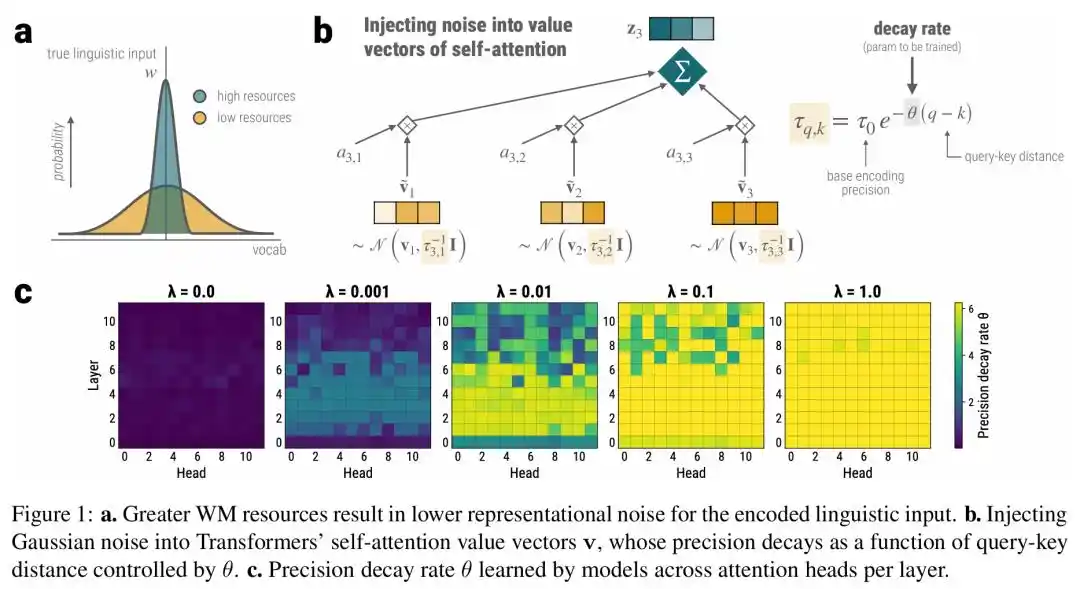
There are two key findings.
First, after adding this working memory constraint, the model's fit to human reading times significantly improved. That is, its "rhythm" of reading sentences became closer to real humans.
Second, and more importantly—to manage encoding precision, the model's contextual representations were reshaped, becoming more "compressed" and more "categorical."
This points to a thought-provoking conclusion: In models of human sentence processing, the working memory "retrieval mechanism" and the underlying "memory representation" can be dissociated.
In other words, giving a model more memory doesn't make it more human-like; rather, giving it a "must save" constraint causes it to develop representations closer to the human brain.
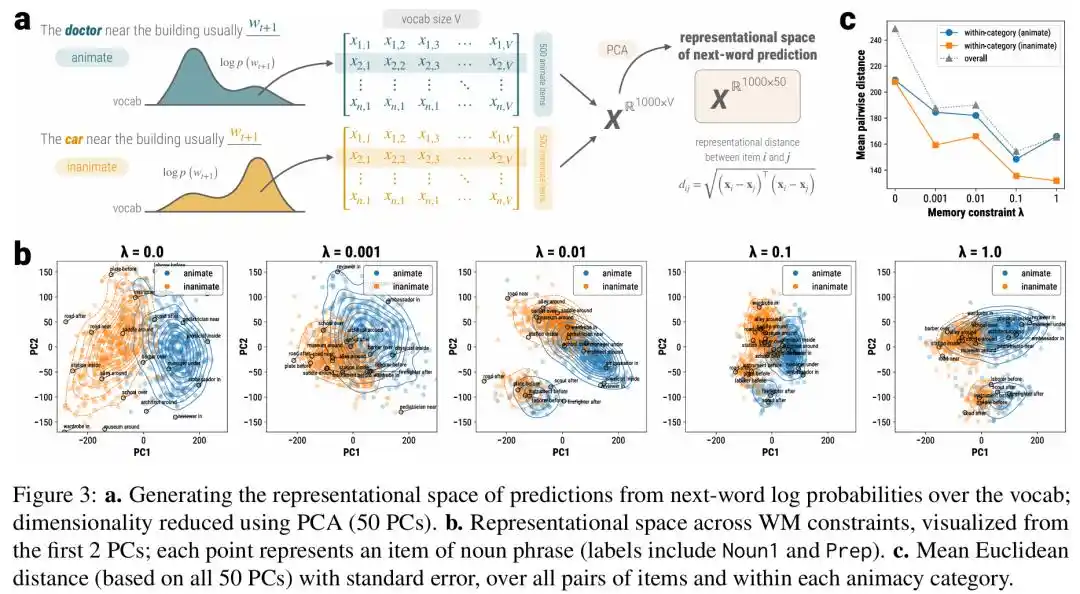
From Spanish Major to Computational Psycholinguistics
First author Weijie Xu is currently a PhD student in Language Science at UC Irvine, advised by computational psycholinguist Richard Futrell, specializing in computational psycholinguistics.
His undergraduate major was Spanish Language and Literature at Shanghai International Studies University. He then earned a Master's in Computational Social Science from the University of Chicago, advised by Ming Xiang.
In Fall 2026, he will begin postdoctoral research at the University of Massachusetts Amherst.
He writes on his homepage that human cognitive systems are heavily constrained, yet operate almost effortlessly; his research aims to use human language as a window to peer into the "limited" nature of the human mind.

Best Paper III: Why "Local-Only" Attention is Actually Stronger
Paper: Characterizing the Expressivity of Local Attention in Transformers
Authors: Jiaoda Li, Ryan Cotterell
Institutions: ETH Zurich
Paper Link:https://aclanthology.org/2026.acl-long.1739/
Transformer's signature skill is "global attention"—each generated word looks back at all previous words. A common variant, "local attention," only lets each word look back at neighbors within a fixed window, reducing quadratic computational cost to linear.
Local attention was originally for saving compute, but people found it often improves model performance. This phenomenon lacked a proper explanation.
This paper uses formal language theory to provide an answer.
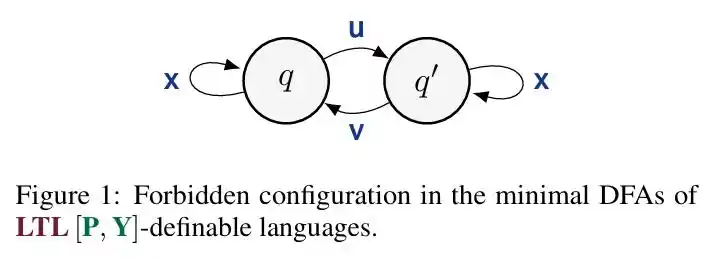
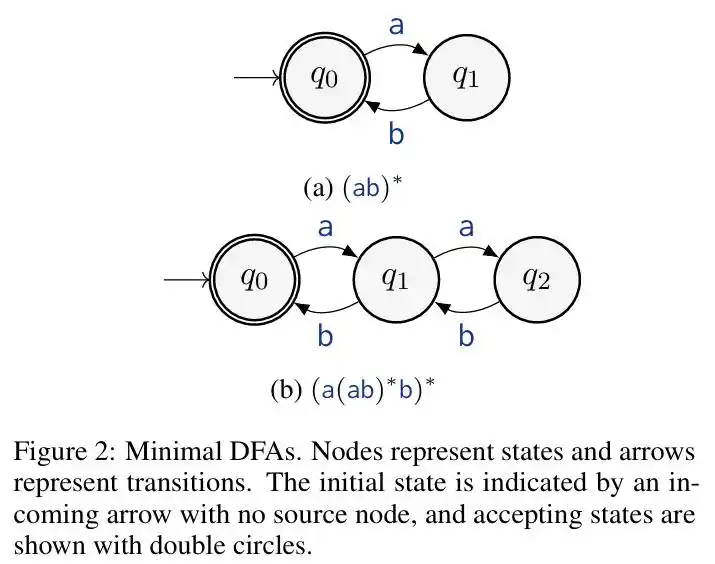
Previous conclusions stated that Transformers with fixed precision and only global attention correspond to the fragment of linear temporal logic containing only one "past operator."
The authors further prove that adding local attention introduces a second temporal operator, strictly expanding the class of regular languages the model can recognize.
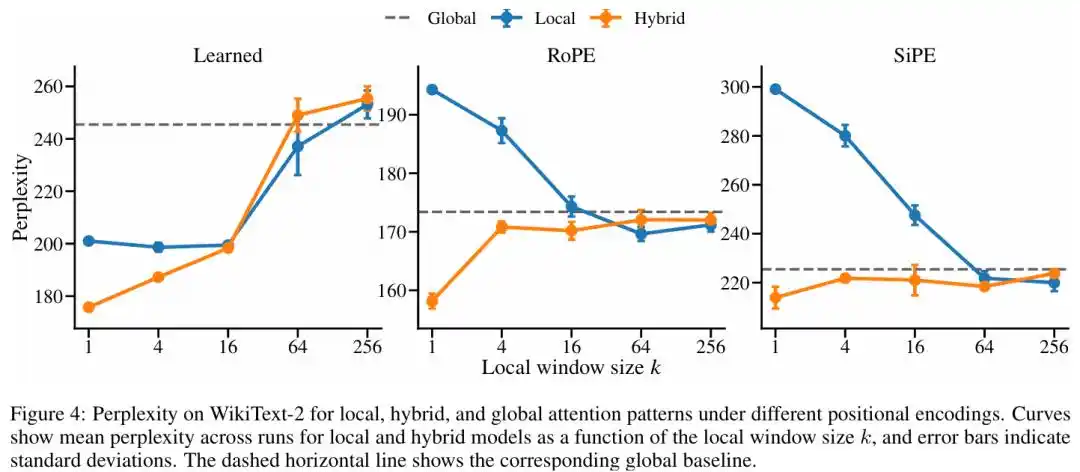
Even better, global and local attention "complement" each other in expressive power; neither can replace the other. Combining both yields the richest class.
Experiments on formal language recognition and natural language modeling confirm this: hybrid Transformers with global+local attention steadily outperform pure global versions.
First author Jiaoda Li is a doctoral researcher at the AI Center of ETH Zurich, advised by computational linguists Ryan Cotterell and Stefan Feuerriegel, focusing on interpretable NLP.
His undergraduate major was Electronic and Communication Engineering at City University of Hong Kong; he then obtained a Master's in Data Science from ETH and continued to his PhD.

Outstanding Papers: Chinese Scholars Nearly Sweep
Besides Best Papers, ACL 2026 also selected 18 Outstanding Papers.
A glance at the list reveals a more direct fact: Chinese scholars occupy nearly half the field, especially in the hottest directions of reinforcement learning and LLM safety, where several papers are entirely by Chinese teams.
Reasoning & Reinforcement Learning
1. Evolutionary Guided Decoding: Iterative Value Refinement for LLMs
Authors: Zhenhua Liu, Lijun Li, Ruizhe Chen, Yuxian Jiang, Tong Zhu, Zhaochen Su, Wenliang Chen, Jing Shao
Institutions: Shanghai AI Laboratory, Soochow University, Zhejiang University, Fudan University
2. Rethinking Entropy Interventions in RLVR: An Entropy Change Perspective
Authors: Zhezheng Hao, Hong Wang, Haoyang Liu, Jian Luo, Jiarui Yu, Hande Dong, Qiang Lin, Can Wang, Jiawei Chen
Institutions: Zhejiang University, Tencent
3. GeoRA: Geometry-Aware Low-Rank Adaptation for RLVR
Authors: Jiaying Zhang, Lei Shi, Jiguo Li, Jun Xu, Jiuchong Gao, Jinghua Hao, Renqing He
Institutions: Meituan, Peking University
4. CURE: Critique-Driven Unified Reinforcement Learning for Test-Time Self-Improvement
Authors: Guirong Chen, Shuqi Ye, Wenkai Yang, Shiqi Shen, Guangyao Shen, Yankai Lin
Agents & Evaluation
5. CAR-bench: Evaluating the Consistency and Limit-Awareness of LLM Agents under Real-World Uncertainty
Authors: Johannes Kirmayr, Lukas Stappen, Elisabeth André
Institutions: BMW Group Research, University of Augsburg
6. MediEval: A Unified Medical Benchmark for Patient-Contextual and Knowledge-Grounded Reasoning in LLMs
Authors: Zhan Qu, Michael Färber
Institutions: Technische Universität Dresden, ScaDS.AI (Germany)
7. Mind the (DH) Gap! A Contrast in Risky Choices Between Reasoning and Conversational LLMs
Authors: Luise Ge, Yongyan Zhang, Yevgeniy Vorobeychik
Institutions: Washington University in St. Louis
8. CIG: Measuring Conversational Information Gain in Deliberative Dialogues with Semantic Memory Dynamics
Authors: Ming-Bin Chen, Jey Han Lau, Lea Frermann
Institutions: University of Melbourne
Safety, Trustworthiness & Detection
9. Lying with Truths: Open-Channel Multi-Agent Collusion for Belief Manipulation via Generative Montage
Authors: Jinwei Hu, Xinmiao Huang, Youcheng Sun, Yi Dong, Xiaowei Huang
Institutions: University of Liverpool, Mohamed bin Zayed University of Artificial Intelligence (MBZUAI)
10. Beyond the Final Actor: Modeling the Dual Roles of Creator and Editor for Fine-Grained LLM-Generated Text Detection
Authors: Yang Li, Qiang Sheng, Zhengjia Wang, Yehan Yang, Danding Wang, Juan Cao
Institutions: Institute of Computing Technology, Chinese Academy of Sciences, University of Chinese Academy of Sciences
11. Maximizing Local Entropy Where It Matters: Prefix-Aware Localized LLM Unlearning
Authors: Naixin Zhai, Pengyang Shao, Binbin Zheng, Yonghui Yang, Fei Shen, Long Bai, Xun Yang
Institutions: University of Science and Technology of China, National University of Singapore
Efficiency
12. From Local to Global: Revisiting Structured Pruning Paradigms for Large Language Models
Authors: Ziyan Wang, Enmao Diao, Qi Le, Pu Wang, Minwoo Lee, Shu-ping Yeh, Evgeny V Stupachenko, Hao Feng, Li Yang
Institutions: University of North Carolina at Charlotte, University of Minnesota, Intel, DreamSoul
Speech & Multimodal
13. MauBERT: Universal Phonetic Inductive Biases for Few-Shot Acoustic Units Discovery
Authors: Angelo Ortiz Tandazo, Manel Khentout, Youssef Benchekroun, Thomas Hueber, Emmanuel Dupoux
Institutions: École Normale Supérieure (ENS/PSL), CNRS, Université Grenoble Alpes (GIPSA-lab), Meta AI (France)
14. Hierarchical Acoustic-Semantic Modeling: Modality Separation and Semantic Coherence for Full-Duplex SLMs
Authors: Zhenyu Liu, Xuanyu Zhang, Yunxin Li, Qixun Teng, Shenyuan Jiang, Haolan Chen, Minjun Zhao, Fanbo Meng, Yu Xu, Yancheng He, Baotian Hu, Haizhou Li, Min Zhang
Institutions: Harbin Institute of Technology (Shenzhen), The Chinese University of Hong Kong (Shenzhen), Shenzhen Loop Area Institute
15. ViLL-E: Video LLM Embeddings for Retrieval
Authors: Rohit Gupta, Jayakrishnan Unnikrishnan, Fan Fei, Sheng Liu, Son Tran, Mubarak Shah
Institutions: Amazon, University of Central Florida
Linguistics & Multilingual
16. Systematicity between Forms and Meanings across Languages Supports Efficient Communication
Authors: Doreen Osmelak, Yang Xu, Michael Hahn, Kate McCurdy
Institutions: Saarland University, University of Toronto
17. Massively Multilingual Joint Segmentation and Glossing
Authors: Michael Ginn, Lindia Tjuatja, Enora Rice, Ali Marashian, Maria Valentini, Jasmine Xu, Graham Neubig, Alexis Palmer
Institutions: University of Colorado Boulder, Carnegie Mellon University
18. CxMP: A Linguistic Minimal-Pair Benchmark for Evaluating Constructional Understanding in Language Models
Authors: Miyu Oba, Saku Sugawara
Institutions: Nara Institute of Science and Technology, National Institute of Informatics, University of Tokyo
References:
https://x.com/BoleiMaBolei/status/2074897470572925124?s=20
https://x.com/weijiexu_97/status/2074923463094218973
https://msukhareva.substack.com/p/outstanding-paper-awards-of-acl-2026
This article is from the WeChat public account "AI Era," author: ASI Revelation; editor: Moses