Abu Dhabi Steps Up Crypto Regulation: Tether, Circle Secure Major Approvals

bitcoinistPubblicato 2025-12-10Pubblicato ultima volta 2025-12-10

Introduzione

Tether and Circle, the issuers of the world's two largest stablecoins, have secured significant regulatory approvals in Abu Dhabi. Tether’s USDT has been recognized as an Accepted Fiat-Referenced Token (ARFT) by the Abu Dhabi Global Market (ADGM), expanding its presence to include several additional blockchains like Aptos, Celo, and TON. This allows authorized entities in ADGM to conduct regulated activities involving USDT. Separately, Circle received a Financial Services Permission (FSP) license, enabling it to operate as a Money Services Provider. These approvals reinforce Abu Dhabi’s ambition to become a global hub for compliant digital finance. The news comes amid a period of renewed growth in the stablecoin market cap after a brief decline in late 2025.

Tether and Circle, issuers of the two largest stablecoins in the world, have just received major regulatory greenlights in UAE’s Abu Dhabi.

Tether’s Stablecoin Recognized As ARFT, While Circle Obtains FSP License

Major developments related to the cryptocurrency sector have occurred in the United Arab Emirates (UAE) this week, with Tether and Circle both winning approvals in Abu Dhabi Global Market (ADGM), the international financial center and free economic zone of Abu Dhabi, UAE’s capital.

First, as Tether has announced in a press release, USDT issued on a number of blockchains has been recognized as an Accepted Fiat-Referenced Token (ARFT) in ADGM. USDT already received approval from ADGM last year, but the previous recognition only included the Ethereum, Solana, and Avalanche versions. With the new regulatory nod, USDT available on Aptos, Celo, Cosmos, Kaia, Near, Polkadot, Tezos, TON, and TRON has also entered the market.

“By extending recognition to USD₮ on several major blockchains, ADGM further strengthens Abu Dhabi’s position as a global hub for compliant digital finance,” said Tether CEO Paolo Ardoino.

USDT being considered as an ARFT means that authorized persons licensed by ADGM’s Financial Services Regulatory Authority (FSRA) can offer regulated activities involving the stablecoin on nearly all its native blockchains. “Introducing USD₮ within ADGM’s regulated digital asset framework reinforces the role of stablecoins as essential components of today’s financial landscape,” noted Ardoino.

Meanwhile, Circle, the issuer of USDC, has also advanced in the region with a new license from the FSRA, according to an announcement. The license, called the Financial Services Permission (FSP), allows the company to operate as a Money Services Provider in ADGM.

Arvind Ramamurthy, ADGM Chief Market Development Officer, said:

Circle’s regulated presence in ADGM reinforces our ambition to build a trusted, institutional-grade digital asset ecosystem in Abu Dhabi, one that enhances market confidence, supports real-world use cases, and cements the UAE’s role as a leading hub for regulated digital finance.

The greenlight from ADGM follows the recognition of Circle’s USD and EUR stablecoins by the Dubai Financial Services Authority (DFSA) in February of this year. The move made USDC and EURC the first stablecoins to be approved in the Dubai International Financial Centre (DIFC).

The new FSP license means “Circle is positioned to expand regulated payment and settlement use cases in the UAE for businesses, developers, and financial institutions,” the statement noted.

Stablecoins have witnessed rapid growth throughout 2025, setting multiple records. The near-constant growth in these tokens, however, saw a break in October, as the combined market cap of this side of the cryptocurrency sector reversed course.
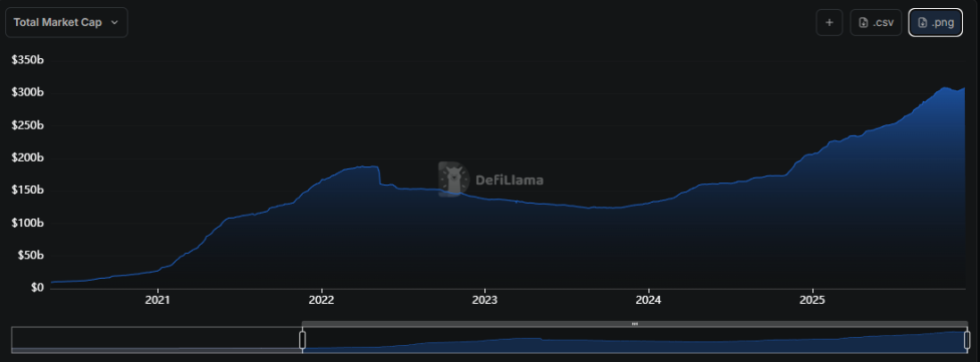
The trend in the market cap of the stablecoins | Source: DefiLlama

As the above chart from DefiLlama shows, the stablecoin market cap declined to a low in mid-November. Since this bottom, though, capital inflows have returned for these fiat-tied assets, with the market cap once again nearing in on a new record.

Bitcoin Price

At the time of writing, Bitcoin is floating around $90,100, up almost 4% in the last seven days.

Looks like the price of the coin has moved sideways over the last few days | Source: BTCUSDT on TradingView

Letture associate

Cardano Price Forecast for August 2026: Will ADA Triangle Breakout Happen Before or After the CLARITY Act Deadline?

Cardano (ADA) is trading at $0.1642, testing the apex of a symmetrical triangle pattern on the daily chart, which signals an impending directional move. Technical analysis identifies key resistance at the 20-day EMA ($0.1650) and the triangle's upper trendline. A breakout above could target the 50-day EMA at $0.1732, with a cup-and-handle pattern potentially forming. Support lies at the SuperTrend indicator ($0.1536) and the June low of $0.1386. Historically, August has been a weak month for ADA, with a median return of -12.8%. A weekly forecast outlines a volatile month influenced by the imminent August 8th deadline for the U.S. CLARITY Act vote, potential SEC regulatory action, and renewed geopolitical tensions following Iran's missile strike. Key bullish catalysts include the potential passage of the CLARITY Act and a major upgrade integrating Cardano's developer documentation and tools into AI coding assistants like Claude, which could significantly boost developer adoption. On-chain data also shows whale accumulation, a potential Wyckoff accumulation signal. The price forecast presents two scenarios: a bullish breakout above $0.1650 targeting $0.17-$0.1732 if the CLARITY Act passes and AI integration fuels momentum, or a bearish break below $0.1536 toward $0.1386 if the bill fails, seasonal weakness persists, and risk appetite diminishes.

cryptonews.ru11 min fa

Cardano Price Forecast for August 2026: Will ADA Triangle Breakout Happen Before or After the CLARITY Act Deadline?

cryptonews.ru11 min fa

Coinbase Vice President: The Wars Over Cryptocurrency Regulation Are Over

Coinbase's new Vice President, Ryan VanGrak, declared that regulatory wars in the cryptocurrency sector are over. Since taking office on July 9, 2026, he has shifted the company's approach from litigation and sanctions to focusing on growth and innovation. The industry can now concentrate on development rather than fighting for its right to exist. He highlighted that the Digital Asset Market Clarity Act (CLARITY Act), which aims to establish a clear federal regulatory framework dividing oversight between the SEC and CFTC, has gained significant momentum. This framework is intended to provide proper supervision, investor protection, and maintain U.S. leadership in digital assets. VanGrak's appointment marks a strategic shift from a "wartime" to a "peacetime" advisor, replacing former Chief Legal Officer Paul Grewal, who oversaw major litigation, including a dismissed 2023 SEC lawsuit. With his background at Citadel Securities and the SEC, VanGrak brings deep regulatory and institutional finance expertise as Coinbase expands beyond a simple exchange into a broader financial services provider, offering stocks, futures, prediction markets, and AI tools. For investors, bipartisan support for crypto legislation like the CLARITY Act represents a major shift from the enforcement-focused environment of 2023-2024. Lawmakers are now focused on *how* to regulate crypto, not *if* it should exist. However, risks remain, as the bill's passage is not yet guaranteed.

cryptonews.ru1 h fa

Coinbase Vice President: The Wars Over Cryptocurrency Regulation Are Over

cryptonews.ru1 h fa

Deep Dive into FWA: An Intriguing Experiment Turning NFTs into "On-Chain Gachapon"

A Deep Dive into FWA: The “On-Chain Gacha” Experiment for NFTs Fake World Assets (FWA), created by TokenWorks, introduces an innovative “NFT gacha machine” fully operating on-chain. Users can deposit eligible NFTs paired with ETH (called Backing) to create a Position, acting as a prize pool. Others can then pay a uniform Acquisition Price for a chance to win a random NFT from the pool. The core mechanism features a reverse probability system: Positions with lower Backing have a higher chance of being selected, serving as common prizes, while high-Backing Positions are rare “jackpots.” The acquisition price is calculated based on the harmonic mean of all Backings, keeping entry costs low. When a Position is won, the purchaser must choose: keep the NFT or accept the Standing Bid (85% of the Backing, claimable in ETH or $FWA tokens), returning the NFT to the original depositor. The protocol involves two main roles. Depositors provide liquidity (NFT + ETH), earning a share of fees from each draw, distributed equally per active Position, plus potential $FWA rewards. Purchasers pay to spin the gacha, receiving $FWA rewards for participation. A special “Crown” reward goes to the Position with the highest Backing. The $FWA token has a fixed supply and is initially obtainable only through protocol participation (depositing or purchasing), with external buying disabled early on to reduce sell pressure. Its value is supported by a built-in buy pressure: when purchasers opt for the $FWA settlement on a Standing Bid, the protocol uses the backing ETH to buy $FWA from the market. Revenue for the protocol comes from a 1% fee on each draw, a 1% settlement fee when an NFT is kept, and the 15% discount from Standing Bid settlements (currently allocated to the protocol). The design cleverly blends Uniswap-style liquidity provision, gacha mechanics, and tokenomics to create a novel, self-regulating marketplace for NFT liquidity and engagement.

marsbit1 h fa

Deep Dive into FWA: An Intriguing Experiment Turning NFTs into "On-Chain Gachapon"

marsbit1 h fa

Trading

Spot
活动图片