Above the Seats: A Covert Power Struggle Deciding the Fate of Encryption

marsbitPubblicato 2026-03-19Pubblicato ultima volta 2026-03-19

Introduzione

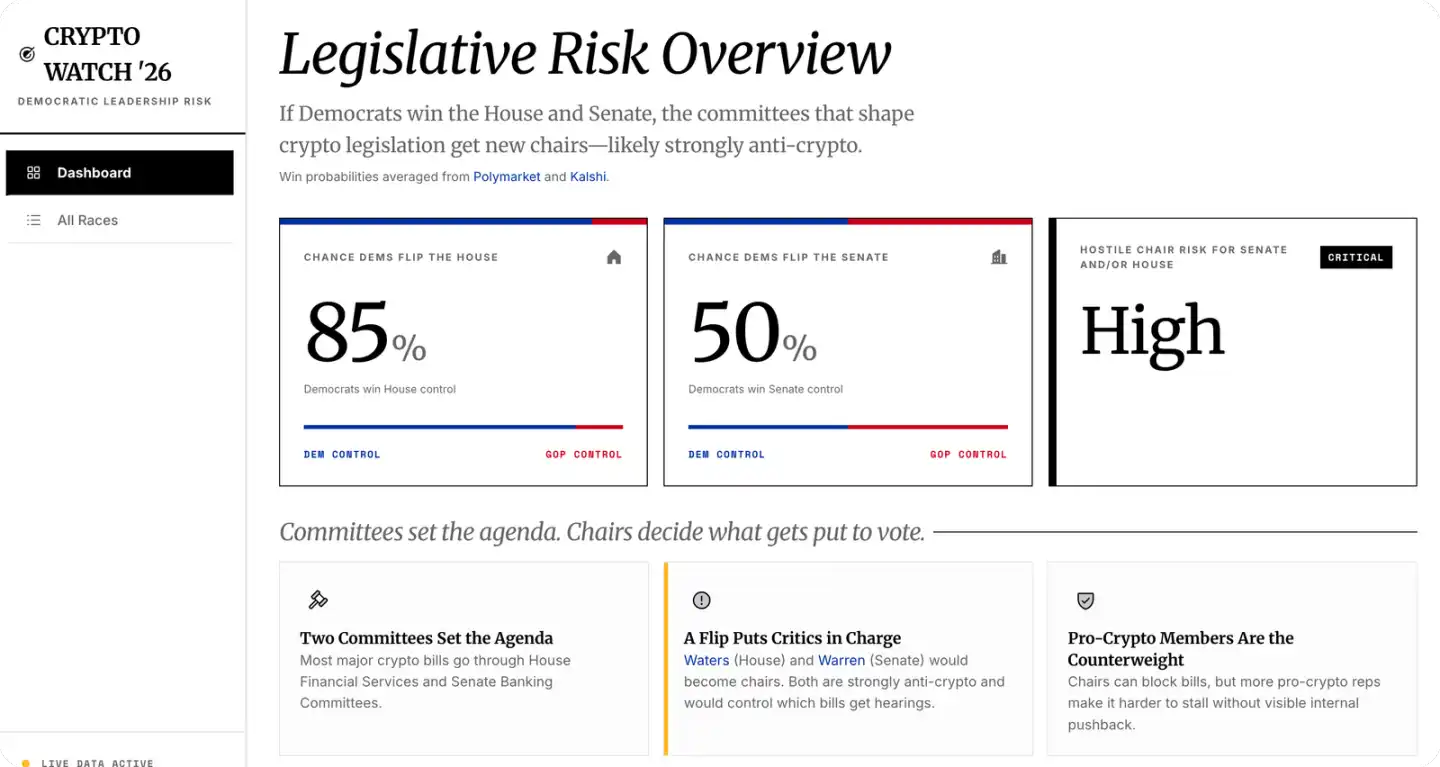
The 2026 US midterm elections pose significant risks to the crypto industry, with Democrats having an 85% chance of taking the House. This would place Maxine Waters, a vocal crypto critic, as Chair of the House Financial Services Committee (HFSC), giving her absolute power to block crypto legislation by controlling the agenda. In the Senate, Elizabeth Warren, another staunch opponent, would likely chair the Banking Committee. While nearly half of Democratic lawmakers voted for the pro-crypto GENIUS Act, this support is superficial. Bills never go to a full floor vote without first passing through committee, where chairs hold unilateral power to kill them. The current pro-crypto Republican chairs, who advanced bills like FIT21 and CLARITY, would be replaced. The analysis highlights that even though pro-crypto Democrats exist, they lack influence in the powerful committees that control legislative progress. Key elections that could shift committee dynamics are limited. The conclusion is that a Democratic sweep would create a severe structural headwind, stalling major crypto legislation in Congress despite bipartisan voter support.

Written by: David Christopher

Compiled by: Saoirse, Foresight News

What level of risk does this midterm election truly conceal for the encryption industry? As the possibility of a Democratic sweep of both the Senate and the House of Representatives in the midterm elections continues to rise, I aim to conduct an in-depth analysis of its potential impact on the future trajectory of the encryption industry, based on current polls.

To this end, I have consulted prediction markets on one hand, and resources like Stand with Crypto (SWC) on the other—a platform that records the policy stances of various candidates towards the encryption industry. I have integrated this information and built an analytical dashboard accordingly.

Although the data is still being supplemented and refined, I have established a core database tracking key districts where Democratic candidates are leading, and correlating their encryption policy positions with potential influence in Congressional committees. This analysis preliminarily reveals the policy landscape for the coming months: superficially, there appears to be room for cooperation, but a deeper look uncovers profound structural issues.
A Surprising Reality

First, it must be clarified that Democratic support for the encryption industry is actually higher than commonly perceived—at least on certain bills.

In the House of Representatives, 101 Democratic lawmakers (approximately 48% of the caucus) voted in favor of the GENIUS Act; in the Senate, 18 Democrats (40%) voted to advance the bill to a floor vote. This seems to form a tangible bipartisan support coalition. However, this support is confined to that specific bill. Once it enters the core stage that truly determines legislative direction—the committee process—this support vanishes entirely.

This is precisely the crux of the issue.

The Core Source of Influence

Encryption-related legislation is never brought directly to a full floor vote.

Whether it's stablecoin regulation, market structure rules, or defining the authority of the U.S. Securities and Exchange Commission (SEC), all issues must first undergo committee review. The House Financial Services Committee (HFSC) and the Senate Banking Committee are the two core bodies that determine the life or death of encryption bills (market structure bills also require input from the Agriculture Committee regarding the relevant authority of the Commodity Futures Trading Commission (CFTC)).

Committee chairs hold absolute agenda control: they decide which bills get hearings, which move to the deliberation stage, and which die quietly in procedural deadlock. A chair opposed to a bill does not need to vote it down; they can simply kill it by refusing to schedule it.

Republican chairs in recent years have fully demonstrated the influence of this power:

  • Senate Banking Committee Chair Tim Scott pushed the GENIUS Act through committee review and helped it pass the Senate vote;
  • Former House Financial Services Committee Chair Patrick McHenry strongly advocated for the FIT21 Act, making it the first major encryption market structure bill to pass the House;
  • Current House Financial Services Committee Chair French Hill has continued this momentum, pushing related bills like the CLARITY Act through the House (although this bill remains stalled in the Senate), and consistently holding hearings on digital assets and capital markets modernization.

So, what changes if Democrats achieve a full victory?

The majority party will control all committee chair positions in Congress, without exception. If Democrats recapture the House, they will chair all House committees; if they take the Senate, they will fully control all Senate committees. The selection of chairs within the majority party is typically based on seniority.

  • House Financial Services Committee: The most senior Democrat is Maxine Waters;
  • Senate Banking Committee: The highest-ranking Democrat is Elizabeth Warren.

It is well-known that both have voted against all major encryption bills. Warren led the opposition during the GENIUS Act deliberations, calling it "a threat to national security"; Waters directly condemned the bill as "a complete and total crypto scam."

The key point of contention in the House is this—once party control changes, the subcommittees will be completely reorganized. The majority party will dictate the allocation and proportional adjustment of seats for new members. Waters will have significant influence over personnel arrangements within the House Financial Services Committee and its subcommittees, including deciding who will oversee "digital asset" related matters. Admittedly, she cannot unilaterally decide all members (the party leadership and caucus have a say), but it is enough to steer the committee towards her preferred anti-encryption stance.

The Democratic contingent in the current House Financial Services Committee is already clearly leaning anti-encryption: Brad Sherman, Stephen Lynch, Emanuel Cleaver, and Sylvia Garcia all hold strong opposing views. Even with pro-encryption members like Jim Himes, Bill Foster, Ritchie Torres, Josh Gottheimer, and Vicente Gonzalez, they cannot control the agenda under Waters' chairmanship.
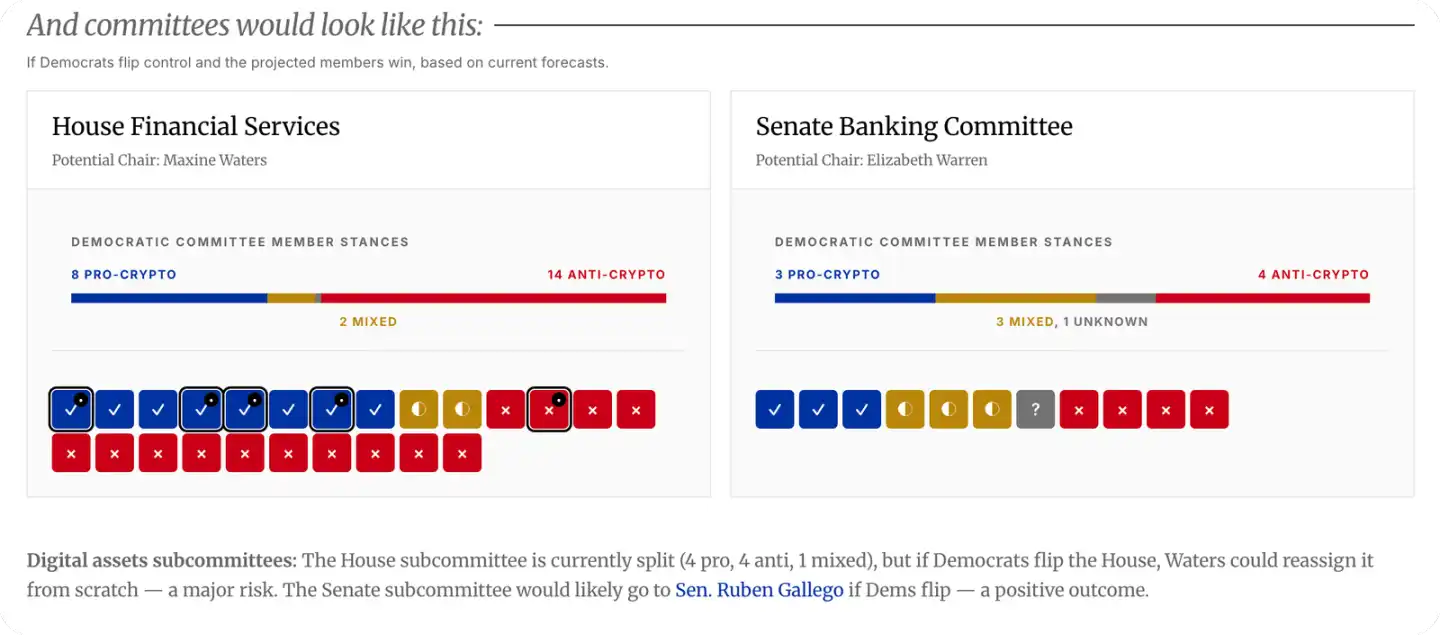
This chart shows the distribution of encryption stances in the two core committees if Democrats regain control of Congress in the 2026 midterm elections, visually reflecting the regulatory landscape the encryption industry will face.

The situation in the Senate Banking Committee is slightly better. Although Warren would become chair, the committee's composition is more diverse: it includes pro-encryption senators (e.g., Mark Warner, Ruben Gallego, Angela Alsobrooks), opponents (e.g., Tina Smith), and swing-vote moderates. A slight positive is that if Democrats control the Senate, Senator Gallego, rated favorably on the SWC platform, is highly likely to chair the digital assets subcommittee. Although Warren would still control the full committee's agenda, Gallego could potentially carve out some space for pro-encryption voices at the subcommittee level.

The Key Elections That Truly Impact the Landscape

Most existing pro-encryption Democratic lawmakers are not on the House Financial Services Committee or the Senate Banking Committee. They can certainly vote in favor of relevant bills in full floor votes, and they can pressure party leadership (though, given the high degree of partisanship on this issue, most are reluctant to speak out for the encryption industry), but they cannot force committee chairs to advance legislation.

Only a handful of elections can truly change the power composition within these committees.
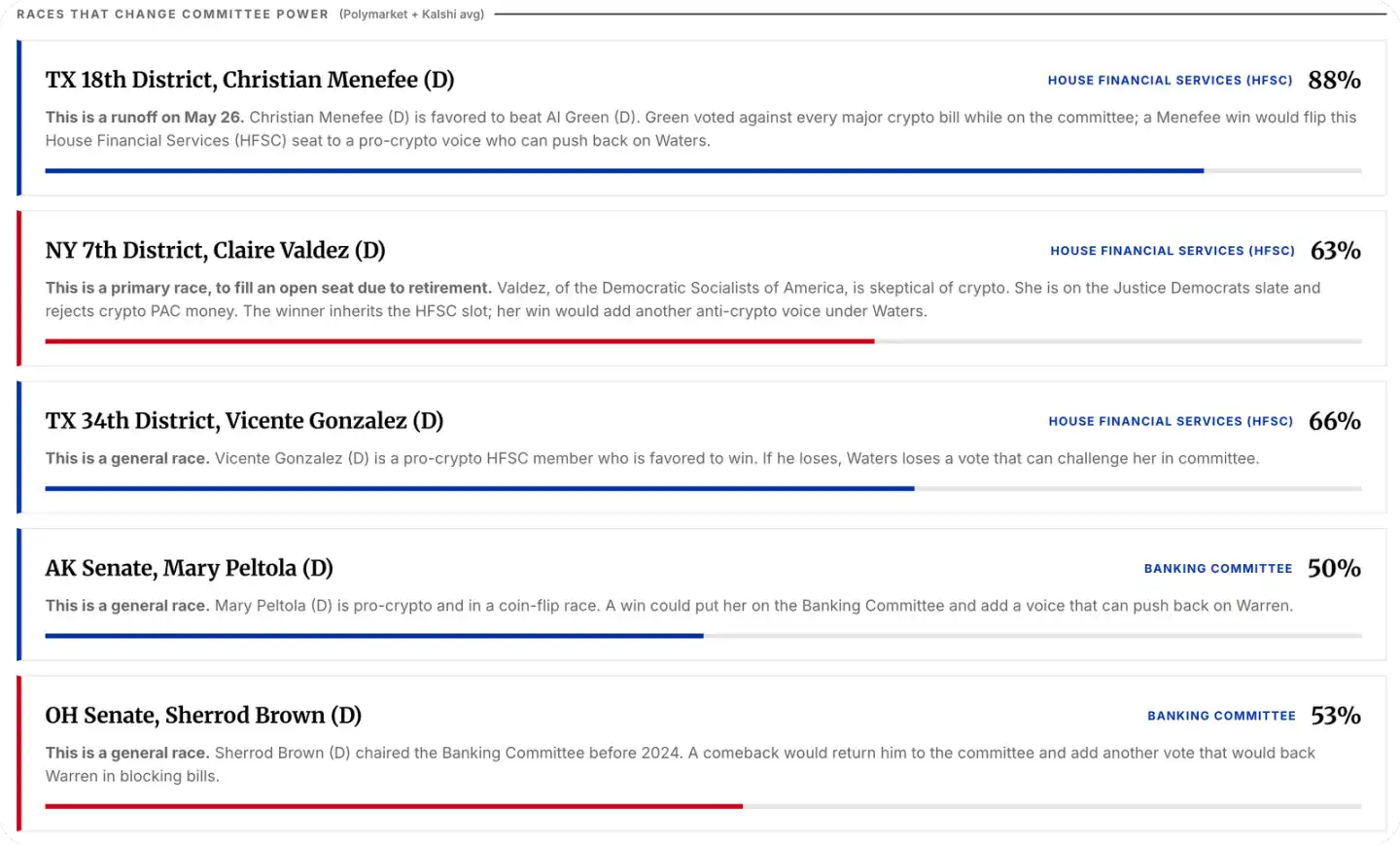
This chart is an analysis of key district races affecting U.S. Congressional encryption legislative power. Data is averaged from Polymarket and Kalshi prediction markets. It corely shows which election results would directly change the encryption stance of the House Financial Services Committee (HFSC) and the Senate Banking Committee.

The Final Conclusion of the Midterm Elections

The prospects in the House are extremely grim.

The probability of Democrats retaking the House is as high as 85%, meaning Waters is highly likely to chair the House Financial Services Committee, wielding absolute power to reorganize subcommittees and control the legislative agenda. The remaining bright spots are extremely limited: Menefee has a chance to defeat Green for a seat, and Gonzalez is highly likely to retain his current seat. These scenarios might create some checks and balances, but they cannot change the core of power—the ownership of the chairmanship.

The Senate is the encryption industry's last remaining stronghold, and the situation worsened last night: Juliana Stratton defeated Raja Krishnamoorthi in the Illinois primary. Based on SWC platform records, combined with the fact that Fairshake (a U.S. Super PAC with ties to the encryption industry, and currently one of the most influential political lobbying organizations in the crypto space) spent $7 million opposing her, it is clear that Stratton is a staunch anti-encryption politician.

Even more frustrating is the overall picture: approximately 47% of Democratic lawmakers in both chambers supported the GENIUS Act, and 37% of House Democrats supported the CLARITY Act—pro-encryption Democrats do exist. But the life or death of bills is never decided by full floor votes; it depends on the committees. Committee votes on market structure bills strictly follow party lines. The existing support base simply cannot transmit to the core环节 that truly determines legislative direction.

The encryption industry should not have become so partisan. Pro-encryption Democrats do exist; they just happen not to be in the key positions that hold real legislative power.


Domande pertinenti

QWhat is the main concern for the crypto industry regarding the upcoming midterm elections according to the article?

AThe main concern is that if Democrats sweep both the House and Senate, key congressional committees like the House Financial Services Committee (HFSC) and Senate Banking Committee will be chaired by strong crypto opponents like Maxine Waters and Elizabeth Warren, who can block crypto-related bills by controlling the agenda and refusing to advance them to a full vote.

QWhich two congressional committees are identified as the most critical for the fate of crypto legislation?

AThe House Financial Services Committee (HFSC) and the Senate Banking Committee are the two core committees that determine the survival or death of crypto bills, as all related legislation must pass through them first before reaching a full floor vote.

QWho are the likely Democratic chairs of the HFSC and Senate Banking Committee if their party gains control, and what are their stances on crypto?

AMaxine Waters would likely chair the House Financial Services Committee (HFSC), and Elizabeth Warren would likely chair the Senate Banking Committee. Both are strong opponents of crypto; Warren called the GENIUS Act a 'threat to national security,' and Waters denounced it as a 'total crypto scam.'

QWhat specific power does a committee chair hold over crypto legislation, as explained in the article?

AA committee chair has absolute agenda control: they decide which bills get hearings, which move to markup, and which die in procedural gridlock. They can kill a bill they oppose simply by refusing to schedule it for consideration, without needing to vote it down.

QDespite significant Democratic support for some crypto bills in full votes, why does the article argue this support is ineffective?

AThe support is ineffective because crypto bills never go directly to a full vote; they must first pass through committees. The chairs of these key committees, who are staunch crypto opponents, can block the bills from ever reaching a full vote, rendering the broader support meaningless.

Letture associate

Gensyn AI: Don't Let AI Repeat the Mistakes of the Internet

In recent months, the rapid growth of the AI industry has attracted significant talent from the crypto sector. A persistent question among researchers intersecting both fields is whether blockchain can become a foundational part of AI infrastructure. While many previous AI and Crypto projects focused on application layers (like AI Agents, on-chain reasoning, data markets, and compute rentals), few achieved viable commercial models. Gensyn differentiates itself by targeting the most critical and expensive layer of AI: model training. Gensyn aims to organize globally distributed GPU resources into an open AI training network. Developers can submit training tasks, nodes provide computational power, and the network verifies results while distributing incentives. The core issue addressed is not decentralization for its own sake, but the increasing centralization of compute power among tech giants. In the era of large models, access to GPUs (like the H100) has become a decisive bottleneck, dictating the pace of AI development. Major AI companies are heavily dependent on large cloud providers for compute resources. Gensyn's approach is significant for several reasons: 1) It operates at the core infrastructure layer (model training), the most resource-intensive and technically demanding part of the AI value chain. 2) It proposes a more open, collaborative model for compute, potentially increasing resource utilization by dynamically pooling idle GPUs, similar to early cloud computing logic. 3) Its technical moat lies in solving complex challenges like verifying training results, ensuring node honesty, and maintaining reliability in a distributed environment—making it more of a deep-tech infrastructure company. 4) It targets a validated, high-growth market with genuine demand, rather than pursuing blockchain integration without purpose. Ultimately, the boundaries between Crypto and AI are blurring. AI requires global resource coordination, incentive mechanisms, and collaborative systems—areas where crypto-native solutions excel. Gensyn represents a step toward making advanced training capabilities more accessible and collaborative, moving beyond a niche controlled by a few giants. If successful, it could evolve into a fundamental piece of AI infrastructure, where the most enduring value in the AI era is often created.

marsbit10 h fa

Gensyn AI: Don't Let AI Repeat the Mistakes of the Internet

marsbit10 h fa

Why is China's AI Developing So Fast? The Answer Lies Inside the Labs

A US researcher's visit to China's top AI labs reveals distinct cultural and organizational factors driving China's rapid AI development. While talent, data, and compute are similar to the West, Chinese labs excel through a pragmatic, execution-focused culture: less emphasis on individual stardom and conceptual debate, and more on teamwork, engineering optimization, and mastering the full tech stack. A key advantage is the integration of young students and researchers who approach model-building with fresh perspectives and low ego, prioritizing collective progress over personal credit. This contrasts with the US culture of self-promotion and "star scientist" narratives. Chinese labs also exhibit a strong "build, don't buy" mentality, preferring to develop core capabilities—like data pipelines and environments—in-house rather than relying on external services. The ecosystem feels more collaborative than tribal, with mutual respect among labs. While government support exists, its scale is unclear, and technical decisions appear driven by labs, not state mandates. Chinese companies across sectors, from platforms to consumer tech, are building their own foundational models to control their tech destiny, reflecting a broader cultural drive for technological sovereignty. Demand for AI is emerging, with spending patterns potentially mirroring cloud infrastructure more than traditional SaaS. Despite challenges like a less mature data industry and GPU shortages, Chinese labs are propelled by vast talent, rapid iteration, and deep integration with the open-source community. The competition is evolving beyond a pure model race into a contest of organizational execution, developer ecosystems, and industrial pragmatism.

marsbit12 h fa

Why is China's AI Developing So Fast? The Answer Lies Inside the Labs

marsbit12 h fa

3 Years, 5 Times: The Rebirth of a Century-Old Glass Factory

Corning, a 175-year-old glass company, is experiencing a dramatic revival as a key player in AI infrastructure, driven by surging demand for high-performance optical fiber in data centers. AI data centers require vastly more fiber than traditional ones—5 to 10 times as much per rack—to handle high-speed data transmission between GPUs. This structural demand shift, coupled with supply constraints from the lengthy expansion cycle for fiber preforms, has created a significant supply-demand gap. Nvidia has invested in Corning, along with Lumentum and Coherent, in a $4.5 billion total commitment to secure the optical supply chain for AI. Corning's competitive edge lies in its expertise in producing ultra-low-loss, high-density, and bend-resistant specialty fiber, which is critical for 800G+ and future 1.6T data rates. Its deep involvement in co-packaged optics (CPO) with partners like Nvidia further solidifies its position. While not the largest fiber manufacturer globally, Corning's revenue from enterprise/data center clients now exceeds 40% of its optical communications sales, and it has secured multi-year supply agreements with major hyperscalers including Meta and Nvidia. Financially, Corning's optical communications revenue has surged, doubling from $1.3 billion in 2023 to over $3 billion in 2025. Its stock price has risen nearly 6-fold since late 2023. Key future catalysts include the rollout of Nvidia's CPO products and the scale of undisclosed customer agreements. However, risks include high current valuations and potential disruption from next-generation technologies like hollow-core fiber. The company's long-term bet on light over electricity, maintained even through the telecom bubble crash, is now being validated by the AI boom.

marsbit12 h fa

3 Years, 5 Times: The Rebirth of a Century-Old Glass Factory

marsbit12 h fa

Trading

Spot
Futures
活动图片




