Aave Is Surrendering the Throne of DeFi Lending Due to Its Own Stupidity

marsbitPubblicato 2026-04-24Pubblicato ultima volta 2026-04-24

Introduzione

An article titled "Aave Is Giving Up Its Throne in DeFi Lending Due to Its Own Foolishness" discusses how Aave mishandled a crisis following a $292 million hack of rsETH from Kelp DAO, leading to significant outflows and reputational damage. After the hack, Aave failed to promptly reassure users or commit to covering potential bad debt—estimated between $123.7 million and $230.1 million—despite having sufficient reserves. This hesitation triggered panic, resulting in $17.2 billion in outflows and liquidity crises across multiple pools. The author argues that Aave’s poor crisis management and reluctance to act quickly exacerbated the situation, damaging its reputation as the "safest DeFi" platform. Meanwhile, competitor Spark, a fork of Aave V3, capitalized on the situation by attracting fleeing funds, growing its TVL by nearly $2 billion. Spark had previously delisted rsETH, avoiding any exposure to the hack. Its proactive communication and strategic positioning contrast sharply with Aave’s delayed response. Although Aave’s founder later announced a relief plan (DeFi United) with multiple partners and a personal donation, the damage to user trust and liquidity may be lasting. The article concludes that Aave’s missteps have allowed competitors like Spark, Morpho, and Jupiter Lend to challenge its dominant position in DeFi lending.

Original | Odaily Planet Daily (@OdailyChina)

Author | Azuma (@azuma_eth)

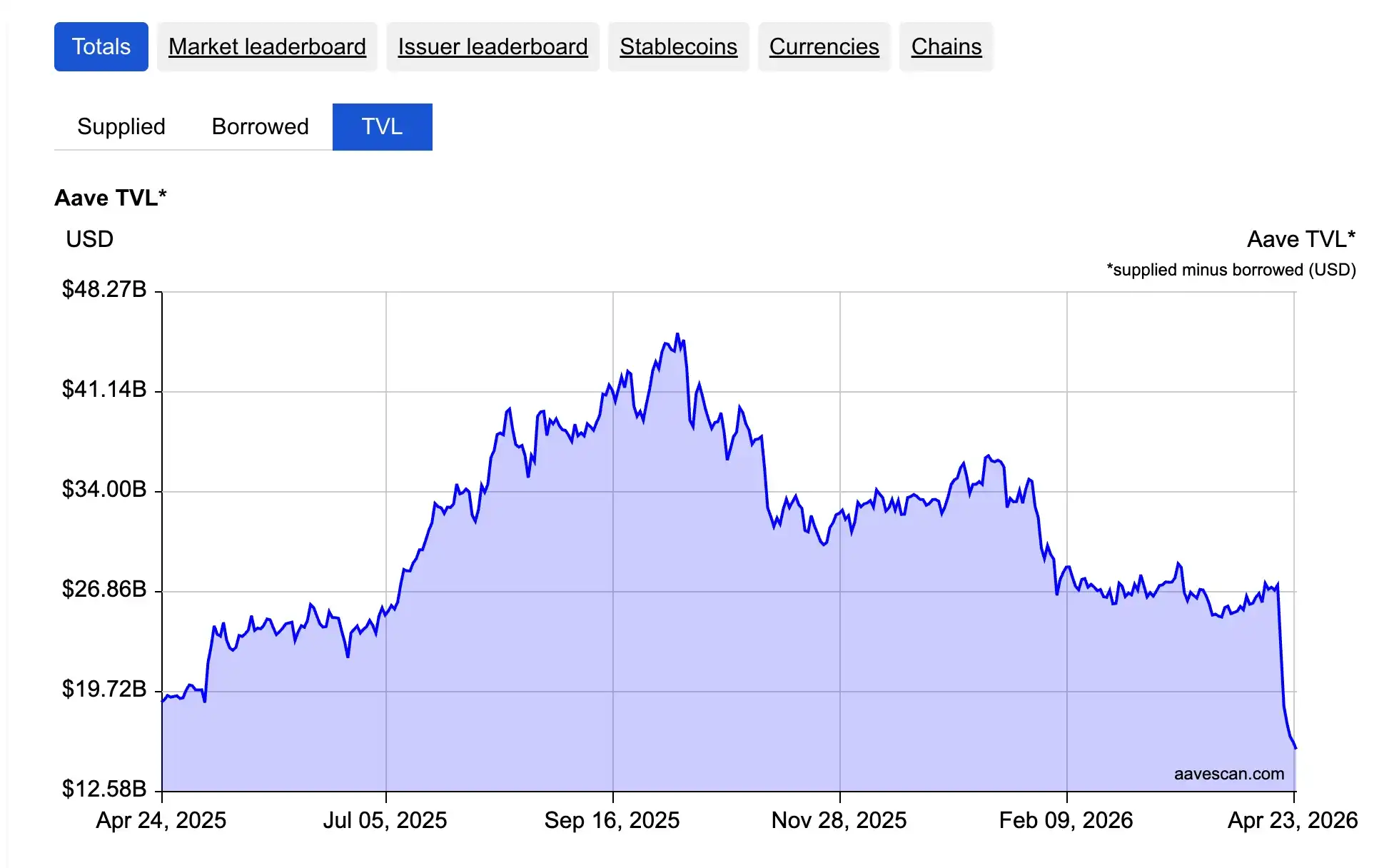
$292 million, this is the total amount of rsETH funds stolen from Kelp DAO; $17.2 billion, this is the scale of funds that have flowed out of Aave since the incident.

Aave is watching the community's panic sentiment ferment for several consecutive days due to its extremely foolish crisis PR strategy, thereby losing its once greatest advantage in the lending track—hundreds of billions of dollars in deposited funds and the user mindset label of "the safest DeFi".
  • Odaily Note: For background, please refer to "DeFi Hacked Again for $292 Million, Is Aave No Longer Safe?" and "The Tripartite Game Under the $290 Million Hole: Who Will Pay the Bill—Aave, L0, or Kelp?".

What Did Aave Do Wrong?

The details of the Kelp DAO hack need not be repeated; blaming Aave for why it granted rsETH such a high LTV is meaningless now. Here, I mainly want to discuss Aave's response strategy after the incident from the perspective of a long-term AAVE user.

First is the bad debt scale issue; Aave itself has done the math. Depending on the different handling of rsETH, there might be two possible bad debt scenarios—if the stolen loss is written off from all rsETH in circulation, it is expected to generate $123.7 million in bad debt; if the value of mainnet rsETH is protected and the loss is fully recorded in the mapped version of rsETH on Layer2, it is expected to generate $230.1 million in bad debt.

In either case, Aave has the capability to cover it with its reserves from Umbrella, the DAO treasury, and the team. I understand that Aave is unwilling to pay this money itself and wants the main responsible party, Kelp DAO, and the secondary responsible party, LayerZero, to contribute as much as possible. But the problem is that the other parties will think the same way—"Aave is so rich, the situation is so awkward, it should bear more." Therefore, in the short term, it is difficult for these three parties to reach a consensus, which implies that a solution that satisfies everyone is temporarily impossible.

But users cannot wait that long—Aave's yield levels have never been very competitive in the industry. Users who choose to deposit with Aave are all attracted by its reputation, security, and liquidity. However, the situation now is that in the most critical days after the incident, Aave consistently failed to give users some kind of bottom-line guarantee promise, but instead kept emphasizing "our code has no problems" and "how rsETH is accounted for is beyond Aave's control" to shift blame.

This is why panic sentiment kept fermenting within the community. Users tried every means to escape and avoid risk: those who could withdraw directly did so, and those who couldn't went to borrow from other pools first, causing the impact to gradually expand. So Aave's current situation is: on one hand, it faces continuous fund outflows; on the other hand, multiple pools are experiencing liquidity drying up due to utilization rates being maxed out.

This awkward situation could have been avoided (or at least not been this bad)... Since Aave can afford the money, why didn't it inject a dose of reassurance into the community from the beginning to prevent a bank run? At most, it's $230 million in bad debt (possibly less), and this money wouldn't necessarily be paid by Aave alone;后续 could continue to dispute with LayerZero and Kelp DAO.

Now, it's done. For the sake of a promised relief of at most $230 million, Aave watched $17.2 billion in deposited funds flow out (the number may continue to grow), and this doesn't even include the decline in AAVE's price these days... No matter how you calculate it, it's a huge loss.

What makes Aave even more uncomfortable is that the worse its situation becomes, the more relaxed opponents like LayerZero and Kelp DAO will be, because they will judge that Aave will be more motivated to solve the problem as soon as possible, which only puts Aave at a disadvantage in the game.

Having reached this point, Aave has brought this upon itself.

Behind Aave, Spark Is Watching Covetously

While Aave is suffering from headaches, the situation of its competitor Spark is booming and extremely positive. What is even more lamentable is that Spark is actually a competitor "personally incubated" by Aave.

Spark was originally a lending protocol forked and developed by Sky (formerly MakerDAO) based on the open-source code of Aave V3; both sides actually use the same underlying code logic. In return, there was once a profit-sharing agreement between Spark and Aave, but later Aave accused Spark of涉嫌 breaching the contract, and coupled with route differences, the two are now purely competitive.

Three months before the Kelp DAO theft, Spark had just removed support for rsETH (for details, please refer to "Same Day, Different Fate: Aave Embraces rsETH and Loses Nearly $200 Million, Spark Exits Unscathed"). You call it strategic conservatism or rigorous risk control, or even attribute it entirely to luck, but the result is that Spark was not affected at all in this incident—on this point alone, Spark can wantonly attack Aave's former "safest DeFi" label.

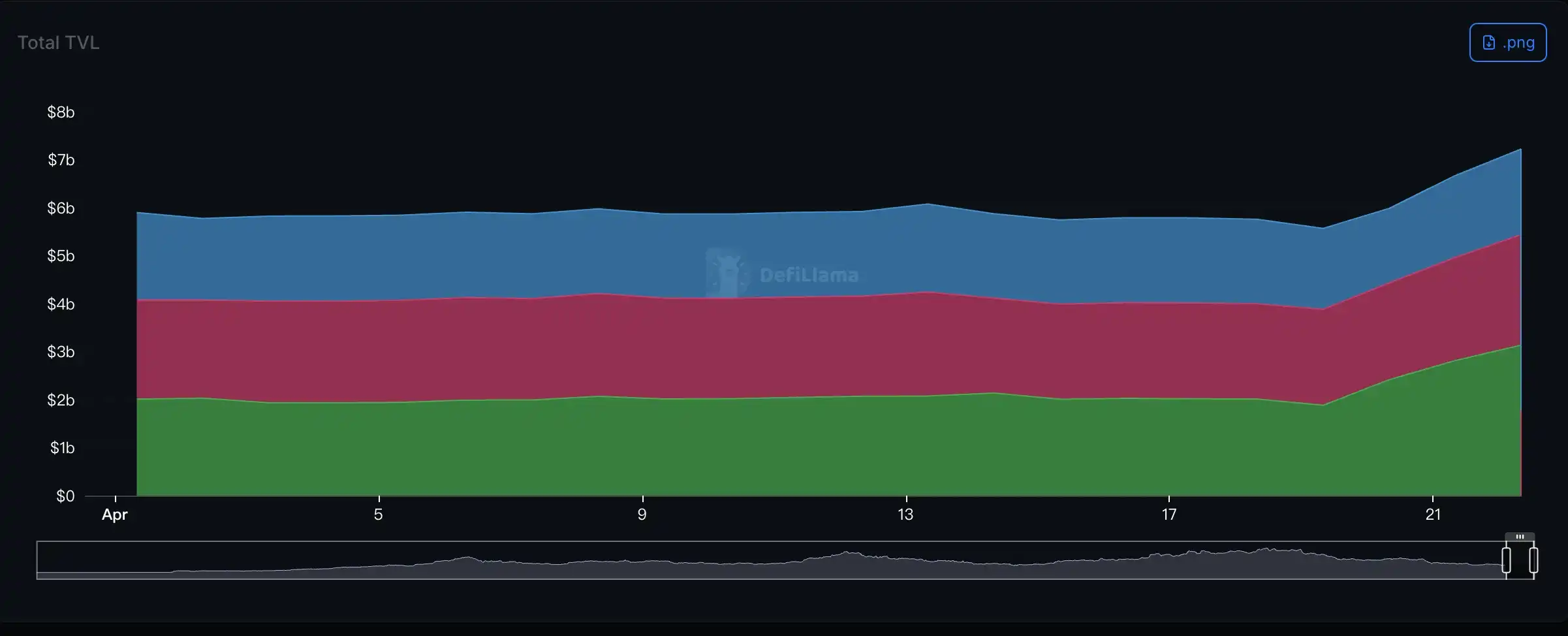
Thus, Spark became one of the safe havens for funds fleeing Aave. Since the incident, Spark's TVL has grown by nearly $2 billion (green part in the chart below). On the day of the incident, Justin Sun withdrew 53,665 ETH (worth $124 million) from Aave and subsequently deposited it into Spark. After continued accumulation in recent days, the total deposit has reached $1.3 billion—in the DeFi world, Brother Sun's operations are really something to learn.
On April 23, Upbit officially announced the launch of the Spark (SPK) Korean Won trading market. SPK, stimulated by this positive news, rose over 80% in a single day, significantly narrowing the market value gap between itself and AAVE.

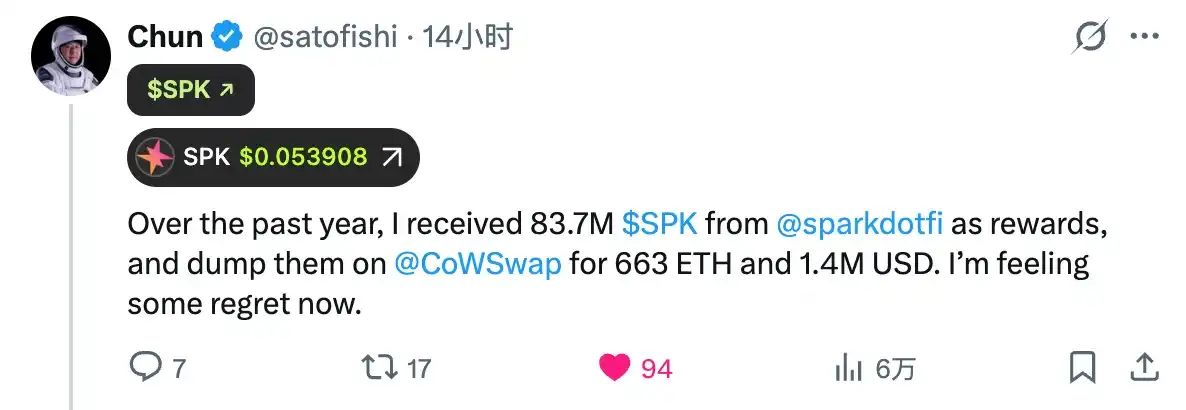
Even Wang Chun, founder of F2Pool, lamented on X: "In the past year, I received 83.7 million SPK rewards from Spark and sold them on CoWSwap for 663 ETH and $1.4 million. Now I kind of regret it."
Spark clearly realizes that this is a perfect opportunity to seize market share from Aave's mouth. Since the incident, Spark's Strategy Lead, MonetSupply, has almost become the most frequent KOL speaking out on this matter, posting dozens of times a day. Although his发言 can indeed help the public understand what happened, it objectively also加剧 the panic sentiment surrounding Aave.

But this is the purest商业 competition; MonetSupply just made the most correct choice.

Aave Is Losing the Throne of DeFi Lending

In the early morning of April 24, perhaps realizing the严峻 situation, Aave founder Stani announced on X the launch of a relief plan called DeFi United. Cooperative participants include LayerZero, Ethena, ether.fi, Ink Foundation, Golem Foundation, Trydo, etc. Stani personally will also donate 5,000 ETH to solve the current problem.

But the funds have already flowed out, and user trust has been severely damaged. Relying solely on this belated statement, Aave will find it difficult to regain deposited funds and user trust in the short term.

The DeFi lending track has long presented a pattern of "one superpower, multiple great powers," with Aave一直以来 having seemingly extremely solid leading advantages. But now, Aave is拱手 surrendering the throne. Behind it, challengers are coming aggressively; besides the booming Spark, other opponents like Morpho and Jupiter Lend also hope to take a bite out of Aave's share.

Last year, Stani bought a five-story luxury house in London for approximately $30 million, one of the most expensive transactions in the UK's sluggish luxury real estate market in the past year. I don't know if there is something like a "jinx," but with precedents like Su Zhu and others, it seems that big shots who consume conspicuously within the circle always run into some倒霉事.

I can't guess what Stani is thinking right now in his five-story luxury house.

Domande pertinenti

QWhat was the main reason for the massive outflow of funds from Aave following the Kelp DAO hack?

AAave's extremely poor crisis management strategy, which failed to provide a timely and reassuring commitment to cover the potential bad debt, led to widespread community panic and a user rush to withdraw funds.

QWhat are the two potential bad debt scenarios calculated by Aave after the rsETH exploit?

AIf the stolen loss is written off from all rsETH in circulation, it would result in approximately $123.7 million in bad debt. If the value of mainnet rsETH is protected and the loss is fully attributed to the mapped version of rsETH on Layer 2, it would result in approximately $230.1 million in bad debt.

QWhich competitor protocol directly benefited from the funds flowing out of Aave, and what was a significant factor in its immunity to the hack?

ASpark Protocol directly benefited, with its TVL growing by nearly $2 billion. A significant factor was that Spark had removed support for rsETH three months prior to the hack, avoiding any exposure to the incident.

QWhat was the name of the key initiative announced by Aave founder Stani Kulechov in a belated attempt to address the crisis?

AStani Kulechov announced an initiative called 'DeFi United,' a relief plan involving partners like LayerZero and Ethena, to which he also personally pledged a donation of 5,000 ETH.

QAccording to the author, what is the fundamental reason users traditionally deposited funds into Aave, given its uncompetitive yield rates?

AUsers traditionally deposited into Aave due to its reputation for safety, security, and deep liquidity, not for competitive yield rates.

Letture associate

SpaceX, OpenAI, Anthropic: The Three AI Giants Racing for IPO, Which One Is Worth Betting On?

SpaceX, OpenAI, and Anthropic are poised for historic IPOs within weeks, potentially raising a combined $180 billion—a sum exceeding the entire internet bubble's fundraising. The hosts of the Limitless Podcast argue this isn't just individual company financing but an unprecedented capital concentration for AI infrastructure, driven by an insatiable need for compute, data centers, power, and chips. SpaceX's IPO is notable for reportedly changing market index rules to allow faster inclusion, potentially funneling trillions in passive retirement funds into its stock, despite its unproven space-based data center business model. In contrast, Anthropic demonstrates explosive growth, with ARR reportedly hitting $45 billion and approaching profitability, fueled by strong enterprise adoption of products like Claude Code. Google's separate $80 billion raise highlights the immense capital pressure, even for giants. The discussion acknowledges bubble risks but leans optimistic. The hosts contend the massive spending is building essential physical infrastructure for the next technological era. A key bottleneck isn't capital but the real-world limits of chip manufacturing and construction speed. As long as demand for AI compute outstrips supply, this investment cycle represents a foundational build-out rather than a purely financial bubble. All three companies are seen as foundational bets on the future, with Anthropic often cited as the most immediately compelling due to its proven revenue trajectory.

marsbit1 h fa

SpaceX, OpenAI, Anthropic: The Three AI Giants Racing for IPO, Which One Is Worth Betting On?

marsbit1 h fa

From 'Old Guys' to 'New Favorites': How AI Is Revaluing Old Infrastructure from Dell to Nokia?

From "Vintage Tech" to "New AI Darlings": How AI Revalues Old Infrastructure One year ago, tech giants like Dell, Nokia, Cisco, and Western Data were seen as slow-growth, low-valuation stories, far from the AI spotlight dominated by players like Nvidia. Now, these legacy tech stocks are gaining market attention, sparking debate on whether this is genuine industry revaluation or a temporary narrative. As AI moves from model parameters to real-world data centers, the market is recognizing companies with proven delivery and infrastructure capabilities. This shift marks a change in the AI investment thesis: from pure model and GPU focus to the complex systems engineering required for deployment. Companies like Dell, HPE, and Corning are being revalued not for being "sexy" AI innovators, but for their decades of accumulated expertise in supply chains, enterprise delivery, and infrastructure—assets that have become critical in the AI buildout phase. The revaluation is unfolding across three key infrastructure lines: 1. **Servers & System Integration:** Dell and HPE are emerging as crucial system integrators or "general contractors" for AI data centers, translating GPU orders into complete, deployable server racks integrated with power, cooling, and networking. 2. **Networking & Connectivity:** AI's scale demands robust high-speed connections. Corning (fiber optics), Nokia (AI-RAN, 6G), and Cisco (data center switches) are gaining importance for enabling efficient data transfer within and between AI clusters. 3. **Storage:** Beyond high-speed memory (HBM/DRAM), the AI data explosion is driving demand for high-capacity hard drives (HDDs) from companies like Western Digital and Seagate to handle training data, logs, and cold storage cost-effectively. For this revaluation to be substantive and not just a narrative, three criteria are key: 1) Concrete AI-related order and revenue growth (e.g., Dell's AI server sales), 2) Upward revisions to company financial guidance, and 3) Sustainable improvements in profit quality, not just top-line revenue spikes. In essence, AI's transition to a real construction phase is re-pricing "old assets" against "new demand." The opportunity, however, is selective. Only those legacy firms that are demonstrably integrated into the capital expenditure chains of data center and enterprise AI deployment are likely to experience a true "logic re-rating" rather than just a temporary valuation bounce.

marsbit1 h fa

From 'Old Guys' to 'New Favorites': How AI Is Revaluing Old Infrastructure from Dell to Nokia?

marsbit1 h fa

The Merger of Codex and ChatGPT Marks the Beginning of a Major Reshuffle in Programming Tools

OpenAI is shifting its strategic focus from ChatGPT to Codex, merging them along with the browser tool Atlas into a unified desktop super-app. This move signals an internal belief that Codex, originally a programming tool, represents the next evolution of AI more than conversational models like ChatGPT. Over the past year, Codex's weekly active users have surged past 5 million. The key distinction is that while ChatGPT answers questions, Codex executes tasks. Enterprises increasingly value this ability to get work done over simply receiving advice. Consequently, Codex is attracting professionals beyond developers, including analysts, bankers, marketers, and product managers. OpenAI's reorganization and increased investment in Codex stem from recognizing that the future of AI competition lies in execution capabilities, not just conversation. The company is launching role-specific plugins (e.g., for data analysis, sales, design) to transform Codex into a broad knowledge work platform that automates and redefines white-collar workflows. Beyond being a tool, Codex reflects OpenAI's ambition to redefine software. New features like "Sites"—which generates interactive websites from documents—and collaborative "Annotations" aim to create a paradigm where the AI understands the goal and handles the tools and steps, functioning more like a digital colleague than traditional software. The ultimate goal is a unified experience where the user cares only about the completed task.

marsbit1 h fa

The Merger of Codex and ChatGPT Marks the Beginning of a Major Reshuffle in Programming Tools

marsbit1 h fa

Interpreting Investment Opportunities in the Age of Great Navigation, Invesco Great Wall Fund Releases '2026 Report on Chinese Enterprises Going Global'

Invesco Great Wall Fund has released its "2026 China Corporate Globalization Report," titled "The 'Great Navigation Era' of Chinese Enterprises." The report analyzes the new trends and investment opportunities as Chinese companies expand globally, moving from simple product exports to comprehensive overseas operations involving services, branding, and local production. Driven by factors like trade friction, the pursuit of higher profit margins abroad, and policy support, globalization is becoming essential for Chinese companies. The report outlines an evolution: from early product export ("Globalization 1.0") to the current "Globalization 2.0," characterized by overseas capacity, capital goods investment, consumer brand expansion, and service exports. Chinese firms' competitive advantages are highlighted, including a vast engineer talent pool, low-cost and robust infrastructure, and complete industrial clusters. Specific sectors with significant出海 potential are identified: * **Capital Goods** (e.g., engineering machinery, power equipment): Benefiting from global demand, especially in Belt & Road markets and the AI-driven power grid upgrade cycle. * **Consumer Brands**: Transitioning from cost to brand advantage, leveraging供应链 efficiency. * **Technology & Innovation**: Including AI applications, optical modules within global tech supply chains, and new energy vehicles focusing on local production. * **Pharmaceuticals**: Chinese biotech firms are becoming preferred partners for global pharma, with potential for breakthrough drugs in areas like oncology and weight loss. The report concludes that corporate globalization represents a sustained, core theme for China's capital markets, though companies must navigate challenges like geopolitics and localization.

marsbit2 h fa

Interpreting Investment Opportunities in the Age of Great Navigation, Invesco Great Wall Fund Releases '2026 Report on Chinese Enterprises Going Global'

marsbit2 h fa

Trading

Spot
Futures

Articoli Popolari

Come comprare AAVE

Benvenuto in HTX.com! Abbiamo reso l'acquisto di Aave Protocol (AAVE) semplice e conveniente. Segui la nostra guida passo passo per intraprendere il tuo viaggio nel mondo delle criptovalute.Step 1: Crea il tuo Account HTXUsa la tua email o numero di telefono per registrarti il tuo account gratuito su HTX. Vivi un'esperienza facile e sblocca tutte le funzionalità,Crea il mio accountStep 2: Vai in Acquista crypto e seleziona il tuo metodo di pagamentoCarta di credito/debito: utilizza la tua Visa o Mastercard per acquistare immediatamente Aave ProtocolAAVE.Bilancio: Usa i fondi dal bilancio del tuo account HTX per fare trading senza problemi.Terze parti: abbiamo aggiunto metodi di pagamento molto utilizzati come Google Pay e Apple Pay per maggiore comodità.P2P: Fai trading direttamente con altri utenti HTX.Over-the-Counter (OTC): Offriamo servizi su misura e tassi di cambio competitivi per i trader.Step 3: Conserva Aave Protocol (AAVE)Dopo aver acquistato Aave Protocol (AAVE), conserva nel tuo account HTX. In alternativa, puoi inviare tramite trasferimento blockchain o scambiare per altre criptovalute.Step 4: Scambia Aave Protocol (AAVE)Scambia facilmente Aave Protocol (AAVE) nel mercato spot di HTX. Accedi al tuo account, seleziona la tua coppia di trading, esegui le tue operazioni e monitora in tempo reale. Offriamo un'esperienza user-friendly sia per chi ha appena iniziato che per i trader più esperti.

329 Totale visualizzazioniPubblicato il 2024.12.11Aggiornato il 2026.06.02

Come comprare AAVE

Discussioni

Benvenuto nella Community HTX. Qui puoi rimanere informato sugli ultimi sviluppi della piattaforma e accedere ad approfondimenti esperti sul mercato. Le opinioni degli utenti sul prezzo di AAVE AAVE sono presentate come di seguito.

活动图片













