Aave Is Surrendering the Throne of DeFi Lending Due to Its Own Stupidity

Odaily星球日报Pubblicato 2026-04-24Pubblicato ultima volta 2026-04-24

Introduzione

Aave, a leading DeFi lending protocol, is facing a severe crisis and losing its dominant market position due to its poor handling of a recent security incident. The crisis began when Kelp DAO suffered a hack resulting in a loss of $292 million in rsETH. In the aftermath, approximately $17.2 billion in funds flowed out of Aave as user panic escalated. The article criticizes Aave's crisis management as "extremely foolish." Instead of promptly offering reassurance or committing to cover the potential bad debt—estimated between $123.7 million and $230.1 million, which Aave could have afforded—the protocol initially deflected blame, emphasizing that its code was not at fault. This delay and lack of a clear guarantee led to widespread user anxiety, triggering a bank run-like scenario where users withdrew funds or borrowed aggressively from other pools, causing liquidity shortages. Meanwhile, Aave’s competitor Spark—a fork of Aave’s own code—has benefited significantly. Having removed support for rsETH months earlier, Spark avoided any losses from the incident and has since seen its TVL grow by nearly $2 billion, attracting major deposits such as over $1.24 billion from Justin Sun. Spark has actively capitalized on the situation, publicly criticizing Aave’s security reputation. Although Aave’s founder Stani eventually announced a relief plan named "DeFi United" with several partners and a personal donation, the damage to user trust and capital outflows may be irreversible. The ar...

Original | Odaily Planet Daily (@OdailyChina)

Author | Azuma (@azuma_eth)

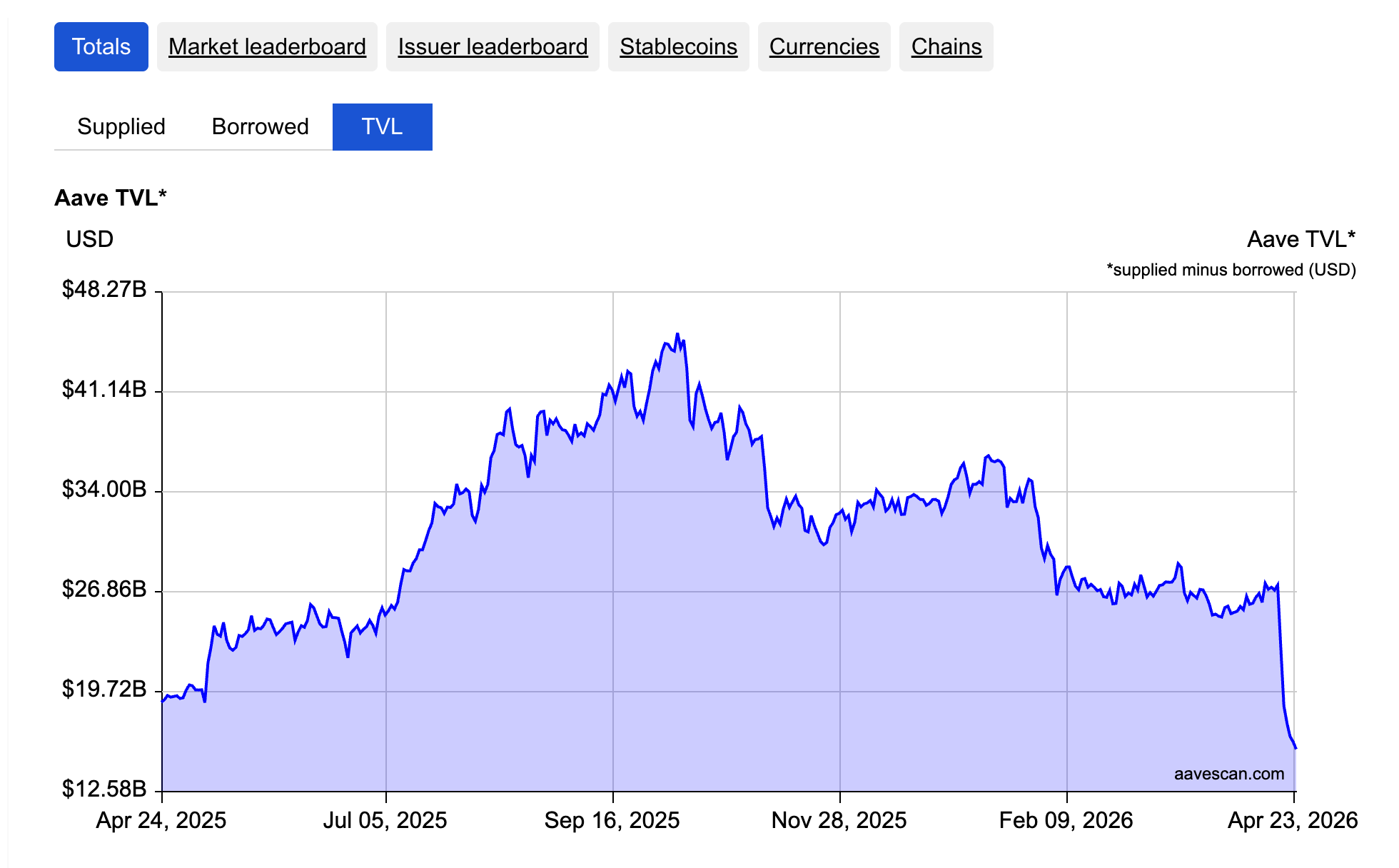
$292 million, this is the total amount of rsETH funds stolen from Kelp DAO; $17.2 billion, this is the scale of funds that have flowed out of Aave since the incident.

Aave is watching as its extremely foolish crisis PR strategy allows community panic to ferment for several consecutive days, thereby losing its former biggest advantage in the lending track — hundreds of billions of dollars in deposited funds and the user perception label of "the safest DeFi".
  • Odaily Note: For background, please refer to "DeFi Hacked Again for $292 Million, Is Aave Not Safe Anymore?"; "The Tripartite Game Under the $290 Million Hole: Who Will Pay, Aave, L0, or Kelp?".

What Did Aave Do Wrong?

The details of the Kelp DAO hack incident need not be repeated. There's no point in blaming Aave for giving rsETH such a high LTV anymore. Here, I mainly want to discuss Aave's response strategy after the incident from the perspective of a long-term AAVE user.

First is the bad debt scale issue. Aave itself has done the math. Depending on the different handling of rsETH, there could be two possibilities for bad debt — If the stolen loss is written off from all circulating rsETH, it is expected to generate $123.7 million in bad debt; If the value of mainnet rsETH is protected, and the loss is fully accounted for in the mapped version of rsETH on Layer2, it is expected to generate $230.1 million in bad debt.

In either case, Aave has the financial strength to cover it with its Umbrella, DAO treasury, and team reserves. I understand that Aave is unwilling to pay this money itself and wants Kelp DAO, the main responsible party, and LayerZero, the secondary responsible party, to also contribute more. But the problem is, the other parties think the same way — "Aave is so rich, the situation is so awkward, surely they should bear more." Therefore, in the short term, it's difficult for these three parties to reach a consensus, meaning a solution that satisfies everyone is temporarily impossible.

But users cannot wait that long — Aave's yield levels have never been very competitive in the industry. Users who choose to deposit funds with Aave do so for its reputation, security, and liquidity. However, the current situation is that in the most critical days following the incident, Aave consistently failed to give users some kind of bottom-line guarantee promise, instead repeatedly emphasizing "our code is not the problem" and "Aave cannot control how rsETH is accounted for" to shift blame.

This is why panic continued to ferment within the community. Users tried every means to escape the risk, withdrawing directly if they could, or borrowing from other pools if they couldn't withdraw, causing the impact to gradually expand. So Aave's current situation is, on one hand, facing continuous fund outflows, and on the other hand, multiple pools are experiencing liquidity drying up due to utilization rates being maxed out.

This awkward situation could have been avoided (or at least not been this bad)...... Since Aave can afford the money, why not inject a dose of reassurance into the community from the start to prevent a bank run? At most, it's $230 million in bad debt (possibly less), and this money wouldn't necessarily be paid by Aave alone; they could negotiate with LayerZero and Kelp DAO later.

Now, it's done. For the sake of saving on a promise of relief worth at most $230 million, Aave watched as $17.2 billion in deposited funds flowed out (the number may continue to grow), and this doesn't even include the decline in the AAVE token price these days...... by any calculation, it's a disastrously bad deal.

What makes Aave even more uncomfortable is that the worse its situation becomes, the more relaxed opponents like LayerZero and Kelp DAO will be, because they will judge that Aave will be more motivated to solve the problem as soon as possible, which only puts Aave at a disadvantage in the博弈 (game theory).

Having reached this point, Aave has brought this upon itself.

Behind Aave, Spark Is Watching Closely

While Aave is suffering from headaches, the situation for its competitor Spark is booming and extremely positive. What's even more lamentable is that Spark is a competitor that Aave "personally incubated".

Spark was originally a lending protocol forked and developed by Sky (formerly MakerDAO) based on the open-source code of Aave V3. Both sides actually use the same underlying code logic. In return, there was once a profit-sharing agreement between Spark and Aave, but later Aave accused Spark of allegedly breaching the contract, and due to route differences, the two are now in a purely competitive relationship.

Three months before the Kelp DAO theft, Spark had just removed support for rsETH (for details, see "Different Fates on the Same Day: Aave Embraces rsETH and Loses Nearly $200M, Spark Exits Unscathed"). You can call it strategic conservatism, rigorous risk control, or even attribute it entirely to luck, but the result is that Spark was completely unaffected by this incident — on this point alone, Spark can brazenly attack Aave's former label of "safest DeFi".

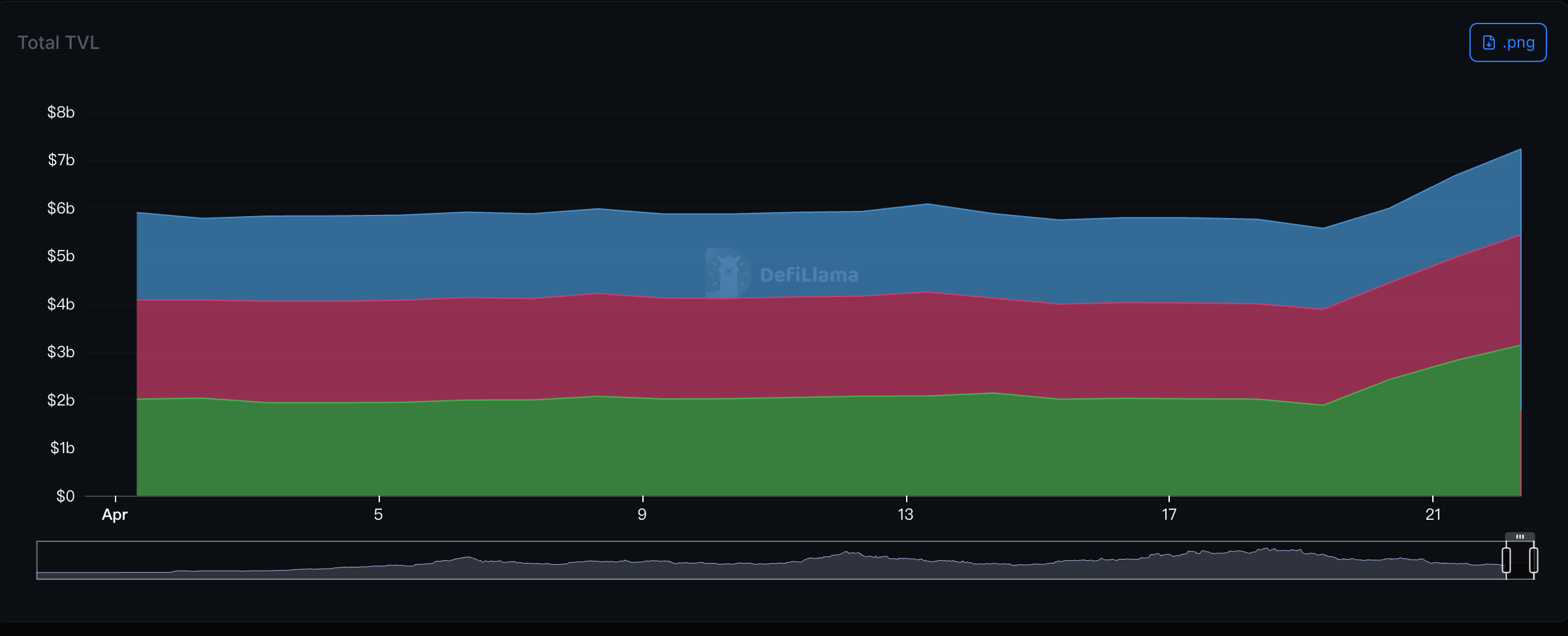
Consequently, Spark became one of the safe havens for funds fleeing Aave. Since the incident, Spark's TVL has grown by nearly $2 billion (green part in the chart below). On the day of the incident, Justin Sun withdrew 53,665 ETH (worth $124 million) from Aave and subsequently deposited it into Spark. After further accumulation in recent days, the total deposit has reached $1.3 billion — In the DeFi world, Brother Sun's (Justin Sun) moves are really something to learn.
On April 23rd, Upbit officially announced the launch of the Spark (SPK) Korean Won trading market. SPK, stimulated by this positive news, surged over 80% in a single day, significantly narrowing the market capitalization gap with AAVE.

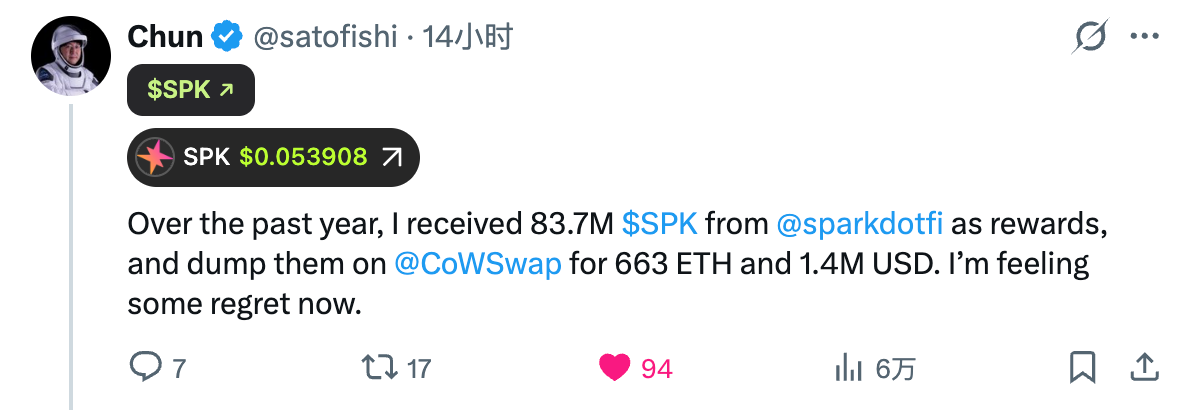
Even Wang Chun, founder of F2Pool, lamented on X: "In the past year, I received 83.7 million SPK rewards from Spark and sold them on CoWSwap for 663 ETH and $1.4 million. Now I kind of regret it."
Spark clearly realizes this is a perfect opportunity to seize market share from Aave's mouth. Since the incident, Spark's Strategy Lead, MonetSupply, has almost become the most vocal KOL on this matter, posting dozens of times a day. Although his comments do help the public understand what happened to some extent, they also objectively exacerbate the panic surrounding Aave.

But this is the purest form of commercial competition. MonetSupply simply made the most correct choice.

Aave Is Losing the Throne of DeFi Lending

In the early hours of April 24th, perhaps realizing the severity of the current situation, Aave founder Stani announced on X the launch of a relief plan called DeFi United. Participating collaborators include LayerZero, Ethena, ether.fi, Ink Foundation, Golem Foundation, Trydo, etc. Stani personally will also donate 5,000 ETH to help resolve the current issue.

But the funds have already flowed out, and user trust has been severely damaged. Relying solely on this belated statement, it will be difficult for Aave to quickly recover the deposited funds and user trust.

The DeFi lending track has long presented a "one superpower, many strong powers" pattern, with Aave一直以来 (yīzhí yǐlái - all along) having a seemingly extremely solid leading advantage. But now, Aave is surrendering the throne. Behind it, challengers are approaching menacingly. Besides the booming Spark, other opponents like Morpho and Jupiter Lend also hope to take a bite out of Aave's share.

Last year, Stani bought a five-story mansion in London for approximately $30 million, one of the most expensive transactions in the UK's sluggish luxury property market over the past year. I don't know if there's something like a "jinx," but following the examples of Su Zhu and others, it seems like big shots in the circle who consume conspicuously always run into some bad luck.

I can't guess what Stani is thinking right now in his five-story mansion.

Domande pertinenti

QWhat was the main reason for the massive outflow of funds from Aave following the Kelp DAO hack?

AAave's poor crisis management strategy, which failed to provide timely reassurance or a bailout guarantee to its users, leading to widespread panic and a bank run.

QWhat are the two potential bad debt scenarios calculated by Aave for the rsETH incident, and what are the amounts?

AIf the stolen loss is written off from all rsETH, the bad debt would be approximately $123.7 million. If the value of mainnet rsETH is protected and the loss is fully accounted for in the Layer2 mapped version of rsETH, the bad debt would be approximately $230.1 million.

QWhich competitor protocol directly benefited from the funds flowing out of Aave, and what was the approximate amount of TVL it gained?

ASpark Protocol directly benefited, gaining nearly $2 billion in Total Value Locked (TVL) following the incident.

QWhat was the name of the relief plan announced by Aave founder Stani Kulechov in response to the crisis, and what was his personal contribution?

AThe relief plan was named 'DeFi United'. Stani Kulechov personally donated 5,000 ETH to help resolve the situation.

QAccording to the article, what was the primary reason users traditionally deposited funds into Aave, given its uncompetitive yield rates?

AUsers primarily deposited funds into Aave due to its reputation for safety, security, and liquidity, not for competitive yield rates.

Letture associate

Ten-Thousand-Word Analysis: From $10 to $290, MRVL Wins the Entire AI Era by 'Not Making GPUs'

Marvell Technology's stock price surged from under $10 in 2016 to a record $290 in June 2026, fueled not by making GPUs, but by dominating AI infrastructure connectivity. This analysis argues the market misvalues MRVL as merely a smaller Broadcom in custom AI chips, overlooking its true, unique position. Marvell's core strength lies in enabling high-speed data flow for AI clusters through three interconnected businesses. First, it holds a commanding ~70% market share in high-speed optical DSPs (essential for data center light modules), a deep-moat business with accelerating growth. Second, its custom AI chip design business serves hyperscalers like AWS, Microsoft, and Google, with a significant revenue pipeline despite lower margins. Third, stable cash flows come from Ethernet switch chips and enterprise storage controllers. Together, they form a full-stack "AI data movement" platform. CEO Matt Murphy's transformative leadership since 2016, involving strategic divestments, key acquisitions (like Inphi for optical DSPs), and securing long-term agreements with major cloud providers, repositioned the company. A pivotal $2 billion strategic investment from NVIDIA in 2026 underscored Marvell's critical role in the AI ecosystem, particularly through collaborations like NVLink Fusion. While Marvell faces risks—including client concentration (losing the Amazon Trainium3 design), lower-margin business mix, competitive threats, insider selling, and complex supply chains—its fundamentals remain strong. The optical interconnect moat is widening with the acquisition of Celestial AI (photonics fabric), and financial metrics show accelerating revenue growth and operating leverage. With a PEG ratio suggesting undervaluation relative to its growth, the thesis is that the market undervalues Marvell's monopolistic position in AI "plumbing" while overemphasizing its competitive custom chip segment. The story transcends investing, symbolizing how in any complex system—from the internet to AI—the value of "connection" ultimately surpasses that of individual "nodes."

marsbit16 min fa

Ten-Thousand-Word Analysis: From $10 to $290, MRVL Wins the Entire AI Era by 'Not Making GPUs'

marsbit16 min fa

AI Relay Stations Spark Heated Debate on Zhihu: Behind Cheap Tokens, What Are Users Really Worried About?

A discussion on Zhihu about "AI relay stations" shifted the niche developer topic of "cheap tokens" into broader user awareness. Users moved beyond simply questioning the legitimacy of these services to focus on practical concerns: Where do cheap tokens truly come from? Is the model being accessed the real one? Can relay stations see prompts, code, and API keys? For occasional users, are the risks worth it? The core debate centered less on price and more on trust. A primary worry is model authenticity—the risk of "model swapping," where users paying for a premium model might be routed to a cheaper one, creating an information asymmetry. Others argued that cost comparisons matter; while cheaper than official pay-as-you-go APIs, relay stations may not be the lowest-cost option versus subscriptions, domestic models, or free tiers, making user needs assessment crucial. Speculation about token sources ranged from legitimate bulk discounts to gray-area methods like account sharing or exploiting regional pricing. This opacity makes risk assessment difficult for users. Data security emerged as a critical concern, especially for enterprise use. When processing sensitive information like code, contracts, or client data, the inability to verify a relay station's data handling, retention, or access policies poses significant compliance and confidentiality risks. The evolving consensus suggests relay stations can be used cautiously for low-sensitivity, disposable tasks (e.g., summarizing public info, simple translation). However, they should not be the default for sensitive, professional, or production workflows involving proprietary data, Agents, or automated systems. Recommendations include avoiding large prepayments, not relying on a single service, using test prompts to monitor quality, anonymizing data where possible, and keeping official channels as backups. Ultimately, the discussion framed tokens not just as a billing unit but as a measure of real cost encompassing price, model integrity, data security, and service stability. The popularity of relay stations highlights user demand for affordable access, but the debate underscores a key trade-off: the savings from cheap tokens may come at the price of trust, transparency, and control over one's data and AI experience.

marsbit46 min fa

AI Relay Stations Spark Heated Debate on Zhihu: Behind Cheap Tokens, What Are Users Really Worried About?

marsbit46 min fa

In-Depth Research Report on TradFi: The Convergence Wave of Crypto and Traditional Finance

In 2026, the crypto industry is undergoing a profound infrastructure-level transformation—TradFi assets are migrating on-chain at an unprecedented pace. According to CoinGecko's Q1 2026 report, the total value locked (TVL) of tokenized real-world assets (RWA) has surpassed $31 billion, a nearly 4x increase from $7.8 billion at the beginning of 2025, with the sector’s aggregate market capitalization reaching $19.3 billion. Among these, the market cap of tokenized stocks surged from $2 million to $486 million, with Q1 spot trading volume reaching $15.1 billion—a single quarter already surpassing the entire second half of 2025. RWA perpetual contract Q1 trading volume reached a staggering $524.8 billion, far exceeding the $313 billion for all of 2025. Meanwhile, BlackRock's BUIDL fund has reached $2.3 billion in scale and has filed for two new tokenized funds, signaling that the world's largest asset manager's tokenization strategy is evolving from pilot to product suite expansion. HTX, as a core participant in the crypto exchange sector, officially launched TradFi perpetual futures products including NVDA, AAPL, MSFT, META, and SPY in 2026, enabling crypto users to gain 24/7 trading access to core U.S. equities. Boston Consulting Group predicts that global tokenized asset scale could reach $16 trillion by 2030, while McKinsey offers a conservative estimate of approximately $2 trillion. The on-chain migration of TradFi assets is no longer a "future narrative" but a structural transformation unfolding in real time, as crypto exchanges evolve from single crypto asset trading platforms toward "multi-asset-class trading infrastructure."

HTX Learn48 min fa

In-Depth Research Report on TradFi: The Convergence Wave of Crypto and Traditional Finance

HTX Learn48 min fa

Trading

Spot
Futures

Articoli Popolari

Come comprare AAVE

Benvenuto in HTX.com! Abbiamo reso l'acquisto di Aave Protocol (AAVE) semplice e conveniente. Segui la nostra guida passo passo per intraprendere il tuo viaggio nel mondo delle criptovalute.Step 1: Crea il tuo Account HTXUsa la tua email o numero di telefono per registrarti il tuo account gratuito su HTX. Vivi un'esperienza facile e sblocca tutte le funzionalità,Crea il mio accountStep 2: Vai in Acquista crypto e seleziona il tuo metodo di pagamentoCarta di credito/debito: utilizza la tua Visa o Mastercard per acquistare immediatamente Aave ProtocolAAVE.Bilancio: Usa i fondi dal bilancio del tuo account HTX per fare trading senza problemi.Terze parti: abbiamo aggiunto metodi di pagamento molto utilizzati come Google Pay e Apple Pay per maggiore comodità.P2P: Fai trading direttamente con altri utenti HTX.Over-the-Counter (OTC): Offriamo servizi su misura e tassi di cambio competitivi per i trader.Step 3: Conserva Aave Protocol (AAVE)Dopo aver acquistato Aave Protocol (AAVE), conserva nel tuo account HTX. In alternativa, puoi inviare tramite trasferimento blockchain o scambiare per altre criptovalute.Step 4: Scambia Aave Protocol (AAVE)Scambia facilmente Aave Protocol (AAVE) nel mercato spot di HTX. Accedi al tuo account, seleziona la tua coppia di trading, esegui le tue operazioni e monitora in tempo reale. Offriamo un'esperienza user-friendly sia per chi ha appena iniziato che per i trader più esperti.

329 Totale visualizzazioniPubblicato il 2024.12.11Aggiornato il 2026.06.02

Come comprare AAVE

Discussioni

Benvenuto nella Community HTX. Qui puoi rimanere informato sugli ultimi sviluppi della piattaforma e accedere ad approfondimenti esperti sul mercato. Le opinioni degli utenti sul prezzo di AAVE AAVE sono presentate come di seguito.

活动图片