Aave Is Surrendering the Throne of DeFi Lending Due to Its Own Stupidity

Odaily星球日报Pubblicato 2026-04-24Pubblicato ultima volta 2026-04-24

Introduzione

Aave, a leading DeFi lending protocol, is facing a severe crisis and losing its dominant market position due to its poor handling of a recent security incident. The crisis began when Kelp DAO suffered a hack resulting in a loss of $292 million in rsETH. In the aftermath, approximately $17.2 billion in funds flowed out of Aave as user panic escalated. The article criticizes Aave's crisis management as "extremely foolish." Instead of promptly offering reassurance or committing to cover the potential bad debt—estimated between $123.7 million and $230.1 million, which Aave could have afforded—the protocol initially deflected blame, emphasizing that its code was not at fault. This delay and lack of a clear guarantee led to widespread user anxiety, triggering a bank run-like scenario where users withdrew funds or borrowed aggressively from other pools, causing liquidity shortages. Meanwhile, Aave’s competitor Spark—a fork of Aave’s own code—has benefited significantly. Having removed support for rsETH months earlier, Spark avoided any losses from the incident and has since seen its TVL grow by nearly $2 billion, attracting major deposits such as over $1.24 billion from Justin Sun. Spark has actively capitalized on the situation, publicly criticizing Aave’s security reputation. Although Aave’s founder Stani eventually announced a relief plan named "DeFi United" with several partners and a personal donation, the damage to user trust and capital outflows may be irreversible. The ar...

Original | Odaily Planet Daily (@OdailyChina)

Author | Azuma (@azuma_eth)

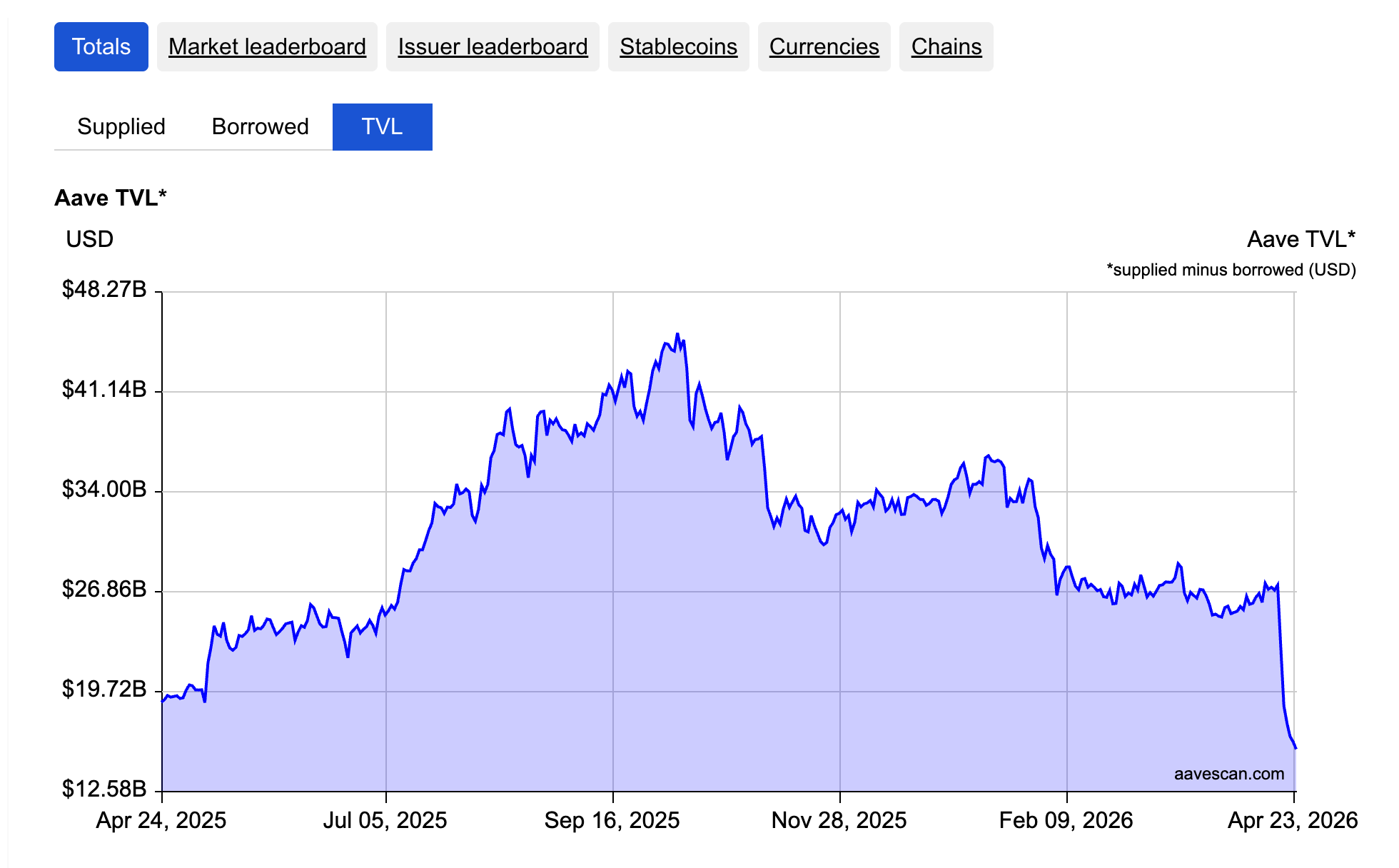
$292 million, this is the total amount of rsETH funds stolen from Kelp DAO; $17.2 billion, this is the scale of funds that have flowed out of Aave since the incident.

Aave is watching as its extremely foolish crisis PR strategy allows community panic to ferment for several consecutive days, thereby losing its former biggest advantage in the lending track — hundreds of billions of dollars in deposited funds and the user perception label of "the safest DeFi".
  • Odaily Note: For background, please refer to "DeFi Hacked Again for $292 Million, Is Aave Not Safe Anymore?"; "The Tripartite Game Under the $290 Million Hole: Who Will Pay, Aave, L0, or Kelp?".

What Did Aave Do Wrong?

The details of the Kelp DAO hack incident need not be repeated. There's no point in blaming Aave for giving rsETH such a high LTV anymore. Here, I mainly want to discuss Aave's response strategy after the incident from the perspective of a long-term AAVE user.

First is the bad debt scale issue. Aave itself has done the math. Depending on the different handling of rsETH, there could be two possibilities for bad debt — If the stolen loss is written off from all circulating rsETH, it is expected to generate $123.7 million in bad debt; If the value of mainnet rsETH is protected, and the loss is fully accounted for in the mapped version of rsETH on Layer2, it is expected to generate $230.1 million in bad debt.

In either case, Aave has the financial strength to cover it with its Umbrella, DAO treasury, and team reserves. I understand that Aave is unwilling to pay this money itself and wants Kelp DAO, the main responsible party, and LayerZero, the secondary responsible party, to also contribute more. But the problem is, the other parties think the same way — "Aave is so rich, the situation is so awkward, surely they should bear more." Therefore, in the short term, it's difficult for these three parties to reach a consensus, meaning a solution that satisfies everyone is temporarily impossible.

But users cannot wait that long — Aave's yield levels have never been very competitive in the industry. Users who choose to deposit funds with Aave do so for its reputation, security, and liquidity. However, the current situation is that in the most critical days following the incident, Aave consistently failed to give users some kind of bottom-line guarantee promise, instead repeatedly emphasizing "our code is not the problem" and "Aave cannot control how rsETH is accounted for" to shift blame.

This is why panic continued to ferment within the community. Users tried every means to escape the risk, withdrawing directly if they could, or borrowing from other pools if they couldn't withdraw, causing the impact to gradually expand. So Aave's current situation is, on one hand, facing continuous fund outflows, and on the other hand, multiple pools are experiencing liquidity drying up due to utilization rates being maxed out.

This awkward situation could have been avoided (or at least not been this bad)...... Since Aave can afford the money, why not inject a dose of reassurance into the community from the start to prevent a bank run? At most, it's $230 million in bad debt (possibly less), and this money wouldn't necessarily be paid by Aave alone; they could negotiate with LayerZero and Kelp DAO later.

Now, it's done. For the sake of saving on a promise of relief worth at most $230 million, Aave watched as $17.2 billion in deposited funds flowed out (the number may continue to grow), and this doesn't even include the decline in the AAVE token price these days...... by any calculation, it's a disastrously bad deal.

What makes Aave even more uncomfortable is that the worse its situation becomes, the more relaxed opponents like LayerZero and Kelp DAO will be, because they will judge that Aave will be more motivated to solve the problem as soon as possible, which only puts Aave at a disadvantage in the博弈 (game theory).

Having reached this point, Aave has brought this upon itself.

Behind Aave, Spark Is Watching Closely

While Aave is suffering from headaches, the situation for its competitor Spark is booming and extremely positive. What's even more lamentable is that Spark is a competitor that Aave "personally incubated".

Spark was originally a lending protocol forked and developed by Sky (formerly MakerDAO) based on the open-source code of Aave V3. Both sides actually use the same underlying code logic. In return, there was once a profit-sharing agreement between Spark and Aave, but later Aave accused Spark of allegedly breaching the contract, and due to route differences, the two are now in a purely competitive relationship.

Three months before the Kelp DAO theft, Spark had just removed support for rsETH (for details, see "Different Fates on the Same Day: Aave Embraces rsETH and Loses Nearly $200M, Spark Exits Unscathed"). You can call it strategic conservatism, rigorous risk control, or even attribute it entirely to luck, but the result is that Spark was completely unaffected by this incident — on this point alone, Spark can brazenly attack Aave's former label of "safest DeFi".

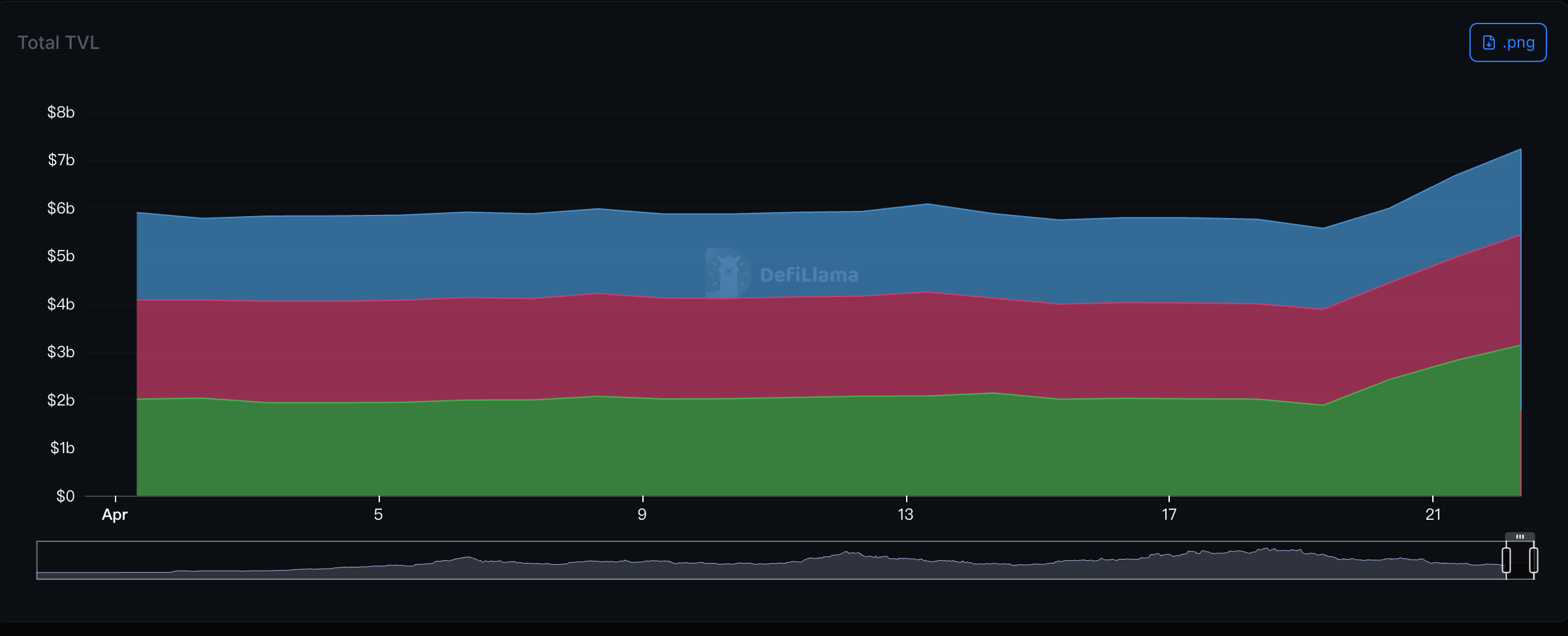
Consequently, Spark became one of the safe havens for funds fleeing Aave. Since the incident, Spark's TVL has grown by nearly $2 billion (green part in the chart below). On the day of the incident, Justin Sun withdrew 53,665 ETH (worth $124 million) from Aave and subsequently deposited it into Spark. After further accumulation in recent days, the total deposit has reached $1.3 billion — In the DeFi world, Brother Sun's (Justin Sun) moves are really something to learn.
On April 23rd, Upbit officially announced the launch of the Spark (SPK) Korean Won trading market. SPK, stimulated by this positive news, surged over 80% in a single day, significantly narrowing the market capitalization gap with AAVE.

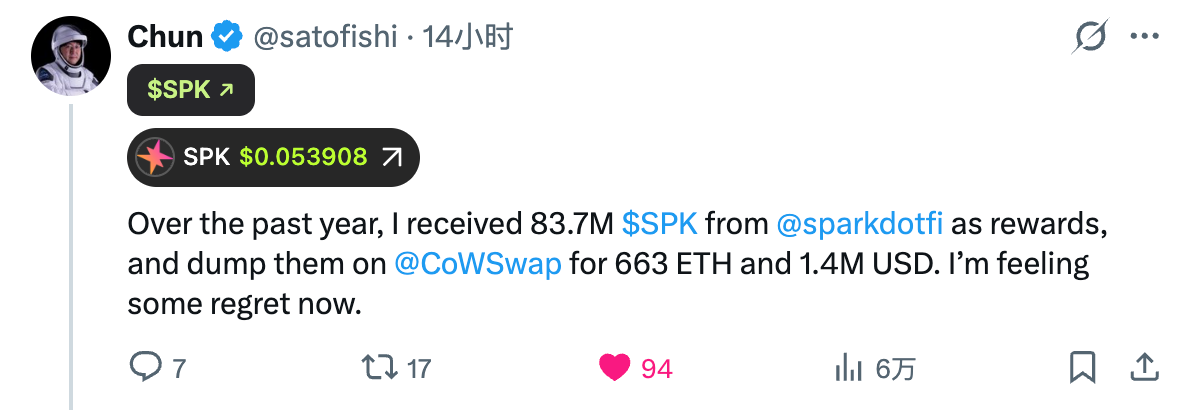
Even Wang Chun, founder of F2Pool, lamented on X: "In the past year, I received 83.7 million SPK rewards from Spark and sold them on CoWSwap for 663 ETH and $1.4 million. Now I kind of regret it."
Spark clearly realizes this is a perfect opportunity to seize market share from Aave's mouth. Since the incident, Spark's Strategy Lead, MonetSupply, has almost become the most vocal KOL on this matter, posting dozens of times a day. Although his comments do help the public understand what happened to some extent, they also objectively exacerbate the panic surrounding Aave.

But this is the purest form of commercial competition. MonetSupply simply made the most correct choice.

Aave Is Losing the Throne of DeFi Lending

In the early hours of April 24th, perhaps realizing the severity of the current situation, Aave founder Stani announced on X the launch of a relief plan called DeFi United. Participating collaborators include LayerZero, Ethena, ether.fi, Ink Foundation, Golem Foundation, Trydo, etc. Stani personally will also donate 5,000 ETH to help resolve the current issue.

But the funds have already flowed out, and user trust has been severely damaged. Relying solely on this belated statement, it will be difficult for Aave to quickly recover the deposited funds and user trust.

The DeFi lending track has long presented a "one superpower, many strong powers" pattern, with Aave一直以来 (yīzhí yǐlái - all along) having a seemingly extremely solid leading advantage. But now, Aave is surrendering the throne. Behind it, challengers are approaching menacingly. Besides the booming Spark, other opponents like Morpho and Jupiter Lend also hope to take a bite out of Aave's share.

Last year, Stani bought a five-story mansion in London for approximately $30 million, one of the most expensive transactions in the UK's sluggish luxury property market over the past year. I don't know if there's something like a "jinx," but following the examples of Su Zhu and others, it seems like big shots in the circle who consume conspicuously always run into some bad luck.

I can't guess what Stani is thinking right now in his five-story mansion.

Crypto di tendenza

Domande pertinenti

QWhat was the main reason for the massive outflow of funds from Aave following the Kelp DAO hack?

AAave's poor crisis management strategy, which failed to provide timely reassurance or a bailout guarantee to its users, leading to widespread panic and a bank run.

QWhat are the two potential bad debt scenarios calculated by Aave for the rsETH incident, and what are the amounts?

AIf the stolen loss is written off from all rsETH, the bad debt would be approximately $123.7 million. If the value of mainnet rsETH is protected and the loss is fully accounted for in the Layer2 mapped version of rsETH, the bad debt would be approximately $230.1 million.

QWhich competitor protocol directly benefited from the funds flowing out of Aave, and what was the approximate amount of TVL it gained?

ASpark Protocol directly benefited, gaining nearly $2 billion in Total Value Locked (TVL) following the incident.

QWhat was the name of the relief plan announced by Aave founder Stani Kulechov in response to the crisis, and what was his personal contribution?

AThe relief plan was named 'DeFi United'. Stani Kulechov personally donated 5,000 ETH to help resolve the situation.

QAccording to the article, what was the primary reason users traditionally deposited funds into Aave, given its uncompetitive yield rates?

AUsers primarily deposited funds into Aave due to its reputation for safety, security, and liquidity, not for competitive yield rates.

Letture associate

7 Months After the Collapse of Huiwang, Southeast Asia's Escrow Platforms Undergo a Major Reshuffle

Following the collapse of Huione Pay—dubbed the "Alipay of Southeast Asia"—seven months ago, the region's underground financial guarantee platform sector is undergoing a significant reshuffle. This power vacuum has been swiftly filled by emerging platforms such as XinBi, Tiger/Navigator, JinBei (renamed JinBo), Dali/Tiancheng, and FullyLight. These platforms, operating largely via Telegram and offering services like escrow for illicit transactions, have absorbed the vast user base and markets left behind by Huione. While positioning themselves as "trust intermediaries," their primary clientele consists of networks involved in online scams, money laundering, illegal gambling, and even human trafficking. For instance, the Tiger/Navigator platform explicitly provides "escrow" services for kidnapping-for-ransom operations ("强押车交易"). Data underscores the immense scale: Huione alone processed over $103 billion in cryptocurrency payments and facilitated over $31 billion through its escrow market before its downfall, linking it to Cambodia's notorious Prince Group. Since its collapse, competitors have seen explosive growth. For example, the XinBi platform has accumulated over $1.6 billion in total USDT revenue, while platforms like NewPay, OkPay (under Dali), and FullyLight Wallet collectively processed over $4.8 billion in USDT in a single year. This ecosystem thrives in regions like Cambodia and Myanmar, where regulatory gaps allow these platforms to act as critical financial infrastructure for sprawling cybercrime industries, from scam compounds to online casinos. The article concludes that the moniker "Southeast Asian Alipay" is a misnomer, obscuring the platforms' fundamental role in enabling serious criminal enterprises rather than representing legitimate financial innovation.

Odaily星球日报30 min fa

7 Months After the Collapse of Huiwang, Southeast Asia's Escrow Platforms Undergo a Major Reshuffle

Odaily星球日报30 min fa

The Changing Landscape: What Are Crypto VCs Experiencing?

Title: The Shifting Landscape of Crypto Venture Capital The era of dedicated crypto venture capital funds is undergoing a significant transformation. Once essential for navigating the sector's complexity and high risk, these specialized funds are now facing an identity crisis as the market matures. This shift mirrors historical patterns in other specialized investment classes like cleantech and SPACs, where initial information advantages dissipate as technologies become mainstream and integrated into existing industry frameworks. The article argues that crypto is reaching a critical inflection point, transitioning from a "building phase" to an "integration phase." Major players like Stripe, BlackRock, and Visa now engage with crypto not for its novel mechanics but as a foundational financial infrastructure. Their needs—regulatory compliance, banking partnerships, distribution channels—align with traditional fintech, a domain easily understood by large, generalist funds like Sequoia and Founders Fund. This evolution creates a "barbell effect" within the VC landscape. On one end are massive, diversified platforms that can incorporate crypto as one vertical among many. On the other are small, nimble funds focused on niche, experimental projects. The middle ground—medium-sized dedicated crypto funds—is being squeezed out. Their typical fund size makes it impossible to generate sufficient returns solely from early-stage crypto bets, yet they cannot compete with giants for later-stage deals. Consequently, leading crypto-native firms like Paradigm and Framework Ventures are expanding into AI, robotics, and other sectors, driven partly by LP pressure for better returns amid a broader VC DPI crisis. Others, like Dragonfly and a16z, have narrowed their crypto focus predominantly to financial infrastructure like stablecoins, reframing the sector's core narrative. For crypto entrepreneurs, this consolidation presents challenges. While generalist funds offer larger checks and broader resources, crypto projects now compete fiercely with AI for attention and capital within these firms. Furthermore, the long-term, non-commercial foundational work that built the ecosystem—funded by dedicated crypto VCs—is less likely to attract generalist capital focused on direct returns. The conclusion is that "crypto investor" as a standalone category is becoming obsolete, akin to "internet investor." Crypto is becoming a baseline infrastructure layer. The future will see a barbell structure: large-scale growth financing handled by generalist funds, while pioneering, speculative projects are funded by small, specialized vehicles. The dedicated crypto funds of the 2017-2021 boom, which incubated core infrastructure, are giving way to this new, bifurcated reality.

Foresight News47 min fa

The Changing Landscape: What Are Crypto VCs Experiencing?

Foresight News47 min fa

As Consensus Accelerates, What Are Young Investors Betting On?

Title: As Consensus Forms Faster, What Are Young Investors Betting On? In the rapid evolution of tech investment, a new generation of young investors is navigating a landscape where AI, robotics, commercial aerospace, and quantum computing are advancing simultaneously. Traditional investment logic based on financial models is giving way to a need for deep technical understanding and the ability to act before industry consensus forms. An analysis of trends from the "WAIC FUTURE TECH" list of young investment leaders reveals key shifts in focus. The first major trend is the movement of AI from the digital screen into the physical world. Investment is shifting from large language models and chatbots towards embodied AI, robotics, AI hardware, and edge computing. While demonstrations generate excitement, the real challenge lies in achieving scalable, reliable, and cost-effective delivery in complex real-world environments like factories and logistics. Success depends not just on algorithms but on the integration of sensors, actuators, and control systems. Second, the competitive focus for large models is moving beyond raw capability toward building an "intelligence flywheel." The goal is to create self-reinforcing systems where user interaction generates data, improving the model, which in turn enhances the user experience and attracts more engagement. Companies that successfully embed AI into workflows to create these closed-loop systems can build lasting value that isn't easily erased by the next model upgrade. Third, facing a potential bottleneck in high-quality human-generated data, investors are looking at new underlying technologies. Reinforcement learning and self-play, as demonstrated by AlphaGo Zero, offer paths for AI to generate its own experience. Scientific foundation models, which aim to build general AI capabilities for fields like life sciences and materials discovery, represent a non-consensus direction that could unlock new frontiers of knowledge and data. Finally, in deep-tech areas like quantum computing, commercial aerospace, and space-based infrastructure, patient capital is essential. These fields have long, uncertain development and validation cycles involving complex engineering, supply chains, and regulations. Investment here requires a long-term view, focusing on foundational team capabilities and the eventual emergence of market demand, even if commercial returns are distant. Collectively, these trends illustrate how young investors are adapting to a new era. They are learning to make earlier, technically-informed judgments, balance hype with real-world viability, and provide the patient capital needed to build the deep-tech foundations of the future.

marsbit1 h fa

As Consensus Accelerates, What Are Young Investors Betting On?

marsbit1 h fa

Trading

Spot

Articoli Popolari

Come comprare AAVE

Benvenuto in HTX.com! Abbiamo reso l'acquisto di Aave Protocol (AAVE) semplice e conveniente. Segui la nostra guida passo passo per intraprendere il tuo viaggio nel mondo delle criptovalute.Step 1: Crea il tuo Account HTXUsa la tua email o numero di telefono per registrarti il tuo account gratuito su HTX. Vivi un'esperienza facile e sblocca tutte le funzionalità,Crea il mio accountStep 2: Vai in Acquista crypto e seleziona il tuo metodo di pagamentoCarta di credito/debito: utilizza la tua Visa o Mastercard per acquistare immediatamente Aave ProtocolAAVE.Bilancio: Usa i fondi dal bilancio del tuo account HTX per fare trading senza problemi.Terze parti: abbiamo aggiunto metodi di pagamento molto utilizzati come Google Pay e Apple Pay per maggiore comodità.P2P: Fai trading direttamente con altri utenti HTX.Over-the-Counter (OTC): Offriamo servizi su misura e tassi di cambio competitivi per i trader.Step 3: Conserva Aave Protocol (AAVE)Dopo aver acquistato Aave Protocol (AAVE), conserva nel tuo account HTX. In alternativa, puoi inviare tramite trasferimento blockchain o scambiare per altre criptovalute.Step 4: Scambia Aave Protocol (AAVE)Scambia facilmente Aave Protocol (AAVE) nel mercato spot di HTX. Accedi al tuo account, seleziona la tua coppia di trading, esegui le tue operazioni e monitora in tempo reale. Offriamo un'esperienza user-friendly sia per chi ha appena iniziato che per i trader più esperti.

347 Totale visualizzazioniPubblicato il 2024.12.11Aggiornato il 2026.06.02

Come comprare AAVE

Discussioni

Benvenuto nella Community HTX. Qui puoi rimanere informato sugli ultimi sviluppi della piattaforma e accedere ad approfondimenti esperti sul mercato. Le opinioni degli utenti sul prezzo di AAVE AAVE sono presentate come di seguito.

活动图片













