Original | Odaily Planet Daily (@OdailyChina)
Author | Azuma (@azuma_eth)

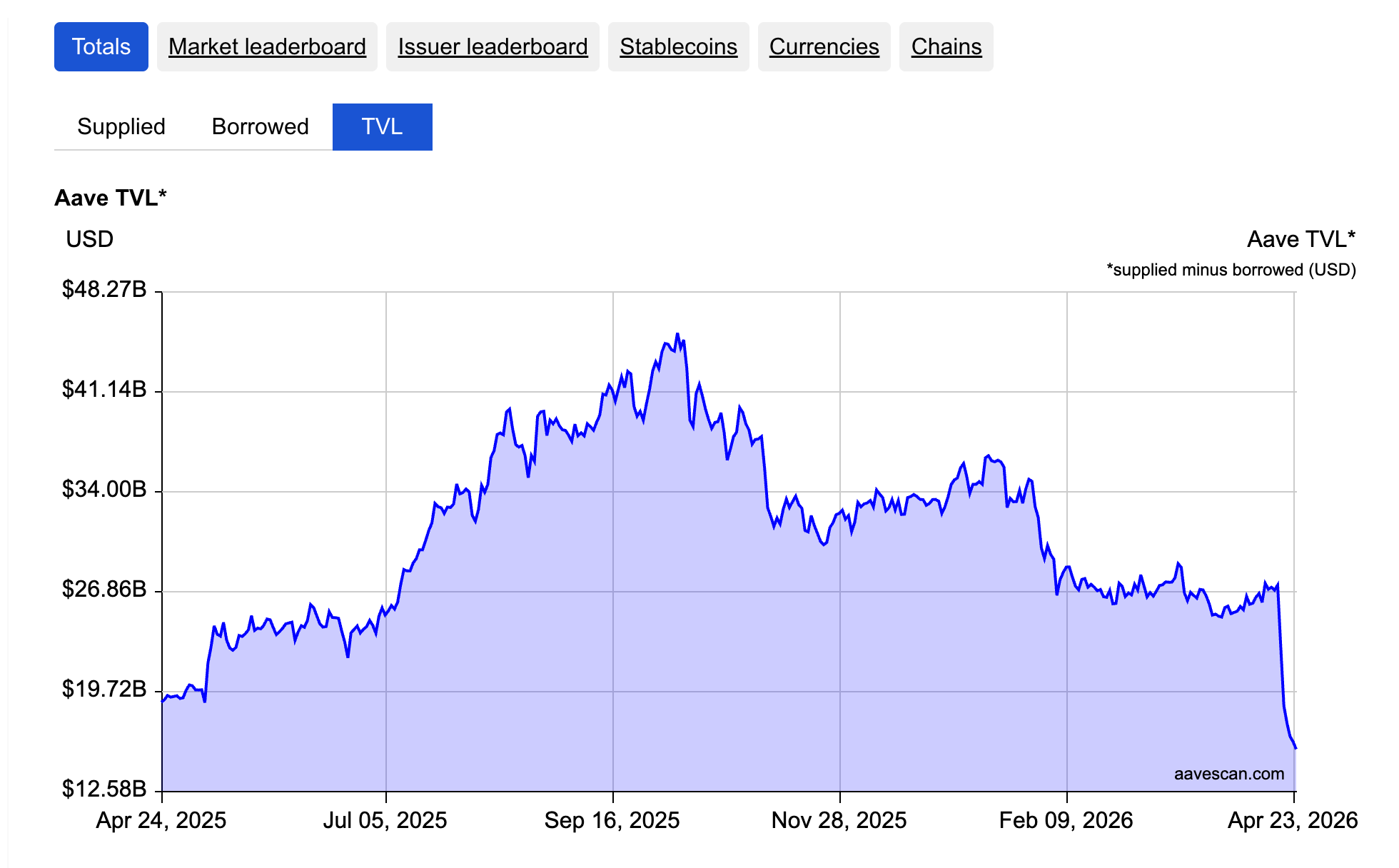
$292 million, this is the total amount of rsETH funds stolen from Kelp DAO; $17.2 billion, this is the scale of funds that have flowed out of Aave since the incident.
Aave is watching as its extremely foolish crisis PR strategy allows community panic to ferment for several consecutive days, thereby losing its former biggest advantage in the lending track — hundreds of billions of dollars in deposited funds and the user perception label of "the safest DeFi".
- Odaily Note: For background, please refer to "DeFi Hacked Again for $292 Million, Is Aave Not Safe Anymore?"; "The Tripartite Game Under the $290 Million Hole: Who Will Pay, Aave, L0, or Kelp?".
What Did Aave Do Wrong?
The details of the Kelp DAO hack incident need not be repeated. There's no point in blaming Aave for giving rsETH such a high LTV anymore. Here, I mainly want to discuss Aave's response strategy after the incident from the perspective of a long-term AAVE user.
First is the bad debt scale issue. Aave itself has done the math. Depending on the different handling of rsETH, there could be two possibilities for bad debt — If the stolen loss is written off from all circulating rsETH, it is expected to generate $123.7 million in bad debt; If the value of mainnet rsETH is protected, and the loss is fully accounted for in the mapped version of rsETH on Layer2, it is expected to generate $230.1 million in bad debt.
In either case, Aave has the financial strength to cover it with its Umbrella, DAO treasury, and team reserves. I understand that Aave is unwilling to pay this money itself and wants Kelp DAO, the main responsible party, and LayerZero, the secondary responsible party, to also contribute more. But the problem is, the other parties think the same way — "Aave is so rich, the situation is so awkward, surely they should bear more." Therefore, in the short term, it's difficult for these three parties to reach a consensus, meaning a solution that satisfies everyone is temporarily impossible.
But users cannot wait that long — Aave's yield levels have never been very competitive in the industry. Users who choose to deposit funds with Aave do so for its reputation, security, and liquidity. However, the current situation is that in the most critical days following the incident, Aave consistently failed to give users some kind of bottom-line guarantee promise, instead repeatedly emphasizing "our code is not the problem" and "Aave cannot control how rsETH is accounted for" to shift blame.
This is why panic continued to ferment within the community. Users tried every means to escape the risk, withdrawing directly if they could, or borrowing from other pools if they couldn't withdraw, causing the impact to gradually expand. So Aave's current situation is, on one hand, facing continuous fund outflows, and on the other hand, multiple pools are experiencing liquidity drying up due to utilization rates being maxed out.
This awkward situation could have been avoided (or at least not been this bad)...... Since Aave can afford the money, why not inject a dose of reassurance into the community from the start to prevent a bank run? At most, it's $230 million in bad debt (possibly less), and this money wouldn't necessarily be paid by Aave alone; they could negotiate with LayerZero and Kelp DAO later.
Now, it's done. For the sake of saving on a promise of relief worth at most $230 million, Aave watched as $17.2 billion in deposited funds flowed out (the number may continue to grow), and this doesn't even include the decline in the AAVE token price these days...... by any calculation, it's a disastrously bad deal.
What makes Aave even more uncomfortable is that the worse its situation becomes, the more relaxed opponents like LayerZero and Kelp DAO will be, because they will judge that Aave will be more motivated to solve the problem as soon as possible, which only puts Aave at a disadvantage in the博弈 (game theory).
Having reached this point, Aave has brought this upon itself.
Behind Aave, Spark Is Watching Closely
While Aave is suffering from headaches, the situation for its competitor Spark is booming and extremely positive. What's even more lamentable is that Spark is a competitor that Aave "personally incubated".
Spark was originally a lending protocol forked and developed by Sky (formerly MakerDAO) based on the open-source code of Aave V3. Both sides actually use the same underlying code logic. In return, there was once a profit-sharing agreement between Spark and Aave, but later Aave accused Spark of allegedly breaching the contract, and due to route differences, the two are now in a purely competitive relationship.
Three months before the Kelp DAO theft, Spark had just removed support for rsETH (for details, see "Different Fates on the Same Day: Aave Embraces rsETH and Loses Nearly $200M, Spark Exits Unscathed"). You can call it strategic conservatism, rigorous risk control, or even attribute it entirely to luck, but the result is that Spark was completely unaffected by this incident — on this point alone, Spark can brazenly attack Aave's former label of "safest DeFi".
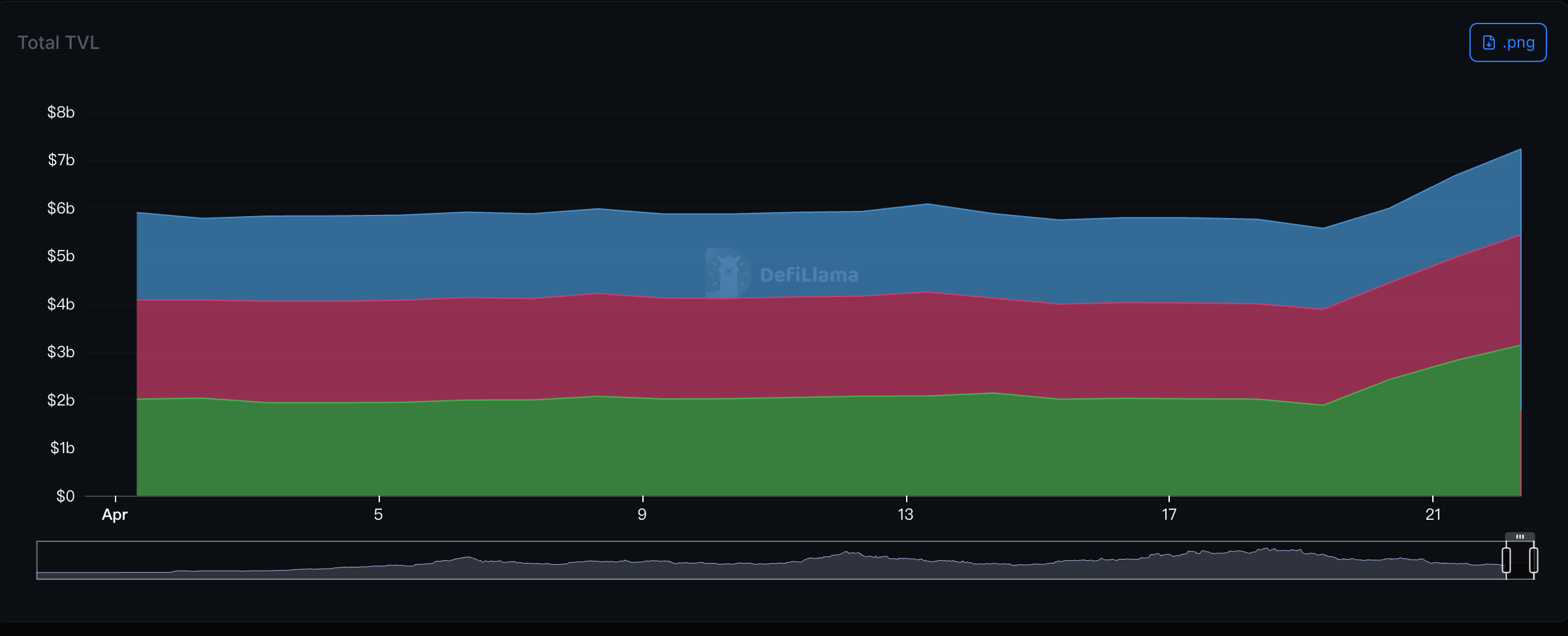
Consequently, Spark became one of the safe havens for funds fleeing Aave. Since the incident, Spark's TVL has grown by nearly $2 billion (green part in the chart below). On the day of the incident, Justin Sun withdrew 53,665 ETH (worth $124 million) from Aave and subsequently deposited it into Spark. After further accumulation in recent days, the total deposit has reached $1.3 billion — In the DeFi world, Brother Sun's (Justin Sun) moves are really something to learn.
On April 23rd, Upbit officially announced the launch of the Spark (SPK) Korean Won trading market. SPK, stimulated by this positive news, surged over 80% in a single day, significantly narrowing the market capitalization gap with AAVE.
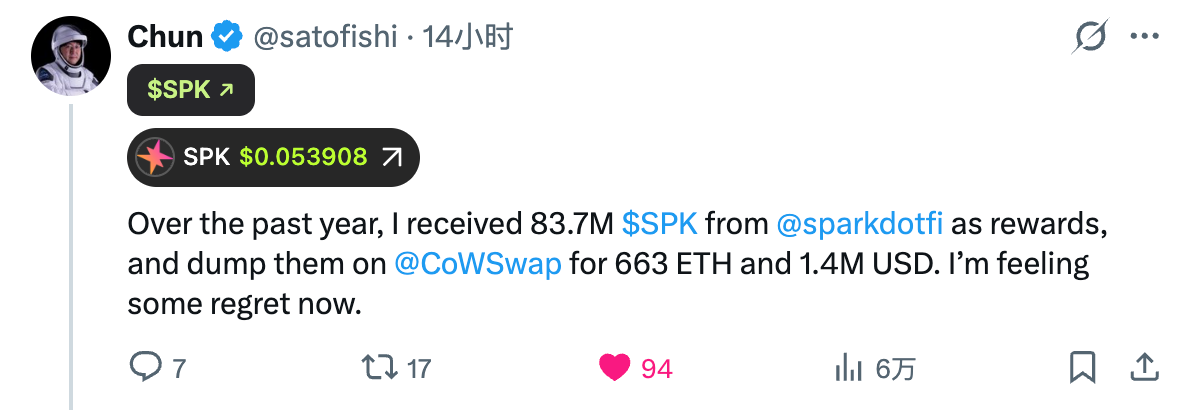
Even Wang Chun, founder of F2Pool, lamented on X: "In the past year, I received 83.7 million SPK rewards from Spark and sold them on CoWSwap for 663 ETH and $1.4 million. Now I kind of regret it."
Spark clearly realizes this is a perfect opportunity to seize market share from Aave's mouth. Since the incident, Spark's Strategy Lead, MonetSupply, has almost become the most vocal KOL on this matter, posting dozens of times a day. Although his comments do help the public understand what happened to some extent, they also objectively exacerbate the panic surrounding Aave.
But this is the purest form of commercial competition. MonetSupply simply made the most correct choice.
Aave Is Losing the Throne of DeFi Lending
In the early hours of April 24th, perhaps realizing the severity of the current situation, Aave founder Stani announced on X the launch of a relief plan called DeFi United. Participating collaborators include LayerZero, Ethena, ether.fi, Ink Foundation, Golem Foundation, Trydo, etc. Stani personally will also donate 5,000 ETH to help resolve the current issue.
But the funds have already flowed out, and user trust has been severely damaged. Relying solely on this belated statement, it will be difficult for Aave to quickly recover the deposited funds and user trust.
The DeFi lending track has long presented a "one superpower, many strong powers" pattern, with Aave一直以来 (yīzhí yǐlái - all along) having a seemingly extremely solid leading advantage. But now, Aave is surrendering the throne. Behind it, challengers are approaching menacingly. Besides the booming Spark, other opponents like Morpho and Jupiter Lend also hope to take a bite out of Aave's share.
Last year, Stani bought a five-story mansion in London for approximately $30 million, one of the most expensive transactions in the UK's sluggish luxury property market over the past year. I don't know if there's something like a "jinx," but following the examples of Su Zhu and others, it seems like big shots in the circle who consume conspicuously always run into some bad luck.
I can't guess what Stani is thinking right now in his five-story mansion.


















