Aave governance vote sparks backlash over rushed escalation

cointelegraphPubblicato 2025-12-22Pubblicato ultima volta 2025-12-22

Introduzione

A governance vote at Aave has sparked significant backlash after a proposal regarding control of the protocol's brand assets was escalated to a snapshot vote, despite unresolved community discussions. The proposal seeks to transfer ownership of domains, social handles, and other intellectual property to AAVE token holders via a DAO-controlled legal structure. Aave founder Stani Kulechov defended the move, stating the community was ready for a decision after five days of discussion. However, critics, including former Aave Labs CTO Ernesto Boado and Aave Chan Initiative lead Marc Zeller, accused the team of rushing the vote without proper consent or dialogue. Zeller described the action as a "hostile takeover attempt," criticizing the timing during the holiday period, which limited participation and mobilization. The controversy highlights ongoing governance challenges within the DeFi protocol concerning control over proposal escalation and decision-making processes.

A governance vote at decentralized finance (DeFi) lending protocol Aave sparked a backlash from key stakeholders after a proposal on ownership of Aave's brand assets was escalated to a snapshot vote amid unresolved discussion.

The proposal asks the community whether Aave (AAVE) token holders should regain control over the protocol’s brand assets, including domains, social handles, naming rights and other intellectual property through a DAO-controlled legal vehicle.

Aave founder Stani Kulechov said the community was interested in a decision, announcing that the proposal had been moved to a vote.

“We realize the community is very interested in a path forward and is ready to make a decision,” Kulechov wrote.

While Kulechov said it was time for tokenholders to vote, other community members argued that the proposal was pushed to a vote prematurely, bypassing governance norms.
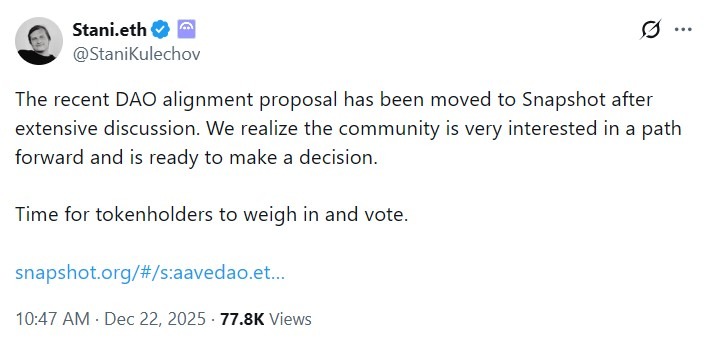
Source: Stani Kulechov

Related: SEC ends probe into Aave after four years, CEO Kulechov says

Aave Labs faces “hostile takeover” accusations

Former Aave Labs chief technology officer Ernesto Boado, whose name appears as the proposal’s author, said the vote was escalated without his consent or knowledge.

“This is not, in ethos, my proposal,” Boado wrote on X, saying that he would not have approved the submission for a vote while community discussion was still ongoing. He said the escalation breaks the code of trust in the community.

Marc Zeller, who leads the Aave Chan Initiative (ACI), said the proposal was “unilaterally escalated” despite unresolved questions from delegates and token holders.

In a public statement, Zeller said that the timing and process choices materially reduced community participation, adding that the ability of late-informed participants to mobilize or redelegate was being limited.

“What started as a push for clarity and a more fair relationship between token holders and the current stewards,” Zeller said, “is now turning into a hostile takeover attempt by Labs.”

Zeller criticized the decision of pushing the vote during the holiday period, which large stakeholders, investors and institutions have flagged as one of the “worst windows” for high-stakes governance votes.

Responding to the criticisms, Kulechov said that the discussion has been going on for five days, with many comments, and claimed that the vote complies with all the requirements.

“People are tired of this discussion and getting into a vote is the best way to resolve, this is governance end of the day,” he wrote.

The dispute highlighted deeper governance questions for Aave, one of the biggest DeFi protocols in the space.

While the proposal focuses on “soft” asset ownership, the backlash underscores how much influence can stem from control over escalation, timing and information flow.

Magazine: Bitcoin whale Metaplanet ‘underwater’ but eyeing more BTC: Asia Express

Domande pertinenti

QWhat is the main reason for the backlash in the Aave governance vote?

AThe backlash occurred because a proposal on ownership of Aave's brand assets was escalated to a snapshot vote prematurely, bypassing governance norms and without resolving ongoing community discussions.

QWho is the author of the controversial proposal, and what was his reaction?

AThe proposal's author is former Aave Labs chief technology officer Ernesto Boado, who stated the vote was escalated without his consent or knowledge, breaking the community's code of trust.

QWhat did Marc Zeller of the Aave Chan Initiative accuse Aave Labs of attempting?

AMarc Zeller accused Aave Labs of attempting a 'hostile takeover' by unilaterally escalating the vote despite unresolved questions and limiting community participation during the holiday period.

QHow did Aave founder Stani Kulechov justify moving the proposal to a vote?

AStani Kulechov claimed the community was tired of the five-day discussion and that moving to a vote was the best way to resolve the issue, asserting it complied with all governance requirements.

QWhat broader governance issue did the dispute highlight for Aave?

AThe dispute highlighted how control over escalation timing and information flow can significantly influence governance outcomes, even for proposals focused on 'soft' asset ownership.

Letture associate

In-Depth Report on the On-Chain Lending Market: When Off-Chain Credit Meets On-Chain Liquidation

The on-chain lending market has evolved from a peripheral DeFi niche into core financial infrastructure. As of early 2026, total value locked (TVL) in on-chain lending protocols has reached $64.3 billion, accounting for 53.54% of total DeFi TVL, making it the largest and most mature vertical within decentralized finance. Aave dominates the sector with approximately $32.9 billion in TVL, commanding nearly half of the market—a leadership position that is unlikely to be challenged in the foreseeable future. However, the path of on-chain lending forward is not without risk. Liquidation cascades, credit defaults, and cross-chain vulnerabilities remain systemic threats hanging over the industry. At the same time, a deeper structural transformation is underway: on-chain lending is shifting from a “leverage tool for crypto-native users” to a “compliant gateway for institutional capital”. The scale of RWA (Real World Asset) lending has surpassed $18.5 billion, with U.S. Treasuries and government securities increasingly serving as core collateral. Institutional capital inflows are reshaping both the user base and risk appetite of the sector. This report systematically analyzes the evolution of on-chain lending definitions, competitive dynamics, core risks, and future trends, providing a comprehensive industry outlook for investors and trade practitioners. Key findings suggest that the “one dominant player with several strong challengers” structure will persist in the short term, while fixed-rate lending, compliant collateral, and institutional credit underwriting will define the next phase of competition. For investors focused on DeFi infrastructure, three key opportunity tracks stand out, namely, the Aave ecosystem (Morpho, Spark), RWA lending protocols (Ondo, Maple) and fixed-rate innovation (Notional, Pendle).

HTX Learn59 min fa

In-Depth Report on the On-Chain Lending Market: When Off-Chain Credit Meets On-Chain Liquidation

HTX Learn59 min fa

Fu Peng's First Public Speech in 2026: What Exactly Are Crypto Assets? Why Did I Join the Crypto Asset Industry?

Fu Peng, a renowned macroeconomist and now Chief Economist at New火 Group, delivered his first public speech of 2026 at the Hong Kong Web3 Festival. He explained his perspective on crypto assets and why he joined the industry, framing it within the context of macroeconomic trends and financial evolution. Fu emphasized that crypto assets are transitioning from an early, belief-driven phase to a mature, institutionally integrated asset class. He drew parallels to the 1970s-80s, when technological advances (like computing) revolutionized traditional finance, leading to the rise of FICC (Fixed Income, Currencies, and Commodities). Similarly, current advancements in AI, data, and blockchain are reshaping finance, with crypto assets becoming part of a new "FICC + C" (C for Crypto) framework. He noted that institutional capital, including traditional hedge funds, avoided early crypto due to its speculative nature but are now engaging as regulatory clarity emerges (e.g., stablecoin laws, CFTC classifying crypto as a commodity). Fu predicted that 2025-2026 marks a turning point where crypto becomes a standardized, financially viable asset for diversified portfolios, akin to commodities or derivatives in traditional finance. Fu defined Bitcoin not as "digital gold" in a simplistic sense but as a value-preserving, financially tradable asset. He highlighted that crypto's future lies in regulated, institutional adoption, moving away from retail-dominated trading. His entry into crypto signals this maturation, where traditional finance integrates crypto into mainstream asset management.

marsbit2 h fa

Fu Peng's First Public Speech in 2026: What Exactly Are Crypto Assets? Why Did I Join the Crypto Asset Industry?

marsbit2 h fa

Justin Sun Sues Trump Family: What $75 Million Bought Was Only a Blacklist

Justin Sun, founder of Tron, has filed a lawsuit in federal court against World Liberty Financial (WLF), alleging he was made the "primary target of a fraudulent scheme" after investing $75 million. Sun claims the investment secured him an advisor title and WLFI tokens, which were later frozen by WLF, causing "hundreds of millions in losses." The dispute began in late 2024 when Sun's investment helped revive WLF's struggling token sale, which ultimately raised $550 million. Shortly after, the SEC dropped its lawsuit against Sun following Donald Trump's inauguration. However, relations soured when Sun refused WLF's demands for additional funding. In August 2025, WLF added a "blacklist" function to its smart contract, allowing it to unilaterally freeze tokens. Sun's holdings, worth approximately $107 million, were frozen, and he was threatened with token destruction. The lawsuit highlights WLF's structure, which directs 75% of token sale profits to the Trump family, who had earned $1 billion by December 2025. WLF's CEO is Zach Witkoff, son of U.S. Middle East envoy Steve Witkoff. The project faces scrutiny for opaque operations, including a controversial loan arrangement on the Dolomite platform, co-founded by a WLF advisor. Despite Sun's history with the SEC, the case underscores centralization risks within DeFi, as WLF controls governance and holds powers to freeze assets arbitrarily. Sun's tokens remain frozen as legal proceedings begin.

marsbit2 h fa

Justin Sun Sues Trump Family: What $75 Million Bought Was Only a Blacklist

marsbit2 h fa

Trading

Spot
Futures

Articoli Popolari

Come comprare AAVE

Benvenuto in HTX.com! Abbiamo reso l'acquisto di Aave Protocol (AAVE) semplice e conveniente. Segui la nostra guida passo passo per intraprendere il tuo viaggio nel mondo delle criptovalute.Step 1: Crea il tuo Account HTXUsa la tua email o numero di telefono per registrarti il tuo account gratuito su HTX. Vivi un'esperienza facile e sblocca tutte le funzionalità,Crea il mio accountStep 2: Vai in Acquista crypto e seleziona il tuo metodo di pagamentoCarta di credito/debito: utilizza la tua Visa o Mastercard per acquistare immediatamente Aave ProtocolAAVE.Bilancio: Usa i fondi dal bilancio del tuo account HTX per fare trading senza problemi.Terze parti: abbiamo aggiunto metodi di pagamento molto utilizzati come Google Pay e Apple Pay per maggiore comodità.P2P: Fai trading direttamente con altri utenti HTX.Over-the-Counter (OTC): Offriamo servizi su misura e tassi di cambio competitivi per i trader.Step 3: Conserva Aave Protocol (AAVE)Dopo aver acquistato Aave Protocol (AAVE), conserva nel tuo account HTX. In alternativa, puoi inviare tramite trasferimento blockchain o scambiare per altre criptovalute.Step 4: Scambia Aave Protocol (AAVE)Scambia facilmente Aave Protocol (AAVE) nel mercato spot di HTX. Accedi al tuo account, seleziona la tua coppia di trading, esegui le tue operazioni e monitora in tempo reale. Offriamo un'esperienza user-friendly sia per chi ha appena iniziato che per i trader più esperti.

313 Totale visualizzazioniPubblicato il 2024.12.11Aggiornato il 2025.03.21

Come comprare AAVE

Discussioni

Benvenuto nella Community HTX. Qui puoi rimanere informato sugli ultimi sviluppi della piattaforma e accedere ad approfondimenti esperti sul mercato. Le opinioni degli utenti sul prezzo di AAVE AAVE sono presentate come di seguito.

活动图片