Aave governance vote sparks backlash over rushed escalation

cointelegraphPubblicato 2025-12-22Pubblicato ultima volta 2025-12-22

Introduzione

A governance vote at Aave has sparked significant backlash after a proposal regarding control of the protocol's brand assets was escalated to a snapshot vote, despite unresolved community discussions. The proposal seeks to transfer ownership of domains, social handles, and other intellectual property to AAVE token holders via a DAO-controlled legal structure. Aave founder Stani Kulechov defended the move, stating the community was ready for a decision after five days of discussion. However, critics, including former Aave Labs CTO Ernesto Boado and Aave Chan Initiative lead Marc Zeller, accused the team of rushing the vote without proper consent or dialogue. Zeller described the action as a "hostile takeover attempt," criticizing the timing during the holiday period, which limited participation and mobilization. The controversy highlights ongoing governance challenges within the DeFi protocol concerning control over proposal escalation and decision-making processes.

A governance vote at decentralized finance (DeFi) lending protocol Aave sparked a backlash from key stakeholders after a proposal on ownership of Aave's brand assets was escalated to a snapshot vote amid unresolved discussion.

The proposal asks the community whether Aave (AAVE) token holders should regain control over the protocol’s brand assets, including domains, social handles, naming rights and other intellectual property through a DAO-controlled legal vehicle.

Aave founder Stani Kulechov said the community was interested in a decision, announcing that the proposal had been moved to a vote.

“We realize the community is very interested in a path forward and is ready to make a decision,” Kulechov wrote.

While Kulechov said it was time for tokenholders to vote, other community members argued that the proposal was pushed to a vote prematurely, bypassing governance norms.
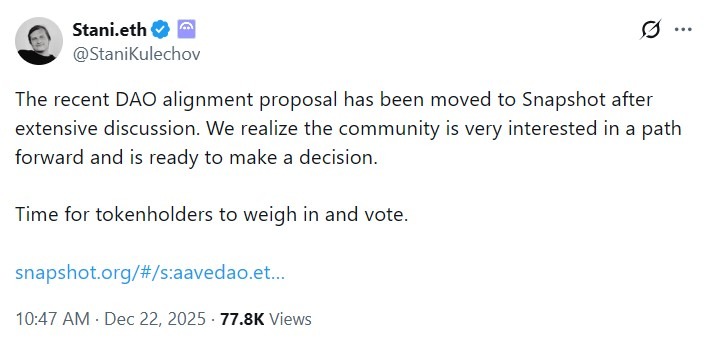
Source: Stani Kulechov

Related: SEC ends probe into Aave after four years, CEO Kulechov says

Aave Labs faces “hostile takeover” accusations

Former Aave Labs chief technology officer Ernesto Boado, whose name appears as the proposal’s author, said the vote was escalated without his consent or knowledge.

“This is not, in ethos, my proposal,” Boado wrote on X, saying that he would not have approved the submission for a vote while community discussion was still ongoing. He said the escalation breaks the code of trust in the community.

Marc Zeller, who leads the Aave Chan Initiative (ACI), said the proposal was “unilaterally escalated” despite unresolved questions from delegates and token holders.

In a public statement, Zeller said that the timing and process choices materially reduced community participation, adding that the ability of late-informed participants to mobilize or redelegate was being limited.

“What started as a push for clarity and a more fair relationship between token holders and the current stewards,” Zeller said, “is now turning into a hostile takeover attempt by Labs.”

Zeller criticized the decision of pushing the vote during the holiday period, which large stakeholders, investors and institutions have flagged as one of the “worst windows” for high-stakes governance votes.

Responding to the criticisms, Kulechov said that the discussion has been going on for five days, with many comments, and claimed that the vote complies with all the requirements.

“People are tired of this discussion and getting into a vote is the best way to resolve, this is governance end of the day,” he wrote.

The dispute highlighted deeper governance questions for Aave, one of the biggest DeFi protocols in the space.

While the proposal focuses on “soft” asset ownership, the backlash underscores how much influence can stem from control over escalation, timing and information flow.

Magazine: Bitcoin whale Metaplanet ‘underwater’ but eyeing more BTC: Asia Express

Crypto di tendenza

Domande pertinenti

QWhat is the main reason for the backlash in the Aave governance vote?

AThe backlash occurred because a proposal on ownership of Aave's brand assets was escalated to a snapshot vote prematurely, bypassing governance norms and without resolving ongoing community discussions.

QWho is the author of the controversial proposal, and what was his reaction?

AThe proposal's author is former Aave Labs chief technology officer Ernesto Boado, who stated the vote was escalated without his consent or knowledge, breaking the community's code of trust.

QWhat did Marc Zeller of the Aave Chan Initiative accuse Aave Labs of attempting?

AMarc Zeller accused Aave Labs of attempting a 'hostile takeover' by unilaterally escalating the vote despite unresolved questions and limiting community participation during the holiday period.

QHow did Aave founder Stani Kulechov justify moving the proposal to a vote?

AStani Kulechov claimed the community was tired of the five-day discussion and that moving to a vote was the best way to resolve the issue, asserting it complied with all governance requirements.

QWhat broader governance issue did the dispute highlight for Aave?

AThe dispute highlighted how control over escalation timing and information flow can significantly influence governance outcomes, even for proposals focused on 'soft' asset ownership.

Letture associate

L2 'Recalibration': When L1 Becomes Its Own Rollup, What Is Ethereum's Endgame?

The article discusses the evolving relationship between Ethereum's Layer 1 (L1) and Layer 2 (L2) solutions, moving beyond the initial "L2 for scaling" model. As Ethereum L1 itself scales (increasing Gas Limit, statelessness, zkEVM), the unique value proposition of L2s shifts from merely providing cheap execution to offering differentiated features like application-specific optimization, privacy, and flexible governance. The piece explores three key themes: 1. **L2's New Role:** L2s are transitioning from a pure scaling technology to a spectrum of execution environments with varying degrees of security inheritance from Ethereum L1. 2. **Interoperability as State Trust:** Solving L2 fragmentation is less about cross-chain bridges and more about enabling faster, trust-minimized state verification between environments. This involves initiatives like faster L1 finality, intent-based architectures (Open Intents Framework), and native account abstraction. 3. **Blurring Layers:** With the potential integration of zk-proofs into L1 validation (making L1 akin to its own "Rollup") and the concept of "Native Rollups," the rigid boundary between L1 and L2 may fade. The future could be a unified system with multiple execution domains (for DeFi, gaming, privacy, etc.) sharing a common security, settlement, and state framework. In conclusion, Ethereum's goal is not to abandon L2s or re-centralize everything on L1, but to re-integrate the fragmented user experience—liquidity, accounts, applications—while preserving the scaling benefits of a multi-environment ecosystem. The endgame is a cohesive "one chain" feeling for users, powered by diverse but securely interconnected execution layers.

marsbit4 min fa

L2 'Recalibration': When L1 Becomes Its Own Rollup, What Is Ethereum's Endgame?

marsbit4 min fa

The Encryption Bill Clarity's Challenge: A Thorny Path of Bipartisan Compromise in the U.S.

U.S. lawmakers are attempting to advance the Clarity Act, a significant crypto market structure bill, but its path is fraught with partisan hurdles. The process has been rocky since January, when a prior bipartisan deal in the Senate Banking Committee was upended. A key compromise in May on "yield" issues allowed the bill to move forward in committee, but only with the conditional support of two Democratic senators, Angela Alsobrooks and Ruben Gallego. They emphasized that their final vote depends on reaching an agreement on ethics provisions for elected officials. Ultimately, the Senate Agriculture Committee passed its version along party lines without Democratic support. As Republicans push for a full Senate vote in July, the demand for strong ethics language has expanded beyond Democrats. Additional controversies surround provisions related to yields (aligning some Republicans with large banks) and developer protections (opposed by enforcement agencies). Core concerns about illicit finance and consumer protection remain central to the debate. Despite consensus on the need for legislation, achieving the necessary bipartisan compromise is proving difficult. While momentum exists—including recent meetings between senators and White House officials—a reconciled bill text faces skepticism. Senator Gallego has stated that without ethics terms acceptable to Democrats, they will not provide the needed votes. The immediate goals for the crypto community in Congress are unclear: a symbolic Senate vote before the August recess, eventual passage into law by 2026, or forging a final compromise framework. The arduous, vote-by-vote effort to build bipartisan support continues, mirroring the traditional legislative grind the industry must now navigate.

Foresight News54 min fa

The Encryption Bill Clarity's Challenge: A Thorny Path of Bipartisan Compromise in the U.S.

Foresight News54 min fa

Trading

Spot

Articoli Popolari

Come comprare AAVE

Benvenuto in HTX.com! Abbiamo reso l'acquisto di Aave Protocol (AAVE) semplice e conveniente. Segui la nostra guida passo passo per intraprendere il tuo viaggio nel mondo delle criptovalute.Step 1: Crea il tuo Account HTXUsa la tua email o numero di telefono per registrarti il tuo account gratuito su HTX. Vivi un'esperienza facile e sblocca tutte le funzionalità,Crea il mio accountStep 2: Vai in Acquista crypto e seleziona il tuo metodo di pagamentoCarta di credito/debito: utilizza la tua Visa o Mastercard per acquistare immediatamente Aave ProtocolAAVE.Bilancio: Usa i fondi dal bilancio del tuo account HTX per fare trading senza problemi.Terze parti: abbiamo aggiunto metodi di pagamento molto utilizzati come Google Pay e Apple Pay per maggiore comodità.P2P: Fai trading direttamente con altri utenti HTX.Over-the-Counter (OTC): Offriamo servizi su misura e tassi di cambio competitivi per i trader.Step 3: Conserva Aave Protocol (AAVE)Dopo aver acquistato Aave Protocol (AAVE), conserva nel tuo account HTX. In alternativa, puoi inviare tramite trasferimento blockchain o scambiare per altre criptovalute.Step 4: Scambia Aave Protocol (AAVE)Scambia facilmente Aave Protocol (AAVE) nel mercato spot di HTX. Accedi al tuo account, seleziona la tua coppia di trading, esegui le tue operazioni e monitora in tempo reale. Offriamo un'esperienza user-friendly sia per chi ha appena iniziato che per i trader più esperti.

347 Totale visualizzazioniPubblicato il 2024.12.11Aggiornato il 2026.06.02

Come comprare AAVE

Discussioni

Benvenuto nella Community HTX. Qui puoi rimanere informato sugli ultimi sviluppi della piattaforma e accedere ad approfondimenti esperti sul mercato. Le opinioni degli utenti sul prezzo di AAVE AAVE sono presentate come di seguito.

活动图片