a16z: Will AI Really Bring an Employment Apocalypse?

marsbitPubblicato 2026-05-08Pubblicato ultima volta 2026-05-08

Introduzione

This article challenges the widespread fear that AI will lead to mass unemployment, framing it as a modern version of the "lump of labor fallacy"—the mistaken belief that the total amount of work in society is fixed. The author argues that history shows transformative technologies like tractors, electricity, and spreadsheets didn't destroy jobs overall; instead, they eliminated specific tasks while creating entirely new industries and occupations (e.g., shifting from agriculture to manufacturing and services, or from bookkeeping to financial analysis). The core argument is that AI is primarily a productivity tool that will redefine work rather than eliminate it. While AI will automate some repetitive tasks, it acts as a "force multiplier," making roles like software engineers, product managers, and systems designers more efficient and valuable. Data indicates that corporate discussions focus far more on AI as an enhancement tool than a replacement, and demand for tech roles is growing. The article concludes that technological progress expands the economic pie, creating new demands and jobs we can't yet imagine. The real impact of AI won't be an employment apocalypse but a reorganization of the labor market, driving higher productivity and new forms of work.

Editor's Note: Whether AI will cause mass unemployment is one of the most common technological anxieties today.

This article argues that this 'AI employment apocalypse narrative' is not new. It essentially follows the old logic of 'fixed total amount of work,' suggesting there is a fixed amount of work in society, and the more AI does, the less humans can do.

The author counters that history hasn't unfolded this way. Tractors reduced the number of farmers but gave rise to manufacturing, services, and software industries; electricity replaced older power sources but reorganized factories and consumer goods industries; Excel didn't eliminate finance jobs but instead spawned more financial analyst positions. Technology does eliminate certain tasks and jobs, but the larger result has often been the creation of new demands and new jobs.

Applied to AI, what truly deserves attention is not 'will humans be completely replaced' but 'which jobs will be redefined by AI.' AI will compress some repetitive labor, but it will also make roles like software engineers, product managers, and systems designers more efficient and important. In other words, AI is more like a productivity tool than a mere job killer.

The core judgment of this article is: AI will not bring the economy to a halt; it will only force a reallocation in the labor market. Doomsayers only see the jobs being replaced but ignore how technological revolutions have consistently created new industries, new professions, and new spaces for growth.

The original text follows:

The panic over a 'permanent underclass' touted by AI pessimists is not a compelling narrative. It's not even a new story. It's merely a repackaged version of the 'lump of labor fallacy.'

The 'lump of labor fallacy' refers to the view that the total amount of work needed in society is fixed. It assumes a zero-sum competition between existing workers and any agent that might perform similar work—whether that's other workers, machines, or this time, AI. If the total amount of useful work is fixed, then the more AI does, the less there must be for humans to do.

The problem with this premise is that it contradicts our basic understanding of people, markets, and economies. Human desires and needs have never been fixed. About a century ago, Keynes famously predicted that automation would lead to a 15-hour workweek, but history proved Keynes wrong. He was right about one thing: automation did create a 'labor surplus'; but instead of lying back to enjoy leisure, we consistently found new, different productive activities to fill our time.

Of course, AI will definitely eliminate some tasks and compress some job roles—and there is already some evidence suggesting this change may be underway. The shape of the labor market will change, just as it has with every transformative technology unleashed. But claiming that AI will cause economy-wide, permanent unemployment is unhelpful marketing rhetoric, poor economic judgment, and a misreading of history. On the contrary, productivity gains should increase the demand for labor because labor itself becomes more valuable.

Here is our argument.

Humans, Checkmated?

We agree with the doomsayers' assessment—frankly, anyone with their eyes open can see it—the price of cognition is collapsing. AI is becoming increasingly adept at handling tasks that, until very recently, were considered the exclusive domain of the human brain.
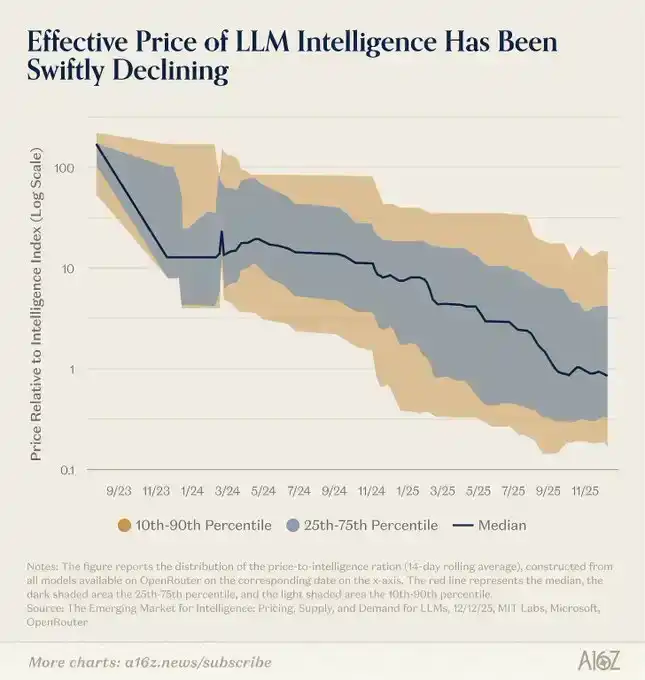
The doomsayer's logic is: 'If AI can think for us, then humanity's 'moat' disappears, and our terminal value goes to zero.' Checkmate, humans. As if we have completed all the thinking we need and want to do; and now, since AI will shoulder an increasing share of the cognitive load, humans can only slide towards obsolescence and uselessness.

But the problem is: both historical precedent and intuition tell us that when the cost of a powerful input falls, the economy doesn't politely stand still. Costs fall, quality improves, speed increases, new products become viable, and demand curves shift outward. Jevons' Paradox still holds here. When fossil fuels initially made energy cheap and abundant, we didn't just put whalers and lumberjacks out of work; we also invented plastic.

Contrary to the doomsayers, we have every reason to expect a similar effect from AI. Since AI will shoulder an increasing share of the cognitive load, humans can instead free up their hands to explore frontiers more ambitious than ever before.
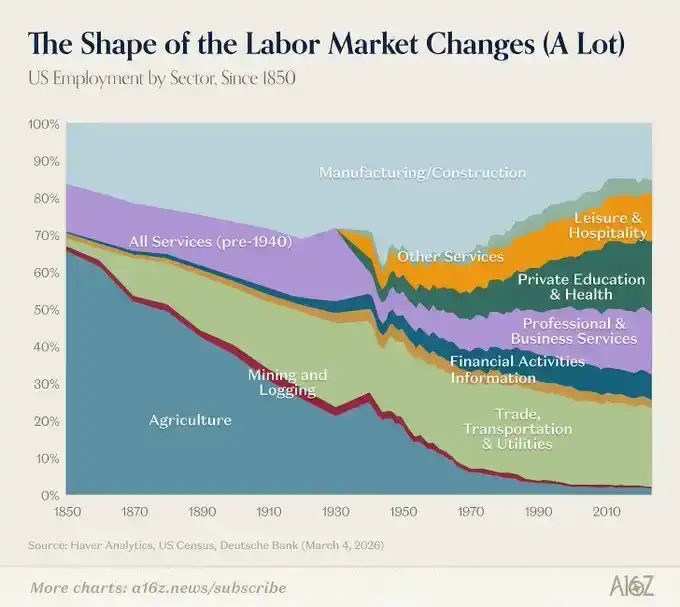
If historical experience remains instructive, then we can expect technological change to make the entire economic pie larger.

Every once-dominant economic sector has eventually given way to a larger successor; which in turn further propelled the overall economy to become even larger.
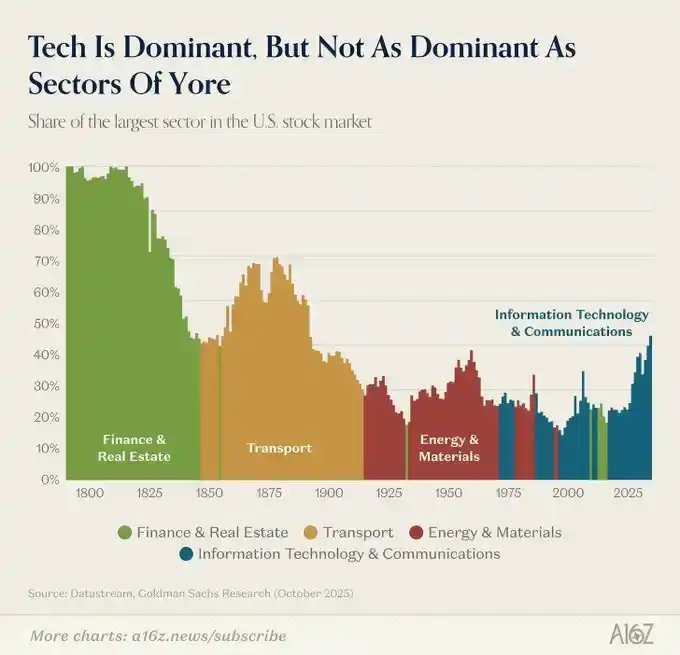
Today, the tech industry's scale already exceeds that once achieved by finance, railroads, or the industrial sector, yet its share of the entire economy or the entire market is still smaller. Productivity gains are far from a zero-sum game; they are an immensely amplified positive-sum force. After we handed over so much labor to machines, the ultimate result was not a shrinking economy and labor market, but ones that became larger, more diverse, and more complex.

Doomsayers want you to ignore the history of innovation, focus only on the single frame of 'cognition costs are collapsing,' and present it as the entire movie. They see task replacement and stop there.

'Our cognitive output will increase tenfold, but we won't think about more things as a result; we'll pat our stomachs and go to lunch early; so will everyone else.' This idea not only reveals a significant lack of imagination but also a failure to observe basic reality. Doomsayers call this 'realism,' but this is not what has truly happened in history—never.

The Failure of Luddism

Let's look at what actually happens when a great leap in productivity sweeps through the economy.

Agriculture

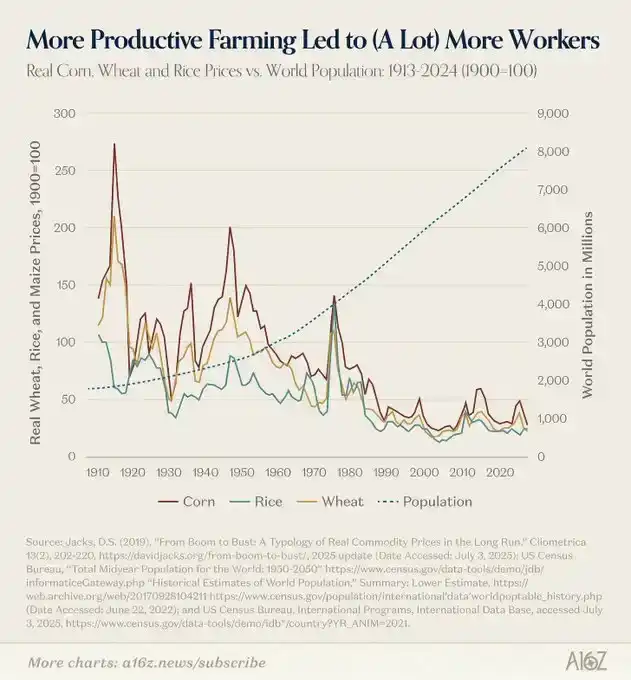
Before the widespread adoption of agricultural mechanization in the early 20th century, about one-third of the US working population was engaged in agriculture. By 2017, this proportion had fallen to about 2%.

If automation caused permanent unemployment, tractors should have already destroyed the labor market. Yet the opposite happened: agricultural output nearly tripled, supporting massive population growth; and those workers who left the farms did not become permanently unemployed but flowed into previously unimaginable new industries—factories, shops, offices, hospitals, laboratories, and eventually into the service and software sectors.

So, of course, it can be said that technology did disrupt the career prospects of the average farmworker; but it was precisely in this process that it unleashed a global surplus of labor and resources and ushered in a whole new economic system.
Electrification

The story of electricity is similar.

Electrification wasn't just about swapping one power source for another. It replaced central line shafts and belts with individual electric motors, forcing factories to reorganize around entirely new workflows and creating entirely new categories of consumer and industrial goods.
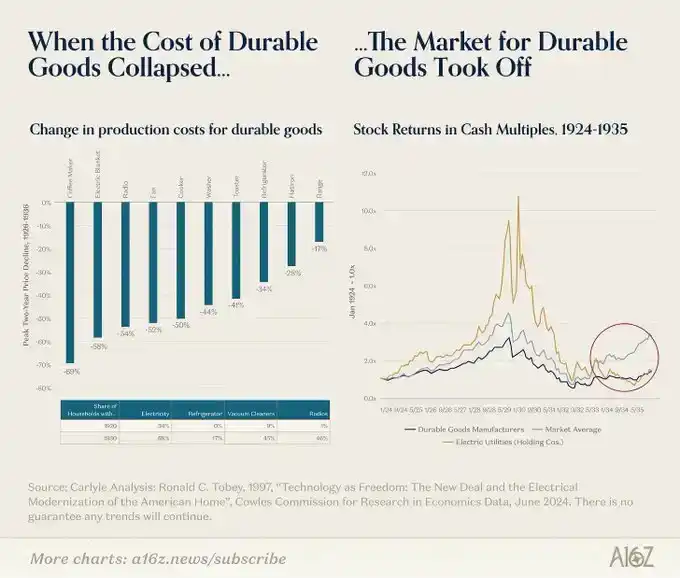
This is a typical feature of how technological revolutions unfold in different phases. Carlota Perez documented this process in 'Technological Revolutions and Financial Capital': a phase of massive investment and intense interest from financial capital appears early on, the cost of durable goods plummets, followed by a generational growth cycle for durable goods manufacturers.

Electricity also took a considerable time to truly unleash its productivity magic. At the turn of the 20th century, only 5% of US factories used electricity to drive machinery, and less than 10% of homes were electrified.
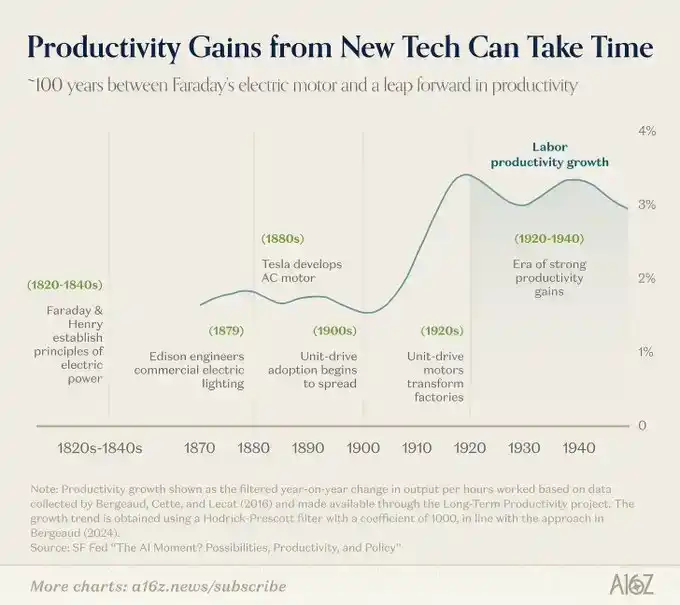
By 1930, electricity supplied nearly 80% of the power for US manufacturing, and labor productivity growth rates doubled in the following decades.

It did not destroy the demand for labor. On the contrary, higher productivity meant more manufacturing activity, more salespeople, more credit issuance, and more commercial activity. Not to mention the second-order effects of labor-saving devices like washing machines and cars—they both freed more people from previously inefficient labor, allowing them to enter higher-value activities that were impossible before.
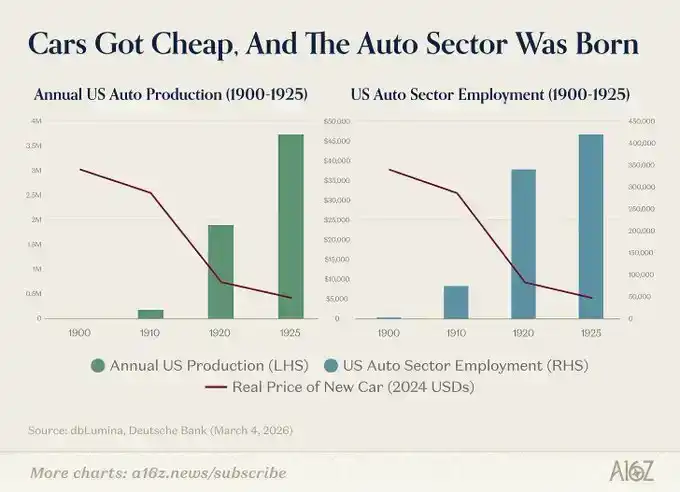
As car prices fell, both car production and employment saw explosive growth. This is the result of a true general-purpose technology: it reorganizes the economy and expands the boundaries of 'useful work.'

We have seen this time and again. Did VisiCalc and Excel spell doom for bookkeepers? Clearly not. Computational technology that drastically improved efficiency actually led to an expansion in bookkeeping positions and created the entire FP&A (Financial Planning & Analysis) industry.
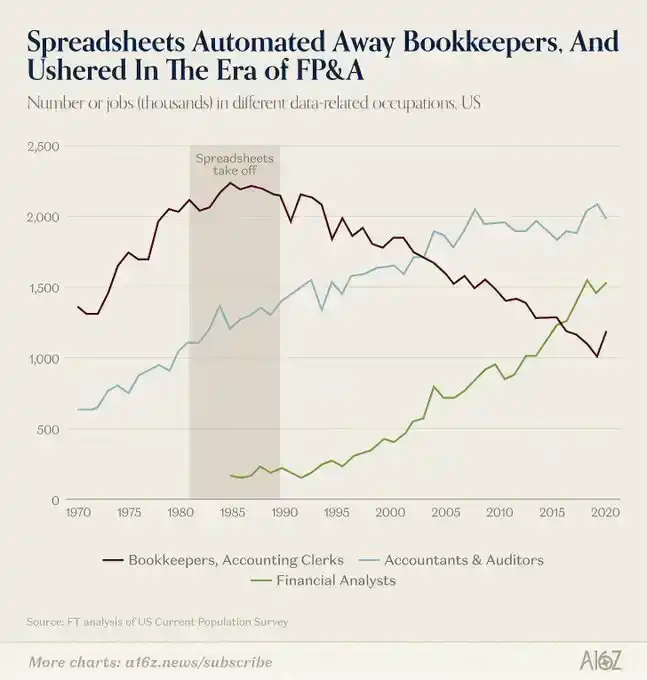
We lost roughly 1 million 'bookkeeper' jobs but gained about 1.5 million 'financial analyst' jobs.

Those New Service Jobs

Of course, task substitution doesn't always lead to job growth in adjacent areas of the economy. Sometimes, the surplus released by productivity manifests as entirely new employment growth in a completely unrelated sector.

But what if AI means some people become extremely wealthy while others are left behind?

At the very least, those extremely wealthy people will have to spend their money somewhere, creating brand-new services from scratch. This is precisely what happened in the past:
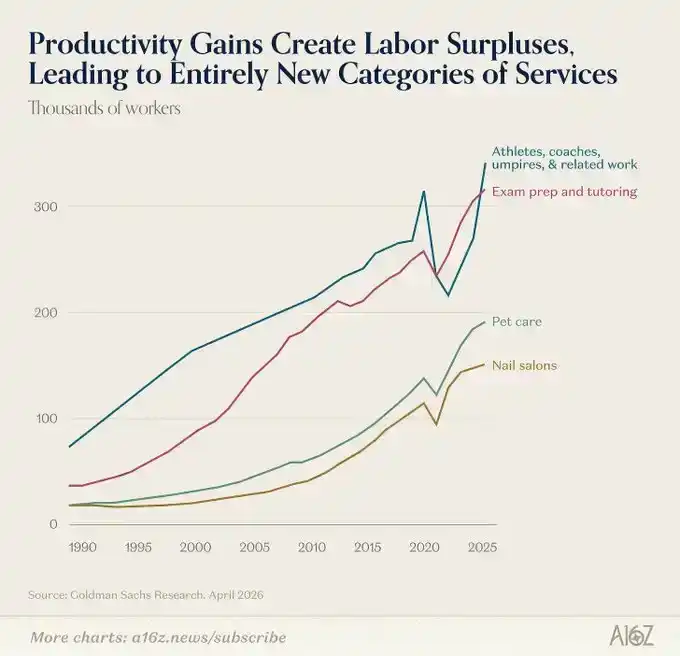
Massive productivity gains and the subsequent wealth creation they brought forth gave rise to many entirely new job types. Without rising incomes and increased labor availability, these jobs might never have truly emerged—even if they were technically feasible before the 1990s. Regardless of how one views service jobs for the wealthy, the end result was that everyone became better off: higher demand drove a significant rise in median wages, thereby creating more 'wealthy' people.

Stripe's internal economist, Ernie Tedeschi, provides a very interesting 'synthetic case': how a job can be impacted, transformed, and reshaped by technology—the travel agent.

Did technology reduce the demand for travel agents? Yes, certainly:
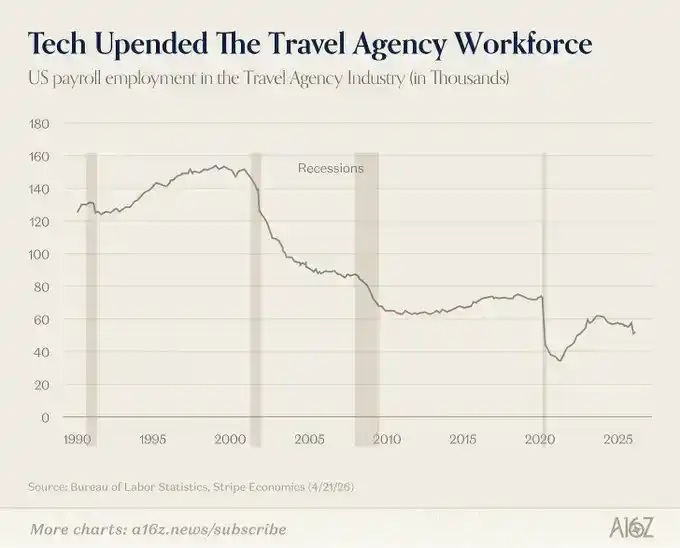
Today, travel agency employment is about half what it was at the turn of the century, almost certainly due to technology.

So, does this mean technology is a job killer? The answer is still no. Because travel agents didn't become permanently unemployed. They found work elsewhere in the economy; overall, the age-adjusted employment-to-population ratio today is roughly the same as in 2000.

Meanwhile, for those travel agents who remain in this now technology-empowered industry, productivity gains mean their wages are higher than before:
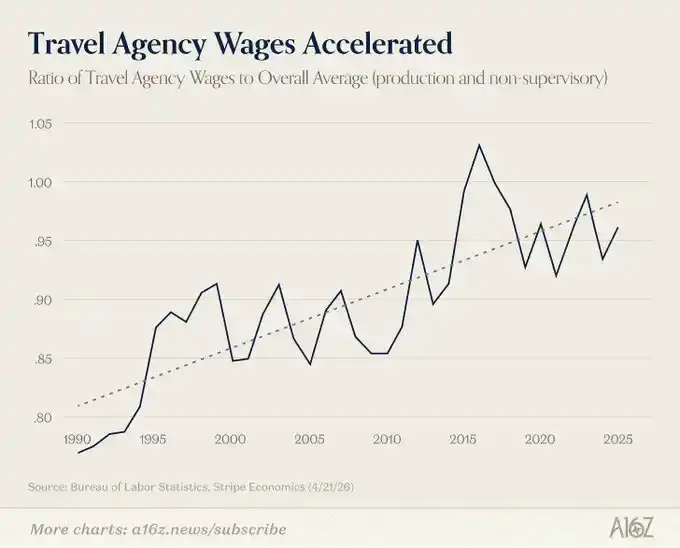
'In the golden era of 2000, the average weekly salary for a travel agent was equivalent to 87% of the overall average weekly salary. By 2025, this ratio had reached 99%, meaning travel agent wages grew faster than the overall private sector during this period.'

So, even in this case where technology did severely impact the scale of travel agent employment, overall employment among the working-age population remained as stable as before, and the travel agents who remained are actually better off than ever.

Augmentation > Substitution, and the Jobs That Don't Exist Yet

This last point is crucial and again shows that doomsayers only tell a very small part of the whole story.

For some jobs, AI is indeed an existential threat. That's true. But for other jobs, AI is a force multiplier that will make these roles more valuable. Next to every job at risk of AI substitution, there are other jobs that might benefit from AI:
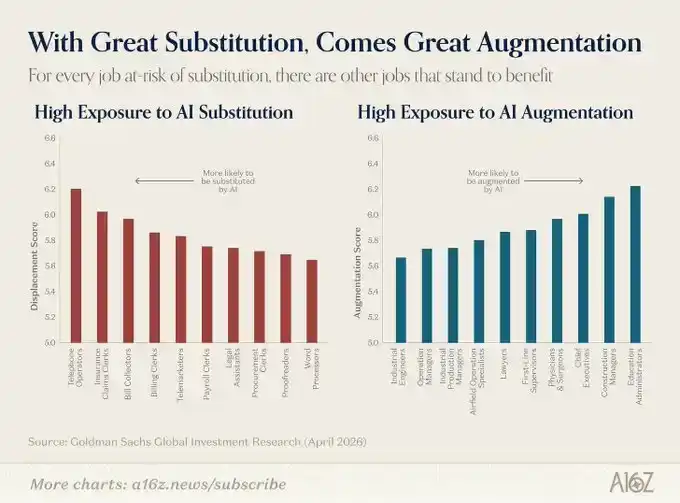
Goldman Sachs's estimated 'AI substitution' effect has been offset, and even overshadowed, by the 'AI augmentation' effect. Management also seems to be focusing more on 'augmentation' than 'substitution'—a point equally worth noting:
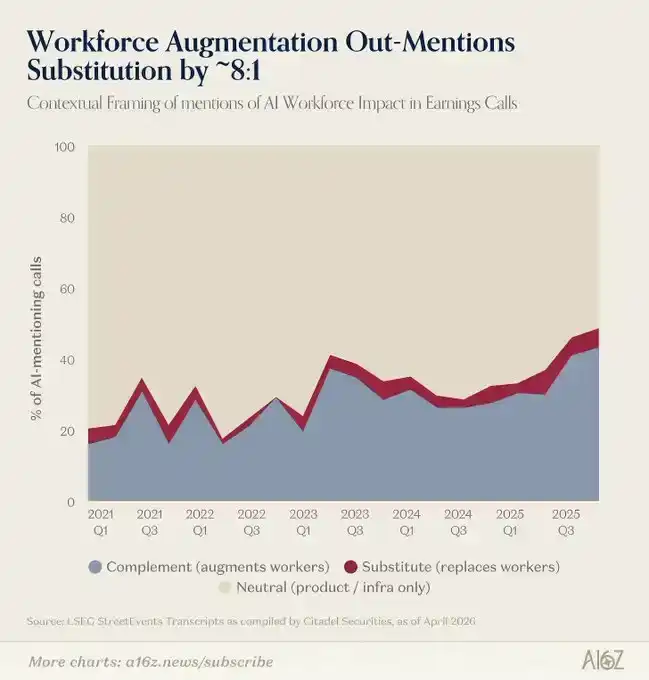
To date, mentions of 'AI as an augmentation tool' on corporate earnings calls are about 8 times more frequent than mentions of 'AI as a substitution tool.'

Although Goldman Sachs didn't even include software engineers on its 'augmentation' list, software engineers are likely the best example of an AI-augmented role. AI is a force multiplier for writing code. Not only are Git commits soaring, but the number of new applications and new companies is increasing, and the demand for software engineers appears to be on an upward inflection:
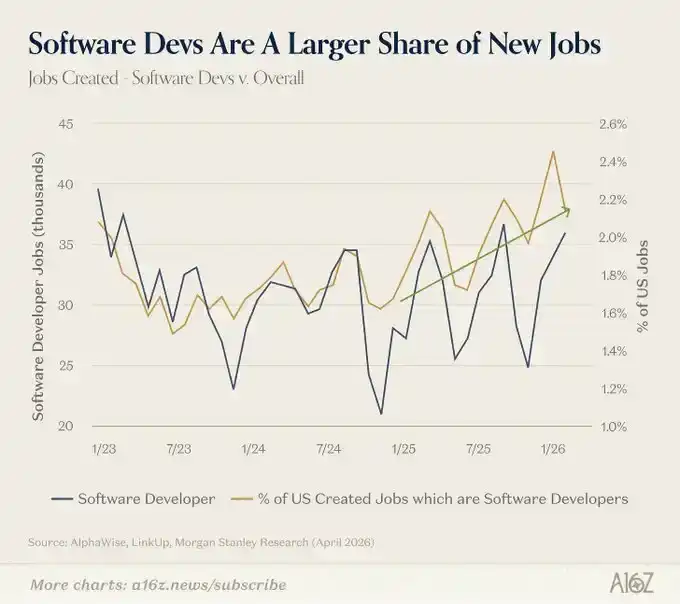
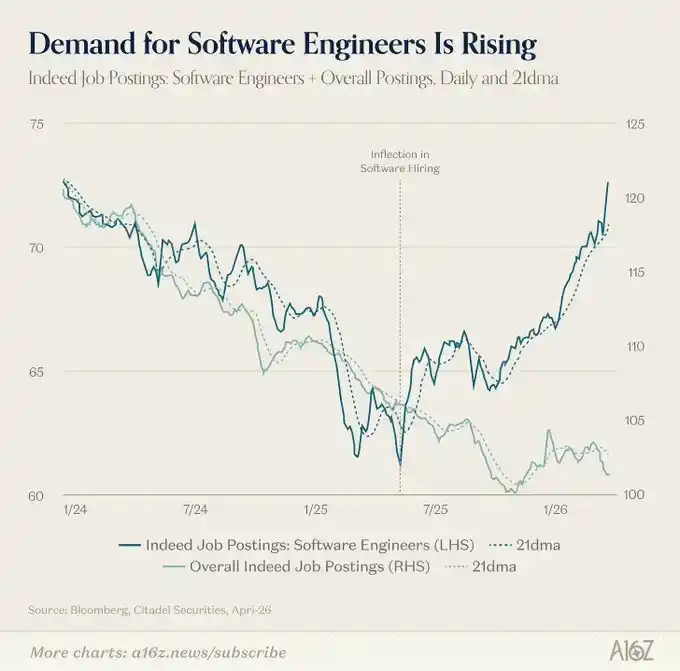
Whether measured by the number of job openings or their share of the overall job market, software development roles have been increasing since early 2025.

Is this because of AI? Honestly, it might still be too early to conclude definitively. But there's no doubt that AI enhances software engineering capabilities, not to mention that AI has become a top concern for every company and every executive.

When everyone is trying to figure out how to integrate AI into their business, companies naturally have reason to hire heavily to achieve this goal. This makes certain employees more valuable, not less:
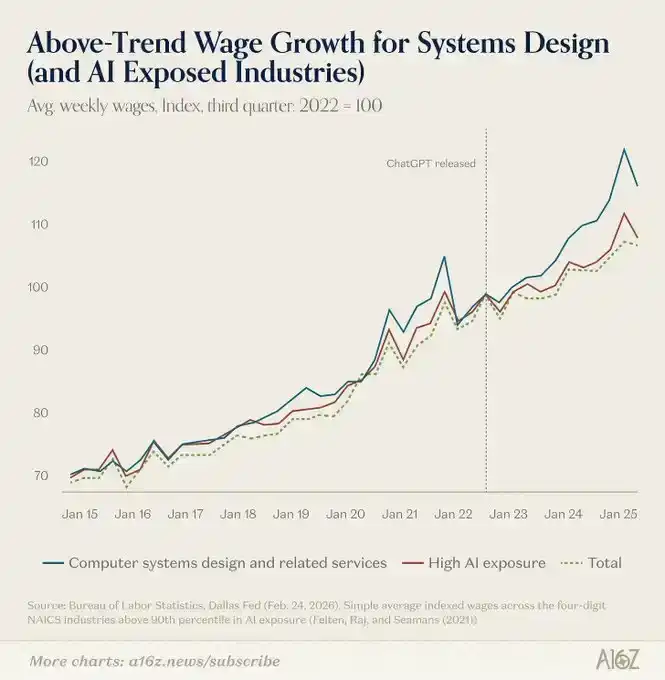
Jobs with higher AI exposure seem to be driving above-trend wage growth; this is particularly evident in systems design roles.

These gains may still be relatively concentrated for now, but it's still very, very early. As professional capabilities diffuse, opportunities will spread accordingly. In any case, this is not the data doomsayers want you to see.

Meanwhile, according to Lenny Rachitsky—author of Lenny's Newsletter and a key insider in the tech community—open product manager roles continue to rise, having recovered from the interest rate-driven collapse and reached their most abundant level since 2022:
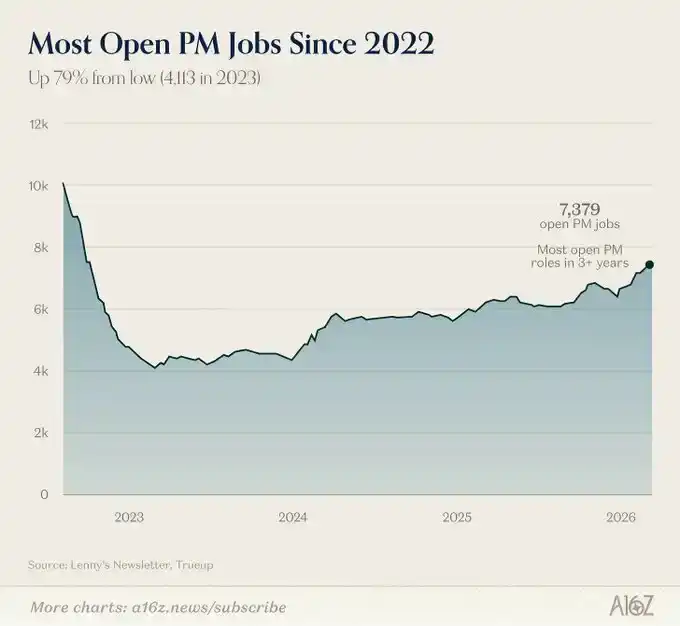
The simultaneous growth in hiring for software engineers and product managers is a concise example of why the 'lump of labor fallacy' is wrong. If AI substituted for thinking in a 1:1 manner, you might reasonably expect: 'product managers need fewer engineers,' or conversely, 'engineers need fewer product managers.' But that's not the reality we see. What we see is that demand for both types of roles continues to rebound because what truly matters is: people can accomplish more work.

This is why the doomsayers' failure is, at its core, a failure of imagination. They only stare at the tasks being automated away but ignore a new demand frontier—one that will create jobs we haven't even imagined yet:
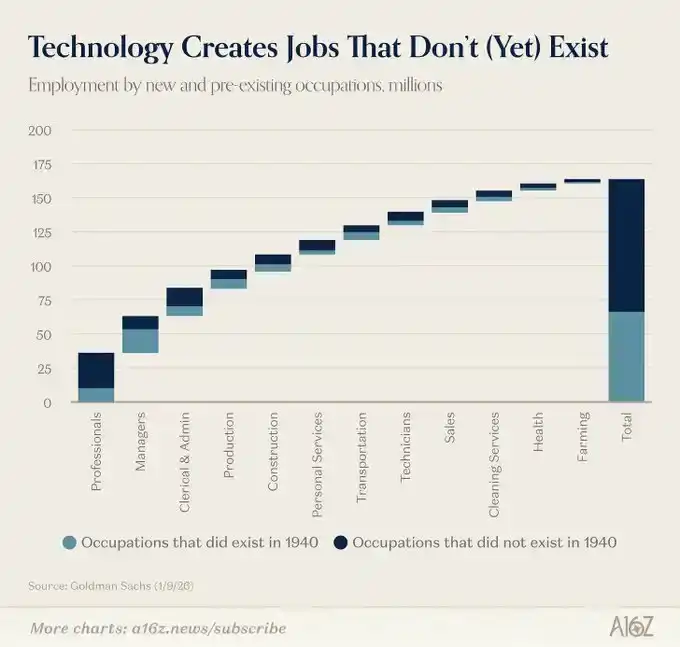
Most new jobs created since 1940 didn't even exist in 1940. By 2000, it was easy to imagine many travel agents losing their jobs, but it was probably hard to imagine then that a mid-market tech services industry built around 'cloud migration' would emerge—after all, the true rise of cloud computing was still over a decade away.


Domande pertinenti

QWhat is the 'Lump of Labor Fallacy' that the author mentions in the article, and how is it related to AI job fears?

AThe 'Lump of Labor Fallacy' is the mistaken belief that the total amount of work available in an economy is fixed. This leads to the zero-sum view that if machines or AI perform more tasks, there will be less work left for humans. The article argues that this fallacy underpins the 'AI job apocalypse' narrative. Historically, this premise is false because technological progress doesn't just destroy jobs; it creates new demands, industries, and types of work, expanding the economic pie rather than just dividing a fixed one.

QAccording to the article, how did past technological revolutions like agricultural mechanization and electrification affect the labor market in the long run?

APast technological revolutions like agricultural mechanization and electrification did displace specific jobs and tasks in the short term. For example, tractors drastically reduced the number of farmers. However, in the long run, they dramatically increased overall productivity, lowered the cost of goods, and freed up labor and resources. This led to the creation of entirely new, larger industries (like manufacturing, services, and software) and new categories of jobs that were previously unimaginable. The economy and the labor market became larger, more diverse, and more complex as a result.

QWhat is the article's main distinction between AI as a 'replacement' tool and AI as an 'augmentation' tool?

AThe article argues that the dominant narrative focuses too much on AI as a 'replacement' tool that eliminates jobs. However, evidence suggests AI often acts as an 'augmentation' or 'force multiplier' tool. It enhances human productivity in existing roles, making certain jobs (like software engineers, product managers, and system designers) more valuable and efficient. Data cited shows corporate discussions about 'AI augmentation' far outnumber those about 'AI replacement,' and demand and wages for AI-exposed roles are growing. This 'augmentation' effect can create more work and new opportunities rather than simply destroying it.

QUsing the example of travel agents and spreadsheet software (Excel), how does the article illustrate technology's complex impact on a specific profession?

AThe article uses the travel agent and spreadsheet software examples to show that technology's impact is nuanced. For travel agents, online booking technology did reduce the total number of jobs in that field by about half. However, the displaced workers found employment elsewhere in the economy. Crucially, for the travel agents who remained, their productivity and wages increased significantly (from 87% to 99% of the average wage). Similarly, spreadsheet software like Excel automated many bookkeeping tasks but didn't destroy the accounting profession. Instead, it led to the creation of more sophisticated financial analysis (FP&A) roles, resulting in a net increase in related jobs (a loss of ~1M bookkeepers but a gain of ~1.5M financial analysts).

QWhat is the article's core argument against the 'AI job apocalypse' narrative, based on historical economic patterns?

AThe article's core argument is that the 'AI job apocalypse' narrative is ahistorical and based on the flawed 'Lump of Labor Fallacy.' History shows that transformative, general-purpose technologies (like steam power, electricity, and computers) do not lead to permanent, economy-wide unemployment. Instead, they cause a painful but temporary reallocation of labor. By drastically reducing the cost and increasing the quality of a key input (in this case, cognitive labor), AI will spur new demand, enable new products and services, and open up new frontiers of human ambition. This will ultimately create new industries, job categories, and economic growth that we cannot yet fully imagine, just as past technologies did.

Letture associate

The Midlife Crisis of Crypto GPs: No PMF, No Next Check from LPs

The article "The Midlife Crisis of Crypto GPs: No PMF, No Next LP Check" analyzes the shifting crypto fundraising landscape. It argues the era of selling grand visions to LPs is over; GPs must now offer products with clear Product-Market Fit (PMF). The author categorizes crypto fundraising products into three types: Primary (VC funds), Liquid (trading strategies), and CeFi/DeFi Native Yield. This summary focuses on the Primary market. Key points include: * **Market Shift:** LPs are impatient, demand immediate returns, and are skeptical of future promises. The "easy money" narrative has faded. * **GP Value Erosion:** LP learning curves have shortened (aided by AI), reducing the value of a GP's basic "crypto knowledge." Superior judgment is now rare. * **Weakened LP Motivations:** Traditional reasons for LPs to invest in crypto VC funds (capturing industry beta, gaining access, leveraging GP judgment) have weakened due to new products like ETFs and increased LP sophistication. * **Surviving in Primary:** The primary market will likely persist for: 1) large funds in endowment mandates treating it as a lottery ticket, 2) family offices/HNWIs using proprietary capital, 3) a few funds with proven recent outperformance, and 4) funds with strong ecosystem "deal-making" capabilities. * **Conclusion:** For most GPs, rebuilding trust requires starting over in a niche, demonstrating alpha-generating ability, or providing concrete value/services to LPs.

marsbit1 h fa

The Midlife Crisis of Crypto GPs: No PMF, No Next Check from LPs

marsbit1 h fa

Crypto GPs' Midlife Crisis: No PMF, No LP's Next Check

The article "The Midlife Crisis of Crypto GPs: No PMF, No LP's Next Check" analyzes the shifting crypto fundraising landscape. It argues that the era of LPs funding vague "vision" is over; GPs must now offer products with clear Product-Market Fit (PMF) to secure capital. The market has matured. LPs, disillusioned by the last cycle's failures and wary of long lock-up periods, now demand tangible, near-term returns rather than speculative narratives. The proliferation of accessible crypto ETFs and other liquid products has reduced the need for VC blind pools as an entry point. The author categorizes crypto fundraising products into three types: Primary (VC funds, with blind pools or clear pipelines), Liquid (alpha/beta, directional/market-neutral strategies), and CeFi/DeFi Native Yield (crypto-specific mechanisms like staking, farming). Focusing on the Primary market, the piece details why traditional LP rationales for investing in crypto VCs have weakened: easier beta access via ETFs, diminished "access" and "judgement" premiums as LPs build internal teams, and a widespread lack of proven superior returns from GPs. Ultimately, only specific players are likely to remain at the primary VC table: large funds with access to patient endowment capital, family offices/HNWIs investing proprietary capital, the few funds with demonstrable excess returns from the last cycle, and those with clear "deal-making" or ecosystem resource advantages. For others, the path forward is to rebuild trust by proving alpha-generation capability in a niche or providing concrete, valuable services.

链捕手1 h fa

Crypto GPs' Midlife Crisis: No PMF, No LP's Next Check

链捕手1 h fa

The Age of Decoupling Has Arrived: Bitcoin is No Longer the Sole Compass of Crypto

The era of the cryptocurrency market moving in lockstep with Bitcoin is ending, as the industry splits into two distinct asset categories: endogenous and exogenous. Endogenous assets, like Bitcoin, derive value purely from the crypto market's cycles. Their narratives swing between being "interstellar money" in bull markets and "digital collectibles" in bear markets. Exogenous assets, however, are nominally crypto but operate with independent value drivers. Examples include: * **Venice:** An AI inference service using tokens for payments; its consumer-AI business model is decoupled from crypto price swings. * **Figure:** A fintech lender using blockchain to speed up loan approvals; its core value is in credit, not crypto. * **Stablecoin firms like BVNK:** Acquired by traditional finance giants (Mastercard, Stripe), their growth is tied to payment infrastructure, not market cycles. Hybrid projects like **Hyperliquid** (a decentralized exchange) show a shift, with a growing share of non-crypto trading (e.g., prediction markets). This divergence is fundamental. Endogenous assets remain highly correlated to Bitcoin, similar to gold miners to gold. Exogenous assets are evolving to have their own fundamentals, like the weak correlation between gold and the S&P 500. This changes investment analysis. Evaluating exogenous assets requires traditional fundamental research—assessing user bases, unit economics, and moats—more akin to fintech investing than charting Bitcoin. Promising exogenous sectors include: on-chain exchanges/brokers, AI-crypto fusion, privacy-focused digital banks, lending (institutional/private credit), stablecoins/real-world asset tokenization, payment rails, and non-financial crypto-consumer products. Currently, investing via equity is often safer than via tokens, as token value accrual mechanisms need further regulatory and industry development (e.g., the CLARITY Act). Nonetheless, the core trend is clear: crypto market drivers are diversifying from a single factor (Bitcoin) to multiple fundamentals, ending the era of uniform market moves.

marsbit2 h fa

The Age of Decoupling Has Arrived: Bitcoin is No Longer the Sole Compass of Crypto

marsbit2 h fa

Trading

Spot
Futures

Articoli Popolari

Cosa è GROK AI

Grok AI: Rivoluzionare la Tecnologia Conversazionale nell'Era Web3 Introduzione Nel panorama in rapida evoluzione dell'intelligenza artificiale, Grok AI si distingue come un progetto notevole che collega i domini della tecnologia avanzata e dell'interazione con l'utente. Sviluppato da xAI, un'azienda guidata dal rinomato imprenditore Elon Musk, Grok AI cerca di ridefinire il modo in cui interagiamo con l'intelligenza artificiale. Mentre il movimento Web3 continua a prosperare, Grok AI mira a sfruttare il potere dell'IA conversazionale per rispondere a query complesse, offrendo agli utenti un'esperienza che è non solo informativa ma anche divertente. Cos'è Grok AI? Grok AI è un sofisticato chatbot di intelligenza artificiale conversazionale progettato per interagire dinamicamente con gli utenti. A differenza di molti sistemi di intelligenza artificiale tradizionali, Grok AI abbraccia un'ampia gamma di domande, comprese quelle tipicamente considerate inappropriate o al di fuori delle risposte standard. Gli obiettivi principali del progetto includono: Ragionamento Affidabile: Grok AI enfatizza il ragionamento di buon senso per fornire risposte logiche basate sulla comprensione contestuale. Supervisione Scalabile: L'integrazione dell'assistenza degli strumenti garantisce che le interazioni degli utenti siano sia monitorate che ottimizzate per la qualità. Verifica Formale: La sicurezza è fondamentale; Grok AI incorpora metodi di verifica formale per migliorare l'affidabilità delle sue uscite. Comprensione del Lungo Contesto: Il modello di IA eccelle nel trattenere e richiamare una vasta storia di conversazione, facilitando discussioni significative e consapevoli del contesto. Robustezza Adversariale: Concentrandosi sul miglioramento delle sue difese contro input manipolati o malevoli, Grok AI mira a mantenere l'integrità delle interazioni degli utenti. In sostanza, Grok AI non è solo un dispositivo di recupero informazioni; è un partner conversazionale immersivo che incoraggia un dialogo dinamico. Creatore di Grok AI Il cervello dietro Grok AI non è altri che Elon Musk, un individuo sinonimo di innovazione in vari campi, tra cui automotive, viaggi spaziali e tecnologia. Sotto l'egida di xAI, un'azienda focalizzata sull'avanzamento della tecnologia AI in modi benefici, la visione di Musk mira a rimodellare la comprensione delle interazioni con l'IA. La leadership e l'etica fondamentale sono profondamente influenzate dall'impegno di Musk nel superare i confini tecnologici. Investitori di Grok AI Sebbene i dettagli specifici riguardanti gli investitori che sostengono Grok AI rimangano limitati, è pubblicamente riconosciuto che xAI, l'incubatore del progetto, è fondato e supportato principalmente dallo stesso Elon Musk. Le precedenti imprese e partecipazioni di Musk forniscono un robusto sostegno, rafforzando ulteriormente la credibilità e il potenziale di crescita di Grok AI. Tuttavia, al momento, le informazioni riguardanti ulteriori fondazioni di investimento o organizzazioni che supportano Grok AI non sono facilmente accessibili, segnando un'area per potenziali esplorazioni future. Come Funziona Grok AI? Le meccaniche operative di Grok AI sono innovative quanto il suo framework concettuale. Il progetto integra diverse tecnologie all'avanguardia che facilitano le sue funzionalità uniche: Infrastruttura Robusta: Grok AI è costruito utilizzando Kubernetes per l'orchestrazione dei container, Rust per prestazioni e sicurezza, e JAX per il calcolo numerico ad alte prestazioni. Questo trio garantisce che il chatbot operi in modo efficiente, si scaldi efficacemente e serva gli utenti prontamente. Accesso alla Conoscenza in Tempo Reale: Una delle caratteristiche distintive di Grok AI è la sua capacità di attingere a dati in tempo reale attraverso la piattaforma X—precedentemente nota come Twitter. Questa capacità consente all'IA di accedere alle informazioni più recenti, permettendole di fornire risposte e raccomandazioni tempestive che altri modelli di IA potrebbero perdere. Due Modalità di Interazione: Grok AI offre agli utenti la scelta tra “Modalità Divertente” e “Modalità Normale”. La Modalità Divertente consente uno stile di interazione più giocoso e umoristico, mentre la Modalità Normale si concentra sulla fornitura di risposte precise e accurate. Questa versatilità garantisce un'esperienza su misura che soddisfa varie preferenze degli utenti. In sostanza, Grok AI sposa prestazioni con coinvolgimento, creando un'esperienza che è sia arricchente che divertente. Cronologia di Grok AI Il viaggio di Grok AI è segnato da traguardi fondamentali che riflettono le sue fasi di sviluppo e distribuzione: Sviluppo Iniziale: La fase fondamentale di Grok AI si è svolta in circa due mesi, durante i quali sono stati condotti l'addestramento iniziale e il perfezionamento del modello. Rilascio Beta di Grok-2: In un significativo avanzamento, è stata annunciata la beta di Grok-2. Questo rilascio ha introdotto due versioni del chatbot—Grok-2 e Grok-2 mini—ognuna dotata delle capacità per chattare, programmare e ragionare. Accesso Pubblico: Dopo lo sviluppo beta, Grok AI è diventato disponibile per gli utenti della piattaforma X. Coloro che hanno account verificati tramite un numero di telefono e attivi per almeno sette giorni possono accedere a una versione limitata, rendendo la tecnologia disponibile a un pubblico più ampio. Questa cronologia racchiude la crescita sistematica di Grok AI dall'inizio all'impegno pubblico, enfatizzando il suo impegno per il miglioramento continuo e l'interazione con gli utenti. Caratteristiche Chiave di Grok AI Grok AI comprende diverse caratteristiche chiave che contribuiscono alla sua identità innovativa: Integrazione della Conoscenza in Tempo Reale: L'accesso a informazioni attuali e rilevanti differenzia Grok AI da molti modelli statici, consentendo un'esperienza utente coinvolgente e accurata. Stili di Interazione Versatili: Offrendo modalità di interazione distinte, Grok AI soddisfa varie preferenze degli utenti, invitando alla creatività e alla personalizzazione nella conversazione con l'IA. Avanzata Struttura Tecnologica: L'utilizzo di Kubernetes, Rust e JAX fornisce al progetto un solido framework per garantire affidabilità e prestazioni ottimali. Considerazione del Discorso Etico: L'inclusione di una funzione di generazione di immagini mette in mostra lo spirito innovativo del progetto. Tuttavia, solleva anche considerazioni etiche riguardanti il copyright e la rappresentazione rispettosa di figure riconoscibili—una discussione in corso all'interno della comunità AI. Conclusione Come entità pionieristica nel campo dell'IA conversazionale, Grok AI incarna il potenziale per esperienze utente trasformative nell'era digitale. Sviluppato da xAI e guidato dall'approccio visionario di Elon Musk, Grok AI integra conoscenze in tempo reale con capacità di interazione avanzate. Si sforza di spingere i confini di ciò che l'intelligenza artificiale può realizzare, mantenendo un focus su considerazioni etiche e sicurezza degli utenti. Grok AI non solo incarna il progresso tecnologico, ma rappresenta anche un nuovo paradigma conversazionale nel panorama Web3, promettendo di coinvolgere gli utenti con sia conoscenze esperte che interazioni giocose. Man mano che il progetto continua a evolversi, si erge come testimonianza di ciò che l'incrocio tra tecnologia, creatività e interazione simile a quella umana può realizzare.

482 Totale visualizzazioniPubblicato il 2024.12.26Aggiornato il 2024.12.26

Cosa è GROK AI

Cosa è ERC AI

Euruka Tech: Una Panoramica di $erc ai e delle sue Ambizioni in Web3 Introduzione Nel panorama in rapida evoluzione della tecnologia blockchain e delle applicazioni decentralizzate, nuovi progetti emergono frequentemente, ciascuno con obiettivi e metodologie uniche. Uno di questi progetti è Euruka Tech, che opera nel vasto dominio delle criptovalute e del Web3. L'obiettivo principale di Euruka Tech, in particolare del suo token $erc ai, è presentare soluzioni innovative progettate per sfruttare le crescenti capacità della tecnologia decentralizzata. Questo articolo si propone di fornire una panoramica completa di Euruka Tech, un'esplorazione dei suoi obiettivi, della funzionalità, dell'identità del suo creatore, dei potenziali investitori e della sua importanza nel contesto più ampio del Web3. Cos'è Euruka Tech, $erc ai? Euruka Tech è caratterizzato come un progetto che sfrutta gli strumenti e le funzionalità offerte dall'ambiente Web3, concentrandosi sull'integrazione dell'intelligenza artificiale nelle sue operazioni. Sebbene i dettagli specifici sul framework del progetto siano piuttosto sfuggenti, è progettato per migliorare l'engagement degli utenti e automatizzare i processi nello spazio crypto. Il progetto mira a creare un ecosistema decentralizzato che non solo faciliti le transazioni, ma incorpori anche funzionalità predittive attraverso l'intelligenza artificiale, da cui il nome del suo token, $erc ai. L'obiettivo è fornire una piattaforma intuitiva che faciliti interazioni più intelligenti e un'elaborazione delle transazioni più efficiente all'interno della crescente sfera del Web3. Chi è il Creatore di Euruka Tech, $erc ai? Attualmente, le informazioni riguardanti il creatore o il team fondatore di Euruka Tech rimangono non specificate e piuttosto opache. Questa assenza di dati solleva preoccupazioni, poiché la conoscenza del background del team è spesso essenziale per stabilire credibilità nel settore blockchain. Pertanto, abbiamo classificato queste informazioni come sconosciute fino a quando dettagli concreti non saranno resi disponibili nel dominio pubblico. Chi sono gli Investitori di Euruka Tech, $erc ai? Allo stesso modo, l'identificazione degli investitori o delle organizzazioni di supporto per il progetto Euruka Tech non è prontamente fornita attraverso la ricerca disponibile. Un aspetto cruciale per i potenziali stakeholder o utenti che considerano di impegnarsi con Euruka Tech è la garanzia che deriva da partnership finanziarie consolidate o dal supporto di società di investimento rispettabili. Senza divulgazioni sulle affiliazioni di investimento, è difficile trarre conclusioni complete sulla sicurezza finanziaria o sulla longevità del progetto. In linea con le informazioni trovate, anche questa sezione rimane allo stato di sconosciuto. Come funziona Euruka Tech, $erc ai? Nonostante la mancanza di specifiche tecniche dettagliate per Euruka Tech, è essenziale considerare le sue ambizioni innovative. Il progetto cerca di sfruttare la potenza computazionale dell'intelligenza artificiale per automatizzare e migliorare l'esperienza dell'utente all'interno dell'ambiente delle criptovalute. Integrando l'IA con la tecnologia blockchain, Euruka Tech mira a fornire funzionalità come operazioni automatizzate, valutazioni del rischio e interfacce utente personalizzate. L'essenza innovativa di Euruka Tech risiede nel suo obiettivo di creare una connessione fluida tra gli utenti e le vaste possibilità presentate dalle reti decentralizzate. Attraverso l'utilizzo di algoritmi di apprendimento automatico e IA, mira a ridurre le sfide degli utenti alle prime armi e semplificare le esperienze transazionali all'interno del framework Web3. Questa simbiosi tra IA e blockchain sottolinea l'importanza del token $erc ai, fungendo da ponte tra le interfacce utente tradizionali e le avanzate capacità delle tecnologie decentralizzate. Cronologia di Euruka Tech, $erc ai Sfortunatamente, a causa delle limitate informazioni disponibili riguardo a Euruka Tech, non siamo in grado di presentare una cronologia dettagliata dei principali sviluppi o traguardi nel percorso del progetto. Questa cronologia, tipicamente preziosa per tracciare l'evoluzione di un progetto e comprendere la sua traiettoria di crescita, non è attualmente disponibile. Man mano che le informazioni su eventi notevoli, partnership o aggiunte funzionali diventano evidenti, gli aggiornamenti miglioreranno sicuramente la visibilità di Euruka Tech nella sfera crypto. Chiarimento su Altri Progetti “Eureka” È importante sottolineare che più progetti e aziende condividono una nomenclatura simile con “Eureka.” La ricerca ha identificato iniziative come un agente IA della NVIDIA Research, che si concentra sull'insegnamento ai robot di compiti complessi utilizzando metodi generativi, così come Eureka Labs ed Eureka AI, che migliorano l'esperienza utente nell'istruzione e nell'analisi del servizio clienti, rispettivamente. Tuttavia, questi progetti sono distinti da Euruka Tech e non dovrebbero essere confusi con i suoi obiettivi o funzionalità. Conclusione Euruka Tech, insieme al suo token $erc ai, rappresenta un attore promettente ma attualmente oscuro nel panorama del Web3. Sebbene i dettagli sul suo creatore e sugli investitori rimangano non divulgati, l'ambizione centrale di combinare intelligenza artificiale e tecnologia blockchain si erge come un punto focale di interesse. Gli approcci unici del progetto nel promuovere l'engagement degli utenti attraverso l'automazione avanzata potrebbero distinguerlo mentre l'ecosistema Web3 progredisce. Con l'evoluzione continua del mercato crypto, gli stakeholder dovrebbero tenere d'occhio gli sviluppi riguardanti Euruka Tech, poiché lo sviluppo di innovazioni documentate, partnership o una roadmap definita potrebbe presentare opportunità significative nel prossimo futuro. Così com'è, attendiamo ulteriori approfondimenti sostanziali che potrebbero svelare il potenziale di Euruka Tech e la sua posizione nel competitivo panorama crypto.

500 Totale visualizzazioniPubblicato il 2025.01.02Aggiornato il 2025.01.02

Cosa è ERC AI

Cosa è DUOLINGO AI

DUOLINGO AI: Integrare l'apprendimento delle lingue con Web3 e innovazione AI In un'era in cui la tecnologia rimodella l'istruzione, l'integrazione dell'intelligenza artificiale (AI) e delle reti blockchain annuncia una nuova frontiera per l'apprendimento delle lingue. Entra in scena DUOLINGO AI e la sua criptovaluta associata, $DUOLINGO AI. Questo progetto aspira a fondere la potenza educativa delle principali piattaforme di apprendimento delle lingue con i benefici della tecnologia decentralizzata Web3. Questo articolo esplora gli aspetti chiave di DUOLINGO AI, esaminando i suoi obiettivi, il framework tecnologico, lo sviluppo storico e il potenziale futuro, mantenendo chiarezza tra la risorsa educativa originale e questa iniziativa indipendente di criptovaluta. Panoramica di DUOLINGO AI Alla sua base, DUOLINGO AI cerca di stabilire un ambiente decentralizzato in cui gli studenti possono guadagnare ricompense crittografiche per il raggiungimento di traguardi educativi nella competenza linguistica. Applicando smart contracts, il progetto mira ad automatizzare i processi di verifica delle competenze e le allocazioni di token, aderendo ai principi di Web3 che enfatizzano la trasparenza e la proprietà da parte degli utenti. Il modello si discosta dagli approcci tradizionali all'acquisizione linguistica, facendo forte affidamento su una struttura di governance guidata dalla comunità, che consente ai detentori di token di suggerire miglioramenti ai contenuti dei corsi e alle distribuzioni delle ricompense. Alcuni degli obiettivi notevoli di DUOLINGO AI includono: Apprendimento Gamificato: Il progetto integra traguardi blockchain e token non fungibili (NFT) per rappresentare i livelli di competenza linguistica, promuovendo la motivazione attraverso ricompense digitali coinvolgenti. Creazione di Contenuti Decentralizzati: Apre opportunità per educatori e appassionati di lingue di contribuire con i propri corsi, facilitando un modello di condivisione dei ricavi che beneficia tutti i collaboratori. Personalizzazione Guidata dall'AI: Utilizzando modelli avanzati di machine learning, DUOLINGO AI personalizza le lezioni per adattarsi ai progressi individuali, simile alle funzionalità adattive presenti nelle piattaforme consolidate. Creatori del Progetto e Governance A partire da aprile 2025, il team dietro $DUOLINGO AI rimane pseudonimo, una pratica comune nel panorama decentralizzato delle criptovalute. Questa anonimato è inteso a promuovere la crescita collettiva e il coinvolgimento degli stakeholder piuttosto che concentrarsi su sviluppatori individuali. Lo smart contract distribuito sulla blockchain di Solana annota l'indirizzo del wallet dello sviluppatore, che segna l'impegno verso la trasparenza riguardo alle transazioni, nonostante l'identità dei creatori sia sconosciuta. Secondo la sua roadmap, DUOLINGO AI mira a evolversi in un'Organizzazione Autonoma Decentralizzata (DAO). Questa struttura di governance consente ai detentori di token di votare su questioni critiche come l'implementazione di funzionalità e le allocazioni del tesoro. Questo modello si allinea con l'etica dell'empowerment della comunità presente in varie applicazioni decentralizzate, enfatizzando l'importanza del processo decisionale collettivo. Investitori e Partnership Strategiche Attualmente, non ci sono investitori istituzionali o capitalisti di rischio identificabili pubblicamente legati a $DUOLINGO AI. Invece, la liquidità del progetto proviene principalmente da scambi decentralizzati (DEX), segnando un netto contrasto con le strategie di finanziamento delle aziende tradizionali di tecnologia educativa. Questo modello di base indica un approccio guidato dalla comunità, riflettendo l'impegno del progetto verso la decentralizzazione. Nel suo whitepaper, DUOLINGO AI menziona la formazione di collaborazioni con “piattaforme educative blockchain” non specificate, mirate ad arricchire la sua offerta di corsi. Sebbene partnership specifiche non siano ancora state divulgate, questi sforzi collaborativi suggeriscono una strategia per mescolare innovazione blockchain con iniziative educative, ampliando l'accesso e il coinvolgimento degli utenti attraverso diverse vie di apprendimento. Architettura Tecnologica Integrazione AI DUOLINGO AI incorpora due componenti principali guidate dall'AI per migliorare la sua offerta educativa: Motore di Apprendimento Adattivo: Questo sofisticato motore apprende dalle interazioni degli utenti, simile ai modelli proprietari delle principali piattaforme educative. Regola dinamicamente la difficoltà delle lezioni per affrontare le sfide specifiche degli studenti, rinforzando le aree deboli attraverso esercizi mirati. Agenti Conversazionali: Utilizzando chatbot alimentati da GPT-4, DUOLINGO AI offre una piattaforma per gli utenti per impegnarsi in conversazioni simulate, promuovendo un'esperienza di apprendimento linguistico più interattiva e pratica. Infrastruttura Blockchain Costruito sulla blockchain di Solana, $DUOLINGO AI utilizza un framework tecnologico completo che include: Smart Contracts per la Verifica delle Competenze: Questa funzionalità assegna automaticamente token agli utenti che superano con successo i test di competenza, rinforzando la struttura di incentivi per risultati di apprendimento genuini. Badge NFT: Questi token digitali significano vari traguardi che gli studenti raggiungono, come completare una sezione del loro corso o padroneggiare competenze specifiche, consentendo loro di scambiare o mostrare digitalmente i loro successi. Governance DAO: I membri della comunità dotati di token possono partecipare alla governance votando su proposte chiave, facilitando una cultura partecipativa che incoraggia l'innovazione nell'offerta di corsi e nelle funzionalità della piattaforma. Cronologia Storica 2022–2023: Concettualizzazione I lavori per DUOLINGO AI iniziano con la creazione di un whitepaper, evidenziando la sinergia tra i progressi dell'AI nell'apprendimento delle lingue e il potenziale decentralizzato della tecnologia blockchain. 2024: Lancio Beta Un lancio beta limitato introduce offerte in lingue popolari, premiando i primi utenti con incentivi in token come parte della strategia di coinvolgimento della comunità del progetto. 2025: Transizione DAO Ad aprile, avviene un lancio completo della mainnet con la circolazione di token, stimolando discussioni nella comunità riguardo a possibili espansioni nelle lingue asiatiche e ad altri sviluppi dei corsi. Sfide e Direzioni Future Ostacoli Tecnici Nonostante i suoi obiettivi ambiziosi, DUOLINGO AI affronta sfide significative. La scalabilità rimane una preoccupazione costante, in particolare nel bilanciare i costi associati all'elaborazione dell'AI e nel mantenere una rete decentralizzata reattiva. Inoltre, garantire la creazione e la moderazione di contenuti di qualità in un'offerta decentralizzata presenta complessità nel mantenere standard educativi. Opportunità Strategiche Guardando al futuro, DUOLINGO AI ha il potenziale per sfruttare partnership di micro-credentialing con istituzioni accademiche, fornendo validazioni verificate dalla blockchain delle competenze linguistiche. Inoltre, l'espansione cross-chain potrebbe consentire al progetto di attingere a basi utenti più ampie e a ulteriori ecosistemi blockchain, migliorando la sua interoperabilità e portata. Conclusione DUOLINGO AI rappresenta una fusione innovativa di intelligenza artificiale e tecnologia blockchain, presentando un'alternativa focalizzata sulla comunità ai sistemi tradizionali di apprendimento delle lingue. Sebbene il suo sviluppo pseudonimo e il modello economico emergente comportino alcuni rischi, l'impegno del progetto verso l'apprendimento gamificato, l'istruzione personalizzata e la governance decentralizzata illumina un percorso per la tecnologia educativa nel regno di Web3. Man mano che l'AI continua a progredire e l'ecosistema blockchain evolve, iniziative come DUOLINGO AI potrebbero ridefinire il modo in cui gli utenti interagiscono con l'istruzione linguistica, potenziando le comunità e premiando il coinvolgimento attraverso meccanismi di apprendimento innovativi.

457 Totale visualizzazioniPubblicato il 2025.04.11Aggiornato il 2025.04.11

Cosa è DUOLINGO AI

Discussioni

Benvenuto nella Community HTX. Qui puoi rimanere informato sugli ultimi sviluppi della piattaforma e accedere ad approfondimenti esperti sul mercato. Le opinioni degli utenti sul prezzo di AI AI sono presentate come di seguito.

活动图片












