a16z Partner: The Next Space War May First Target Commercial Satellites

marsbitPubblicato 2026-06-23Pubblicato ultima volta 2026-06-23

Introduzione

In May 2026, Russian Cosmos satellites maneuvered to within 500 meters of the commercial ICEYE-X36 radar satellite supporting Ukraine, highlighting the growing military targeting of commercial space assets. As constellations like Starlink and ICEYE provide critical communication, reconnaissance, and imaging services in conflicts, they are increasingly viewed as legitimate military objectives. This incident exemplifies modern space warfare's grey zone—actions like close approaches, jamming, or cyberattacks that fall short of kinetic destruction but demonstrate coercion and capability. Space warfare is constrained by physics, orbital congestion, and the threat of debris from kinetic strikes. While the US holds advantages in launch frequency, reusable rockets (led by SpaceX), and large commercial constellations, these assets are now vulnerable. True resilience requires distributed, proliferated satellite architectures, rapid replenishment, and robust space domain awareness. The future of space conflict will likely involve non-kinetic tactics to degrade an adversary's space-based support while avoiding catastrophic debris generation. The key is maintaining functionality under threat and deterring attacks by ensuring their cost outweighs any potential gain.

In May 2026, multiple Russian Cosmos satellites maneuvered close to the ICEYE-X36 commercial radar satellite, which supports Ukraine. Public orbit analysis indicated that both parties entered a nearly co-planar orbit, with a lateral distance once reaching approximately 500 meters.

This was not a missile interception, nor was there any public destruction of satellites, yet it brought a real-world issue to the forefront: when commercial satellites already provide communication, reconnaissance, positioning, and timing services for warfare, will they also become military targets?

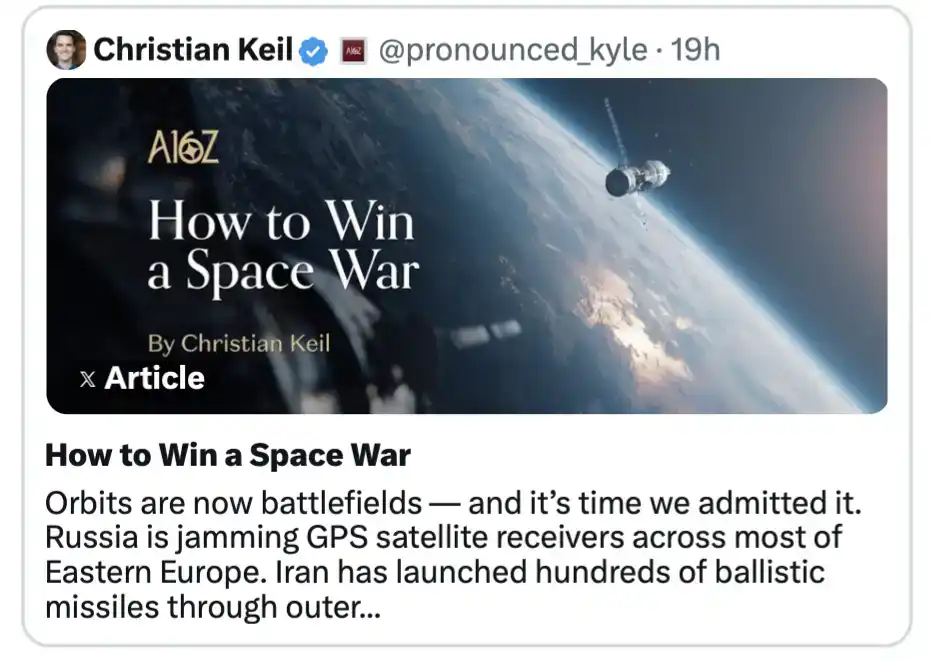
In a lengthy article, a16z partners Christian Keil and Alex Oliver viewed this incident as a typical fragment of modern space confrontation. Russia had previously publicly stated that commercial space facilities supporting military operations could become "legitimate targets for retaliation." In the Russia-Ukraine war, Starlink provides communications, and ICEYE-type synthetic aperture radar satellites provide imaging. Commercial constellations are no longer just civilian infrastructure but part of the battlefield information chain.
500-Meter Proximity: Commercial Satellites Enter the Military Crosshairs

Dealroom relayed an orbit analysis by Integrity ISR, stating that at least four to five of the Russian Cosmos 2609 to 2614 satellites performed orbital maneuvers between May 14 and 20, 2026. They adjusted their inclination from approximately 97.0 degrees to around 97.8 degrees, consuming about 105 m/s of delta-v, and established a near-co-planar relationship with ICEYE-X36.

ICEYE-X36 is not a traditional military reconnaissance satellite. It belongs to the Finnish and American company ICEYE, uses synthetic aperture radar for imaging, and can continuously observe ground targets under night and cloud cover conditions. Since the Russia-Ukraine war, the value of such commercial remote sensing capabilities for Ukrainian battlefield awareness has risen, thereby entering Russia's threat list.

500 meters doesn't sound very close on the ground, but in low Earth orbit, where two spacecraft travel at several kilometers per second, any unplanned maneuver could lead to collision, interference, or coercion signals. Close-proximity operations themselves can serve multiple purposes: surveillance, simulated attacks, testing reactions, demonstrating capability, or even preparing for future co-orbital anti-satellite actions.

The most challenging aspect of space conflict is that many actions fall between normal operations and military coercion. Satellite proximity does not equal an attack, and malfunctions are not necessarily due to hostile actions. However, in a wartime environment, a single close approach is enough to alter an adversary's risk assessment.

Space is Close, but Extremely Difficult to Access

The uniqueness of space warfare stems first from physical constraints. Low Earth Orbit is only a few hundred kilometers above the Earth's surface, where the International Space Station and many Starlink satellites operate. The key to reaching orbit is not "flying high" but achieving sufficient horizontal velocity so that an object continuously falls but always misses the Earth.
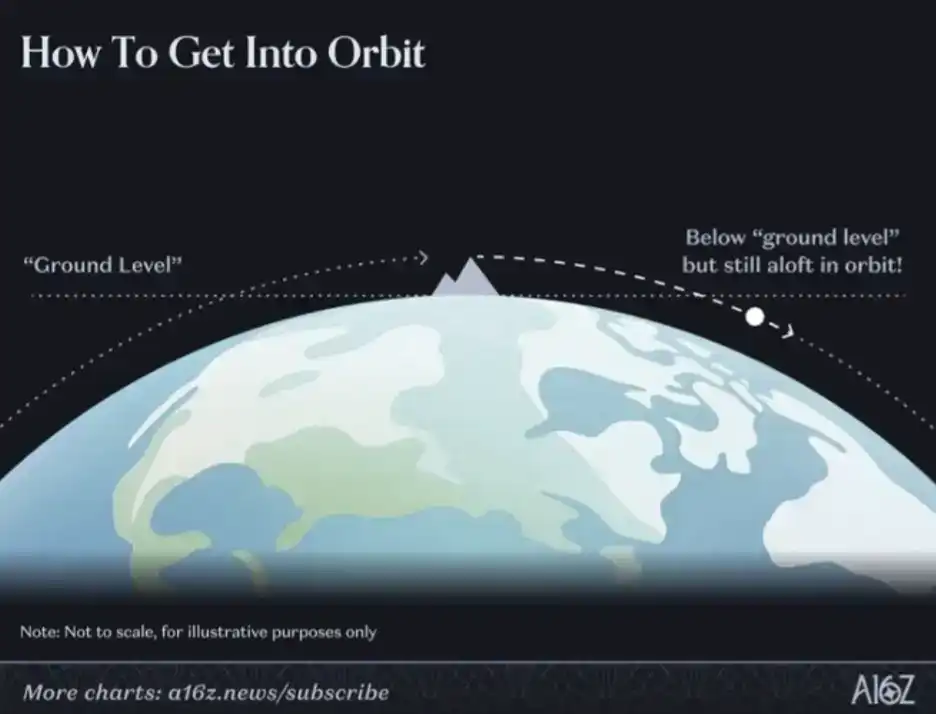
This threshold typically requires a delta-v of about 9.4 km/s. How much mass one can reliably place into orbit determines a nation's capacity to deploy satellites, the amount of fuel, sensors, protection, and redundancy they can carry.

Traditional satellites are often large and expensive because every gram is scarce, and design must be highly optimized. However, such "precious large satellites" become high-value targets in war. The more functions a single satellite carries, the greater the loss if it is blinded, jammed, or destroyed. Insufficient maneuverability and redundancy also make it harder to evade threats.

Orbital space itself is not as spacious as imagined. LEO constellations operate at different altitudes and inclinations, and their orbital planes intersect. Geostationary orbit, while at 36,000 km altitude, is essentially a limited resource line of longitude above the equator for communication satellites. Spectrum is similarly scarce; communication resources like the Ka-band require coordination. Space is vast physically but limited in operational resources.

An even greater nuisance is debris. Kinetic anti-satellite weapons, upon shattering a target, can create thousands of high-speed debris fragments. These fragments do not disappear but continue to orbit, repeatedly crossing relevant areas in the future, threatening other satellites. If collisions trigger more collisions, some orbits may become unusable for extended periods.

The US Has Scale Advantage, But Advantage Does Not Equal Safety

Judging from launch data, the US remains in a leading position. According to statistics from sources like Ill-Defined Space, the US had approximately 192 successful orbital launches in 2025, China about 90 successful out of 93 attempts, and Russia 17. Different agencies have slight variations in their definitions of "success" and "attempt," but the US lead is clear.
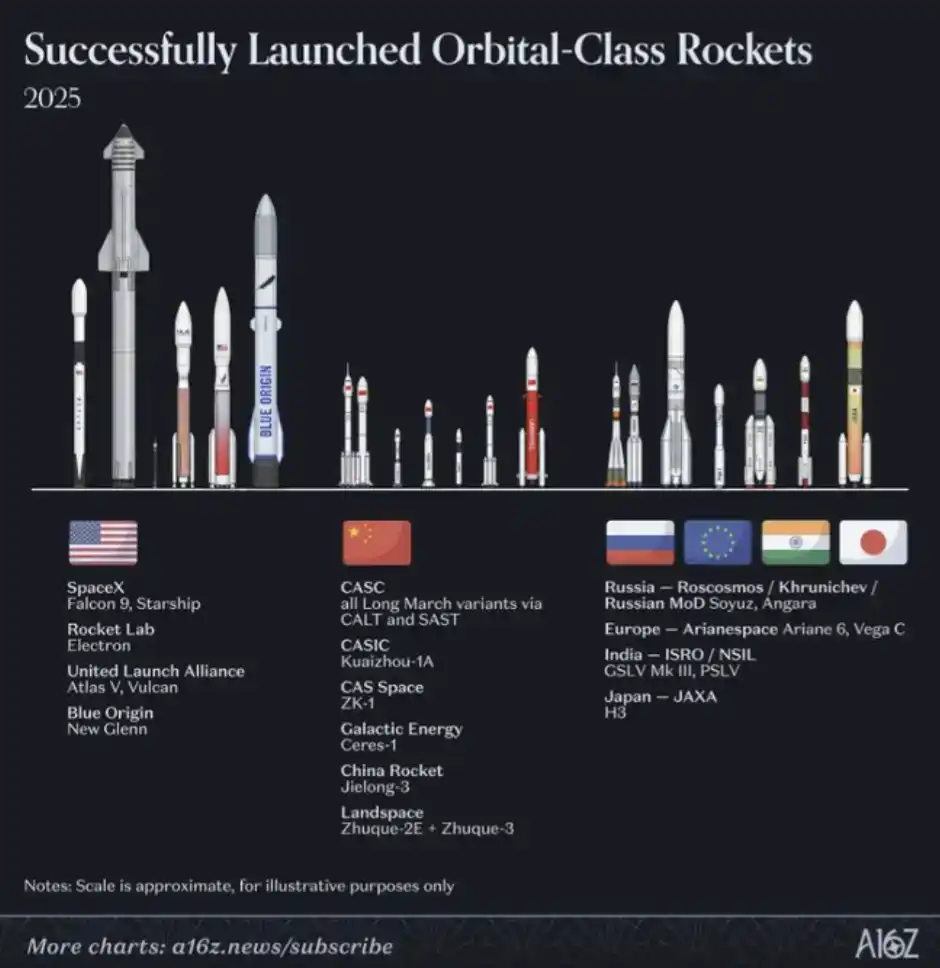
This is almost inseparable from SpaceX. In 2025, Falcon 9 launched approximately 165 times. SpaceX is also currently the only company to achieve large-scale reuse of orbital-class boosters. Reusability shifts launch from a scarce, expensive, low-frequency endeavor toward a higher-frequency, more industrialized rhythm. For military space capability, this impacts the speed of replenishment, expansion, generational upgrades, and wartime recovery.

Starlink demonstrates another type of advantage: scale. SpaceX's EU prospectus disclosed on June 5, 2026, shows that as of March 31, 2026, approximately 9,600 Starlink broadband and mobile satellites were operational in orbit. Third-party tracking data from June indicates the active number had exceeded 10,000.

Starlink's use in the Ukraine battlefield proves that commercial constellations can be rapidly transformed into wartime communication infrastructure. Its government version, Starshield, is more directly oriented toward defense needs.

But scale also brings new risks. Adversaries may no longer distinguish between commercial and military, viewing all commercial satellites capable of supporting war as dual-use targets. Russia's close-proximity operations around ICEYE-X36 are a real-world demonstration of this logic.

The US's true vulnerability lies in the fact that if critical missions like high-end reconnaissance, missile warning, and nuclear command communications remain concentrated on a few expensive satellites, even with a large overall satellite count, adversaries might target these few critical nodes. Space superiority cannot be judged solely by "how many satellites" but also by whether the architecture is dispersed, capable of rapid replenishment, whether ground systems are reliable, and whether operations can continue after jamming.

Space Warfare is More Likely to Remain in the Gray Zone

Winning a space war does not mean being the first to destroy more satellites. The real goal is to preserve one's own communication, reconnaissance, positioning, navigation, and timing capabilities, while making the adversary believe that an attack cannot yield decisive gains.

The first layer is launch capability. Whoever can place payloads into orbit faster, cheaper, and on a larger scale possesses wartime recovery capability. Reusable rockets, launch pad capacity, supply chains, and regulatory efficiency all become part of national security capability. Globally active orbital launch pads are few, and launch infrastructure itself becomes a high-value target.

The second layer is satellite manufacturing. Space no longer needs only a few "jewel-grade" satellites but requires large numbers of expendable, replaceable, functionally dispersed constellations. Military satellites need to distribute missions across more platforms so that the loss of a single point does not cripple the system.

The third layer is space domain awareness. In orbit, knowing who is approaching, at what speed, and with what possible intent is more critical than post-event attribution. Satellite jamming, blinding, collision, or internal failure can all manifest as malfunctions, making attribution often difficult. Without sufficient tracking and evidence chains, deterrence is weakened.

The cost of directly shattering satellites is also high. The 1962 US Starfish Prime high-altitude nuclear test detonated a nuclear bomb at about 400 km altitude, creating an artificial radiation belt that lasted for years and damaged or prematurely disabled multiple satellites. By various estimates, affected satellites at the time comprised about one-quarter to one-third of satellites in orbit. Modern orbital asset density is far higher than then, making the consequences of nuclear anti-satellite or large-scale kinetic strikes harder to control.

More realistic space confrontation may long remain within the realms of electronic jamming, GPS spoofing, laser dazzling, cyber attacks, close-proximity maneuvers, spectrum competition, and ground station attacks. China and Russia are developing counter-space capabilities, while the US is promoting more dispersed proliferated military constellations, such as PWSA. The ITU's spectrum and orbital slot rules will also become a field of competition.

The Most Dangerous Thing is Misjudging that Space is Still Peaceful

Space has long been packaged as a realm of peace, science, and commercial expansion, but modern warfare has proven it to be the infrastructure of ground battlefields. Without satellite communications, troops struggle to coordinate. Without remote sensing and navigation, missiles, drones, and artillery lose precision. Without timing systems, finance, power grids, and communication networks are also affected.

The peculiarity of Russia's approach to ICEYE-X36 is that it did not create an explosion but demonstrated the reality of commercial satellites being incorporated into military coercion. Future space warfare may not start with a missile but more likely with an approach, an interference, a spectrum grab, or a difficult-to-attribute failure.

The US's current advantage is real: leading in launch numbers, SpaceX has established a reusable rocket advantage, and Starlink has proven the wartime value of commercial constellations. Blue Origin, Rocket Lab, and Chinese commercial aerospace are catching up, while Russia and China are accumulating co-orbital, electronic warfare, and anti-satellite capabilities. If a few expensive platforms still bear critical missions, the orbital high ground will increasingly resemble a set of tempting targets.

The end goal of space warfare should not be to turn near-Earth orbit into a debris field. A more controllable outcome is to keep orbits usable, allow communications, reconnaissance, and navigation to recover under attack, and make adversaries believe that disrupting order will incur higher costs. Commercial spaceflight has given the US unprecedented scale advantages but also exposed commercial assets to new military risks. The Russian satellite's 500-meter approach is merely the clearest reminder of this stage.


Crypto di tendenza

Domande pertinenti

QAccording to the article, what specific event in May 2026 does the author consider a key moment for highlighting the vulnerability of commercial satellites in conflict?

AThe author points to Russia's Cosmos satellites maneuvering to within approximately 500 meters of the Ukrainian-supporting ICEYE-X36 commercial radar satellite as a key moment, demonstrating how commercial satellites used for military support can become targets for military coercion or potential attack.

QWhat are the two main advantages the United States holds in space according to the article's analysis?

AThe article identifies two main US advantages: 1) Dominant launch capability, primarily through SpaceX's reusable Falcon 9 rockets enabling frequent, cost-effective access to orbit. 2) Scale of satellite constellations, exemplified by Starlink's thousands of operational satellites, which provide resilient and rapidly deployable infrastructure.

QWhy is a direct kinetic attack (like destroying a satellite with a missile) considered a high-risk option in space warfare?

ADirect kinetic attacks create persistent space debris. The fragments orbit at high speeds for years, posing a long-term collision threat to all satellites in similar orbital regions. This could trigger a chain reaction of collisions (Kessler Syndrome), potentially making certain orbits unusable and harming the attacker's own space assets.

QWhat does the article suggest is a more likely form of space conflict than outright destruction of satellites?

AThe article suggests future space conflict is more likely to occur in a 'gray zone' using non-kinetic or coercive tactics. These include electronic jamming, GPS spoofing, laser dazzling, cyber attacks, close-proximity satellite maneuvers, spectrum interference, and attacks on ground stations.

QWhat is the core strategic goal of space warfare as defined in the article, beyond simply destroying enemy satellites?

AThe core strategic goal is to preserve one's own capabilities for communication, reconnaissance, positioning, navigation, and timing (PNT) while convincing the adversary that an attack would not provide decisive benefits. The aim is to maintain a functioning orbital environment where critical services can survive and recover from disruption.

Letture associate

Conversation with Co-founder of Hyperdash: Why is Hyperliquid Still Severely Undervalued?

Interview Summary with Hanson Birringer, Co-founder of Hyperdash: Why Hyperliquid Remains Undervalued In an interview on *The Rollup*, Hanson Birringer, Co-founder and Chief Revenue Officer of Hyperdash—a trading data analytics platform for Hyperliquid—shared his investment thesis on the Hyperliquid ecosystem. He described Hyperliquid as a pure play on three key crypto super-trends: perpetual contracts, real-world assets (RWAs), and stablecoins. The platform is an open-source, decentralized, and high-performance financial system uniquely positioned to bridge traditional institutional capital with decentralized finance. Birringer highlighted Hyperliquid's leadership in perpetual DEX trading and its recent innovation of RWA perpetual contracts. He emphasized the significance of USDC becoming a core quoting asset, which, by allocating 90% of its backend yield from assets like US treasuries to a protocol buyback fund, creates substantial, programmatic buy pressure for the Hype token. He addressed regulatory challenges, noting that Hyperliquid's policy team is actively engaging with US regulators like the CFTC to establish clear rules for decentralized venues. Once achieved, regulated brokers could route orders directly to Hyperliquid's backend, tapping into its low-cost liquidity layer. Regarding revenue, Birringer was optimistic, citing the immense size of traditional financial markets. Even capturing a small fraction of global trading volume in products like RWA perpetuals could lead to exponential growth for the protocol. The recently launched Grayscale Hyperliquid ETF, seeded by their SPV (Hyper Holdings Global), provides a compliant on-ramp for institutional investors drawn to the clear "cash flow + token buyback" model. Finally, he discussed Hyperdash's acquisition of Imperator, enhancing its data and node infrastructure to serve both retail traders and traditional asset managers. His bullish case rests on Hyperliquid's potential to provide unprecedented global access to dollar-based capital markets. He struggled to articulate a bear case, seeing the long-term trends of internet adoption and financial inclusion as powerful tailwinds.

marsbit1 h fa

Conversation with Co-founder of Hyperdash: Why is Hyperliquid Still Severely Undervalued?

marsbit1 h fa

DeepSeek V4 'Full-Blooded Edition' Leaked, Could Be Released As Early As Tomorrow

The highly anticipated full release of DeepSeek V4 is imminent, expected to launch as early as tomorrow after nearly three months of waiting. A select group has already received access to the GA (General Availability) beta, which includes two versions: DeepSeek V4 Flash and DeepSeek V4 Pro. Early testers report that V4's overall performance is close to the level of Opus 4.8, with coding capabilities rivaling GPT-5.6 Sol. Its agent abilities are significantly enhanced, and 3D/SVG generation has improved notably. While it may not surpass the recently released Kimi K3 in performance, its expected price point is significantly lower. The official release will introduce a new "peak/off-peak" pricing model for its API. For example, deepseek-v4-pro will cost $0.87 per million output tokens during standard times and $1.74 during peak hours. The flash version is even more aggressive at $0.28/$0.56 per million tokens, with cached input tokens priced extremely low at $0.0028. This makes V4 a strong contender in terms of cost-effectiveness, potentially offering Opus-level capabilities at a fraction of the cost, continuing DeepSeek's reputation as a "price disruptor" in the AI market. Initial demos showcasing V4's capabilities have begun circulating, including generated 3D simulation games, HTML games blending elements of Minecraft and No Man's Sky, and classic games like a "Cut the Rope" clone. The final GA version is set to replace the older deepseek-chat and deepseek-reasoner models, which will be retired on July 24th.

marsbit1 h fa

DeepSeek V4 'Full-Blooded Edition' Leaked, Could Be Released As Early As Tomorrow

marsbit1 h fa

WEEX Labs Weekly Observation: The 'Power Restructuring' of AI Infrastructure and the 'Deep Dive Movement' into the Real Economy

WEEX Labs Weekly Review: AI Infrastructure's "Power Restructuring" and the "Deep Dive" into the Real Economy Mid-July 2026 marks a pivotal shift in the global AI industry. The allocation of computing power is transferring from cloud giants to compute resource owners, while the core value of AI is solidifying around its penetration into physical industry, moving beyond the race for model parameters. The era of fragmented model development is over, replaced by a capital-intensive, integrated chain driven by hard tech. Key developments this week include Meta's planned entry into the cloud computing market with "MetaCompute." This move by social media giants with massive GPU clusters challenges traditional cloud providers like AWS, integrating compute, models, and data into one-stop services, which will squeeze smaller rental providers and shift enterprise focus towards underlying model ecosystems. Chinese foundational models like DeepSeek-V4 and Tencent's Hy-3 are pushing towards "utility" status through open-source releases and extreme cost reductions via MoE architectures. This lowers entry barriers for enterprises, allowing them to focus resources on private deployment and deep business integration. Embodied intelligence, particularly humanoid robots, is transitioning from lab demos to real-world factory applications, driven by policies promoting large-scale, practical deployment in logistics and manufacturing. The value focus is shifting from spectacle to stable industrial data and real operational efficiency. Global governance, through forums like WAIC, is evolving from theoretical ethics to practical operational frameworks for "Sovereign AI," raising geopolitical compliance barriers and making auditability and data sovereignty core design requirements from the outset. WEEX Labs Insights: The current transformation shows AI's prosperity is deeply embedding into the fabric of global manufacturing. Strategic recommendations include: 1) leveraging open-source models for private, proprietary knowledge bases; 2) maintaining cloud provider diversity to avoid vendor lock-in from integrated model ecosystems; and 3) seeking opportunities in the "embodied infrastructure" supporting robots, such as data collection, industrial simulation, and factory AI adaptation services.

marsbit1 h fa

WEEX Labs Weekly Observation: The 'Power Restructuring' of AI Infrastructure and the 'Deep Dive Movement' into the Real Economy

marsbit1 h fa

Is WEEX TradFi Reliable? What You Should Know Before Your First Trade of U.S. Stock Tokens

In recent years, cryptocurrency users have expanded their focus beyond Bitcoin and Ethereum to include popular traditional financial (TradFi) assets like Nvidia, Apple, and Tesla stocks. This shift raises key questions: What do these TradFi assets represent on crypto trading platforms? How do they differ from traditional stock ownership? And how can users assess the reliability of platforms offering such products? TradFi products, such as those offered by WEEX TradFi (including NVDA, MSFT, AAPL, TSLA, and QQQ tokens), are blurring the lines between crypto and traditional markets. They allow users to trade based on the price movements of traditional assets within a familiar digital asset trading environment. However, it's crucial to understand that trading a "stock token" is not equivalent to owning the actual stock. Users are participating in price speculation, not gaining shareholder rights like dividends or voting. A key feature of these products is 7x24 trading, offering flexibility beyond traditional market hours. While convenient, this also introduces unique risks, such as potential liquidity gaps and volatility when underlying markets are closed. For users evaluating TradFi products, reliability hinges on transparency and risk management. Critical factors include understanding the product mechanism, how prices track the underlying assets, and the associated risks—especially when using leverage. Popular stocks and indices are still subject to company performance, macroeconomic shifts, and sector trends. Ultimately, TradFi represents a new gateway connecting crypto users to global markets. The future points toward integrated trading environments where the distinction between "crypto investor" and "traditional investor" fades. For newcomers, a platform's reliability stems not from promises, but from a clear understanding of the product, a comprehensive view of risks, and informed judgment of the platform's capabilities.

marsbit1 h fa

Is WEEX TradFi Reliable? What You Should Know Before Your First Trade of U.S. Stock Tokens

marsbit1 h fa

Trading

Spot

Articoli Popolari

Come comprare WAR

Benvenuto in HTX.com! Abbiamo reso l'acquisto di WAR (WAR) semplice e conveniente. Segui la nostra guida passo passo per intraprendere il tuo viaggio nel mondo delle criptovalute.Step 1: Crea il tuo Account HTXUsa la tua email o numero di telefono per registrarti il tuo account gratuito su HTX. Vivi un'esperienza facile e sblocca tutte le funzionalità,Crea il mio accountStep 2: Vai in Acquista crypto e seleziona il tuo metodo di pagamentoCarta di credito/debito: utilizza la tua Visa o Mastercard per acquistare immediatamente WARWAR.Bilancio: Usa i fondi dal bilancio del tuo account HTX per fare trading senza problemi.Terze parti: abbiamo aggiunto metodi di pagamento molto utilizzati come Google Pay e Apple Pay per maggiore comodità.P2P: Fai trading direttamente con altri utenti HTX.Over-the-Counter (OTC): Offriamo servizi su misura e tassi di cambio competitivi per i trader.Step 3: Conserva WAR (WAR)Dopo aver acquistato WAR (WAR), conserva nel tuo account HTX. In alternativa, puoi inviare tramite trasferimento blockchain o scambiare per altre criptovalute.Step 4: Scambia WAR (WAR)Scambia facilmente WAR (WAR) nel mercato spot di HTX. Accedi al tuo account, seleziona la tua coppia di trading, esegui le tue operazioni e monitora in tempo reale. Offriamo un'esperienza user-friendly sia per chi ha appena iniziato che per i trader più esperti.

231 Totale visualizzazioniPubblicato il 2024.12.11Aggiornato il 2026.06.02

Come comprare WAR

Discussioni

Benvenuto nella Community HTX. Qui puoi rimanere informato sugli ultimi sviluppi della piattaforma e accedere ad approfondimenti esperti sul mercato. Le opinioni degli utenti sul prezzo di WAR WAR sono presentate come di seguito.

活动图片