a16z Crypto Partner: Cryptocurrency is Being Repackaged by Financial Institutions, Its Potential Far Exceeds Imagination

链捕手Pubblicato 2026-05-08Pubblicato ultima volta 2026-05-08

Introduzione

"Digital Assets" and the Real Digital Transformation of Finance The term "digital assets" puzzles many in crypto, as most assets today are already digital. Yet, the financial industry's core infrastructure has largely escaped the profound digital transformation seen in other sectors like media and retail. Beneath modern interfaces, finance still relies on fragmented systems, manual reconciliation, and paper-based processes. The true driver for blockchain adoption by large financial institutions is not ideology but a practical need to solve coordination problems. It provides a neutral system for multiple parties to collaborate without ceding control to a single entity. Asset ownership is encoded directly into the software, eliminating separate ledgers and disputes over records. The asset *is* the record. While crypto's adoption by Wall Street involves compromises and compliance, it inherits a key capability: *composability*. When financial assets exist on shared, programmable infrastructure, they can be combined, extended, and integrated seamlessly. The immediate benefits are faster settlement and lower costs, but the deeper, structural change is the newfound ease of building applications on top of this system. In essence, crypto technology is not disappearing into financial institutions but being repackaged as foundational infrastructure. As Wall Street adopts it, the industry may ultimately inherit more of crypto's transformative potential than it initially anticipated.

Author:Guy Wuollet

Compiler: Jiahuan, ChainCatcher

As someone who identifies as part of the 'crypto space,' I've always wondered: why do Wall Street and, increasingly, politicians in Washington insist on using the term 'digital assets'?

Almost all the assets I deal with daily are digital.

I can't even remember the last time I carried cash. From bank accounts to brokerage accounts, all my personal finances are online. I rarely even pull out a physical credit card. Talking to peers, I'm not an exception.

For most people in developed countries, the truly non-digital assets left are things like houses and cars. These are called 'real assets,' which ironically adds more confusion—it implies that stocks, bonds, network tokens, and derivatives are somehow not 'real.'

But of course they are real.

However, after years of investing and building systems in the fintech space, I've realized something: much of finance is not as digital as we think.

Most other sectors of the economy—from media and retail to logistics—have been fundamentally restructured around software. Finance looks similar on the surface, but its foundations have barely moved—the wave of digitization that the mobile internet and cloud computing brought to the global economy largely bypassed the financial industry.

And now, this is finally starting to change.

The Coordination Problem in Finance

Financial institutions are, in many ways, stuck in the past.

They operate on fragmented systems, relying on files and constant reconciliation to keep things running. Just figuring out 'who owns what,' 'when to settle,' 'how to sequence transactions,' and 'which rules apply' takes an immense amount of time.

In theory, a shared database could solve this. But in practice, harder questions immediately arise: who controls this database? Who has permission to change it? What happens when the participants don't trust each other?

This is why blockchain is gaining traction in places that look very different from the early crypto scene.

Crypto culture initially revolved around ideas like 'decentralization' and 'financial sovereignty,' which remain important today. But what is pushing large financial institutions toward this technology is not ideology, but the more pragmatic problem of coordination.

Wall Street's logic has always been more pragmatic than idealistic.

Every trading firm is as sensitive to counterparty default risk as every startup is to platform risk (like a project built on Facebook that could be kicked off at any moment).

Counterparty risk must be managed, censorship resistance must be managed, and fair sequencing and best execution must be managed. Wall Street might not call this 'decentralization,' but what it's solving for is essentially the same thing.

In my view, blockchain is the first time a decent answer has been provided for these old problems.

It provides a neutral system that allows multiple parties to coordinate without having to hand control to a single owner. Asset ownership is written directly into the software, eliminating the need for a separate ledger to reconcile against, and there is no external record to adjudicate who owns what.

The asset *is* the record.

This is the real reason Wall Street is starting to seriously embrace blockchain: not because they suddenly believe in decentralization, but because blockchain provides a common 'default option' among multiple counterparties, enabling them to upgrade their respective backend systems.

This is what the term 'digital asset' truly aims to convey—it represents the digital transformation of financial services, much like cloud services represented the digital transformation of large enterprises.

What Moving On-Chain Means

As the crypto industry moves towards Wall Street, it is also shedding some of its rebellious spirit, entering an adult world filled with dress shirts, compliance reviews, and various compromises.

But while Wall Street uses blockchain for digital transformation, it is also, perhaps unknowingly, inheriting the strongest capability of the crypto space—one that the software industry has possessed for decades: composability.

When financial assets run on shared, programmable infrastructure, they can be composed, extended, and integrated without having to be rebuilt from scratch every time.

Some of the benefits are obvious, like faster settlement and lower costs. But the deeper change is structural: building applications on top of this system will become much easier.

In other words, crypto technology will not disappear once it enters financial institutions; it will simply be repackaged.

This movement is becoming infrastructure. And when Wall Street starts using this infrastructure, the crypto spirit it ultimately inherits may be far greater than it originally anticipated.

Domande pertinenti

QWhat is the main reason Wall Street and financial institutions are embracing blockchain technology, according to the author?

AThe primary reason is not ideology, such as a belief in decentralization, but a practical need to solve coordination problems. Blockchain provides a neutral system for multiple parties to coordinate without ceding control to a single owner, acting as a common 'default option' for upgrading backend systems and managing issues like counterparty risk and transaction ordering.

QWhat key ability does the author claim the financial industry will inherit by adopting blockchain-based infrastructure?

AThe financial industry will inherit the powerful ability of 'composability.' When financial assets run on shared, programmable infrastructure, they can be composed, extended, and integrated, making it much easier to build applications without starting from scratch each time, similar to capabilities in the software industry.

QWhy does the author find the term 'digital assets' used by Wall Street and Washington politicians confusing?

AThe author finds it confusing because most assets people interact with in developed economies are already digital (e.g., bank accounts, brokerage accounts). The term seems redundant and implies that other assets like stocks or bonds are somehow not 'real,' whereas the more meaningful distinction is about the underlying infrastructure's digitization.

QHow does the author describe the current state of digitization in the finance industry compared to other sectors?

AThe author states that while finance appears digitized on the surface, its foundational systems have largely been left untouched by the digital wave that transformed other industries like media, retail, and logistics. Finance still relies on fragmented systems, manual reconciliation, and file-based processes, making it less digitally transformed than it seems.

QWhat does the author suggest is the deeper, structural change enabled by moving financial assets onto a shared, programmable ledger?

ABeyond obvious benefits like faster settlement and lower costs, the deeper change is structural: it becomes significantly easier to build applications on top of this system. This foundational shift means crypto technology is being repackaged as infrastructure within financial institutions, potentially leading to greater adoption of its core capabilities than initially anticipated.

Letture associate

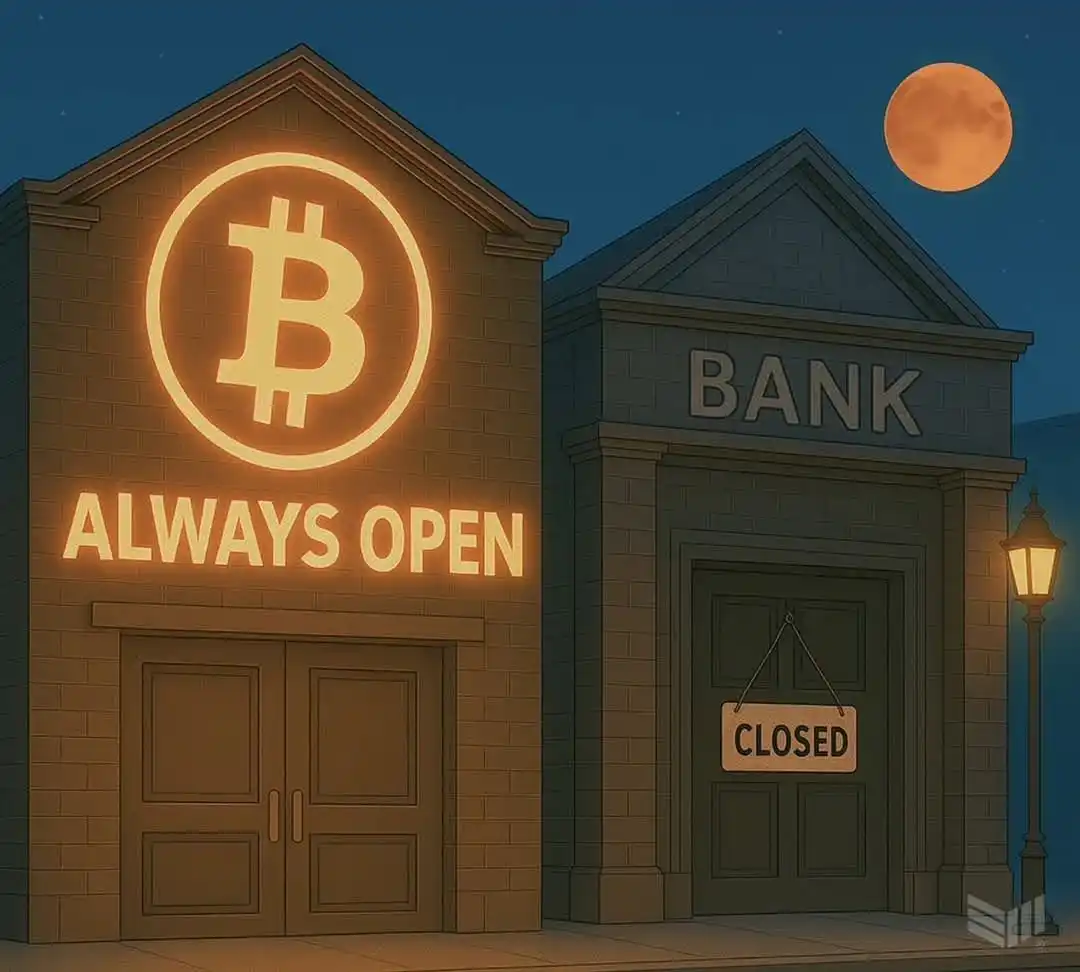
For Hedging, Buy Gold and Oil; For Explosive Growth, Buy AI; Bitcoin, the 'Outdated' Asset, Enters a Bear Market

Bitcoin’s price has recently fallen sharply, hitting a two-month low near $66,000, with Ethereum also dropping to a three-month low. While surface explanations point to ETF outflows, geopolitical tensions, and corporate selling, a deeper issue is emerging: Bitcoin is losing a crucial asset competition. For years, Bitcoin thrived in a low-rate environment where investors sought alternatives amid inflation fears and dissatisfaction with traditional options. Now, the market landscape has shifted, leaving Bitcoin stuck in an "awkward middle ground," facing challenges on three fronts: 1. **As an inflation hedge, gold is winning.** Investors worried about persistent inflation are turning to tangible assets like gold, energy stocks, and commodity producers, which offer more direct pricing power and physical backing. 2. **For growth exposure, AI is winning.** Those seeking high growth now favor AI-related companies with actual revenues and profits, an area where Bitcoin's lack of cash flow puts it at a disadvantage. 3. **Within crypto, infrastructure and stablecoins are winning.** Even investors wanting crypto exposure have alternatives like exchanges, stablecoin issuers, and tokenization firms, whose performance is directly tied to real-world adoption and offers clearer operational leverage. The recent market reaction to inflation warnings highlights this shift. Instead of boosting Bitcoin as "digital gold," such news now drives flows toward traditional inflation-sensitive assets. Therefore, recent events like ETF outflows and corporate selling are seen not as causes, but as symptoms of this new reality. Capital has more compelling options, and investors are becoming more selective. The emerging bear case for Bitcoin is no longer about it being a fraud or failed technology, but rather that **scarcity alone is no longer enough**. It is no longer seen as the best hedge, the best growth asset, or the only crypto play.

marsbit3 min fa

For Hedging, Buy Gold and Oil; For Explosive Growth, Buy AI; Bitcoin, the 'Outdated' Asset, Enters a Bear Market

marsbit3 min fa

SaaS Battle Royale: The Survivors Who Win All Share One Common Trait

**Summary** The AI revolution has triggered a "SaaS apocalypse," forcing a brutal market shakeout. The key dividing line is the pricing model. Companies like Snowflake and Datadog, which charge based on consumption (e.g., data processed or compute used), are thriving. AI workloads actively *generate* more demand for their services, fueling growth. Datadog's accelerating revenue is a prime example. Microsoft and Palantir, as platform/ecosystem players, also benefit by acting as essential channels for AI deployment. In contrast, traditional SaaS firms built on per-seat or per-task licensing (e.g., Intuit, Adobe) face direct pressure, as AI threatens to automate the very human tasks their software supports. Companies like Salesforce, a per-seat giant, are caught in the middle. While showing strong AI monetization (e.g., its Agentforce platform) and experimenting with consumption-based "Flex Credits," its stock remains under pressure, illustrating that the market rewards *completed* transitions, not just the intent. The recent Microsoft Build conference underscored key trends: AI is evolving from an assistant to an autonomous "agent," and platform providers like Microsoft are consolidating their control. The market's recovery is highly selective, focused on identifying which companies are "fed by AI" versus "eaten by AI." Future focus will be on the diffusion of this recovery to transforming companies and the real-world adoption data of AI agents like Microsoft Copilot.

marsbit20 min fa

SaaS Battle Royale: The Survivors Who Win All Share One Common Trait

marsbit20 min fa

Trading

Spot
Futures
活动图片