a16z crypto Partner: Cash Flow Is the True Moat

Foresight NewsPubblicato 2026-06-11Pubblicato ultima volta 2026-06-11

Introduzione

Title: a16z Crypto Partner: Capital Flow is the True Moat In business history, enduringly successful enterprises often share a core logic: capturing value by facilitating its creation and transfer within an ecosystem, taking a share of the proceeds. The scale of value flowing through the ecosystem directly correlates with the company's growth. Cryptography is the first modern technology natively suited to this commercial logic. Startups that don't leverage this framework in product design and business model construction miss significant opportunities. Stablecoins enable internet-speed, 24/7 global settlement of value with end-to-end programmability. With open underlying channels for capital flow and transparent unit economics, every circulating dollar globally represents potential flow in this arena. Blockchain is inherently a network business model. All transactions are recorded on a shared ledger, and each new participant strengthens this foundational system for future developers. More users and applications increase the network's value for all. Crypto entrepreneurs start with built-in network effects, unlike traditional businesses that spend years building them on legacy infrastructure. Network tokens amplify this advantage. A well-designed token system aligns users, developers, service providers, and validators around a common goal—network growth—while distributing rewards based on contribution. All proceeds flow back to ecosystem participants, creating a virtuous cyc...


Author: Jason Rosenthal, Operating Partner at a16z crypto

Compiled by: Chopper, Foresight News


Throughout business history, the success logic of many enduring enterprises has been inseparable from the link of capital flow: undertaking businesses that create and transfer value within the ecosystem and extracting revenue from them. The larger the volume of value flowing through the ecosystem, the larger the scale of the enterprise tends to be.


Cryptographic technology is the first modern technology inherently suited to this business logic. If a startup does not base its product design and business model architecture on this logic during the planning stages, it misses out on tremendous opportunities. The proliferation of stablecoins has endowed capital and value with internet-level transfer speeds, enabling 24/7 global settlement with end-to-end programmability. Now, the underlying channels for capital flow are fully open, unit economic models are transparent, and every circulating dollar globally represents potential flow in this arena.


Underlying Business Logic


Blockchain is fundamentally a network-based business model. All transactions are uniformly recorded on a shared ledger, and each new participant reinforces this underlying system for subsequent developers. The more people who use the ecosystem and build applications, the greater the value of the entire network for all users.


Most traditional enterprises spend years building network effects on top of outdated infrastructure; whereas entrepreneurs in the crypto space start with inherent network effects from the outset.


Network tokens further amplify this advantage. A well-designed token system can bind users, developers, service providers, node validators, and the protocol ecosystem to a common goal—driving network growth—while distributing revenue according to each party's contributions. The revenue generated by the protocol ultimately belongs to all ecosystem participants. There are no secret rebates, no special deals, only the formation of a positive feedback loop: value circulates within the system, and returns flow back to everyone building the ecosystem.


This business logic is not new; it's just that the crypto industry is the first to enable startups to implement and scale it more easily.


The profit core of railroad companies was never selling locomotives, but charging a toll for every freight train transporting grain, coal, or steel. Standard Oil, U.S. Steel, and AT&T were all giants rooted in the links of value flow. Google and Meta replaced traditional print and television media not merely because their advertising formats were better, but because they occupied the critical node where attention converts into commercial transactions, taking a cut from trillions of dollars in commercial flow. Amazon Web Services occupies the central position for computing resources.
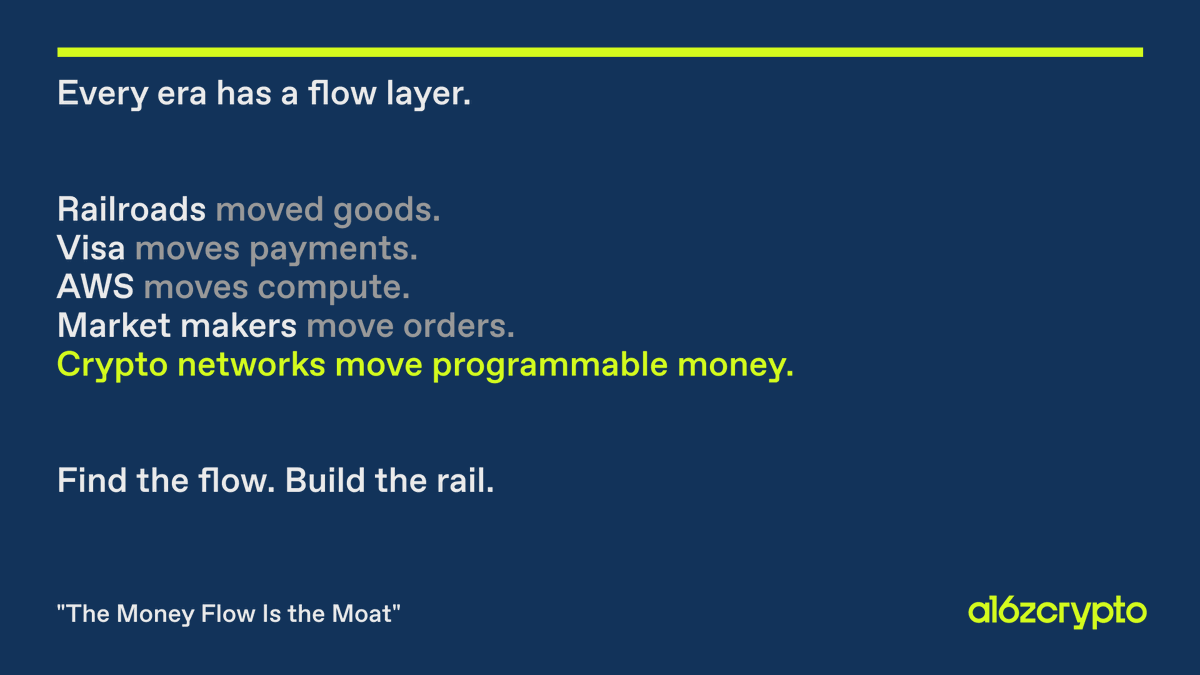


The pattern remains consistent: find the core path of value flow and occupy a key position within it.


This logic is vividly reflected in financial markets. In fiscal year 2024, Visa processed payment volumes totaling $15.7 trillion, generating net revenue of $35.9 billion. The well-known market maker Jane Street's trading net revenue reached $20.5 billion last year, surpassing Citibank and Bank of America. The top five market makers in the US handled 87% of order flow payments: they don't predict market ups and downs, they just need to reside in the flow path of every order; the higher the trading volume, the greater their earnings.


Such enterprises share another commonality: powerful network effects. The more merchants that accept Visa cards, the more valuable the card is to cardholders; conversely, the more cardholders, the more merchants are attracted to offer the service. The order flow market is similar: the more brokers connected, the narrower the bid-ask spread, which in turn attracts more brokers, bringing even larger order flow.


Cash flow coupled with network effects is one of the most robust business models in the commercial world.


Your Margin Is My Opportunity


Jeff Bezos once proposed a classic viewpoint: "Your margin is my opportunity." This statement originally targeted the retail industry, but it fits even more aptly in the traditional financial services sector—the industry with the largest scale of profit capture globally. This holds true across subsectors like payments, asset custody, lending, foreign exchange, asset securitization, trade settlement, and market making.


Visa and Mastercard, based on networks built in the 1960s, charge transaction fees of 2% to 3%; cross-border remittance channels have fees as high as 6% to 9%; prime brokers and asset custodians take a cut from every securities transaction. Even though the US shortened the securities settlement cycle to T+1 in 2024, funds can still sit idle overnight, which constitutes a structural cost borne by all market participants.


The existing profit margins in these industries are all potential entry points for disruption. Reducing transaction costs, improving capital flow efficiency, and potentially further expanding the overall market size. Stripe and Square have proven this model works in payments.
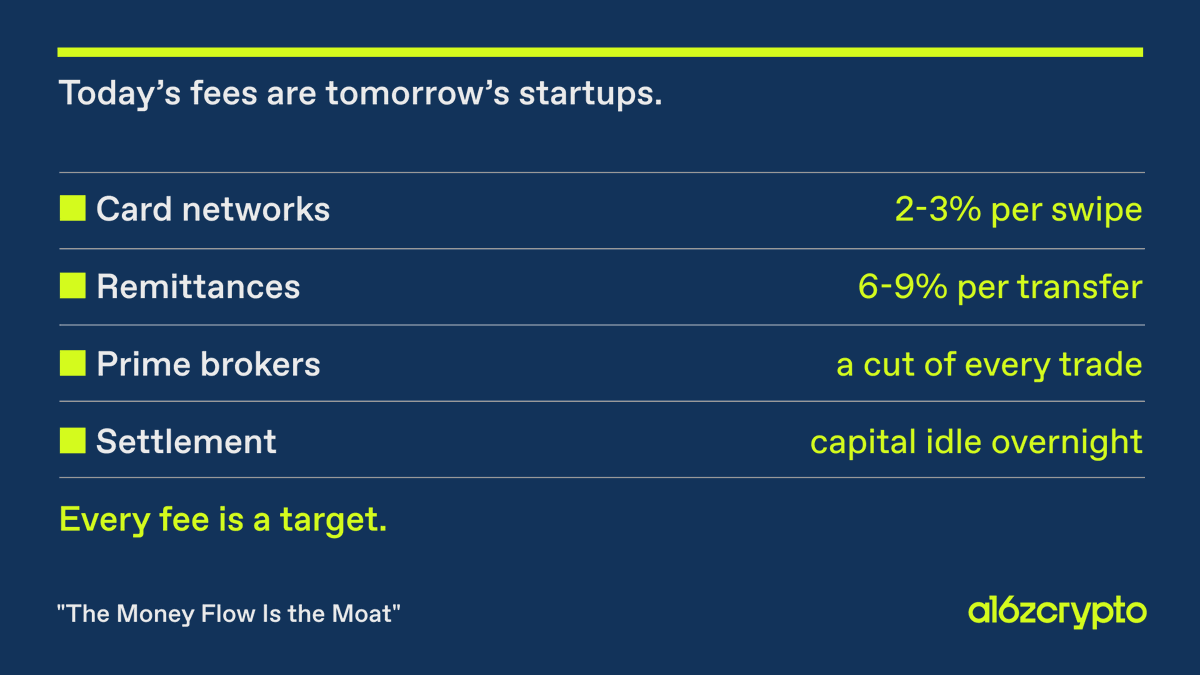


Entrepreneurs in the crypto industry have the opportunity to build the next-generation infrastructure: programmable, transactions settled instantly, globally accessible services, and rooted in the capital flow chain from its inception.


The opportunities also extend far beyond financial services. Markets for computing power and GPU trading, storage chips, AI training data, energy, robotics, aerospace, rare earth metals, and more are all on the verge of experiencing large-scale global value flow, for which existing traditional channels are completely inadequate.


The aforementioned sectors represent entirely new blue-ocean markets built on programmable infrastructure, centered on the cash flow model. Here, there are no deeply entrenched legacy platforms, no tangled webs of middlemen, and no old structures to defend.


As an entrepreneur, ask yourself a few questions: Is your current business positioned in the core link of value flow? When the transaction volume and value scale of your product ecosystem grow tenfold, can your revenue grow in sync? If you are developing a new product, in your target market, which link has the highest profit capture relative to the value it creates?


Where the answer lies, there lies the opportunity. Compress the costs of the original links, enter new value flow tracks, and then achieve sustained growth by leveraging network effects.


Crypto di tendenza

Domande pertinenti

QWhat is the core business logic shared by many enduring enterprises throughout business history, according to the article?

AThe core business logic is to occupy a key position in the flow of value, capturing a portion of the value as it moves through an ecosystem. The greater the volume of value flowing, the larger the enterprise typically becomes.

QHow does the article characterize the fundamental nature of blockchain technology in relation to business models?

AThe article characterizes blockchain as fundamentally a network-based business model. All transactions are recorded on a shared ledger, and each new participant strengthens this underlying system for subsequent developers. The more people who use and build on the ecosystem, the more valuable the entire network becomes for all users.

QAccording to the article, what creates one of the most durable business models in the commercial world?

AThe combination of capital flow and network effects creates one of the most durable business models in the commercial world.

QWhat is the meaning of Bezos's quote 'Your margin is my opportunity' in the context of traditional financial services?

AIn the context of traditional financial services, the quote means that the existing profit margins (or high fees) in sectors like payments, asset custody, and cross-border transfers represent opportunities for new, more efficient entrants to disrupt the industry by compressing those costs and capturing market share.

QWhat key questions should entrepreneurs ask themselves to identify opportunities, as suggested by the article?

AEntrepreneurs should ask: 1) Is my current business positioned at the core of a value flow? 2) If the transaction volume and value in my product's ecosystem grow tenfold, will my revenue grow correspondingly? 3) In my target market, which segment has the highest profit margin relative to the value it creates? The answers point to where the opportunities lie.

Letture associate

The Changing Landscape: What Are Crypto VCs Experiencing?

Title: The Shifting Landscape of Crypto Venture Capital The era of dedicated crypto venture capital funds is undergoing a significant transformation. Once essential for navigating the sector's complexity and high risk, these specialized funds are now facing an identity crisis as the market matures. This shift mirrors historical patterns in other specialized investment classes like cleantech and SPACs, where initial information advantages dissipate as technologies become mainstream and integrated into existing industry frameworks. The article argues that crypto is reaching a critical inflection point, transitioning from a "building phase" to an "integration phase." Major players like Stripe, BlackRock, and Visa now engage with crypto not for its novel mechanics but as a foundational financial infrastructure. Their needs—regulatory compliance, banking partnerships, distribution channels—align with traditional fintech, a domain easily understood by large, generalist funds like Sequoia and Founders Fund. This evolution creates a "barbell effect" within the VC landscape. On one end are massive, diversified platforms that can incorporate crypto as one vertical among many. On the other are small, nimble funds focused on niche, experimental projects. The middle ground—medium-sized dedicated crypto funds—is being squeezed out. Their typical fund size makes it impossible to generate sufficient returns solely from early-stage crypto bets, yet they cannot compete with giants for later-stage deals. Consequently, leading crypto-native firms like Paradigm and Framework Ventures are expanding into AI, robotics, and other sectors, driven partly by LP pressure for better returns amid a broader VC DPI crisis. Others, like Dragonfly and a16z, have narrowed their crypto focus predominantly to financial infrastructure like stablecoins, reframing the sector's core narrative. For crypto entrepreneurs, this consolidation presents challenges. While generalist funds offer larger checks and broader resources, crypto projects now compete fiercely with AI for attention and capital within these firms. Furthermore, the long-term, non-commercial foundational work that built the ecosystem—funded by dedicated crypto VCs—is less likely to attract generalist capital focused on direct returns. The conclusion is that "crypto investor" as a standalone category is becoming obsolete, akin to "internet investor." Crypto is becoming a baseline infrastructure layer. The future will see a barbell structure: large-scale growth financing handled by generalist funds, while pioneering, speculative projects are funded by small, specialized vehicles. The dedicated crypto funds of the 2017-2021 boom, which incubated core infrastructure, are giving way to this new, bifurcated reality.

Foresight News13 min fa

The Changing Landscape: What Are Crypto VCs Experiencing?

Foresight News13 min fa

As Consensus Accelerates, What Are Young Investors Betting On?

Title: As Consensus Forms Faster, What Are Young Investors Betting On? In the rapid evolution of tech investment, a new generation of young investors is navigating a landscape where AI, robotics, commercial aerospace, and quantum computing are advancing simultaneously. Traditional investment logic based on financial models is giving way to a need for deep technical understanding and the ability to act before industry consensus forms. An analysis of trends from the "WAIC FUTURE TECH" list of young investment leaders reveals key shifts in focus. The first major trend is the movement of AI from the digital screen into the physical world. Investment is shifting from large language models and chatbots towards embodied AI, robotics, AI hardware, and edge computing. While demonstrations generate excitement, the real challenge lies in achieving scalable, reliable, and cost-effective delivery in complex real-world environments like factories and logistics. Success depends not just on algorithms but on the integration of sensors, actuators, and control systems. Second, the competitive focus for large models is moving beyond raw capability toward building an "intelligence flywheel." The goal is to create self-reinforcing systems where user interaction generates data, improving the model, which in turn enhances the user experience and attracts more engagement. Companies that successfully embed AI into workflows to create these closed-loop systems can build lasting value that isn't easily erased by the next model upgrade. Third, facing a potential bottleneck in high-quality human-generated data, investors are looking at new underlying technologies. Reinforcement learning and self-play, as demonstrated by AlphaGo Zero, offer paths for AI to generate its own experience. Scientific foundation models, which aim to build general AI capabilities for fields like life sciences and materials discovery, represent a non-consensus direction that could unlock new frontiers of knowledge and data. Finally, in deep-tech areas like quantum computing, commercial aerospace, and space-based infrastructure, patient capital is essential. These fields have long, uncertain development and validation cycles involving complex engineering, supply chains, and regulations. Investment here requires a long-term view, focusing on foundational team capabilities and the eventual emergence of market demand, even if commercial returns are distant. Collectively, these trends illustrate how young investors are adapting to a new era. They are learning to make earlier, technically-informed judgments, balance hype with real-world viability, and provide the patient capital needed to build the deep-tech foundations of the future.

marsbit41 min fa

As Consensus Accelerates, What Are Young Investors Betting On?

marsbit41 min fa

Can Japan Buy Growth with AI? Will the Bond Market Believe It?

Japan's cabinet has introduced the 2026 Basic Policy on Economic and Fiscal Management and Reform, shifting its primary fiscal target. The new framework moves away from the traditional annual primary balance goal and instead prioritizes a stable reduction of the debt-to-GDP ratio. This change is tied to a strategy of increased "responsible proactive fiscal" spending, aiming to boost long-term growth through investments in strategic sectors like AI, semiconductors, energy, and robotics. The government estimates total public and private investment in 62 key technologies could exceed 370 trillion yen by 2040. The market reaction has been mixed and cautious. While equity markets may respond to policy signals, bond markets are focused on fiscal credibility. Concerns center on whether the weakening of the clear primary balance anchor could lead to looser fiscal discipline. If investors doubt that these strategic investments will generate sufficient productivity gains, tax revenue, and nominal growth to outpace rising interest costs, they may demand higher yields on Japanese Government Bonds (JGBs). Recent volatility in the yen and JGB yields, with the 10-year yield briefly reaching 2.9%, reflects this skepticism. The success of this new framework hinges on two factors: whether Japan can achieve a nominal growth rate consistently higher than its long-term interest rates, and whether future budgets demonstrate disciplined control over bond issuance. The government's narrative is that strategic investment is essential to break Japan's cycle of low growth, aging, and labor shortages. However, the bond market will continuously assess the credibility of this plan, pricing the risk that it may represent fiscal expansion rather than a viable growth strategy.

marsbit1 h fa

Can Japan Buy Growth with AI? Will the Bond Market Believe It?

marsbit1 h fa

Trading

Spot

Articoli Popolari

Come comprare FLOW

Benvenuto in HTX.com! Abbiamo reso l'acquisto di Flow (FLOW) semplice e conveniente. Segui la nostra guida passo passo per intraprendere il tuo viaggio nel mondo delle criptovalute.Step 1: Crea il tuo Account HTXUsa la tua email o numero di telefono per registrarti il tuo account gratuito su HTX. Vivi un'esperienza facile e sblocca tutte le funzionalità,Crea il mio accountStep 2: Vai in Acquista crypto e seleziona il tuo metodo di pagamentoCarta di credito/debito: utilizza la tua Visa o Mastercard per acquistare immediatamente FlowFLOW.Bilancio: Usa i fondi dal bilancio del tuo account HTX per fare trading senza problemi.Terze parti: abbiamo aggiunto metodi di pagamento molto utilizzati come Google Pay e Apple Pay per maggiore comodità.P2P: Fai trading direttamente con altri utenti HTX.Over-the-Counter (OTC): Offriamo servizi su misura e tassi di cambio competitivi per i trader.Step 3: Conserva Flow (FLOW)Dopo aver acquistato Flow (FLOW), conserva nel tuo account HTX. In alternativa, puoi inviare tramite trasferimento blockchain o scambiare per altre criptovalute.Step 4: Scambia Flow (FLOW)Scambia facilmente Flow (FLOW) nel mercato spot di HTX. Accedi al tuo account, seleziona la tua coppia di trading, esegui le tue operazioni e monitora in tempo reale. Offriamo un'esperienza user-friendly sia per chi ha appena iniziato che per i trader più esperti.

207 Totale visualizzazioniPubblicato il 2024.12.10Aggiornato il 2026.06.02

Come comprare FLOW

Discussioni

Benvenuto nella Community HTX. Qui puoi rimanere informato sugli ultimi sviluppi della piattaforma e accedere ad approfondimenti esperti sul mercato. Le opinioni degli utenti sul prezzo di FLOW FLOW sono presentate come di seguito.

活动图片












