a16z Crypto Partner: Cash Flow is the Moat

marsbitPubblicato 2026-06-12Pubblicato ultima volta 2026-06-12

Introduzione

Cash Flow as the Moat: A Playbook for Crypto Founders Historically, the most enduring businesses have been built by positioning themselves within the "flow of funds"—facilitating the creation and transfer of value in a network and extracting a portion of it. Cryptocurrency is the first modern technology natively built for this purpose. For startups, failing to architect products and businesses to leverage these principles means missing a major opportunity. Blockchains are inherently network businesses. Each transaction settles on a shared ledger, and every new participant strengthens the underlying network for all. Well-designed network tokens amplify this by aligning users, developers, and validators around growing the network, with value flowing back to contributors in a transparent feedback loop. This model is not new; companies from railroads and Standard Oil to Google, Meta, and AWS have thrived by inserting themselves into critical flows of value (goods, attention, compute). Financial markets make it even clearer: firms like Visa and major market makers generate immense revenue not by predicting markets but by being in the path of transactions. The combination of fund flow and network effects creates one of the most durable business structures. The high margins in traditional finance (payments, custody, lending, FX) represent prime targets. Crypto founders have the opportunity to build the next version—programmable, instant, global, and natively in the flow of funds...

Author: Jason Rosenthal, a16z Operating Partner

Translation: Hu Tao, ChainCatcher Selection

Many of history's greatest businesses were built by positioning themselves in the "flow of funds"—facilitating the creation and transfer of value within a network and taking a cut of it. The more value that flows through the network, the larger the business typically becomes.

Cryptocurrency is the first modern technology natively built for this purpose. If your startup hasn't yet architected its product and business to benefit from these principles, you're missing an opportunity. Thanks to stablecoins, capital and value now flow at internet speed—settling globally, 24/7, with end-to-end programmability. Payment channels are unobstructed, unit economics are transparent, and every dollar flowing anywhere in the world is reachable.

The Model

Blockchains are network businesses by design. Every transaction settles on a shared ledger. Each new participant reinforces the same underlying network that the next builder can use. As more people use and build on it, the network becomes more valuable to all users.

Most companies spend years manufacturing network effects on top of traditional infrastructure. Crypto founders inherit them as a starting condition.

Network tokens amplify this. Well-designed tokens can align users, developers, suppliers, validators, and protocols around a single outcome—growing the network—and pay proportionally to each participant's contribution. But the protocol's revenue belongs to the people who use it. No partner rebates, no side deals. Just a feedback loop between value flowing through the system and value accruing to the hands of those building and growing it.

This isn't a new model. Cryptocurrency just makes it accessible and scalable for startups for the first time.

Railroads didn't make money from locomotives. They made money from every ton of grain, coal, and steel that crossed their tracks. Standard Oil, U.S. Steel, and AT&T were all companies in the flow of funds. Google and Meta displaced print and TV not because their ads were better, but because they sat at the chokepoint where attention converts to commerce, enabling them to take a cut of trillions in commercial intent. AWS is in the flow of computation.

The model is consistent: find where value flows, and position yourself in the middle of it.
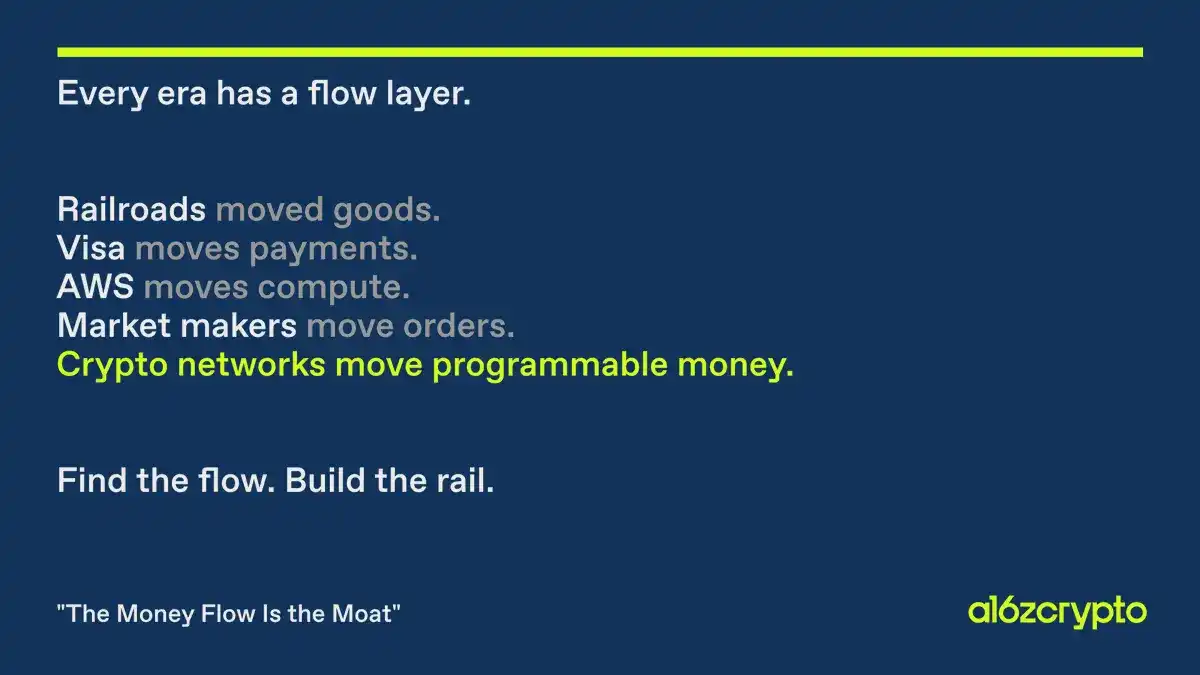
Financial markets make this model even clearer. Visa processed $15.7 trillion in payment volume in FY2024, reporting $35.9 billion in net revenue. Jane Street posted $20.5 billion in net trading revenue last year—more than Citigroup or Bank of America. The top five U.S. market makers handled 87% of order flow payment: they don't predict the market; they sit in the flow of every order and earn more as trading volume grows.

These businesses share another commonality: network effects. Visa is more useful to more merchants because there are more cards; more useful to more cardholders because more merchants accept it. It's the same with order flow—each additional broker narrows spreads, attracting more brokers, which attracts more flow.

The flow of funds plus network effects is one of the most durable business structures ever.

Your Margin is My Opportunity

Bezos called it "your margin is my opportunity." He was talking about retail, but it applies even more to traditional financial services—the world's largest pool of margin extraction. Payments, custody, lending, FX, securitization, settlement, market making—all of it. Visa and Mastercard charge 2-3% transaction fees on networks designed in the 1960s. Remittance corridors charge 6-9%. Prime brokers and custodians take a piece of every securities trade. Even after the U.S. shifted to T+1 settlement in 2024, money still sits idle overnight as a structural tax on every participant.

Each of these margins is a target. Compress cost, increase speed, and potentially expand the entire market. Stripe and Square proved this is possible in payments.

Crypto founders have the opportunity to build the next version—programmable, instant, global, and natively in the flow of funds.

And the frontier extends far beyond financial services. Compute and GPU markets. Memory chips. AI training data. Energy. Robotics. Space. Rare earth metals. Each category is an area where global value can begin to flow at volumes the existing rails were never designed to handle.

Each is an open field for building flow-of-funds businesses from the ground up on programmable infrastructure. These markets have no existing rails, no entrenched intermediaries, and nothing to defend.

As a founder, ask yourself:

1. Are you in the flow of funds today?

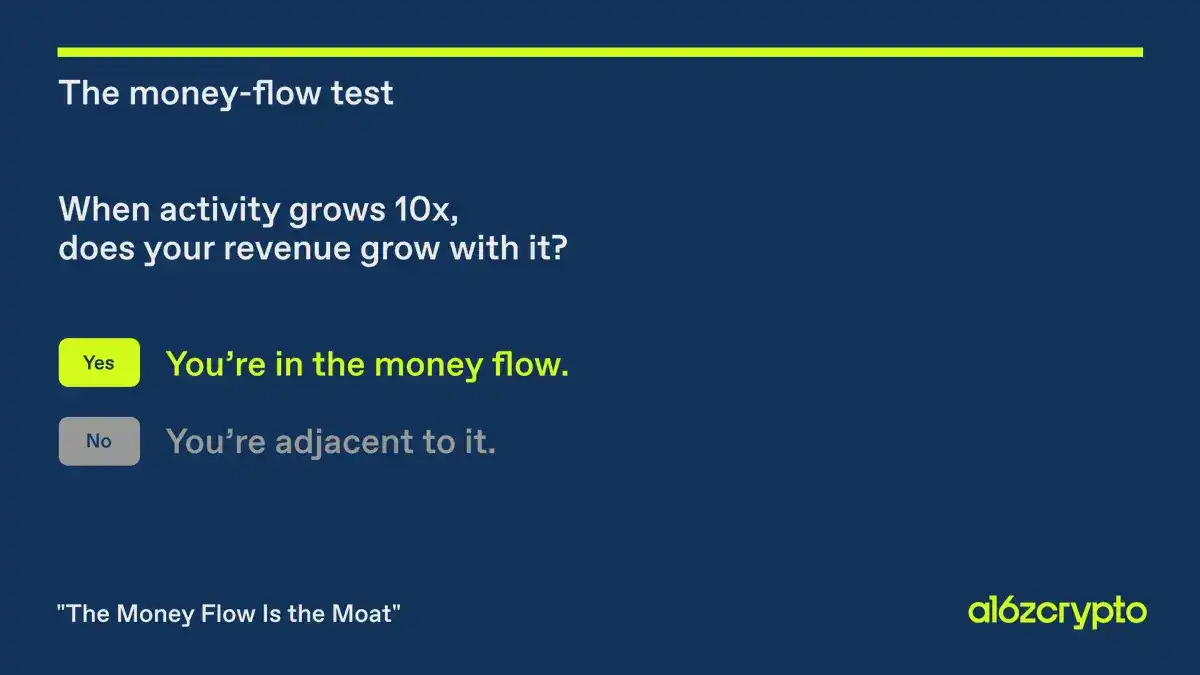
2. When the value of activity on your product grows 10x, does your revenue grow with it?

3. If you're building a new product, where in your target market is the margin extraction highest relative to the value being created?
The opportunity is there. Seize it, ride the new flow, and let the network compound from there.


Crypto di tendenza

Domande pertinenti

QAccording to the article, what are the core characteristics of successful business models historically?

AHistorically, many of the best businesses positioned themselves within 'cash flows'—facilitating the creation and transfer of value within a network and taking a cut of that flow. The more value that flows through the network, the larger the business typically becomes.

QHow does the article describe the fundamental advantage that cryptocurrency offers for startups?

ACryptocurrency is the first modern technology natively built for cash flow. It enables value to move at internet speed—24/7, global settlement, with end-to-end programmability—providing startups with accessible and scalable network effects and open unit economics from the start.

QWhat is the relationship between network tokens and business growth as explained in the text?

AWell-designed network tokens align users, developers, suppliers, validators, and the protocol around a single outcome: growing the network. Participants are paid proportionally to their contributions. This creates a feedback loop between the value flowing through the system and the value accumulating to those building it, without private deals or rebates.

QWhat does the phrase 'your margin is my opportunity' refer to in the context of the article?

AIt refers to the opportunity for new, often crypto-native, businesses to compete by targeting high-margin areas in traditional industries (especially financial services). By reducing costs, increasing speed, and building on programmable infrastructure, they can capture market share from established players with inefficient profit structures.

QWhat are the three key questions founders should ask themselves, according to the article's conclusion?

A1. Are you in the cash flow today? 2. When the value of activity on your product grows 10x, does your revenue grow with it? 3. If you're building a new product, where in your target market is the profit-taking highest relative to the value being created?

Letture associate

Must-Watch Events Next Week|CLARITY Act Could Face Senate Vote; SpaceX, Circle to Report Earnings (8.3-8.9)

**Summary: Key Events and Developments to Watch (August 3-9)** The upcoming week is marked by significant financial disclosures, key legislative deadlines, and notable product updates. **Major Financial Events:** Several companies are scheduled to release their Q2 2026 earnings. American Bitcoin (ABTC) will report on August 3, followed by SpaceX and Hut 8 Mining Corp. on August 4, and Circle on August 5. Notably, a significant portion of SpaceX shares (up to 12% of total shares) will be unlocked on August 6 following their earnings release. **Key Legislative Deadline:** The U.S. Senate faces an August 7 deadline to secure 60 votes for the CLARITY Act, a bipartisan bill aiming to establish a federal regulatory framework for cryptocurrencies. The Senate may hold a full vote on the bill during the week. **Economic Data:** The U.S. July Non-Farm Payrolls report will be released on August 7, providing crucial labor market data. **Technology & Product Updates:** * **Shutdowns:** DeFi portfolio tracker Zapper and wallet app Ctrl Wallet will cease operations on August 3. * **Upgrades:** LayerZero will deprecate its v1 relayers on August 3. XRP Ledger's new version 3.3.0, featuring five new functions, is expected next week. * **AI:** Elon Musk announced that the advanced Grok 4.6 AI model is set for release around August 7. * **Bitcoin:** The BIP-110 forced signaling for a potential Bitcoin network change is scheduled to begin around August 8. **Other Notable Events:** Chinese robotics firm Unitree Tech has set its preliminary price inquiry for its IPO for August 5. South Korean exchange Upbit will delist AQT and AERGO tokens on August 3.

marsbit1 h fa

Must-Watch Events Next Week|CLARITY Act Could Face Senate Vote; SpaceX, Circle to Report Earnings (8.3-8.9)

marsbit1 h fa

Stocks Are Plummeting More Sharply Than Cryptocurrencies. Where Has the Money Gone?

Stock Markets Plunge Deeper Than Cryptocurrencies: Where Did the Money Go? In late July, Seoul's Kospi index triggered circuit breakers for two consecutive days, plummeting over 40% from its June high. The collapse was led by heavyweight stocks like SK Hynix, whose record profits still disappointed investors, and devastating leveraged ETFs, with one major product losing over 83% of its value. This signaled a global, forced deleveraging targeting the most crowded trades. Interestingly, while stocks exhibited extreme volatility akin to crypto markets, Bitcoin rose nearly 15% in July after a prior steep drop. Analysis shows the money fleeing equities did not flow into Bitcoin. Instead, Bitcoin had already absorbed its sell-off in May-June, when U.S. spot Bitcoin ETFs saw historic outflows. The true safe-haven beneficiary was gold, whose price rose over 20% year-on-year, highlighting a decoupling between Bitcoin and gold as "digital gold." The sell-off was a targeted unwinding of leveraged positions in tech and semiconductors, accelerated by broker-dealer risk management and shifts in the AI narrative, including new competition from Chinese memory chipmakers. The retreat path was clear: from high-valuation tech stocks to cash and U.S. Treasuries, then to gold. For Bitcoin to attract sustained institutional inflows, conditions like eased global liquidity pressure, a "soft-landing" Fed rate cut, and U.S. regulatory clarity via legislation like the stalled CLARITY Act are needed. Currently, Bitcoin is not a safe haven but an already-cleared asset. Its low correlation with tech stocks, however, makes it a potential diversification play for institutional portfolios once the storm passes. The money isn't here yet, but the positioning is underway.

marsbit1 h fa

Stocks Are Plummeting More Sharply Than Cryptocurrencies. Where Has the Money Gone?

marsbit1 h fa

In Conversation with Ray Dalio: We Are Currently in an AI Bubble, with 1% of My Portfolio in Bitcoin

Ray Dalio, founder of Bridgewater Associates, warns in an interview that the current AI boom shows classic bubble characteristics, which could lead to significant economic downturns as seen in past cycles like 1929 or 2000. He explains that speculative enthusiasm, fueled by debt and overvaluation, often precedes a crash when rising rates or taxation force asset sales, causing widespread losses and recession. Dalio also outlines his "Big Cycle" theory, describing an approximate 80-year pattern where widening wealth gaps, massive government deficits, and shifting geopolitical power (like China's rise) create internal conflict and global instability. He emphasizes that we are in a late-cycle, transitional phase where traditional powers like the US and UK face decline. For personal wealth protection, Dalio advises diversification beyond cash into assets like stocks, bonds, real estate, and particularly gold, which he prefers over Bitcoin. While he holds about 1% of his portfolio in Bitcoin as a non-printable hard asset, he views gold as more secure from technological or governmental threats. Regarding AI's impact, Dalio believes it will disproportionately benefit capital owners, worsening inequality by replacing both physical and cognitive labor. He suggests that human intuition and emotional intelligence, combined with AI, will be key for future workers. On taxation, Dalio argues that wealth taxes are impractical and risk triggering asset sell-offs, reducing productive investment. He points to the UK as a cautionary example of debt, low productivity, and political strife. Geopolitically, Dalio foresees a more regionalized world, with the US showing weakness in prolonged conflicts like with Iran, akin to past imperial declines. The ideal outcome, he suggests, is coexisting powerful blocs (e.g., Americas, China-Asia Pacific) without major war.

marsbit5 h fa

In Conversation with Ray Dalio: We Are Currently in an AI Bubble, with 1% of My Portfolio in Bitcoin

marsbit5 h fa

Trading

Spot

Articoli Popolari

Come comprare FLOW

Benvenuto in HTX.com! Abbiamo reso l'acquisto di Flow (FLOW) semplice e conveniente. Segui la nostra guida passo passo per intraprendere il tuo viaggio nel mondo delle criptovalute.Step 1: Crea il tuo Account HTXUsa la tua email o numero di telefono per registrarti il tuo account gratuito su HTX. Vivi un'esperienza facile e sblocca tutte le funzionalità,Crea il mio accountStep 2: Vai in Acquista crypto e seleziona il tuo metodo di pagamentoCarta di credito/debito: utilizza la tua Visa o Mastercard per acquistare immediatamente FlowFLOW.Bilancio: Usa i fondi dal bilancio del tuo account HTX per fare trading senza problemi.Terze parti: abbiamo aggiunto metodi di pagamento molto utilizzati come Google Pay e Apple Pay per maggiore comodità.P2P: Fai trading direttamente con altri utenti HTX.Over-the-Counter (OTC): Offriamo servizi su misura e tassi di cambio competitivi per i trader.Step 3: Conserva Flow (FLOW)Dopo aver acquistato Flow (FLOW), conserva nel tuo account HTX. In alternativa, puoi inviare tramite trasferimento blockchain o scambiare per altre criptovalute.Step 4: Scambia Flow (FLOW)Scambia facilmente Flow (FLOW) nel mercato spot di HTX. Accedi al tuo account, seleziona la tua coppia di trading, esegui le tue operazioni e monitora in tempo reale. Offriamo un'esperienza user-friendly sia per chi ha appena iniziato che per i trader più esperti.

210 Totale visualizzazioniPubblicato il 2024.12.10Aggiornato il 2026.06.02

Come comprare FLOW

Discussioni

Benvenuto nella Community HTX. Qui puoi rimanere informato sugli ultimi sviluppi della piattaforma e accedere ad approfondimenti esperti sul mercato. Le opinioni degli utenti sul prezzo di FLOW FLOW sono presentate come di seguito.

活动图片












