A New Red Line for Crypto? Washington Targets On‑Chain “Death Bets” In Prediction Markets

bitcoinistPubblicato 2026-03-11Pubblicato ultima volta 2026-03-11

Introduzione

A new U.S. bill called the DEATH BETS Act, introduced by Senator Adam Schiff and Representative Mike Levin, aims to explicitly ban prediction market contracts related to terrorism, assassination, war, or an individual’s death on CFTC-regulated platforms. The legislation responds to concerns over platforms like Kalshi and Polymarket offering contracts tied to events such as assassinations, military actions, or political removals. Critics argue these markets allow unethical profiting from real-world violence and human suffering. If passed, the law would push such trading to unregulated offshore platforms while allowing conventional prediction markets (e.g., elections or economic data) to continue. The move signals broader regulatory scrutiny over what crypto-based prediction markets can offer.

A Democratic U.S. Senator from California is introducing new legislation targeting crypto‐driven prediction markets

An Act Against Death

On March 10, Democrat U.S. Senator Adam Schiff (California) and Representative Mike Levin (CA-49) introduced the DEATH BETS Act, a bill aimed explicitly at banning prediction market contracts tied to terrorism, assassination, war or an individual’s death on any platform registered in the Commodity Futures Trading Commission (CTFC). This includes regulated venues like Kalshi or Polymarket’s newly U.S. licensed arm, plus other designated contract markets (DCM) that list event contracts via brokers.

The current law, the Commodity Exchange Act, gives authority to the CFTC to bar contracts tied to terrorism, war or assassination if they are deemed to be “contrary to the public interest”. Schiff’s proposed bill would revoke such flexibility: the senator argues that the agency has too much discretion as it rewrites prediction‐market rules under Chair Mike Selig:

At a time when CFTC Chair Selig has indicated that he will rewrite the rules on prediction markets, the CFTC can no longer be granted this discretion. The DEATH BETS Act will unequivocally ban these contracts.

The DEATH BETS Act And The Crypto World

The proposed bill follows the Senate Democrats pressure to the CFTC to “halt prediction contracts that involve betting on physical injury, death or war”, as stated on a letter sent to Chair Michael Selig in February 23. The letter specifically quotes Polymarket’s on-chain “dangerous prediction contracts” on whether the Artemis II would explode, if Venezuela’s former regime head Nicolás Maduro would be removed from power and if Ukraine’s Myrnohad would be captured by Russian forces.

“The Wild West”

In Senator Schiff’s words, the prediction markets have turned into “the Wild West”:

There is no justification for gambling on lives, or public benefit to be derived by such a market. With regulators turning a blind eye, prediction markets have rapidly become the Wild West.

Now, the Iran war episode takes the spotlight, as the Senator’s office highlights that a bet on whether Iran’s Ali Khamenei would be “out as Supreme Leader” had $54 million in trading volume on Kalshi before it was paused. There are hundreds of millions in Iran‐related bets, with a reported 10 wallets making over $1.2–1.4 million in profit right before U.S. strikes.

Rep. Levin stressed the importance of not letting “someone make money off the outbreak of war or the deaths of American service members”.

We already saw what that looks like: over half a billion dollars was wagered on the timing of U.S. military strikes on Iran alone. That is unacceptable, and this legislation puts a stop to it.

What The DEATH BET Act Means For Traders

Under the DEATH BET Act, CFTC‐supervised platforms will likely become safer but more limited, while riskier war/death flows are pushed further into offshore or permissionless crypto venues, where legal and reputational risks spike. Bets on elections, inflation points and macro data will continue to be safe game, but Washington aims to draw the line on banally “gambling” with the lives of real people.

The DEATH BET Act isn’t a ban on crypto prediction markets, but it is a signal that the next regulatory battles in crypto won’t just be over Bitcoin or ETFs: they’ll be over what the industry considers acceptable to let people bet on.
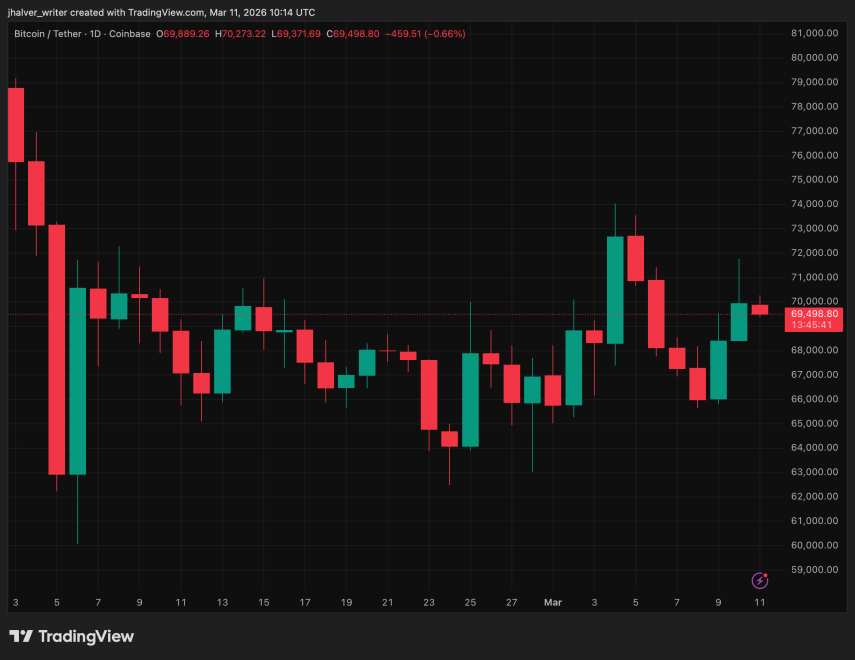
BTC’s price trends to the downside on the daily chart. Source: BTCUSDT on Tradingview

Cover image from Perplexity, BTCUSDT chart from Tradingview

Domande pertinenti

QWhat is the main purpose of the DEATH BETS Act introduced by Senator Schiff?

AThe DEATH BETS Act aims to explicitly ban prediction market contracts tied to terrorism, assassination, war, or an individual's death on any platform registered with the CFTC.

QWhich specific examples of prediction contracts did Senate Democrats cite in their letter to CFTC Chair Michael Selig?

AThe letter cited Polymarket's on-chain contracts on whether the Artemis II would explode, if Venezuela's Nicolás Maduro would be removed from power, and if Ukraine's Myrnohad would be captured by Russian forces.

QHow does Senator Schiff characterize the current state of prediction markets in his statement?

ASenator Schiff characterized prediction markets as 'the Wild West' where regulators have been turning a blind eye to gambling on lives.

QWhat significant trading activity was mentioned regarding Iran-related prediction markets?

AA bet on whether Iran's Ali Khamenei would be 'out as Supreme Leader' had $54 million in trading volume on Kalshi before being paused, with reported profits of $1.2-1.4 million for some traders before U.S. strikes.

QWhat will be the practical effect of the DEATH BET Act on trading platforms according to the article?

ACFTC-supervised platforms will become safer but more limited, while riskier war/death betting will be pushed to offshore or permissionless crypto venues, increasing legal and reputational risks there.

Letture associate

UNI Doubles in Two Months Against the Trend: A 5-Year-Overdue Value Realization

Amidst a generally stagnant crypto market in June and July, UNI, the governance token of Uniswap, saw a significant surge, nearly doubling in price from around $2.3 to $4.6. This rally represents a delayed but significant value reassessment, triggered by the practical implementation of its long-debated "fee switch" mechanism. The key turning point was the on-chain execution of the UNIfication proposal in December 2025. It activated a protocol fee on select pools, directed Unichain sequencer revenue (net of costs) to a communal treasury, executed a one-time burn of 100 million UNI, and established a system where all protocol revenue flows into a "TokenJar" contract. This treasury has a single exit: purchasing and permanently burning UNI via a "Firepit" contract. Initially, the market reacted tepidly as the generated revenue and corresponding burn rate were modest. The narrative shifted dramatically in July 2025 with two major developments. First, the launch of Robinhood Chain, tailored for tokenized stocks, rapidly became a primary source of volume and fees for Uniswap, at one point contributing nearly half of its weekly fees. Second, governance votes successfully expanded the fee mechanism to v4 pools and initiated a temperature check for fees on Robinhood Chain. The activation of v4 fees caused the protocol's daily revenue earmarked for UNI burns to nearly triple. The core of UNI's recent price action is the transition from a pure governance token to a cash-flow asset with a permanent, protocol-funded buyer. Its effectiveness is amplified by UNI's mature and widely distributed supply, with no major impending unlocks to dilute the impact of the buybacks. The sustainability of this rally now hinges on whether the transaction volume, particularly on Robinhood Chain, persists after its initial gas subsidies expire, determining if this is a genuine value realization or a subsidy-fueled spike.

marsbit1 h fa

UNI Doubles in Two Months Against the Trend: A 5-Year-Overdue Value Realization

marsbit1 h fa

Breaking: Google Earth Urgently Pulls Back Nano Banana 2 Image Generation Feature!

Google Earth's newly launched "Create image" feature, powered by the Nano Banana 2 AI image generation model, was abruptly withdrawn shortly after its release due to being "played" by users. The feature allowed users to generate and overlay AI-created visuals directly onto real-world satellite and 3D maps in Google Earth. The tool enabled creative applications like historical recreations (e.g., visualizing ancient Pompeii), generating informational graphics for landmarks, and envisioning architectural projects or futuristic cityscapes on real terrain. It operated under "geospatial grounding," meaning the AI respected the underlying geography, topography, and perspective of the chosen map view. The model also integrated with Gemini to retrieve relevant factual information. However, upon release, users quickly tested its limits. A prominent example involved reimagining Philadelphia's historic Independence Hall as a post-apocalyptic ruin overrun by "happy" zombies, evil clowns, and giant alien mechs. This highlighted both the feature's playful potential and its risks regarding the generation of inappropriate or misleading content on realistic maps, leading to its swift temporary removal. Google stated it would re-release the feature after implementing "enhanced guardrails." Analysts note this move strategically leverages Google's vast proprietary geospatial data, positioning its AI not just for artistic generation but for spatially accurate world visualization—a unique advantage in the competitive AI image generation landscape.

marsbit2 h fa

Breaking: Google Earth Urgently Pulls Back Nano Banana 2 Image Generation Feature!

marsbit2 h fa

Altman Admits: Overestimated AI Snatching Jobs! Huang Renxun: The Unemployment Narrative Is Completely Backwards

Sam Altman has revised his earlier predictions about AI rapidly replacing jobs, admitting he overestimated the speed at which AI would eliminate entry-level white-collar roles. Speaking on the "Invest Like the Best" podcast, he stated that people do not truly want an AI CEO, as accountability and human connection remain critical. He found that individuals prefer interacting with people who can be held responsible for decisions. Similarly, NVIDIA's Jensen Huang argued that the narrative of AI destroying jobs is misguided. He distinguishes between tasks and jobs, noting that while AI can automate specific tasks, entire jobs—encompassing communication, judgment, coordination, and accountability—are not eliminated. He cited examples like radiologists and software engineers, where demand for these roles has increased as AI handles repetitive tasks, allowing for business expansion and the creation of more positions. Data from a University of Maryland and LinkUp study supports this, showing that U.S. job postings for new graduates have actually risen, countering the fear of vanishing entry-level roles. However, a significant shift is occurring: the traditional entry-level tasks that help newcomers gain experience are being automated, making initial career access more challenging. The key insight is that as AI takes over standardized tasks, the enduring value of human work shifts toward areas of responsibility, trust-building, and final decision-making—aspects that AI cannot replicate. The real "moat" for professionals lies in these irreplaceable human elements.

marsbit3 h fa

Altman Admits: Overestimated AI Snatching Jobs! Huang Renxun: The Unemployment Narrative Is Completely Backwards

marsbit3 h fa

Trading

Spot
活动图片