A New Paradigm in Tokenomics? When Backpack Makes VCs 'Delay Gratification'

marsbitPubblicato 2026-02-10Pubblicato ultima volta 2026-02-10

Introduzione

The article discusses Backpack's innovative tokenomics model, which challenges conventional practices in the cryptocurrency industry. Unlike typical projects where teams and venture capitalists (VCs) receive immediate token allocations, Backpack allocates 100% of liquid tokens to users at TGE. The remaining 37.5% of tokens, traditionally reserved for teams and investors, are locked in a corporate vault and tied to the company’s eventual IPO. This structure ensures that internal stakeholders can only benefit after a successful IPO, with an additional one-year lock-up period post-IPO to prevent early sell-offs. Backpack’s approach emphasizes long-term alignment with user interests and project sustainability. The token distribution prioritizes community incentives, with 25% of tokens released at TGE to reward users and NFT holders. Future unlocks are tied to product milestones, ensuring that new token releases contribute more value to the ecosystem than they dilute the token’s price. Additionally, Backpack prioritizes regulatory compliance, currently serving only 48% of global regions to adhere to legal standards. Its goal is to build a hybrid platform integrating crypto and traditional financial services. Market reactions are mixed: Backpack is reportedly seeking funding at a $1 billion valuation, but predictions about its token FDV reflect uncertainty. Ultimately, Backpack’s model represents a shift toward transparency, long-term value, and user-centric growth in Web3.

In the "Wild West" of cryptocurrency, "founders cashing out and exiting" and "project teams rug-pulling retail investors" have become blatant acts of profit plunder, turning into chronic maladies that shackle the development of Web3. Consequently, "tokenomics" is often seen as an accelerator for team wealth and a touchstone for user confidence.

However, when we turn our attention to Backpack, we see a completely different design: Backpack has chosen a thorny path that directly addresses the industry's pain points: at TGE, all liquid tokens are given to users, while the returns for the team and investors are entirely tied to the company's IPO process.

This move by Backpack abandons the rugged design of "VCs setting up the game, retail investors footing the bill." Whether it ultimately succeeds or not, this is a respectable attempt in the history of cryptocurrency.

Delayed Gratification: The Long-Term Game Between Team and Capital

In Backpack's token economic system, the most attention-grabbing aspect is the strict constraints on returns for the team and investors—no founders, executives, employees, or venture capitalists directly receive token allocations.

As Backpack founder and CEO Armani Ferrante put it, the "escape velocity" Backpack seeks is never about reaching a market cap of billions of dollars or hitting some short-term milestone in user numbers, but about the company successfully completing an IPO in the United States.

All tokens originally intended for "team incentives" and "investor returns" (37.5% of the total supply) are deposited into the company's "corporate treasury," i.e., on Backpack's balance sheet. Even after a successful IPO, these tokens are subject to a fully locked period of at least one year, further eliminating the possibility of "cashing out immediately upon listing."

This design of "delayed gratification" is the best protection for the project's long-term value. In the crypto industry, too many projects collapse due to the "short-sightedness" of teams and investors—selling tokens too early to cash out, causing token prices to crash, losing user trust, and ultimately leading to demise. Backpack's approach completely severs the path for insiders to "cash out short-term," forcing the team and investors to "sink or swim" with the project.

Of course, an IPO is no easy path. Backpack's founders admit that going public could be imminent, could be far off, or might never happen. But regardless of the outcome, they will give it their all. This "break or break through" determination makes Backpack stand out among the myriad of short-sighted crypto projects, yet it has won the trust of users who truly value long-term value.

User-First Token Distribution: Igniting the Growth Engine with Incentives

In Backpack's tokenomics, all liquid tokens are entirely allocated to users. In Backpack's view, users are the core driving force behind project growth, so tokens should serve as fuel to incentivize user participation and drive product development.
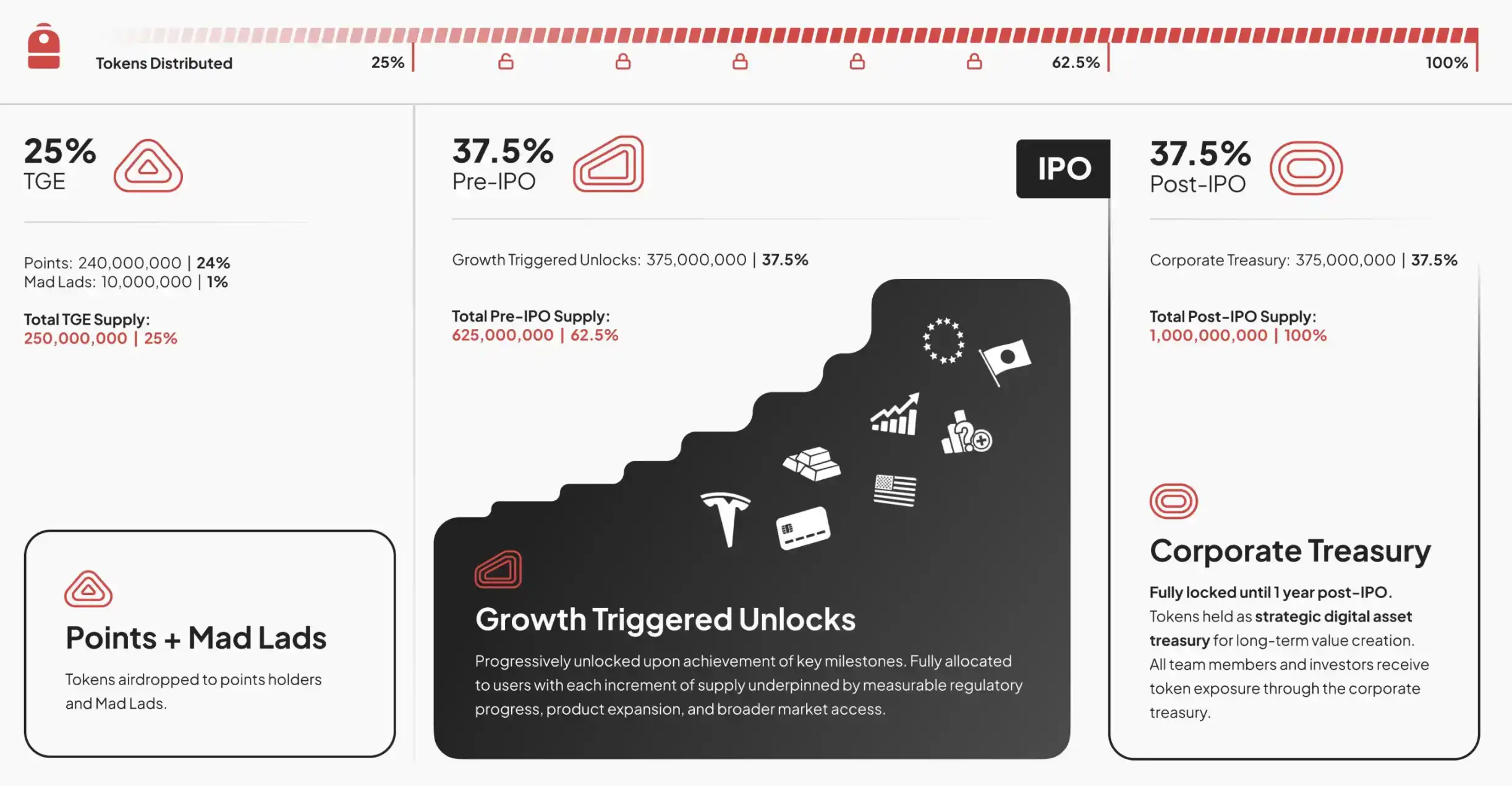
· Total supply of 1 billion tokens, 25% directly released to the community at TGE: Among these, points holders account for 24%, and Mad Lads holders account for 1%.

· Unlocked (37.5%) triggered by key product milestones before IPO. Every market expansion, every new product launch, is an opportunity to incentivize users with tokens, each triggering corresponding token unlocks. This design, through a predictable token unlock model, continuously attracts new users and expands the community scale.

More importantly, according to Armani Ferrante, Backpack has set strict constraints for token unlocks: the new ecological value brought by token unlocks must always be greater than its dilutive effect on the token price.

This design protects the core interests of users while ensuring the project's long-term value is not diluted by short-term unlocking behavior, making token incentives a true catalyst for platform growth, achieving a triple win of "user benefit, ecological value addition, and project growth."

Under Compliance: Slow is Fast

Beyond the innovation in token distribution, another distinctive feature of Backpack is its pursuit of compliance. This stands in stark contrast to the common logic in the industry of "expand first, comply later" and "prioritize scale over compliance."

As Armani Ferrante revealed, "Backpack currently serves only about 48% of regions globally. Behind this seemingly slow expansion lies a pursuit of compliance."

This strategic choice might mean missing market opportunities in the short term, but from a long-term development perspective, it is key to building a trust barrier.

Currently, Backpack's positioning is a compliant crypto exchange, offering cryptocurrency spot, derivatives, and lending services. But it is not content with being a pure cryptocurrency trading platform; it aims to build a compliant platform integrating crypto assets and traditional financial (TradFi) services. To achieve this goal, the team is laying banking rails globally and also plans to gradually launch diversified services like securities products in the future. In January, Backpack also launched a unified margin and cross-collateralization prediction product.

Market Perspective: How to View Backpack's FDV?

The market's attitude towards Backpack also reflects the controversy and potential of its model from the side.

According to Axios citing informed sources, Backpack is negotiating terms for new financing, with a pre-money valuation already reaching $1 billion.

On the prediction market Polymarket, market expectations for Backpack's token show significant volatility: the probability of Backpack's token FDV exceeding $1 billion within one day of listing is 21%, while in November 2025, this probability once reached over 80%. Of course, this volatility largely stems from the inherent uncertainty of the crypto market and also reflects the market's cautious attitude towards the "IPO-bound returns" model.

Summary

When tokens become tools for project teams to cash out, and users become targets to be harvested, the crypto industry loses its original ideals. Backpack's token distribution essentially creates a physical separation between Web2 equity incentives and Web3 token utility.

· For the team: The only way out is to make the product stronger and more compliant until the IPO. If the company fails midway or cannot go public, the equity in the team's hands will be worthless, with no possibility of cashing out.

· For the community: They are no longer the liquidity exit for VCs. Tokens are purely user rewards and ecological tools, not the team's ATM.

Backpack's choice is to redefine the value logic of crypto projects with compliance, transparency, and long-termism, showing us another possibility for the Web3 industry.

As Armani Ferrante said: "We either go big, or we go home." This statement is not only the manifesto of the Backpack team but also a mandatory question for the entire Web3 industry: Do we continue to revel in the speculative bubble,透支行业的信任与未来透支行业的信任与未来 (overdrawing the industry's trust and future原文此处为中文); or do we, like Backpack, choose the harder, slower, but more hopeful path, using long-termism to reconstruct the industry ecosystem?

Of course, an IPO is not easy, and the road is long and arduous, especially in the crypto industry, facing multiple challenges like regulation, market, and competition. Accidents and uncertainties are everywhere.


Domande pertinenti

QWhat is the core innovation in Backpack's token economics model?

ABackpack's token economics model allocates all liquid tokens to users at TGE, while team and investor rewards are entirely tied to the company's IPO process, preventing early insider sales and aligning long-term incentives.

QHow does Backpack ensure that token unlocks benefit the ecosystem without diluting value?

ABackpack sets strict constraints for token unlocks: the new ecological value generated from unlocks must always exceed the dilutive effect on the token price, ensuring user benefits and sustainable growth.

QWhat percentage of the total token supply is allocated to the community at TGE, and how is it distributed?

AAt TGE, 25% of the total 1 billion token supply is allocated to the community: 24% to points holders and 1% to Mad Lads holders.

QWhy does Backpack prioritize compliance in its expansion strategy, and what regions does it currently serve?

ABackpack prioritizes compliance to build long-term trust and regulatory security, currently serving only about 48% of global regions to ensure adherence to local laws before expanding.

QWhat is the significance of tying team and investor rewards to Backpack's IPO instead of token sales?

ALinking rewards to the IPO ensures that team and investors are fully committed to the project's long-term success, as they cannot cash out until after a successful IPO, which may take years or never happen, aligning their interests with sustainable growth.

Letture associate

As Consensus Accelerates, What Are Young Investors Betting On?

Title: As Consensus Forms Faster, What Are Young Investors Betting On? In the rapid evolution of tech investment, a new generation of young investors is navigating a landscape where AI, robotics, commercial aerospace, and quantum computing are advancing simultaneously. Traditional investment logic based on financial models is giving way to a need for deep technical understanding and the ability to act before industry consensus forms. An analysis of trends from the "WAIC FUTURE TECH" list of young investment leaders reveals key shifts in focus. The first major trend is the movement of AI from the digital screen into the physical world. Investment is shifting from large language models and chatbots towards embodied AI, robotics, AI hardware, and edge computing. While demonstrations generate excitement, the real challenge lies in achieving scalable, reliable, and cost-effective delivery in complex real-world environments like factories and logistics. Success depends not just on algorithms but on the integration of sensors, actuators, and control systems. Second, the competitive focus for large models is moving beyond raw capability toward building an "intelligence flywheel." The goal is to create self-reinforcing systems where user interaction generates data, improving the model, which in turn enhances the user experience and attracts more engagement. Companies that successfully embed AI into workflows to create these closed-loop systems can build lasting value that isn't easily erased by the next model upgrade. Third, facing a potential bottleneck in high-quality human-generated data, investors are looking at new underlying technologies. Reinforcement learning and self-play, as demonstrated by AlphaGo Zero, offer paths for AI to generate its own experience. Scientific foundation models, which aim to build general AI capabilities for fields like life sciences and materials discovery, represent a non-consensus direction that could unlock new frontiers of knowledge and data. Finally, in deep-tech areas like quantum computing, commercial aerospace, and space-based infrastructure, patient capital is essential. These fields have long, uncertain development and validation cycles involving complex engineering, supply chains, and regulations. Investment here requires a long-term view, focusing on foundational team capabilities and the eventual emergence of market demand, even if commercial returns are distant. Collectively, these trends illustrate how young investors are adapting to a new era. They are learning to make earlier, technically-informed judgments, balance hype with real-world viability, and provide the patient capital needed to build the deep-tech foundations of the future.

marsbit4 min fa

As Consensus Accelerates, What Are Young Investors Betting On?

marsbit4 min fa

Can Japan Buy Growth with AI? Will the Bond Market Believe It?

Japan's cabinet has introduced the 2026 Basic Policy on Economic and Fiscal Management and Reform, shifting its primary fiscal target. The new framework moves away from the traditional annual primary balance goal and instead prioritizes a stable reduction of the debt-to-GDP ratio. This change is tied to a strategy of increased "responsible proactive fiscal" spending, aiming to boost long-term growth through investments in strategic sectors like AI, semiconductors, energy, and robotics. The government estimates total public and private investment in 62 key technologies could exceed 370 trillion yen by 2040. The market reaction has been mixed and cautious. While equity markets may respond to policy signals, bond markets are focused on fiscal credibility. Concerns center on whether the weakening of the clear primary balance anchor could lead to looser fiscal discipline. If investors doubt that these strategic investments will generate sufficient productivity gains, tax revenue, and nominal growth to outpace rising interest costs, they may demand higher yields on Japanese Government Bonds (JGBs). Recent volatility in the yen and JGB yields, with the 10-year yield briefly reaching 2.9%, reflects this skepticism. The success of this new framework hinges on two factors: whether Japan can achieve a nominal growth rate consistently higher than its long-term interest rates, and whether future budgets demonstrate disciplined control over bond issuance. The government's narrative is that strategic investment is essential to break Japan's cycle of low growth, aging, and labor shortages. However, the bond market will continuously assess the credibility of this plan, pricing the risk that it may represent fiscal expansion rather than a viable growth strategy.

marsbit41 min fa

Can Japan Buy Growth with AI? Will the Bond Market Believe It?

marsbit41 min fa

Misjudged A-Shares: Resilience, Expectations, and Confidence

China's A-share market recently faced selling pressure, especially in tech sectors, initially triggered by a global tech sell-off that began in South Korea. However, the article argues this is a case of "mistaken injury" and highlights the market's underlying resilience. This resilience stems from three main pillars: **1) Tech Sector Fundamentals:** Unlike Korea's market dominated by a few memory chip stocks, China's tech sector is diversified across computing, communications, electronics, and semiconductors, supported by dual narratives of global AI supply chains and domestic substitution. Core areas like optical modules and fiber optics continue to show strong earnings growth. **2) "National Team" Support:** State-backed institutions and large corporations have made significant market purchases and announced buybacks, providing liquidity and signaling confidence. This is seen as a stabilizing policy signal, often associated with market bottoms. **3) Broader Market Pillars:** Other major sectors are showing endogenous recovery momentum. Consumer stocks benefit from stabilizing CPI and signs of sector recovery (e.g., liquor price hikes). Cyclical sectors like aluminum have high earnings, potential price increases due to tight supply, and low valuations. The financial sector offers stable dividends and low valuations. The conclusion is that the sell-off was driven by external contagion, not a collapse in fundamentals. With strong policy support and recovering momentum across key sectors, the A-share market possesses the toughness to regain stability.

marsbit1 h fa

Misjudged A-Shares: Resilience, Expectations, and Confidence

marsbit1 h fa

Trading

Spot
活动图片




