A Company 'Destined to Be Killed' – How Did Its Returns Outperform Solana, the S&P, and Nasdaq?

marsbitPubblicato 2026-03-30Pubblicato ultima volta 2026-03-30

Introduzione

The article argues that the biggest beneficiaries of stablecoin technology are not the startups building it, but established companies with existing distribution channels. The author uses Western Union (WU) as a prime example. Initially believing stablecoins would disrupt WU's business, the author instead found a valuable, cash-generating company whose stock was priced for imminent failure (trading at a P/E of 3-6x). The market had given WU zero credit for its powerful, trusted brand and massive global distribution network. The core "Inversion" thesis is that the market structurally overvalues tech innovators and undervalues old-economy companies, pricing their potential adoption of new technology at zero. This creates a significant margin of safety and asymmetric upside. The author's bet on WU over Solana paid off, as WU's management began embracing stablecoins, launching USDPT on Solana to reduce costs. The author contends that mature companies with distribution are best positioned to capture the efficiency gains from technologies like stablecoins and AI, leveraging their existing customer trust and reach to expand margins while startups commoditize the infrastructure.

Author: Santiago Roel Santos

Compiled by: Deep Tide TechFlow

Deep Tide's Introduction: The core argument of this article is a counterintuitive judgment: the biggest beneficiaries of stablecoins are not the startups building them, but the established institutions that own the distribution channels.

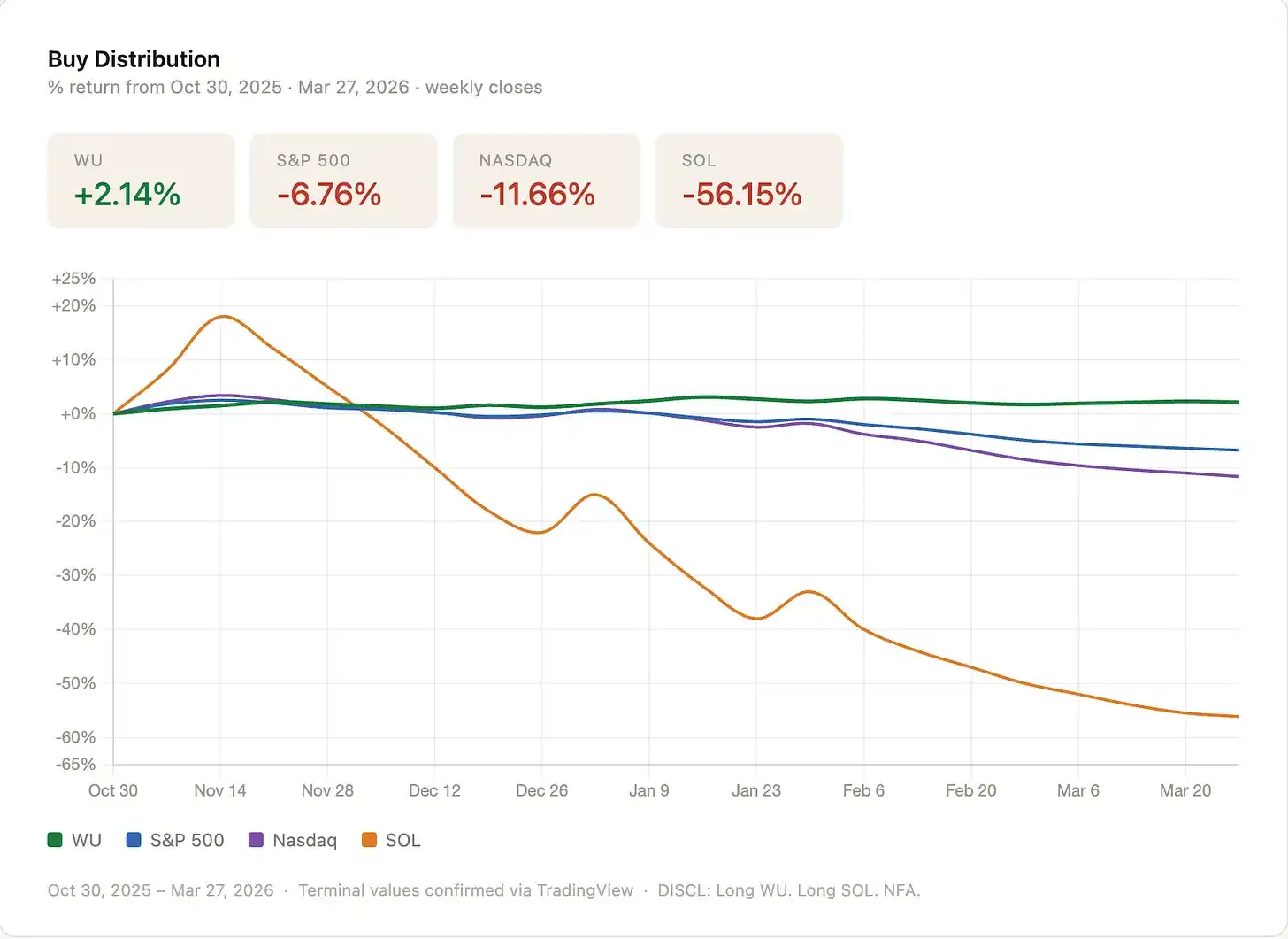
The author bet in November 2025 that Western Union would outperform Solana, and it paid off, also incidentally outperforming the S&P and Nasdaq.

What's worth reading is not just the conclusion, but the framework he uses to find opportunities: "the disruption narrative depresses valuations, distribution channels are priced at zero."

Full text as follows:

I started researching Western Union because I thought stablecoins would disrupt its business. Why pay WU fees when you can use stablecoins to send money anywhere in the world at extremely low cost? Later I realized: WU's business is much stronger than this framework suggests, and it is better positioned than almost anyone to embrace stablecoins itself. It has the brand and the distribution channels. The key risk is whether management will act.

They hadn't acted before. Until recently, they were dismissive. When I placed my bet in November 2025, I was willing to bet that they would eventually act, or someone would force them to act. I'm not an activist investor, but I felt the pressure building.

This week I also spoke at the Digital Asset Summit, and WU's CEO was on stage. I saw a completely different CEO, one who clearly articulated how stablecoins will compress the cost of global money movement.

I took on the risk of this happening, but I liked my odds. At the time, WU's P/E ratio was 3x, and it was experiencing declining growth. Many companies trade at these valuation levels and then go bankrupt. Betting on troubled companies is tempting; some will transform, some will go to zero.

What I saw in WU, and still see, is the distribution channel. A market leader with a brand, trust, and deep insight into consumer behavior—understanding both consumer resistance to new financial primitives like stablecoins and their reliance on the familiar. People will always pay for convenience. They trust WU. It's embedded in small grocery stores, convenience stores, and retail service points where less tech-savvy consumers withdraw cash. This won't disappear overnight.

I've read *The Innovator's Dilemma*, and I've invested in the very technology that claims to replace WU. But I've come to recognize that distribution channels are incredibly hard to build, and trust is even harder—especially in financial services.

All this is to say: Since I bet on WU to outperform Solana, it has indeed outperformed, and by a significant margin, also incidentally beating the S&P and Nasdaq. A classic mean reversion.
Starting from the assumption that the market is right

I always assume the market is right, then work backwards to understand why.

For WU, I kept arriving at the same answer: the market was pricing it as a melting ice cube. A business heading towards its end, slowly being eroded by Remitly, Wise, and some stablecoin-native remittance startup that just got seed funding last week. If management does nothing, maybe it's right. But price is the most important variable, and at this valuation level, there was a significant margin of safety.

WU's market cap is $2.8 billion. When I first researched it last year, the P/E ratio was nearly 3x; today it's 6x. $4.1 billion in revenue, $923 million EBITDA, $500 million net profit, 12% net margin. This isn't a dying business; it's a cash machine the market has given up on.

The gap in valuation multiples is real, and the reasons behind it are real.

WU's business is larger than both (referring to Remitly and Wise), covers over 200 countries, and generates nearly $1 billion in EBITDA annually. A 6x P/E ratio means you're not paying for any recovery, any technology adoption, any optionality. The market is pricing future upside at zero. The margin of safety is here.

Core Thesis

This is the core thesis that prompted me to found Inversion.

The market will treat certain businesses as dead men walking, assume disruption is imminent, and give zero credit for the brand and distribution channels these companies built over decades. Layer on the optionality of technology adoption, and the asymmetry becomes interesting.

The market is structurally long tech and short anything that looks old. The pace of innovation is accelerating, and it feels like AI will replace everything. This isn't a discussion about whether creative destruction will happen—it always does. It's a discussion about price, and what you're paying for it.

WU is acting, and faster than expected.

Western Union CEO Devin McGranahan has recently changed his stance. He clearly articulated this week at the New York Digital Asset Summit how stablecoins will compress the cost of global money movement—turning negative float into positive float, turning a cost center into a revenue source. WU has now announced the launch of its own stablecoin, USDPT, on Solana, ironically issued through Anchorage Digital. This shift was catalyzed by the GENIUS Act.

This is not a small signal. A 175-year-old money transfer company going from skeptical to launching its own stablecoin on Solana in less than a year is a major shift in management posture. The bear case was always that they wouldn't act, and they are now acting. That alone warrants a repricing.

Execution risk remains, it always will. Everything gets disrupted eventually. The key is understanding what price you are paying for the future to happen. The downside risk is a 20% to 30% drawdown if revenue decline accelerates, buffered by a 10% dividend yield and $500 million in annual net profit. The upside, as noted above, is 4x to 5x if they regain any growth credibility.

In contrast, most high-multiple tech companies are priced for perfect execution, and when something is priced for perfection, it only takes a small deviation to upend the thesis. When something is seen as dead, it only takes a small sign of life. WU is showing signs of life.

The product vision I keep coming back to

As much as I believe in technology, its deployment and persuading customers to use it takes a long time. The more you understand technology, the more you realize it's brilliant at what it does, but certain core human behaviors don't change. This is especially true when it comes to money. Most people won't try something new when the existing thing works fine. Consumers will always pay for convenience.

A user would rather click on WU than download and learn a digital wallet. This isn't ignorance; it's a lifetime of accumulated inertia, trust, and familiarity. This inertia has real economic value. That's why WU still processes nearly 300 million transactions annually, and why you can buy it at 6x P/E and collect a 10% dividend while you wait.

My core thesis and position is this: the biggest beneficiary of cost-reducing technology is not the startup building it, but the mature enterprise that adopts it and owns the distribution channel. Whether it's stablecoins compressing money movement costs or AI compressing operational costs, incumbent distribution channels are the leverage point. Startups commoditize infrastructure, incumbents capture profits.

WU can use stablecoin rails to reduce costs while maintaining its trait of being known for convenience. If they're smart, they'll launch a digital wallet to lower payout commissions. Global users could choose to receive and hold dollars in a WU wallet, then spend with a Visa card. If users don't withdraw cash, WU doesn't need to raise liquidity in the destination market, further compressing costs. The distribution channel remains the same, the infrastructure gets cheaper, margins expand. Cost reduction is something you can control, inherently less risky than underwriting revenue growth.

This is the optionality the market prices at zero.

WU is just one example

I've long accepted that I will never get the timing right. My predictions about the future are no better than the next person's. What I believe is that, with the right positioning, I can get better returns.

That positioning always comes back to the same thesis: buying durable businesses with distribution channels at the right price. These businesses have massive embedded optionality. Not all will act in time; some will die. But those that do will massively outperform, and those gains will far outweigh the losses.

You see General Catalyst, Thrive, and Bezos now moving into traditional businesses to inject AI. The opportunity with stablecoin and blockchain rails is the same.

Inversion's thesis is simple: buy assets with distribution channels at the best possible price, with the optionality of reshaping the business with technology. The disruption narrative depresses valuation multiples; that's the entry point.

Invert, always invert. The question isn't whether WU will be disrupted, but whether you are sufficiently compensated for taking that risk at ~$923M EBITDA and ~6x P/E. I think yes, and generously so.

Disclosure: Long WU. Long SOL. This is not investment advice.

Domande pertinenti

QWhat is the core argument of the article regarding the primary beneficiaries of stablecoin technology?

AThe core argument is that the biggest beneficiaries of stablecoin technology are not the startups building it, but the established, incumbent companies that have existing distribution channels and brand trust.

QWhat was the author's investment thesis for Western Union (WU) and what key risk did it involve?

AThe author's investment thesis was that WU, with its strong brand, trust, and massive distribution network, was severely undervalued because the market priced its future upside at zero. The key risk was whether its management would act to embrace new technologies like stablecoins.

QAccording to the author, why is the valuation multiple of Western Union considered to have a significant 'margin of safety'?

AThe margin of safety comes from its low valuation (e.g., a P/E ratio of 6x) combined with its strong fundamentals ($5B net profit, 12% net margin). The market priced it as a dying business, offering a high dividend yield and a large potential upside if the company showed any signs of adapting, with limited downside risk.

QWhat specific change in management's stance does the author point to as a major signal for Western Union?

AThe author points to CEO Devin McGranahan's changed stance, from being dismissive to clearly articulating how stablecoins would reduce global money movement costs and subsequently launching their own stablecoin, USDPT, on the Solana blockchain.

QWhat is the 'Inversion' thesis described in the article?

AThe 'Inversion' thesis is to invest in durable businesses with strong distribution channels that are undervalued because of a 'disruption narrative.' The goal is to buy them at a low price, capturing the embedded optionality value if they successfully adopt new technologies to reshape their business.

Letture associate

Cook's Curtain Call and Ternus Takes the Helm: The Disruption and Reboot of Apple's 4 Trillion Dollar Empire

Tim Cook has officially announced he will step down as CEO of Apple in September, transitioning to executive chairman after a 15-year tenure during which he grew the company’s market value from around $350 billion to nearly $4 trillion. He will be succeeded by John Ternus, a 50-year-old hardware engineering veteran who has been groomed for the role through increasing public visibility and internal responsibility. Ternus’s appointment signals a strategic shift toward hardware and engineering leadership, with Johny Srouji—head of Apple Silicon—taking on an expanded role as Chief Hardware Officer. This consolidation aims to strengthen Apple’s core technological capabilities. However, Cook’s departure highlights a significant unresolved issue: Apple’s delayed and fragmented approach to artificial intelligence. Despite early efforts, such as hiring John Giannandrea from Google in 2018, Apple’s AI initiatives—particularly around Siri—have struggled with internal restructuring and reliance on external partnerships, including with Google. The transition comes at a critical moment as Apple faces paradigm shifts with the rise of artificial general intelligence (ASI). The company’s closed ecosystem of hardware, software, and services—once a major advantage—now presents challenges in adapting to an AI-centric world where intelligence may matter more than the device itself. Ternus must quickly articulate a clear AI strategy, possibly starting at WWDC, to reassure markets and redefine Apple’s role in a new technological era. His task is not only to maintain Apple’s operational excellence but also to reinvigorate its capacity to innovate and lead in the age of AI.

marsbit2 h fa

Cook's Curtain Call and Ternus Takes the Helm: The Disruption and Reboot of Apple's 4 Trillion Dollar Empire

marsbit2 h fa

Trading

Spot
Futures

Articoli Popolari

Cosa è $S$

Comprendere SPERO: Una Panoramica Completa Introduzione a SPERO Mentre il panorama dell'innovazione continua a evolversi, l'emergere delle tecnologie web3 e dei progetti di criptovaluta gioca un ruolo fondamentale nel plasmare il futuro digitale. Un progetto che ha attirato l'attenzione in questo campo dinamico è SPERO, denotato come SPERO,$$s$. Questo articolo mira a raccogliere e presentare informazioni dettagliate su SPERO, per aiutare gli appassionati e gli investitori a comprendere le sue basi, obiettivi e innovazioni nei domini web3 e crypto. Che cos'è SPERO,$$s$? SPERO,$$s$ è un progetto unico all'interno dello spazio crypto che cerca di sfruttare i principi della decentralizzazione e della tecnologia blockchain per creare un ecosistema che promuove l'impegno, l'utilità e l'inclusione finanziaria. Il progetto è progettato per facilitare interazioni peer-to-peer in modi nuovi, fornendo agli utenti soluzioni e servizi finanziari innovativi. Al suo interno, SPERO,$$s$ mira a responsabilizzare gli individui fornendo strumenti e piattaforme che migliorano l'esperienza dell'utente nello spazio delle criptovalute. Questo include la possibilità di metodi di transazione più flessibili, la promozione di iniziative guidate dalla comunità e la creazione di percorsi per opportunità finanziarie attraverso applicazioni decentralizzate (dApps). La visione sottostante di SPERO,$$s$ ruota attorno all'inclusività, cercando di colmare le lacune all'interno della finanza tradizionale mentre sfrutta i vantaggi della tecnologia blockchain. Chi è il Creatore di SPERO,$$s$? L'identità del creatore di SPERO,$$s$ rimane piuttosto oscura, poiché ci sono risorse pubblicamente disponibili limitate che forniscono informazioni dettagliate sul suo fondatore o fondatori. Questa mancanza di trasparenza può derivare dall'impegno del progetto per la decentralizzazione—un ethos che molti progetti web3 condividono, dando priorità ai contributi collettivi rispetto al riconoscimento individuale. Centrando le discussioni attorno alla comunità e ai suoi obiettivi collettivi, SPERO,$$s$ incarna l'essenza dell'empowerment senza mettere in evidenza individui specifici. Pertanto, comprendere l'etica e la missione di SPERO rimane più importante che identificare un creatore singolo. Chi sono gli Investitori di SPERO,$$s$? SPERO,$$s$ è supportato da una varietà di investitori che vanno dai capitalisti di rischio agli investitori angelici dedicati a promuovere l'innovazione nel settore crypto. Il focus di questi investitori generalmente si allinea con la missione di SPERO—dando priorità a progetti che promettono avanzamenti tecnologici sociali, inclusività finanziaria e governance decentralizzata. Queste fondazioni di investitori sono tipicamente interessate a progetti che non solo offrono prodotti innovativi, ma contribuiscono anche positivamente alla comunità blockchain e ai suoi ecosistemi. Il supporto di questi investitori rafforza SPERO,$$s$ come un concorrente degno di nota nel dominio in rapida evoluzione dei progetti crypto. Come Funziona SPERO,$$s$? SPERO,$$s$ impiega un framework multifunzionale che lo distingue dai progetti di criptovaluta convenzionali. Ecco alcune delle caratteristiche chiave che sottolineano la sua unicità e innovazione: Governance Decentralizzata: SPERO,$$s$ integra modelli di governance decentralizzati, responsabilizzando gli utenti a partecipare attivamente ai processi decisionali riguardanti il futuro del progetto. Questo approccio favorisce un senso di proprietà e responsabilità tra i membri della comunità. Utilità del Token: SPERO,$$s$ utilizza il proprio token di criptovaluta, progettato per servire varie funzioni all'interno dell'ecosistema. Questi token abilitano transazioni, premi e la facilitazione dei servizi offerti sulla piattaforma, migliorando l'impegno e l'utilità complessivi. Architettura Stratificata: L'architettura tecnica di SPERO,$$s$ supporta la modularità e la scalabilità, consentendo un'integrazione fluida di funzionalità e applicazioni aggiuntive man mano che il progetto evolve. Questa adattabilità è fondamentale per mantenere la rilevanza nel panorama crypto in continua evoluzione. Coinvolgimento della Comunità: Il progetto enfatizza iniziative guidate dalla comunità, impiegando meccanismi che incentivano la collaborazione e il feedback. Nutrendo una comunità forte, SPERO,$$s$ può affrontare meglio le esigenze degli utenti e adattarsi alle tendenze di mercato. Focus sull'Inclusione: Offrendo basse commissioni di transazione e interfacce user-friendly, SPERO,$$s$ mira ad attrarre una base utenti diversificata, inclusi individui che potrebbero non aver precedentemente interagito nello spazio crypto. Questo impegno per l'inclusione si allinea con la sua missione generale di empowerment attraverso l'accessibilità. Cronologia di SPERO,$$s$ Comprendere la storia di un progetto fornisce preziose intuizioni sulla sua traiettoria di sviluppo e sui traguardi. Di seguito è riportata una cronologia suggerita che mappa eventi significativi nell'evoluzione di SPERO,$$s$: Fase di Concettualizzazione e Ideazione: Le idee iniziali che formano la base di SPERO,$$s$ sono state concepite, allineandosi strettamente con i principi di decentralizzazione e focus sulla comunità all'interno dell'industria blockchain. Lancio del Whitepaper del Progetto: Dopo la fase concettuale, è stato rilasciato un whitepaper completo che dettaglia la visione, gli obiettivi e l'infrastruttura tecnologica di SPERO,$$s$ per suscitare interesse e feedback dalla comunità. Costruzione della Comunità e Prime Interazioni: Sono stati effettuati sforzi attivi di outreach per costruire una comunità di early adopters e potenziali investitori, facilitando discussioni attorno agli obiettivi del progetto e ottenendo supporto. Evento di Generazione del Token: SPERO,$$s$ ha condotto un evento di generazione del token (TGE) per distribuire i propri token nativi ai primi sostenitori e stabilire una liquidità iniziale all'interno dell'ecosistema. Lancio della Prima dApp: La prima applicazione decentralizzata (dApp) associata a SPERO,$$s$ è stata attivata, consentendo agli utenti di interagire con le funzionalità principali della piattaforma. Sviluppo Continuo e Partnership: Aggiornamenti e miglioramenti continui alle offerte del progetto, inclusi partnership strategiche con altri attori nello spazio blockchain, hanno plasmato SPERO,$$s$ in un concorrente competitivo e in evoluzione nel mercato crypto. Conclusione SPERO,$$s$ rappresenta una testimonianza del potenziale del web3 e delle criptovalute di rivoluzionare i sistemi finanziari e responsabilizzare gli individui. Con un impegno per la governance decentralizzata, il coinvolgimento della comunità e funzionalità progettate in modo innovativo, apre la strada verso un panorama finanziario più inclusivo. Come per qualsiasi investimento nello spazio crypto in rapida evoluzione, si incoraggiano potenziali investitori e utenti a ricercare approfonditamente e a impegnarsi in modo riflessivo con gli sviluppi in corso all'interno di SPERO,$$s$. Il progetto mostra lo spirito innovativo dell'industria crypto, invitando a ulteriori esplorazioni delle sue innumerevoli possibilità. Mentre il percorso di SPERO,$$s$ è ancora in fase di sviluppo, i suoi principi fondamentali potrebbero effettivamente influenzare il futuro di come interagiamo con la tecnologia, la finanza e tra di noi in ecosistemi digitali interconnessi.

75 Totale visualizzazioniPubblicato il 2024.12.17Aggiornato il 2024.12.17

Cosa è $S$

Cosa è AGENT S

Agent S: Il Futuro dell'Interazione Autonoma in Web3 Introduzione Nel panorama in continua evoluzione di Web3 e criptovalute, le innovazioni stanno costantemente ridefinendo il modo in cui gli individui interagiscono con le piattaforme digitali. Uno di questi progetti pionieristici, Agent S, promette di rivoluzionare l'interazione uomo-computer attraverso il suo framework agentico aperto. Aprendo la strada a interazioni autonome, Agent S mira a semplificare compiti complessi, offrendo applicazioni trasformative nell'intelligenza artificiale (AI). Questa esplorazione dettagliata approfondirà le complessità del progetto, le sue caratteristiche uniche e le implicazioni per il dominio delle criptovalute. Cos'è Agent S? Agent S si presenta come un innovativo framework agentico aperto, progettato specificamente per affrontare tre sfide fondamentali nell'automazione dei compiti informatici: Acquisizione di Conoscenze Specifiche del Dominio: Il framework apprende in modo intelligente da varie fonti di conoscenza esterne ed esperienze interne. Questo approccio duale gli consente di costruire un ricco repository di conoscenze specifiche del dominio, migliorando le sue prestazioni nell'esecuzione dei compiti. Pianificazione su Lungo Orizzonte di Compiti: Agent S impiega una pianificazione gerarchica potenziata dall'esperienza, un approccio strategico che facilita la suddivisione e l'esecuzione efficiente di compiti complessi. Questa caratteristica migliora significativamente la sua capacità di gestire più sottocompiti in modo efficiente ed efficace. Gestione di Interfacce Dinamiche e Non Uniformi: Il progetto introduce l'Interfaccia Agente-Computer (ACI), una soluzione innovativa che migliora l'interazione tra agenti e utenti. Utilizzando Modelli Linguistici Multimodali di Grandi Dimensioni (MLLM), Agent S può navigare e manipolare senza sforzo diverse interfacce grafiche utente. Attraverso queste caratteristiche pionieristiche, Agent S fornisce un framework robusto che affronta le complessità coinvolte nell'automazione dell'interazione umana con le macchine, preparando il terreno per innumerevoli applicazioni nell'AI e oltre. Chi è il Creatore di Agent S? Sebbene il concetto di Agent S sia fondamentalmente innovativo, informazioni specifiche sul suo creatore rimangono elusive. Il creatore è attualmente sconosciuto, il che evidenzia sia la fase embrionale del progetto sia la scelta strategica di mantenere i membri fondatori sotto anonimato. Indipendentemente dall'anonimato, l'attenzione rimane sulle capacità e sul potenziale del framework. Chi sono gli Investitori di Agent S? Poiché Agent S è relativamente nuovo nell'ecosistema crittografico, informazioni dettagliate riguardanti i suoi investitori e sostenitori finanziari non sono documentate esplicitamente. La mancanza di approfondimenti pubblicamente disponibili sulle fondazioni di investimento o sulle organizzazioni che supportano il progetto solleva interrogativi sulla sua struttura di finanziamento e sulla roadmap di sviluppo. Comprendere il supporto è cruciale per valutare la sostenibilità del progetto e il suo potenziale impatto sul mercato. Come Funziona Agent S? Al centro di Agent S si trova una tecnologia all'avanguardia che gli consente di funzionare efficacemente in contesti diversi. Il suo modello operativo è costruito attorno a diverse caratteristiche chiave: Interazione Uomo-Computer Simile a Quella Umana: Il framework offre una pianificazione AI avanzata, cercando di rendere le interazioni con i computer più intuitive. Mimando il comportamento umano nell'esecuzione dei compiti, promette di elevare le esperienze degli utenti. Memoria Narrativa: Utilizzata per sfruttare esperienze di alto livello, Agent S utilizza la memoria narrativa per tenere traccia delle storie dei compiti, migliorando così i suoi processi decisionali. Memoria Episodica: Questa caratteristica fornisce agli utenti una guida passo-passo, consentendo al framework di offrire supporto contestuale mentre i compiti si sviluppano. Supporto per OpenACI: Con la capacità di funzionare localmente, Agent S consente agli utenti di mantenere il controllo sulle proprie interazioni e flussi di lavoro, allineandosi con l'etica decentralizzata di Web3. Facile Integrazione con API Esterne: La sua versatilità e compatibilità con varie piattaforme AI garantiscono che Agent S possa adattarsi senza problemi agli ecosistemi tecnologici esistenti, rendendolo una scelta attraente per sviluppatori e organizzazioni. Queste funzionalità contribuiscono collettivamente alla posizione unica di Agent S all'interno dello spazio crittografico, poiché automatizza compiti complessi e multi-fase con un intervento umano minimo. Man mano che il progetto evolve, le sue potenziali applicazioni in Web3 potrebbero ridefinire il modo in cui si svolgono le interazioni digitali. Cronologia di Agent S Lo sviluppo e le tappe di Agent S possono essere riassunti in una cronologia che evidenzia i suoi eventi significativi: 27 Settembre 2024: Il concetto di Agent S è stato lanciato in un documento di ricerca completo intitolato “Un Framework Agentico Aperto che Usa i Computer Come un Umano”, mostrando le basi per il progetto. 10 Ottobre 2024: Il documento di ricerca è stato reso pubblicamente disponibile su arXiv, offrendo un'esplorazione approfondita del framework e della sua valutazione delle prestazioni basata sul benchmark OSWorld. 12 Ottobre 2024: È stata rilasciata una presentazione video, fornendo un'idea visiva delle capacità e delle caratteristiche di Agent S, coinvolgendo ulteriormente potenziali utenti e investitori. Questi indicatori nella cronologia non solo illustrano i progressi di Agent S, ma indicano anche il suo impegno per la trasparenza e il coinvolgimento della comunità. Punti Chiave su Agent S Man mano che il framework Agent S continua a evolversi, diversi attributi chiave si distinguono, sottolineando la sua natura innovativa e il potenziale: Framework Innovativo: Progettato per fornire un uso intuitivo dei computer simile all'interazione umana, Agent S porta un approccio nuovo all'automazione dei compiti. Interazione Autonoma: La capacità di interagire autonomamente con i computer attraverso GUI segna un passo avanti verso soluzioni informatiche più intelligenti ed efficienti. Automazione di Compiti Complessi: Con la sua metodologia robusta, può automatizzare compiti complessi e multi-fase, rendendo i processi più veloci e meno soggetti a errori. Miglioramento Continuo: I meccanismi di apprendimento consentono ad Agent S di migliorare dalle esperienze passate, migliorando continuamente le sue prestazioni e la sua efficacia. Versatilità: La sua adattabilità attraverso diversi ambienti operativi come OSWorld e WindowsAgentArena garantisce che possa servire un'ampia gamma di applicazioni. Man mano che Agent S si posiziona nel panorama di Web3 e delle criptovalute, il suo potenziale per migliorare le capacità di interazione e automatizzare i processi segna un significativo avanzamento nelle tecnologie AI. Attraverso il suo framework innovativo, Agent S esemplifica il futuro delle interazioni digitali, promettendo un'esperienza più fluida ed efficiente per gli utenti in vari settori. Conclusione Agent S rappresenta un audace passo avanti nell'unione tra AI e Web3, con la capacità di ridefinire il modo in cui interagiamo con la tecnologia. Sebbene sia ancora nelle sue fasi iniziali, le possibilità per la sua applicazione sono vaste e coinvolgenti. Attraverso il suo framework completo che affronta sfide critiche, Agent S mira a portare le interazioni autonome al centro dell'esperienza digitale. Man mano che ci addentriamo nei regni delle criptovalute e della decentralizzazione, progetti come Agent S giocheranno senza dubbio un ruolo cruciale nel plasmare il futuro della tecnologia e della collaborazione uomo-computer.

402 Totale visualizzazioniPubblicato il 2025.01.14Aggiornato il 2025.01.14

Cosa è AGENT S

Come comprare S

Benvenuto in HTX.com! Abbiamo reso l'acquisto di Sonic (S) semplice e conveniente. Segui la nostra guida passo passo per intraprendere il tuo viaggio nel mondo delle criptovalute.Step 1: Crea il tuo Account HTXUsa la tua email o numero di telefono per registrarti il tuo account gratuito su HTX. Vivi un'esperienza facile e sblocca tutte le funzionalità,Crea il mio accountStep 2: Vai in Acquista crypto e seleziona il tuo metodo di pagamentoCarta di credito/debito: utilizza la tua Visa o Mastercard per acquistare immediatamente SonicS.Bilancio: Usa i fondi dal bilancio del tuo account HTX per fare trading senza problemi.Terze parti: abbiamo aggiunto metodi di pagamento molto utilizzati come Google Pay e Apple Pay per maggiore comodità.P2P: Fai trading direttamente con altri utenti HTX.Over-the-Counter (OTC): Offriamo servizi su misura e tassi di cambio competitivi per i trader.Step 3: Conserva Sonic (S)Dopo aver acquistato Sonic (S), conserva nel tuo account HTX. In alternativa, puoi inviare tramite trasferimento blockchain o scambiare per altre criptovalute.Step 4: Scambia Sonic (S)Scambia facilmente Sonic (S) nel mercato spot di HTX. Accedi al tuo account, seleziona la tua coppia di trading, esegui le tue operazioni e monitora in tempo reale. Offriamo un'esperienza user-friendly sia per chi ha appena iniziato che per i trader più esperti.

827 Totale visualizzazioniPubblicato il 2025.01.15Aggiornato il 2025.03.21

Come comprare S

Discussioni

Benvenuto nella Community HTX. Qui puoi rimanere informato sugli ultimi sviluppi della piattaforma e accedere ad approfondimenti esperti sul mercato. Le opinioni degli utenti sul prezzo di S S sono presentate come di seguito.

活动图片