
A $20 Million Loss Lesson: For Buying the Dip in U.S. Stocks, Just Remember These 'Three Dos and Three Don'ts'

marsbitPubblicato 2026-02-14Pubblicato ultima volta 2026-02-14

Introduzione

"Losing 20 Million: A Painful Lesson on Bottom-Fishing in the U.S. Stock Market — Remember the 'Three Dos and Three Don'ts'" The author shares hard-earned insights after significant losses, concluding that while timing the peak is crucial for A-shares, bottom-fishing is key for U.S. stocks. The U.S. market's long-term upward trend makes buying the dip a core strategy, though it is psychologically challenging for many investors accustomed to A-shares' volatility. The article defines market corrections into three levels based on decline magnitude and duration: daily (5%+ drop or 2+ weeks), weekly (10%+ or 4+ weeks), and monthly (15%+ or 4+ months). Only 7 monthly corrections occurred in the S&P 500 over 20 years, each driven by macro events like rate hikes or crises. The core of U.S. stock bottom-fishing is a disciplined, batched approach. The "Three Dos and Three Don'ts" are: 1. Do plan batched entries; don’t make impulsive trades. 2. Prioritize "buying enough" over "buying cheap." 3. Use time-based batches (e.g., buying every few weeks) over price-based batches. For weekly corrections, a three-batch plan over ~10 weeks is suggested. For rarer monthly corrections, a 6-month plan with decreasing batch sizes (1/2, 1/3, 1/6) is advised. The strategy assumes the market’s long-term growth and relatively low volatility. The article also categorizes downturns: natural pullbacks, valuation-driven adjustments, and systemic crises (e.g., 2008, 2020). While black swan events are unp...

Author: SOL, the Unfathomable

After losing $20 million, I finally understood the probabilities of investing: for A-shares, the most important thing is to exit at the top; for U.S. stocks, the most important thing is to buy the dip.

Exiting the top in A-shares, especially a major top, is both the easiest and the most difficult. It's easy because the top of A-shares is typically a peak of euphoria; in hindsight, the word "major top" is almost written on the chart.

It's difficult because A-shares only make money when going long, and the stock market generally rises over the long term. Exiting the top locks in profits but doesn't make money by itself, and human nature is inherently greedy.

In contrast, the most important thing for U.S. stocks is to buy the dip. Looking at the market over the past 20 years, buying on every dip has been the most important investment rule.

One could say that for money already invested, it's simply a matter of holding on; the key is when to buy the dip with new money? And for investing in U.S. stocks, the easiest and most difficult thing is also buying the dip.

It's easy because buying the dip in U.S. stocks means "buy a little on small dips, buy a lot on big dips, don't buy when there's no dip."
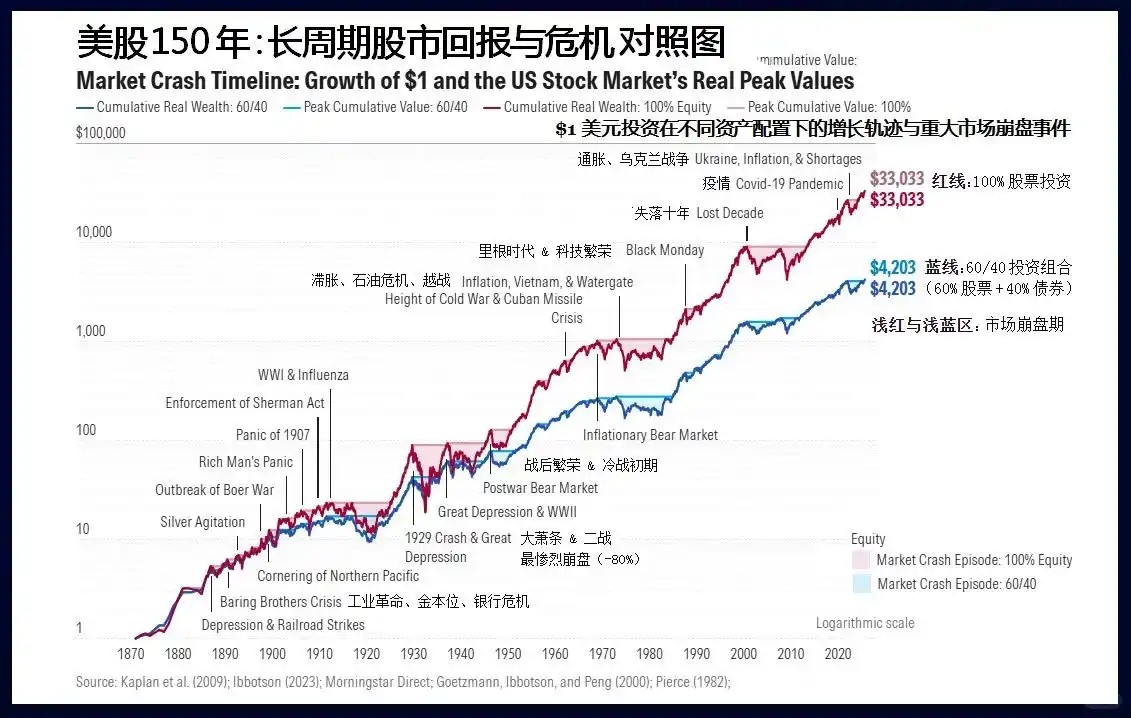
Since 1776, everyone who has bet against America has ultimately ended in their own miserable failure.

It's most difficult because most people come from A-shares, where they've experienced "buying the dip halfway down the mountain," suffering from "dip-buying PTSD syndrome." They always want to buy lower to give themselves some safety cushion, resulting in not daring to buy during the dip and then chasing the rebound.

Therefore, when a dip-buying opportunity arises in U.S. stocks, everyone must clarify two questions:

1. Under normal circumstances, how much does a typical U.S. stock correction fall?

2. If a black swan event occurs and the fall seems endless, what should be done?

1. How deep are U.S. stock corrections? First, let's define what a "correction" is.

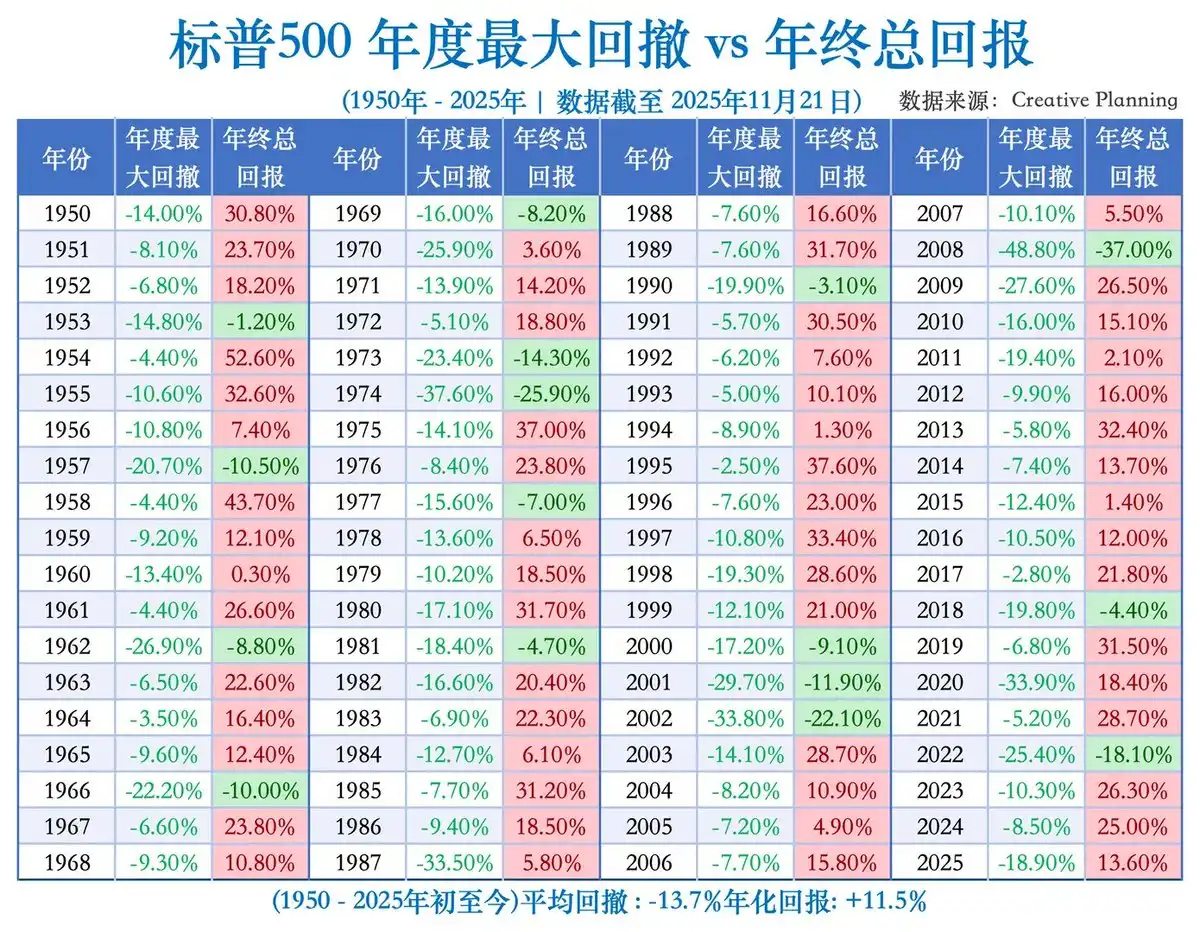
Corrections are usually divided into three levels: daily, weekly, and monthly. A round of decline must meet one of two conditions: magnitude or duration (everyone's definition may differ; this article only represents my standard).

  • Daily level: A drop of 5% or more from the highest point, or a duration of more than two weeks (referring to the time span from the highest to the lowest point);
  • Weekly level: A drop of 10% or more from the highest point, or a duration of more than 4 weeks;
  • Monthly level: A drop of 15% or more from the highest point, or a duration of more than 4 months.

Meeting one of the two conditions is sufficient. Some corrections are not deep in magnitude but drag on for a long time; others are the opposite. After clarifying the definition, buying the dip essentially has two goals:

  • Goal one: Buy all the positions you want
  • Goal two: Buy as cheaply as possible

Market trends are always clear in hindsight but confusing in real-time. When a correction is happening, we can only be sure of two things—how much it has fallen from the previous high to today, and how many days it has been falling?

It could continue to fall, consolidate, or start rising again.

So these two goals conflict. Buying too quickly might achieve goal one but at a higher price;

But if you only focus on buying cheap, you might miss out and the price could rise without you.

This requires us to have a probabilistic understanding of the magnitude of corrections in the historical trends of U.S. stocks to set a reasonable goal.
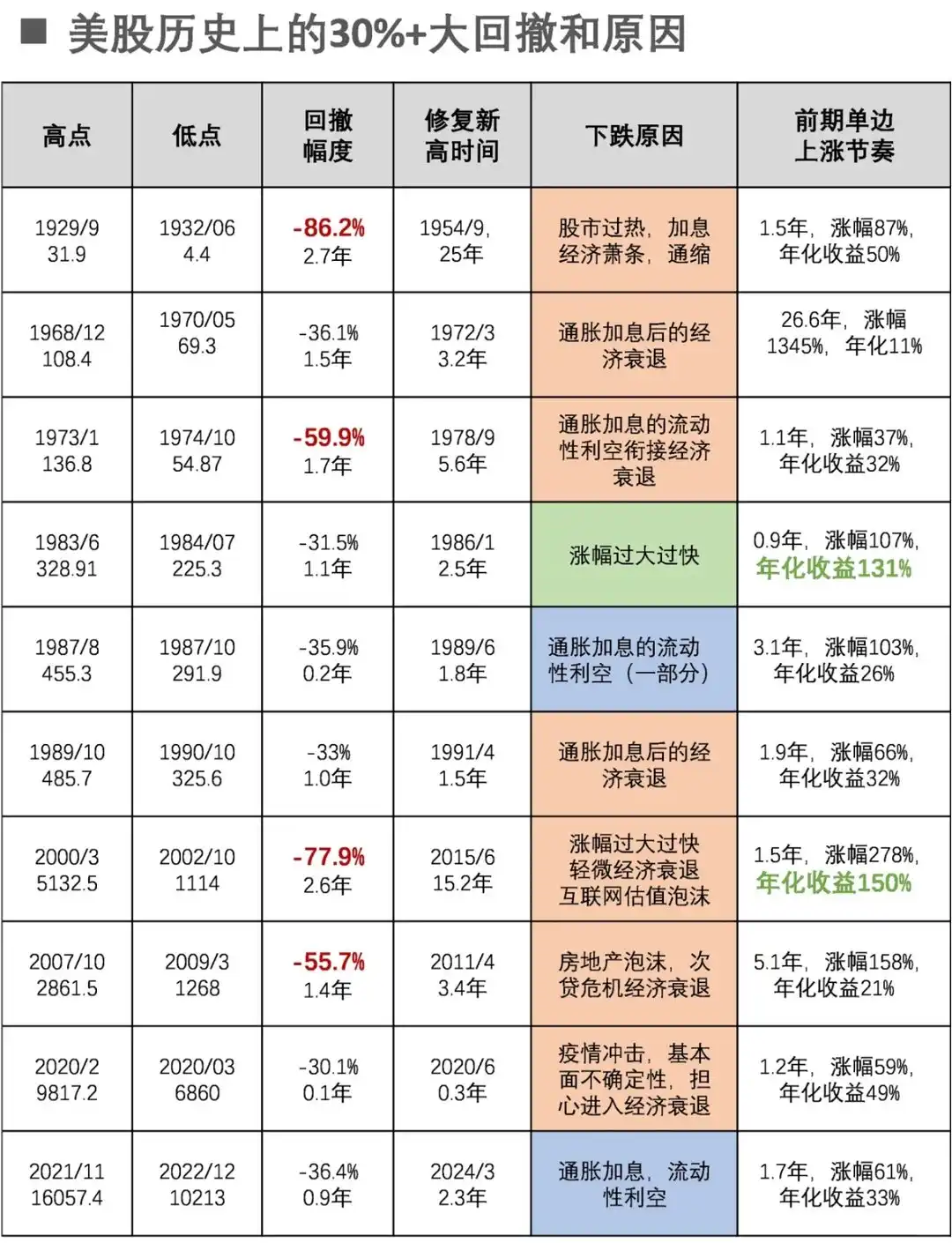
Major Drawdowns of 30%+ in U.S. Stock History and Their Causes

Taking the S&P 500 Index as an example, there have been only 7 monthly-level corrections in the past 20 years since 2004, with reasons分别为:

  • Jan-Oct 2022: The most aggressive interest rate hike cycle in 40 years
  • Feb-Mar 2020: Global public health event
  • Sep-Dec 2018: Trade war combined with interest rate hikes
  • Jul 2015 - Feb 2016: Chinese economic slowdown combined with interest rate hike expectations
  • Apr-Sep 2011: Deepening European debt crisis
  • Apr-Jun 2010: European debt crisis and Goldman Sachs fraud scandal
  • Oct 2007 - Mar 2009: Subprime mortgage crisis

So monthly-level corrections in U.S. stocks are still very rare, occurring on average once every three years, each with macro-fundamental reasons. From September 2011 to July 2015, there was a 44-month period without one, a proper long bull market.

Weekly-level corrections are more frequent, happening 2-3 times a year, and don't necessarily require fundamental reasons; just rising too much can lead to a correction.

Therefore, when buying the dip, the first thing to judge is whether this is a weekly-level or a monthly-level correction?

But stock movements are influenced by various new pieces of information, making accurate prediction difficult. The Fed isn't your family's business; negative and positive news won't arrive according to your plan—fortunately, you can still decide your own goal.

You need to think about a question, imagine it's haggling with a vendor: if you can only choose one goal between "buying" and "buying cheaply," which do you choose?

If it's the former, you should assume the correction is weekly-level and plan accordingly. This way, even if it turns out to be a monthly-level correction, you can still complete your first goal. Similarly, if your goal is "buying cheaply," you should prepare a dip-buying plan for a monthly-level correction.

However, generally, I recommend making "buying" the primary goal, especially when you have idle cash. First, because monthly-level corrections occur only every three years, the probability is indeed low. Second, with idle cash, if you don't buy U.S. stocks, you might end up buying other high-risk products.

With a goal, the plan becomes much simpler.

2. Time Plan vs. Price Plan: The First Question in Buying U.S. Stock Dips—When to Start the Plan?

Taking a weekly-level correction's dip-buying as an example, as long as it doesn't hit a new high for two weeks, a daily-level correction is already happening, and you should prepare a dip-buying plan for a weekly-level correction.

The core of buying U.S. stock dips is two words—scale in.
There are two types of scaling-in plans: one is time-based scaling, buying at fixed time intervals; the other is price-based scaling, buying when the price falls to certain levels. Based on the trends of the past 20 years, for weekly-level corrections (excluding monthly-level ones), the average time from high to bottom is 10 weeks. Thus, time-based scaling can be divided into three batches: starting from the high, buy the dip every three weeks afterward, with a longer interval between the second and first batches.

Price-based scaling can also be divided into three batches, buying one batch at a 3% drop from the high. If the maximum drop is 10%, the entire dip-buying plan can be completed.

The completion probabilities of these two plans differ. The time plan can generally be completed unless it's only a daily-level correction that quickly hits new highs—which isn't regrettable, as you've at least seized a daily-level correction opportunity to add positions.

But the price-based plan might not be completed. Many weekly-level corrections in U.S. stocks only last longer without reaching a 10% drop.

For weekly-level corrections, with "completing the dip buy" as the primary goal, "time-based scaling" should be prioritized. Even if the drop hasn't reached the target, once the correction time arrives, execute the scaling-in plan.

Now, considering a dip-buying plan targeting monthly-level corrections: the average time to bottom is 6.5 months, but it varies greatly. So, adopt the mindset of "probably won't complete the buy" and buy as much as possible.

Don't average the position sizes; instead, use a front-heavy approach: three batches at 1/2, 1/3, and 1/6 of the total plan.

The time plan can be batched as: first month, third month, sixth month. The price plan can be batched as: 3% drop, 8% drop, 15% drop. Often, when you target a "monthly-level" correction, you end up completing a weekly-level correction's dip-buying plan but with insufficient volume. Hence, I initially suggest focusing on the weekly-level correction plan as much as possible.

Buying U.S. stock dips can be simply summarized as three dos and three don'ts:

1. Do make a scaling-in plan; don't make random decisions or trade impulsively during the session;

2. Prioritize "buying enough" over "buying cheaply";

3. Prioritize "time-based scaling" over "price-based scaling." Buying U.S. stock dips is a very mechanical plan, and the premise of this plan is the long-term upward and relatively low-volatility trend of U.S. stocks.

But the stock market is ultimately a place of human博弈, and economic operations themselves are unpredictable. Black swan events can happen at any time and will inevitably happen.

If the correction's duration or depth exceeds the plan, how should you respond? If a black swan event occurs, what should be done?

3. Black Swan Events

The above corrections are divided into monthly and weekly levels, which has the advantage of clear standards. But even among monthly-level corrections, differences are significant. For instance, 2008 and 2020 were actually economic crises, not mere stock market corrections.

Thus, market adjustments can also be categorized into three types based on causes:
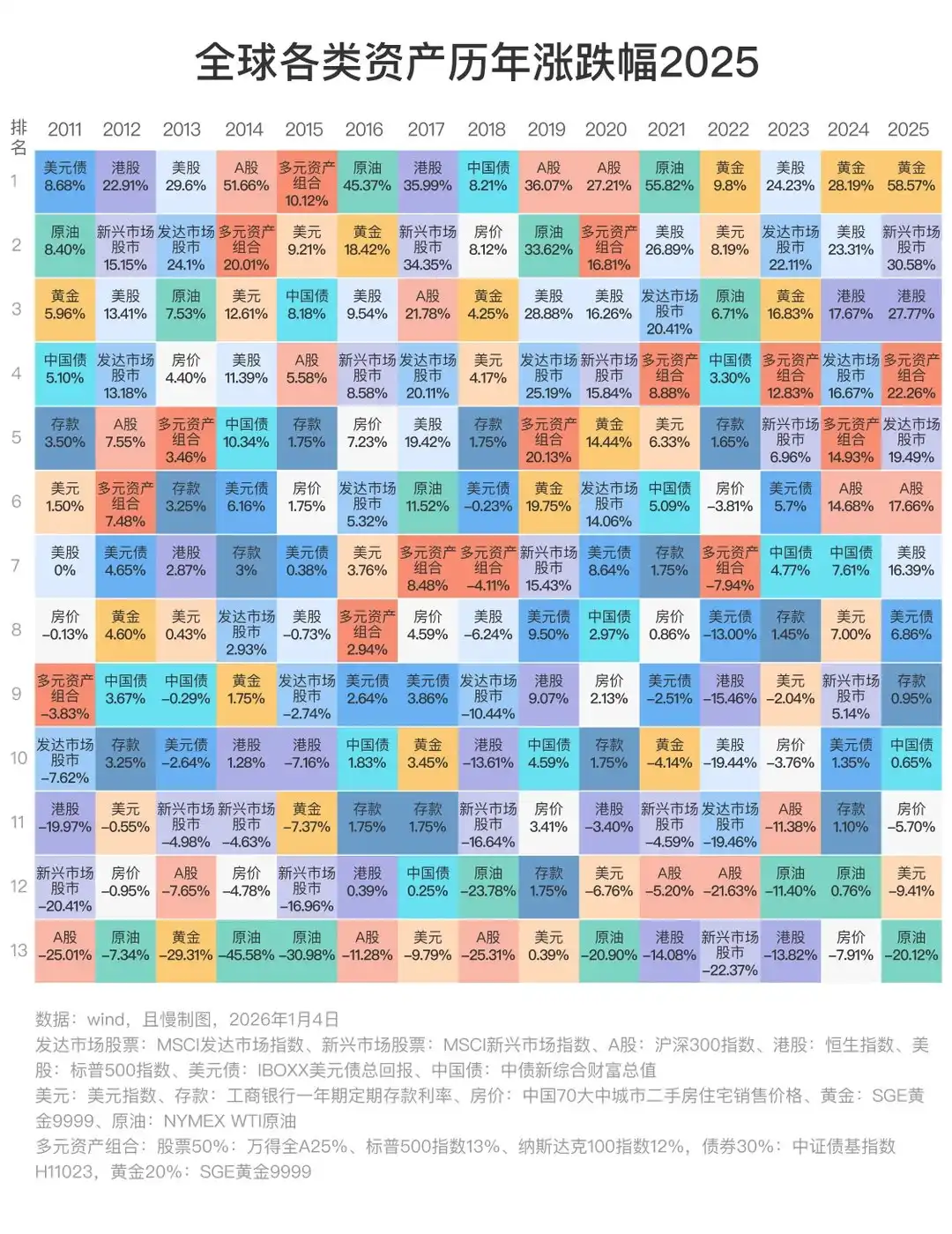
1. Natural correction due to excessive cumulative gains, but macro fundamentals are generally positive—Most daily and weekly-level corrections fall into this category.

2. Correction due to overvaluation combined with economic recession or a shift to hawkish monetary policy—A minority of weekly and most monthly-level corrections belong here.

3. Economic crisis or major recession caused by systemic risk—A minority of monthly-level corrections or long-term bear markets fall into this category.

In the past 20 years, the 2008 subprime crisis and the 2020 public health event belong to the third type. The former fell 58% in over a year; the latter fell 35% in two months. So the third situation exceeds our dip-buying plan and requires separate analysis.

However, crises and corrections are indistinguishable at the beginning. When U.S. stocks started falling in 2007, the market thought it was an economic recession. After the Fed began cutting rates, the market rebounded. By early 2008, investors were already buying the dip aggressively.

Therefore, during the dip-buying process, continuously observe whether new events have occurred initially or whether the initial causes of the decline have worsened.

Taking recent deep declines as examples: A standard bear market like the 27% drop in 2022 is actually the easiest to judge. It's driven by standard macro logic; everyone is discussing rate hikes; all prices are soaring; every month, data tells you it's worse than the last. At most, you might have losses at the initial confirmation of the dip buy; later, you'll naturally know it's a protracted battle, requiring an extended dip-buying timeline.

A "once-in-a-lifetime" crash like the 36% drop in one month during the 2020 public health event, triggered by non-economic black swan factors, is indeed panic-inducing short-term, but once it's over, it's over. In this case, you can only endure.

The most difficult was the 58% drop during the 2008 financial crisis, which was a mix of the above two situations. A crisis event during an ordinary recession triggered a deep recessionary bear market. It couldn't be predicted, only responded to.

Going further back, the 2000 dot-com bubble burst was a rare暴跌 caused by excessive valuation, which in turn dragged down the economy. But the valuation levels then were much, much higher than now. It was a discernible gray rhino event, but no one wanted to "get off first."

Synthesizing these types of U.S. stock declines, you'll find that it's best not to predict U.S. stock declines in advance. The most important thing is to face reality and respond after it happens; the sky won't fall.

Of course, having no expectations and making timely and correct responses after the fact requires you to pay attention to the market. You can't just allocate like wealth management without management. You still need to assess, after a certain stage of decline, whether it might evolve into a crisis.


Domande pertinenti

QWhat are the 'three dos and three don'ts' for bottom-fishing in the U.S. stock market as summarized in the article?

AThe three dos and three don'ts are: 1. Do make a batch plan; don't make random decisions or emotional trades during the session. 2. Prioritize 'buying enough' over 'buying cheap'. 3. Prioritize 'time-based batching' over 'price-based batching'.

QAccording to the author, what is the most important rule for investing in U.S. stocks over the past 20 years?

AThe most important investment rule for U.S. stocks over the past 20 years is to buy on every dip.

QHow does the article define a monthly-level correction for the U.S. stock market?

AA monthly-level correction is defined as a drop of 15% or more from the highest point, or a time span lasting 4 months or more from the peak to the trough.

QWhat are the only two things one can be sure of during a market correction, as stated in the article?

ADuring a market correction, the only two things one can be sure of are how much it has fallen from the previous high to the present day and how many days it has been falling.

QWhat are the three types of market adjustments classified by cause in the article?

AThe three types are: 1. Natural adjustments due to excessive cumulative gains, with macro fundamentals generally sound. 2. Adjustments caused by overvaluation combined with an economic recession or a shift to hawkish monetary policy. 3. Economic crises or major recessions caused by systemic risks.

Letture associate

Trading

Spot
Futures

Articoli Popolari

Cosa è SOLANA

HarryPotterWifHatMyroWynn10Inu,$solana: Un’Immersione nel Trendy Meme Coin Project Introduzione Nel panorama in continua evoluzione delle criptovalute, progetti innovativi emergono continuamente, catturando l'immaginazione di investitori ed appassionati. Uno di questi progetti è HarryPotterWifHatMyroWynn10Inu,$solana, una meme coin che ha iniziato a ritagliarsi una sua nicchia all'interno della comunità crypto. Questo articolo ha l'obiettivo di fornirti una panoramica completa del progetto, spiegandone lo scopo, l'architettura, il creatore, gli investitori e i traguardi significativi lungo il percorso. Cos'è HarryPotterWifHatMyroWynn10Inu,$solana? Panoramica HarryPotterWifHatMyroWynn10Inu,$solana è un progetto di meme coin strutturato sulla blockchain di Solana – una piattaforma rinomata per la sua scalabilità e velocità. Con l'intento di portare gioia e creatività nello spazio crypto, questo progetto non solo funge da token di scambio ma anche come catalizzatore per la generazione e la condivisione di contenuti meme. La comunità al suo interno è incoraggiata a partecipare attivamente, fornendo un ecosistema dinamico dove la creatività e la collaborazione prosperano. Obiettivi e Scopi Nella sua essenza, il progetto mira a favorire un ambiente dove gli appassionati di meme possano riunirsi, condividere e creare nuovi contenuti meme. Questo approccio narrativo infonde entusiasmo nella comunità, promuovendo il coinvolgimento e allo stesso tempo evidenziando le robuste funzionalità insite nella blockchain di Solana. Costruendo un progetto incentrato sulla comunità, HarryPotterWifHatMyroWynn10Inu,$solana desidera inoltre esplorare l'impatto sociale delle valute digitali come mezzo di espressione. Chi è il Creatore di HarryPotterWifHatMyroWynn10Inu,$solana? L'identità del creatore dietro HarryPotterWifHatMyroWynn10Inu,$solana rimane avvolta nel mistero. Il progetto è stato strutturato in modo tale che la proprietà sia stata rinunciata; pertanto, prospera come un'iniziativa guidata dalla comunità. Questa decentralizzazione promuove la trasparenza e la partecipazione democratica tra tutti i soggetti coinvolti. Tale approccio è sempre più popolare nel mondo delle meme coin, dove il coinvolgimento della comunità regna sovrano. Chi sono gli Investitori di HarryPotterWifHatMyroWynn10Inu,$solana? Attualmente, non ci sono informazioni pubblicamente disponibili riguardo agli specifici investitori o fondazioni che supportano HarryPotterWifHatMyroWynn10Inu,$solana. L'assenza di investitori noti sottolinea ulteriormente l'etica orientata alla comunità del progetto, che si mantiene indipendente dai tradizionali schemi finanziari. Questa indipendenza consente al progetto di sviluppare la propria identità libera da pressioni esterne, facendo affidamento invece sull'interesse collettivo della sua base utenti. Come Funziona HarryPotterWifHatMyroWynn10Inu,$solana? Modello Economico Il progetto impiega un modello economico unico che sostiene la sua funzionalità e il coinvolgimento degli utenti. Le transazioni all'interno di HarryPotterWifHatMyroWynn10Inu,$solana sono progettate per essere vantaggiose per tutte le parti coinvolte. Ogni operazione comporta una commissione, che viene successivamente redistribuita tra gli attuali possessori, aumentando al contempo il pool di liquidità. I componenti chiave di questo modello includono: Meccanismo di Riflesso: Una parte delle commissioni di transazione viene restituita ai possessori, promuovendo l'investimento a lungo termine nel token. Acquisizione di Pool di Liquidità: I fondi sono destinati a migliorare la liquidità, garantendo che le operazioni di acquisto e vendita possano essere eseguite senza intoppi. Meccanismi di Bruciatura: Una parte dei token potrebbe essere bruciata per creare scarsità, aumentando potenzialmente il valore man mano che la domanda cresce. Questo design incoraggia un ecosistema autosufficiente che prospera grazie alle interazioni e agli investimenti della comunità. Coinvolgimento della Comunità Nel cuore di HarryPotterWifHatMyroWynn10Inu,$solana c'è il valore attribuito al coinvolgimento della comunità. Permettendo agli utenti di partecipare allo sviluppo del progetto attraverso varie attività, come la creazione di meme e promozioni, il progetto favorisce un ecosistema vibrante dove la creatività può fiorire. Cronologia di HarryPotterWifHatMyroWynn10Inu,$solana La traiettoria di HarryPotterWifHatMyroWynn10Inu,$solana presenta diversi eventi degni di nota che hanno plasmato la sua posizione attuale nella comunità crypto: Creazione: La data specifica di creazione rimane non divulgata, ma l'ideazione del progetto è radicata nella cultura meme che permea l'era digitale. Passaggio alla Comunità: Dopo la rinuncia alla proprietà da parte del suo creatore, il progetto è passato a un modello guidato dalla comunità, permettendo a tutti i partecipanti di avere una parte nel suo successo. Audit e Collezione NFT: In un tentativo di aumentare la credibilità, il progetto ha completato un audit approfondito, lanciando simultaneamente una collezione NFT che serve a incarnare la sua etica centrata sui meme. Partnership e Sviluppo: Il progetto è attualmente impegnato a esplorare potenziali partnership con altri token e a organizzare lo sviluppo di un sito web unico e opzioni di merchandising basate sui suoi leggendari meme. Punti Chiave In sintesi, HarryPotterWifHatMyroWynn10Inu,$solana si presenta come un attore notevole nel settore delle meme coin delle criptovalute. Ecco alcuni dei punti salienti: Iniziativa Guidata dalla Comunità: Il progetto prospera come uno sforzo collaborativo, incoraggiando contributi attivi da parte dei membri della comunità mentre si distacca da pretese di proprietà. Modello Economico Innovativo: Utilizzando meccanismi di riflesso, acquisizione di liquidità e bruciatura, crea un ambiente finanziario robusto e coinvolgente per gli utenti. Coinvolgimento con NFT e Merchandising: Con il lancio di una collezione NFT, il progetto mira a approfondire il coinvolgimento all'interno della sua comunità, rafforzando il legame tra cultura meme e valuta digitale. Esplorazione di Partnership: L'iniziativa non è stagnante – lo sviluppo in corso e le potenziali partnership indicano un approccio lungimirante volto alla crescita sostenuta. Conclusione Mentre HarryPotterWifHatMyroWynn10Inu,$solana continua a guadagnare slancio all'interno del panorama delle criptovalute, la sua combinazione unica di coinvolgimento della comunità, strutture economiche innovative e integrazione della cultura meme delineano il suo potenziale percorso futuro. Anche con il mistero che circonda le sue origini e le affiliazioni degli investitori, il progetto cattura una storia intrigante che parla dell'essenza dell'innovazione decentralizzata. In un mondo dove le criptovalute sono spesso viste attraverso una lente puramente finanziaria, HarryPotterWifHatMyroWynn10Inu,$solana dimostra che il movimento crypto incorpora creatività, comunità e collaborazione. Che tu sia un investitore esperto o un neofita, il percorso che si sta sviluppando di questo progetto di meme coin rappresenta sicuramente uno studio di caso coinvolgente degno di attenzione.

394 Totale visualizzazioniPubblicato il 2024.04.04Aggiornato il 2024.12.03

Cosa è SOLANA

Cosa è SOLANA 2.0

BarbieCrashBandicootRFK777Inu, $SOLANA 2.0: Un Nuovo Giocatore nel Paesaggio Cripto Introduzione a BarbieCrashBandicootRFK777Inu, $SOLANA 2.0 Nel paesaggio in continua evoluzione delle criptovalute, nuovi entrant catturano costantemente l'attenzione di investitori ed entusiasti. Tra questi progetti emergenti c'è BarbieCrashBandicootRFK777Inu, rappresentato dal simbolo della criptovaluta $SOLANA 2.0. Questa iniziativa unica combina elementi di glamour, avventura e cultura meme, proponendosi di sfidare le aspettative in un'area estremamente competitiva. Con aspirazioni di crescita e innovazione, questo progetto cattura lo spirito di un underdog che lotta contro giganti affermati. Che cos'è BarbieCrashBandicootRFK777Inu, $SOLANA 2.0? Alla sua essenza, BarbieCrashBandicootRFK777Inu è un progetto di criptovaluta che trae ispirazione da varie riferimenti culturali iconici. Includendo l'eleganza e il fascino associati a Barbie, l'energia dinamica di Crash Bandicoot e la spinta instancabile rappresentata da RFK, il progetto mira a offrire un'esperienza multifattoriale nel mondo delle criptovalute. Il principale obiettivo del progetto BarbieCrashBandicootRFK777Inu è quello di unire questi elementi disparati in un ecosistema coeso che attragga un vasto pubblico. Abbracciando la fantasia della cultura meme, rimanendo però ancorato ai principi di decentralizzazione e empowerment finanziario, il progetto si è posizionato come un'opzione convincente sia per investitori esperti che per neofiti del mondo cripto. Chi è il Creatore di BarbieCrashBandicootRFK777Inu, $SOLANA 2.0? Nonostante l'interesse crescente per BarbieCrashBandicootRFK777Inu, le informazioni riguardanti il suo creatore rimangono per lo più sconosciute. L'anonimato del suo fondatore o team di sviluppo solleva interrogativi sulla struttura e governance del progetto. Nel mondo delle criptovalute, non è raro che i progetti operino senza creatori pubblici. Questa mancanza di informazioni potrebbe scoraggiare alcuni potenziali investitori, mentre altri potrebbero vederla come un'opportunità per abbracciare lo spirito di decentralizzazione che sottende molte iniziative nel campo delle criptovalute. Chi sono gli Investitori di BarbieCrashBandicootRFK777Inu, $SOLANA 2.0? Attualmente, ci sono poche informazioni disponibili riguardo ai fondamenti d'investimento o alle organizzazioni che supportano BarbieCrashBandicootRFK777Inu. La mancanza di un sostegno d'investimento dettagliato per il progetto evidenzia la natura indipendente di numerose criptovalute. In questo caso, resta da vedere se il finanziamento del progetto provenga da un supporto della comunità a livello locale o dal supporto di entità finanziarie più grandi. Come Funziona BarbieCrashBandicootRFK777Inu, $SOLANA 2.0? BarbieCrashBandicootRFK777Inu è progettato con una serie di funzionalità che contribuiscono alla sua unicità all'interno dello spazio cripto affollato. Sebbene i dettagli tecnici specifici rimangano segreti, si prevede che il progetto incorpori funzionalità volte a migliorare il coinvolgimento degli utenti e a promuovere la crescita della comunità. La combinazione di influenze variegate—dalla moda e avventura ai giochi—incoraggia un'atmosfera inclusiva che si rivolge a interessi diversi. Inoltre, i legami del progetto con l'ecosistema $SOLANA 2.0 suggeriscono potenziali vantaggi tecnologici. Questo potrebbe includere velocità di transazione innovative, scalabilità e costi contenuti, allineandosi con le capacità tecniche della blockchain di Solana. I fondatori del progetto sembrano voler sfruttare questa base tecnologica per creare un'esperienza comunitaria duratura e un'offerta di prodotto sostanziale. Timeline di BarbieCrashBandicootRFK777Inu, $SOLANA 2.0 Il percorso di BarbieCrashBandicootRFK777Inu contiene diverse tappe chiave, fornendo spunti sullo sviluppo del progetto fino ad ora: Concettualizzazione del Progetto: Sono emerse idee iniziali riguardo alla fusione di glamour, avventura e cultura meme, dando forma al concetto unico del progetto. Creazione del Token: È stato istituito il token simbolico $SOLANA 2.0, progettato per incarnare le aspirazioni del progetto e attrarre l'interesse di potenziali investitori. Sviluppo del Progetto: Attualmente, il progetto è in fase di ulteriore sviluppo, con un'enfasi sulla sfida ai player consolidati nel campo delle criptovalute e sulla fornitura di offerte innovative. Queste tappe riflettono la traiettoria di crescita del progetto, evidenziando il suo impegno a sviluppare un'esperienza pionieristica nel campo delle criptovalute. Punti Chiave su BarbieCrashBandicootRFK777Inu, $SOLANA 2.0 Concetto Unico: BarbieCrashBandicootRFK777Inu si distingue per la fusione di elementi di glamour, avventura e cultura meme in un unico progetto di criptovaluta. Spirito da Underdog: Il progetto abbraccia una persona underdog, mirante a sfidare progetti di criptovaluta consolidati e ritagliarsi una nicchia nell'industria. Fase di Sviluppo: Sono in corso sforzi di sviluppo attivi, con l'intenzione di fornire offerte fresche e innovative in linea con le aspettative della comunità e degli investitori. Conclusione BarbieCrashBandicootRFK777Inu, rappresentato dal simbolo $SOLANA 2.0, è un nuovo e interessante entrant nel mercato delle criptovalute. La sua combinazione unica di riferimenti culturali e visione ambiziosa potrebbe risuonare con coloro che cercano valori alternativi nei progetti cripto. Sebbene lo stato sconosciuto del suo creatore e degli investitori possa sollevare sopracciglia, l'enfasi del progetto su fascino e avventura presenta una narrativa affascinante che espande i confini di ciò che le criptovalute possono incarnare. Man mano che il progetto continua a svilupparsi, sarà interessante osservare la sua evoluzione all'interno del più ampio paesaggio cripto e come si posizioni tra i suoi concorrenti. Per coloro che vi sono coinvolti, BarbieCrashBandicootRFK777Inu potrebbe svelare esperienze sorprendenti che ridefiniscono l'interazione con gli asset digitali. Per ora, mentre il progetto avanza, il suo percorso rimane un promemoria che l'innovazione nel settore cripto non conosce limiti, offrendo tutto, dall'eccitazione e intrattenimento alla possibilità di empowerment finanziario.

154 Totale visualizzazioniPubblicato il 2024.04.05Aggiornato il 2024.12.03

Cosa è SOLANA 2.0

Come comprare SOL

Benvenuto in HTX.com! Abbiamo reso l'acquisto di Solana (SOL) semplice e conveniente. Segui la nostra guida passo passo per intraprendere il tuo viaggio nel mondo delle criptovalute.Step 1: Crea il tuo Account HTXUsa la tua email o numero di telefono per registrarti il tuo account gratuito su HTX. Vivi un'esperienza facile e sblocca tutte le funzionalità,Crea il mio accountStep 2: Vai in Acquista crypto e seleziona il tuo metodo di pagamentoCarta di credito/debito: utilizza la tua Visa o Mastercard per acquistare immediatamente SolanaSOL.Bilancio: Usa i fondi dal bilancio del tuo account HTX per fare trading senza problemi.Terze parti: abbiamo aggiunto metodi di pagamento molto utilizzati come Google Pay e Apple Pay per maggiore comodità.P2P: Fai trading direttamente con altri utenti HTX.Over-the-Counter (OTC): Offriamo servizi su misura e tassi di cambio competitivi per i trader.Step 3: Conserva Solana (SOL)Dopo aver acquistato Solana (SOL), conserva nel tuo account HTX. In alternativa, puoi inviare tramite trasferimento blockchain o scambiare per altre criptovalute.Step 4: Scambia Solana (SOL)Scambia facilmente Solana (SOL) nel mercato spot di HTX. Accedi al tuo account, seleziona la tua coppia di trading, esegui le tue operazioni e monitora in tempo reale. Offriamo un'esperienza user-friendly sia per chi ha appena iniziato che per i trader più esperti.

1.7k Totale visualizzazioniPubblicato il 2024.12.12Aggiornato il 2025.03.21

Come comprare SOL

Discussioni

Benvenuto nella Community HTX. Qui puoi rimanere informato sugli ultimi sviluppi della piattaforma e accedere ad approfondimenti esperti sul mercato. Le opinioni degli utenti sul prezzo di SOL SOL sono presentate come di seguito.

活动图片













