A $20 Billion Valuation: Kalshi and Polymarket in an Arms Race?

marsbitPubblicato 2026-03-09Pubblicato ultima volta 2026-03-09

Introduzione

A potential "arms race" is brewing in the prediction market sector, with industry leaders Polymarket and Kalshi each reportedly in funding talks at valuations around $20 billion. This represents a near doubling of their respective $12 billion and $11 billion valuations from late 2025. As of February 2026, the global prediction market has reached a cumulative notional trading volume of $127.5 billion. Polymarket leads with $56.07 billion, followed closely by Kalshi at $44.71 billion, together commanding 79% market share. Their growth trajectories differ: Kalshi has experienced explosive user growth, with monthly active users surging from 600,000 to over 5.1 million in 2025, while Polymarket's user growth has been steadier, peaking around 700,000 monthly active users. Kalshi's trading volume skyrocketed over 1100% in 2025, largely driven by sports contracts which account for 81% of its volume. It has secured key partnerships with platforms like Robinhood, which contributed over 50% of its volume in late 2025, and media outlets like CNBC and CNN. Polymarket maintains a stronghold in political and crypto event markets. It has formed significant partnerships with X (formerly Twitter), ICE (for a strategic investment up to $2 billion), and the UFC for exclusive prediction market data. Both platforms are also official partners of the NHL, and their data is integrated into Google's search and finance products. Their divergent strategies—Kalshi's focus on USD-compliant trading and...

Recently, according to The Wall Street Journal, the two leading prediction market platforms, Polymarket and Kalshi, have been in talks with potential investors for funding rounds, each with an estimated valuation of around $20 billion. In November 2025, it was reported that Polymarket was negotiating funding at a $12 billion valuation. That December, Kalshi completed a $1 billion funding round, bringing its valuation to $11 billion.

In just a few months, the valuations have nearly doubled again.

According to public market data and industry reports, as of the end of February 2026, the cumulative nominal trading volume of the global prediction market reached $127.5 billion, with Polymarket leading at $56.07 billion and Kalshi at $44.71 billion, together accounting for 79% of the market share.

While leading in cumulative trading volume, Kalshi showed more outstanding growth in 2025, not only reversing its market share from a minority position at the beginning of the year to over 60% but also driving its monthly active users (MAU) from 600,000 to over 5.1 million, demonstrating a faster pace of scale expansion. In contrast, Polymarket, leveraging its crypto-native advantages, maintained its global event coverage and cumulative trading lead, but its user growth was relatively steady, with peak MAU hovering around 700,000. The two core metrics—trading volume and MAU—clearly outline Kalshi's explosive catch-up and Polymarket's sustained深耕 (deep cultivation), forming a duopoly in the prediction market.

Specifically regarding trading volume performance, Kalshi's growth trajectory shows a leap from a low base to a high volume.
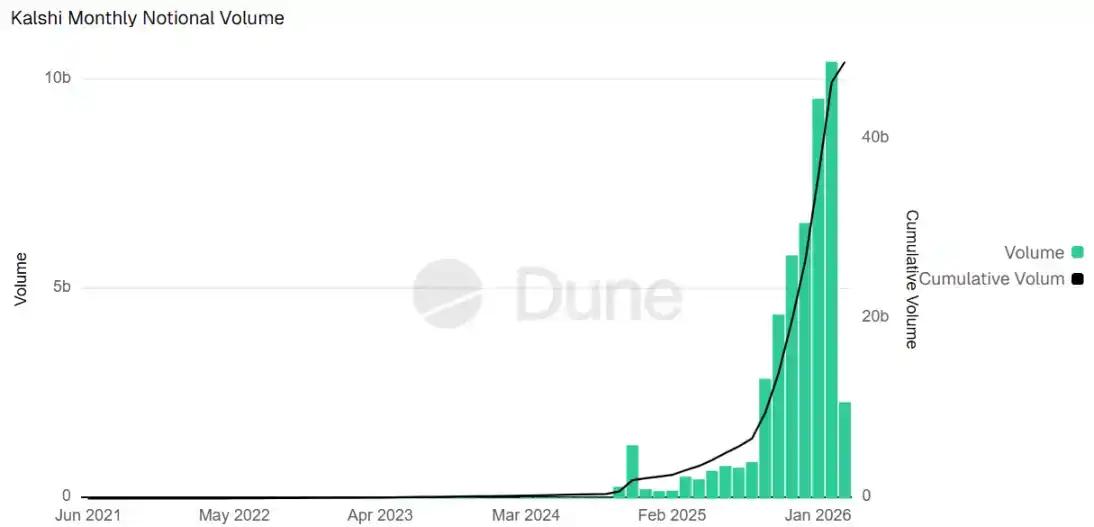
In 2024, Kalshi's annual nominal trading volume was approximately $1.9 billion, limited by early regulatory frameworks and market awareness, primarily driven by a few events. Entering 2025, this number surged to about $23.8 billion, a year-on-year increase of over 1100%. This explosion was directly reflected in monthly and weekly records: September single-month trading reached $2.86 billion, October further climbed to $4.39 billion, and December skyrocketed to $6.58 billion. The strong momentum continued into the beginning of 2026, with January's monthly trading exceeding $10.4 billion.
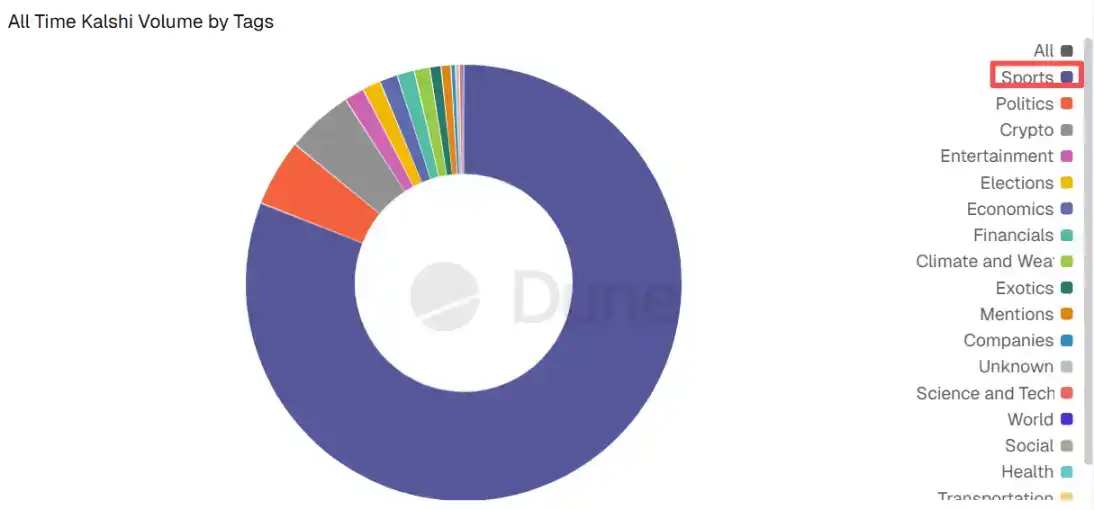
Sports event contracts contributed about 81% of this trading volume.

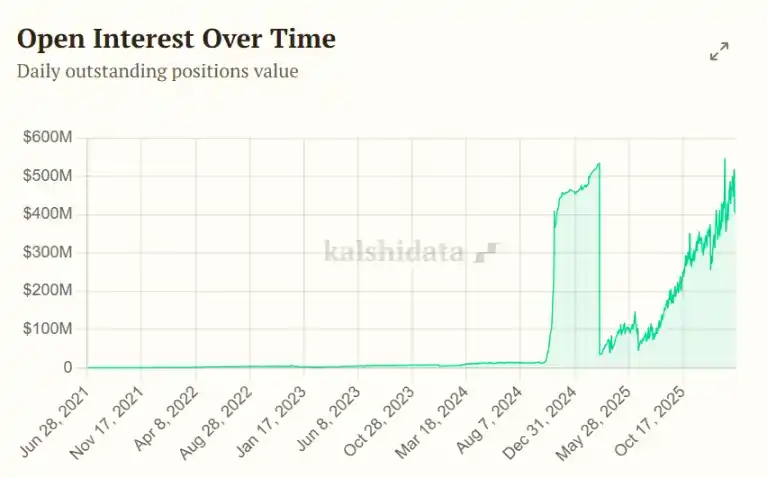
As of March 9, Kalshi's cumulative total trading volume exceeded $48.6 billion. Currently, its open interest hovers around $500 million.
Polymarket's trading volume reflects its earlier accumulation advantage and later steady maintenance. Dune Analytics data shows that in 2024, Polymarket's monthly nominal trading volume experienced explosive growth, reaching a historical high of $4.266 billion in October 2024, bringing its cumulative trading volume to $7.6 billion.
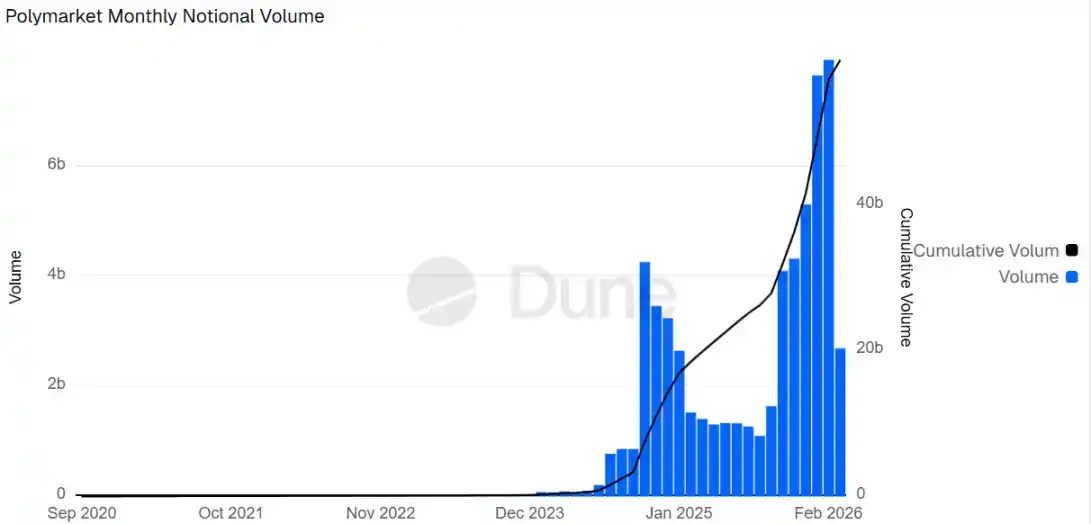
Subsequently, although its monthly trading volume slowly declined, it remained at a high level. The turning point occurred in September 2025, when Polymarket began its pulse-like surge in trading volume.

October single-month trading broke $4.1 billion, November broke $4.3 billion.

By 2026, in January alone, its trading volume broke $7.658 billion, and February broke $7.9 billion. As of March 9, its cumulative trading volume exceeded $59.9 billion.
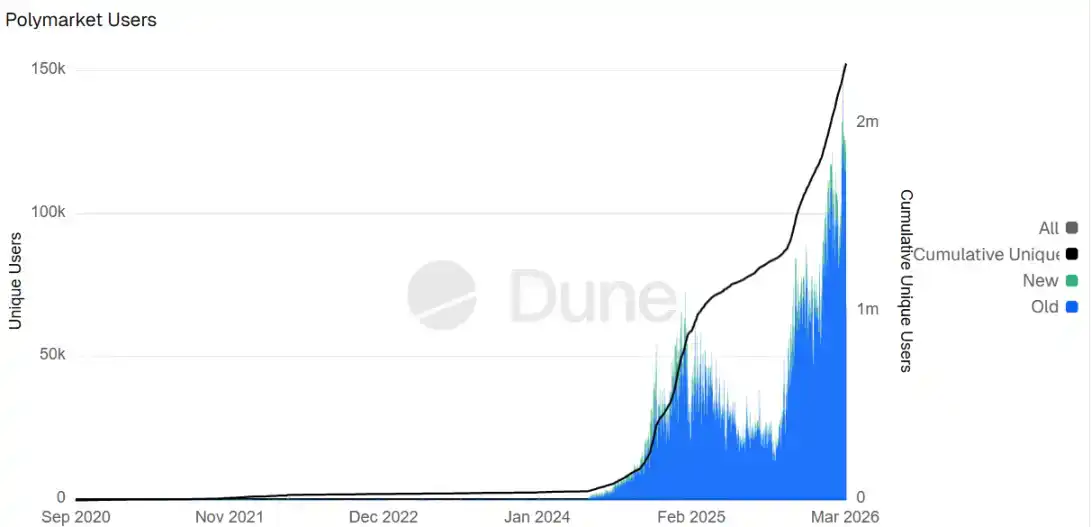
According to Dune data statistics, its total number of users has skyrocketed from 40,000 in 2024 to 2.31 million today.

It is worth noting that Polymarket still holds an advantage in liquidity depth for political and crypto events, with some weekly transaction counts accounting for up to 57%, but its overall market share dropped from 95% to 35-40% in mid-2025 before gradually stabilizing.

The divergence in trading volume data between the two platforms essentially stems from differences in business focus and user access models. Kalshi, as a CFTC-regulated entity, focuses on compliant trading in USD, covering over 42 US states. Kalshi gains the upper hand in sports dominance, while Polymarket maintains a lead in political and crypto domains, jointly pushing the entire market's weekly nominal trading volume to stably remain in the tens of billions of dollars.

In terms of ecosystem partnerships, the two major prediction markets are also frequently active, deeply integrating with mainstream institutions, media, and sports IPs. Both are not only opening offline pop-up shops but also expanding疯狂 (frantically) online.

Kalshi focuses on leveraging its compliance advantages, forming a strategic partnership with Tradeweb and receiving a minority equity investment, embedding real-time probability data into its institutional trading platform; Robinhood became its largest traffic source, contributing over 50% of trading volume in the second half of 2025; simultaneously, it secured exclusive media partnerships with CNBC and CNN, with data directly integrated into programs and reports.

Polymarket, on the other hand, emphasizes Wall Street data output and entertainment penetration. In June last year, Polymarket partnered with X, becoming its official prediction partner. It secured a strategic investment of up to $2 billion from ICE, which incorporates the data into financial product streams. In November, Polymarket reached a multi-year exclusive agreement with TKO Group, becoming the official prediction market partner for UFC and Zuffa Boxing, with data integrated into broadcasts and live events.

In January 2026, Polymarket entered an exclusive partnership with Dow Jones-owned media, providing prediction market data to media outlets including Barron's and The Wall Street Journal.

Interestingly, both are official NHL prediction market partners. Additionally, Google has integrated data from both into its search and finance platforms.

Overall, judging from the trading volume and MAU data over the past two years, both are jointly driving the evolution of prediction markets from niche tools into mainstream information and risk management platforms. This trend is not only reshaping the valuation logic of the crypto industry but also providing real-time signal references for traditional finance. If subsequent funding rounds materialize, coupled with热门 (hot) geopolitical events (US-Iran conflict), World Cup tournaments, and the eve of the US election, various data points for both platforms in 2026 are expected to break historical records.


Domande pertinenti

QWhat are the current valuations of Polymarket and Kalshi, and how have they changed recently?

ABoth Polymarket and Kalshi are currently in talks with potential investors at valuations around $20 billion. In November 2025, Polymarket was negotiating funding at a $12 billion valuation, and in December 2025, Kalshi completed a $1 billion financing round at an $11 billion valuation. Their valuations have nearly doubled in just a few months.

QWhich platform leads in cumulative nominal trading volume, and what is the combined market share of these two companies?

AAs of the end of February 2026, Polymarket leads with a cumulative nominal trading volume of $56.07 billion, followed by Kalshi with $44.71 billion. Together, they account for 79% of the global prediction market share.

QWhat drove Kalshi's explosive growth in trading volume in 2025?

AKalshi's trading volume surged by over 1100% in 2025, driven primarily by sports event contracts, which contributed approximately 81% of its trading volume. Key monthly records included $6.58 billion in December 2025 and over $10.4 billion in January 2026.

QHow do Polymarket and Kalshi differ in their business focus and user access models?

AKalshi, as a CFTC-regulated entity, focuses on compliant USD trading and is available in over 42 U.S. states, with a strong emphasis on sports contracts. Polymarket leverages its crypto-native advantages, maintaining leadership in political and crypto events, and uses cryptocurrency for settlements.

QWhat major partnerships have Polymarket and Kalshi established to expand their influence?

AKalshi partnered with Tradeweb for institutional data integration, Robinhood for significant traffic, and CNBC and CNN for media coverage. Polymarket collaborated with X (Twitter) as its official prediction partner, ICE for a strategic investment, TKO Group for UFC and boxing data, and Dow Jones media outlets including The Wall Street Journal.

Letture associate

Gensyn AI: Don't Let AI Repeat the Mistakes of the Internet

In recent months, the rapid growth of the AI industry has attracted significant talent from the crypto sector. A persistent question among researchers intersecting both fields is whether blockchain can become a foundational part of AI infrastructure. While many previous AI and Crypto projects focused on application layers (like AI Agents, on-chain reasoning, data markets, and compute rentals), few achieved viable commercial models. Gensyn differentiates itself by targeting the most critical and expensive layer of AI: model training. Gensyn aims to organize globally distributed GPU resources into an open AI training network. Developers can submit training tasks, nodes provide computational power, and the network verifies results while distributing incentives. The core issue addressed is not decentralization for its own sake, but the increasing centralization of compute power among tech giants. In the era of large models, access to GPUs (like the H100) has become a decisive bottleneck, dictating the pace of AI development. Major AI companies are heavily dependent on large cloud providers for compute resources. Gensyn's approach is significant for several reasons: 1) It operates at the core infrastructure layer (model training), the most resource-intensive and technically demanding part of the AI value chain. 2) It proposes a more open, collaborative model for compute, potentially increasing resource utilization by dynamically pooling idle GPUs, similar to early cloud computing logic. 3) Its technical moat lies in solving complex challenges like verifying training results, ensuring node honesty, and maintaining reliability in a distributed environment—making it more of a deep-tech infrastructure company. 4) It targets a validated, high-growth market with genuine demand, rather than pursuing blockchain integration without purpose. Ultimately, the boundaries between Crypto and AI are blurring. AI requires global resource coordination, incentive mechanisms, and collaborative systems—areas where crypto-native solutions excel. Gensyn represents a step toward making advanced training capabilities more accessible and collaborative, moving beyond a niche controlled by a few giants. If successful, it could evolve into a fundamental piece of AI infrastructure, where the most enduring value in the AI era is often created.

marsbit8 h fa

Gensyn AI: Don't Let AI Repeat the Mistakes of the Internet

marsbit8 h fa

Why is China's AI Developing So Fast? The Answer Lies Inside the Labs

A US researcher's visit to China's top AI labs reveals distinct cultural and organizational factors driving China's rapid AI development. While talent, data, and compute are similar to the West, Chinese labs excel through a pragmatic, execution-focused culture: less emphasis on individual stardom and conceptual debate, and more on teamwork, engineering optimization, and mastering the full tech stack. A key advantage is the integration of young students and researchers who approach model-building with fresh perspectives and low ego, prioritizing collective progress over personal credit. This contrasts with the US culture of self-promotion and "star scientist" narratives. Chinese labs also exhibit a strong "build, don't buy" mentality, preferring to develop core capabilities—like data pipelines and environments—in-house rather than relying on external services. The ecosystem feels more collaborative than tribal, with mutual respect among labs. While government support exists, its scale is unclear, and technical decisions appear driven by labs, not state mandates. Chinese companies across sectors, from platforms to consumer tech, are building their own foundational models to control their tech destiny, reflecting a broader cultural drive for technological sovereignty. Demand for AI is emerging, with spending patterns potentially mirroring cloud infrastructure more than traditional SaaS. Despite challenges like a less mature data industry and GPU shortages, Chinese labs are propelled by vast talent, rapid iteration, and deep integration with the open-source community. The competition is evolving beyond a pure model race into a contest of organizational execution, developer ecosystems, and industrial pragmatism.

marsbit9 h fa

Why is China's AI Developing So Fast? The Answer Lies Inside the Labs

marsbit9 h fa

3 Years, 5 Times: The Rebirth of a Century-Old Glass Factory

Corning, a 175-year-old glass company, is experiencing a dramatic revival as a key player in AI infrastructure, driven by surging demand for high-performance optical fiber in data centers. AI data centers require vastly more fiber than traditional ones—5 to 10 times as much per rack—to handle high-speed data transmission between GPUs. This structural demand shift, coupled with supply constraints from the lengthy expansion cycle for fiber preforms, has created a significant supply-demand gap. Nvidia has invested in Corning, along with Lumentum and Coherent, in a $4.5 billion total commitment to secure the optical supply chain for AI. Corning's competitive edge lies in its expertise in producing ultra-low-loss, high-density, and bend-resistant specialty fiber, which is critical for 800G+ and future 1.6T data rates. Its deep involvement in co-packaged optics (CPO) with partners like Nvidia further solidifies its position. While not the largest fiber manufacturer globally, Corning's revenue from enterprise/data center clients now exceeds 40% of its optical communications sales, and it has secured multi-year supply agreements with major hyperscalers including Meta and Nvidia. Financially, Corning's optical communications revenue has surged, doubling from $1.3 billion in 2023 to over $3 billion in 2025. Its stock price has risen nearly 6-fold since late 2023. Key future catalysts include the rollout of Nvidia's CPO products and the scale of undisclosed customer agreements. However, risks include high current valuations and potential disruption from next-generation technologies like hollow-core fiber. The company's long-term bet on light over electricity, maintained even through the telecom bubble crash, is now being validated by the AI boom.

marsbit10 h fa

3 Years, 5 Times: The Rebirth of a Century-Old Glass Factory

marsbit10 h fa

Trading

Spot
Futures
活动图片




