How to Quickly Get Started in the Base Ecosystem?

marsbitPubblicato 2026-05-22Pubblicato ultima volta 2026-05-22

Introduzione

The Base ecosystem is booming. For newcomers, learning how to quickly get up to speed is key. This guide suggests using advanced features of on-chain trading terminals like GMGN to efficiently understand the ecosystem. Start by checking the top profit addresses on Base via GMGN's "Explore" function. Analyzing the recent profitable trades of these addresses reveals current trends. For example, one top address made significant profits from the meme coin $TSG. Investigate such tokens by visiting their social pages to understand the narrative—$TSG gained traction due to influencers promoting a specific slogan. Follow these influencers and use GMGN's monitoring tools to track their activity and set alerts for key terms, preparing for potential second-wave opportunities. Another profitable address held $LFI long-term. Research such projects on sites like BlockBeats to grasp deeper narratives, such as RWA or AI themes like "vvv" and $aeon on Base. The process can also be reversed: use platforms like DexScreener to see top-traded Base tokens, then analyze them via GMGN. The ultimate goals are to identify the chain's main narratives, build a database of profitable addresses and influencers for ongoing tracking, and anticipate key turning points for tokens. Leveraging these tools helps newcomers navigate Base efficiently without wasting time browsing social media aimlessly.

The Base ecosystem has been heating up lately, with concepts like "vvv" and $aeon emerging. However, if you're a newcomer to the Base ecosystem, you might face some confusion about "how to get started quickly," such as which people to follow and what the latest popular concepts in the ecosystem are.

The functionality of on-chain trading terminals is now quite advanced. We often use terminals like gmgn for buying and selling on-chain. But by leveraging other features of these trading terminals, we can also use them to quickly get up to speed with a new ecosystem.

Take gmgn as an example. Its "Explore" function includes a profit ranking for addresses on the Base chain. I directly observe the recent profitable targets of these addresses to gain a preliminary understanding of the current ecosystem dynamics.

These 2 addresses are the top 2 in terms of 30-day profit. They both have the "Sniper" label. The first impression is that these are fast-in, fast-out type of players, who typically profit from trading fast-paced meme coins. Therefore, I hope to see the current popular trends of meme coins in the Base ecosystem through these 2 addresses.

Then, let's look in detail at the profit sources of these 2 addresses. First, the address at the top of the screenshot has nearly 130,000 in profit, of which 108,000 comes from $TSG.

Click into the details page of this token, and use the social media button on the page to jump to the token's X page.
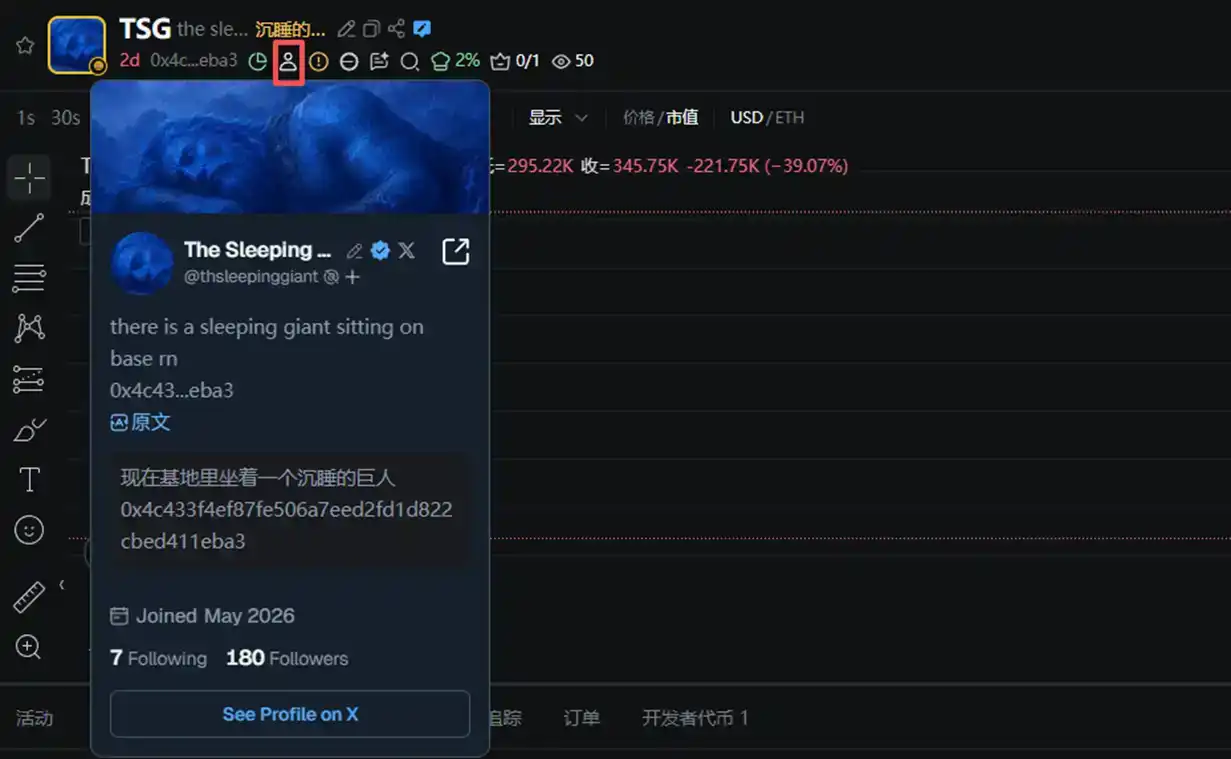
First, skim through the content on the X page's profile, including the CA and other details, to confirm that the redirected X account indeed corresponds to this token. Then, scrolling through the tweets reveals that this is a meme coin. The reason it became popular is that the following influential figures all mentioned a slogan: "there is a sleeping giant sitting on base rn."
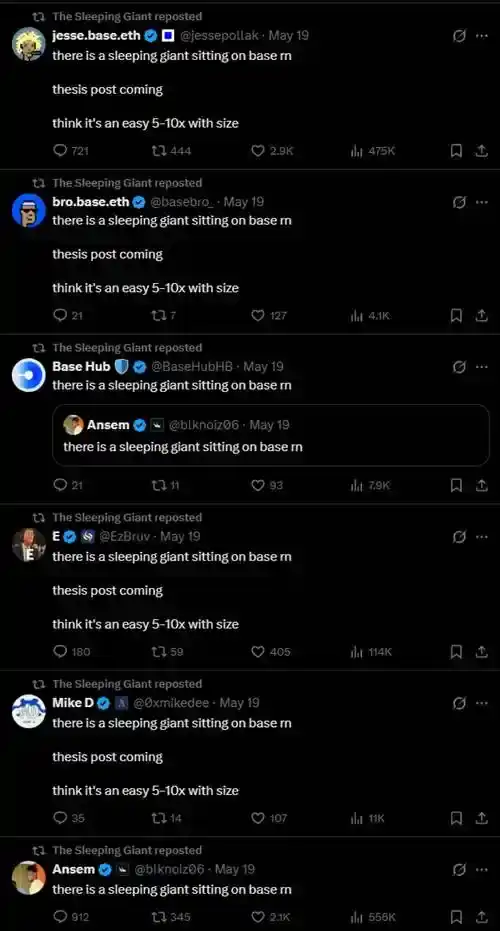
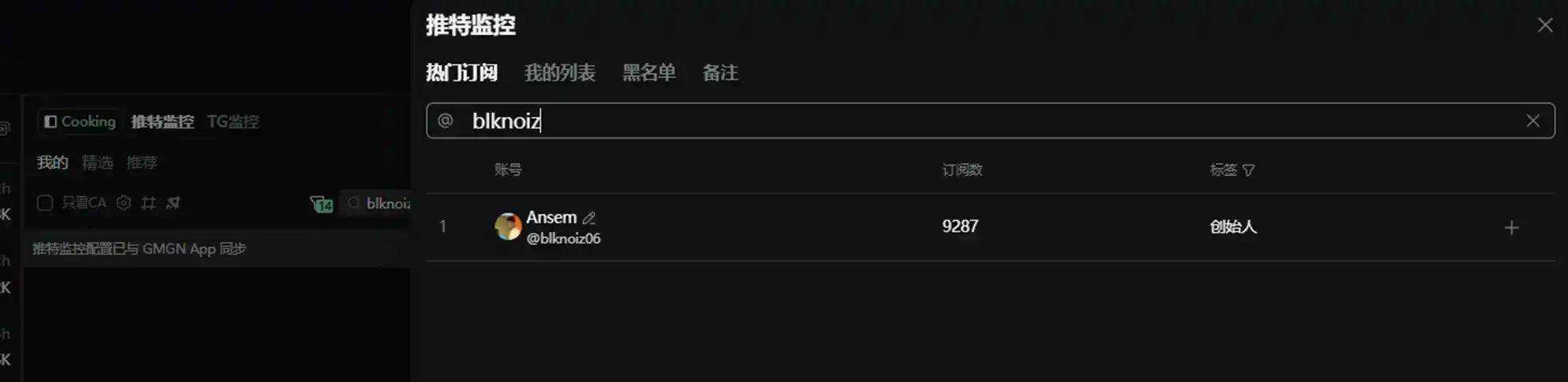
Through the screenshot above, we can follow all the influencers who retweeted the official $TSG tweet. Here, we can again use gmgn's tracking function to add these accounts to Twitter monitoring, allowing gmgn to push their content in real-time.
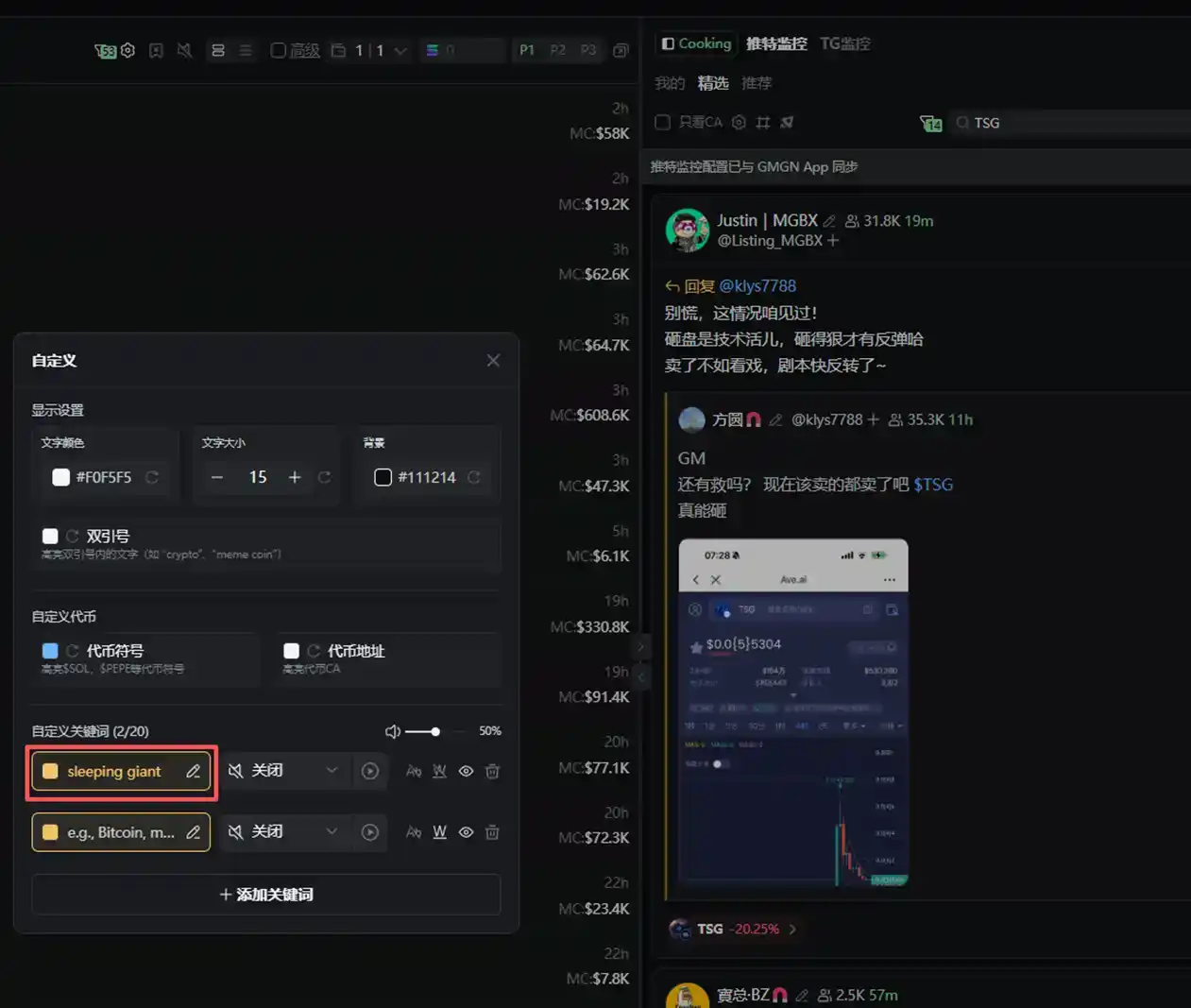
This $TSG once surged to a market cap of 7 million dollars but then fell significantly after the rapid rise. At this point, we can also consider that if these influencers mention this concept again, it might present a re-entry opportunity. Using the monitoring function again, we can set up a related keyword for more precise monitoring notifications.
Finally, let's go back and check the entry point of this high-profit $TSG address. The buy-in price was indeed very low, achieving high profits through sniping.
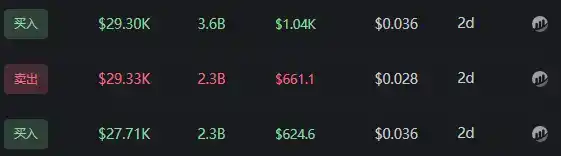
By this point, we have gained:

- A high-profit address with a style of early, low-price, fast sniping. We can mark this address on gmgn, for example, as "TSG 100K Profit Sniper," and continuously track it. If more aggressive, we can use gmgn to do a small copy trade on this address and continuously monitor the profit/loss situation of the copy trade, stopping the copy strategy when the address's win rate drops.

- The popular meme trend on Base. We can see that this coin gained attention because famous people teamed up to shout a slogan. We add these people to our tweet tracking list. Furthermore, we can delve into these celebrities' tweet interactions and follow lists to expand our list of influencers in the Base ecosystem.

- A potential second-phase opportunity, assuming the slogan is mentioned again, the price could rebound quickly.

Then let's look at the second address. This address has currently profited over 170,000 dollars on $LFI, with a holding period of 19 days, indicating it's a long-term play.

So now we can consider what its narrative is, and whether we can identify the current thematic focus of the Base ecosystem through this token's narrative. Here, we can directly search for LFI on LianDong:

By reading articles on LianDong, we can quickly understand what these projects are about, as well as deeper on-chain trends. For example, LFI represents RWA + Team Background Play, and AI on Base chain has concepts like "vvv" and aeon, etc.

Of course, the above operations can also be reversed. For instance, you could first switch to Base chain tokens on dexscreener and skim through the tokens with the highest 24-hour trading volume, then use gmgn to check profitable addresses, analyze narratives, etc.

The ultimate goal is consistent:

- Clarify the main narratives on the Base chain.

- Expand the database of high-profit addresses and influencers, tag the styles of these addresses/personas for easy categorization and tracking to stay updated on the latest changes.

- For coins that have already risen/fallen, consider potential upcoming key turning points, and use corresponding tools for tracking.

With the now well-developed supporting features of trading terminals, we no longer need to feel lost about how to start with a new ecosystem or spend a lot of time aimlessly browsing X and Farcaster. I hope this article is helpful for you who have just entered the Base ecosystem.


Domande pertinenti

QAccording to the article, what is the primary function of the 'Explore' feature on the gmgn trading terminal for users new to the Base ecosystem?

AThe 'Explore' feature on the gmgn trading terminal allows users to view profit leaderboards for addresses on the Base chain. By observing the recent profitable trades of top-performing addresses, new users can quickly gain an initial understanding of the current trends and popular projects within the ecosystem.

QHow did the meme coin $TSG gain popularity according to the investigation in the article?

A$TSG gained popularity because influential figures on social media collectively promoted it using a specific phrase: 'there is a sleeping giant sitting on base rn (Base上现在有一个沉睡的巨人).' This coordinated mention by multiple influencers helped drive attention and popularity to the token.

QWhat practical steps does the article suggest after identifying influential people associated with a trending project like $TSG?

AThe article suggests two main steps: 1) Follow all the influential accounts that retweeted the project's official posts. 2) Use the monitoring/tracking features of tools like gmgn to add these accounts to a watchlist for real-time push notifications of their content, allowing for timely updates on ecosystem developments.

QWhat is the key difference in trading style between the two top profit addresses analyzed in the article, based on their holdings in $TSG and $LFI?

AThe first address, which profited from $TSG, employed a 'sniper' style, characterized by fast, early entry at a very low price for quick profits. The second address, which profited from $LFI, demonstrated a long-term holding strategy, as indicated by its 19-day holding period for that asset.

QWhat are the three final goals the article states for effectively using trading terminals to understand a new ecosystem like Base?

AThe three final goals are: 1) To clarify the main narrative trends on the Base chain. 2) To expand a database of highly profitable addresses and influential figures, categorizing them by style for targeted tracking. 3) To identify potential future turning points (key nodes) for tokens that have already risen or fallen, and use appropriate tools to monitor these developments.

Letture associate

Token Packages Are Here, Are Telecom Operators in a Hurry?

Major Chinese telecom operators are launching token-based AI computing packages, sparking public debate and highlighting a strategic shift amid slowing traditional revenue growth. In May, Shanghai Telecom introduced token plans (e.g., 9.9 RMB for 10 million tokens), quickly followed by nationwide offerings from China Telecom, China Mobile, and China Unicom. While priced higher than major AI firms like DeepSeek, these packages allow users to access multiple AI models via API using their phone bills, similar to purchasing universal mobile data. The move reflects operators' anxiety as traditional voice, SMS, and data services stagnate. With revenue growth hitting multi-year lows in 2025, AI and computing power represent a critical new frontier. However, current C端 offerings, such as AI photo editing or virtual pets, are seen as non-essential and highlight operators' role as "pipes" or integrators rather than creators of compelling AI products. Beyond consumer packages, operators aim to become key infrastructure players in China’s national computing power network. They position themselves as the "power grid" delivering AI算力, leveraging their vast network of base stations to ensure low-latency, reliable coverage, especially for applications like autonomous driving. This infrastructure role, coupled with unified national调度, could make算力 a ubiquitous utility, driving new consumption scenarios even if mass adoption of token packages remains uncertain.

marsbit1 min fa

Token Packages Are Here, Are Telecom Operators in a Hurry?

marsbit1 min fa

The Five Value Logics Behind Enterprises Selling Bitcoin

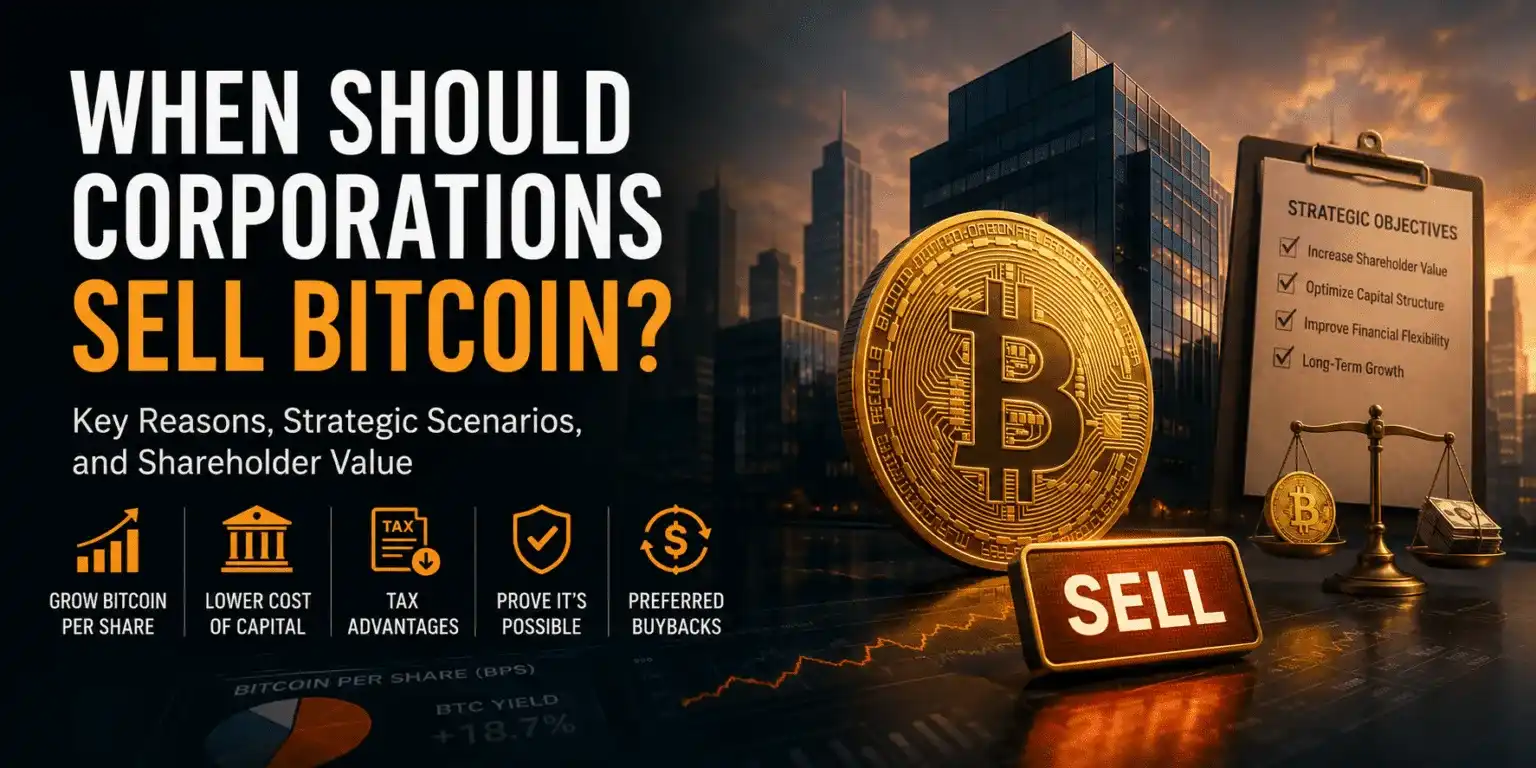
"Five Value Logics Behind Corporate Bitcoin Sell-offs" Recent news of Strategy company considering selling part of its bitcoin holdings to meet operational goals sparked market discussions, challenging its previous "never sell" stance. While long-term holding aligns with crypto investment philosophy, selling bitcoin can be a rational corporate decision aimed at maximizing shareholder value, unlike personal sales for life improvements. For instance, in Q1 2026, miners sold 25,376 BTC to fund a pivot into AI, deeming it a higher-return investment. For treasury-holding firms like Strategy, selling bitcoin can create value through five key logics: 1. **Increasing Bitcoin Per Share:** The core metric is bitcoin per share. If a company's stock trades below its bitcoin asset value, selling BTC to buy back shares can increase this ratio, as the reduction in shares outstanding outweighs the BTC sold. Similarly, using BTC proceeds to cover fixed costs like dividends during stock undervaluation minimizes the dilution of bitcoin per share. 2. **Optimizing Capital Structure & Lowering Financing Costs:** Credit ratings significantly influence financing costs. Rating agencies like S&P value cash reserves. By selling bitcoin to boost cash, companies can meet capital market expectations, secure better ratings, and issue debt at lower costs. Reducing debt through BTC sales also improves the appeal of preferred stock. Lower interest rates compound over time, boosting profits. 3. **Legitimate Tax Planning:** The US currently has no wash-sale rules for bitcoin. Companies can sell to realize a book loss, immediately repurchase at a lower cost basis, and use the loss to offset taxes—a strategy Strategy used in 2022's bear market. This can be combined with stock buybacks or debt repayment for multiple benefits. 4. **Dispelling Market FUD (Fear, Uncertainty, Doubt):** Negative narratives claim large corporate BTC sales could crash the market or invalidate the treasury model. A controlled sale (e.g., 50,000 BTC) without causing major market or stock price volatility could debunk such myths, helping the market accept bitcoin as a corporate asset. This reason is the most subjective of the five. 5. **Buying Back Preferred Stock at a Discount:** This lesser-known strategy involves repurchasing a company's own floating-rate preferred stock when it trades significantly below its par value. For example, if a $100-par security like STRC trades at $82, selling bitcoin to buy it back yields an $18 per-share, tax-free profit. Price drops may occur due to leveraged trading cascades, unrelated to BTC's price. Repurchasing avoids future increased dividend costs. In conclusion, corporate bitcoin sales should not be automatically viewed as bearish. In many scenarios, they protect the interests of the company and its shareholders. Bitcoin's monetary properties offer flexible capital allocation; using the asset rationally unlocks its maximum value.

marsbit1 min fa

The Five Value Logics Behind Enterprises Selling Bitcoin

marsbit1 min fa

I Tested with $10,000: Zero Wear, 8% APY, and Earn Points (Full Tutorial + Screenshots Included)

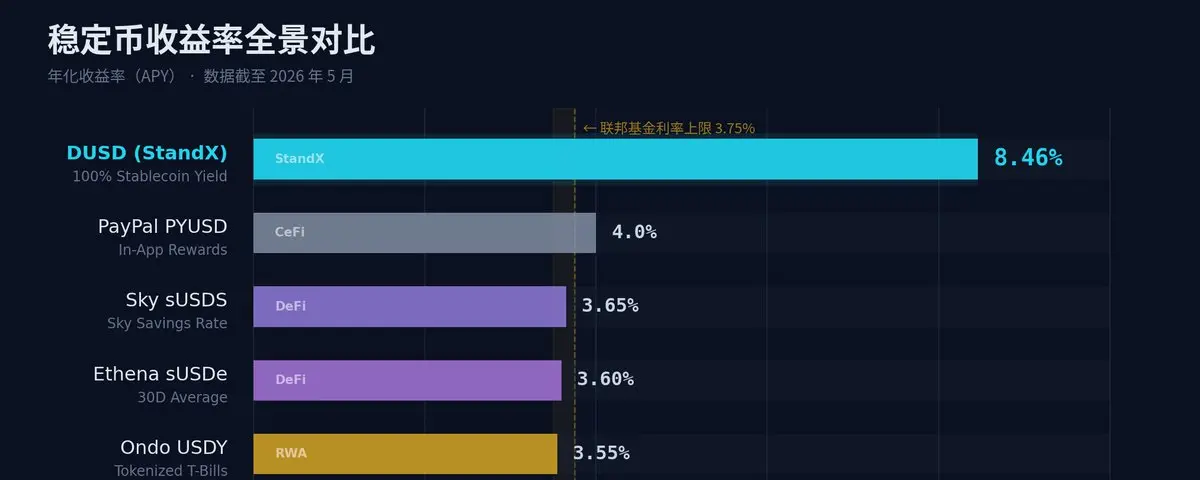
**Title:** My $10,000 Real-World Test: Zero Wear-and-Tear, ~8% APY, Plus Earning Points (Full Guide + Screenshots Included) **Summary:** This article details a personal experiment with $10,000 on the StandX platform to verify its advertised ~8% APY for its stablecoin, DUSD, while earning trading points. The author created two accounts, each depositing $5,000 worth of DUSD, and used StandX's unique "Block Trade" feature to open perfectly offsetting long and short BTC positions (2x leverage each). This neutralized directional market risk. **Key Results (Over 8 Days):** * **Total Profit:** $16.91 (~7.8% annualized). * **Zero Net Directional P&L:** BTC price movements canceled out. * **Zero Wear-and-Tear:** No losses from fees, slippage, or gas from frequent trading. * **Points Earned:** 380+ trading points. **Source of the ~8.46% APY:** The yield is composed of three layers, all paid in DUSD (real USD value, not governance tokens): 1. **DUSD Base (~1.27%):** Derived from funding rates (similar to Ethena's USDe). 2. **SIP-2 Position Boost (~2.27%):** A protocol revenue-sharing mechanism. Users providing liquidity (via open positions) earn a share of platform trading fees. Leverage acts as a multiplier on this yield. 3. **SIP-3 Universal Fee Share (~4.92%):** A portion of all platform trading fees is distributed to *every* DUSD holder, regardless of whether they trade. **Sustainability Claim:** The author argues this yield is more sustainable than pure funding-rate models (e.g., Ethena) because over 7% of it comes from transaction fees (SIP-2 + SIP-3), which are less dependent on market cycles. **Step-by-Step Strategy:** A concise 3-step guide is provided for replicating the zero-risk strategy using two wallets and StandX's Block Trade to create matched long/short positions. **Risk Disclosures:** The article notes standard DeFi risks: smart contract vulnerability and yield fluctuation (Base yield varies with funding rates; SIP-2/3 yields depend on platform trading volume). **Author's Note:** The author discloses their role in Growth at StandX. The piece is presented as personal testing and analysis, not investment advice.

链捕手35 min fa

I Tested with $10,000: Zero Wear, 8% APY, and Earn Points (Full Tutorial + Screenshots Included)

链捕手35 min fa

Senior Analyst Dialogue: What Powell's Departure and Warsh's Appointment Mean for Crypto?

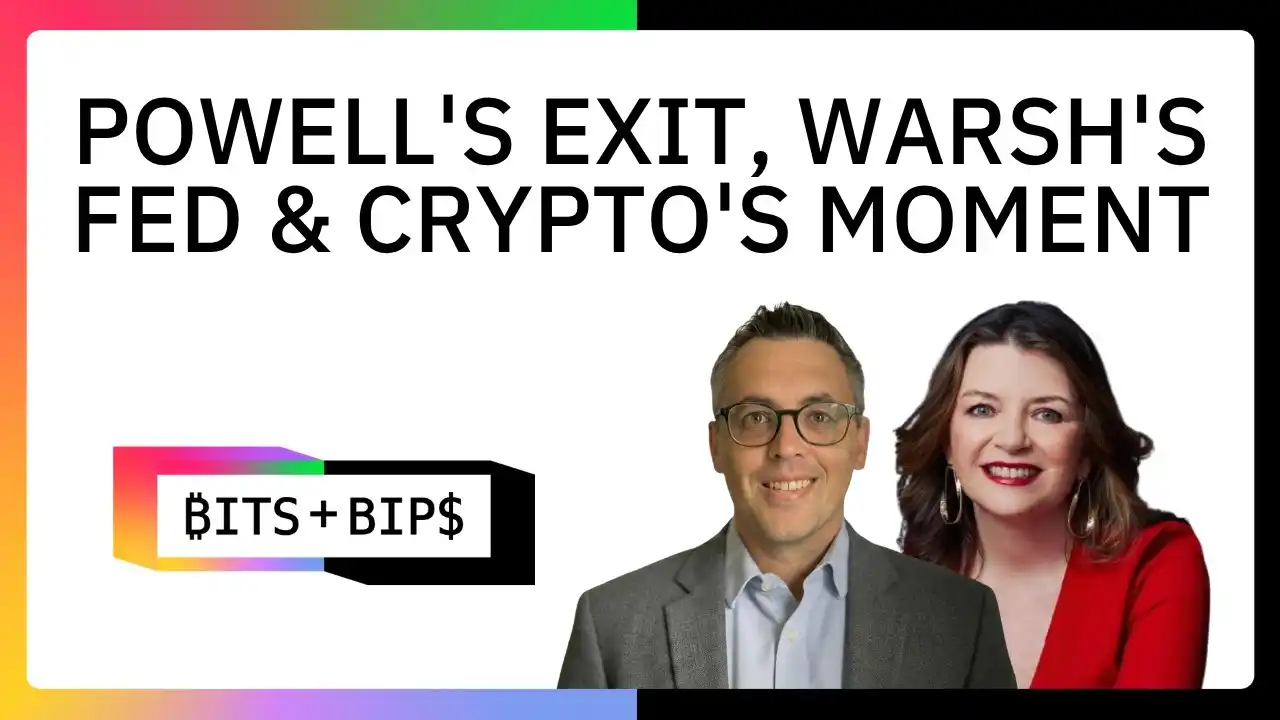
The podcast episode "Powell Is Out, Warsh Is In: What It Means for Crypto" features an analysis by Noelle Acheson on the macro-economic landscape and its implications for crypto. Key discussion points include: * **Equity-Bond Divergence:** Acheson highlights a significant and growing disconnect between stock and bond markets. While bond yields rise globally, signaling tighter financial conditions, equities are driven by AI-related hype and speculation, reminiscent of the 1999 dot-com bubble. * **'Bliss Trade' and Systemic Fragility:** The discussion explores the concept of a structural, cross-party government expectation to provide fiscal support ("Bliss Trade"), which underpins risk asset valuations and carries its own systemic vulnerabilities. * **Inflation Outlook:** Acheson argues that inflation is not meaningfully declining, citing core CPI stagnation and attributing the trend to de-globalization, tariffs, and geopolitical tensions like the Strait of Hormuz crisis. * **Powell's Legacy:** Powell's tenure receives mixed marks. While his defense of Fed independence is noted, he is also criticized for overseeing the "de-banking" of crypto firms in 2023 and initially misjudging inflation. * **Outlook for Warsh:** Expectations for the incoming Fed Chair, Kevin Warsh, are measured. While he may aim to reduce Fed balance sheet size and forward guidance, market realities and the FOMC will likely constrain his ability to enact significant policy shifts, particularly rate cuts. * **Crypto as a Macro Asset:** Bitcoin's role is framed as a hedge against currency debasement, benefiting from expectations of monetary stimulus. However, its maturation as a macro asset means it now competes with other high-volatility investments like AI stocks, potentially limiting near-term price catalysts. * **Market Structure & Tokenization:** The potential Clarity Act is seen as more beneficial for assets like Ethereum than Bitcoin, which already has relative regulatory clarity. Concerns are raised about "innovation exemptions" for tokenization if they enable third-party derivatives that encourage pure speculation over capital formation. In conclusion, the analysis suggests crypto markets lack a near-term positive catalyst and are caught between competing macro narratives, with significant underlying fragilities in traditional markets.

marsbit46 min fa

Senior Analyst Dialogue: What Powell's Departure and Warsh's Appointment Mean for Crypto?

marsbit46 min fa

Trading

Spot
Futures
活动图片