How Did BitMine, with Staked ETH Generating $46 Million in Steady Income, Still End Up in Massive Losses?

Foresight NewsPubblicato 2026-07-16Pubblicato ultima volta 2026-07-16

Introduzione

BitMine, a crypto asset manager, reported strong revenue growth in its fiscal Q3 2026, primarily from its Ethereum staking operations, which generated $45.7 million. However, the company posted a net loss of $83.6 million for the quarter. This significant loss was driven by a $92.1 million deficit from Ethereum derivative options trading, completely offsetting the staking income. The company is aggressively shifting from Bitcoin mining to accumulating Ethereum, financing this strategy almost entirely by issuing new common stock. This has led to substantial shareholder dilution, with the share count increasing by 149% over nine months. As of late May, BitMine held 5.42 million ETH with a massive unrealized loss of approximately $8.2 billion due to market depreciation. While the staking business provides a stable cash flow that covers core operational costs, profitability is pressured by high, fixed fees from long-term service agreements and growing administrative expenses. Although the company holds no traditional debt, its model heavily relies on continuous access to capital markets for equity financing to sustain its Ethereum accumulation. The company's long-term viability hinges on its ability to manage derivative risks, control costs, and benefit from a significant recovery in Ethereum's price.


Author: Oluwapelumi Adejumo

Translation: Chopper, Foresight News


BitMine aggressively built up its Ethereum holdings, attempting to transform them into a stable source of cash flow, with its staking business generating nearly $46 million in revenue last quarter.


However, a $92.1 million loss on derivatives and options completely offset these staking gains. Combined with persistently high asset management costs and the company's aggressive issuance of new shares, the profit potential for existing shareholders was significantly compressed.


The Q3 FY2026 financial report, for the period ending May 31, shows company revenue soared to $46.5 million from $2.1 million in the same period last year; 98% ($45.7 million) of this came from staking and node validation services. BitMine is accelerating its exit from Bitcoin mining to fully transition to an Ethereum treasury model.


Despite the substantial revenue growth, the company reported a net loss of $83.6 million for the quarter, a dramatic increase compared to a modest loss of $623,000 in the same period last year.


Massive Options Losses Wipe Out All Ethereum Staking Gains


The core factor dragging down this quarter's performance was the company's Ethereum derivatives and options trading strategy. BitMine incurred a combined loss of $92.1 million on Ethereum-related derivatives this quarter, approximately double the total revenue from its staking business during the same period. This included $78.6 million in net losses from expired option contracts and $14 million from exercised positions. Gains of only $534,000 from unsettled contracts provided negligible offset.


The company engaged in no derivatives trading during the same period last year, marking a qualitative leap in its asset management risk exposure. For the first nine months of the fiscal year, cumulative derivatives losses totaled $133.3 million, consisting of $79.3 million from exercised losses and $54.5 million from expired contracts, with only $515,000 in gains from unsettled positions. During the same period, staking and validation services generated only $56.9 million, making derivatives losses more than double the staking income.


BitMine stated that its options strategy primarily involves selling put options as part of its overall portfolio management. While selling puts can generate premium income and allow for asset accumulation at lower prices, it can result in massive losses if the market moves against the position and contracts are exercised under unfavorable conditions. The scale of this loss clearly demonstrates that the attempt to enhance returns with options has, for now, completely negated the stable income generated by the node staking business.


Simultaneously, the company's general and administrative expenses surged to $37.3 million from $744,000 a year ago. Management explained that the increase was primarily due to digital asset custody and management service fees, salary adjustments, and increased cash and stock-based compensation for directors.


Excluding changes in the valuation of crypto assets, staking income was sufficient to cover the quarter's cost of sales and administrative expenses. Even after adjusting for several non-cash items, the company's own adjusted non-GAAP net loss still reached $70.8 million. This financial report indicates that while the node validation business has generated a substantial and stable cash flow, the overall portfolio trading strategy continues to consume staking profits.


Continuous BMNR Share Issuance to Hoard Ethereum, Sharply Diluting Shareholder Equity


The funds for BitMine's large-scale Ethereum accumulation came almost entirely from public market offerings of common stock, with the cost fully borne by existing shareholders. In the nine months ending May 31, the company sold 340.7 million shares of BMNR common stock through its at-the-market offering program, raising $11.87 billion net of issuance costs; during the same period, it spent $11.69 billion purchasing Ethereum.


Shareholder equity was significantly diluted. The number of common shares outstanding increased by 149% over nine months, from 232.4 million as of August 31, 2025, to 579.7 million by the end of May 2026; issuance continued after the quarter ended, with total shares reaching 603.2 million as of July 9.


Fueled by equity financing, BitMine had accumulated holdings of 5.42 million Ethereum by May 31, with a combined acquisition cost of $19.05 billion; holdings had increased to 5.7 million Ethereum at the time of writing.
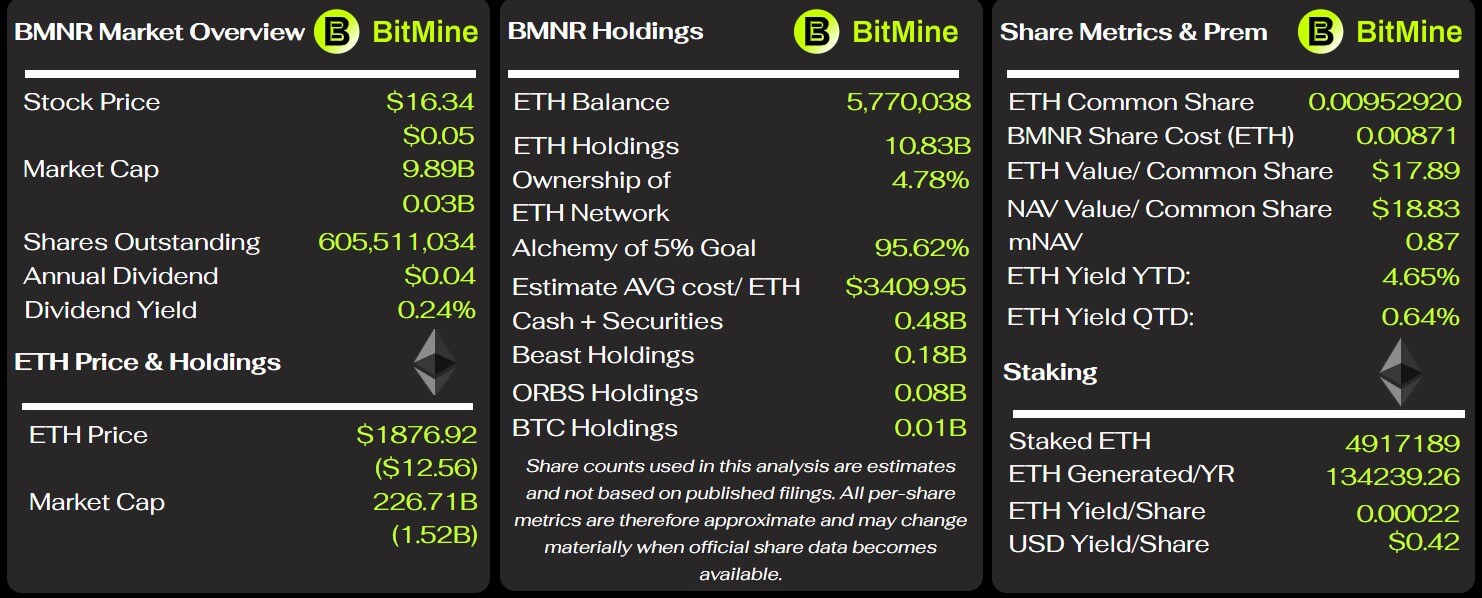

Key Metrics for BitMine, Source: BitMine Tracker


As of the end of May, this Ethereum portfolio was valued at only $10.86 billion, representing an unrealized loss of approximately $8.2 billion, a 43% decline from cost.


This portfolio devaluation was the primary source of the $9.04 billion unrealized loss on digital assets for the first nine months of the fiscal year, during which the company reported a cumulative net loss of $9.1 billion. The massive unrealized loss vividly illustrates that BitMine's share issuances purchased Ethereum at high prices, with all the risk borne by shareholders.


A shareholder meeting in January approved an increase in the company's authorized common shares from 500 million to 50 billion. This authorization does not obligate the company to issue all shares but grants management ample room to continue issuing stock for purchasing digital assets and other investments.


BitMine cautioned that its ability to expand its Ethereum holdings is highly dependent on continuous and unimpeded access to financing. A decline in Ethereum's price, weakness in the company's stock price, or a decrease in investor appetite for its offerings could all increase the cost of future financing or even restrict the company's ability to issue securities on favorable terms.


The viability of this business model depends not only on staking yields and future Ethereum price appreciation but also on shareholders accepting significant equity dilution and the portfolio carrying billions in unrealized losses, while continuously providing capital for the company's coin accumulation.


Long-Term Service Contracts Increase Staking Operating Costs, Compressing Profit Margins


BitMine relies on its staking business to hedge against portfolio price volatility, but accompanying long-term cooperation agreements generate fixed fees and profit-sharing, continuously compressing overall profitability. The company has a ten-year consulting agreement with third-party service provider Ethereum Tower, incurring an expense of $12.8 million this quarter, representing about 28% of the period's total staking revenue. Cumulative fees for the first nine months amounted to $37.5 million; the company estimates annual fees in the range of $40 to $50 million, calculated on a tiered basis against the total value of managed digital assets.


The agreement can only be terminated under a few specific conditions. If BitMine terminates without cause, it must pay Ethereum Tower 85% of all estimated service fees for the remaining contract term.


Furthermore, following its acquisition of node operator Pier Two, BitMine entered into a separate ten-year management services agreement. This agreement grants Ethereum Tower a 2% equity stake in the MAVAN platform, with monthly profit-sharing based on a percentage of the platform's native staking rewards. As of May 31, the company had not accrued any expenses related to this agreement, so the profit-sharing costs are not yet reflected in the staking business's income statement.


BitMine stated that the vast majority of its Ethereum is staked through MAVAN, and over the long term, staking rewards are expected to cover asset custody costs. Looking solely at the operational level this quarter, staking revenue did cover sales and administrative expenses excluding crypto asset valuation changes. However, the combination of a decade-long fixed consulting fee, future profit-sharing, and various other asset management expenses means that relying solely on staking income does not accurately reflect the business's true profitability.


Despite No Debt, BitMine's Dependence on Capital Markets Deepens


As of the end of May, BitMine's balance sheet showed extremely low leverage, with $340.3 million in cash, working capital of $433.1 million, and no traditional debt. Total assets were $11.63 billion, with total liabilities of only $30.1 million, and assets predominantly consisting of Ethereum and other digital assets. On paper, the company faces no immediate debt crisis, but operating activities used $287.6 million in cash during the first nine months. The company attributed the cash burn primarily to legal, consulting, and investment banking fundraising fees associated with expanding its Ethereum holdings.


After the quarter ended, BitMine issued an additional 3.5 million shares of its 9.5% annual perpetual preferred stock, BMNP, raising $273.8 million. While this offering supplemented short-term liquidity, it adds a new, rigid annual dividend expense of approximately $33.25 million for the preferred shares. Although this security is equity, not debt, it has priority over common shares in liquidation, and its high dividend continuously consumes company cash flow.


Management believes existing cash, expected operating cash flow, and the at-the-market offering facility are sufficient to fund operations for at least the next 12 months. This assessment assumes the capital markets remain open: if Ethereum prices remain depressed long-term, the company's stock price weakens, or investor appetite wanes, the company's financing costs will rise, and its operational flexibility will be constrained.


Synthesizing the latest financial report, BitMine presents a set of contradictory realities: On one hand, the company has established a mature staking business generating tens of millions in quarterly revenue, enough to cover core operational expenses. On the other hand, massive options losses completely devour staking profits, long-term contracts persistently increase management costs, and Ethereum accumulation relies entirely on share issuance, with the total share count more than doubling.


Therefore, BitMine's long-term economic viability depends on whether staking income can stably cover various asset management costs and options losses, whether the company can sustainably secure equity financing, and whether Ethereum's price can stage a significant recovery.

Crypto di tendenza

Domande pertinenti

QWhat was the main driver behind BitMine's significant increase in revenue for the fiscal year Q3 2026, and what percentage of total revenue did it constitute?

AThe significant increase in revenue was primarily driven by BitMine's Ethereum staking and node validation business, which generated approximately $45.7 million and constituted 98% of the total quarterly revenue of $46.5 million.

QHow did BitMine's derivatives trading strategy impact its overall financial performance in the reported quarter, and what was the nature of this strategy?

ABitMine's Ethereum derivatives trading strategy resulted in a loss of $92.1 million, completely negating the $45.7 million earned from staking. The strategy involved primarily selling put options to earn premiums and accumulate assets at lower prices, which backfired due to adverse market movements.

QHow did BitMine finance its large-scale accumulation of Ethereum, and what was the impact on existing shareholders?

ABitMine financed its Ethereum purchases almost entirely by issuing new common stock (BMNR) to the public market. Over nine months, it issued 340.7 million shares, raising $11.87 billion. This diluted existing shareholders' equity significantly, increasing the number of common shares outstanding by 149%.

QWhat are the key long-term costs associated with BitMine's staking operations that squeeze its profit margins?

AKey long-term costs include a 10-year consulting agreement with Ethereum Tower, costing $12.8 million in the quarter (28% of staking revenue), and a 10-year management services agreement related to the Pier Two acquisition, which will give Ethereum Tower 2% equity in the MAVAN platform and a share of future staking rewards.

QDespite having no traditional debt, what are the significant risks and dependencies in BitMine's financial model according to the article?

ABitMine's financial model is heavily dependent on continuous access to capital markets through equity financing to fund its Ethereum accumulation and operations. Risks include: high dilution for shareholders, massive unrealized losses on its Ethereum holdings ($8.2 billion), large mandatory costs from long-term service contracts, and vulnerability to declines in Ethereum's price or the company's stock price, which could hinder its ability to raise funds.

Letture associate

Bitwise: RWA and Prediction Markets Continue to Gain Momentum, Crypto is Bottoming Out

Bitwise's Q2 2026 report highlights a challenging crypto market. The Bitwise 10 Crypto Index fell 15.4%, and spot Bitcoin ETFs saw a record $4.9 billion in quarterly outflows as Bitcoin dropped below $60,000. Overall sentiment is described as one of the worst in eight years. Despite the downturn, key sectors show resilience and growth. Real-World Asset (RWA) tokenization reached a record $33 billion, up 45% year-to-date. Prediction markets also hit new highs, with open interest at $1.8 billion and quarterly volume hitting $43 billion, driven partly by political events. Crypto equities outperformed, with the Bitwise Crypto Innovators 30 Index rising 30.6%, largely fueled by AI-related Bitcoin miners. These stocks exhibited low correlation with other major asset classes. Major DeFi protocols like Aave demonstrated strong revenue generation, with the top ten crypto applications collectively earning $5.9 billion over the past year. The report notes that while prices and on-chain activity are down from peaks, fundamental metrics like stablecoin supply (~$300B) and Ethereum transaction activity are significantly higher than at the 2022 bear market bottom. Key Q3 factors include the fate of the CLARITY Act, final rules for the GENIUS stablecoin act, and policy signals from the new Fed Chair. The conclusion is that the industry is building a stronger foundation—with greater adoption, institutional involvement, and real utility—even at depressed prices, setting the stage for the next cycle.

Odaily星球日报26 min fa

Bitwise: RWA and Prediction Markets Continue to Gain Momentum, Crypto is Bottoming Out

Odaily星球日报26 min fa

Bitcoin Shifts to Building a Bottom, with Selling Pressure from Long-Term Holders Significantly Easing

Bitcoin is transitioning into a basing phase, with significant selling pressure from long-term holders showing signs of easing. The market is testing overhead resistance, with Bitcoin responding more positively to favorable macro data like soft inflation reports than major equity indices. Its correlation with stocks is weakening while its inverse relationship with the US dollar strengthens, indicating a shift in primary drivers towards liquidity factors rather than risk sentiment. On-chain analysis reveals that long-term holder profit-taking has largely dried up, and the wave of capitulation selling from this cohort has peaked and begun to recede. Buyers successfully absorbed selling pressure at the June lows. Bitcoin currently trades between the network's average realized price (a support floor) and the short-term holder cost basis near $69k, which will be a key resistance level. A breakout above this level is needed to signal a more sustained recovery. In derivatives markets, traders are unwinding bearish bets, with put/call ratios falling and crash protection premiums declining. However, this futures and options positioning adjustment has not been accompanied by significant spot buying. US spot ETF outflows have slowed but not reversed. Volatility has compressed to low levels. In summary, the foundations for a bottom are forming: long-term holder selling is subsiding, demand absorbed the recent low, and the market is reacting to positive catalysts. However, confirmation is still lacking, requiring a spot-driven breakout and hold above the short-term holder cost basis around $69k.

Foresight News34 min fa

Bitcoin Shifts to Building a Bottom, with Selling Pressure from Long-Term Holders Significantly Easing

Foresight News34 min fa

Trading

Spot

Articoli Popolari

Cosa è ETH 3.0

ETH3.0 e $eth 3.0: Un'Analisi Approfondita del Futuro di Ethereum Introduzione Nel panorama in rapida evoluzione delle criptovalute e della tecnologia blockchain, ETH3.0, spesso indicato come $eth 3.0, è emerso come un argomento di considerevole interesse e speculazione. Il termine comprende due concetti principali che warrantono chiarimenti: Ethereum 3.0: Questo rappresenta un potenziale futuro aggiornamento volto ad aumentare le capacità dell'attuale blockchain di Ethereum, concentrandosi principalmente sul miglioramento della scalabilità e delle prestazioni. ETH3.0 Meme Token: Questo progetto di criptovaluta distinto cerca di sfruttare la blockchain di Ethereum per creare un ecosistema incentrato sui meme, promuovendo il coinvolgimento all'interno della comunità delle criptovalute. Comprendere questi aspetti di ETH3.0 è essenziale non solo per gli appassionati di criptovalute, ma anche per coloro che osservano tendenze tecnologiche più ampie nello spazio digitale. Che cos'è ETH3.0? Ethereum 3.0 Ethereum 3.0 è pubblicizzato come un aggiornamento proposto per la rete Ethereum già stabilita, che è stata la spina dorsale di molte applicazioni decentralizzate (dApps) e contratti smart sin dalla sua nascita. I miglioramenti previsti si concentrano principalmente sulla scalabilità, integrando tecnologie avanzate come lo sharding e le prove a conoscenza zero (zk-proofs). Queste innovazioni tecnologiche mirano a facilitare un numero senza precedenti di transazioni al secondo (TPS), potenzialmente raggiungendo milioni, affrontando così una delle limitazioni più significative della tecnologia blockchain attuale. Il miglioramento non è meramente tecnico, ma anche strategico; è volto a preparare la rete Ethereum per un'adozione e un'utilità diffuse in un futuro contrassegnato da un aumento della domanda di soluzioni decentralizzate. ETH3.0 Meme Token Al contrario di Ethereum 3.0, l'ETH3.0 Meme Token si avventura in un dominio più leggero e giocoso, combinando la cultura dei meme di internet con la dinamica delle criptovalute. Questo progetto consente agli utenti di acquistare, vendere e scambiare meme sulla blockchain di Ethereum, fornendo una piattaforma che promuove il coinvolgimento della comunità attraverso la creatività e interessi condivisi. L'ETH3.0 Meme Token mira a dimostrare come la tecnologia blockchain possa intersecarsi con la cultura digitale, creando casi d'uso che siano sia divertenti che finanziariamente praticabili. Chi è il Creatore di ETH3.0? Ethereum 3.0 L'iniziativa verso Ethereum 3.0 è principalmente propulsa da un consorzio di sviluppatori e ricercatori all'interno della comunità di Ethereum, tra cui Justin Drake. Conosciuto per le sue intuizioni e contributi all'evoluzione di Ethereum, Drake è stato una figura di spicco nelle discussioni riguardanti la transizione di Ethereum verso un nuovo livello di consenso, chiamato “Beam Chain.” Questo approccio collaborativo allo sviluppo significa che Ethereum 3.0 non è il prodotto di un creatore singolo, ma piuttosto una manifestazione di ingegno collettivo focalizzato sul progresso della tecnologia blockchain. ETH3.0 Meme Token I dettagli riguardanti il creatore dell'ETH3.0 Meme Token sono attualmente non rintracciabili. La natura dei token meme conduce spesso a una struttura più decentralizzata e guidata dalla comunità, il che potrebbe spiegare la mancanza di attribuzione specifica. Questo si allinea con l'etica della comunità crypto più ampia, dove l'innovazione spesso nasce da sforzi collaborativi piuttosto che individuali. Chi sono gli Investitori di ETH3.0? Ethereum 3.0 Il supporto per Ethereum 3.0 proviene principalmente dalla Ethereum Foundation insieme a una comunità entusiasta di sviluppatori e investitori. Questa associazione fondamentale fornisce un considerevole grado di legittimità e migliora le prospettive di implementazione di successo poiché sfrutta la fiducia e la credibilità costruite nel corso degli anni di operazioni della rete. Nel clima in rapida evoluzione delle criptovalute, il supporto della comunità gioca un ruolo cruciale nello sviluppo e nell'adozione, posizionando Ethereum 3.0 come un serio contenditore per i futuri progressi della blockchain. ETH3.0 Meme Token Sebbene le fonti attualmente disponibili non forniscano informazioni esplicite riguardo ai fondamenti o alle organizzazioni di investimento che sostengono l'ETH3.0 Meme Token, ciò è indicativo del modello di finanziamento tipico per i token meme, che spesso si basa sul supporto di base e sul coinvolgimento della comunità. Gli investitori in tali progetti sono tipicamente individui motivati dal potenziale per innovazioni guidate dalla comunità e dallo spirito di cooperazione trovato all'interno della comunità crypto. Come Funziona ETH3.0? Ethereum 3.0 Le caratteristiche distintive dell'Ethereum 3.0 risiedono nella sua proposta di implementazione della tecnologia di sharding e zk-proof. Lo sharding è un metodo di partizionamento della blockchain in pezzi più piccoli e gestibili o “shard,” che possono elaborare transazioni in modo concorrente piuttosto che sequenziale. Questa decentralizzazione dell'elaborazione aiuta a prevenire la congestione e garantisce che la rete rimanga reattiva anche sotto un carico pesante. La tecnologia delle prove a conoscenza zero (zk-proof) contribuisce con un ulteriore livello di sofisticazione consentendo la validazione delle transazioni senza rivelare i dati sottostanti coinvolti. Questo aspetto non solo migliora la privacy, ma aumenta anche l'efficienza complessiva della rete. Si parla anche di incorporare una macchina virtuale Ethereum a conoscenza zero (zkEVM) in questo aggiornamento, amplificando ulteriormente le capacità e l'utilità della rete. ETH3.0 Meme Token L'ETH3.0 Meme Token si distingue capitalizzando sulla popolarità della cultura dei meme. Stabilisce un mercato per gli utenti che desiderano partecipare al trading di meme, non solo per divertimento, ma anche per potenziale guadagno economico. Integrando funzioni come lo staking, la fornitura di liquidità e meccanismi di governance, il progetto promuove un ambiente che incentiva l'interazione e la partecipazione della comunità. Offrendo una miscela unica di intrattenimento e opportunità economica, l'ETH3.0 Meme Token mira ad attrarre un pubblico variegato, che va dagli appassionati di crypto ai semplici intenditori di meme. Timeline di ETH3.0 Ethereum 3.0 11 Novembre 2024: Justin Drake accenna al prossimo aggiornamento ETH 3.0, incentrato sui miglioramenti della scalabilità. Questo annuncio segna l'inizio delle discussioni formali riguardo l'architettura futura di Ethereum. 12 Novembre 2024: La proposta attesa per Ethereum 3.0 dovrebbe essere svelata a Devcon a Bangkok, preparando il terreno per un feedback più ampio della comunità e potenziali passi successivi nello sviluppo. ETH3.0 Meme Token 21 Marzo 2024: L'ETH3.0 Meme Token viene ufficialmente elencato su CoinMarketCap, segnando il suo ingresso nel dominio pubblico delle criptovalute e aumentando la visibilità per il suo ecosistema basato sui meme. Punti Chiave In conclusione, Ethereum 3.0 rappresenta una significativa evoluzione all'interno della rete Ethereum, concentrandosi sul superamento delle limitazioni riguardanti scalabilità e prestazioni attraverso tecnologie avanzate. I suoi aggiornamenti proposti riflettono un approccio proattivo alle future esigenze e usabilità. D'altra parte, l'ETH3.0 Meme Token incarna l'essenza della cultura guidata dalla comunità nello spazio delle criptovalute, sfruttando la cultura dei meme per creare piattaforme coinvolgenti che incoraggiano la creatività e la partecipazione degli utenti. Comprendere gli scopi e le funzionalità distinte di ETH3.0 e $eth 3.0 è fondamentale per chiunque sia interessato ai continui sviluppi nello spazio crypto. Con entrambe le iniziative che tracciano percorsi unici, esse sottolineano collettivamente la natura dinamica e multifacetica dell'innovazione blockchain.

211 Totale visualizzazioniPubblicato il 2024.04.04Aggiornato il 2024.12.03

Cosa è ETH 3.0

Cosa è ETHEREUM

HarryPotterTrumpHomerSimpson777Inu: Panoramica di un Progetto Crypto Web3 Introduzione Nel mondo in rapida evoluzione delle criptovalute e della finanza decentralizzata, progetti innovativi emergono frequentemente, catturando l'interesse della comunità degli investitori e degli appassionati di crypto. Uno di questi progetti è HarryPotterTrumpHomerSimpson777Inu, una criptovaluta che si trova all'incrocio tra cultura popolare e tecnologia blockchain. Questo token guidato dalla comunità mescola personaggi e figure politiche ben noti, con l'obiettivo di creare una piattaforma coinvolgente e promuovere un'adozione diffusa. Che cos'è HarryPotterTrumpHomerSimpson777Inu? HarryPotterTrumpHomerSimpson777Inu è un token costruito sulla blockchain di Ethereum, progettato per essere accessibile e divertente per un pubblico diversificato. L'unicità di questo progetto deriva dal suo approccio tematico, che intreccia elementi di fantasia, politica e intrattenimento. Sfruttando il fascino nostalgico di personaggi amati, il progetto cerca di creare un'esperienza di criptovaluta coinvolgente, incoraggiando il coinvolgimento e la partecipazione della comunità. L'obiettivo principale di HarryPotterTrumpHomerSimpson777Inu è stabilire un token che risuoni con gli utenti a livello personale, promuovendo sia il divertimento che il coinvolgimento nell'ambito crypto. Questo branding distintivo mira ad attrarre individui che in precedenza potrebbero non essersi interessati alle criptovalute, facilitando un nuovo punto di ingresso per utenti potenziali. Creatore di HarryPotterTrumpHomerSimpson777Inu L'identità del creatore dietro HarryPotterTrumpHomerSimpson777Inu rimane sconosciuta. Questa non è una pratica rara nel dominio delle criptovalute, dove l'anonimato è spesso preferito dai fondatori come mezzo di protezione della privacy e promozione di un ethos decentralizzato. Questa oscurità non diminuisce il valore del progetto; al contrario, riflette una tendenza più ampia all'interno del settore, dove molti progetti di successo sono emersi da origini anonime. Investitori di HarryPotterTrumpHomerSimpson777Inu Le informazioni pubbliche riguardo agli investitori di HarryPotterTrumpHomerSimpson777Inu sono limitate. La natura del progetto, incentrata sul coinvolgimento della comunità, suggerisce una dipendenza da investimenti di piccole dimensioni da parte di singoli appassionati piuttosto che da sostegni sostanziali da fondazioni di investimento consolidate o corporation. Questo livello di trasparenza nel finanziamento è tipico di molti progetti di criptovaluta guidati dalla comunità, dove il supporto spesso proviene da movimenti di base piuttosto che da investitori istituzionali. Come Funziona HarryPotterTrumpHomerSimpson777Inu? Operando sulla blockchain di Ethereum, HarryPotterTrumpHomerSimpson777Inu sfrutta la sua solida infrastruttura per facilitare transazioni e promuovere interazioni tra gli utenti all'interno della comunità. Ciò che distingue questo progetto è il suo posizionamento tematico: canalizzando il carisma di personaggi iconici provenienti da diversi ambiti culturali, crea un'identità di marca distintiva. Questo approccio non solo attrae gli utenti, ma coltiva anche una comunità fedele attorno al token. Le meccaniche operative del progetto si concentrano sul coinvolgimento della comunità. Adotta un modello decentralizzato che incoraggia la partecipazione, consentendo agli utenti di interagire attraverso vari canali mentre promuovono lo scambio di idee e esperienze. Inoltre, il progetto abbraccia i principi del Web3, privilegiando la sovranità degli utenti e la decentralizzazione, che sono i pilastri del futuro di Internet. Timeline di HarryPotterTrumpHomerSimpson777Inu La storia di HarryPotterTrumpHomerSimpson777Inu è segnata da diversi eventi decisivi: 12 agosto 2023: L'inizio di HarryPotterTrumpHomerSimpson777Inu, segnando il suo ingresso nell'ecosistema delle criptovalute. Fase di Sviluppo: Un periodo focalizzato sulla costruzione di una strategia completa per stimolare la crescita guidata dalla comunità e il coinvolgimento degli utenti. Listing sugli Scambi: Sebbene i dettagli specifici di listing non siano stati divulgati, il progetto è stato reso accessibile su vari scambi di criptovalute, migliorando la sua visibilità nel mercato. Coinvolgimento della Comunità: Sforzi continui per coinvolgere attivamente la comunità, stabilendo canali di dialogo e promuovendo la partecipazione attraverso varie attività, tra cui concorsi, discussioni e votazioni comunitarie. Aspetti Chiave di HarryPotterTrumpHomerSimpson777Inu Focus sulla Comunità Un tratto distintivo di HarryPotterTrumpHomerSimpson777Inu è la sua forte enfasi sul coinvolgimento della comunità. Il progetto incoraggia attivamente gli utenti a partecipare a discussioni, condividere idee e contribuire all'evoluzione del progetto. Questa interazione coltiva un senso di appartenenza e di ownership tra i membri della comunità, essenziale per la sostenibilità a lungo termine del token. Utilizzo della Blockchain di Ethereum La scelta di costruire sulla blockchain di Ethereum consente a HarryPotterTrumpHomerSimpson777Inu di sfruttare le sue caratteristiche di sicurezza ben consolidate e architettura decentralizzata. Questa base garantisce affidabilità per le transazioni e fornisce un framework affidabile su cui sviluppare varie funzionalità. Approccio Tematico Unico Fusione di elementi della cultura pop nella sua identità, HarryPotterTrumpHomerSimpson777Inu crea una narrazione coinvolgente che lo differenzia da altre criptovalute. L'amalgama di personaggi e temi genera riconoscimento e intrigo immediati, rendendo il token relazionabile a un'ampia gamma di utenti potenziali. Anonimato nello Sviluppo Il creatore anonimo del progetto rimane una caratteristica ricorrente in molte iniziative di criptovaluta. Questo aspetto evidenzia un ethos di decentralizzazione, introducendo anche un livello di mistero che potrebbe affascinare un segmento della comunità crypto, attirando l'attenzione sul progetto e invitando l'impegno da parte di utenti che supportano l'idea di un'iniziativa decentralizzata e gestita dalla comunità. Conclusione HarryPotterTrumpHomerSimpson777Inu si presenta come un'aggiunta distintiva al panorama delle criptovalute, combinando il fascino della cultura popolare con le meccaniche innovative della tecnologia blockchain. Sebbene i dettagli riguardanti il creatore e gli investitori specifici rimangano non divulgati, il focus del progetto sulla comunità e il suo approccio tematico lo contraddistinguono come un potenziale attore influente nel contesto del Web3 e delle criptovalute. Man mano che l'ecosistema delle criptovalute continua ad espandersi, iniziative come HarryPotterTrumpHomerSimpson777Inu ci ricordano le molteplici modalità in cui la blockchain può connettere le comunità globali attraverso narrazioni e valori condivisi.

1.0k Totale visualizzazioniPubblicato il 2024.04.06Aggiornato il 2024.12.03

Cosa è ETHEREUM

Come comprare ETH

Benvenuto in HTX.com! Abbiamo reso l'acquisto di Ethereum (ETH) semplice e conveniente. Segui la nostra guida passo passo per intraprendere il tuo viaggio nel mondo delle criptovalute.Step 1: Crea il tuo Account HTXUsa la tua email o numero di telefono per registrarti il tuo account gratuito su HTX. Vivi un'esperienza facile e sblocca tutte le funzionalità,Crea il mio accountStep 2: Vai in Acquista crypto e seleziona il tuo metodo di pagamentoCarta di credito/debito: utilizza la tua Visa o Mastercard per acquistare immediatamente EthereumETH.Bilancio: Usa i fondi dal bilancio del tuo account HTX per fare trading senza problemi.Terze parti: abbiamo aggiunto metodi di pagamento molto utilizzati come Google Pay e Apple Pay per maggiore comodità.P2P: Fai trading direttamente con altri utenti HTX.Over-the-Counter (OTC): Offriamo servizi su misura e tassi di cambio competitivi per i trader.Step 3: Conserva Ethereum (ETH)Dopo aver acquistato Ethereum (ETH), conserva nel tuo account HTX. In alternativa, puoi inviare tramite trasferimento blockchain o scambiare per altre criptovalute.Step 4: Scambia Ethereum (ETH)Scambia facilmente Ethereum (ETH) nel mercato spot di HTX. Accedi al tuo account, seleziona la tua coppia di trading, esegui le tue operazioni e monitora in tempo reale. Offriamo un'esperienza user-friendly sia per chi ha appena iniziato che per i trader più esperti.

3.0k Totale visualizzazioniPubblicato il 2024.12.10Aggiornato il 2026.06.02

Come comprare ETH

Discussioni

Benvenuto nella Community HTX. Qui puoi rimanere informato sugli ultimi sviluppi della piattaforma e accedere ad approfondimenti esperti sul mercato. Le opinioni degli utenti sul prezzo di ETH ETH sono presentate come di seguito.

活动图片