Original | Odaily Planet Daily (@OdailyChina)
Author | Asher(@Asher_ 0210)

As the World Cup group stage progresses, a very counter-intuitive phenomenon is becoming increasingly clear—buying the favorite, doesn't necessarily make money; buying the underdog, isn't necessarily easy to hold onto either, but if you blindly buy the draw for every match, you might actually be raking it in.
Calculated based on Polymarket pre-match prediction data, if you put $1000 on "Draw" for every match, there have been 11 draws in the previous 36 matches (as shown below). That is to say, with a total investment of $36,000, the winnings from successful bets amount to $73,214. After deducting the principal, the net profit is $37,214, representing a return of over 100%.
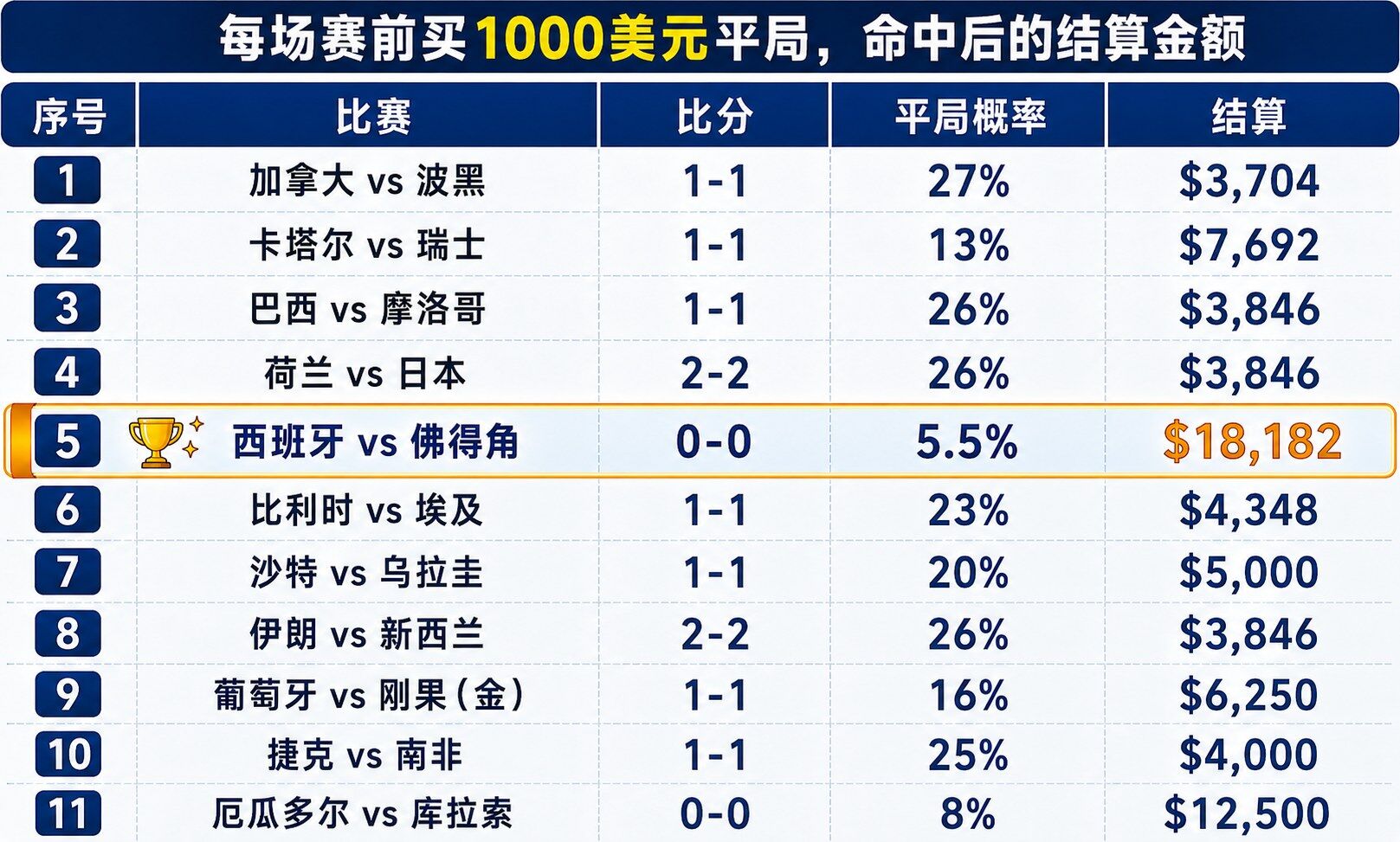
Even more impressive, according to Polymarket pre-match prediction data, if we continue the strategy of "$1000 on Draw per match" for today's 4 matches (total investment of $4000). Looking at the results: Spain 4-0 Saudi Arabia, New Zealand 1-3 Egypt—these two resulted in a loss of the stake; but Belgium 0-0 Iran and Uruguay 2-2 Cape Verde were hits, with a combined payout of approximately $8,700. This means that even with only 2 hits out of the 4 matches today, the daily net profit is still around $4,700.
Including today's 4 matches, out of 40 World Cup group stage matches, there have been 13 draws. With a total investment of $40,000, the total payout from winning bets is approximately $81,914. After deducting all investments, the net profit is about $41,914, representing a return of nearly 105%.
A hit rate of 13/40 isn't particularly high, but the key to the draw strategy is never about "hitting often," but about "hitting big." The lower the pre-match probability of a draw, the higher the payout multiplier when it hits. Matches like Spain vs. Cape Verde with a 5.5% draw probability, Ecuador vs. Curaçao with an 8% draw probability, or Qatar vs. Switzerland with a 13% draw probability—hitting just a few of these is enough to turn the entire strategy from a small loss into a massive gain.
Cape Verde's Draw Against Spain Is the Most Typical "Liquidation Game" of the World Cup So Far
The Spain vs. Cape Verde group stage match wasn't just a big win for the draw strategy; it was also a nightmare for pre-match buyers backing the favorite.
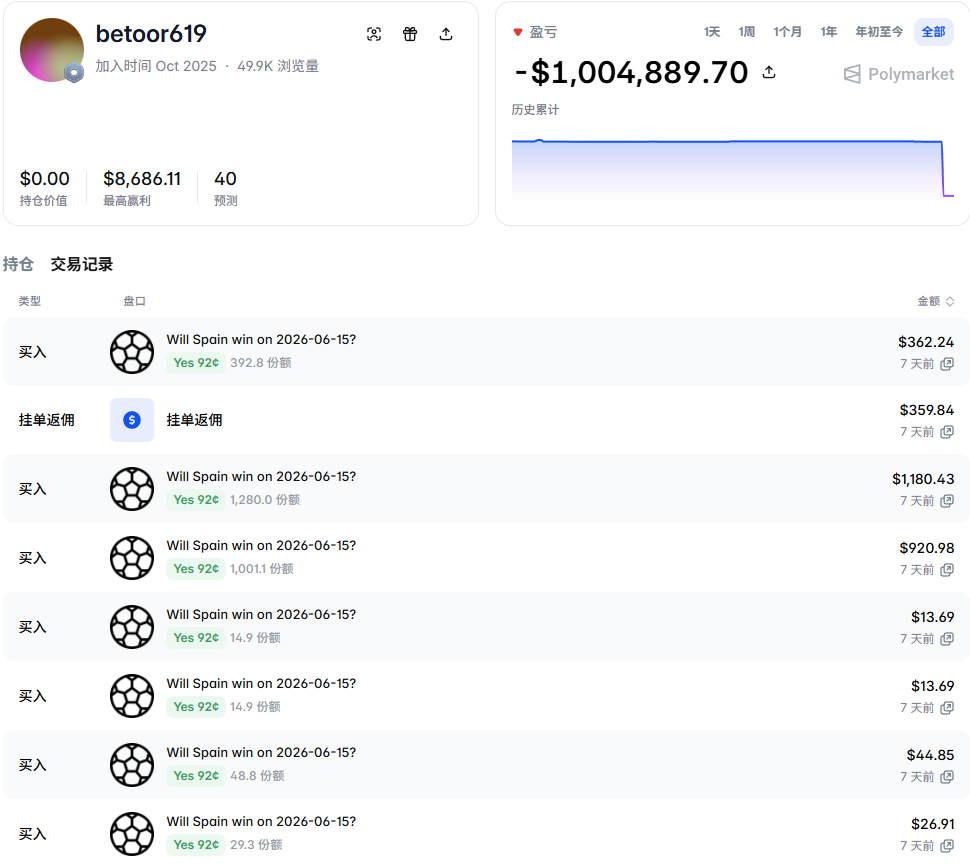
In this group stage match, Spain's pre-match win probability was as high as 92%. Polymarket data shows that account @betoor619 (address: 0x70088c990ffae782c699b9250f5aa6cbe4e3c666) bought Spain to win in the World Cup group stage match Spain vs. Cape Verde. The match ended 0:0, resulting in a loss of $999,000 for this user.
It's worth noting that this user bought in at the 92-cent moment, meaning they staked $1 million in principal for a potential profit of $85,000. A seemingly sure-win trade ultimately resulted in a cold loss due to the 7 incredible saves by Cape Verde's 40-year-old goalkeeper and Cape Verde's extremely resilient defense.
0-0 and 1-1 Are Becoming the Main Theme of This World Cup So Far
Looking at the draw results that have hit so far, draws in this World Cup group stage aren't appearing randomly but are concentrated in a few typical scorelines.
The most common is 1-1. Canada vs. Bosnia and Herzegovina, Qatar vs. Switzerland, Brazil vs. Morocco, Belgium vs. Egypt, Saudi Arabia vs. Uruguay, Portugal vs. DR Congo, Czech Republic vs. South Africa—all ended with this score. The commonality in these matches is that neither side was completely without chances, nor did the weaker team simply park the bus until the end. More often, the stronger team failed to convert their advantage into a win, while the weaker team seized an opportunity to respond. The matches seemed back-and-forth, but in the end, neither side could truly break through the other.
For traders, the value of 1-1 lies in its stability. It's not the most exaggerated source of profit, but it occurs frequently, forming the foundation of this "buy draw every match" strategy.
What really boosts the profits are the 0-0 draws.
Spain vs. Cape Verde is the most typical example. Spain was considered the absolute favorite pre-match, with only a 5.5% draw probability. But the match ended 0-0. If $1,000 was invested pre-match on the draw, the payout would be approximately $18,182. Ecuador vs. Curaçao follows a similar logic. With only an 8% draw probability, it also resulted in 0-0, with $1,000 invested corresponding to a payout of $12,500.
Therefore, the real money-making aspect of the draw strategy isn't about hitting every match, but rather that a few low-probability draws, when they do hit, come with very exaggerated payout multipliers. This is especially true for 0-0 matches, where the on-field action often involves the favorite team attacking constantly while the underdog's goalkeeper and defense repeatedly clear the ball.
Group G Is Even More Ridiculous: 3 Draws in 4 Matches
If Spain vs. Cape Verde represents low-probability draws, then Group G is more like a microcosm of the "draw density" in this group stage.
Out of the first 4 matches, Group G has produced 3 draws. In the first round: Belgium 1-1 Egypt, Iran 2-2 New Zealand; in the second round: Belgium 0-0 Iran. The only match with a decisive result was New Zealand vs. Egypt, but this doesn't change one fact: the overall rhythm of this group has been completely slowed down by draws.
Especially Belgium, who have drawn both of their group stage matches so far. For the team, this means the pressure to qualify from the group continues; but for those who bought a Belgium win pre-match, the outcome of both matches was the same—no loss, but their position wiped out.
This is also where the draw is most underestimated in prediction markets. The market prefers to buy the favorite to win because it seems more intuitive; but the real logic of group stage football isn't "the favorite must win," but rather that many teams are willing to settle for 1 point. The weaker team doesn't want to lose, the stronger team doesn't want to take risks too early. Once a match reaches a stalemate, a draw becomes a very realistic outcome.
3 draws in the first 4 matches of Group G indicates that draws are not accidental upsets, but part of the group stage tactical game. Especially when the points haven't been significantly separated, every team starts calculating—winning is of course best, but avoiding losing first is often the safer choice.
Summary
In this World Cup, the strong teams are still the main characters.
Spain will win, Brazil will win, and favorites will always have matches where they deliver a crushing victory. But if we look purely at trading profits, the most profitable script in the group stage so far might not be the big wins by the giants, but rather those recurring 1-1s, 0-0s, and 2-2s.
Those who bought the favorites are waiting for goals, those who bought the draw are waiting for the final whistle, and so far, the latter are laughing louder.