The Real Cost of Being One Minute in Prediction Markets — A Study on the Golden Entry Windows for Different Events

marsbitPubblicato 2026-02-14Pubblicato ultima volta 2026-02-14

Introduzione

In prediction markets, the cost of hesitation is measured in minutes. This analysis of 2,023 on-chain trades on Polymarket reveals that the "confirmation tax"—the price paid for waiting to verify news—can be devastatingly high. The core metric is "Remaining Alpha" (1 - current price). For events that resolve to "YES" ($1), buying at $0.20 offers $0.80 in potential profit, while buying at $0.90 leaves only $0.10. The research identifies three distinct event types with their own profit decay curves: 1. **Sudden & Certain Events** (e.g., "Maduro arrested"): The golden window is the first 60 seconds, with an average entry price of $0.56 (44% Alpha). Alpha's half-life is less than 2 minutes, evaporating entirely after ~10 minutes. Strategy: Prioritize position over 100% certainty. 2. **Negotiation & Correction Events** (e.g., "SVB acquisition"): The decay is step-like. A 6-hour observation window existed with prices stable at ~$0.65, followed by a sharp price correction. Strategy: Look for confirmation signals (e.g., large smart money buys) rather than racing to be first. 3. **Priced-In Events** (e.g., "TikTok ban"): The event is highly anticipated. By the official deadline (T0), the price is already efficient (~$0.84), offering near-zero Alpha. Strategy: Avoid entering at T0; it's the finish line, not the start. The key takeaway: Time is an exponential function of money in prediction markets. A one-minute delay can mean forfeiting the vast majority of profitable alpha, t...

Author: Hubble AI

For prediction market traders, the biggest pain point is often not "not knowing," but "being too late."

When we see breaking news, our instinctive reaction is usually to first verify:"Is this news reliable?" or "Is it a rumor?" This caution is a virtue in traditional investing, but in binary options markets like Polymarket, it can be an extremely expensive hidden cost.

We call this cost the "confirmation tax."

The PolyHub team reviewed 2,023 on-chain trade-by-trade data points from Polymarket, attempting to answer a quantitative question: How much Alpha (excess return) did you actually sacrifice to obtain 100% information certainty?

The data conclusion was more brutal than we anticipated: in the most liquid突发事件 (sudden events), the first 10 minutes absorbed 96% of the information advantage. This means that when you spend 1 minute confirming the authenticity of the news, you have actually handed over the vast majority of the profits to those opponents who are willing to take risks or have faster information sources.

This article does not instill anxiety; it only uses on-chain data from three typical markets to reconstruct the "golden entry window" for different types of news events.

The conclusion is brutal and simple: In prediction markets, time is an exponential function of money. The later you enter, the smaller the remaining profit space you can capture, and this decay rate often far exceeds most people's imagination.

I. Defining the Metric: What is "Remaining Profit Space"?

To quantify the cost of "entering late," we use a simple metric:

Remaining Profit Space (Alpha) = 1 - Current Buy Price

For a contract that最终结算 (settles) at $1 (YES):

  • Entering at $0.20, your remaining space is $0.80.

  • Entering at $0.90, your remaining space is only $0.10.

This is the money still left on the table for you. Our research found that as time passes, this money doesn't decrease linearly; it evaporates exponentially.

II. On-Chain Review: Three Different "Decay Curves"

1. Sudden & Certain Type: Only "Blind Rush," No "Confirmation"

  • Case: Maduro Arrested (Maduro out by Jan 31, 2026?)

  • Characteristics: Physical event + Instant official confirmation.

  • On-Chain Data Reconstruction:

0-1 minute (Golden Window): Within 60 seconds after the information shock, the average transaction price was only $0.56, meaning the remaining profit space was as high as 0.44 (44%).

1-5 minutes: Just a few minutes later, large amounts of capital rushed in, and the remaining space quickly dropped to 0.12.

After 10 minutes: The price stabilized at $0.97, Alpha exhausted.

Trading Insight: In this type of market, the half-life of Alpha is < 2 minutes. If you try to wait for "in-depth reports" from mainstream media to confirm the information, you are essentially providing exit liquidity for those who entered in the first minute. The strategy here is only one: Sacrifice certainty for entry position, under controllable risk.

2. Game Correction Type: Compete on "Signals," Not Speed

  • Case: Silicon Valley Bank Acquisition (Will SVB be acquired?)

  • Characteristics: No single breaking news; composed of weekend negotiations, rumors, and market expectation corrections.

On-Chain Data Reconstruction:

  • First 6 hours (Observation Period): Even though it was Monday morning, the price remained at 0.61-0.64, the market was hesitating.

  • 极狐

    6-12 hours (Confirmation Period): The price showed step-like jumps, rising from 0.64 to 0.94.

Trading Insight: The decay in this type of market is "step-like." The golden window lasts 0-6 hours. You don't need to compete on speed here; what you need to look for are "confirmation signals" that can change market consensus(e.g., rumors of谈判破裂 (negotiation breakdown), large buy orders from Smart Money).

3. Already Priced-In Type: Buying Means Catching the Falling Knife

  • Case: TikTok US Ban (TikTok banned in the US)

  • Characteristics: The event itself has been highly anticipated for a long time, with huge market liquidity.

On-Chain Data Reconstruction: In the 60 minutes before and after the official生效 (enforcement) of the ban (T0), the price stabilized around 0.84, with almost no Alpha generation visible.

Trading Insight: For highly anticipated institutional events, T0 is not the starting line, but the finish line. Entering at this point offers no information advantage, only the risk of "selling the news."

III. Practical Advice: Build Your "Entry Decision Tree"

Based on the above data, we advise traders, when seeing news, not to rush to place an order immediately, but to spend 5 seconds judging the event type, and then match the corresponding strategy:
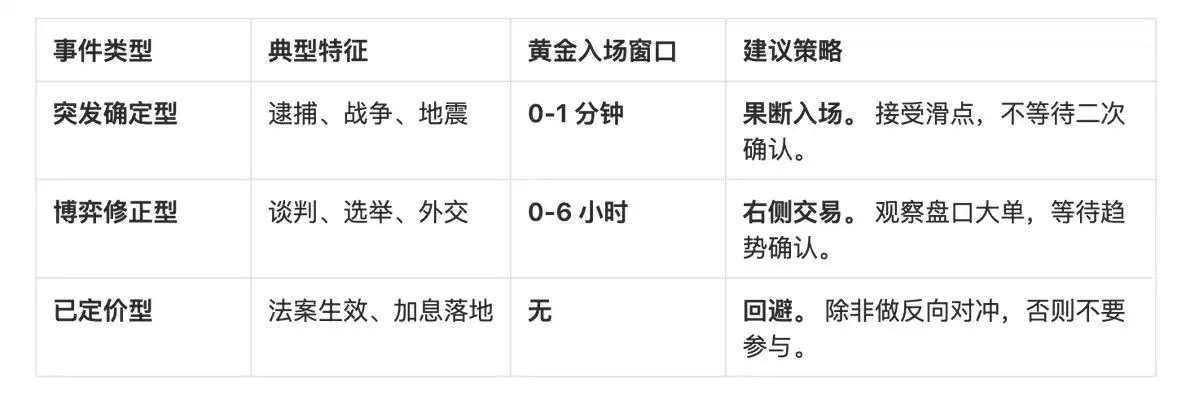
Conclusion

In prediction markets, 1 minute of hesitation corresponds not to the passage of time, but to a violent collapse of the profit-loss ratio.

Next time you face major news, ask yourself this question:

"Am I entering now as a hunter to capture Alpha, or as prey to provide liquidity?"

Domande pertinenti

QWhat is the 'confirmation tax' mentioned in the article, and why is it costly in prediction markets?

AThe 'confirmation tax' is the cost of sacrificing potential alpha (excess returns) by taking time to verify the authenticity of news before trading. In prediction markets like Polymarket, this is extremely expensive because the first few minutes after an event absorb the vast majority of the information advantage. Waiting even one minute to confirm news can mean forfeiting most of the profits to faster, risk-taking traders.

QAccording to the data, what percentage of the information advantage is absorbed within the first 10 minutes in high-liquidity突发事件 (sudden events)?

AAccording to the analysis of 2,023 on-chain trades, the first 10 minutes absorb 96% of the information advantage in high-liquidity sudden events.

QWhat are the three types of event decay curves identified in the research, and name one example for each.

AThe three types are: 1. Sudden Deterministic Events (e.g., 'Maduro out by Jan 31, 2026?'), 2. Game Theory Correction Events (e.g., 'Will SVB be acquired?'), and 3. Already Priced-In Events (e.g., 'TikTok banned in the US').

QFor a 'Sudden Deterministic' event, what is the approximate half-life of alpha, and what is the only viable strategy?

AFor a 'Sudden Deterministic' event, the half-life of alpha is less than 2 minutes. The only viable strategy is to sacrifice certainty in exchange for an entry position, acting on the news quickly within a risk-controllable framework.

QWhat is the key difference in strategy between a 'Sudden Deterministic' event and a 'Game Theory Correction' event?

AFor a 'Sudden Deterministic' event, the strategy requires extreme speed, acting within the first minute. For a 'Game Theory Correction' event, speed is less critical; the strategy focuses on identifying 'confirmation signals' that shift market consensus over a longer window (e.g., 0-6 hours), such as rumors of failed negotiations or large buys from smart money.

Letture associate

Dialogue with BlackRock's Head of Digital Assets: How Do Tokenized Stocks Work?

The article "Dialogue with BlackRock's Digital Asset Head: How Do Tokenized Stocks Work?" features a discussion with industry experts including Robert Mitchnick (BlackRock), Rob Hadick (Dragonfly), and Noah Levine (a16z). The conversation explores the evolution and mechanics of tokenized assets, particularly stocks. Key takeaways highlight that tokenization is primarily an "access" story, enabling broader investor participation in traditionally hard-to-reach asset classes, rather than just an efficiency improvement. Stablecoins are evolving from payment tools into foundational financial infrastructure, acting as an entry point for investment and asset management. Most current "tokenized stock" offerings are transitional, often representing derivative-like structures rather than true on-chain ownership, with limitations like transfer restrictions due to whitelisting and compliance requirements. The discussion covers three main structures for tokenized equities: SPV-based models, rights-based tokens (e.g., Securitize’s approach), and native on-chain issuance (e.g., Superstate). The latter is seen as the most promising for enabling true composability and functionality like collateralization. Regulatory clarity and infrastructure development are critical for advancing toward permissionless, liquid markets. Initiatives like the NYSE’s partnership with Securitize for 24/7 trading are noted, though the core demand is for improved asset utilization efficiency, not just extended hours. The piece also differentiates stablecoins (serving cross-border and crypto-native users) from tokenized deposits (focused on banking efficiency), predicting both will coexist. Privacy emerges as a growing need in on-chain capital markets, with technologies like ZK-proofs gaining relevance. Long-term, tokenization could flatten financial market structures by reducing intermediaries, lowering costs, and expanding access, ultimately integrating crypto infrastructure into mainstream finance.

marsbit1 h fa

Dialogue with BlackRock's Head of Digital Assets: How Do Tokenized Stocks Work?

marsbit1 h fa

Trading

Spot
Futures

Articoli Popolari

Come comprare ONE

Benvenuto in HTX.com! Abbiamo reso l'acquisto di Harmony (ONE) semplice e conveniente. Segui la nostra guida passo passo per intraprendere il tuo viaggio nel mondo delle criptovalute.Step 1: Crea il tuo Account HTXUsa la tua email o numero di telefono per registrarti il tuo account gratuito su HTX. Vivi un'esperienza facile e sblocca tutte le funzionalità,Crea il mio accountStep 2: Vai in Acquista crypto e seleziona il tuo metodo di pagamentoCarta di credito/debito: utilizza la tua Visa o Mastercard per acquistare immediatamente HarmonyONE.Bilancio: Usa i fondi dal bilancio del tuo account HTX per fare trading senza problemi.Terze parti: abbiamo aggiunto metodi di pagamento molto utilizzati come Google Pay e Apple Pay per maggiore comodità.P2P: Fai trading direttamente con altri utenti HTX.Over-the-Counter (OTC): Offriamo servizi su misura e tassi di cambio competitivi per i trader.Step 3: Conserva Harmony (ONE)Dopo aver acquistato Harmony (ONE), conserva nel tuo account HTX. In alternativa, puoi inviare tramite trasferimento blockchain o scambiare per altre criptovalute.Step 4: Scambia Harmony (ONE)Scambia facilmente Harmony (ONE) nel mercato spot di HTX. Accedi al tuo account, seleziona la tua coppia di trading, esegui le tue operazioni e monitora in tempo reale. Offriamo un'esperienza user-friendly sia per chi ha appena iniziato che per i trader più esperti.

196 Totale visualizzazioniPubblicato il 2024.12.12Aggiornato il 2025.03.21

Come comprare ONE

Discussioni

Benvenuto nella Community HTX. Qui puoi rimanere informato sugli ultimi sviluppi della piattaforma e accedere ad approfondimenti esperti sul mercato. Le opinioni degli utenti sul prezzo di ONE ONE sono presentate come di seguito.

活动图片