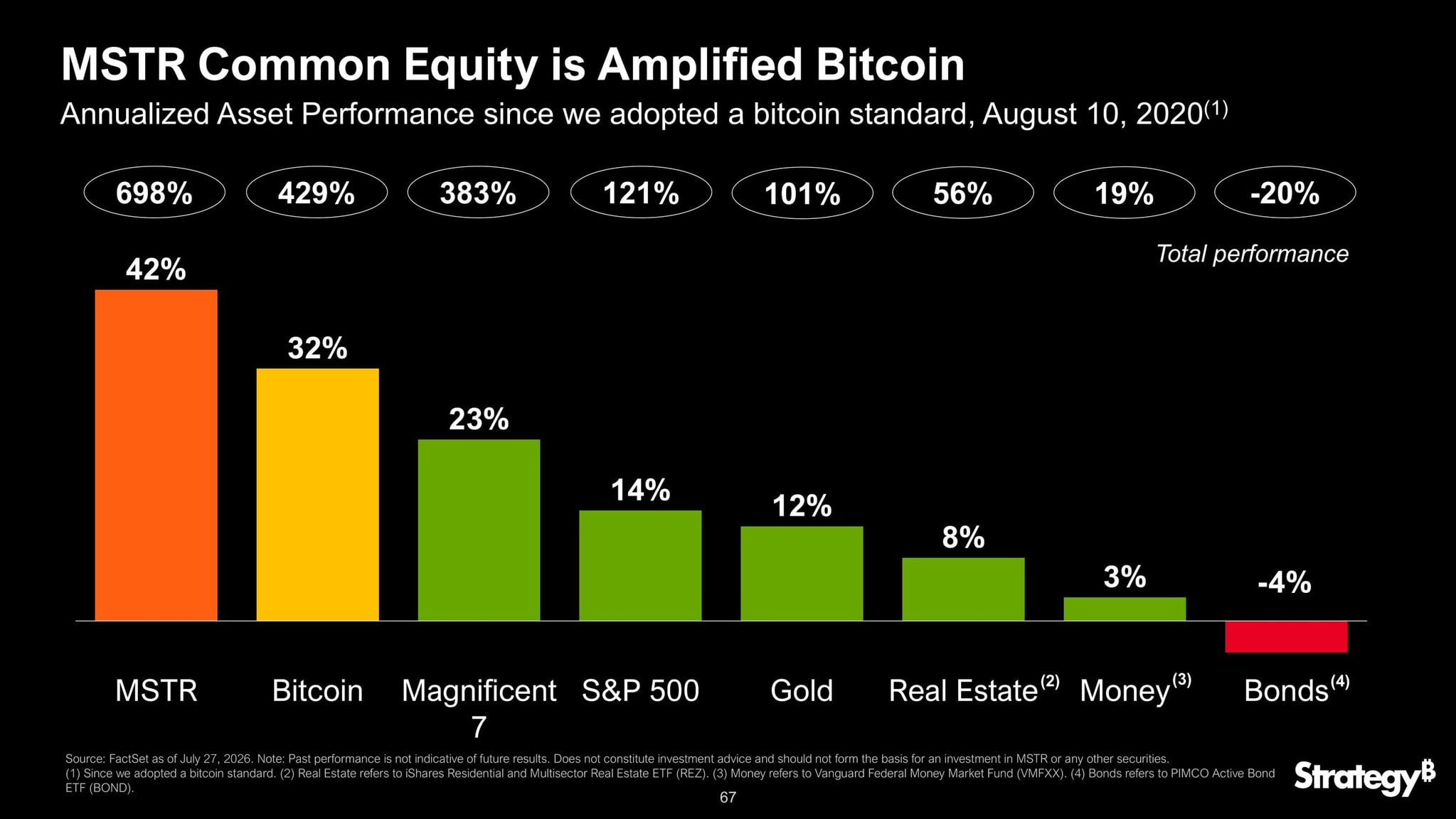
This week, the company of Strategy's Executive Chairman Michael Saylor highlighted its multi-year stock performance, informing subscribers that MSTR has delivered an annual return of 42% since the software company adopted a bitcoin-based treasury strategy on August 10, 2020. This performance surpasses that of Bitcoin ($BTC), the so-called 'Magnificent Seven' group of large-cap tech stocks, and the S&P 500 index over the same period.
This volatility was particularly evident in 2026. Strategy's stock fell sharply from its highs, even as the company continued to accumulate bitcoin—this divergence forced Saylor to resort to new ways of explaining this position to shareholders.
New Metrics for a Complex Balance Sheet
On July 24, Strategy introduced a new reporting framework based on metrics such as "Net $BTC Per Share," "$BTC Hurdle ARR," and "$BTC Floor ARR"—three metrics designed to show investors the real value of the company's bitcoin assets after deducting debt and preferred stock obligations.
The "Net $BTC Per Share" metric works similarly to a traditional book value per share calculation, but is expressed in bitcoin rather than dollars. "$BTC Hurdle ARR" is the annual return in bitcoin that Strategy needs just to cover its financing costs, while "$BTC Floor ARR" denotes the minimum annual return required to maintain the company's financial leverage ratio, known as the "$BTC Rating," at a sustainable level of 1.0x.
Saylor noted that this restructuring reflects how much more complex Strategy's capital structure has become, as the company has added several classes of preferred stock in addition to its original bitcoin bet.
The 'Other Side of the Balance Sheet' for the Treasury
The new framework is being introduced at a time when Strategy's core bitcoin position is significantly below its acquisition cost. As of July 29, the company owns 843,775 $BTC, acquired for a total of $63.69 billion at an average price of $75,476 per coin. These figures mean Strategy is carrying an implied loss of approximately $11.4 billion, roughly 17.9% below cost.
This gap illustrates the mechanism behind the claim of a 42% annual return. MSTR stock, because it trades as a leveraged instrument linked to bitcoin rather than direct ownership, can exhibit outsized annual returns over a multi-year period even if the company's net bitcoin position is temporarily "underwater" in dollar terms.
Strategy's early purchases in 2020 and 2021, made when bitcoin traded for a small fraction of current prices, still form the basis of the stock's long-term performance metrics, even as later purchases at higher prices lower the portfolio's average cost basis.
Despite the decline in value, Strategy has continued to build its bitcoin holdings into 2026; the company recently resolved to top up its dollar reserve by $525 million (primarily to strengthen coverage for preferred stock dividends).
end-content