Morgan Stanley Research Report Analysis: Google at a 12% Premium, Meta at a 30% Discount - Internet Giants' Valuations Diverge

marsbitPubblicato 2026-08-27Pubblicato ultima volta 2026-08-27

Introduzione

In a volatile end to the summer for internet stocks, Morgan Stanley's latest valuation report highlights a significant divergence in how the market is pricing major tech giants. While the sector's average forward EV/EBITDA multiple trades below historical averages, individual company valuations are splitting, largely driven by perceived AI capabilities. Alphabet (Google) is the standout, trading at a 12% premium to its 3-year average on an EV/EBITDA basis. This premium is attributed to upward revisions for its AI hardware (TPU) sales potential, advancements in its Gemini models, and cloud margin expansion. In stark contrast, Meta trades at a deep 30% discount to its 2-year average, as concerns over social media advertising competition outweigh its progress in AI-powered ad tools. Amazon sits in the middle, trading at a moderate discount. The report notes a broader sector trend: EV/Sales multiples are expanding while EV/EBITDA multiples are contracting, indicating the market is placing a higher premium on profitability over pure revenue growth. Sub-sectors like e-commerce and digital media face the most valuation pressure. Furthermore, adjusting earnings for stock-based compensation (SBC) reveals significantly higher "true" valuation multiples across the board. Morgan Stanley concludes that valuation recovery for the internet sector will depend on upward revisions to profit estimates—driven by catalysts like new AI product cycles and cloud growth stabilization—rather than s...

Written by: Rita

The summer rally in the internet sector concluded amidst volatility. Over the past week, the average performance of internet companies covered by Morgan Stanley fell by 2%, moving in sync with the S&P 500 and Nasdaq indices. However, individual stock performances varied significantly, with Meta dropping approximately 7%, Amazon falling about 2%, and Google remaining largely flat.

On August 25th, Morgan Stanley released a valuation dynamics report for the internet industry, providing a detailed breakdown of the valuation positions of the three giants. Amazon currently trades at 19 times its 2026 estimated P/E ratio, representing a 36% discount to its historical average; Google trades at 17 times, a 36% premium; and Meta trades at 17 times, a 24% discount. Google's valuation premium stands in stark contrast to Meta's deep discount. Morgan Stanley maintains an "Attractive" rating for the internet sector.

This summer, the market's pricing logic for these three companies has seen a fundamental divergence. AI capabilities are becoming the core variable driving valuation differentiation.

Google's Valuation Premium Coexists with Meta's Deep Discount

Google is the only company among the three giants trading above its historical average valuation. On an EV/EBITDA basis, its current multiple of 15.1x represents an 8% premium to the 2-year average and a 12% premium to the 3-year average.
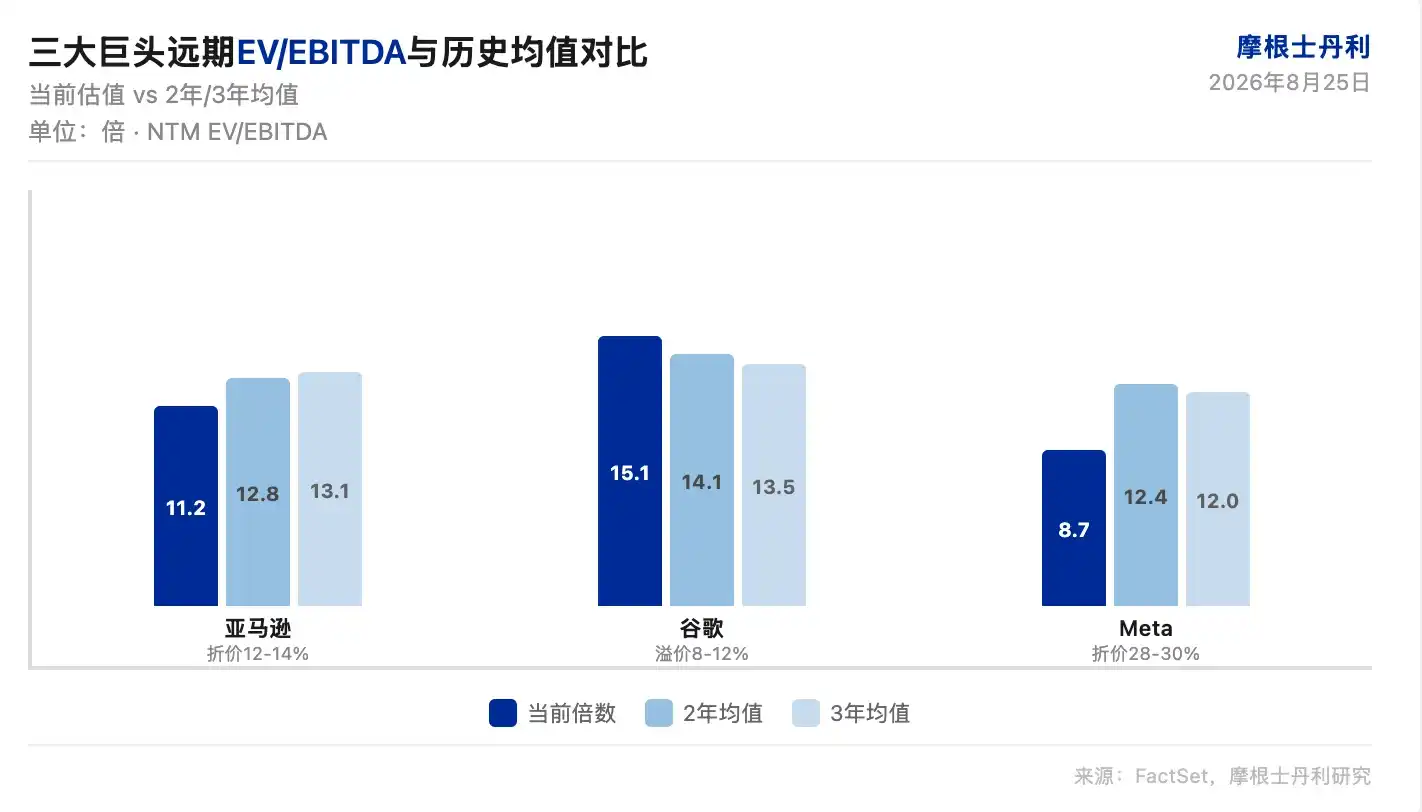
Google's valuation premium stems from the market's reassessment of its AI capabilities. Upward revisions for external TPU sales (Morgan Stanley previously raised its revenue per GW assumption from $20 billion to $27 billion), iterations of the Gemini model, and expanding margins in its cloud business collectively support the valuation. The market is willing to price in AI-driven growth ahead of time.

Meta's valuation is moving in the opposite direction. Its current forward EV/EBITDA multiple of 8.7x represents a 30% discount to the 2-year average and a 28% discount to the 3-year average. Although Meta is making good progress in monetizing its AI advertising tools, market concerns about competition in social media advertising continue to suppress its valuation. Amazon sits in the middle, with a current forward EV/EBITDA of 11.2x, representing discounts of 12% and 14% to the 2-year and 3-year averages, respectively.

Sector Valuations Show Divergence in Pricing for Revenue vs. Profit

Morgan Stanley data shows that the internet sector's current forward EV/EBITDA multiple is 9% below its 5-year average and 16% below its 10-year average. Over the same period, the EV/Sales multiple is 16% above the 5-year average and 17% above the 10-year average. Revenue multiples are expanding while profit multiples are contracting, indicating that the market is raising its requirements for earnings quality.

E-commerce and digital media are the sub-sectors with the most concentrated valuation discounts. The median forward EV/EBITDA for the digital media sub-sector is around 9.6x, with companies like SNAP still operating at a loss. The e-commerce sub-sector's valuation is also under pressure, mainly due to the dual impact of slowing consumer spending and intensifying competition.

SBC Adjustment Reveals True Valuation Pressure

After adjusting for stock-based compensation (SBC) as a cash expense, the true valuation multiples for each sub-sector are significantly higher than the apparent numbers.

The adjusted EV/EBITDA multiple for the digital media sub-sector rises by an average of approximately 36%, the e-commerce sub-sector by about 30%, and the travel & shared economy sub-sector by around 44%. The proportion of SBC in tech companies continues to grow, widening the gap between valuation multiples calculated on cash profits versus those based on reported profits. Solely looking at reported EV/EBITDA may underestimate the true valuation pressure. Recalculating by treating SBC as a cash expense better reflects the actual costs borne by shareholders.

Valuation Recovery Requires Earnings Revisions, Not Just Mean Reversion

Morgan Stanley believes that a recovery in internet sector valuations requires new catalysts. Key variables to monitor in the coming quarters include: the release cadence and market acceptance of Google's Gemini 4, whether Amazon AWS's growth rate stabilizes, Meta's progress in monetizing AI advertising tools, and the ongoing impact of changes in the interest rate environment on high-valuation growth stocks.

In the near term, overall sector valuations are within a reasonable range. Discounts exist in e-commerce and digital media, but the discount itself is not a buy signal. Valuation recovery needs to be driven by upward revisions to earnings expectations, not merely mean reversion.

Disclaimer

This article is Chaoxiang Research's organization and interpretation of a third-party brokerage research report (Morgan Stanley, August 25, 2026), combined with publicly available market information. The ratings, target prices, earnings forecasts, and related judgments cited in the text are the views of that brokerage's analyst, representing solely the position of their affiliated institution. They do not represent the views of Chaoxiang Research nor constitute any investment advice.

The market carries risks; decisions should be made independently. This article should not be used as a basis for trading any securities.


Domande pertinenti

QAccording to Morgan Stanley's report, what are the current valuation premiums/discounts for Google, Meta, and Amazon compared to their historical averages (using the EV/EBITDA metric)?

AAccording to Morgan Stanley's report, Google's current valuation is at a premium: 8% above its 2-year average and 12% above its 3-year average EV/EBITDA. Meta is at a significant discount: 30% below its 2-year average and 28% below its 3-year average. Amazon is at a moderate discount: 12% below its 2-year average and 14% below its 3-year average.

QWhat is identified as the core variable driving the fundamental divergence in the market's pricing logic for the three internet giants?

AThe article identifies AI capability as the core variable driving the fundamental divergence in the market's pricing logic for Google, Meta, and Amazon.

QWhat does the article highlight as a key reason for Google's valuation premium?

AThe article highlights that Google's valuation premium comes from the market's reassessment of its AI capabilities, specifically citing factors like upward revisions for its TPU external sales, iterations of the Gemini model, and margin expansion in its cloud business.

QWhy does the article suggest that looking at reported EV/EBITDA might underestimate true valuation pressure, and what adjustment does it propose?

AThe article suggests that reported EV/EBITDA might underestimate true valuation pressure because it doesn't account for Stock-Based Compensation (SBC) as a cash expense. It proposes adjusting for SBC as a cash outflow to calculate valuation multiples that better reflect the actual cost borne by shareholders.

QAccording to Morgan Stanley's conclusion, what does the valuation repair for the internet sector require, rather than simple mean reversion?

AAccording to Morgan Stanley, valuation repair for the internet sector requires upward revisions in earnings expectations (profit upgrades) to drive it, not just simple mean reversion or the existence of a discount itself.

Letture associate

Behind the Trillion-Dollar Capital Gamble: Time is Becoming the Counterparty to AI

Amidst unprecedented capital investment in AI, a trillion-dollar "gamble" is unfolding where time itself is becoming the opposing force. Recent events illustrate the volatility and profound uncertainty underlying this rush. In July 2026, hedge fund Situational Awareness, founded by Leopold Aschenbrenner and heavily leveraged on AI hardware stocks like Sandisk, lost $35 billion in a month as a market selloff triggered massive declines, highlighting the irrational human foundations of even AI-augmented markets. Simultaneously, the regulatory landscape is shifting dramatically. Social media addiction lawsuits in the US have exploded, with major platforms like Meta, Snap, TikTok, and Google now facing billions in liabilities. This signals a critical change: the "algorithm is neutral" defense is crumbling for AI, introducing massive legal and governance uncertainties that threaten AI's business models. Financially, the sector is fueled by unsustainable capital intensity. Google reported its first-ever negative free cash flow (-$5.9B) in Q2 2026, while its AI capex is projected to hit $200B. Industry-wide, debt issuance for AI infrastructure could reach $1.5 trillion. Companies like OpenAI and Anthropic project profitability only by 2030, betting on future revenues in the hundreds of billions. This mirrors a national dilemma: the U.S. faces a looming debt crisis, with interest costs projected to exceed $1 trillion annually, creating pressure to secure technological supremacy through AI. The core paradox is that this historic capital infusion aims to buy time for AI to mature and dominate. However, if the anticipated technological leap or market scale fails to materialize within the narrow window before profitability deadlines or a debt crisis, the simultaneous collapse of both corporate and national financial bets could be catastrophic. The race is not just for technological advantage, but against the clock.

marsbit2 min fa

Behind the Trillion-Dollar Capital Gamble: Time is Becoming the Counterparty to AI

marsbit2 min fa

Monero Price Forecast for 2026-2032: Is it Worth Buying XMR Now?

**Article Summary: Monero (XMR) Price Forecast for 2026-2032 and Investment Outlook** This article analyzes the potential future price trajectory of privacy-focused cryptocurrency Monero (XMR). Based on technical analysis and market sentiment, it presents a bullish long-term forecast. **Key Price Predictions:** * By the end of 2026, XMR is projected to reach **$825.20**. * A maximum price of **$1,016.93** is forecast for late 2029. * The price could surge to **$1,753.23** by 2032. **Current Market Analysis (as of August 2026):** * The current price is approximately $430.66, having faced resistance at $450. * Market sentiment is labeled as "Bullish," though short-term volatility persists with support found around $430. * Technical indicators like moving averages suggest a mixed but generally positive outlook. **Investment Thesis:** Monero is presented as a compelling investment due to its core focus on transaction privacy and security, which drives demand. Its decentralized development model and growing utility are cited as foundations for long-term growth. However, the article cautions investors about significant risks, including regulatory scrutiny, market volatility, and the cryptocurrency's association with illicit activities, which could hinder mainstream adoption. **Conclusion:** While the forecast is optimistic, the article strongly advises investors to conduct thorough personal research and consult experts before investing in the volatile cryptocurrency market. The potential for XMR to reach $1,000 or surpass its all-time high is deemed possible under favorable conditions but remains highly dependent on regulatory developments and broader market dynamics.

cryptonews.ru36 min fa

Monero Price Forecast for 2026-2032: Is it Worth Buying XMR Now?

cryptonews.ru36 min fa

Livio, CEO of New Huo Group: RWA Will Become the Bridge Connecting Carbon-Based Humans and Silicon-Based AI, Crypto's Next 100 Million Users to Come from AI Agents

At the "Deep Integration of AI and Crypto" roundtable during the Bitcoin Asia conference, Livio Weng, CEO of Bitfire at New Huo Group, stated that the core narrative for AI and Crypto convergence in the coming years will likely focus on the "agential economy." As infrastructure for AI identity recognition, authorized wallets, and payment protocols matures, AI will progressively gain the ability to autonomously use, manage, and transact assets, deeply integrating with existing crypto sectors like trading, prediction markets, asset management, and payments. Livio believes Real World Assets (RWA) will serve as a crucial bridge connecting carbon-based humans and silicon-based AI. On one hand, RWA can tokenize traditional assets, enabling AI to use and trade assets from human society. On the other hand, "AI assets" such as computing power, data, and AI-generated services can also be made accessible to humans through RWA formats for purchase, analysis, and trading. This process will drive deeper integration between humans and AI. "The next 100 to 200 million new crypto users may not be humans, but AI Agents," Livio suggested, noting that future critical infrastructure and applications might be autonomously generated by AI rather than primarily coded by humans. As AI evolves from an information assistant to a wealth management assistant and further into an autonomous task executor, AI Agents are poised to become significant participants in the Crypto ecosystem. Livio also highlighted that deep AI-Crypto integration requires robust underlying infrastructure, including settlement layers for autonomous machine transactions, identity and authorization layers for AI independent identity and recognition, and incentive/disincentive layers to address fraud and misconduct. Protocols like X402 and EIP-8004 are exploring related applications, but challenges in security, governance, and ethics remain. In practice, New Huo is actively embracing RWA to seize opportunities from AI-Crypto convergence. The group recently launched comprehensive RWA operator services and released Hong Kong's first compliant crypto asset quantitative strategy. By incorporating RWA assets, this strategy aims to offer cross-asset allocation and risk hedging opportunities, helping investors navigate volatility across different asset classes and market cycles. Livio concluded that RWA is not only a vehicle for traditional assets to enter the on-chain world but also potential key infrastructure for AI to participate in the real economy, utilize real-world assets, and provide services to humans. As the machine economy develops, the intersection between AI and Crypto will expand, offering substantial room for innovation and growth.

marsbit43 min fa

Livio, CEO of New Huo Group: RWA Will Become the Bridge Connecting Carbon-Based Humans and Silicon-Based AI, Crypto's Next 100 Million Users to Come from AI Agents

marsbit43 min fa

Successes of Cheburnet: the share of free mobile internet in Central Russia decreased to 30.5%

Russia's "Sovereign Internet" project continues to advance, significantly impacting mobile internet access. In July 2026, only 30.5% of mobile data sessions in Central Russia were unrestricted, with the majority routed through a state-approved "whitelist." This represents a 31% increase in whitelist usage since January. The implementation is geographically uneven: Moscow and St. Petersburg see higher rates of free access (~49% and ~44% respectively), while border regions like Belgorod have seen unrestricted access plummet to around 12%. International forces are also contributing to digital isolation. Major certificate authority GlobalSign began revoking TLS certificates for Russian domains in June to comply with international sanctions, affecting thousands of domains, including those of major corporations like Rosneft. While its market share is small, the move aligns with the trend of separating the Russian internet segment. Domestically, authorities are preparing alternatives to maintain critical services. The government has tasked officials with ensuring the operation of key platforms like healthcare portals and payment systems during internet restrictions. The Ministry of Digital Development promotes a transition to certificates from a Russian National Certification Authority, which are natively supported by domestic browsers but may require manual installation for other devices. An AI analysis raises concerns, comparing the plan to Kazakhstan's failed 2019 attempt to mandate a state root certificate, which was blocked by major browsers as a security threat. This poses a future risk: users may eventually face a choice between foreign browsers potentially incompatible with Russian certificates or domestic software that fully trusts state-issued ones.

cryptonews.ru1 h fa

Successes of Cheburnet: the share of free mobile internet in Central Russia decreased to 30.5%

cryptonews.ru1 h fa

Trading

Spot
活动图片