Hash Global Research Report: Bitcoin Hasn't Risen Yet, Why Are We Starting to Think the Bear Market Might Be Over?

marsbitPubblicato 2026-08-13Pubblicato ultima volta 2026-08-13

Introduzione

Hash Global Research Report: Why We Think the Bear Market Might Be Ending Even Before Bitcoin Rises Over the past six months, AI has dominated market attention, causing a significant shakeout in crypto. Bitcoin has tested the $58-60K support three times since February, with volatility hitting multi-year lows. Despite stagnant prices, key underlying dynamics are shifting. The forces that drove the market down are weakening: macro tightening fears are easing as US inflation and jobs data cool, the perceived systemic risk from large holders like MicroStrategy selling is diminishing as they shore up finances, and institutional outflows have stopped. Simultaneously, on-chain data shows a rare concentration of over 240,000 BTC (approx. 12% of supply) accumulated in the $61-65K range, forming a new, consolidated base reminiscent of historical bottoms. Meanwhile, the AI trade is cooling, potentially redirecting capital towards undervalued crypto assets, as seen in July's relative outperformance. The current phase, where AI money hesitates and crypto veterans await a final dip, creates a "no-man's-land" investment opportunity—a potential entry point before a new consensus forms. While a definitive upturn isn't guaranteed, the confluence of weakening bearish pressures, improved on-chain structure, and a possible capital rotation suggests the window for positioning for the next cycle is opening.

Author:Jessica Feng (@Jf4172), Investment Manager of Hash Global BNB Fund;

Henry Yang (@ARSHenry1), Investment Partner, Head of Hash Global Secondary Market Funds.

Over the past six months, the booming AI market has almost captured the market's full attention, even shaking the last bastion of faith in Crypto - Bitcoin. Since falling below $70,000 in February, BTC has tested the $58,000–$60,000 range three times. Veteran players in the industry—Strategy—have begun selling coins, mining companies are shifting to AI, and the dim industry outlook has made each wave of panic feel more real than the last.

While US stocks continue to climb and gold rebounds from its lows, Crypto seems to have been forgotten by the world: BTC has been consolidating between $62,000 and $65,000 for nearly two months, with the 30-day implied volatility once dropping to 36%, hitting multi-year lows. The lifeless market conditions make it difficult for the public to be optimistic.

Recently, however, we have been focusing more on the "changes" and "perspectives"—the shifts happening beneath the price surface.

The forces that previously weighed down the market are weakening one by one: expectations for macro tightening are cooling, the Strategy blow-up crisis is easing, and institutional fund outflows have ceased.

Meanwhile, on-chain Bitcoin holdings are re-accumulating amidst the consolidation.

Everything seems to signal an approaching inflection point, but these changes have not yet been reflected in the price because the market is waiting for clearer signals.

Outside the market, AI trading is cooling down, and funds are about to begin a new round of allocation switching. Inside the market, veteran OGs are still waiting for the final dip and have yet to act. This moment of calm on the surface precisely offers us the best entry angle and timing.

Predicting exactly when the rally will start is difficult, but what can be grasped is that we are entering the time window to position for the next cycle.

I. Beneath the Unchanging Price, the Holdings Structure is Being Reshuffled, a New Bottom is Forming

BTC has tested the $60,000 level three times, and each time it has found clear support.

Subsequently, the price rebounded to around $65,000, where selling pressure re-emerged, and the market fell back into repeated fluctuations between $63,000 and $65,000. On the surface, the price has hardly changed, but on-chain holdings have quietly undergone a round of redistribution.

Currently, over 2.4 million BTC have settled in the $61,000–$65,000 range, accounting for about 12% of the circulating supply; of this, over 1 million BTC are concentrated around $63,000 alone, representing about 5.2% of the circulating supply. The degree of concentration has risen to historically rare levels.
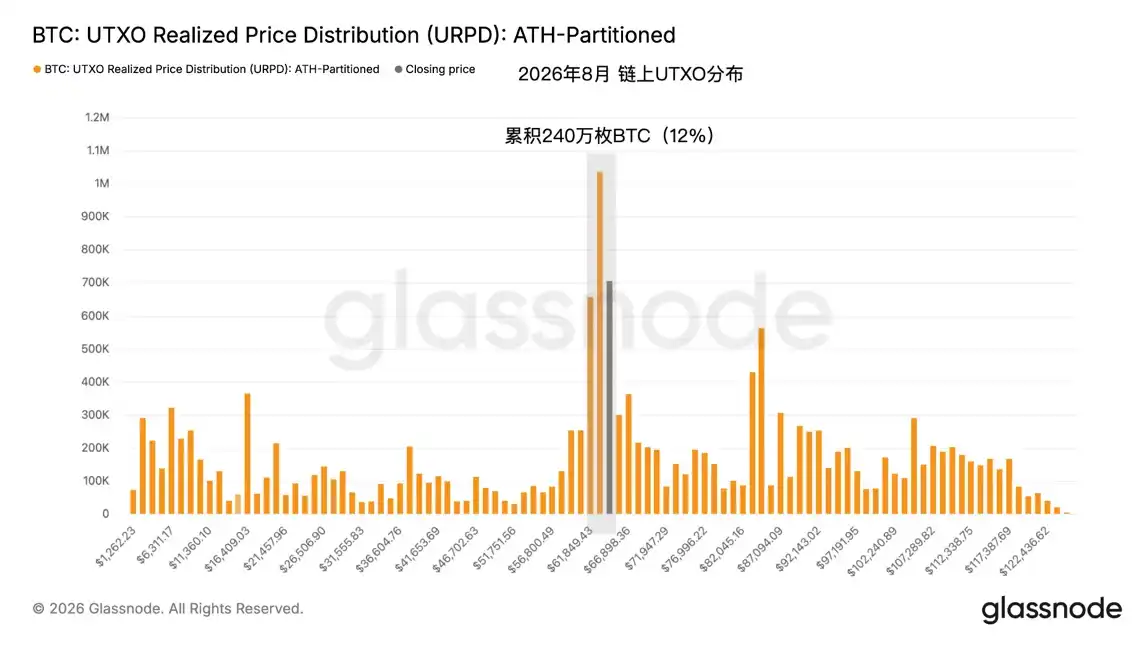
This change deserves more attention than short-term price movements. Bottoms do not appear suddenly; they are "bought out" by the market through repeated tugs-of-war: some exit, while others take positions; old holdings are constantly transferred, and new capital re-establishes a cost basis at lower levels. As more and more BTC clusters around similar price levels, a new price consensus is also being established.

Therefore, changes in momentum often precede price. Looking back at history, between May and November 2024, BTC also experienced a half-year adjustment after the ETF rally. Before rising from $60,000 to $100,000, the chain also showed a highly concentrated structure around the $50,000–$60,000 range. In hindsight, the bottom formed then was the springboard for the subsequent rally.
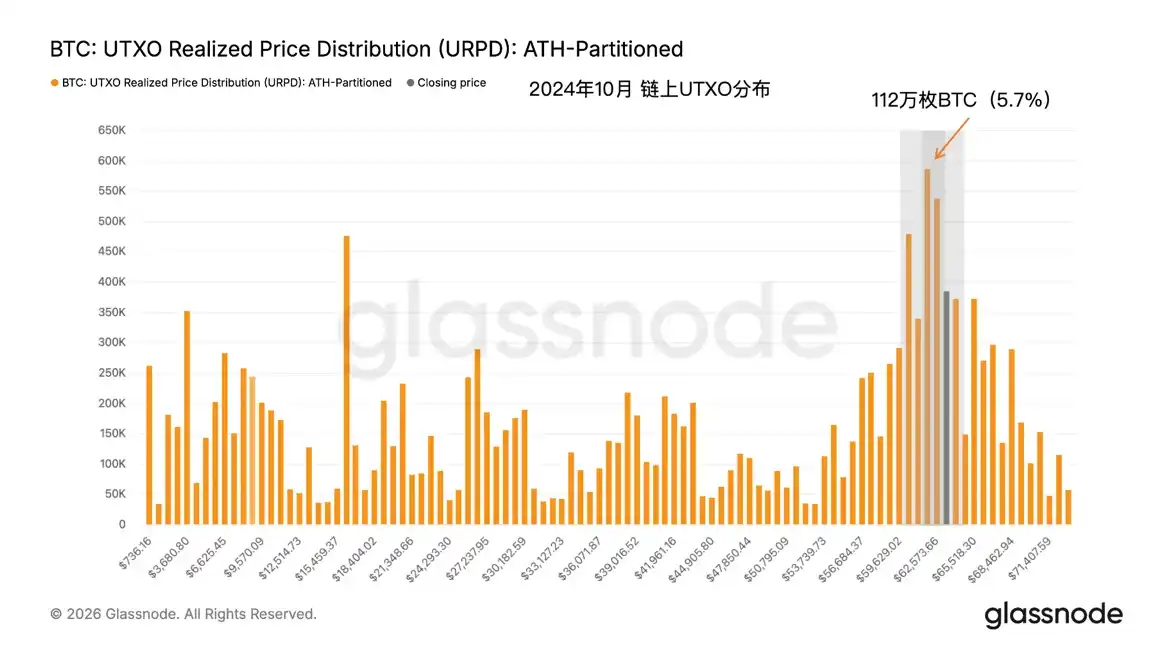
History doesn't simply repeat, but a similar holdings structure indicates the market is undergoing a similar bottoming and transfer process.

II. A Directional Choice Approaches, the Forces Suppressing the Market are Crumbling

Holdings concentration represents intensified contention, meaning the market is about to make a choice, but it alone cannot predict the direction.

What truly tilts the balance upward is that the several forces that drove the market down are weakening.

1. Macro Pressure Easing, Interest Rate Hike Risk Diminishing

The most important driver behind this round of adjustment has been market concerns over higher interest rates.

Geopolitical conflicts fueled inflation expectations, the Fed released hawkish signals, US Treasury yields and the dollar strengthened, naturally pressuring risk assets.

Recently, however, this high-interest-rate pricing logic has begun to loosen.

US CPI for June fell 0.4% month-over-month, the largest single-month drop since April 2020; core CPI was flat month-over-month, below market expectations. Meanwhile, July non-farm payrolls decreased by 23,000, also significantly weaker than expected.

Inflation is cooling, and employment is weakening. This marginal change has reversed the conditions for the market's previous tightening pricing.

When this expectation loosens, the pressure on risk assets naturally lessens.

2. Blow-up Crisis Cooling, Strategy Embarks on a Third Transformation

Over the past few months, FUD surrounding Strategy further amplified panic. Many believed Strategy's capital structure was problematic, and the largest buyer supporting this cycle would turn into a structural seller that could overwhelm the market during a downturn.

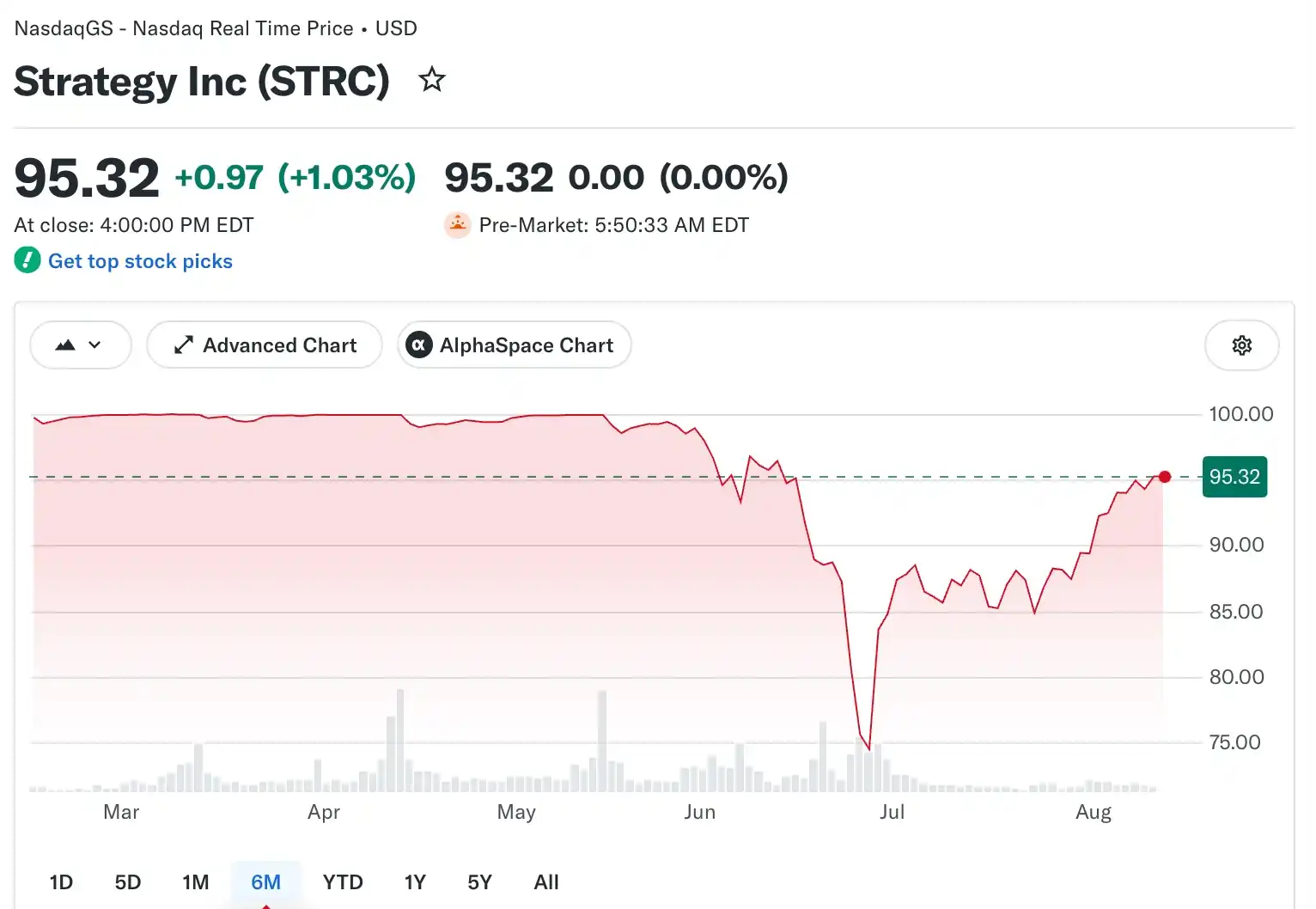
Due to these concerns, STRC once fell to $74, and MSTR's mNAV also dropped below 1x.

However, after Strategy actually began selling coins, the market's reaction gradually diminished. Behind this "desensitization" lies the market's evolving understanding of Strategy's tactics.

To date, Strategy has sold a total of 0.26% of its BTC holdings, boosting cash reserves to about $4.5 billion, sufficient to cover approximately 3 years of interest payments. It has also significantly repurchased discounted STRC, continuously reducing its debt scale at low cost. The market is gradually realizing that Strategy's series of operations precisely constitutes a transformation—from passive holding to active capital management, cutting off the negative spiral the market feared.

By contracting positions during the bear market, supplementing liquidity and stabilizing the capital structure through small-scale sales to ensure survival, Strategy preserves sufficient financing capacity to restart the flywheel in the next market cycle.

Recently, STRC has rebounded to around $95, and Strategy has resumed MSTR financing. Short-term funding pressure has eased, reducing the risk of forced large-scale sell-offs.

This means one of the most concerning structural selling pressures is clearly weakening.
3. AI Trading Cools, Crypto's Allure for Allocation is Rising, Possibly Attracting Fund Flows Back

Over the past six months, the AI sector has significantly diverted global capital.

Compared to narrative-starved Crypto, AI offered investment opportunities with more certain growth. Recently, however, AI trading has begun to cool.

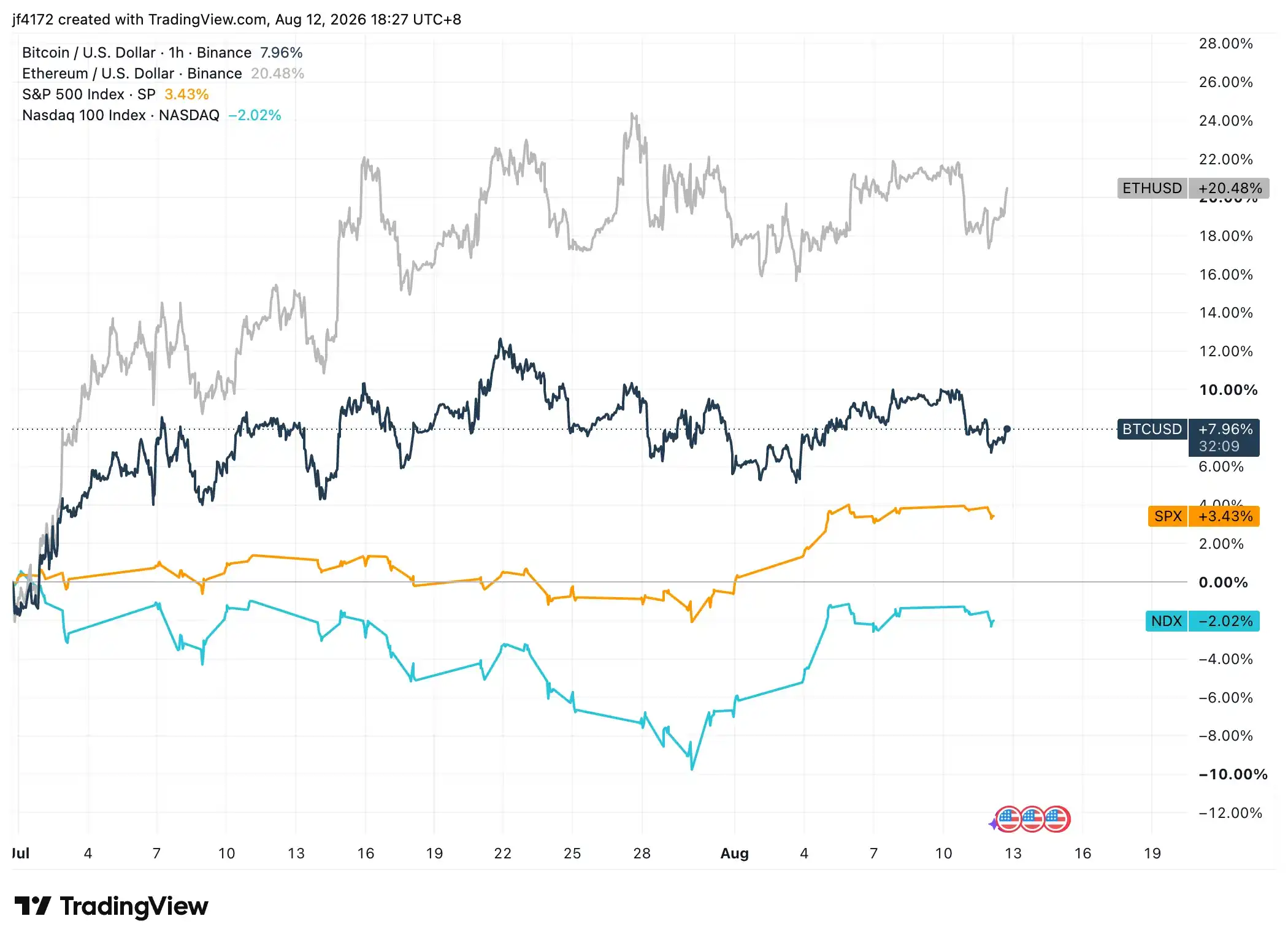
As valuations continued to climb, growth expectations became fully priced in, and the crowded AI trade saw concentrated deleveraging in July: the Nasdaq 100 index fell about 7%, the S&P 500 was flat month-over-month, while previously oversold Crypto assets saw a counter-trend recovery: BTC gained about 6% for the month, ETH rose about 18%. Blue-chip DeFi assets with significantly improved fundamentals performed even stronger, with UNI surging over 100% for the month.

When funds begin looking for new allocation directions, undervalued crypto assets with improving policy and fundamental backdrops may re-enter the sight of capital.
III. Before the Tide Arrives, Position During the "Unclaimed" Period

Marginal improvement in pressure factors does not equal a full reversal, so it's premature to conclude that the rally has already arrived.

While the market waits for clearer signals, this precisely provides a valuable time window.

Legendary investor Stanley Druckenmiller, when reflecting on his investment in Teva Pharmaceuticals, spoke of the concept of the "Unclaimed Territory": value investors were selling due to strategic transformation, while growth investors were still on the sidelines as the transformation was incomplete. When neither type of capital had truly entered, it presented a structurally disjointed investment opportunity.

BTC currently faces a similar disjointed opportunity: Crypto hasn't started its move yet, funds driven by AI FOMO are still chasing the final feast; the long-awaited industry blow-up moment hasn't arrived, and old money within the industry is still waiting for the final dip.

At this juncture, what's truly worth pondering is, when the market steps into the unclaimed territory, do we dare to move ahead of the consensus and position ourselves early?


Crypto di tendenza

Domande pertinenti

QAccording to the Hash Global research report, what key change in Bitcoin's on-chain structure suggests a potential market bottom is forming?

AThe report highlights that a large amount of BTC, over 2.4 million coins (about 12% of circulating supply), has accumulated in the price range of $61k to $65k, with a particular concentration of over 1 million BTC (about 5.2% of supply) near $63k. This high degree of price range concentration indicates strong accumulation and the establishment of a new cost base, a pattern seen before previous bull market cycles, suggesting a new market bottom is being 'bought' through consolidation.

QWhat three main forces that previously pushed the crypto market down are now weakening, according to the report?

A1. Macro Pressure: Expectations for prolonged high interest rates are easing due to cooling inflation (e.g., June CPI drop) and a weakening labor market. 2. Strategy's Crisis: The fear of a large-scale, forced sell-off by Strategy has diminished. Strategy has sold a very small portion of its BTC (0.26%), bolstered cash reserves, repurchased its discounted bonds, and resumed convertible note financing, easing its short-term liquidity pressure. 3. AI Capital Outflow: The hype and capital flow into the AI stock trade has cooled, which may lead funds to seek new allocation opportunities in undervalued assets like crypto, as seen in July's relative outperformance.

QWhat is the concept of the 'unclaimed zone' mentioned in the report, and how does it relate to the current Bitcoin market?

AThe 'unclaimed zone' is a concept from investor Stanley Druckenmiller, referring to a structural gap where one type of investor (e.g., value investors) has sold an asset, but the next group of buyers (e.g., growth investors) has not yet stepped in due to uncertainty or waiting for a catalyst. The report argues that Bitcoin is currently in such a zone: external AI-focused capital is not yet rotating in, while experienced crypto investors ('old money') are still waiting for a final price dip, creating a potential investment opportunity for those willing to act before a clear consensus forms.

QHow did the performance of crypto assets compare to major stock indices in July, and what does the report suggest this indicates?

AIn July, while the Nasdaq 100 index fell about 7% and the S&P 500 was flat, Bitcoin rose about 6% and Ethereum about 18%. Some DeFi blue-chips like UNI performed even stronger, rising over 100%. The report suggests this relative outperformance indicates that as the crowded AI trade cools, capital is beginning to rotate back into undervalued crypto assets with improving fundamentals and policy outlooks, marking a potential shift in market leadership.

QWhat strategic shift has Strategy undertaken according to the report, and how does it address market concerns?

AStrategy has shifted from a passive 'buy and hold' strategy to an active capital management strategy. This involves selling a minimal portion of its BTC holdings to significantly increase its cash reserves (to ~$4.5B, covering ~3 years of interest), repurchasing its heavily discounted bonds (STRC) to reduce debt at low cost, and resuming equity financing via MSTR convertible notes. This transformation aims to break the 'negative spiral' the market feared—where falling BTC prices would force massive liquidations—by proactively securing long-term liquidity and stabilizing its capital structure to survive the bear market and be ready for the next cycle.

Letture associate

Wall Street Morning Report: CPI Lands Mildly, U.S. Stocks Stage Deep V-Shaped Reversal, AI Cloud, Storage, and Optical Communications Collectively Surge

Wall Street Morning Report: US stocks staged a deep V-shaped recovery following a mild CPI report, with AI cloud, storage, and optical communication sectors leading the rally. Major indexes were mixed: the Dow dipped slightly, while the S&P 500 and Nasdaq gained, nearing record highs. The July CPI data met expectations, with core inflation hitting its slowest pace since March 2021, further reducing expectations for a September Fed rate hike. Market focus shifted decisively towards AI infrastructure. The Philadelphia Semiconductor Index jumped 2.49%. AI cloud providers NEBIUS and CoreWeave surged 34% and 19% respectively on strong earnings and massive order backlogs. Optical communication stocks like Lumentum and Coherent also posted significant gains. The storage sector rallied broadly, with SK Hynix and Micron among the advancers. Meanwhile, major tech giants saw divergence. Nvidia rose over 3%, while Apple, Microsoft, Amazon, and Meta closed lower. In commodities, gold and silver remained strong, while oil prices retreated as markets awaited developments in the Strait of Hormuz. The US federal budget deficit widened significantly in July, raising long-term concerns. Key upcoming events include US PPI data, Sandisk's investor day, and the SEC's 13F filings deadline, which will reveal institutional holdings.

marsbit1 h fa

Wall Street Morning Report: CPI Lands Mildly, U.S. Stocks Stage Deep V-Shaped Reversal, AI Cloud, Storage, and Optical Communications Collectively Surge

marsbit1 h fa

A 22-Year-Old Mathematical Puzzle, Solved by a Union Hospital Intern?

In an astonishing development, a longstanding mathematical problem known as the Crouzeix conjecture, which had challenged experts in numerical linear algebra for 22 years, appears to have been solved by Shanmu Jin, a neurosurgery resident and postdoctoral researcher at Peking Union Medical College Hospital. With no formal advanced mathematical training—his background is in geology and medicine—Jin relied on self-study and, crucially, the AI model GPT-5.6. The conjecture, proposed by mathematician Michel Crouzeix in 2004, concerns a fundamental constant (speculated to be 2) bounding the relationship between matrix norms and polynomial values over numerical ranges. It is critical for applications in matrix function analysis and numerical methods. Despite dedicated efforts by leading mathematicians, the best proven constant had only been reduced to 2.414. Jin approached the problem using sophisticated prompt engineering with GPT-5.6. He adapted a known prompting strategy, isolating the AI from external resources to force original reasoning, employing multiple divergent "sub-agents" to explore different paths, and enforcing rigorous adversarial review of proposed proof steps. After about 16 hours of autonomous, unsupervised operation, the AI produced a novel and elegant proof. The key insight involved a clever "sampling strategy" that reduced the problem to a simple positivity condition—a solution described as elegant and unexpected by experts. The proof was verified by the conjecture's originator, Michel Crouzeix, and other specialists like Alex Townsend and Anne Greenbaum, who expressed astonishment at its validity. Jin has made the entire process open-source, including the prompt, drafts, and formal verification code. Remarkably, just eight days after Jin's preprint appeared, mathematicians Emiel Lorist and Felix Schwenninger published an independent, concise 5-page proof using a different approach, also developed with the aid of ChatGPT 5.6. Jin welcomed this complementary work. This event marks a potential turning point, demonstrating how AI can enable experts from non-traditional backgrounds to solve deep theoretical problems and dramatically accelerate scientific discovery, heralding what some are calling a new "golden age" for interdisciplinary research.

marsbit1 h fa

A 22-Year-Old Mathematical Puzzle, Solved by a Union Hospital Intern?

marsbit1 h fa

Trading

Spot

Articoli Popolari

Cosa è BITCOIN

Comprendere HarryPotterObamaSonic10Inu (ERC-20) e la sua posizione nel mondo delle criptovalute Negli ultimi anni, il mercato delle criptovalute ha assistito a un aumento della popolarità delle meme coin, catturando l'interesse non solo dei trader, ma anche di coloro che cercano coinvolgimento comunitario e valore di intrattenimento. Tra questi token unici c'è HarryPotterObamaSonic10Inu (ERC-20), un progetto intrigante che mescola riferimenti culturali nel tessuto delle criptovalute. Questo articolo esplora gli aspetti chiave di HarryPotterObamaSonic10Inu, analizzando i suoi meccanismi, l'etica guidata dalla comunità e il suo coinvolgimento con il panorama crittografico più ampio. Che cos'è HarryPotterObamaSonic10Inu (ERC-20)? Come suggerisce il suo nome, HarryPotterObamaSonic10Inu è una meme coin costruita sulla blockchain di Ethereum, classificata secondo lo standard ERC-20. A differenza delle criptovalute tradizionali che possono enfatizzare l'utilità pratica o il potenziale investimento, questo token prospera grazie al valore di intrattenimento e alla forza della sua comunità. Il progetto mira a creare un ambiente in cui gli utenti coinvolti possono riunirsi, condividere idee e partecipare ad attività ispirate a diversi fenomeni culturali. Una caratteristica notevole di HarryPotterObamaSonic10Inu è la zero tassa sulle transazioni. Questo elemento allettante tende a incoraggiare il trading e il coinvolgimento della comunità, privo di costi aggiuntivi che possono scoraggiare i trader di piccole dimensioni. L'offerta totale della moneta è fissata a un miliardo di token, un numero che segna la sua intenzione di mantenere una circolazione sostanziale all'interno della comunità. Creatore di HarryPotterObamaSonic10Inu (ERC-20) Le origini di HarryPotterObamaSonic10Inu sono avvolte in un certo mistero; i dettagli sul creatore rimangono sconosciuti. Lo sviluppo di questo token non presenta un team identificabile o un piano esplicito, cosa non rara nel settore delle meme coin. Invece, il progetto è emerso organicamente, con il suo progresso fortemente dipendente dall'entusiasmo e dalla partecipazione della sua comunità. Investitori di HarryPotterObamaSonic10Inu (ERC-20) Per quanto riguarda investimenti esterni e finanziamenti, HarryPotterObamaSonic10Inu rimane ambiguo. Il token non elenca alcuna fondazione di investimento conosciuta o un sostegno organizzativo significativo. Invece, la linfa vitale del progetto è la sua comunità di base, che informa la sua crescita e sostenibilità attraverso azioni collettive e coinvolgimento nello spazio crittografico. Come funziona HarryPotterObamaSonic10Inu (ERC-20)? In quanto meme coin, HarryPotterObamaSonic10Inu opera principalmente al di fuori delle strutture tradizionali che governano spesso il valore degli asset. Ci sono diversi aspetti distintivi che definiscono il funzionamento del progetto: Transazioni senza tasse: Senza costi fiscali sulle transazioni, gli utenti possono comprare e vendere liberamente il token senza preoccuparsi di costi nascosti. Coinvolgimento della comunità: Il progetto prospera sull'interazione della comunità, sfruttando le piattaforme social per creare entusiasmo e facilitare il coinvolgimento. Discussioni, condivisione di contenuti e coinvolgimento sono elementi cruciali che aiutano ad espandere la sua portata e a favorire la lealtà tra i sostenitori. Nessuna utilità pratica: Va notato che HarryPotterObamaSonic10Inu non offre un'utilità concreta all'interno dell'ecosistema finanziario. Piuttosto, è classificato come un token principalmente per attività di intrattenimento e comunitarie. Riferimento culturale: Il token incorpora astutamente elementi della cultura pop per attirare interesse, collegandosi a appassionati di meme e seguaci delle criptovalute. HarryPotterObamaSonic10Inu esemplifica come le meme coin operino in modo diverso rispetto ai progetti di criptovalute più tradizionali, entrando nel mercato come costrutti sociali innovativi piuttosto che come asset utilitari. Cronologia di HarryPotterObamaSonic10Inu (ERC-20) La storia di HarryPotterObamaSonic10Inu è segnata da diversi traguardi notevoli: Creazione: Il token è emerso da un meme virale, catturando l'immaginazione di molti appassionati di criptovalute. Le date di creazione specifiche non sono disponibili, sottolineando la sua crescita organica. Inserimento negli scambi: HarryPotterObamaSonic10Inu ha fatto il suo ingresso in vari scambi, consentendo un accesso e un trading più facili da parte della comunità. Iniziative di coinvolgimento della comunità: Attività in corso volte a migliorare l'interazione della comunità, comprese gare, campagne sui social media e generazione di contenuti da parte di fan e sostenitori. Piani di espansione futura: La tabella di marcia del progetto include il lancio di una collezione NFT, merchandising e un sito di eCommerce relativo ai suoi temi culturali, coinvolgendo ulteriormente la comunità e cercando di aggiungere più dimensioni al suo ecosistema. Punti chiave su HarryPotterObamaSonic10Inu (ERC-20) Natura guidata dalla comunità: Il progetto dà priorità al contributo collettivo e alla creatività, garantendo che il coinvolgimento degli utenti sia al centro del suo sviluppo. Classificazione come meme coin: Rappresenta l'epitome delle criptovalute basate sull'intrattenimento, distinguendosi dai veicoli d'investimento tradizionali. Nessuna affiliazione diretta con Bitcoin: Nonostante la somiglianza nel nome del ticker, HarryPotterObamaSonic10Inu è distintivo e non ha alcuna relazione con Bitcoin o altre criptovalute consolidate. Focus sulla collaborazione: HarryPotterObamaSonic10Inu è progettato per creare uno spazio per la collaborazione e la condivisione di storie tra i suoi detentori, fornendo un canale per la creatività e il legame comunitario. Prospettive future: L'ambizione di espandersi oltre il suo presupposto iniziale verso NFT e merchandising delinea un percorso per il progetto per potenzialmente entrare in strade più mainstream all'interno della cultura digitale. Poiché le meme coin continuano a catturare l'immaginazione della comunità crittografica, HarryPotterObamaSonic10Inu (ERC-20) si distingue per i suoi legami culturali e il suo approccio centrato sulla comunità. Anche se potrebbe non adattarsi al modello tipico di un token orientato all'utilità, la sua essenza risiede nella gioia e nella camaraderia coltivate tra i suoi sostenitori, evidenziando la natura in evoluzione delle criptovalute in un'epoca sempre più digitale. Con la continuazione dello sviluppo del progetto, sarà importante osservare come le dinamiche della comunità influenzano la sua traiettoria nel panorama in continuo cambiamento della tecnologia blockchain.

2.3k Totale visualizzazioniPubblicato il 2024.04.01Aggiornato il 2024.12.03

Cosa è BITCOIN

Come comprare BTC

Benvenuto in HTX.com! Abbiamo reso l'acquisto di Bitcoin (BTC) semplice e conveniente. Segui la nostra guida passo passo per intraprendere il tuo viaggio nel mondo delle criptovalute.Step 1: Crea il tuo Account HTXUsa la tua email o numero di telefono per registrarti il tuo account gratuito su HTX. Vivi un'esperienza facile e sblocca tutte le funzionalità,Crea il mio accountStep 2: Vai in Acquista crypto e seleziona il tuo metodo di pagamentoCarta di credito/debito: utilizza la tua Visa o Mastercard per acquistare immediatamente BitcoinBTC.Bilancio: Usa i fondi dal bilancio del tuo account HTX per fare trading senza problemi.Terze parti: abbiamo aggiunto metodi di pagamento molto utilizzati come Google Pay e Apple Pay per maggiore comodità.P2P: Fai trading direttamente con altri utenti HTX.Over-the-Counter (OTC): Offriamo servizi su misura e tassi di cambio competitivi per i trader.Step 3: Conserva Bitcoin (BTC)Dopo aver acquistato Bitcoin (BTC), conserva nel tuo account HTX. In alternativa, puoi inviare tramite trasferimento blockchain o scambiare per altre criptovalute.Step 4: Scambia Bitcoin (BTC)Scambia facilmente Bitcoin (BTC) nel mercato spot di HTX. Accedi al tuo account, seleziona la tua coppia di trading, esegui le tue operazioni e monitora in tempo reale. Offriamo un'esperienza user-friendly sia per chi ha appena iniziato che per i trader più esperti.

4.7k Totale visualizzazioniPubblicato il 2024.12.12Aggiornato il 2026.06.02

Come comprare BTC

Cosa è $BITCOIN

ORO DIGITALE ($BITCOIN): Un'Analisi Completa Introduzione all'ORO DIGITALE ($BITCOIN) L'ORO DIGITALE ($BITCOIN) è un progetto basato su blockchain che opera sulla rete Solana, con l'obiettivo di combinare le caratteristiche dei metalli preziosi tradizionali con l'innovazione delle tecnologie decentralizzate. Sebbene condivida un nome con Bitcoin, spesso definito “oro digitale” a causa della sua percezione come riserva di valore, l'ORO DIGITALE è un token separato progettato per creare un ecosistema unico all'interno del panorama Web3. Il suo obiettivo è posizionarsi come un asset digitale alternativo valido, anche se i dettagli riguardanti le sue applicazioni e funzionalità sono ancora in fase di sviluppo. Cos'è l'ORO DIGITALE ($BITCOIN)? L'ORO DIGITALE ($BITCOIN) è un token di criptovaluta esplicitamente progettato per l'uso sulla blockchain di Solana. A differenza di Bitcoin, che fornisce un ruolo di stoccaggio di valore ampiamente riconosciuto, questo token sembra concentrarsi su applicazioni e caratteristiche più ampie. Aspetti notevoli includono: Infrastruttura Blockchain: Il token è costruito sulla blockchain di Solana, nota per la sua capacità di gestire transazioni ad alta velocità e a basso costo. Dinamiche di Offerta: L'ORO DIGITALE ha un'offerta massima fissata a 100 quadrilioni di token (100P $BITCOIN), sebbene i dettagli riguardanti la sua offerta circolante siano attualmente non divulgati. Utilità: Sebbene le funzionalità precise non siano esplicitamente delineate, ci sono indicazioni che il token potrebbe essere utilizzato per varie applicazioni, potenzialmente coinvolgendo applicazioni decentralizzate (dApp) o strategie di tokenizzazione degli asset. Chi è il Creatore dell'ORO DIGITALE ($BITCOIN)? Attualmente, l'identità dei creatori e del team di sviluppo dietro l'ORO DIGITALE ($BITCOIN) rimane sconosciuta. Questa situazione è tipica tra molti progetti innovativi nel settore blockchain, in particolare quelli allineati con la finanza decentralizzata e i fenomeni delle meme coin. Sebbene tale anonimato possa favorire una cultura guidata dalla comunità, intensifica le preoccupazioni riguardo alla governance e alla responsabilità. Chi sono gli Investitori dell'ORO DIGITALE ($BITCOIN)? Le informazioni disponibili indicano che l'ORO DIGITALE ($BITCOIN) non ha alcun sostenitore istituzionale noto o investimenti di venture capital prominenti. Il progetto sembra operare su un modello peer-to-peer incentrato sul supporto e sull'adozione della comunità piuttosto che su percorsi di finanziamento tradizionali. La sua attività e liquidità si trovano principalmente su exchange decentralizzati (DEX), come PumpSwap, piuttosto che su piattaforme di trading centralizzate consolidate, evidenziando ulteriormente il suo approccio di base. Come Funziona l'ORO DIGITALE ($BITCOIN) Le meccaniche operative dell'ORO DIGITALE ($BITCOIN) possono essere elaborate in base al suo design blockchain e alle caratteristiche della rete: Meccanismo di Consenso: Sfruttando il proof-of-history (PoH) unico di Solana combinato con un modello di proof-of-stake (PoS), il progetto garantisce una validazione efficiente delle transazioni contribuendo all'alta performance della rete. Tokenomics: Sebbene meccanismi deflazionistici specifici non siano stati dettagliati ampiamente, l'ampia offerta massima di token implica che potrebbe soddisfare microtransazioni o casi d'uso di nicchia che devono ancora essere definiti. Interoperabilità: Esiste il potenziale per l'integrazione con l'ecosistema più ampio di Solana, inclusi vari piattaforme di finanza decentralizzata (DeFi). Tuttavia, i dettagli riguardanti integrazioni specifiche rimangono non specificati. Cronologia degli Eventi Chiave Ecco una cronologia che evidenzia traguardi significativi riguardanti l'ORO DIGITALE ($BITCOIN): 2023: Il dispiegamento iniziale del token avviene sulla blockchain di Solana, contrassegnato dal suo indirizzo di contratto. 2024: L'ORO DIGITALE guadagna visibilità poiché diventa disponibile per il trading su exchange decentralizzati come PumpSwap, consentendo agli utenti di scambiarlo contro SOL. 2025: Il progetto assiste a un'attività di trading sporadica e a un potenziale interesse per impegni guidati dalla comunità, sebbene non siano state documentate partnership significative o avanzamenti tecnici fino ad ora. Analisi Critica Punti di Forza Scalabilità: L'infrastruttura sottostante di Solana supporta alti volumi di transazioni, il che potrebbe migliorare l'utilità di $BITCOIN in vari scenari di transazione. Accessibilità: Il potenziale basso prezzo di trading per token potrebbe attrarre investitori al dettaglio, facilitando una partecipazione più ampia grazie a opportunità di proprietà frazionata. Rischi Mancanza di Trasparenza: L'assenza di sostenitori, sviluppatori o di un processo di audit pubblicamente noti potrebbe generare scetticismo riguardo alla sostenibilità e all'affidabilità del progetto. Volatilità del Mercato: L'attività di trading è fortemente dipendente dal comportamento speculativo, il che può comportare una significativa volatilità dei prezzi e incertezze per gli investitori. Conclusione L'ORO DIGITALE ($BITCOIN) emerge come un progetto intrigante ma ambiguo all'interno dell'evolvente ecosistema di Solana. Sebbene tenti di sfruttare la narrativa dell'“oro digitale”, la sua partenza dal ruolo consolidato di Bitcoin come riserva di valore sottolinea la necessità di una chiara differenziazione della sua utilità e struttura di governance. L'accettazione e l'adozione future dipenderanno probabilmente dall'affrontare l'attuale opacità e dalla definizione più esplicita delle sue strategie operative ed economiche. Nota: Questo rapporto comprende informazioni sintetizzate disponibili a ottobre 2023, e potrebbero essersi verificati sviluppi oltre il periodo di ricerca.

475 Totale visualizzazioniPubblicato il 2025.05.13Aggiornato il 2025.05.13

Cosa è $BITCOIN

Discussioni

Benvenuto nella Community HTX. Qui puoi rimanere informato sugli ultimi sviluppi della piattaforma e accedere ad approfondimenti esperti sul mercato. Le opinioni degli utenti sul prezzo di BTC BTC sono presentate come di seguito.

活动图片