Hinton Praises, Gemini Core Contributor Speaks: In the Future, There Will Be Billions of Superhuman AI Einsteins

marsbitPubblicato 2026-07-04Pubblicato ultima volta 2026-07-04

Introduzione

In his speech "Training Sand to Think: Artificial General Intelligence & Future of Physics," Adam Brown, a core contributor to Gemini, outlines the rapid and transformative evolution of AI. He describes how large language models (LLMs), grown rather than programmed through pre-training and fine-tuning, have progressed from performing poorly on high-school math tests to achieving gold-medal level at the International Mathematical Olympiad and recently making a genuine mathematical breakthrough by disproving a decades-old conjecture. Brown attributes this acceleration to the "Scaling Law," where predictable performance gains come from increasing compute, data, and model size. He draws parallels to the history of chess AI, predicting a similar trajectory for scientific research: moving from tools to "centaur" human-AI collaboration, and eventually to autonomous, superhuman "AI scientists." Even if progress halted today, AI already reshapes physics as a tireless tutor, powerful programming assistant, and exhaustive literature reviewer. However, Brown argues progress will continue due to immense economic runway and technical optimizations. He envisions a near-future golden age of human-AI collaboration in science, potentially leading to billions of replicated, superhuman AI researchers, making the coming years the most exciting in physics' history.

Recently, Adam Brown, a core contributor to Gemini and head of the Blueshift team at DeepMind, delivered a lengthy speech titled 'Training Sand to Think: Artificial General Intelligence and the Future of Physics' at the Perimeter Institute for Theoretical Physics, attracting widespread attention. In his talk, he described witnessing AI progress from a 'kindergarten level' all the way to a doctoral level, and extrapolated: if this trend continues, what will become of physics?

Speech Title: Training Sand to Think: Artificial General Intelligence & Future of Physics

Speech URL: https://www.youtube.com/watch?v=Mw60FH5iflI&t=3s

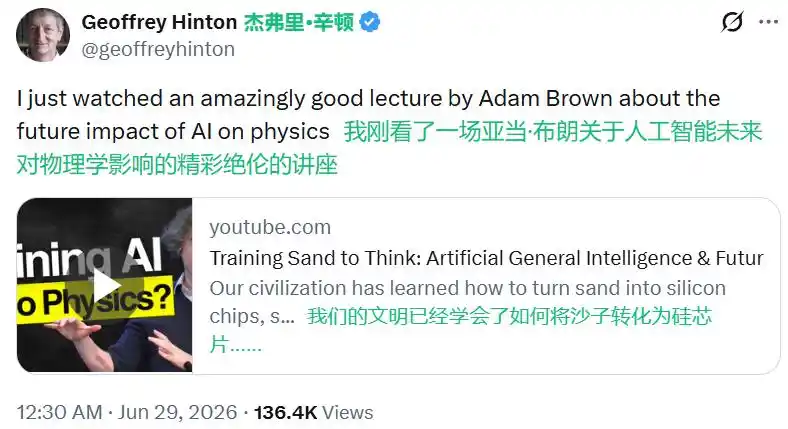
The speech was also highly praised by Nobel laureate in Physics and Turing Award winner Geoffrey Hinton, who called it 'amazingly good.'
Before delving into this amazing speech, it's necessary to introduce the speaker, Adam Brown.
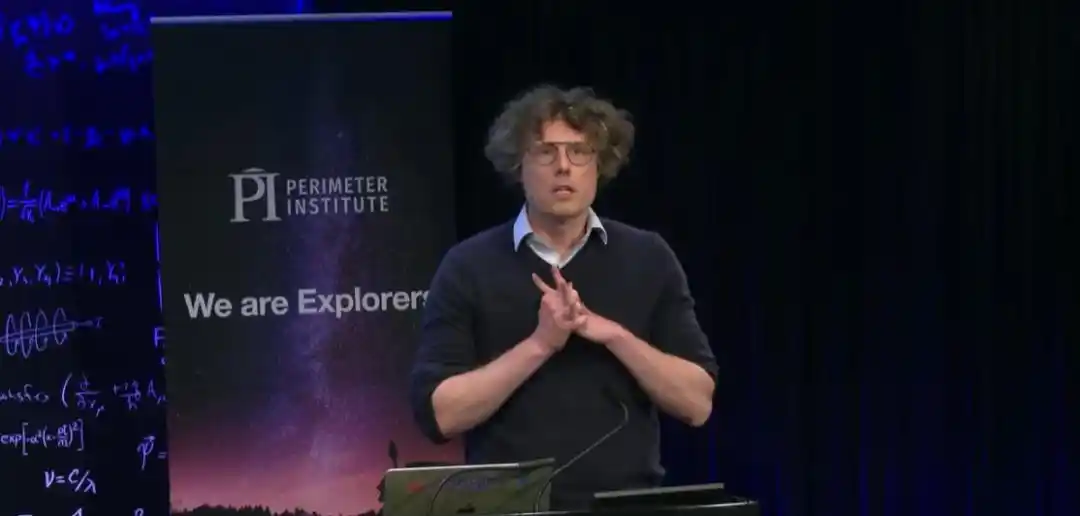
Brown's career is a textbook case of 'how a theoretical physicist's fate was changed by AI.' He studied a joint degree in Physics and Philosophy at Oxford, earned his Ph.D. from Columbia University, and subsequently taught in the physics departments at Princeton and Stanford. At Stanford, he taught Einstein's general relativity, researching topics ranging from the Big Bang, cosmic inflation, multiverses, black holes, and quantum computing, to ideas that sound like science fiction plots such as 'space elevators,' 'bubbles of nothing,' and the ultimate fate of the universe, while also maintaining a long-standing interest in the deep connections between physics and computer science.

In 2018, Brown joined Google. Today, he leads a team called Blueshift within DeepMind, focusing on enhancing AI's scientific and reasoning capabilities, and is also one of the core contributors to the Gemini large language model.

At the beginning of his speech, he mentioned that he had written about forty theoretical physics papers in his career but had stopped writing them by hand in recent years. The reason wasn't a lack of ideas, but that he felt writing papers one by one by hand was more like a 'guilty pleasure' because what he should really be doing now is participating in building a machine that can generate knowledge 'on an industrial scale.'

This opening statement set the tone for the entire talk: someone at the center of the 'AI+Science' technological storm trying to describe its true shape to his peers.

With the aid of AI, we have also summarized the key points of Brown's remarkable speech.

From Sand to Thinking Machines

Brown summarized the unique position of human civilization in one sentence: We have learned to purify sand into silicon, make chips from silicon, assemble chips into neural networks, and now we have learned to train these neural networks to think.

He particularly emphasized that this time it's different from any previous 'computational tool.' From the abacus to pocket calculators, humans have long had various tools to assist scientific research, but those were single-purpose tools, only capable of completing a single step in a process, leaving the rest for humans to do.

Large language models (LLMs) are different; they possess the potential to complete the entire workflow of a theoretical physicist, which is precisely the meaning of the term 'general intelligence.' Brown believes that LLMs are likely the fundamental substrate humans will use to build artificial general intelligence.

He reminded the audience that while they may have used chatbots like ChatGPT, Gemini, or Claude, they might not have noticed a quiet fact: these systems quietly passed the Turing test years ago, and almost no one specifically celebrated it.
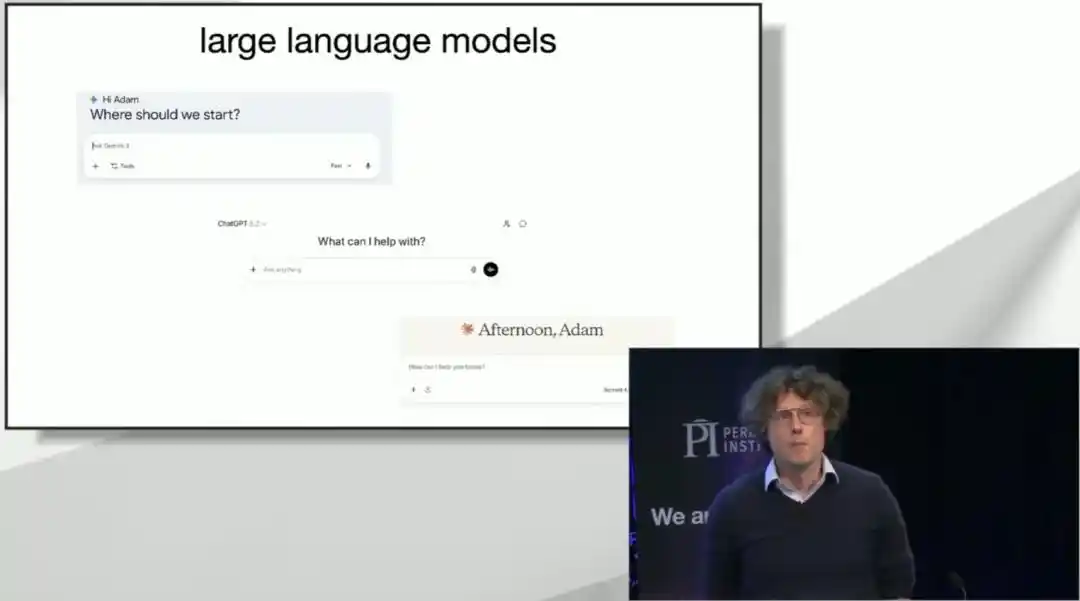
Neural Networks are 'Grown,' Not 'Programmed'

To understand why large models are fundamentally different from traditional computer programs, Brown offered a core metaphor: LLMs are not programmed; they are grown. That is, they are cultivated rather than coded.
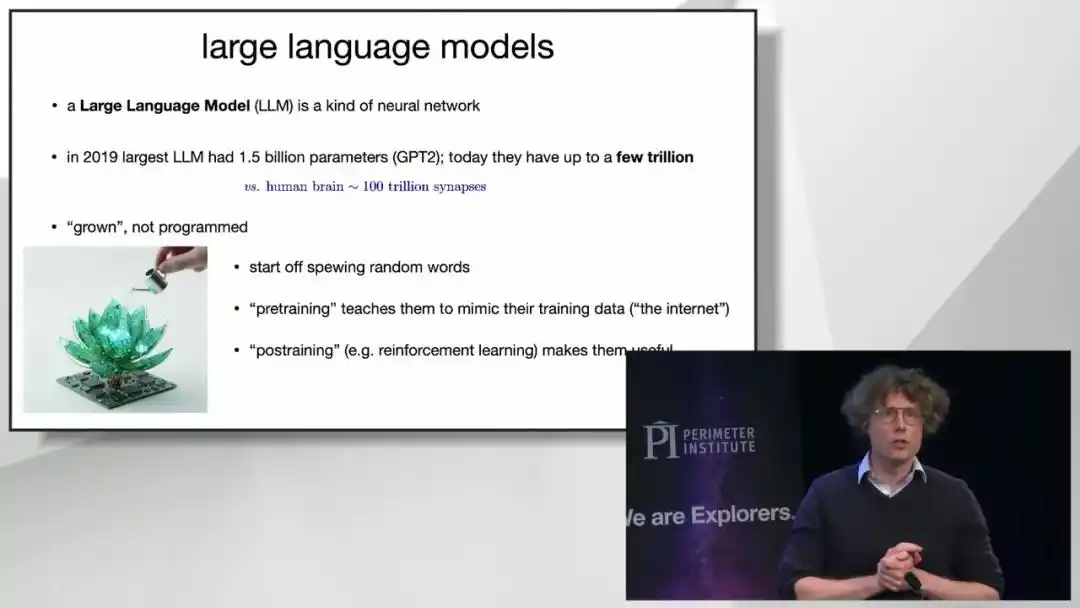
The specific process consists of two stages.

The first stage is called 'pre-training.' Engineers start with a set of randomly connected, nearly nonsensical artificial neurons and have it continuously try to predict the 'next word' in a piece of text. If it guesses correctly, the corresponding neural pathways are strengthened; if wrong, they are weakened. This process is extremely long: after seeing a million words, the model's output is still mostly gibberish; after reading tens of millions to billions of words, it can produce grammatically correct but somewhat stiff sentences; only after reading the entire internet (tens of trillions of words) can it engage in fluent, coherent conversations on almost any topic.

The second stage is called 'post-training,' which Brown describes as sending the model to 'finishing school.' A model fresh out of pre-training only mechanically predicts the next word, speaking rudely and uncooperatively. Post-training's task is to teach it to be polite and willing to cooperate with users, not just play a word completion game. Today, the parameter count of mainstream large models has jumped from billions a decade ago to several trillions, still far below the scale of the human brain's roughly one hundred trillion synaptic connections, but this scale is already sufficient for miracles to happen.

Physicists' Unexpected Role: Scaling Law Ignited This Revolution

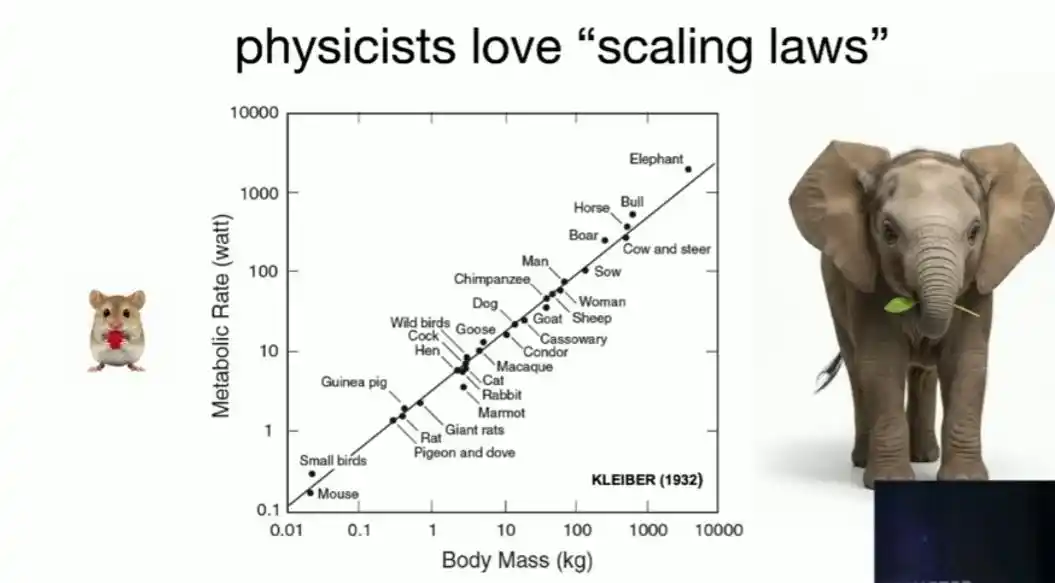
Brown specifically mentioned that physicists played an unexpected role at the beginning of this AI revolution: they brought the mindset of the 'Scaling Law.'

Physicists are inherently obsessed with finding simple power-law relationships: if you double Alice's height, her surface area becomes four times larger, and her weight becomes eight times larger—this is the simplest dimensional analysis. Kleiber's discovery nearly a century ago of a power-law relationship between animal metabolic rate and body weight is a more subtle example—it took physicists many years later to explain its underlying principle using the fractal dimension of the vascular system.
Not to mention the famous Moore's Law:
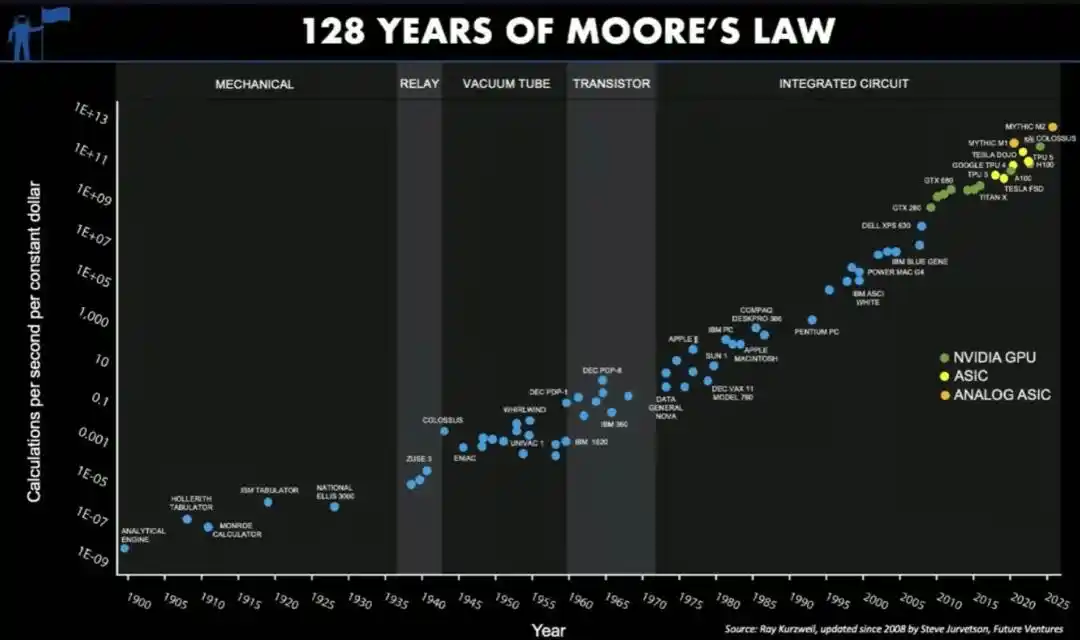
In 2020, several researchers with physics backgrounds applied this mindset to neural networks and discovered that as long as the computational power used for training, data volume, and model scale were proportionally increased, the model's performance on the 'predict the next word' task would improve steadily along a straight line on a log-log coordinate system.
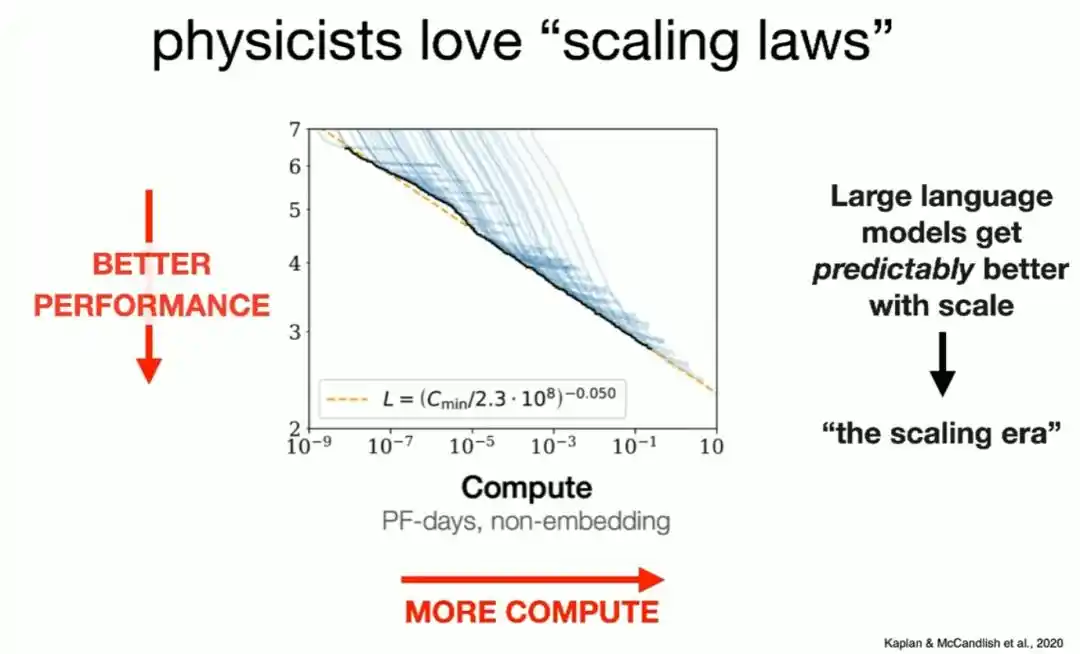
This curve was later extended by a full eight orders of magnitude and still held.

Brown joked that this chart was 'simple enough for venture capitalists to understand,' and it directly told capital markets: invest money (i.e., compute) and get a stronger model in return.

This simple curve was precisely the starting point of the Scaling era over the past six years.

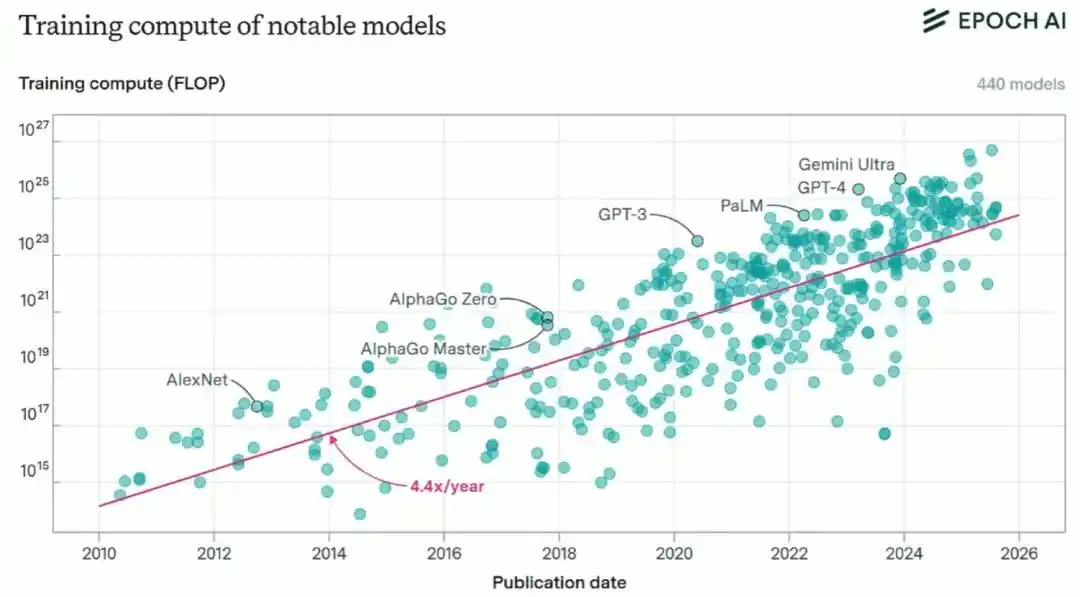
However, Brown also pointed out that just scaling compute is only part of the story. Over the past decade, the compute consumed by cutting-edge AI training has grown about fourfold annually, and the funds invested in training have grown about 2.7 times per year.
Currently, a top-tier training run requires compute costing several hundred million dollars, while the annual US GDP is nearly thirty trillion dollars, meaning there is still a very long growth runway for this curve.
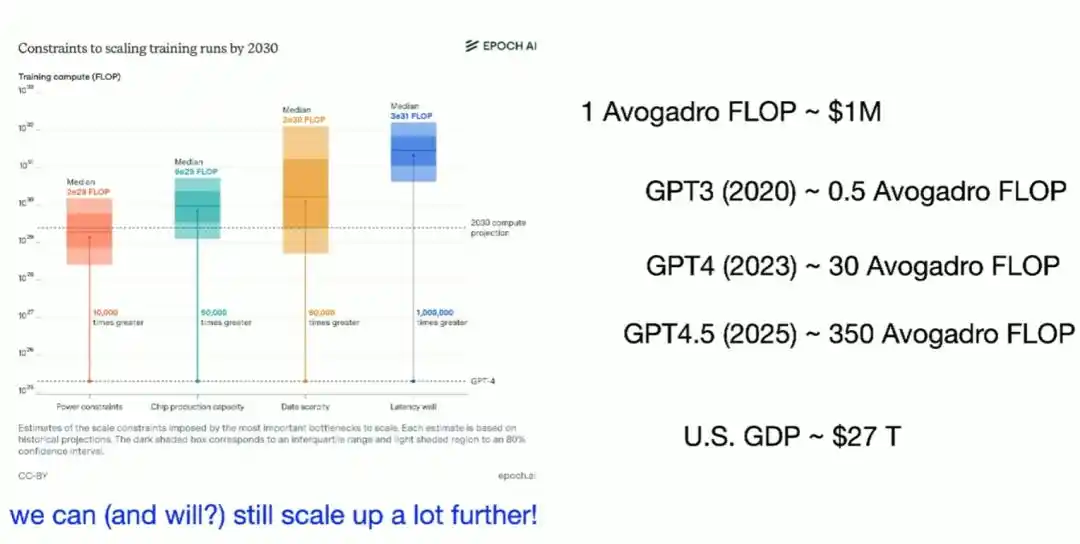
But more important than scaling compute is the continuous refinement at the algorithmic level: Researchers constantly identify inefficiencies in the training pipeline and improve them; this is the true 'primary engine' behind AI progress over the past decade.

The 'Short History' of Benchmarks: From Preschool to PhD

If Scaling Law explains 'why AI gets stronger,' then the rise and fall of a series of benchmarks record 'exactly how strong AI has become.' Brown used a set of test scores to depict a dizzying curve.

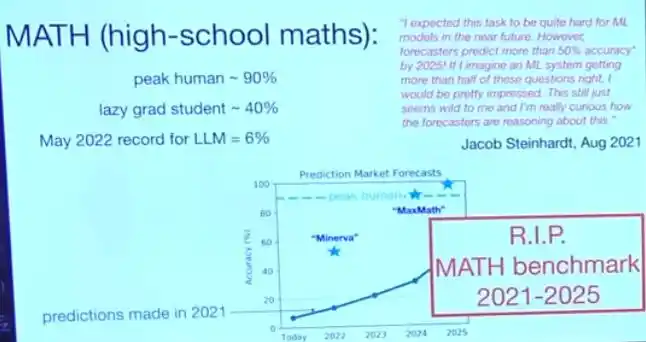
Four years ago, a benchmark called MATH for high school math problems emerged. The researchers had a computer science Ph.D. student who wasn't particularly good at math take the test, scoring about 40%; they also had a three-time International Mathematical Olympiad (IMO) gold medalist take it, scoring 90%. At that time, the most advanced large model could only manage 6%—almost indistinguishable from random guessing, as the model couldn't even understand what the questions were asking.

The prediction market at the time thought that by 2025, a model achieving 50% would be 'reckless optimism.' The benchmark's creator publicly stated that if a model actually achieved this, he would be 'quite shocked.'
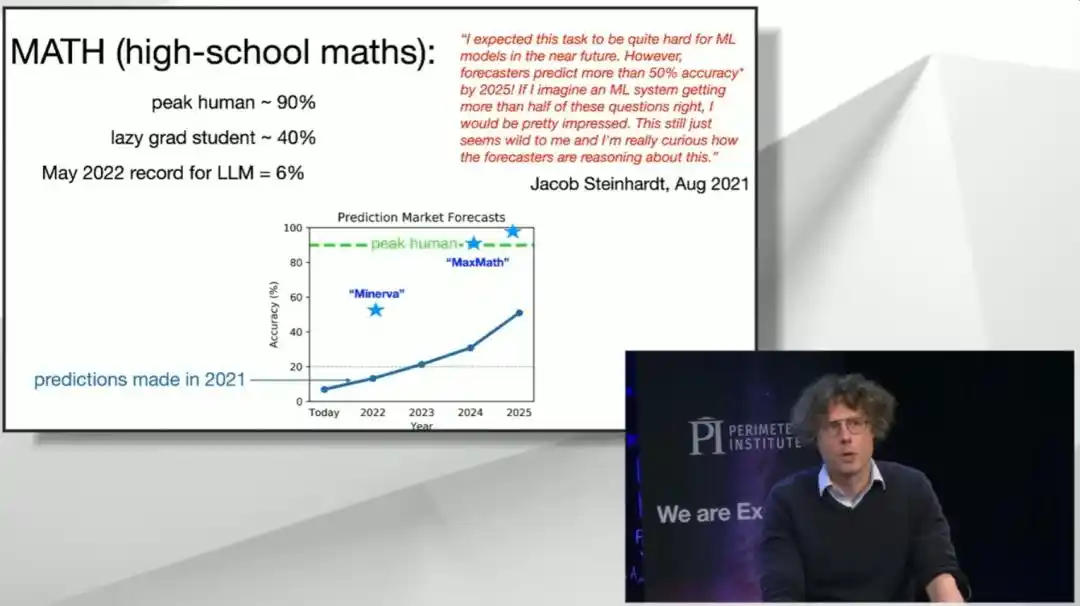
As it turned out, this 50% threshold was crossed 'immediately' by a system called Minerva. By mid-2024, Brown's team's system scored 90% on this benchmark. They even held a 1990s-style roller disco party to celebrate. However, just six months later, off-the-shelf large models were solving these problems nearly perfectly. The MATH benchmark thus 'died,' and it went directly from 'too difficult' to 'too easy,' with almost no pause in between.
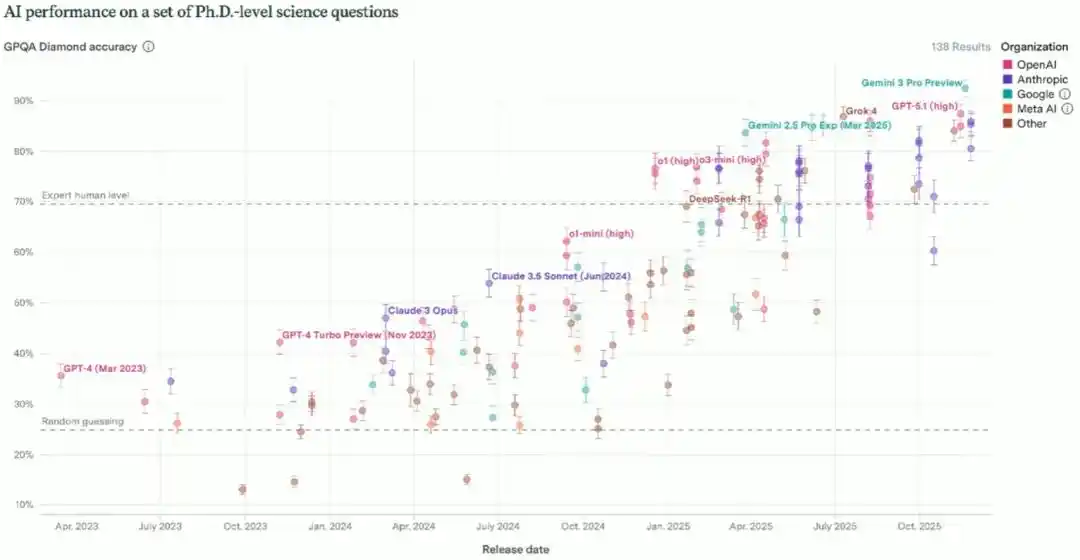
Next to fall was the GPQA test aimed at graduate students, simulating the difficulty of first-year Ph.D. qualifying exams, with human experts averaging around 70%. Starting close to random guessing, models surged past expert level between 2024 and 2025, now achieving near-perfect scores. To rule out the possibility that 'the model just memorized the answers,' Brown's team specifically designed new questions from the same distribution that had never appeared on the internet, and the model's performance barely declined.
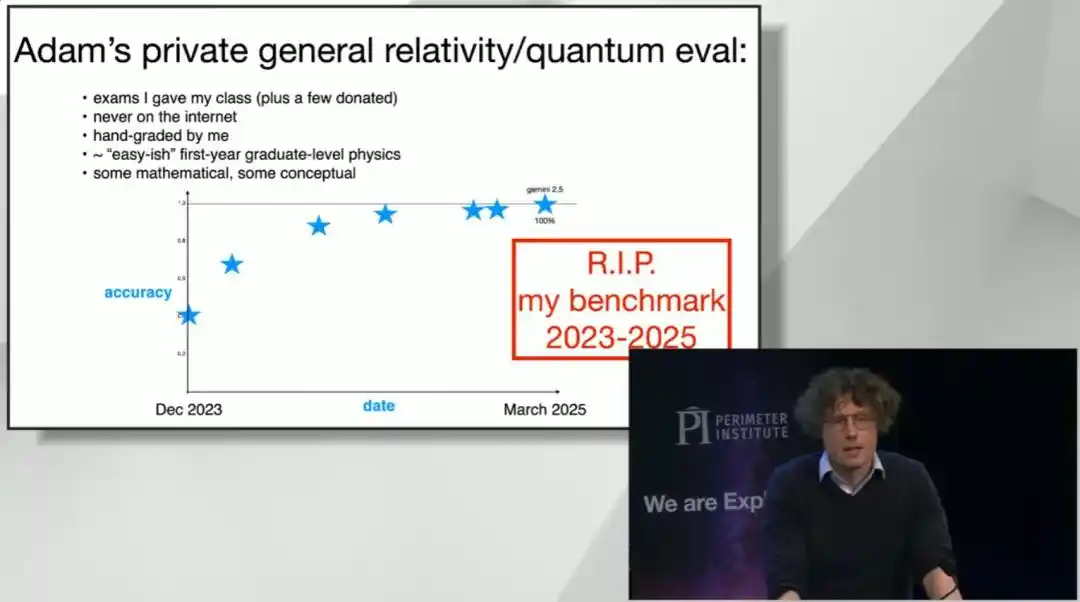
Brown even presented his own graduate-level final exams on general relativity and quantum mechanics, which he had personally graded at Stanford (these questions had never been online), and the model also achieved perfect scores within a year and a half. He half-joked that even his own exam questions had 'unfortunately fallen.'
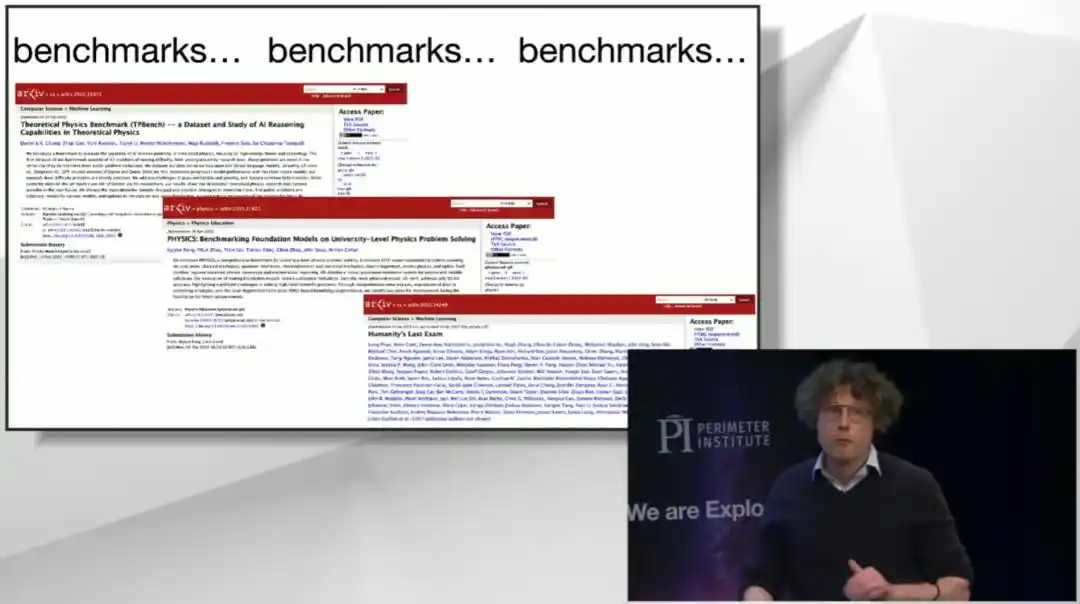
Since then, the list of fallen benchmarks has grown longer, including a super-difficult comprehensive test once called 'Humanity's Last Exam.'
But the most symbolic leap occurred on the International Mathematical Olympiad.

Crossing the IMO Threshold

Just over a year ago, a Turing Award winner told Brown in person that large models would never be able to solve problems at the level of the International Mathematical Olympiad (IMO) because that required genuine creativity, not something that could be faked by rote memorization. IMO problems are known as 'the hardest problems within the scope of high school mathematics': the smartest teenagers in the world train for one to two years to compete, and winning a gold medal by solving a few of the six problems is an exceptional feat.
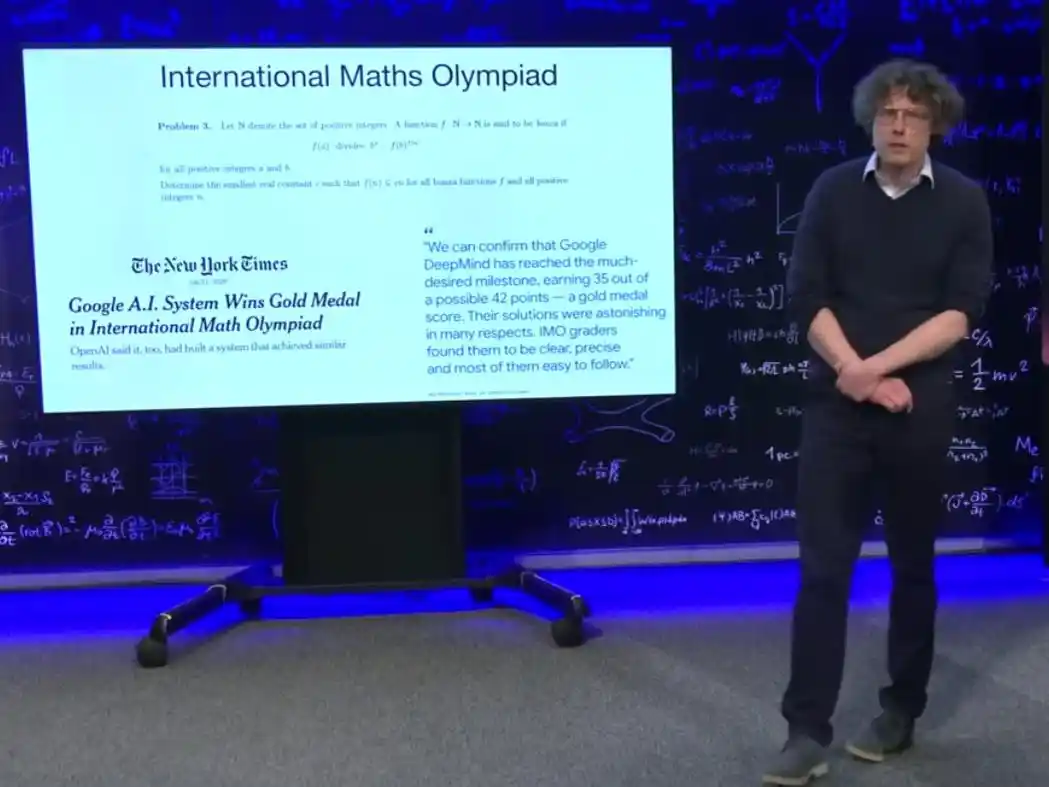
Last summer, this threshold was crossed. Brown's team's system solved five out of six problems on an IMO-level test, achieving gold medal standard. Moreover, the system didn't brute-force its way through with long, incomprehensible formal proofs. The IMO President publicly commented that these solutions were 'surprising in many ways,' with graders finding them clear, precise, mostly easy to understand, and employing mathematical abstractions similar to those used by humans.

Brown also candidly showcased a 'failure case' of large models.

A classic brainteaser goes: A father and son are in a car accident; the father dies, the son is taken to the operating room, and the surgeon sees the boy and says, 'I can't operate on him, he's my son.' The question is how this is possible (the standard answer is the surgeon is the boy's mother). This question tests whether the reader assumes the surgeon is male. Large models handle this 'viral internet puzzle' with ease because they've seen it thousands of times in training data. But when Brown reversed the puzzle: the mother dies, and the surgeon is specifically noted as 'the boy's father,' then asked the same question, the model completely failed to notice the reversal and mechanically applied the standard answer of 'the surgeon is the other parent.'

Brown said this exposes a specific 'quirk' left by the model's training method.

Centaur Collaboration: AI Writes Proofs Mathematicians Will Co-Author

Ten months after crossing the IMO threshold, Brown's team accomplished something he considers even more significant: genuine, previously unknown mathematical research.

Last September, Brown's team collaborated with several professional mathematicians in a mode he calls the 'Centaur' model—the centaur being a half-human, half-horse creature from Greek mythology, but here, the 'non-human half' is an LLM.
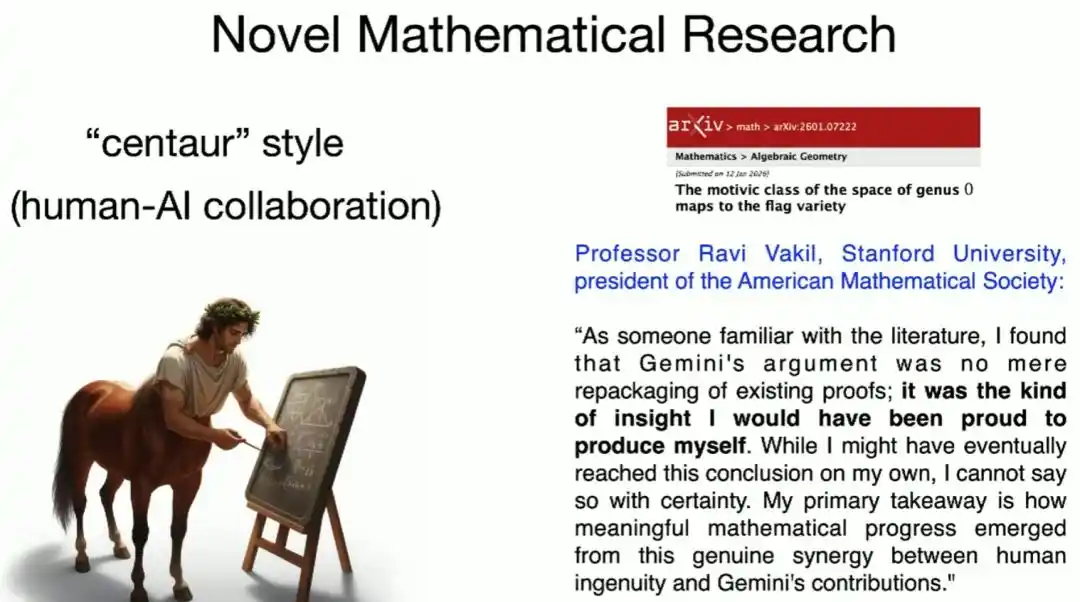
The entire process was a continuous dialogue: the model proposed candidate proof ideas, human experts judged which were valuable and guided the model to delve deeper, ultimately producing a complete mathematical paper under human guidance. One of the paper's co-authors is a Stanford professor and the current president of the American Mathematical Society. This professor's evaluation was that the arguments proposed by Gemini were by no means simple repackaging of existing proofs but represented insights he himself would be proud of.

Brown emphasized that this was, at the time (late last year), the highest level large models had reached in mathematics. But he immediately added: in terms of the true significance of 'highest level,' this was still far from it.

The Real Turning Point: AI Independently Solves an 80-Year-Old Conjecture

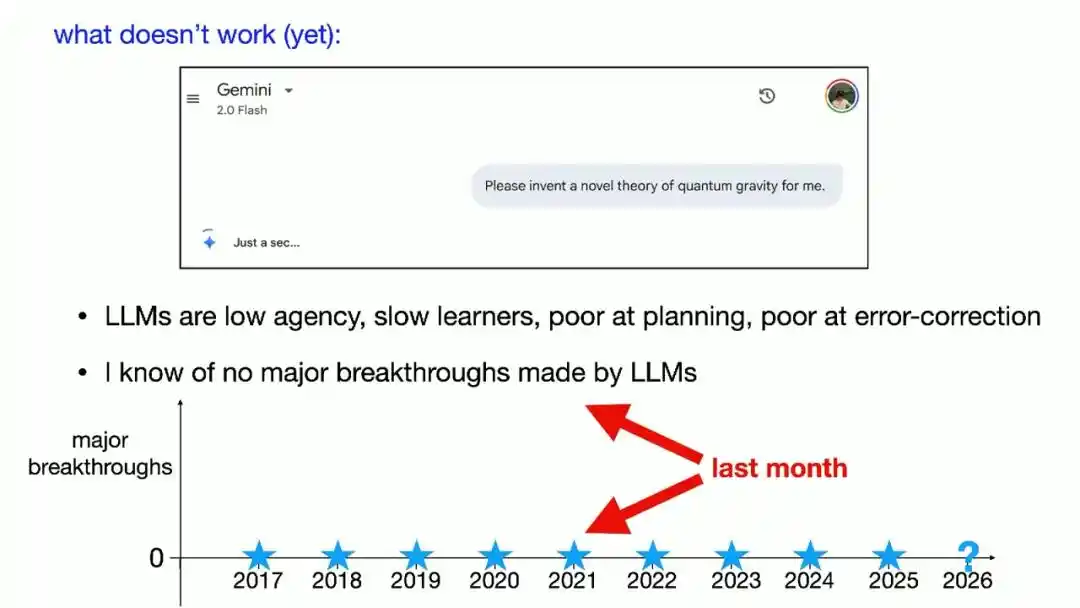
Entering 2026, the situation changed dramatically—for the better. Brown began with a near-provocative joke: 'Just last week, LLMs hadn't made any truly significant mathematical breakthroughs.' Now, that statement is no longer true.
Many have already heard about this major event. Erdős's 1946 'Unit Distance Conjecture,' believed for eighty years by the mathematical community to have the square grid configuration as the known optimal solution. A large model inside OpenAI independently provided a counterexample, using tools from algebraic number theory to construct a series of point sets where the number of unit distance pairs exceeded the previously accepted upper bound. This effectively disproved a long-held belief.
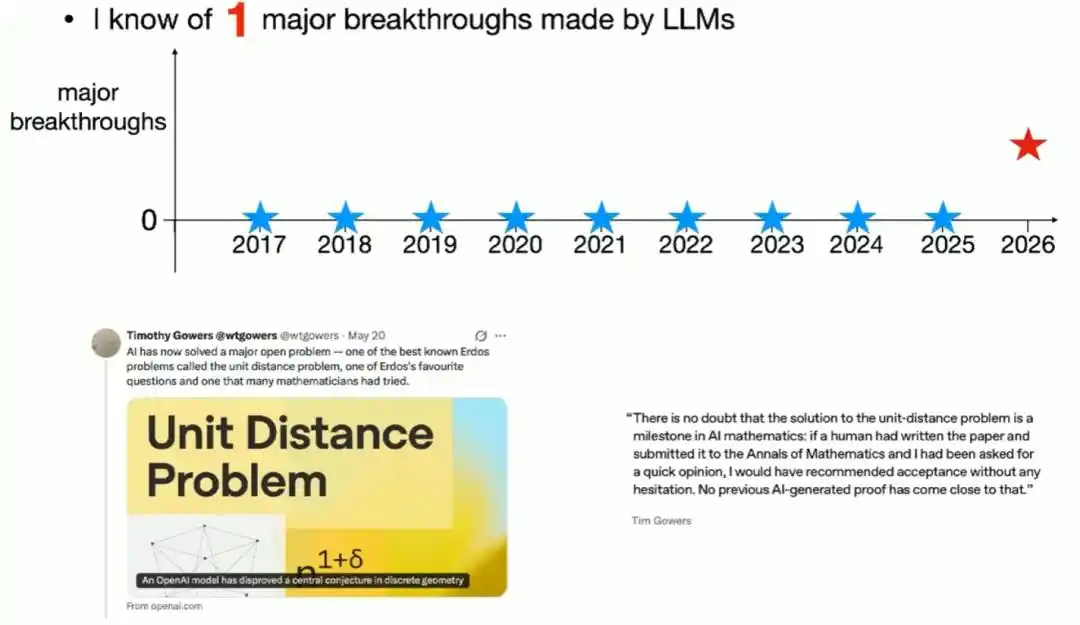
It's worth noting that this problem was not obscure; many had tried before, but mathematicians spent significant effort always wandering in the direction of 'proving' rather than 'disproving' the conjecture. Brown specifically mentioned that Fields Medalist Timothy Gowers participated in reviewing this result and gave it high praise.

Brown judges this to be the first genuinely significant breakthrough by large models in mathematics, and he believes it certainly won't be the last—'the floodgates have opened.' As model capabilities continue to surpass 'the threshold required to produce breakthroughs,' he expects more similar results to appear in succession.

He half-jokingly added that in retrospect, the reason this problem was cracked first is probably because its structure happened to fall within large models' 'comfort zone.' Next, models will first solve problems 'friendly to AI,' then gradually tackle those 'less friendly' ones.

The Prophecy from Chess

To convince the audience that this curve will continue to rise, Brown presented a graph that at first glance looked like a casually drawn line: a steadily climbing straight line. Of course, this graph wasn't drawn out of thin air; it was taken directly from real data on chess computer strength over time, with the y-axis being the Elo rating measuring playing strength and the x-axis being the year.
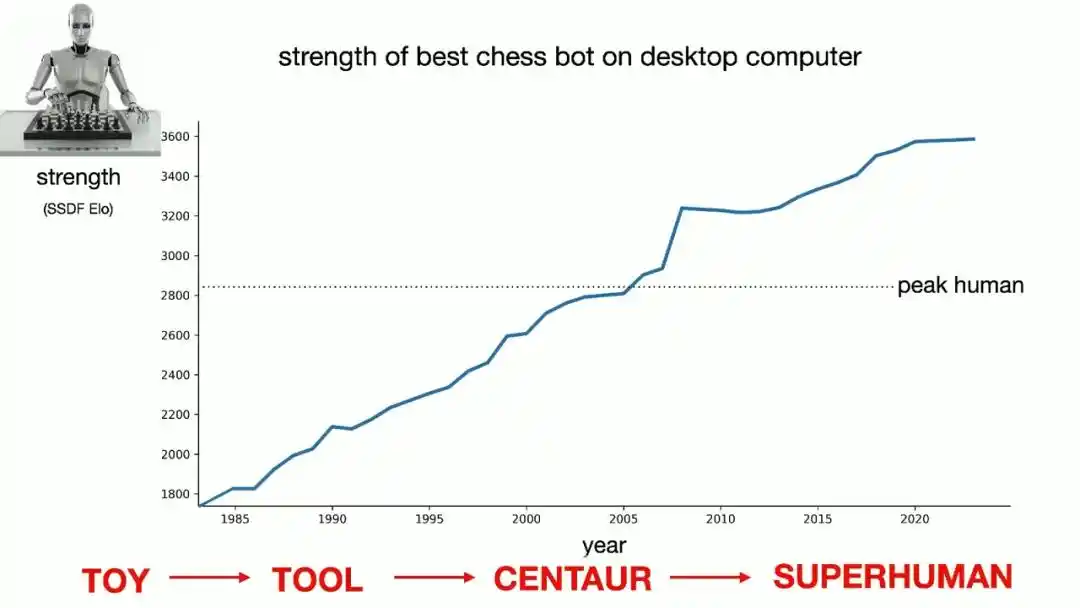
Brown outlined four historical stages of chess AI:

Initially, the 'Toy Era,' where getting a computer to make a single reasonable move was considered a miracle;

Then, the 'Tool Era,' where computers were only useful in specific aspects like endgame calculation or opening memorization;

Next, the 'Centaur Era,' where the strongest chess entity in the universe was the collaboration between grandmasters and the deep search capabilities of computers;

And now, humanity has fully entered the 'Superhuman Era': when top human players collaborate with computers, the optimal strategy is simply to let the computer play on its own.

Brown believes these four stages can be closely mapped to the field of scientific research.
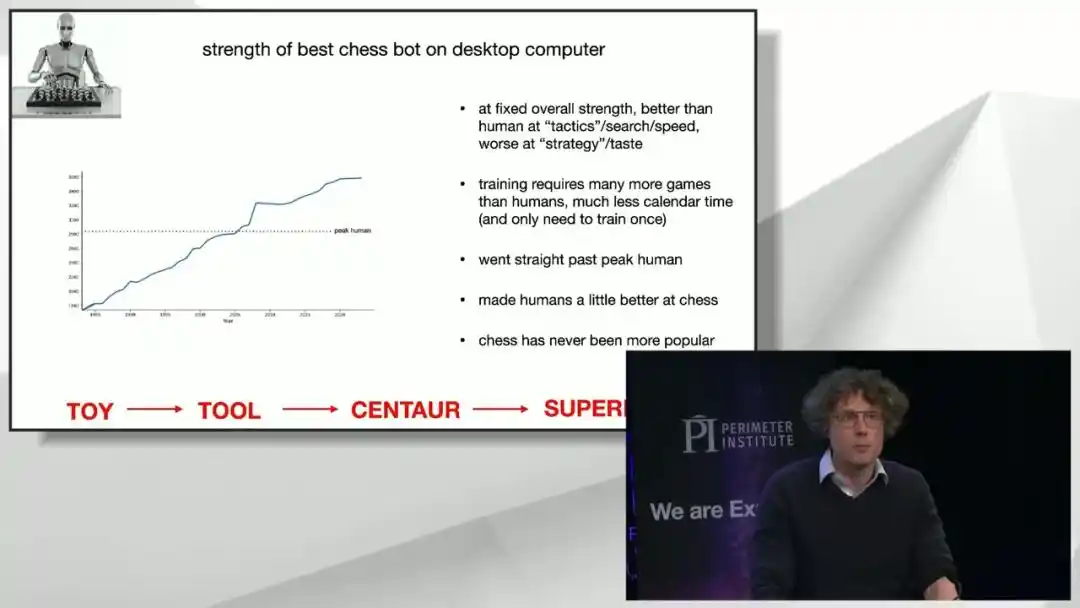
The first pattern is: at comparable overall strength, computers surpass humans in tactics and search speed but are weaker in strategy and 'taste' judgment. This precisely matches the characteristics currently exposed by large models in mathematical and physical research: they excel at applying existing lemmas and techniques but are less adept at judging 'which overall direction to take,' though this shortcoming is rapidly shrinking.

The second pattern is: the number of games needed to 'experience' for training a chess AI far exceeds the total number of games a human can play in a lifetime, but because machines can tirelessly play against themselves at high speed, the actual 'calendar time' required is far shorter than training a human chess player.

The third pattern is that once computer chess strength surpassed peak human level, it never stopped, as there is no physical or logical reason for it to conveniently stop near human level.

The fourth comforting fact is: the rise of chess AI has actually improved the overall level of human chess players; the strongest human players today are stronger than at any time in history, partly thanks to learning from super-strong AIs; and the game of chess itself has never been more popular.

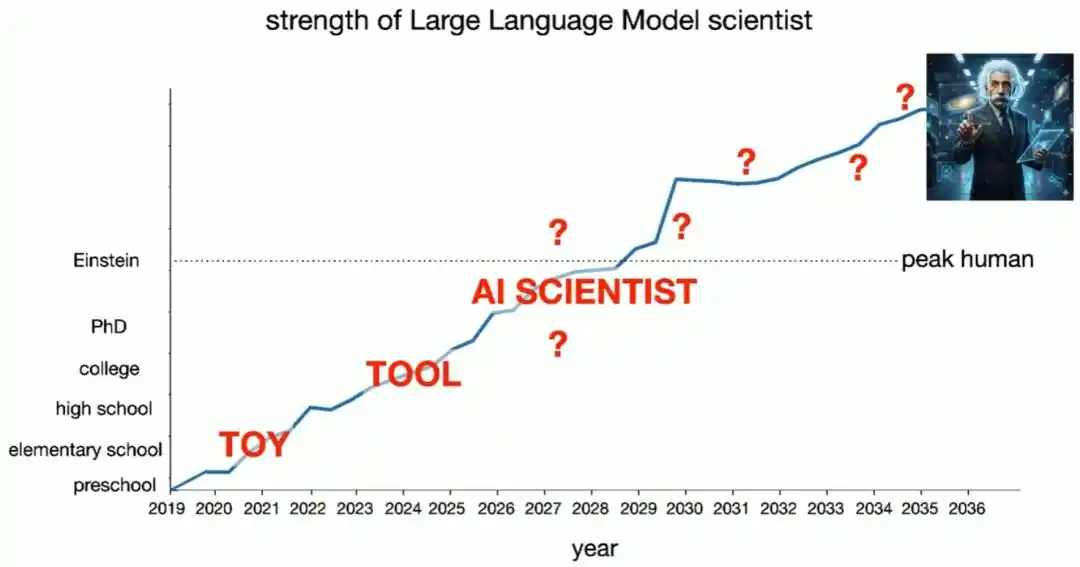
Brown's implication is clear: if scientific research follows this trajectory, humanity will likely first encounter fully autonomous 'AI scientists,' followed by something akin to 'AI Einsteins'... What happens after that, he admits, is beyond his predictive abilities.
Even if Progress Stops Here, Physics Has Already Been Transformed

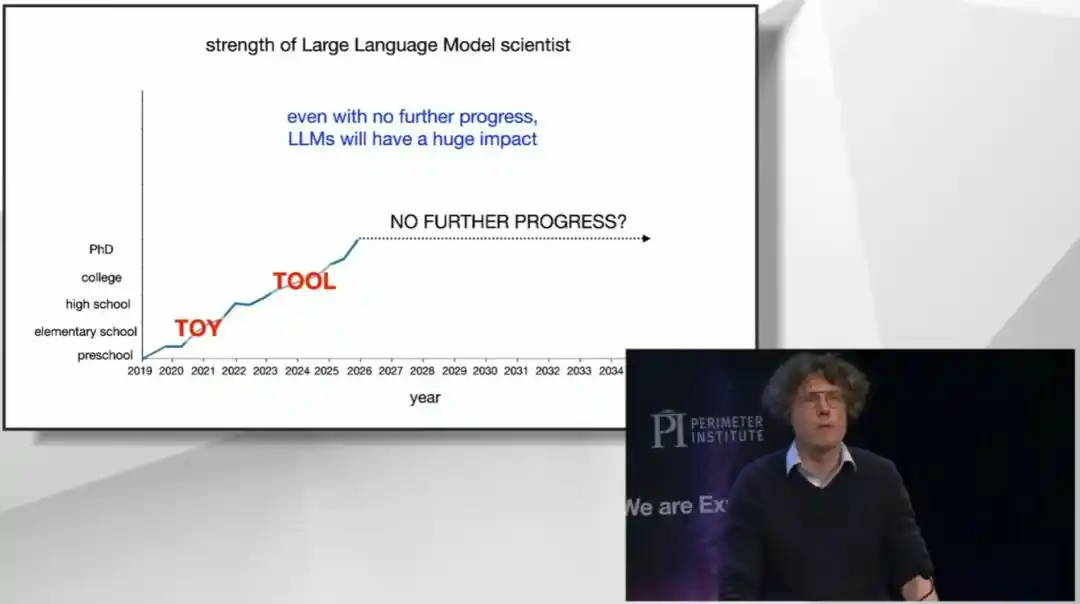
Brown also raised a cautionary 'pessimistic hypothesis': what if large model capabilities completely stagnate starting today?
He bluntly stated that what truly 'doesn't work' right now is directly asking the model, 'Please invent a brand new theory of quantum gravity for me.' The answer would likely be worthless, sleep-inducing 'AI nonsense.'

More generally, current large models still have four obvious shortcomings: low autonomy, slow learning speed, poor planning ability, and weak error-correction capability.
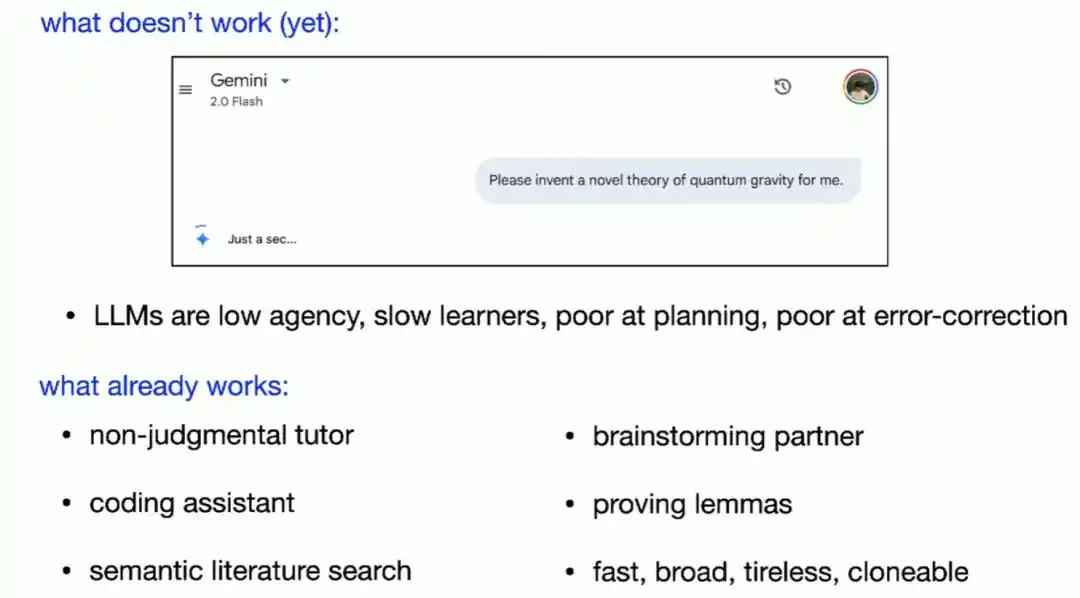
Brown admitted that all four shortcomings have significantly improved over the past year, but none have been completely solved. Consequently, a system that can ace graduate-level exams in every discipline has yet to produce results that could be called 'major breakthroughs.'

While preparing for this speech, he even specifically drew this as a flat 'straight line' marked with a question mark, self-deprecatingly admitting it was perhaps the only chart in the entire talk that 'didn't keep rising.' But he added that before the end of 2026, people would probably start arguing about how to define the term 'major breakthrough.' As it turned out, this day arrived even sooner than he himself anticipated.

However, even if progress truly stopped at this moment, Brown believes large models are already sufficient to completely transform the landscape of physics research.

He listed several already mature and still-improving use cases:

As a 'non-judgmental private tutor,' available at 3 AM to answer a physicist's own unclear knowledge gaps without waking a world-class expert;

As a programming assistant, now so strong that 'calling it just a programming assistant feels somewhat insulting.' Many physics problems previously considered 'not programming problems' can now be reframed as coding problems to solve;

As a literature retrieval tool, capable of reading an entire field's paper repository and directly telling you if an idea has already been explored; additionally, serving as a brainstorming partner.

Brown summarized that the core advantages of large models are: they are fast, broad in coverage, tireless, and can be replicated indefinitely. It takes decades to train a physicist, but once a powerful model is trained, you can run thousands of copies simultaneously—this alone is enough to 'completely change' the discipline.

Conclusion: The Golden Age of Physics

At the end of his speech, Brown gave his judgment on 'why progress won't stop.'
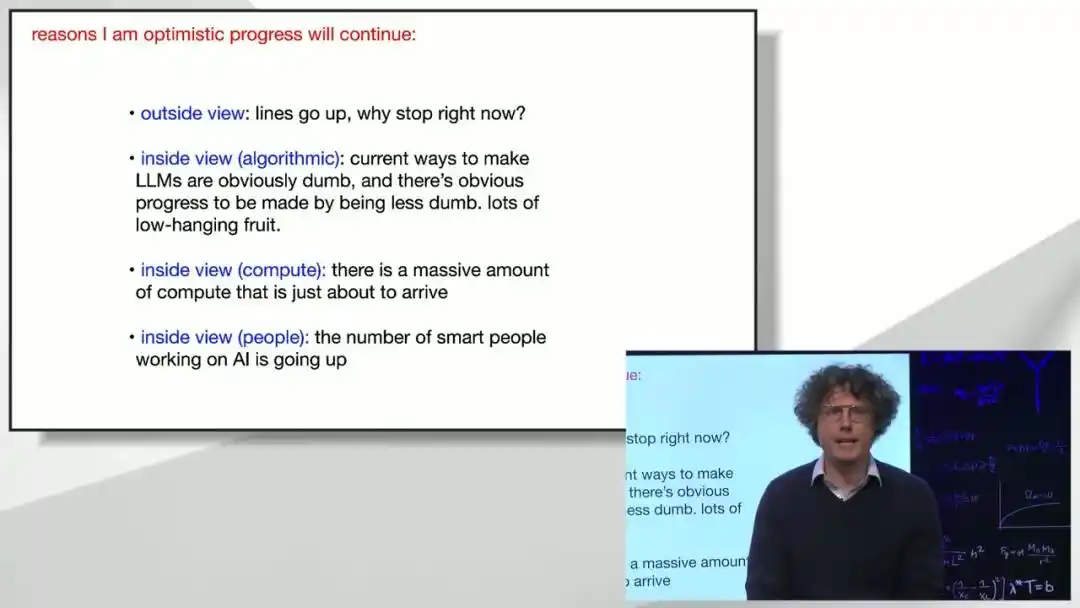
From a macroeconomic perspective, the funds currently invested in training still represent a very small fraction of global GDP, leaving ample room for growth. From a technical internal perspective, current methods for training large models are 'far less sophisticated than they appear.' Many obvious yet untried improvement ideas remain to be explored. Combined with the continuous influx of talent and compute into the field, Brown judges that current model architectures and compute scales are already sufficient to lead to Artificial General Intelligence, even without entirely new theoretical breakthroughs.

He also responded to a long-standing pessimistic view that large models only do 'pattern matching' and cannot generate genuinely new ideas.
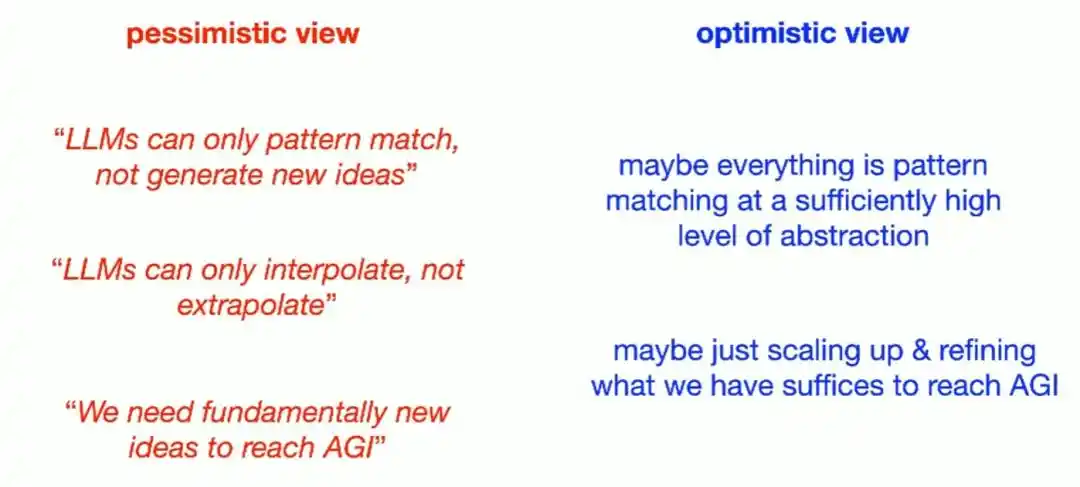
Brown's view is that if you abstract to a high enough level, almost all human creations that seem like 'major breakthroughs' are essentially a form of higher-dimensional pattern matching. A recurring phrase in this field that has been repeatedly validated is: 'these models just want to learn.' No matter how many seemingly reasonable theoretical reasons suggest they shouldn't learn well, their performance always exceeds expectations.

Brown's conclusion is that in the next few years, we will usher in a golden 'Centaur' era of human-AI collaboration: these tools will be placed in the hands of human physicists, mathematicians, and experts across fields, jointly kickstarting a new Renaissance in science and mathematics.

Further ahead, if 'creating an AI Einstein' is truly achieved, since replicating a trained model comes at almost no extra cost, humanity will likely soon have billions of 'superhuman-level AI Einsteins' operating simultaneously. This sounds like science fiction, but it's happening.
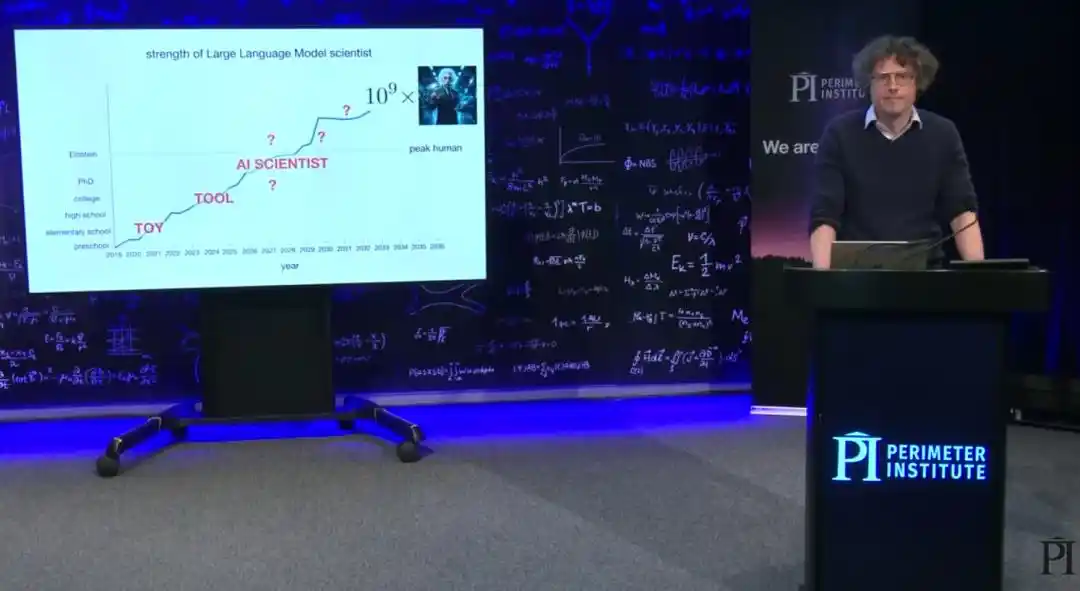
Brown said that in the long run, where AI will ultimately take physics is as difficult for him to predict as for anyone else. He even believes that the continuous improvement of AI capabilities is making the future of the entire world harder to predict. But one thing he is sure of: the next few years will be the most exciting time in the history of physics. He expects the problems that have plagued his entire career to be answered one by one in the not-too-distant future.

This article is from the WeChat public account 'Machine Heart' (ID: almosthuman2014), Author: Following AI.


Crypto di tendenza

Domande pertinenti

QWhat is the title of Adam Brown's speech mentioned in the article, and who praised it as 'amazingly good'?

AThe title of Adam Brown's speech is 'Training Sand to Think: Artificial General Intelligence & Future of Physics.' It was praised as 'amazingly good' by Nobel laureate and Turing Award winner Geoffrey Hinton.

QAccording to Adam Brown, how are Large Language Models (LLMs) fundamentally different from traditional computer programs?

AAdam Brown states that LLMs are not 'programmed' but 'grown.' They are developed through a two-stage process: pre-training on vast amounts of text to predict the next word, and post-training (akin to 'finishing school') to make them more useful and polite, rather than being explicitly coded with rules.

QWhat was the significant mathematical breakthrough achieved by an AI model regarding Erdős' 1946 'unit distances' conjecture?

AAn AI model independently found a counterexample to Erdős' 1946 'unit distances' conjecture. It constructed a set of points with more unit distance pairs than was previously thought possible for a given number of points, effectively disproving the long-standing conjecture.

QWhat analogy does Brown use to describe the likely future stages of AI in scientific research, based on the history of chess AI?

ABrown uses the history of chess AI to describe four likely stages for AI in science: 1) Toy Stage (early capabilities), 2) Tool Stage (useful for specific tasks), 3) Centaur Stage (deep human-AI collaboration), and 4) Superhuman Stage (AI surpassing human capabilities and operating autonomously).

QWhat are the current four major shortcomings of large models that Brown identifies, even if progress were to stop today?

AThe four major shortcomings Brown identifies are: 1) Low autonomy, 2) Slow learning speed (compared to runtime inference), 3) Poor planning ability, and 4) Weak error-correction capability. Despite these, he believes AI has already reshaped physics research.

Letture associate

Valuation of $8 Billion, Up 200% in 8 Months! What's Behind Crypto-Friendly Bank Erebor Bank's Rise?

Erebor Bank, a digital bank founded by Palmer Luckey and backed by Peter Thiel, is in talks for new funding at a target valuation of $8 billion, double its $4.35 billion valuation from December. This surge is driven by explosive deposit growth, which soared from $1.1 billion in March to approximately $4.05 billion within a quarter, alongside adding nearly 400 new clients. The bank, launched in February 2026, holds a full national bank charter from the OCC, a strategic choice to avoid reliance on partner banks. It aims to serve tech startups, defense contractors, and crypto-native businesses, addressing gaps left by Silicon Valley Bank's collapse. Core promises include lending against non-traditional assets like hardware, offering 24/7 settlement, and integrating stablecoin services with traditional banking. It has already enabled stablecoin deposits and withdrawals on the Sui network. However, its current financials show minimal lending activity and a net loss, with high liquidity in cash and securities. The valuation hinges on future potential to monetize deposits through lending and crypto services. The bank's experienced management team includes veterans from Wells Fargo and crypto compliance firms. Risks are significant. Its concentrated customer base and exposure to volatile sectors like crypto and venture capital echo SVB's vulnerabilities. Its entire model depends on continued regulatory favor towards digital assets, which could shift. Erebor represents a high-profile experiment at the intersection of banking, crypto, and industrial policy, with its execution and market demand yet to be fully proven.

marsbit1 h fa

Valuation of $8 Billion, Up 200% in 8 Months! What's Behind Crypto-Friendly Bank Erebor Bank's Rise?

marsbit1 h fa

$8 Billion Valuation, 2x Growth in 8 Months! What Makes Crypto-Friendly Bank Erebor Bank So Special?

Erebor Bank, a crypto-friendly U.S. bank founded by Palmer Luckey, is reportedly in talks for a new funding round targeting a valuation of at least $8 billion, double its $4.35 billion valuation from December. Despite being operational for only a few months, its rapid growth—deposits surged from $1.1 billion in March to approximately $4.05 billion within a quarter, adding nearly 400 clients—has attracted investor interest. The bank aims to fill the void left by Silicon Valley Bank's collapse, targeting startups and businesses with non-traditional assets like defense contracts and digital tokens. Its strategy involves holding its own banking license to offer services like stablecoin deposits, payments, and 24/7 on-chain settlement. While digital assets are a core long-term focus, recent growth has been driven more by financing for U.S. manufacturing and defense sectors. Erebor's leadership combines Luckey's tech/defense background with a seasoned financial team. It received a national bank charter from the OCC in early 2026, benefiting from a favorable regulatory climate for digital assets. However, the bank faces significant risks, including reliance on a concentrated client base, exposure to crypto market volatility, potential regulatory shifts, and the unproven demand for its integrated banking model. Investors are betting on its future potential to monetize deposits through lending and crypto services, despite current losses typical for a new bank.

链捕手1 h fa

$8 Billion Valuation, 2x Growth in 8 Months! What Makes Crypto-Friendly Bank Erebor Bank So Special?

链捕手1 h fa

Trading

Spot

Articoli Popolari

Cosa è GROK AI

Grok AI: Rivoluzionare la Tecnologia Conversazionale nell'Era Web3 Introduzione Nel panorama in rapida evoluzione dell'intelligenza artificiale, Grok AI si distingue come un progetto notevole che collega i domini della tecnologia avanzata e dell'interazione con l'utente. Sviluppato da xAI, un'azienda guidata dal rinomato imprenditore Elon Musk, Grok AI cerca di ridefinire il modo in cui interagiamo con l'intelligenza artificiale. Mentre il movimento Web3 continua a prosperare, Grok AI mira a sfruttare il potere dell'IA conversazionale per rispondere a query complesse, offrendo agli utenti un'esperienza che è non solo informativa ma anche divertente. Cos'è Grok AI? Grok AI è un sofisticato chatbot di intelligenza artificiale conversazionale progettato per interagire dinamicamente con gli utenti. A differenza di molti sistemi di intelligenza artificiale tradizionali, Grok AI abbraccia un'ampia gamma di domande, comprese quelle tipicamente considerate inappropriate o al di fuori delle risposte standard. Gli obiettivi principali del progetto includono: Ragionamento Affidabile: Grok AI enfatizza il ragionamento di buon senso per fornire risposte logiche basate sulla comprensione contestuale. Supervisione Scalabile: L'integrazione dell'assistenza degli strumenti garantisce che le interazioni degli utenti siano sia monitorate che ottimizzate per la qualità. Verifica Formale: La sicurezza è fondamentale; Grok AI incorpora metodi di verifica formale per migliorare l'affidabilità delle sue uscite. Comprensione del Lungo Contesto: Il modello di IA eccelle nel trattenere e richiamare una vasta storia di conversazione, facilitando discussioni significative e consapevoli del contesto. Robustezza Adversariale: Concentrandosi sul miglioramento delle sue difese contro input manipolati o malevoli, Grok AI mira a mantenere l'integrità delle interazioni degli utenti. In sostanza, Grok AI non è solo un dispositivo di recupero informazioni; è un partner conversazionale immersivo che incoraggia un dialogo dinamico. Creatore di Grok AI Il cervello dietro Grok AI non è altri che Elon Musk, un individuo sinonimo di innovazione in vari campi, tra cui automotive, viaggi spaziali e tecnologia. Sotto l'egida di xAI, un'azienda focalizzata sull'avanzamento della tecnologia AI in modi benefici, la visione di Musk mira a rimodellare la comprensione delle interazioni con l'IA. La leadership e l'etica fondamentale sono profondamente influenzate dall'impegno di Musk nel superare i confini tecnologici. Investitori di Grok AI Sebbene i dettagli specifici riguardanti gli investitori che sostengono Grok AI rimangano limitati, è pubblicamente riconosciuto che xAI, l'incubatore del progetto, è fondato e supportato principalmente dallo stesso Elon Musk. Le precedenti imprese e partecipazioni di Musk forniscono un robusto sostegno, rafforzando ulteriormente la credibilità e il potenziale di crescita di Grok AI. Tuttavia, al momento, le informazioni riguardanti ulteriori fondazioni di investimento o organizzazioni che supportano Grok AI non sono facilmente accessibili, segnando un'area per potenziali esplorazioni future. Come Funziona Grok AI? Le meccaniche operative di Grok AI sono innovative quanto il suo framework concettuale. Il progetto integra diverse tecnologie all'avanguardia che facilitano le sue funzionalità uniche: Infrastruttura Robusta: Grok AI è costruito utilizzando Kubernetes per l'orchestrazione dei container, Rust per prestazioni e sicurezza, e JAX per il calcolo numerico ad alte prestazioni. Questo trio garantisce che il chatbot operi in modo efficiente, si scaldi efficacemente e serva gli utenti prontamente. Accesso alla Conoscenza in Tempo Reale: Una delle caratteristiche distintive di Grok AI è la sua capacità di attingere a dati in tempo reale attraverso la piattaforma X—precedentemente nota come Twitter. Questa capacità consente all'IA di accedere alle informazioni più recenti, permettendole di fornire risposte e raccomandazioni tempestive che altri modelli di IA potrebbero perdere. Due Modalità di Interazione: Grok AI offre agli utenti la scelta tra “Modalità Divertente” e “Modalità Normale”. La Modalità Divertente consente uno stile di interazione più giocoso e umoristico, mentre la Modalità Normale si concentra sulla fornitura di risposte precise e accurate. Questa versatilità garantisce un'esperienza su misura che soddisfa varie preferenze degli utenti. In sostanza, Grok AI sposa prestazioni con coinvolgimento, creando un'esperienza che è sia arricchente che divertente. Cronologia di Grok AI Il viaggio di Grok AI è segnato da traguardi fondamentali che riflettono le sue fasi di sviluppo e distribuzione: Sviluppo Iniziale: La fase fondamentale di Grok AI si è svolta in circa due mesi, durante i quali sono stati condotti l'addestramento iniziale e il perfezionamento del modello. Rilascio Beta di Grok-2: In un significativo avanzamento, è stata annunciata la beta di Grok-2. Questo rilascio ha introdotto due versioni del chatbot—Grok-2 e Grok-2 mini—ognuna dotata delle capacità per chattare, programmare e ragionare. Accesso Pubblico: Dopo lo sviluppo beta, Grok AI è diventato disponibile per gli utenti della piattaforma X. Coloro che hanno account verificati tramite un numero di telefono e attivi per almeno sette giorni possono accedere a una versione limitata, rendendo la tecnologia disponibile a un pubblico più ampio. Questa cronologia racchiude la crescita sistematica di Grok AI dall'inizio all'impegno pubblico, enfatizzando il suo impegno per il miglioramento continuo e l'interazione con gli utenti. Caratteristiche Chiave di Grok AI Grok AI comprende diverse caratteristiche chiave che contribuiscono alla sua identità innovativa: Integrazione della Conoscenza in Tempo Reale: L'accesso a informazioni attuali e rilevanti differenzia Grok AI da molti modelli statici, consentendo un'esperienza utente coinvolgente e accurata. Stili di Interazione Versatili: Offrendo modalità di interazione distinte, Grok AI soddisfa varie preferenze degli utenti, invitando alla creatività e alla personalizzazione nella conversazione con l'IA. Avanzata Struttura Tecnologica: L'utilizzo di Kubernetes, Rust e JAX fornisce al progetto un solido framework per garantire affidabilità e prestazioni ottimali. Considerazione del Discorso Etico: L'inclusione di una funzione di generazione di immagini mette in mostra lo spirito innovativo del progetto. Tuttavia, solleva anche considerazioni etiche riguardanti il copyright e la rappresentazione rispettosa di figure riconoscibili—una discussione in corso all'interno della comunità AI. Conclusione Come entità pionieristica nel campo dell'IA conversazionale, Grok AI incarna il potenziale per esperienze utente trasformative nell'era digitale. Sviluppato da xAI e guidato dall'approccio visionario di Elon Musk, Grok AI integra conoscenze in tempo reale con capacità di interazione avanzate. Si sforza di spingere i confini di ciò che l'intelligenza artificiale può realizzare, mantenendo un focus su considerazioni etiche e sicurezza degli utenti. Grok AI non solo incarna il progresso tecnologico, ma rappresenta anche un nuovo paradigma conversazionale nel panorama Web3, promettendo di coinvolgere gli utenti con sia conoscenze esperte che interazioni giocose. Man mano che il progetto continua a evolversi, si erge come testimonianza di ciò che l'incrocio tra tecnologia, creatività e interazione simile a quella umana può realizzare.

511 Totale visualizzazioniPubblicato il 2024.12.26Aggiornato il 2024.12.26

Cosa è GROK AI

Cosa è ERC AI

Euruka Tech: Una Panoramica di $erc ai e delle sue Ambizioni in Web3 Introduzione Nel panorama in rapida evoluzione della tecnologia blockchain e delle applicazioni decentralizzate, nuovi progetti emergono frequentemente, ciascuno con obiettivi e metodologie uniche. Uno di questi progetti è Euruka Tech, che opera nel vasto dominio delle criptovalute e del Web3. L'obiettivo principale di Euruka Tech, in particolare del suo token $erc ai, è presentare soluzioni innovative progettate per sfruttare le crescenti capacità della tecnologia decentralizzata. Questo articolo si propone di fornire una panoramica completa di Euruka Tech, un'esplorazione dei suoi obiettivi, della funzionalità, dell'identità del suo creatore, dei potenziali investitori e della sua importanza nel contesto più ampio del Web3. Cos'è Euruka Tech, $erc ai? Euruka Tech è caratterizzato come un progetto che sfrutta gli strumenti e le funzionalità offerte dall'ambiente Web3, concentrandosi sull'integrazione dell'intelligenza artificiale nelle sue operazioni. Sebbene i dettagli specifici sul framework del progetto siano piuttosto sfuggenti, è progettato per migliorare l'engagement degli utenti e automatizzare i processi nello spazio crypto. Il progetto mira a creare un ecosistema decentralizzato che non solo faciliti le transazioni, ma incorpori anche funzionalità predittive attraverso l'intelligenza artificiale, da cui il nome del suo token, $erc ai. L'obiettivo è fornire una piattaforma intuitiva che faciliti interazioni più intelligenti e un'elaborazione delle transazioni più efficiente all'interno della crescente sfera del Web3. Chi è il Creatore di Euruka Tech, $erc ai? Attualmente, le informazioni riguardanti il creatore o il team fondatore di Euruka Tech rimangono non specificate e piuttosto opache. Questa assenza di dati solleva preoccupazioni, poiché la conoscenza del background del team è spesso essenziale per stabilire credibilità nel settore blockchain. Pertanto, abbiamo classificato queste informazioni come sconosciute fino a quando dettagli concreti non saranno resi disponibili nel dominio pubblico. Chi sono gli Investitori di Euruka Tech, $erc ai? Allo stesso modo, l'identificazione degli investitori o delle organizzazioni di supporto per il progetto Euruka Tech non è prontamente fornita attraverso la ricerca disponibile. Un aspetto cruciale per i potenziali stakeholder o utenti che considerano di impegnarsi con Euruka Tech è la garanzia che deriva da partnership finanziarie consolidate o dal supporto di società di investimento rispettabili. Senza divulgazioni sulle affiliazioni di investimento, è difficile trarre conclusioni complete sulla sicurezza finanziaria o sulla longevità del progetto. In linea con le informazioni trovate, anche questa sezione rimane allo stato di sconosciuto. Come funziona Euruka Tech, $erc ai? Nonostante la mancanza di specifiche tecniche dettagliate per Euruka Tech, è essenziale considerare le sue ambizioni innovative. Il progetto cerca di sfruttare la potenza computazionale dell'intelligenza artificiale per automatizzare e migliorare l'esperienza dell'utente all'interno dell'ambiente delle criptovalute. Integrando l'IA con la tecnologia blockchain, Euruka Tech mira a fornire funzionalità come operazioni automatizzate, valutazioni del rischio e interfacce utente personalizzate. L'essenza innovativa di Euruka Tech risiede nel suo obiettivo di creare una connessione fluida tra gli utenti e le vaste possibilità presentate dalle reti decentralizzate. Attraverso l'utilizzo di algoritmi di apprendimento automatico e IA, mira a ridurre le sfide degli utenti alle prime armi e semplificare le esperienze transazionali all'interno del framework Web3. Questa simbiosi tra IA e blockchain sottolinea l'importanza del token $erc ai, fungendo da ponte tra le interfacce utente tradizionali e le avanzate capacità delle tecnologie decentralizzate. Cronologia di Euruka Tech, $erc ai Sfortunatamente, a causa delle limitate informazioni disponibili riguardo a Euruka Tech, non siamo in grado di presentare una cronologia dettagliata dei principali sviluppi o traguardi nel percorso del progetto. Questa cronologia, tipicamente preziosa per tracciare l'evoluzione di un progetto e comprendere la sua traiettoria di crescita, non è attualmente disponibile. Man mano che le informazioni su eventi notevoli, partnership o aggiunte funzionali diventano evidenti, gli aggiornamenti miglioreranno sicuramente la visibilità di Euruka Tech nella sfera crypto. Chiarimento su Altri Progetti “Eureka” È importante sottolineare che più progetti e aziende condividono una nomenclatura simile con “Eureka.” La ricerca ha identificato iniziative come un agente IA della NVIDIA Research, che si concentra sull'insegnamento ai robot di compiti complessi utilizzando metodi generativi, così come Eureka Labs ed Eureka AI, che migliorano l'esperienza utente nell'istruzione e nell'analisi del servizio clienti, rispettivamente. Tuttavia, questi progetti sono distinti da Euruka Tech e non dovrebbero essere confusi con i suoi obiettivi o funzionalità. Conclusione Euruka Tech, insieme al suo token $erc ai, rappresenta un attore promettente ma attualmente oscuro nel panorama del Web3. Sebbene i dettagli sul suo creatore e sugli investitori rimangano non divulgati, l'ambizione centrale di combinare intelligenza artificiale e tecnologia blockchain si erge come un punto focale di interesse. Gli approcci unici del progetto nel promuovere l'engagement degli utenti attraverso l'automazione avanzata potrebbero distinguerlo mentre l'ecosistema Web3 progredisce. Con l'evoluzione continua del mercato crypto, gli stakeholder dovrebbero tenere d'occhio gli sviluppi riguardanti Euruka Tech, poiché lo sviluppo di innovazioni documentate, partnership o una roadmap definita potrebbe presentare opportunità significative nel prossimo futuro. Così com'è, attendiamo ulteriori approfondimenti sostanziali che potrebbero svelare il potenziale di Euruka Tech e la sua posizione nel competitivo panorama crypto.

532 Totale visualizzazioniPubblicato il 2025.01.02Aggiornato il 2025.01.02

Cosa è ERC AI

Cosa è DUOLINGO AI

DUOLINGO AI: Integrare l'apprendimento delle lingue con Web3 e innovazione AI In un'era in cui la tecnologia rimodella l'istruzione, l'integrazione dell'intelligenza artificiale (AI) e delle reti blockchain annuncia una nuova frontiera per l'apprendimento delle lingue. Entra in scena DUOLINGO AI e la sua criptovaluta associata, $DUOLINGO AI. Questo progetto aspira a fondere la potenza educativa delle principali piattaforme di apprendimento delle lingue con i benefici della tecnologia decentralizzata Web3. Questo articolo esplora gli aspetti chiave di DUOLINGO AI, esaminando i suoi obiettivi, il framework tecnologico, lo sviluppo storico e il potenziale futuro, mantenendo chiarezza tra la risorsa educativa originale e questa iniziativa indipendente di criptovaluta. Panoramica di DUOLINGO AI Alla sua base, DUOLINGO AI cerca di stabilire un ambiente decentralizzato in cui gli studenti possono guadagnare ricompense crittografiche per il raggiungimento di traguardi educativi nella competenza linguistica. Applicando smart contracts, il progetto mira ad automatizzare i processi di verifica delle competenze e le allocazioni di token, aderendo ai principi di Web3 che enfatizzano la trasparenza e la proprietà da parte degli utenti. Il modello si discosta dagli approcci tradizionali all'acquisizione linguistica, facendo forte affidamento su una struttura di governance guidata dalla comunità, che consente ai detentori di token di suggerire miglioramenti ai contenuti dei corsi e alle distribuzioni delle ricompense. Alcuni degli obiettivi notevoli di DUOLINGO AI includono: Apprendimento Gamificato: Il progetto integra traguardi blockchain e token non fungibili (NFT) per rappresentare i livelli di competenza linguistica, promuovendo la motivazione attraverso ricompense digitali coinvolgenti. Creazione di Contenuti Decentralizzati: Apre opportunità per educatori e appassionati di lingue di contribuire con i propri corsi, facilitando un modello di condivisione dei ricavi che beneficia tutti i collaboratori. Personalizzazione Guidata dall'AI: Utilizzando modelli avanzati di machine learning, DUOLINGO AI personalizza le lezioni per adattarsi ai progressi individuali, simile alle funzionalità adattive presenti nelle piattaforme consolidate. Creatori del Progetto e Governance A partire da aprile 2025, il team dietro $DUOLINGO AI rimane pseudonimo, una pratica comune nel panorama decentralizzato delle criptovalute. Questa anonimato è inteso a promuovere la crescita collettiva e il coinvolgimento degli stakeholder piuttosto che concentrarsi su sviluppatori individuali. Lo smart contract distribuito sulla blockchain di Solana annota l'indirizzo del wallet dello sviluppatore, che segna l'impegno verso la trasparenza riguardo alle transazioni, nonostante l'identità dei creatori sia sconosciuta. Secondo la sua roadmap, DUOLINGO AI mira a evolversi in un'Organizzazione Autonoma Decentralizzata (DAO). Questa struttura di governance consente ai detentori di token di votare su questioni critiche come l'implementazione di funzionalità e le allocazioni del tesoro. Questo modello si allinea con l'etica dell'empowerment della comunità presente in varie applicazioni decentralizzate, enfatizzando l'importanza del processo decisionale collettivo. Investitori e Partnership Strategiche Attualmente, non ci sono investitori istituzionali o capitalisti di rischio identificabili pubblicamente legati a $DUOLINGO AI. Invece, la liquidità del progetto proviene principalmente da scambi decentralizzati (DEX), segnando un netto contrasto con le strategie di finanziamento delle aziende tradizionali di tecnologia educativa. Questo modello di base indica un approccio guidato dalla comunità, riflettendo l'impegno del progetto verso la decentralizzazione. Nel suo whitepaper, DUOLINGO AI menziona la formazione di collaborazioni con “piattaforme educative blockchain” non specificate, mirate ad arricchire la sua offerta di corsi. Sebbene partnership specifiche non siano ancora state divulgate, questi sforzi collaborativi suggeriscono una strategia per mescolare innovazione blockchain con iniziative educative, ampliando l'accesso e il coinvolgimento degli utenti attraverso diverse vie di apprendimento. Architettura Tecnologica Integrazione AI DUOLINGO AI incorpora due componenti principali guidate dall'AI per migliorare la sua offerta educativa: Motore di Apprendimento Adattivo: Questo sofisticato motore apprende dalle interazioni degli utenti, simile ai modelli proprietari delle principali piattaforme educative. Regola dinamicamente la difficoltà delle lezioni per affrontare le sfide specifiche degli studenti, rinforzando le aree deboli attraverso esercizi mirati. Agenti Conversazionali: Utilizzando chatbot alimentati da GPT-4, DUOLINGO AI offre una piattaforma per gli utenti per impegnarsi in conversazioni simulate, promuovendo un'esperienza di apprendimento linguistico più interattiva e pratica. Infrastruttura Blockchain Costruito sulla blockchain di Solana, $DUOLINGO AI utilizza un framework tecnologico completo che include: Smart Contracts per la Verifica delle Competenze: Questa funzionalità assegna automaticamente token agli utenti che superano con successo i test di competenza, rinforzando la struttura di incentivi per risultati di apprendimento genuini. Badge NFT: Questi token digitali significano vari traguardi che gli studenti raggiungono, come completare una sezione del loro corso o padroneggiare competenze specifiche, consentendo loro di scambiare o mostrare digitalmente i loro successi. Governance DAO: I membri della comunità dotati di token possono partecipare alla governance votando su proposte chiave, facilitando una cultura partecipativa che incoraggia l'innovazione nell'offerta di corsi e nelle funzionalità della piattaforma. Cronologia Storica 2022–2023: Concettualizzazione I lavori per DUOLINGO AI iniziano con la creazione di un whitepaper, evidenziando la sinergia tra i progressi dell'AI nell'apprendimento delle lingue e il potenziale decentralizzato della tecnologia blockchain. 2024: Lancio Beta Un lancio beta limitato introduce offerte in lingue popolari, premiando i primi utenti con incentivi in token come parte della strategia di coinvolgimento della comunità del progetto. 2025: Transizione DAO Ad aprile, avviene un lancio completo della mainnet con la circolazione di token, stimolando discussioni nella comunità riguardo a possibili espansioni nelle lingue asiatiche e ad altri sviluppi dei corsi. Sfide e Direzioni Future Ostacoli Tecnici Nonostante i suoi obiettivi ambiziosi, DUOLINGO AI affronta sfide significative. La scalabilità rimane una preoccupazione costante, in particolare nel bilanciare i costi associati all'elaborazione dell'AI e nel mantenere una rete decentralizzata reattiva. Inoltre, garantire la creazione e la moderazione di contenuti di qualità in un'offerta decentralizzata presenta complessità nel mantenere standard educativi. Opportunità Strategiche Guardando al futuro, DUOLINGO AI ha il potenziale per sfruttare partnership di micro-credentialing con istituzioni accademiche, fornendo validazioni verificate dalla blockchain delle competenze linguistiche. Inoltre, l'espansione cross-chain potrebbe consentire al progetto di attingere a basi utenti più ampie e a ulteriori ecosistemi blockchain, migliorando la sua interoperabilità e portata. Conclusione DUOLINGO AI rappresenta una fusione innovativa di intelligenza artificiale e tecnologia blockchain, presentando un'alternativa focalizzata sulla comunità ai sistemi tradizionali di apprendimento delle lingue. Sebbene il suo sviluppo pseudonimo e il modello economico emergente comportino alcuni rischi, l'impegno del progetto verso l'apprendimento gamificato, l'istruzione personalizzata e la governance decentralizzata illumina un percorso per la tecnologia educativa nel regno di Web3. Man mano che l'AI continua a progredire e l'ecosistema blockchain evolve, iniziative come DUOLINGO AI potrebbero ridefinire il modo in cui gli utenti interagiscono con l'istruzione linguistica, potenziando le comunità e premiando il coinvolgimento attraverso meccanismi di apprendimento innovativi.

483 Totale visualizzazioniPubblicato il 2025.04.11Aggiornato il 2025.04.11

Cosa è DUOLINGO AI

Discussioni

Benvenuto nella Community HTX. Qui puoi rimanere informato sugli ultimi sviluppi della piattaforma e accedere ad approfondimenti esperti sul mercato. Le opinioni degli utenti sul prezzo di AI AI sono presentate come di seguito.

活动图片