This is the age of artificial intelligence, filled with paradoxes—prediction paradox, employment quantification paradox, productivity paradox, data value paradox, industrial revolution paradox... We move forward amidst these paradoxes.
Prediction Paradox
Regarding the future of AI, people always seem to get their predictions wrong, whether they are Turing Award winners, Nobel laureates, entrepreneurs, or startup founders. They consistently make unrealistic or overly conservative judgments. This is the prediction paradox of AI.
Historically, pioneers like Marvin Minsky, Allen Newell, and Herbert Simon have all made predictions that later seemed laughably inaccurate. For example, Marvin Minsky stated in 1970: 'In from three to eight years we will have a machine with the general intelligence of an average human being.' We are still working towards that goal today.
Geoffrey Hinton is one of the most influential figures today, hailed as the 'Godfather of AI.' He predicted in 2016: 'We should stop training radiologists now. It's just completely obvious that within five years, deep learning is going to do better than radiologists.' This did not come true; reality moved in the opposite direction, with both the number of radiologists and their incomes significantly increasing in the US over the past decade.
Demis Hassabis holds a status comparable to Hinton. He stated (2025): 'In about ten years or so, AI may help cure all diseases.' As the most successful AI entrepreneur, Sam Altman (2025) believes AI can double human lifespan within 5-10 years. We await these near-future prophecies.
The above are the predictions of the six most famous figures. In terms of topics, AGI is currently the most sought-after. There is a clear divergence in judgments about the timeline for AGI between entrepreneurs and scholars. Entrepreneurs are radically optimistic, even believing it will arrive very soon. There are mainly four categories: 1) it's already here (we are in it but don't realize it), 2) it's coming immediately (one or two years), 3) it will come in the short term (three to five years), 4) it will only come in the long term (five to ten years, or even longer). Some of these judgments have already been disproven, while others still need time to test. As shown in the table below. Scholars are generally pessimistic, even considering AGI a pseudo-problem that will never arrive. For example, Iris van Rooij points out (2024): 'Creating AGI with human-level cognitive abilities is impossible.'
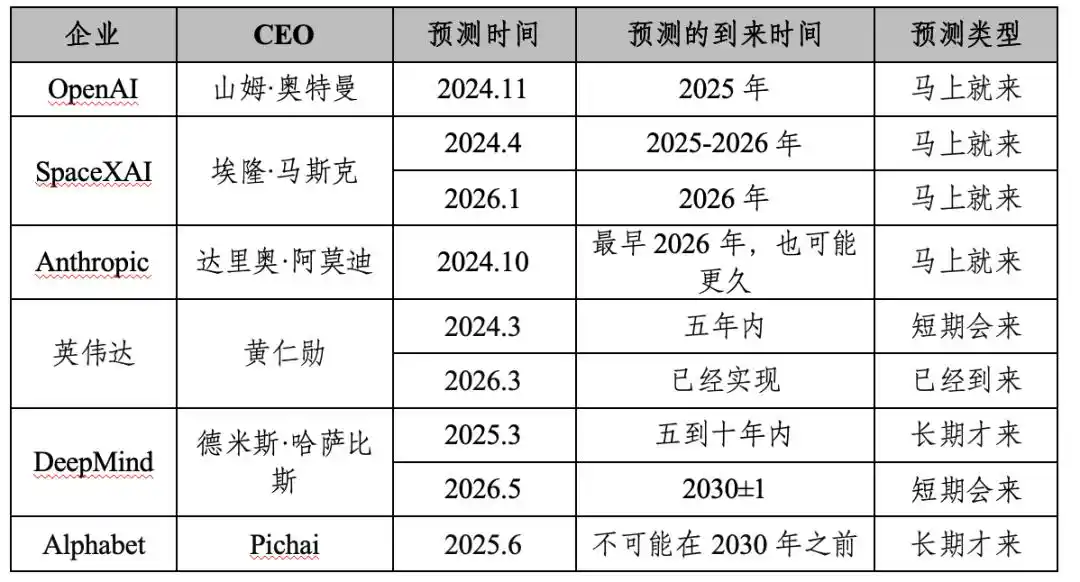
Table: Predictions of Famous AI Company CEOs on AGI Arrival Time Source: Tencent Research Institute compilation, May 2026
People love to predict. Some do it for publicity and self-motivation, some for papers and research projects, and others purely for verbal debate. In fact, no one knows what the future holds. The future does not follow a predetermined script; it is shaped by the choices and actions of many, and by radical breaks from the past, full of coincidences and paradoxes. Like a pig living a peaceful life, it cannot predict the black swan of Spring Festival.
Employment Quantification Paradox
The impact of technology on employment is a prominent and, in some ways, an esoteric field of study. It is an ancient topic, like a ghost, wandering for hundreds of years. It is known to everyone, from scholars to the common people, who can discuss it with ease. Its lower limit is very low, its upper limit very high, leading to endless debates and diverse opinions. In recent years, scholars and institutions have turned to 'letting data speak,' attempting to prove their insights using methods that appear scientific, rigorous, and sophisticated. The OECD, IMF, World Economic Forum, UNCTAD, International Labour Organization, World Bank, and consulting firms like Goldman Sachs, McKinsey, and Pew Research Center have all released reports quantifying AI's impact on employment. As shown in the table below.
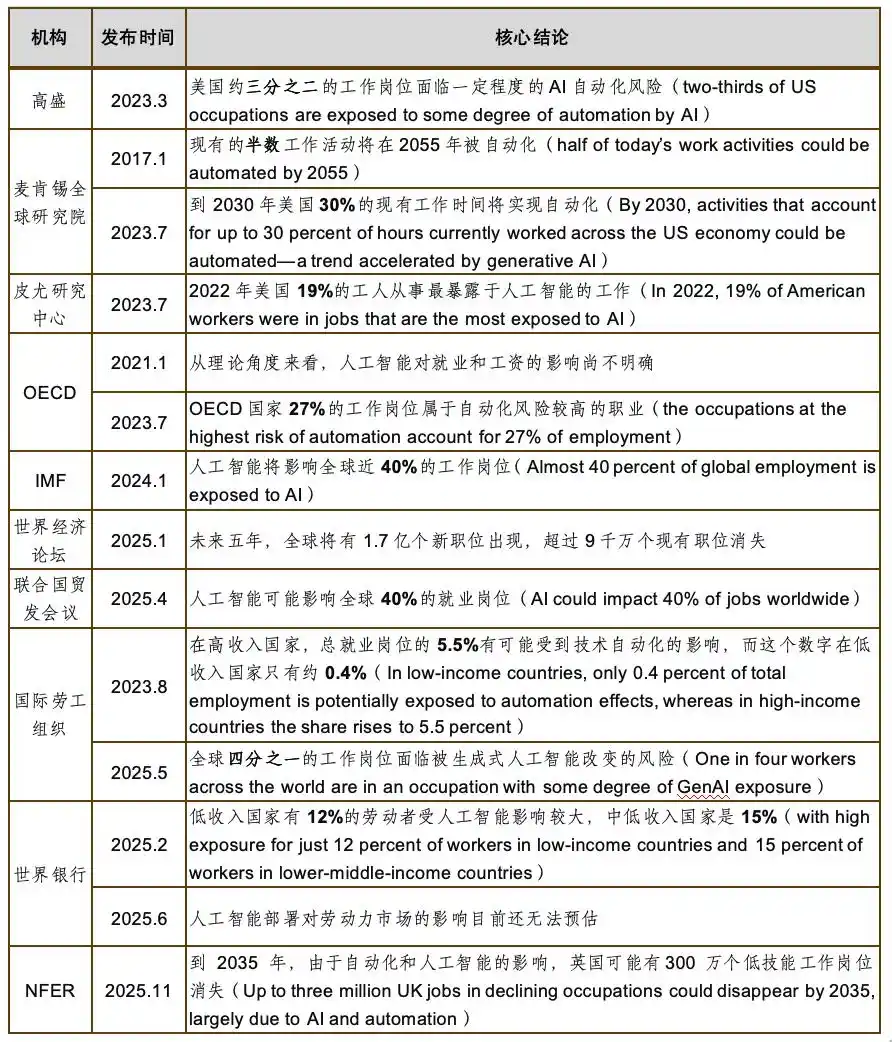
Table: Selected Quantitative Estimates of AI's Impact on Employment
Individually, each report carries significant weight, even being regarded as authoritative. But when these reports are placed together, we find vast differences in their estimated results, generally ranging between 0.4% and 67%, making them almost incomparable. It's disillusioning.
The prerequisite for quantifying employment impacts is the ability to accurately grasp the development pulse of technology. As mentioned earlier, even tech giants cannot accurately predict the future development of AI technology. How can economists quantify its employment impact? They can only assume that technology is static or develops at a predetermined speed, which is not how it works in reality. On the other hand, AI is not an independent influencing factor; multiple elements such as economic cycles, industrial economy, technological development, demographic structure, employment preferences, employment policies, globalization, and unexpected events jointly affect employment. They are interconnected and interact, making it impossible to cleanly isolate AI's effect. In this sense, quantifying AI's impact on employment is a paradox.
Productivity Paradox
Artificial intelligence is a new General Purpose Technology (GPT), characterized by broad applicability, continuous improvement, and the ability to spur innovation, making it an engine for future economic growth. The term AI has been around for 70 years, the machine learning revolution for 14 years, and the current AI wave is in full swing—from large language models and multimodal AI to world models, agents, and physical AI, emerging one after another. However, the growth rate of productivity has not significantly accelerated and may even be facing a productivity crisis (Rogers, 2024).
Since the release of ChatGPT, the EU's hourly labor productivity growth rate has fluctuated around 0%, with a growth of 0.1% in the first quarter of this year. Among the 14 quarters from Q4 2022 to Q1 2026, only 3 quarters saw productivity growth exceeding the long-term average (1.0%) since 1999. As shown in the figure below. The US shows strong growth; from Q4 2022 to Q2 2026, the annual average productivity growth in the nonfarm business sector was 2.2%, standing out among Western nations, but this only matches the long-term average since 1948 (Source: US Bureau of Labor Statistics).
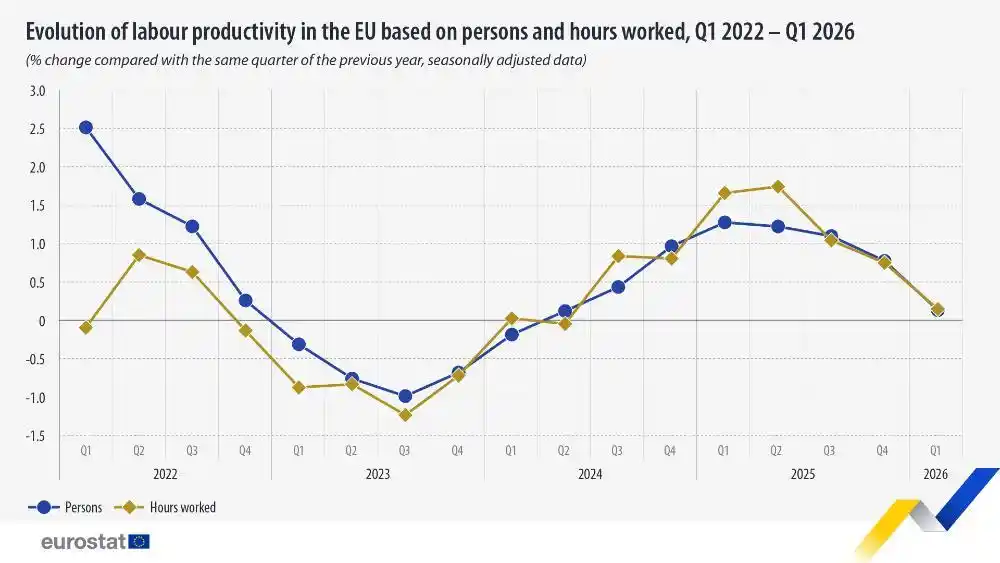
Figure: Recent EU Labor Productivity Growth Rate (Source: Eurostat)
This simultaneous existence of 'rapid technological innovation and disappointing productivity growth' is the productivity paradox. It's not the first occurrence. Nobel laureate Robert Solow wrote in 1987: 'You can see the computer age everywhere but in the productivity statistics.' This is seen as the most classic expression of the 'productivity paradox' or 'Solow paradox.'
Explanations for the productivity paradox mainly include wrong expectations, measurement errors, and time lags. Brynjolfsson believes (2017) that the time lag explanation is most convincing and is the main reason for the productivity paradox, summarizing the lag effect of GPTs on productivity as the 'J-curve.' General Purpose Technologies require multiple rounds of secondary innovations, complementary innovations, and organizational changes before substantially impacting productivity. Historically, the steam engine, electric generator, and computer began to significantly boost productivity 118, 91, and 49 years after their invention, and 54, 40, and 21 years after commercialization, respectively. Therefore, in the long run, the productivity paradox is not a paradox. It will take time for AI to markedly increase productivity.
Data Value Paradox
Data is the food for AI—needed in vast, bottomless quantities and of high quality, as 'garbage in, garbage out (GIGO),' or data can be 'noble' or 'vulgar.' Data determines the upper limit of AI capabilities and is often hailed as the 'new oil' (Clive Humby, 2006) and 'the world's most valuable resource' (The Economist, 2017), 'as important as energy and material resources' (2004 Chinese policy document). The use value of data is enormous, yet unlike ordinary commodities, it lacks transactional or monetary value in the same way. As Li Guojie (2025) said: 'The value of data can only be determined in its use.'
The OECD (2024) reviewed policy documents on data from 46 countries and found the policy contexts where 'data' appears, ranked from high to low, are: innovation, trust, society, market openness, utilization, employment, and access—they do not focus on 'transaction.' Chen Changsheng (2023) pointed out: 'Data exchanges are blooming everywhere, but the "transactions" within these exchanges are not developing well.' 'Amidst the nationwide upsurge in data market construction, we should be wary of forming a behavioral tendency that "only data bought and sold through transactions is usable data."'
The value density of data is low, making it difficult to monetize and reflect on balance sheets, where it constitutes a minuscule, almost negligible percentage. According to the latest data from Shanghai Advanced Institute of Finance at Shanghai Jiao Tong University, 136 listed companies in China have disclosed matters related to data resource capitalization, with a total capitalized amount of 3.786 billion yuan. Based on this, the former accounts for only 2.5% of A-share listed companies, and the latter is equivalent to only 0.3% of China's core AI industry scale.
The three major telecom operators dominate in terms of capitalization scale, with a combined capitalized amount of 2.1 billion yuan in 2025, accounting for 55.46% of the total capitalized amount among listed companies. However, these data resources constitute only about 0.06% of these companies' total assets, negligible. As shown in the table below.
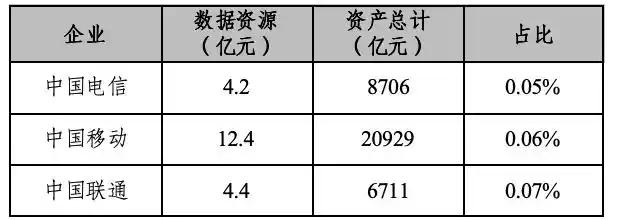
Table: Data Resource Capitalization Amount and Share of Three Major Telecom Operators (2025.12.31) Data Source: Compiled from consolidated balance sheets in financial reports.
Industrial Revolution Paradox
Every time a new technological wave rises, someone inevitably compares it to the steam engine, electricity, or computers, and excitedly exclaims: 'It will trigger the Fourth Industrial Revolution!' This phenomenon has persisted for at least half a century, with early examples like microelectronics (1984), computers (1988), nanotechnology (1994), the internet (2000), alternative energy (2010), and cyber-physical systems (2014). It has intensified in the last decade, with big data (2016), artificial intelligence (2016), the Internet of Things (2016), Industrial Internet (2017), blockchain (2017), quantum computing (2018), and smart manufacturing (2021) all being tasked with the mission of the Fourth Industrial Revolution. As shown in the figure below.
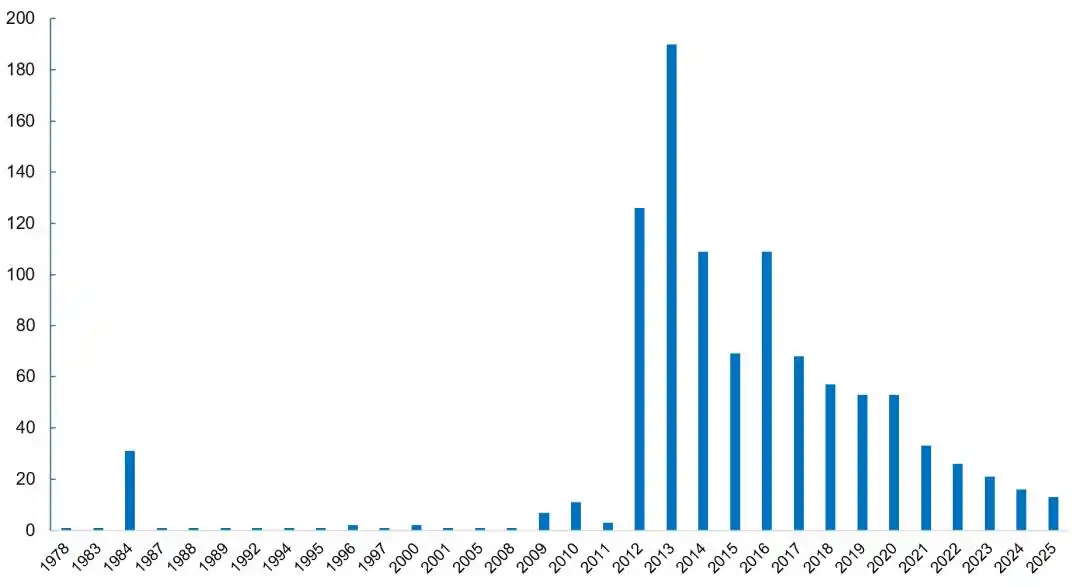
Figure: Distribution of Article Counts with 'Fourth Industrial Revolution' etc. in CNKI Article Titles Note: Selection criteria are articles whose titles include 'Third Industrial Revolution,' 'Third Industry Revolution,' 'Fourth Industrial Revolution,' or 'Fourth Industry Revolution.' For the current revolution, some believe it's the third, others the fourth; moreover, 'Industrial Revolution' and 'Industry Revolution' are the same phrase 'Industrial Revolution' in English. Therefore, this article does not strictly differentiate.
We are almost constantly experiencing the Fourth Industrial Revolution through media. The technology said to spark this revolution always sees 'new leaves on the tree pushing off the old, waves in the river letting the earlier ones pass'—preliminary statistics show at least over 20. The emergence of a new technology and the attribution of revolutionary significance to it seem to imply that previous attributions were all wrong. Currently, people generally believe AI is the Fourth Industrial Revolution. Demis Hassabis (2026) even states: 'The scale and speed of AGI could be 10 times that of the Industrial Revolution.' Domestically, some entrepreneurs view AI as humanity's final technological revolution. AI has disproven the past; how will AI itself be proven?
We cannot argue, but will emphasize two points. First, an industrial revolution and an economic crisis cannot occur simultaneously. Second, past industrial revolutions were not foreseen by those living through them but were narratives constructed afterward. People at the time did not know they were in an industrial revolution. The term 'Industrial Revolution' only became widely known to the public 40 years after the First Industrial Revolution (1760s–1840s), promoted by Arnold Toynbee. Economists only began using 'Second Industrial Revolution' 40 years after the Second Industrial Revolution (1870s–1914) ended, and its academic definition was standardized 55 years after its end by David Landes in 'The Unbound Prometheus' (1969). There is no unified understanding of the Third Industrial Revolution. Jeremy Rifkin (2011) believes its theme is the convergence of the internet and renewable energy; The Economist (2012) believes it is the digitization of manufacturing; Erik Brynjolfsson and Andrew McAfee (2011) argue the third revolution is driven by computers and networks. Let's hope this time is different.
This article is from the WeChat public account 'Tencent Research Institute' (ID: cyberlawrc), Author: Yan Deli