BUILDon: Can B hold 12% price gains while facing THIS hurdle

ambcryptoPubblicato 2026-07-06Pubblicato ultima volta 2026-07-06

Introduzione

BUILDon (B) surged 12% in the past day, driven by bullish sentiment and positive, yet mild, funding rates in the perpetual market. Open Interest rose to $27.34 million, indicating sustained but not overheated long positioning. However, technical analysis presents significant hurdles: a death cross formation and repeated rejection at the 200-day SMA resistance threaten a pullback toward $0.21 support. Furthermore, the Chaikin Money Flow (CMF) and Accumulation/Distribution (A/D) indicators have turned negative, signaling growing underlying selling pressure. The rally's sustainability now hinges on whether elevated trading volume can overcome these bearish technical signals or if the resistance and weakening momentum will trigger a downturn.

BUILDon [B] has been one of the standout assets in the market over the past day, with sentiment pushing the token 12% within the period.

Community sentiment on CoinMarketCap reflects this outlook, as roughly 100% of votes cast on the platform lean bullish on BUILDon. However, several other factors could determine whether the rally is sustainable or a breakdown lies ahead.

What’s driving the BUILDon rally

Traders in the perpetual market have had the clearest impact on B’s price surge.

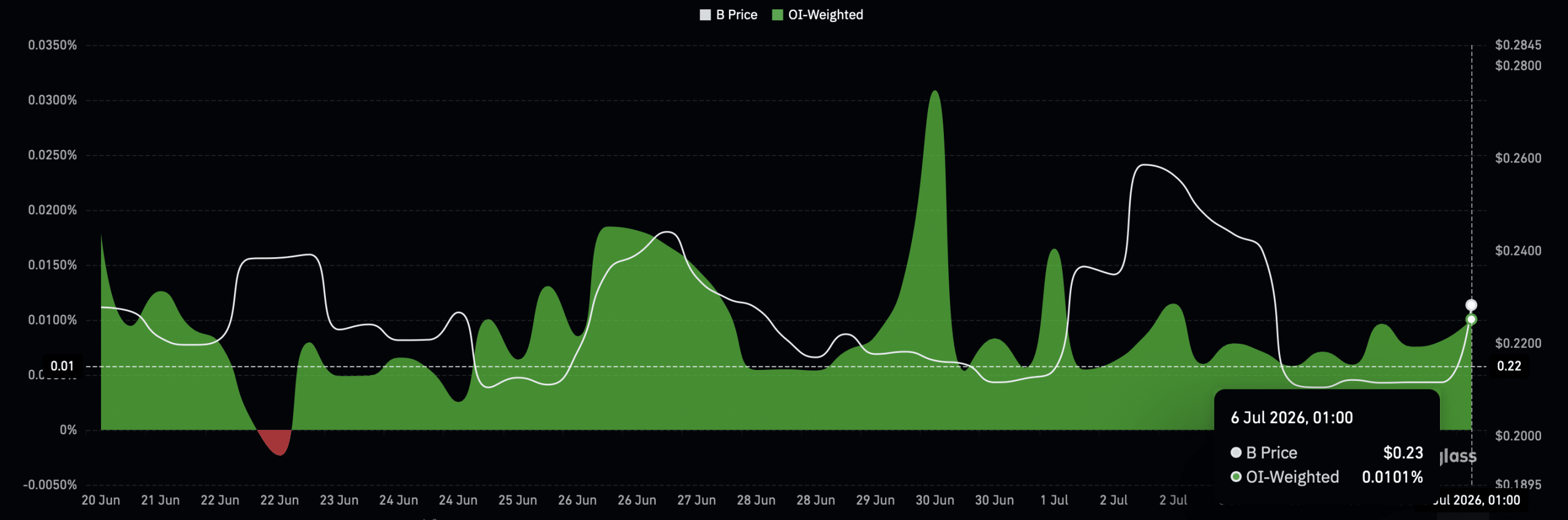
The key metric has been the positive Funding Rate, which, at a reading of 0.0101% as of writing, implied that the net-long positions dominate the market.

However, the Funding Rate, despite being positive, has remained mild, suggesting long positioning in the market has yet to grow overheated.
Source: CoinGlass

Growing capital in the perpetual market has added to this outlook as well. Open Interest, which measures this capital, has risen 5.44% to $27.34 million.

Continued bullish bets from these traders, without the market overheating, would support B’s broader performance and help sustain the rally as it extends higher.

Decoding BUILDon’s structural gap

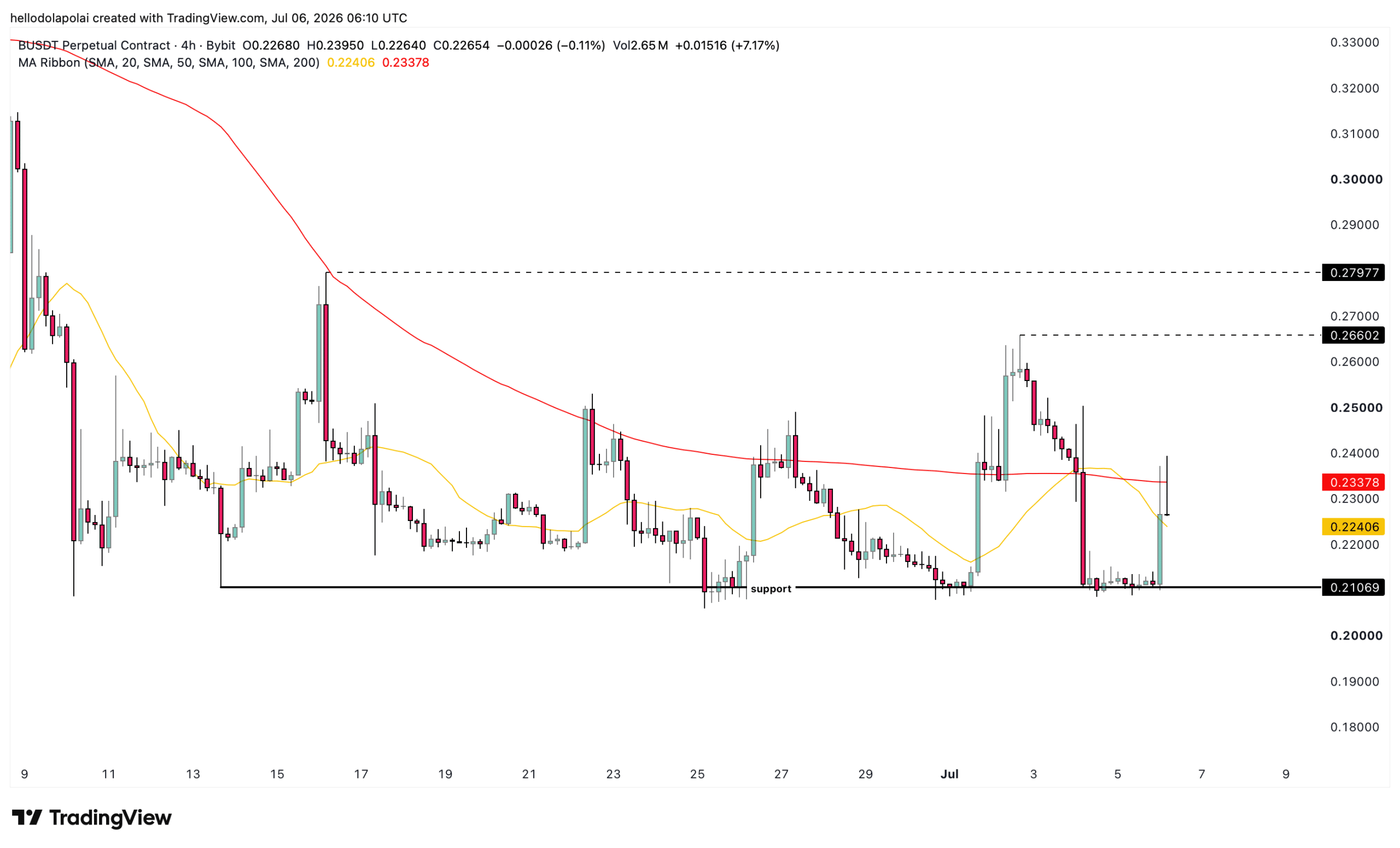
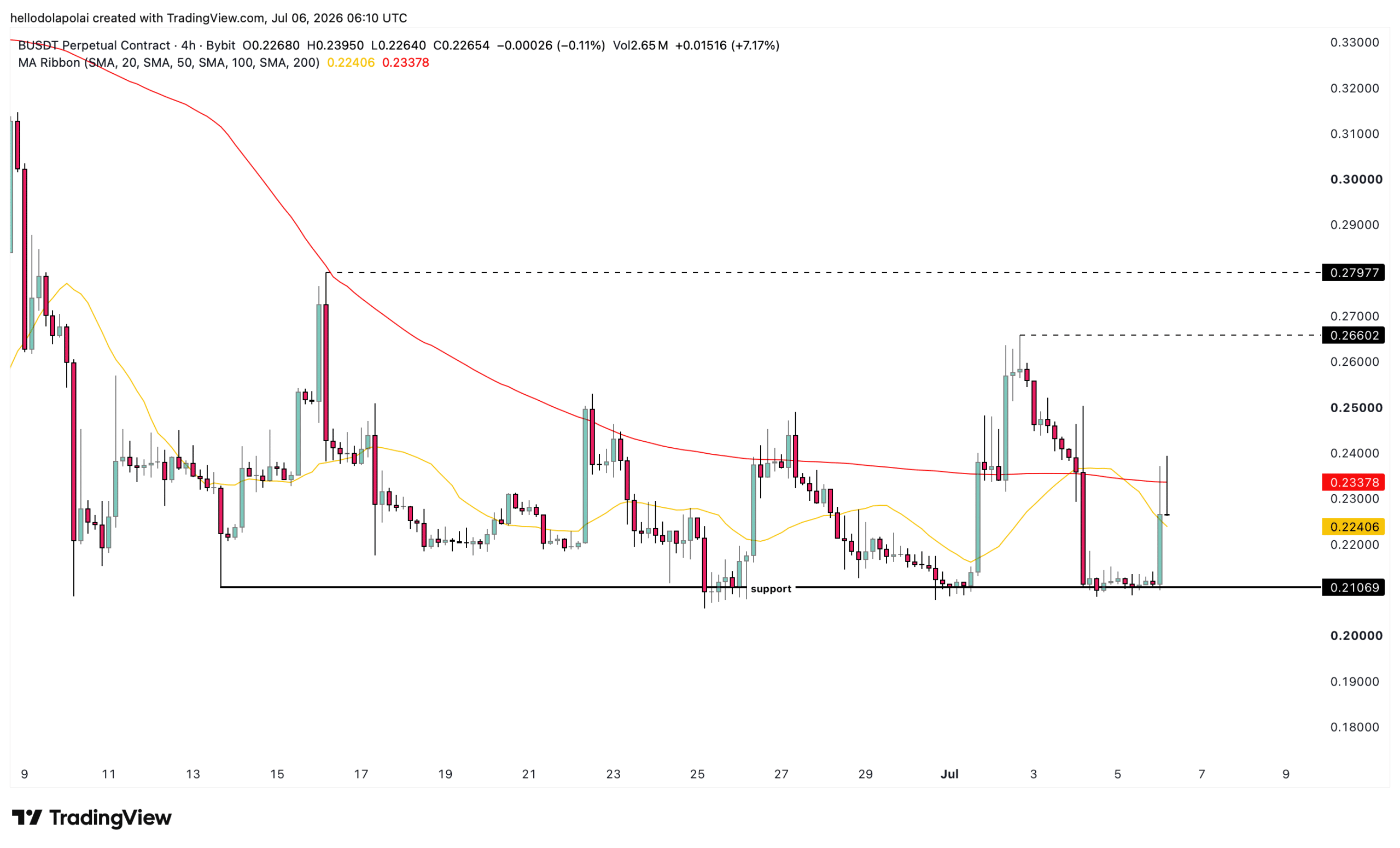
Analysis of the perpetual market alone isn’t sufficient to determine the direction the asset would take. BUILDon’s chart shows the asset being hindered by resistance at the 200-day SMA.

Beyond the 20 SMA recently crossing below it, a death cross that reads as bearish, this level has forced price lower on four separate occasions and could deliver the same impact again.
Source: Tradingview

If selling pressure emerges as it has in the past, BUILDon could drop to the lower support at $0.21, marked in black on the chart. There, it would likely consolidate briefly before attempting an upswing, provided the pressure isn’t extensive.

On the other hand, if the 200 SMA resistance fails, two key levels stand out: $0.266, the nearest price level, and $0.279, the next target. Both could offer a solid upward run.

Selling pressure builds beneath B’s rally

While the price chart leaves room for a move in either direction and a possible struggle ahead, it doesn’t confirm the sentiment.

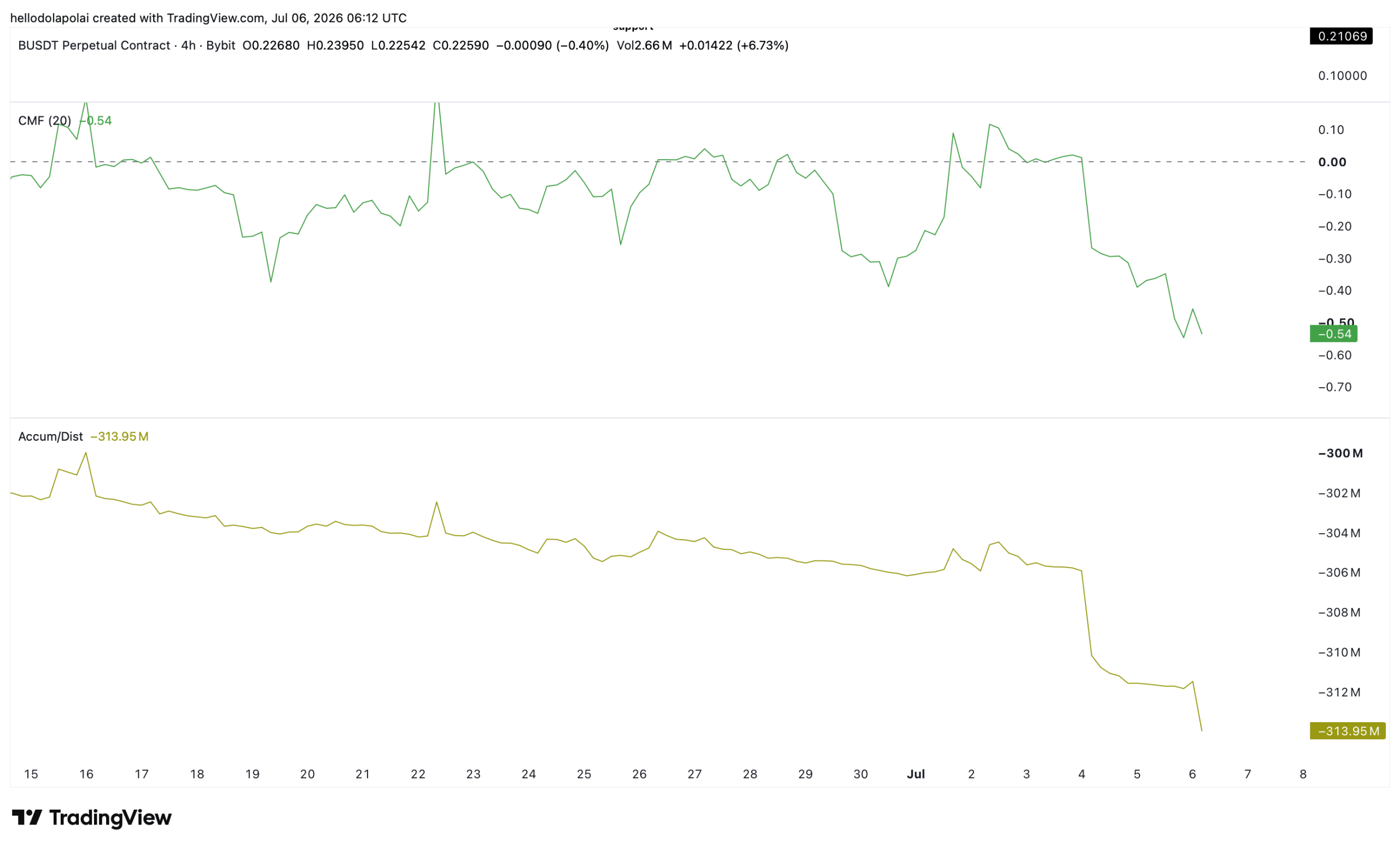
The Chaikin Money Flow, which tracks whether buy-side or sell-side volume dominates, shows that selling pressure has been growing significantly, as the CMF isn’t just in negative territory but is presently declining even lower on the chart.
Source: Tradingview

The Accumulation/Distribution indicator, which confirms whether investors have been buying or selling in the market, has also turned down into the negative region.

Layering this on actual volume data shows that volume remains elevated at $7.25 million, a 25% increase over the past day. Unless volume drops significantly, there’s a high chance B continues to move upward until the momentum weakens.


Final Summary

  • BUILDon’s 12% rally was perp-driven, as the Open Interest rose to $27.34 million, showing net-long conviction that hasn’t overheated.
  • However, the chart disagreed, with a fresh death cross, 200-day SMA resistance, and negative CMF and A/D readings all pointing lower unless volume holds.


Domande pertinenti

QWhat has been the primary driver behind BUILDon's recent 12% price surge according to the article?

AThe article states that traders in the perpetual market have had the clearest impact on BUILDon's price surge. This is indicated by a positive Funding Rate (0.0101%) showing net-long dominance and a 5.44% increase in Open Interest to $27.34 million.

QWhat is the main technical hurdle or resistance level that BUILDon is currently facing?

AThe main technical hurdle is resistance at the 200-day Simple Moving Average (SMA). The article notes that this level has forced the price lower on four previous occasions and could have the same impact again.

QWhat do the Chaikin Money Flow (CMF) and Accumulation/Distribution (A/D) indicators suggest about the market sentiment for BUILDon?

ABoth the Chaikin Money Flow (CMF) and the Accumulation/Distribution (A/D) indicator suggest growing selling pressure. The CMF is in negative territory and declining, while the A/D has also turned down into the negative region.

QWhat potential price levels are mentioned as upside targets if BUILDon breaks through the 200-day SMA resistance?

AIf the 200-day SMA resistance fails, the article identifies two key upside target levels: the nearest price level at $0.266 and the next target at $0.279.

QWhat key factor does the article suggest could help BUILDon sustain its upward momentum despite the bearish technical signals?

AThe article suggests that sustained high trading volume could help BUILDon continue moving upward. Volume remains elevated at $7.25 million (a 25% increase), and unless it drops significantly, there's a high chance the momentum persists until it weakens.

Letture associate

MSTR Discloses Sale of 3,588 Bitcoins, Stock Price Drops Over 5% at One Point During Trading

MicroStrategy, the world's largest corporate holder of Bitcoin, has significantly shifted its business model. Between June 29 and July 5, the company sold 3,588 bitcoins for approximately $216 million to fund quarterly dividends for its preferred stock. This marks its largest-ever Bitcoin sale and signals a strategic pivot: Bitcoin is transitioning from a "buy-and-hold" reserve asset to a liquidity management tool for the company. This move follows a recent authorization allowing Bitcoin sales when equity fundraising is less attractive. The announcement contributed to a more than 5% intraday drop in MicroStrategy's stock price, while Bitcoin fell to around $61,800—below the company's average holding cost of roughly $75,700. The sale represents a major departure from MicroStrategy's long-standing "never sell" commitment, which saw its first minor breach in May with a $2.5 million sale. The latest, hundred-times-larger transaction underscores growing financial pressures. Analysts note the company faces about $1.5 billion in annual preferred dividend obligations, far exceeding cash flow from its software business. As of July 5, MicroStrategy holds 843,775 bitcoins. Its current operational logic involves buying Bitcoin during favorable financing conditions and selling portions to cover dividends when needed, creating a flexible capital management cycle amidst a challenging market environment.

华尔街日报2 h fa

MSTR Discloses Sale of 3,588 Bitcoins, Stock Price Drops Over 5% at One Point During Trading

华尔街日报2 h fa

Q-Day Countdown: Will Quantum Computing End Cryptocurrencies?

Quantum Computing's Threat to Cryptocurrency: A Countdown to Q-Day Quantum computing, specifically Shor's algorithm, poses a fundamental threat to the public-key cryptography (e.g., ECDSA, RSA) that secures blockchain networks like Bitcoin and Ethereum. This critical juncture, known as Q-Day, is estimated to occur potentially within the next 5-15 years. The core vulnerability stems from the public and immutable nature of blockchains. Assets in addresses where the public key is already exposed on-chain (e.g., spent outputs) are at direct risk, as a sufficiently powerful quantum computer could derive the private key. This threatens the very trust model of cryptocurrencies. The response lies in Post-Quantum Cryptography (PQC)—algorithms like lattice-based ML-DSA and hash-based SLH-DSA, which are resistant to quantum attacks. NIST has standardized key PQC algorithms (FIPS 203, 204, 205), providing a migration path. However, the primary challenge is not technical but socio-economic and involves complex governance: * **Bitcoin's** path is constrained by its conservative ethos. Migrating requires a soft-fork to new address types, facing hurdles like significantly larger signature sizes and, most critically, the divisive governance question of how to handle at-risk legacy UTXOs without violating core principles. * **Ethereum** is pursuing a "cryptographic agility" strategy, with a multi-layered roadmap. It leverages account abstraction for user accounts and is developing compressed hash-based signatures (e.g., leanXMSS) for its consensus layer, aiming for a full-stack upgrade over time. In conclusion, quantum computing does not spell an instant end for cryptocurrency but initiates a critical countdown. The industry has a limited "engineering comfort window" to orchestrate a coordinated, ecosystem-wide migration to PQC. The ultimate bottlenecks are the immense coordination efforts and governance decisions required for this foundational transition.

marsbit3 h fa

Q-Day Countdown: Will Quantum Computing End Cryptocurrencies?

marsbit3 h fa

Trump, the President Who Knows Best How to 'Trade Stocks'

Former US President Donald Trump reported a record-breaking $2.2 billion in personal income for 2025, the highest annual income ever disclosed by a sitting president. This figure, from a 927-page government ethics filing, represented a 3.5-fold increase from his $600 million income in 2024 and boosted his net worth to $6.5 billion. The primary drivers were cryptocurrency (64% of income, approximately $1.4 billion) and real estate (26%, approximately $575 million). His crypto earnings stemmed largely from the launch of his personal meme coin, $TRUMP, generating over $600 million in licensing fees, and substantial profits from the WLFI token and its parent company. Despite a sluggish property market, his Mar-a-Lago resort and associated golf clubs saw revenue surges of 50% and 27%, respectively, attributed to their use as venues for presidential events. Trump's financial disclosure also revealed an unprecedented level of stock market activity, with over 22,000 trades executed in 2025, averaging 87 trades per market day. Media analyses noted several instances where significant trading coincided with major policy announcements, such as proposed tariffs, raising questions about potential conflicts of interest. While the White House stated these trades were handled by a family-managed trust fund and not Trump directly, critics highlighted this as a departure from the blind trusts traditionally used by presidents post-Watergate. The report has intensified debate over the commercialization of the presidency. Supporters view it as a success story of a businessman-president, while critics argue it demonstrates an unprecedented conversion of public influence into private wealth, with policy decisions potentially linked to personal financial gains. The controversy centers on whether Trump's earnings represent innovative entrepreneurship or a fundamental conflict of interest, sparking renewed calls for stricter ethics reforms in US governance.

marsbit3 h fa

Trump, the President Who Knows Best How to 'Trade Stocks'

marsbit3 h fa

Countdown to Q-Day: Will Quantum Computing End Cryptocurrencies?

The article explores the existential threat quantum computing poses to cryptocurrencies and the urgent need for "post-quantum" migration. It outlines that quantum computers, through Shor's algorithm, could break the elliptic-curve cryptography (ECC) underlying blockchain security, potentially allowing private keys to be derived from public keys. The core challenge is not a lack of post-quantum cryptography (PQC) standards—like NIST's ML-KEM and ML-DSA—but the immense complexity of upgrading entire ecosystems before "Q-Day" (when quantum computers become capable of such attacks, estimated around 2035-2045). Key points include: * **Bitcoin's** risk is concentrated in legacy UTXOs with exposed public keys (e.g., early P2PK outputs). Migration faces massive hurdles: PQC signatures are much larger, increasing transaction size and cost, and the governance dilemma of handling un-migrated assets threatens its "code is law" ethos. * **Ethereum's** strategy focuses on "cryptographic agility," using Account Abstraction for user accounts and developing compressed hash-based signatures (like leanXMSS with SNARK aggregation) for consensus. Its migration is a complex, full-stack overhaul of execution, consensus, and data layers. * The "security debt" is enormous. The comfortable engineering window for a coordinated, ecosystem-wide upgrade is only 5-8 years. High-value infrastructure (exchanges, bridges) may face pressure before mainnet protocols. In conclusion, quantum computing is not an instant "doomsday" event but a forcing function for systemic change. Bitcoin's ultimate test is social consensus and property rights governance, while Ethereum's is technical complexity. Failure to migrate in time could lead to a fundamental re-pricing of crypto assets.

链捕手3 h fa

Countdown to Q-Day: Will Quantum Computing End Cryptocurrencies?

链捕手3 h fa

Trading

Spot
活动图片