Produced by | Huxiu Tech Group
Author | Liang Ka'er
Editor | Miao Zhengqing
Header Image | Visual China Group
Xiaomi defended two bottom lines of concern to investors this quarter.
One is smartphone gross margin. Facing rising costs of core components like memory, Xiaomi stabilized its smartphone gross margin at 8.5% by adjusting its product mix, pushing the average selling price (ASP) to a high level. The other is the investment pace in new businesses. Vehicle deliveries exceeded 100,000 units this quarter, and the loss for the innovation business segment, which includes automobiles and AI, remained within the expected range of over 2 billion yuan.
However, the financial report also presented another set of noteworthy data: while Xiaomi's smartphone ASP increased by nearly 300 yuan year-over-year, its global shipments decreased by 26.5%. Automobiles have become a significant incremental revenue source but have not yet taken over the baton of profit growth. In the post-earnings conference call, management spent considerable time elaborating on businesses like large models, Super Xiaoai, and embodied robots, but commercialization is still in its early stages.
This constitutes the most core operational issue Xiaomi faces currently. Smartphones are shifting from prioritizing scale to optimizing structure, automobiles are still climbing the profit slope, while AI and robots are even further from generating scaled revenue. Multiple growth curves coexist, but their commercialization timelines are not synchronized, creating a "time gap" during the transition between old and new growth engines.
Phones Defend Margin, But Also Bear Scale Pressure
For a long time, Xiaomi's business model has been built on the synergistic flywheel of hardware and the internet. Smartphones are responsible for acquiring a large-scale user base, the operating system and IoT devices enhance user stickiness, and internet services take on profit monetization. Smartphones are not just a hardware business but also the most critical user entry point for Xiaomi's ecosystem. A premise for this model's continuous operation is sustained growth in smartphone user scale.
Rising component costs have disrupted the original rhythm. Lu Weibing, President of Xiaomi Group, stated in the conference call that the rise in memory prices in Q4 last year, especially in Q1 and Q2 this year, exceeded expectations.
Facing cost pressure, Xiaomi began adjusting its product mix and pricing. Lu Weibing, President of Xiaomi Group, said it was necessary to re-evaluate the product line, redefine products, which requires a relatively long cycle from product planning and definition to market launch. CFO Lin Shiwei stated that by optimizing the product mix and raising prices, Xiaomi's smartphone ASP reached a record high.
The financial report shows that in Q2, Xiaomi's smartphone ASP increased by nearly 300 yuan year-over-year, with the gross margin maintained at 8.5%. From a profit defense perspective, this adjustment served its purpose, but the flip side is scale contraction.
Omdia data shows that in Q2, Xiaomi's global smartphone shipments were 31.2 million units, down about 26% year-over-year (Xiaomi's financial report disclosed a decline of 26.5%). Its global market share dropped from 15% last year to 11%, still ranking third, but the market shares of Samsung and Apple both increased during the same period.
Although ASP helped Xiaomi defend the 8% gross margin red line widely watched by the market, it also somewhat affected the scale expansion of the smartphone business. For general hardware manufacturers, raising prices is a rational defense against rising costs. But for Xiaomi, a contraction in shipments of entry-level products means a slowdown in the growth rate of new ecosystem users, which could have a knock-on effect on its IoT and internet businesses in the long run.
Can Premiumization Inherit the Original Scale?
Xiaomi is more sensitive to this round of cost increases due to its product mix.
Omdia stated that over half of Xiaomi's smartphone shipments are concentrated below $200. Among the world's top five manufacturers, Xiaomi's sensitivity to rising memory costs is relatively high. Low-price models inherently have limited profit margins. After component costs rise, manufacturers either absorb the costs themselves or adjust specifications and pricing. The former compresses profits, while the latter may suppress demand in price-sensitive markets.
Regional data already reflects this pressure. In Q2, Xiaomi's smartphone shipments in China declined by 21%, and by 10% in India; in the Middle East and Africa markets, shipments fell by 50% and 30%, respectively.
New product performance provides a more specific sample. A Counterpoint report shows that after the launch of the Redmi Note 17 series, Xiaomi's share of weekly sales in Europe once rose to second place in week 30, indicating new products can still bring阶段性拉动. However, as the main sales driver, the Note 17 Pro, despite having adjusted some configurations and having a higher price than its predecessor, still sold less than the previous generation product.
If the low-price market faces cost pressure, seeking growth in the premium market becomes a natural choice, and the market provides a corresponding window. In the first half of 2026, global sales of premium smartphones priced at $600 and above increased by 5% year-over-year, accounting for 29% of total global smartphone sales, higher than the same period in 2025. Rising component prices are also narrowing the price gap between mid-range Android phones and older flagship or discounted flagship models.
But whether Xiaomi's premiumization is successful cannot be judged solely by ASP. More importantly, whether premium products can inherit the reduced shipment volume from the low-price market, and whether smartphone revenue and market share can stabilize.
Xiaomi is attempting to enhance the product value of flagship phones through the MiMo large model and OS upgrades. However, at this stage, the contribution of AI to the smartphone business is more reflected in experience improvement, user stickiness, and brand perception. How much incremental sales and product premium it has actually brought remains lacking in data that can be accounted for separately.
Public channel information shows that in August, Xiaomi initiated a new round of price adjustments involving series like the Mi 17, Redmi K90, and Turbo 5, with adjustment ranges of about 300 to 500 yuan. Since these changes occurred after Q2, their impact will only become more apparent in the second half of the year.
If ASP and gross margin rise while revenue and share also tend to stabilize, it indicates initial success in product mix upgrades. Conversely, if shipments and revenue remain under pressure, it means premium products have not fully inherited the original scale. This transition carries risks.
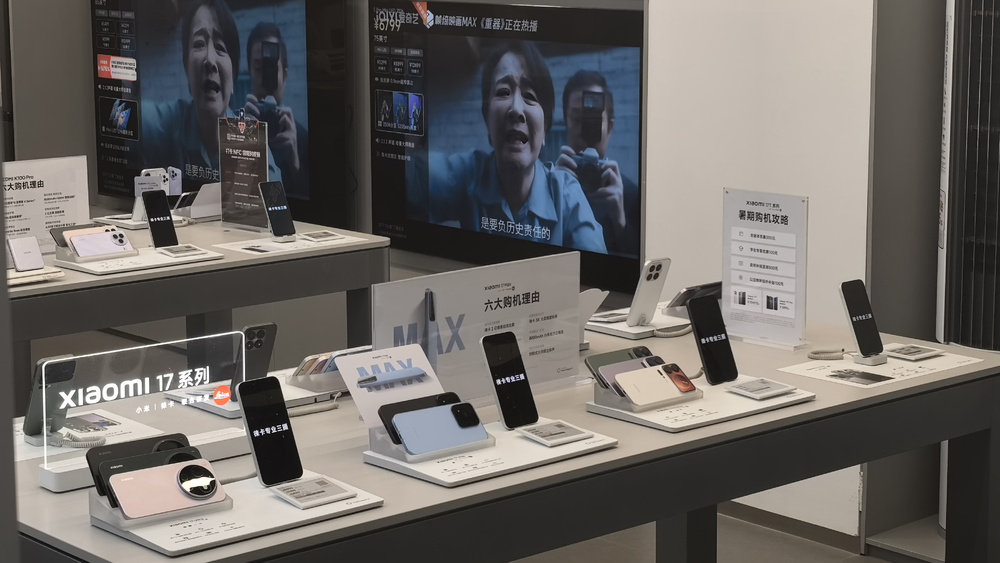
Image Source: Photo by Huxiu
Cars Already Contribute Revenue, Still Need to Bear Profit
On the other end of the hardware ecosystem, automobiles have become Xiaomi's most definite new source of incremental revenue.
In Q2, Xiaomi's EV deliveries reached 104,200 units, generating revenue of 23.9 billion yuan, already a significant driver of group revenue growth. This means Xiaomi Auto has completed the leap from a new business to scaled revenue.
Responding to questions about gross margin fluctuations, Lin Shiwei stated that aside from vehicle model mix adjustments and cost increases, large model-related investments also impacted the gross margin of the automotive and AI innovation business segment. The segment's gross margin was 19.2%.
Since automobiles and AI are reported together, it's temporarily difficult for outsiders to separate the profitability of each business. But the stages they are in differ: automobiles have already formed quarterly revenue of tens of billions, while AI is still focused on R&D and computing power investment.
The long-term value of automobiles to Xiaomi is not just measured by vehicle sales revenue. The core logic of the "Human x Car x Home Full Ecosystem" is that cars can become a new ecosystem entry point, driving revenue for other businesses. However, Xiaomi has not yet disclosed how much incremental value car users have brought, and in areas like smart driving and in-car software, a fully validated subscription model has not yet been formed.
Therefore, Xiaomi Auto's profit capability and ecosystem synergy value remain to be proven. Only when it improves per-vehicle economics while expanding deliveries and brings software revenue and ecosystem consumption will the car truly take over as the growth engine.
AI and Robots Still Need to Prove Commercial Value
While smartphones adjust and automobiles climb the slope, Xiaomi is increasing the strategic priority of AI and embodied intelligence.
Lu Weibing introduced that Xiaomi's robotics team has achieved an industrial validation of "98% self-tapping nut success rate" in its automobile factory. However, he also stated that humanoid robots are still a long way from large-scale commercialization and maturity, making it difficult to set short-term goals.
At the 2026 World Robot Conference, Xiaomi showcased a new generation of humanoid robots, about 1.7 meters tall, weighing 66 kilograms, with 66 degrees of freedom throughout its body. Xiaomi claimed its interaction relies on large model-driven, autonomous execution, capable of handling multi-scenario applications. Besides the product shown this time, this robot is already operating in Xiaomi's automobile factory.
This means Xiaomi can leverage its own factories to provide real industrial scenarios for robots. Compared to targeting consumers directly, factory tasks have clearer boundaries and are easier to measure value through specific data metrics. However, moving from technological validation to an independent business still requires navigating a series of steps. Until that is clear, robotics remains a long-term technology reserve.
Several interviewed securities firm industry analysts told Huxiu that it's currently impossible to establish an independent valuation model for Xiaomi's robotics business, unable to compare it to Tesla or Honor. Lu Weibing directly stated, "We are optimistic about its synergy with our ecosystem and business, but it is still in a relatively early stage; don't get bogged down in specific targets."
At this stage, the business providing stable profit support for Xiaomi is still its Internet Services. This business achieved a gross margin of 76.8% this quarter, with revenue of 9 billion yuan, while global monthly active users reached a new high of 771 million. This is the accumulation formed over years of expanding hardware user scale and indicates that the model of "acquiring users through hardware, monetizing through the internet" is still functioning.
However, the new high in MAU is not contradictory to the decline in smartphone shipments. The former primarily reflects the existing user scale, while the latter relates to the speed of future new user additions. Whether the slowdown in smartphone shipments will impact the internet business still requires ongoing observation. Overall, Xiaomi does not face short-term financial pressure. The company has ample funds on its balance sheet, with stock buyback amounts exceeding HK$11.7 billion within 2026, and vehicle deliveries are also steadily climbing.
Lu Weibing stated at the end of the conference call that the company will "resolutely increase investment in hard-core technology fields like AI, chips, operating systems, and embodied intelligence to accumulate strength for the next generation of growth." In other words, Xiaomi does not lack growth directions; the key is when these directions will be reflected in the financial statements. The next round of growth may depend on whether the new engine can complete the handover before the old engine slows down.
This article is from Huxiu, author: Liang Ka'er Original link: https://www.huxiu.com/article/4884962.html?type=text