Will Maple Finance [SYRUP] extend rally as TVL hits $2.2B? THESE metrics say…

ambcryptoPubblicato 2026-07-11Pubblicato ultima volta 2026-07-11

Introduzione

Maple Finance's SYRUP token rallied 14%, driven by strong fundamental growth. The protocol's assets under management hit $4.6 billion in H1 2026, an 81% year-on-year increase, while total value locked (TVL) surged past $2.2 billion. A key driver is the recent launch of syrupUSDG on Robinhood, which saw over $200 million in inflows. On-chain data shows about 18% of SYRUP's supply is staked, tightening market availability. Additionally, the protocol reported strong yields, outperforming industry benchmarks. A proposed revenue-linked buyback program could further support the token's value, with buybacks scaling up to 30% of monthly revenue if it exceeds $2 million.

Maple Finance [SYRUP] has climbed over the past day, and much of that move traces back to the protocol’s strengthening fundamentals.

The altcoin rallied 14% as fresh partnerships and capital rotation flowed into the ecosystem, and that underlying performance could sustain the rally across the next several trading sessions.

Capital inflows power SYRUP’s fundamentals

Capital moving into Maple Finance has driven much of the token’s recent performance.

Assets under management reached $4.6 billion in the first half of 2026, up 81% year-on-year, while loans outstanding hit an all-time high of $1.9 billion, a 123% jump over the same period.

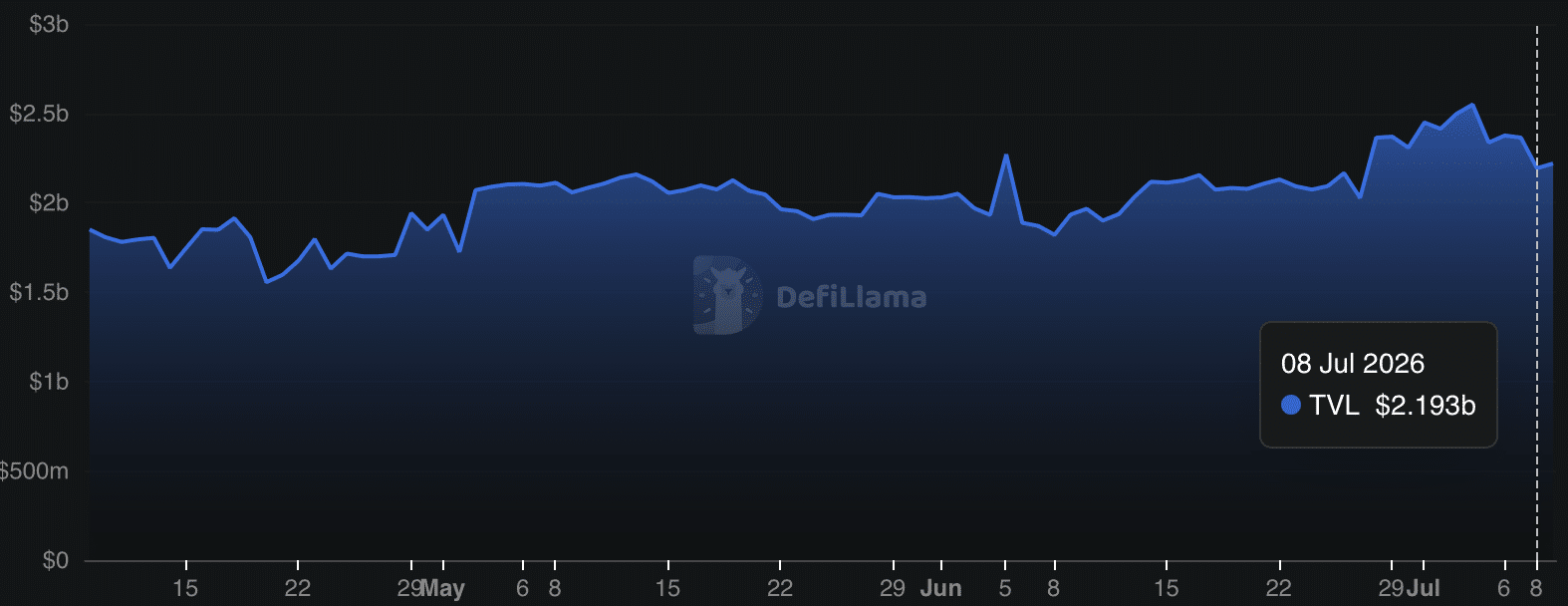
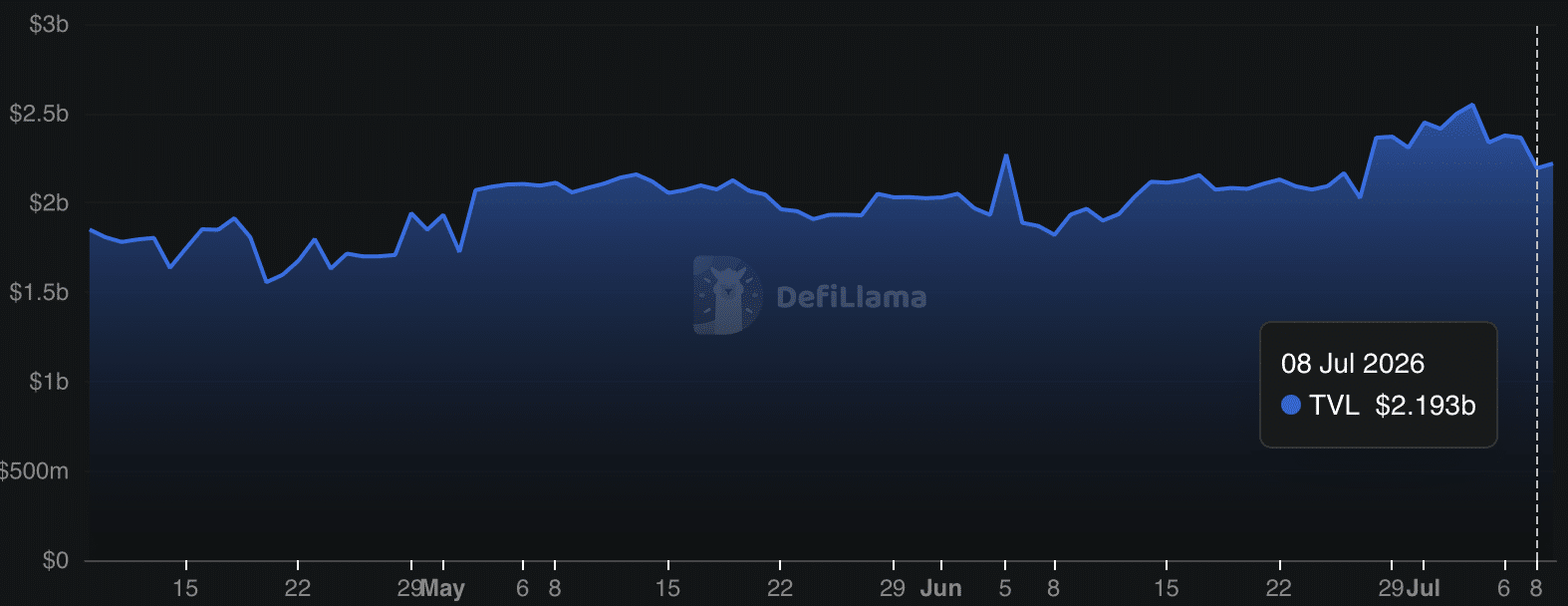
The flow reflects in the protocol’s total value locked (TVL), which measures the assets deposited and locked on the platform mostly by investors holding a long-term outlook, and which surged by more than $220 million over the past day to reach a high of $2.265 billion.
Source: TradingView

Much of the inflow points to syrupUSDG, which recently launched on Robinhood and has seen its assets under management climb by more than $200 million according to Maple’s own data.

Sid Powell, co-founder and CEO of Maple Finance, tied much of the growth to demand from fintech and neobank users, noting that the comparable SyrupUSDT product took more than 18 months to reach $100 million in AUM.

How syrupUSDG demand translates to SYRUP growth

SyrupUSDG is an interest-bearing token issued by the decentralized credit protocol Maple Finance, and holders who deposit the Global Dollar (USDG) stablecoin earn returns generated through institutional lending.

Rising adoption of SyrupUSDG feeds activity back into Maple, and that in turn lifts demand for the native token.

The link shows up on-chain, with DeFiLlama data reporting roughly 18% of the token’s market capitalization already staked, worth $36.93 million at the time of reporting, tightening the supply available to the market.

Maple’s yields has played a major role too. The company’s recent report shows the protocol outperformed the industry benchmark by more than 117 basis points at an APY of 4.765% against a benchmark of roughly 3.590%.

SYRUP market outlook and buyback proposal

SYRUP carries a longer-term case beyond the current move, anchored by a proposal to introduce revenue-linked buybacks that scale with earnings.

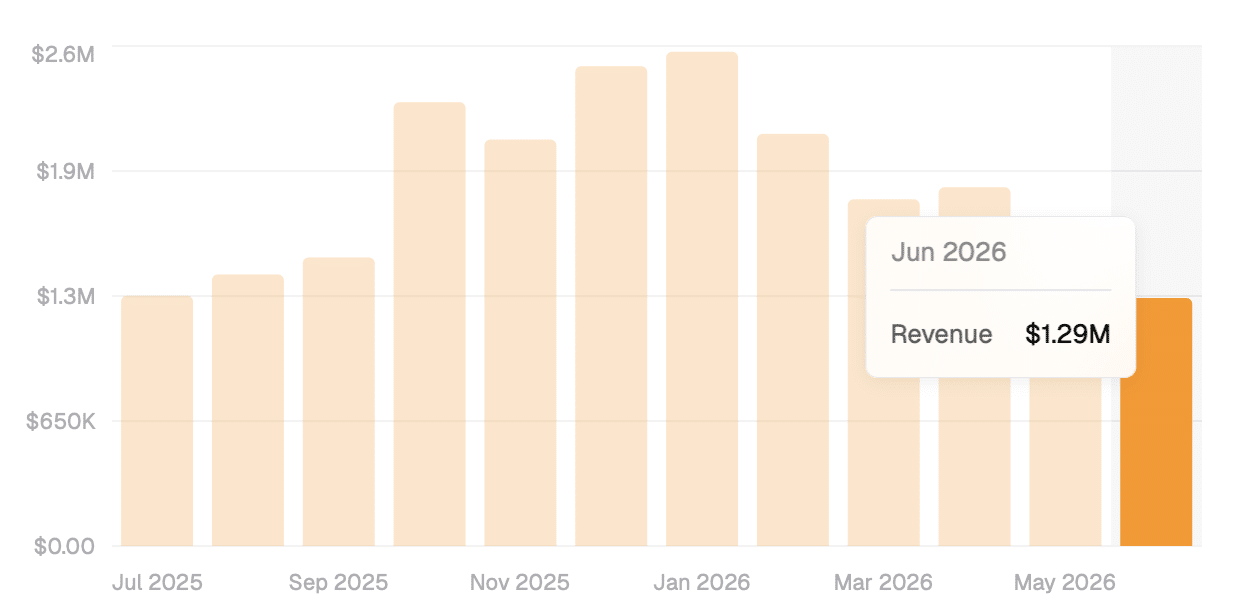
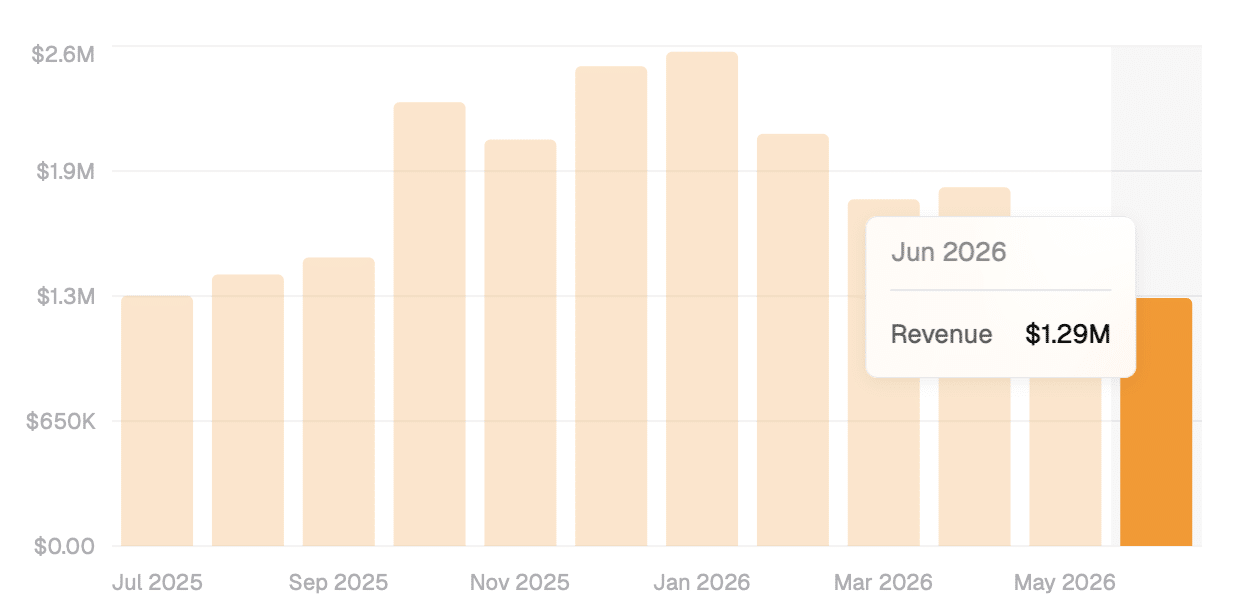
The SYRUP Strategic fund released a plan for a tiered buyback tied to a share of monthly revenue, under which repurchases could rise to as much as 30% once revenue climbs above $2 million.
Source: MapleFinance

That threshold is within reach given the protocol’s trajectory. Maple posted $4.4 million in second-quarter revenue, up 47% year-on-year, and now runs at $17.6 million in annualised recurring revenue, which works out to just under $1.5 million a month against June’s $1.29 million.

The framework would run for roughly six months if approved, landing at a point where the protocol’s revenue is closing in on the level that would unlock its steepest buyback tier.


Final Summary

  • Maple Finance’s SYRUP rallied 14% as H1 2026 assets under management reached $4.6 billion, up 81% year-on-year.
  • A proposed revenue-linked buyback could repurchase up to 30% of monthly revenue once it clears $2 million, and could contribute to shortterm outlook.


Crypto di tendenza

Domande pertinenti

QWhat is the main reason behind Maple Finance's SYRUP token rallying 14% recently?

AThe main reason is the protocol's strengthening fundamentals, driven by capital inflows, fresh partnerships, and new product launches like syrupUSDG.

QHow has Maple Finance's Total Value Locked (TVL) changed recently, and what does it signify?

AMaple Finance's TVL surged by over $220 million in a day to reach a new high of $2.265 billion. This signifies strong capital inflows from investors with a long-term outlook.

QWhat is syrupUSDG and how does its demand impact the SYRUP token?

AsyrupUSDG is an interest-bearing token issued by Maple Finance for the USDG stablecoin. Rising demand for it increases activity on the Maple protocol, which in turn boosts demand for the native SYRUP token and tightens its available supply.

QWhat is the proposed plan regarding SYRUP buybacks, and how is it structured?

AThe SYRUP Strategic fund proposed a tiered, revenue-linked buyback plan. It would use a share of monthly revenue to repurchase SYRUP, with buybacks scaling up to as much as 30% of revenue once it climbs above $2 million per month.

QWhat were Maple Finance's key financial performance metrics mentioned for the first half of 2026?

AKey metrics for H1 2026 included: Assets Under Management reaching $4.6 billion (up 81% YoY), loans outstanding hitting an all-time high of $1.9 billion (up 123% YoY), and Q2 revenue of $4.4 million (up 47% YoY).

Letture associate

In Just 11 Days, Claude Rewrote Millions of Lines of Code, an Epic AI Engineering Feat Sparks Fury

In just 11 days, Bun's founder Jarred Sumner used Anthropic's Claude AI models to rewrite its million lines of code from Zig to Rust. This move sparked significant controversy, particularly from Zig's creator, Andrew Kelley, who publicly criticized Sumner's engineering practices and the decision to use AI for such a massive rewrite. Bun, a high-performance JavaScript/TypeScript runtime and rival to Node.js, was originally written in Zig. After Anthropic acquired Bun, the team encountered persistent stability and memory safety bugs in the Zig codebase. These issues, combined with Zig's strict policy against LLM-generated code, led to the decision to rewrite in Rust. The rewrite was executed using Claude AI tools at an estimated API cost of $165,000, dramatically reducing the expected time and financial cost. Andrew Kelley's response was scathing. He blamed the original bugs on poor engineering habits, calling Bun's Zig code a collection of "hacks on top of hacks." He expressed relief that Bun was no longer associated with Zig, fearing it would misrepresent the language and attract low-quality, AI-generated contributions. The tech community is divided; some view Kelley's critique as unprofessional, while others see it as a defense of engineering integrity. A major concern about the AI-driven rewrite is the resulting code quality. The translation from Zig left approximately 27,000 lines of unsafe Rust code, raising fears about long-term maintainability and technical debt. The debate centers on whether this project is a milestone in AI-assisted development or a future maintenance nightmare.

marsbit30 min fa

In Just 11 Days, Claude Rewrote Millions of Lines of Code, an Epic AI Engineering Feat Sparks Fury

marsbit30 min fa

From Auto Finance to Bitcoin to AI Engines: An Analysis of Cango's 'What Not to Do' Strategy

From Auto Finance to Bitcoin and Now AI: Cango's "What Not to Do" Strategy Cango, a Chinese auto finance platform that went public on the NYSE in 2018, is undergoing its third major transformation. After selling its entire auto business in 2024, it pivoted to become a large-scale Bitcoin miner, acquiring 50 exahash of mining rigs from Bitmain. However, its true goal was never Bitcoin, but owning and controlling energy infrastructure. Now, Cango is pivoting again. While most listed Bitcoin miners are leasing power to giant hyperscalers for AI training clusters, Cango is taking the opposite path. It has launched an AI inference subsidiary called EcoHash, focusing not on training but on distributed inference. The company's strategy hinges on the insight that over 70% of mining industry power is controlled by small, independent sites (10-50 MW), which are too small for hyperscalers but ideal for low-latency AI inference. Cango aims to partner with these small operators, providing the AI technology, customers, and financing through its EcoLink software layer, which can distribute workloads across sites for reliability. Cango maintains a hybrid model, running roughly 31.7 EH/s of Bitcoin mining for cash flow while aggressively cleaning its balance sheet—slashing long-term debt by 94.5% to $30.6 million and raising $75 million for its AI venture. Its first AI deployment will be at a 50 MW site in Georgia. The strategy faces skepticism, given the high costs of converting mining sites and the potential for an AI bubble. However, Cango's leadership believes discipline around "what not to do"—avoiding direct competition with hyperscalers in training—positions it to capture the long-tail demand for distributed AI inference power.

Foresight News46 min fa

From Auto Finance to Bitcoin to AI Engines: An Analysis of Cango's 'What Not to Do' Strategy

Foresight News46 min fa

Strategy's Bitcoin Sales Cap Far Exceeds $1.25 Billion: A Detail the Market Overlooked

The article discusses how MicroStrategy's potential Bitcoin sales go far beyond the announced $1.25 billion "reserve-building capacity." It clarifies a key distinction in the company's "BTC Monetization Program": selling Bitcoin to *build* a new dollar reserve (the $1.25B cap) versus selling to *replenish* the existing USD Reserve after it's used for expenses like preferred share dividends. The recent $216M BTC sale for dividend payments was a "replenishment," leaving the headline $1.25B building quota untouched. The plan actually outlines three potential funding pools from BTC sales: 1) Building the reserve ($1.25B cap), 2) Covering preferred share/ debt costs (no specified cap), and 3) Funding buyback programs (up to $20B). This means the structured sales potential exceeds $30 billion, not including uncapped replenishment sales. The piece argues this marks MicroStrategy's shift from a passive "buy-and-hold" Bitcoin proxy to an actively managed entity using BTC as a balance-sheet tool to manage its complex capital structure (common stock, preferred shares, debt, reserve). This creates new dynamics and potential conflicts, as actions benefiting one part (e.g., selling BTC to pay dividends) may pressure another (e.g., undermining the "never sell" narrative). Investors must now parse the company's specific terminology ("build" vs. "replenish") to understand the true scope of future BTC sales, which is significantly larger than the market initially perceived.

marsbit53 min fa

Strategy's Bitcoin Sales Cap Far Exceeds $1.25 Billion: A Detail the Market Overlooked

marsbit53 min fa

Goldman Sachs Report Deconstructs the Competitive Landscape of China's AI Large Models: Who Will Be the Long-Term Winner?

Goldman Sachs analyzes China's AI large language model (LLM) landscape, identifying key players and a strategic shift towards efficiency and global expansion. The report highlights that Chinese open-source/open-weight models are closing the performance gap with top global proprietary models at significantly lower cost, driven by architectural innovations like MoE. This enables a "two-tier" market: a high-end segment (e.g., GLM5.2, Qwen3.7 Max) with pricing at ~$1 per million tokens, and a low-end, price-sensitive global segment. Open-source strategies aid adoption but limit monetization, as deployments via third-party platforms (e.g., AWS Bedrock, Alibaba Cloud) may not generate direct revenue for model creators. The industry is thus moving towards "open-weight + community license" models with revenue-sharing to improve unit economics. Internationally, the focus is shifting from "token maximization" to ROI-driven enterprise adoption, particularly in non-U.S. markets. Major cloud platforms are integrating Chinese models (e.g., DeepSeek, MiniMax). Using a competitive framework based on pricing power, cost advantage, and financial strength, Goldman Sachs identifies **Zhipu AI** and **DeepSeek** as leaders in foundational text models, and **ByteDance** (with Seedance) leading in multimodal/video generation. **MiniMax** and **Kuaishou** are also rated favorably. The firm forecasts China's AI model API/subscription revenue growing from ~RMB 35bn (2026E) to RMB 879bn by 2030.

marsbit53 min fa

Goldman Sachs Report Deconstructs the Competitive Landscape of China's AI Large Models: Who Will Be the Long-Term Winner?

marsbit53 min fa

Trading

Spot

Articoli Popolari

Come comprare SYRUP

Benvenuto in HTX.com! Abbiamo reso l'acquisto di Maple Finance (SYRUP) semplice e conveniente. Segui la nostra guida passo passo per intraprendere il tuo viaggio nel mondo delle criptovalute.Step 1: Crea il tuo Account HTXUsa la tua email o numero di telefono per registrarti il tuo account gratuito su HTX. Vivi un'esperienza facile e sblocca tutte le funzionalità,Crea il mio accountStep 2: Vai in Acquista crypto e seleziona il tuo metodo di pagamentoCarta di credito/debito: utilizza la tua Visa o Mastercard per acquistare immediatamente Maple FinanceSYRUP.Bilancio: Usa i fondi dal bilancio del tuo account HTX per fare trading senza problemi.Terze parti: abbiamo aggiunto metodi di pagamento molto utilizzati come Google Pay e Apple Pay per maggiore comodità.P2P: Fai trading direttamente con altri utenti HTX.Over-the-Counter (OTC): Offriamo servizi su misura e tassi di cambio competitivi per i trader.Step 3: Conserva Maple Finance (SYRUP)Dopo aver acquistato Maple Finance (SYRUP), conserva nel tuo account HTX. In alternativa, puoi inviare tramite trasferimento blockchain o scambiare per altre criptovalute.Step 4: Scambia Maple Finance (SYRUP)Scambia facilmente Maple Finance (SYRUP) nel mercato spot di HTX. Accedi al tuo account, seleziona la tua coppia di trading, esegui le tue operazioni e monitora in tempo reale. Offriamo un'esperienza user-friendly sia per chi ha appena iniziato che per i trader più esperti.

145 Totale visualizzazioniPubblicato il 2025.05.08Aggiornato il 2026.06.02

Come comprare SYRUP

Discussioni

Benvenuto nella Community HTX. Qui puoi rimanere informato sugli ultimi sviluppi della piattaforma e accedere ad approfondimenti esperti sul mercato. Le opinioni degli utenti sul prezzo di SYRUP SYRUP sono presentate come di seguito.

活动图片