Claude to Mandate "Face-Scan ID Verification", No ID No Service Starting July?

链捕手Pubblicato 2026-06-15Pubblicato ultima volta 2026-06-15

Introduzione

Anthropic, the creator of Claude AI, has sent privacy policy update emails to users, signaling a significant shift. The key change, effective July 8, is the potential requirement for consumer-level users (Free, Pro, Max plans) to verify their age or identity. This verification would be conducted through the third-party service Persona, involving uploading a government-issued photo ID and taking a live selfie for comparison. Anthropic states this data is for security purposes only, will not be used for model training, and is processed by Persona, not stored on its own servers. The update also clarifies data handling for Claude's new capabilities: when performing multi-step tasks or connecting to third-party apps, user data may flow between Anthropic and those external services. Additionally, more information may be collected from users who participate in Anthropic research. This move is seen as a major step towards establishing accountability as AI agents become more powerful and autonomous, capable of executing complex, real-world tasks. It follows previous enforcement actions, like the banning of the "Fable 5" account, and indicates a broader industry trend toward stricter user identification and safety measures. The verification is expected to apply in specific scenarios, particularly as users engage Claude in more complex agentic workflows.

Author: New Zhiyuan

Anthropic is in the headlines again!

In recent days, many Claude users opened their email to find a message from Anthropic. The title seemed innocuous - "Privacy Policy Update Notification". But the content left them stunned:

"We may ask you to verify your age or identity."
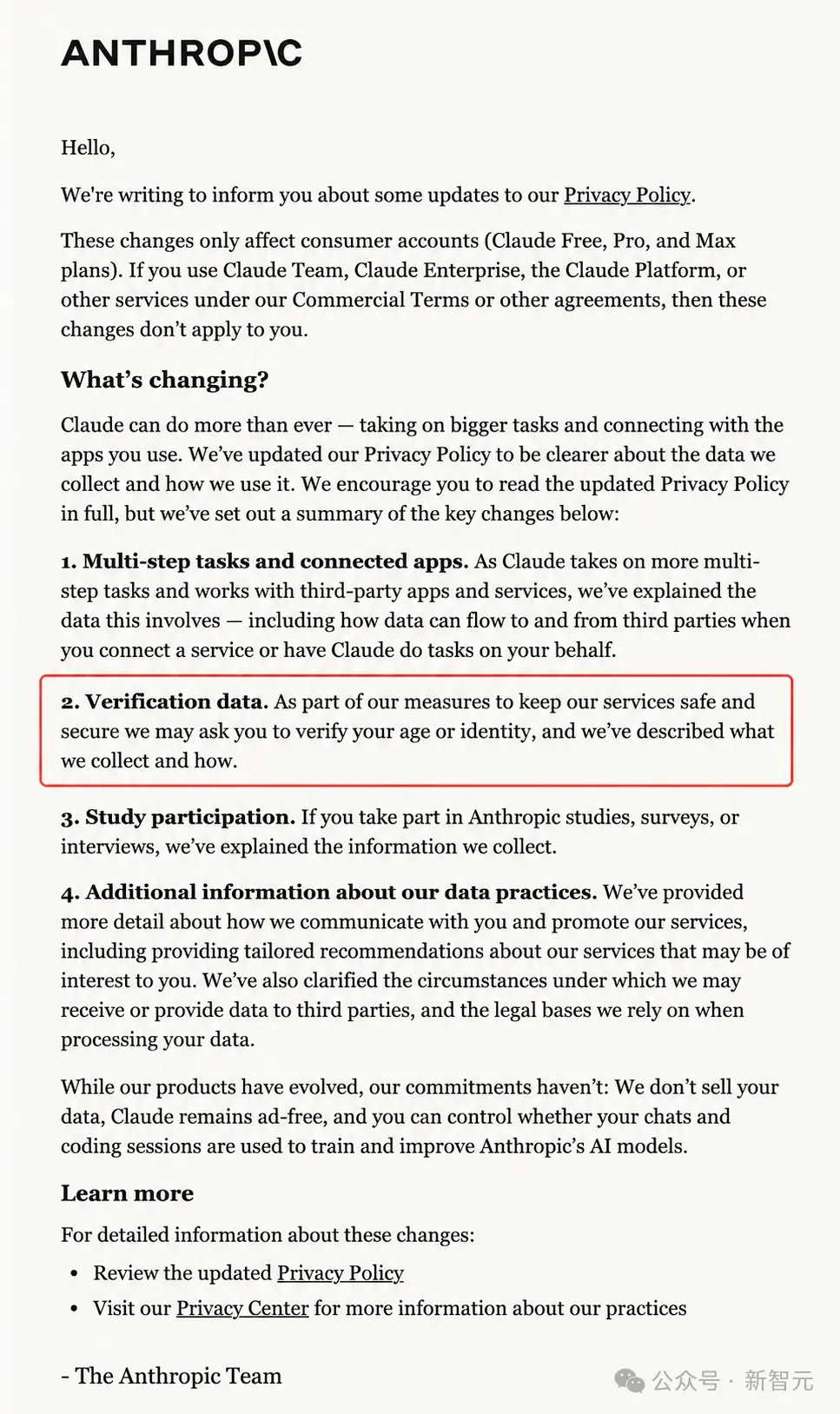
Someone shared a screenshot of the email on X, and the comments exploded. According to the email content, starting July 8th, Claude will likely start asking for your ID. Has Anthropic's real-name verification finally arrived?
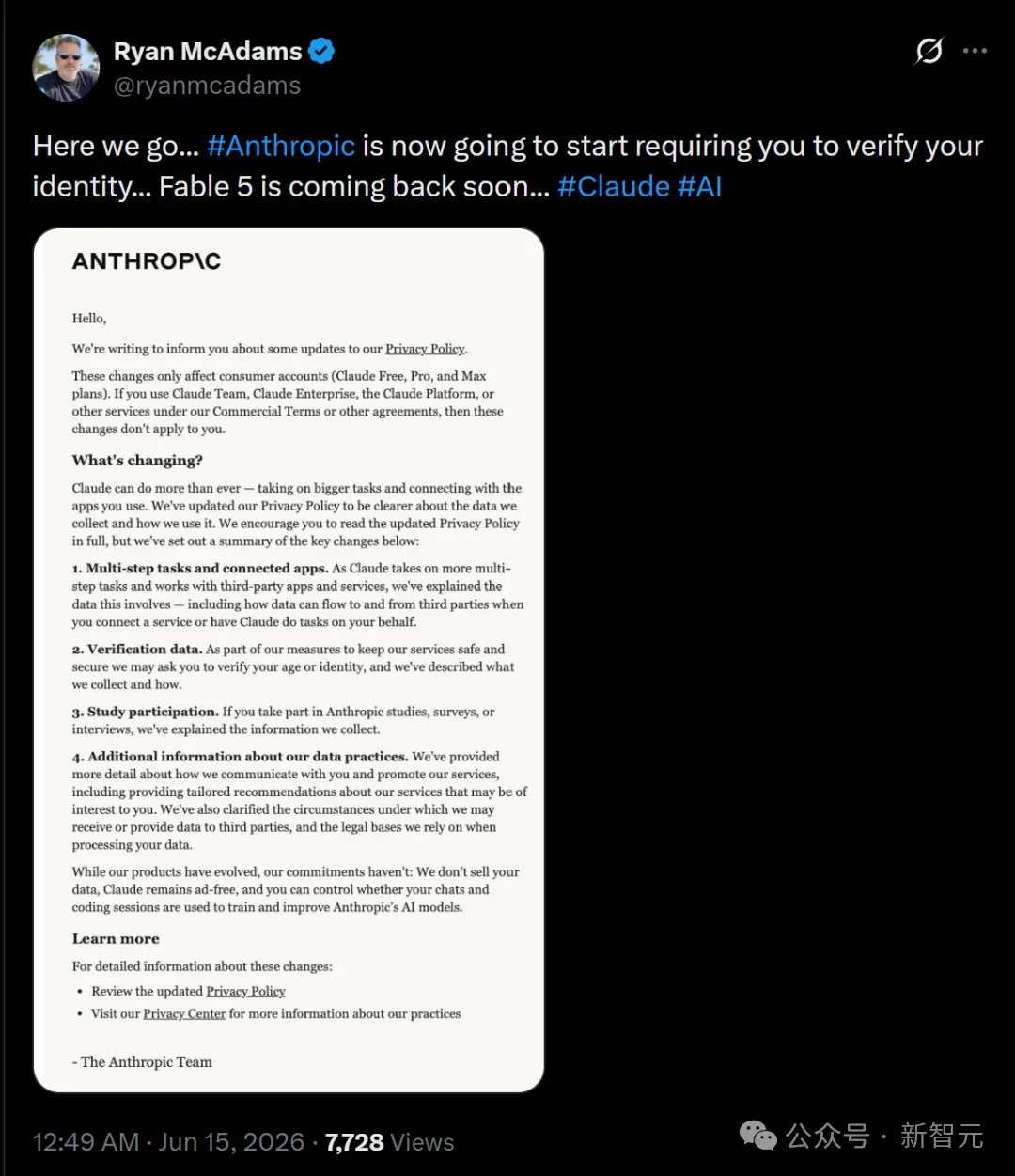
Anthropic Suddenly Announces, Is Real-Name Verification Really Coming?

On June 10th, many Claude users' inboxes received an email from Anthropic.
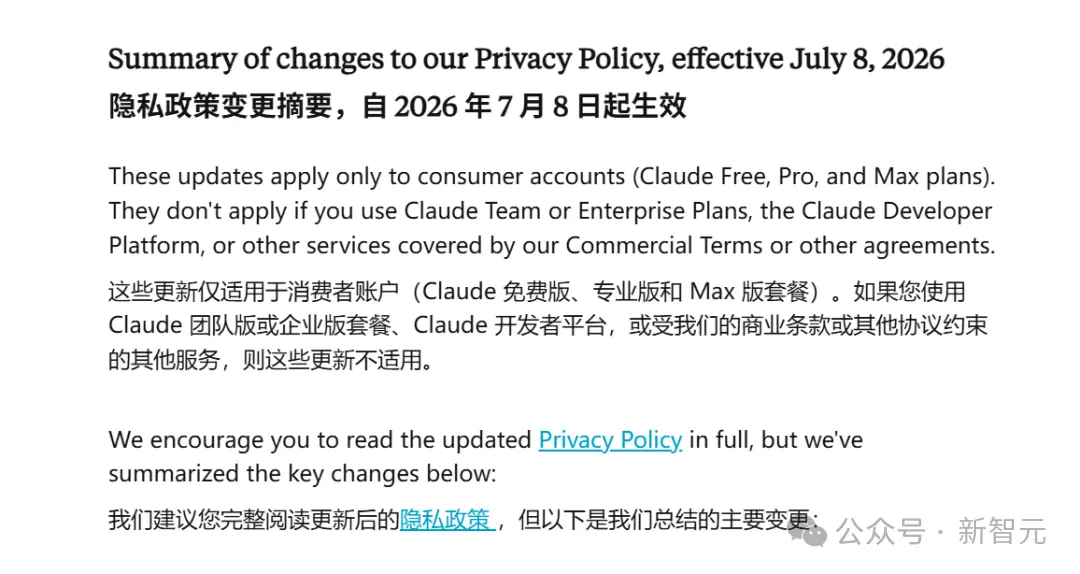
The email mentions that starting July 8th, Anthropic may ask users to verify their age or identity, citing the reason as "enhancing security." More interestingly, some found they just received this email today, while their other accounts hadn't received it at all before, suggesting it might be a batch rollout or an A/B test.

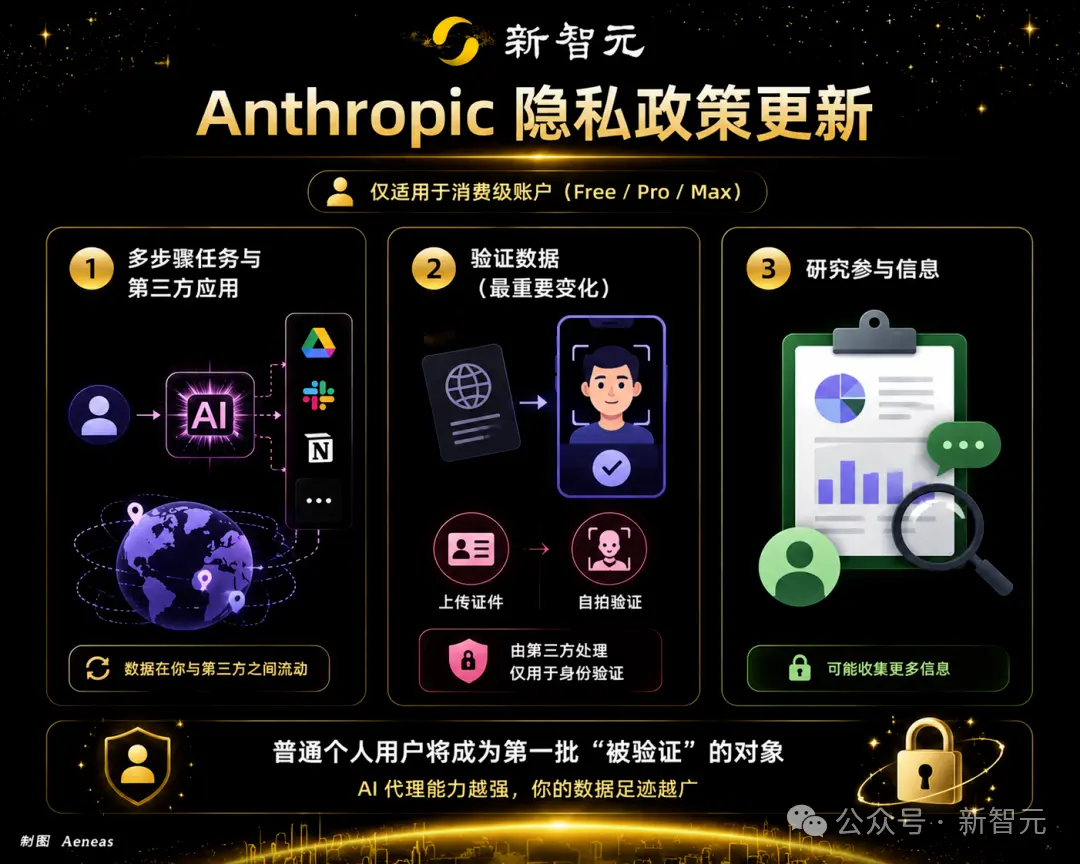
According to the officially updated privacy policy in the email, there are three core changes:
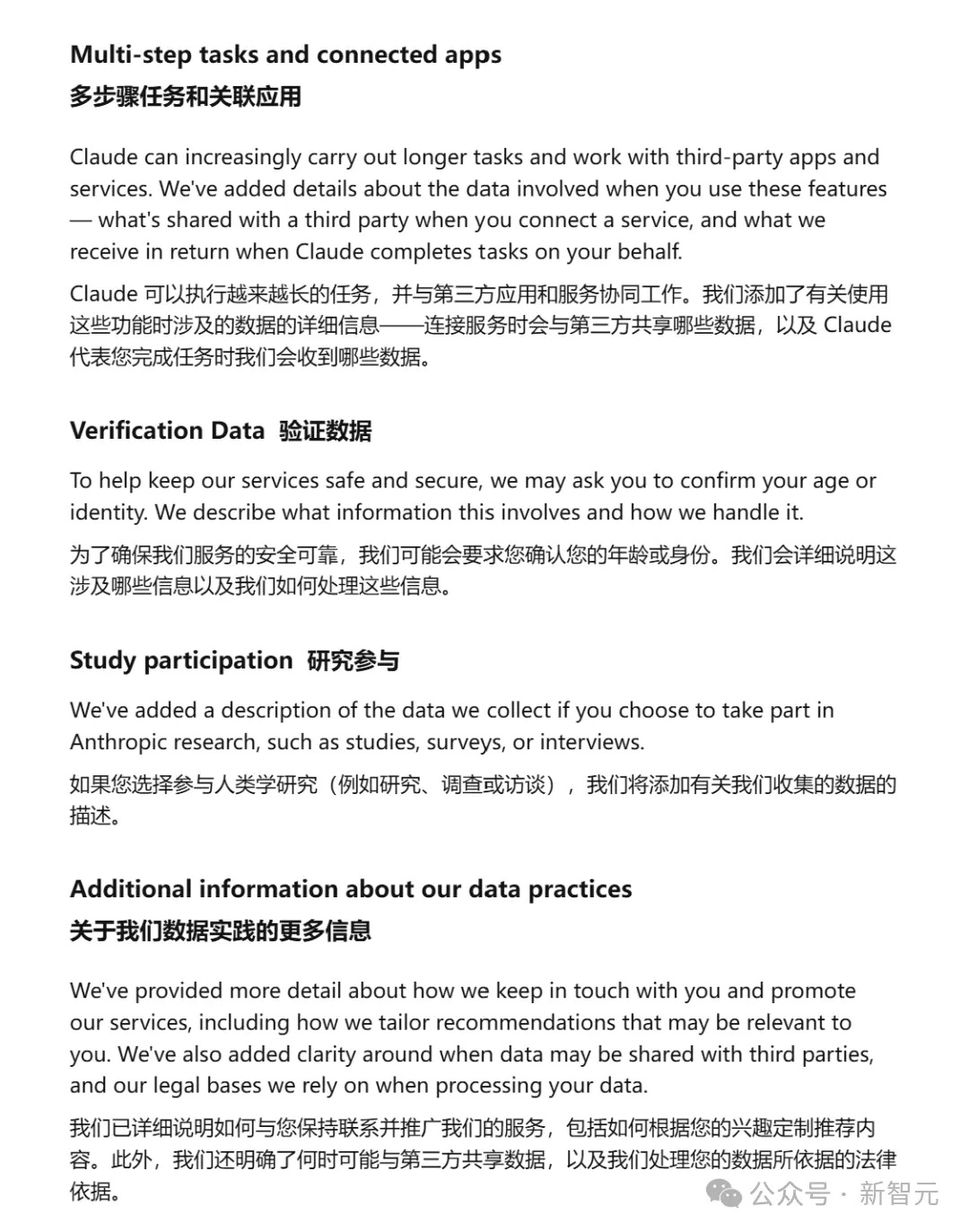
1. Data Flow for Multi-Step Tasks and Third-Party Apps

As Claude's capabilities improve, it can perform multi-step tasks on behalf of users (like helping you plan a full trip: checking flights, booking hotels, arranging itineraries), and can also connect to third-party apps (like Google Drive, Slack, Notion, etc.).

Moreover, your data no longer stays solely on Anthropic's servers. Anthropic explicitly states in the updated privacy policy: When you connect a service or have Claude perform tasks for you, data can flow between you and third parties.

This means your conversation content, uploaded files, and even your commands may leave Anthropic's servers and enter third-party app processing pipelines. For ordinary users, the more powerful the AI's "agentic capabilities," the broader your data footprint becomes.

2. Verification Data (Core Change)

This is the most impactful part of this update. The policy text reads:

As part of our efforts to maintain the security and reliability of our services, we may ask you to verify your age or identity. We are explaining here what information we collect and how.

How will verification be done?

According to Anthropic's official support page, verification will be conducted through the third-party service Persona. The specific process includes:

  • Uploading a government-issued, photo ID document (passport, driver's license, ID card, etc.)

  • Taking a real-time selfie (for comparison with the ID photo)

Anthropic attempts to reassure users, emphasizing that this data is only used to confirm identity, and will not be used for model training; data will not be stored on Anthropic's own servers (handled by Persona); and the entire process is only for specific security and compliance scenarios.

Nevertheless, this notification still shocked the user base. On platform X, one user shared an email screenshot with the caption: "Received on June 10th, thought it was just a regular update at the time... looking back now, terrifying to contemplate." Another user joked: They said they need to verify identity, so is Fable 5 coming back?

3. Research Participation Information

If you participate in Anthropic's research surveys or interviews, they will collect more information.
⚠️ Important Note:

The above three changes apply only to consumer accounts (Free, Pro, Max). Business customers (Team, Enterprise) are not affected. This means ordinary individual users will be the first batch to undergo "verification."

Anthropic explains on its official support page: Identity verification was previously only used in specific scenarios targeting minors, violators, or accounts in unsupported regions. In the future, as agent tasks become more complex, the scope of verification will gradually expand.

Identity verification is not something Anthropic is doing for the first time. Previously, when dealing with minor protection, violators, and accounts in some unsupported regions, similar verification methods have been used. The difference is that this time, the wording and scope are more explicit, and they specifically highlighted one sentence—in the future, as Agent tasks become increasingly complex, verification scenarios may continue to expand.

Many heavy Agent users worry: in the future, when using Claude to run automated tasks, will there be constant pop-ups asking for face scans? Currently, the official has not provided more detailed trigger conditions; after July 8th, there will likely be more specific explanations.

AI's "Wild West Era" Is Coming to an End

Thinking back to the recent uproar over the "Fable 5 Ban" incident, everything seems to have been foreshadowed.

When the Fable 5 account was banned by the authorities for crossing safety red lines, it shocked everyone. Many thought it might be a one-off disciplinary action for an extreme case, but now it appears that Fable 5's downfall is not an isolated incident, but rather a prelude to a comprehensive tightening by Anthropic and even the entire AI industry.

As AI's capabilities evolve from a "chat companion tool" to an "all-powerful agent" capable of operating third-party applications and executing complex tasks, the authorities will never allow another Fable 5 to run wild beyond legal boundaries.

The so-called "real-name system" and "face-scan verification" mark that on the eve of the full-scale explosion of AI Agents, major players must establish an unbreakable accountability tracing mechanism in advance. Once AI causes trouble while booking tickets, editing files, or even executing more complex business commands on your behalf, the platform must know exactly which real-life "person" is giving the orders behind the screen.

From July 8th onward, every time you attempt to have Claude help you complete multi-step complex tasks, it might be accompanied by a pop-up: Please upload your ID document.

Anthropic's message reveals—winter is coming. From now on, face-scan verification and account purging will likely become the norm for the AI industry in 2026.

In another month, when using Claude, one must be prepared to hold up their ID at any moment.

References:

  • https://x.com/ryanmcadams/status/2066201356034011370?s=20

  • https://privacy.claude.com/en/articles/10301952-updates-to-our-privacy-polic

Domande pertinenti

QWhat is the main announcement Anthropic made to its users regarding Claude's privacy policy, and what change is expected starting July 8th?

AAnthropic announced an update to Claude's privacy policy, notifying users that starting July 8th, the company may require them to verify their age or identity to enhance security. This verification would be conducted through the third-party service Persona and could involve uploading a government-issued photo ID and taking a live selfie.

QAccording to the article, what are the three key changes outlined in the updated privacy policy?

AThe three key changes are: 1) Clarification on how user data flows during multi-step tasks and interactions with third-party apps connected to Claude. 2) The introduction of identity and age verification for users. 3) Clarification on the collection of information for users participating in Anthropic's research programs, such as surveys and interviews.

QWhich group of Claude users will primarily be affected by the new identity verification requirement?

AThe new identity verification requirement will primarily affect consumer-level accounts, including Free, Pro, and Max plans. Business customers using Team or Enterprise plans are not impacted by this change.

QWhat is the stated reason Anthropic is implementing identity verification, and how does the company claim to handle the collected data?

AAnthropic states the reason for implementing identity verification is to enhance the safety and reliability of its services. The company claims the data will only be used to confirm identity, not for model training. The verification process is handled by the third-party service Persona, and the data is not stored on Anthropic's own servers.

QHow does the article connect this policy change to the broader trend in the AI industry, specifically mentioning the 'Fable 5' incident?

AThe article suggests this policy change is part of a broader industry-wide tightening of regulations. It connects it to the 'Fable 5' incident, where an account was banned for safety violations, implying that as AI agents like Claude become capable of performing complex, multi-step tasks, companies must establish clear accountability and traceability to prevent misuse, marking the end of a more 'wild' era for AI.

Letture associate

The Shutdown of Claude Mythos Revealed the True Cost of Renting AI to Me

The sudden shutdown of Claude Mythos this week starkly highlights a critical, often overlooked risk for founders: when your core capability relies entirely on someone else's platform, your fate is not in your own hands. The key question becomes: who truly owns the intelligence your product depends on? For years, the debate around open-source models focused on cost. Now, the evidence is clear: fine-tuned open-source models can achieve frontier-level quality for specific, mission-critical tasks at a fraction of the cost. However, the deeper issue is control. Relying on a third-party API is like renting; it works until the landlord changes the rules, raises the rent, or asks you to leave—as Mythos experienced. The lesson is not to stop using frontier models—they are incredible infrastructure. The goal is ownership. Ownership means starting with a powerful open-source model and shaping it around what makes your company unique: your data, workflows, domain expertise, and definition of "good." Over time, the model becomes less generic and more reflective of your business, creating durable value. The optimistic conclusion is that AI's future doesn't hinge on one superior model. There is no single frontier. The frontier includes proprietary models, models fine-tuned on company-specific knowledge, specialized models for narrow problems, and intelligent routers orchestrating model ensembles. The most interesting development is not models getting smarter, but intelligence becoming increasingly customizable. The winning companies will be those that transform intelligence into a unique, owned asset. Looking ahead, the vision is not one model dominating all, but many teams owning the part of the frontier that matters most to them.

marsbit19 min fa

The Shutdown of Claude Mythos Revealed the True Cost of Renting AI to Me

marsbit19 min fa

Tiger Research: U.S. Strategic Bitcoin Reserve - Should the Market Be Happy or Disappointed?

Tiger Research analyzes the evolution of U.S. legislative efforts regarding a strategic Bitcoin reserve, concluding the market impact is limited in the short term but potentially positive long-term. The core event was a March 2025 executive order by former President Trump, which designated confiscated Bitcoin as a strategic reserve and promised not to sell existing holdings (approx. 190k BTC). As it contained no mandate to purchase new Bitcoin, the market reacted negatively, with prices dropping 5.7%. Legislative history shows a significant retreat from initial ambitions. The 2024 "BITCOIN Act" proposed mandatory purchases of 1 million BTC over five years. Reintroduced in 2025, it stalled due to high fiscal costs, concerns over dollar hegemony, and opposition from the Treasury Secretary. The current frontrunner, the 2026 "American Retirement and Monetary Advancement (ARMA) Act," is a compromise. It lacks any purchase requirement, instead focusing on consolidating existing government-held Bitcoin and legally prohibiting its sale for at least 20 years. While ARMA has higher passage odds due to bipartisan support and no purchase mandate, its immediate market effect is neutral. It eliminates potential government selling pressure but creates no new demand. The long-term significance is that formally establishing Bitcoin as a national reserve asset in law could later reignite debates on mandatory purchases. Therefore, the path to a government buyer is longer than initially priced by the market, but the directional narrative remains intact.

marsbit22 min fa

Tiger Research: U.S. Strategic Bitcoin Reserve - Should the Market Be Happy or Disappointed?

marsbit22 min fa

US Stock Market Trend (June 16): SpaceX Rises 42% in Two Days, New Fed Chairman Takes Office Today

**U.S. Stocks Trend (June 16): SpaceX Soars 42% in Two Days, New Fed Chair Takes Office Today** Markets surged on Monday following former President Trump's social media announcement of a completed U.S.-Iran deal to reopen the Strait of Hormuz, pending a June 19 signing. The news triggered a broad risk-on rally: oil prices crashed, tech stocks soared, bond yields fell, and defensive sectors lagged. **Market Performance:** The Nasdaq jumped 3.07%, led by semiconductor stocks like Micron (+9.2%). The S&P 500 gained 1.65%, and the Dow rose 0.92% to a record high. However, the Russell 2000 small-cap index underperformed (+0.72%). SpaceX continued its hot streak, rising another 5% pre-market after disclosures of large buys by an Australian billionaire and Cathie Wood's ARK. Boeing also rallied on the transportation optimism. Conversely, energy stocks like Chevron fell over 3% on the oil price plunge, with other defensive sectors also selling off. The day's action showed a clear rotation of funds from energy/defensive plays into AI and tech narratives. **Macro & Outlook:** The VIX fear index fell 8.37%. Treasury yields declined, and WTI crude dropped over 5%. Attention now shifts to a packed schedule: the Bank of Japan is widely expected to hike rates to 1.0% on Tuesday. The Fed's June meeting concludes Wednesday, marking new Chair Wash's debut. While rates are expected to hold, his tone on stubborn inflation and the "dot plot" will be crucial for gauging the 2024 rate path. The formal Iran deal signing is set for Friday. **Trend Perspective:** While the peace deal is a genuine positive, Monday's explosive rally may have gotten ahead of itself, pricing in a swift resolution to inflation concerns. The shortened trading week faces a triple test: BoJ tightening, the Fed's policy stance, and deal implementation details. Tech and semiconductors, which led the surge, remain vulnerable to any disappointment from these key events. The real price discovery begins with the central banks' communications this week.

marsbit43 min fa

US Stock Market Trend (June 16): SpaceX Rises 42% in Two Days, New Fed Chairman Takes Office Today

marsbit43 min fa

Xiaohongshu's Second Great Voyage, This Time Sailing Towards AI

Xiaohongshu's Second Voyage: Navigating Towards AI Since ChatGPT's emergence, Xiaohongshu's founder Mao Wenchao has been acutely aware of AI's potential threat, recognizing that the life advice people seek from chatbots overlaps directly with his platform's core business. Founded in 2013 as a PDF shopping guide for Chinese tourists, Xiaohongshu evolved into a massive community where millions share authentic, personal experiences—from product reviews to travel tips. This vast repository of "I've tried this" human judgment became its most valuable asset. However, the rise of AI, which delivers instant answers, challenges the very need for users to sift through numerous personal notes. Fearing its treasure trove of lived experience could become mere training data for others, Xiaohongshu is proactively adapting. In 2026, it established a dedicated AI division (Dots), launched RED Skill to turn user experiences into usable AI tools, and acquired the AI search product "Diandian." Its investments now extend to AI firms like MiniMax and hardware startups, moving upstream to address needs before they even become search queries. The platform's commercialization strategy is also evolving. With a newly acquired payment license and tools like the AIPS model to track consumer decision journeys, Xiaohongshu aims to seamlessly integrate recommendations with transactions, embedding commerce within AI-generated answers. Yet, a critical tension remains. While building smarter machines to organize and leverage its human experiences, Xiaohongshu must prevent AI from drowning out the authentic, flawed, and trustworthy "I've tried this" voices that built its community. Its core challenge is to harness AI's power without letting the map—the machine's perfect, synthesized answer—replace the territory of genuine human experience. This balance between technological advancement and preserving human trust defines its current journey and its future.

marsbit1 h fa

Xiaohongshu's Second Great Voyage, This Time Sailing Towards AI

marsbit1 h fa

Trading

Spot
Futures

Articoli Popolari

Come comprare ID

Benvenuto in HTX.com! Abbiamo reso l'acquisto di SPACE ID (ID) semplice e conveniente. Segui la nostra guida passo passo per intraprendere il tuo viaggio nel mondo delle criptovalute.Step 1: Crea il tuo Account HTXUsa la tua email o numero di telefono per registrarti il tuo account gratuito su HTX. Vivi un'esperienza facile e sblocca tutte le funzionalità,Crea il mio accountStep 2: Vai in Acquista crypto e seleziona il tuo metodo di pagamentoCarta di credito/debito: utilizza la tua Visa o Mastercard per acquistare immediatamente SPACE IDID.Bilancio: Usa i fondi dal bilancio del tuo account HTX per fare trading senza problemi.Terze parti: abbiamo aggiunto metodi di pagamento molto utilizzati come Google Pay e Apple Pay per maggiore comodità.P2P: Fai trading direttamente con altri utenti HTX.Over-the-Counter (OTC): Offriamo servizi su misura e tassi di cambio competitivi per i trader.Step 3: Conserva SPACE ID (ID)Dopo aver acquistato SPACE ID (ID), conserva nel tuo account HTX. In alternativa, puoi inviare tramite trasferimento blockchain o scambiare per altre criptovalute.Step 4: Scambia SPACE ID (ID)Scambia facilmente SPACE ID (ID) nel mercato spot di HTX. Accedi al tuo account, seleziona la tua coppia di trading, esegui le tue operazioni e monitora in tempo reale. Offriamo un'esperienza user-friendly sia per chi ha appena iniziato che per i trader più esperti.

196 Totale visualizzazioniPubblicato il 2024.12.12Aggiornato il 2026.06.02

Come comprare ID

Discussioni

Benvenuto nella Community HTX. Qui puoi rimanere informato sugli ultimi sviluppi della piattaforma e accedere ad approfondimenti esperti sul mercato. Le opinioni degli utenti sul prezzo di ID ID sono presentate come di seguito.

活动图片