Have you ever thought that AI agents might also need email? This sounds like a plot from a science fiction novel, but it's actually happening. What's even more shocking is that some AI agents have already started registering for email services on their own—they find AgentMail through web searches, browse the website, and create their own email accounts, all without any human involvement. When the founding team of AgentMail first observed this phenomenon, they realized a significant turning point had arrived: AI agents are no longer just tools; they are becoming independent entities on the internet.
This San Francisco-based startup, which just completed a $6 million seed funding round, is doing something that seems simple but has profound implications: providing dedicated email services for AI agents. The funding round was led by General Catalyst, with participation from Y Combinator and Phosphor Capital. Angel investors include Paul Graham, HubSpot's CTO Dharmesh Shah, Supabase's CEO Paul Copplestone, and Ramp's CTO Karim Atiyeh. The involvement of these investors itself indicates a fundamental shift in the software industry: we are witnessing AI agents transitioning from being auxiliary tools to becoming the primary users of the internet.

As I delved deeper into AgentMail, I gradually understood why email is so important for AI agents and what kind of industry transformation lies behind this. This is not just about technological innovation; it's about how we redefine the concept of "users" and how the future software ecosystem will evolve.
Why AI Agents Need Email
For humans, email is a natural part of life. We use it daily to send and receive messages, verify identities, register accounts, and reset passwords. Over 300 billion emails are sent globally every day, most of which are from humans to humans. But I've been pondering a question: if AI agents become new users of the internet, what will this number become? One trillion? Ten trillion? Or perhaps, will email evolve into a communication protocol between AI agents?
The reality is that most AI agents today are not part of this email conversation network. This is paradoxical because they can perform complex reasoning, maintain long-term memory, and manage workflows, yet they cannot participate in humanity's most basic form of communication. The reason is simple: email systems were designed for humans, not for AI agents.
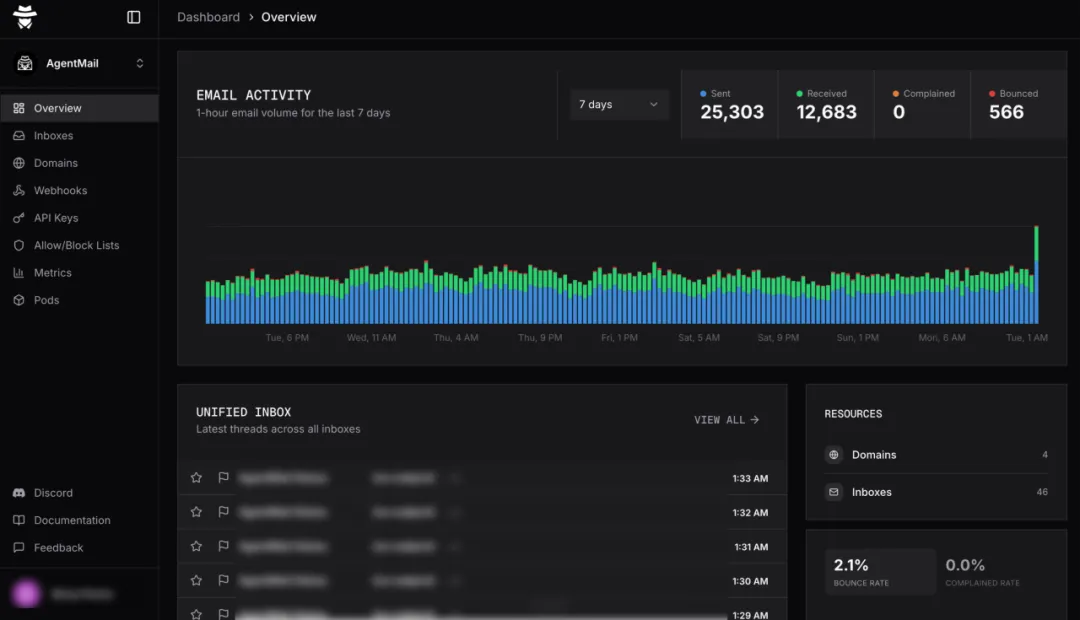
I believe email is so important because it represents more than just a communication tool; it is the core of internet identity. Think about it: your inbox records your entire digital life—every registered account, every conversation, every receipt, every verification. If a large language model wants to understand how a person uses the internet, that person's inbox might be the richest source of information. This is why AgentMail's founder, Haakam Aujla, says, "The real purpose of email for humans isn't even communication; it's identity verification."
Email is so powerful because of its universality and decentralized nature. No single company controls the entire email system; protocols like SMTP and IMAP have remained largely unchanged for decades. There are 4.8 billion email accounts globally, and almost every service accepts them. This universality is unmatched by other communication methods. Social media platforms have their own account systems, instant messaging tools are scattered across different ecosystems, but email is universal. When AI agents have programmatic access to email, they gain a significant advantage.
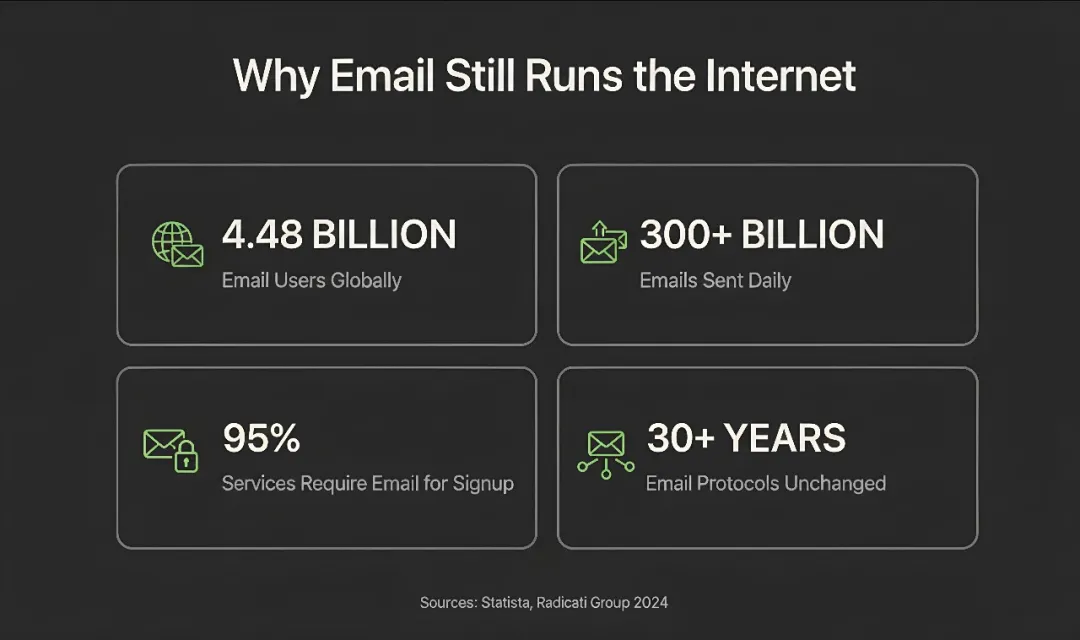
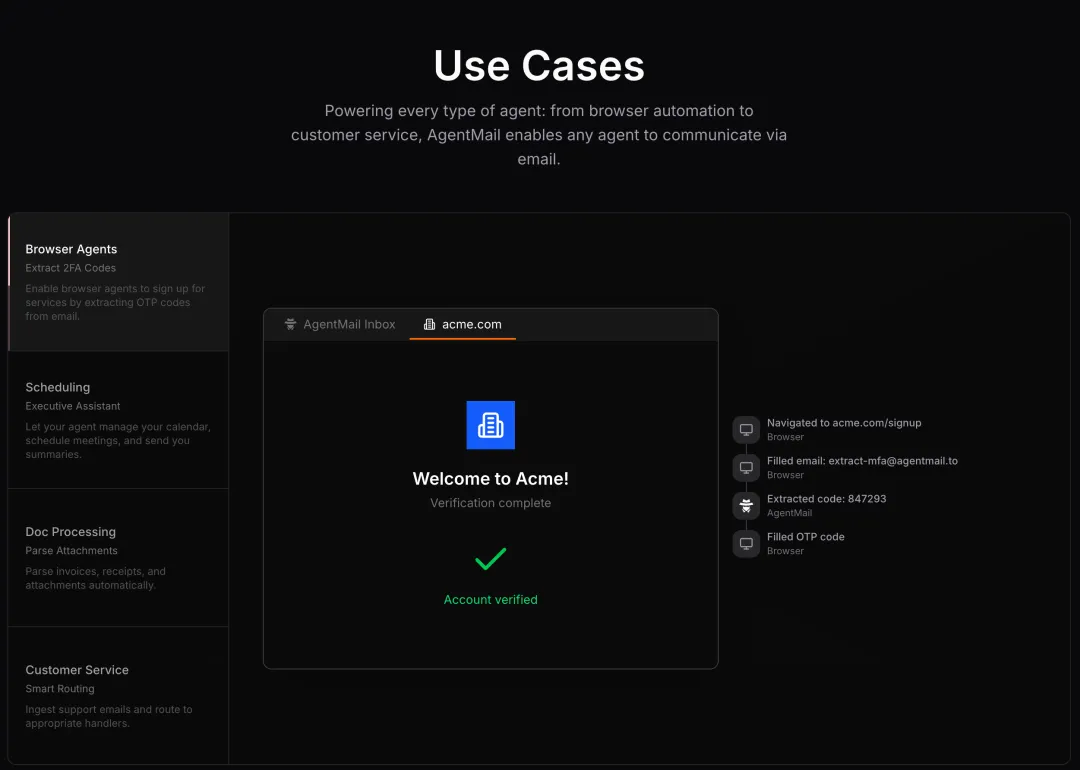
I carefully studied the key capabilities that email unlocks for AI agents. The first is third-party identity verification. Most services on the internet require email to register accounts. By giving your AI agent an email, it can automatically handle verification processes: receiving one-time passwords, clicking confirmation links, all without human intervention. This creates a powerful capability: an independent identity for AI agents on the internet. Every registration, every verification, every confirmation is done through the inbox, making the inbox an audit trail for all the AI agent's online activities.
The second capability is bidirectional communication. Email is inherently bidirectional. Your AI agent can receive messages from customers, service providers, and partners, process these messages, and then reply, follow up, or escalate. Communication in both directions happens through the same channel, and conversation threads persist across multiple exchanges. Human interaction with AI agents is exactly the same as with other people: write an email, send it, and it's done. Your AI agent maintains conversation threads across multiple exchanges, processes received messages, and responds without waiting for human intermediaries.
The third capability is automatic audit trails and documentation. Email automatically creates documentation; every message is timestamped, and every exchange is stored. Legal teams understand email, and compliance teams can audit it. Your AI agent's email history becomes a searchable record of every interaction, with no need for special tools. This is especially important for industries that require strict record-keeping and auditing, such as finance, healthcare, and legal services.
The fourth capability is multi-threaded conversations. Email is inherently multi-threaded. Your AI agent can be CC'd into existing threads, forwarded into ongoing conversations, and communicate with 50 people simultaneously while maintaining the context of each exchange. This isn't simple one-on-one messaging; it's parallel conversations across teams, customers, and systems. When your AI agent needs human input, it can bring people in; when humans need to escalate to an AI agent, they can forward the thread. Context travels with the conversation, with no loss of information.
What Problem Is AgentMail Solving?
I found that traditional email providers haven't considered AI agent use cases at all. Services like Gmail and Outlook are designed for humans; they have complex OAuth authentication processes, strict sending rate limits, and pricing models tailored to individual users. When you want to create an email account for an AI agent, these limitations become significant obstacles.
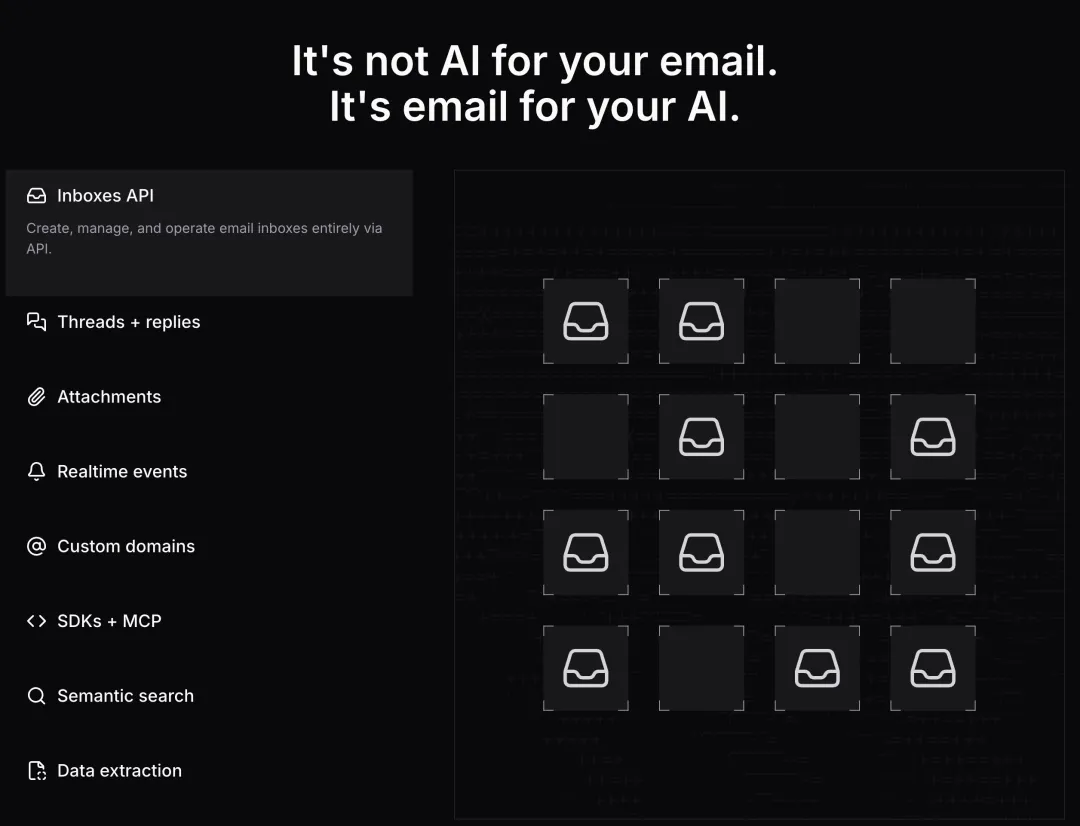
AgentMail's founder, Haakam Aujla, explained their approach in an interview with TechCrunch: "When you open Gmail, you see a bunch of threads, each thread can have many messages, and these messages might have attachments. You want to be able to label them, search, filter, reply, forward. We think our AI agents should be able to do these things, but they shouldn't need to click buttons on a screen because that's too cumbersome for AI agents. They should just need to make API calls."
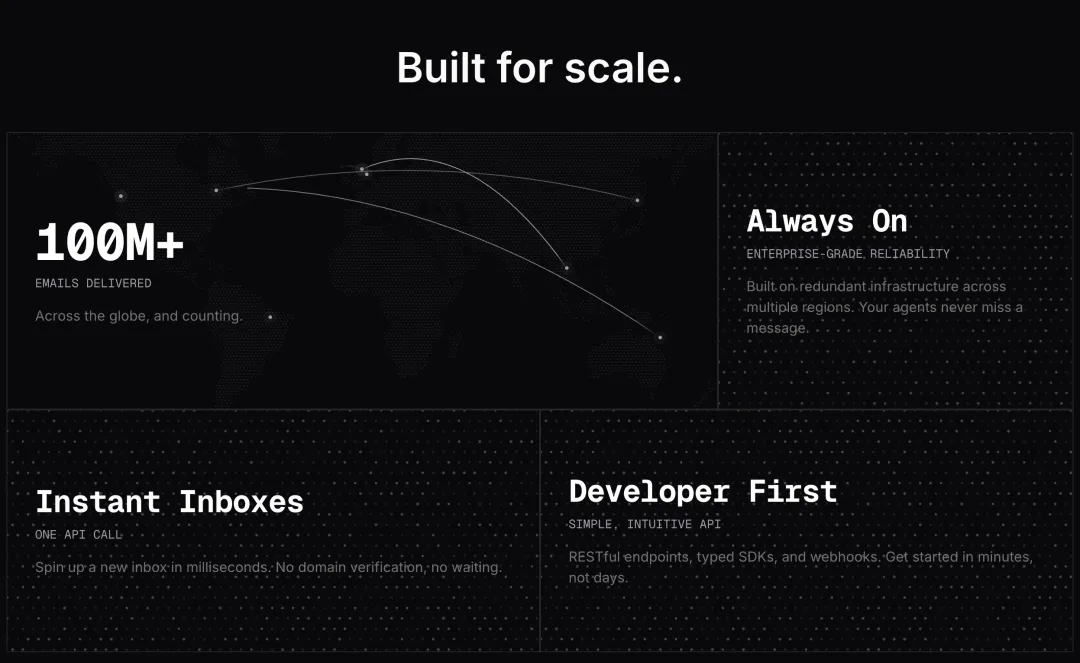
This seemingly simple insight actually reveals a deeper problem: humans and AI agents access the same functionalities in completely different ways. Humans need graphical interfaces, buttons, and menus, while AI agents need APIs, programmatic interfaces, and structured data. AgentMail provides exactly this kind of email experience designed specifically for AI agents.
One API call can create an email account. Your AI agent gets a real email address with full bidirectional communication capabilities: send, receive, thread management, reply, search, and labels. Built-in spam detection and security mechanisms ensure deliverability even with high email volumes. No manual setup, no OAuth flow, no human involvement required.
Unlike transactional email APIs that can only send one-way notifications, AgentMail is built for AI agents that need to engage in real conversations. AI agents can extract structured data from unstructured emails, automatically label and categorize incoming messages. Webhooks and WebSockets deliver events in real time. It supports LangChain, LlamaIndex, CrewAI, and any framework that can make API calls out of the box.
I particularly appreciate the measures AgentMail has taken to prevent abuse. Providing email to AI agents does pose abuse risks, and Aujla explained their systems: AI agent email accounts can only send 10 emails per day unless manually verified; if an account shows unusually high activity levels, the platform imposes rate limits; it monitors bounce rates; and randomly samples new accounts to filter for sensitive keywords. These mechanisms provide AI agents with freedom while ensuring the system isn't misused.
What It Means That AI Agents Are Registering for Email Themselves
The AgentMail team observed a phenomenon they hadn't anticipated at all: autonomous AI agents started registering for AgentMail services on their own. These AI agents found AgentMail through web searches, browsed the website, and created their own email accounts, all without any developer involvement. When I first read this information, I realized this isn't just a technical detail; it's a landmark event.
This shows that AI agents are no longer passive tools but active participants. They can identify their own needs—such as needing an email account to complete a task—then find solutions and execute them independently. This emergence of autonomy reminds me of the early days of the internet: when the first automated programs started crawling web pages and indexing content, people realized that internet users weren't just humans.
The AgentMail team said: "We've always believed the next billion users of the internet will be AI agents. It turns out they're already here." This statement made me think deeply. We often imagine the large-scale adoption of AI agents as something in the future, but in reality, this future is already quietly happening. When AI agents start registering for services, managing identities, and communicating on their own, they've already become part of the internet ecosystem.
To support this autonomy, AgentMail launched an onboarding API alongside announcing their funding. You can point your AI agent directly to this API, and it can register and create an email account for itself. This isn't an interface designed for humans; it's self-service designed for AI agents. This shift in design philosophy is crucial: software no longer assumes a human operator behind it but directly targets AI agents as first-class users.
Real Use Cases Beyond Imagination
Since launching in the Y Combinator Summer 2025 batch, AgentMail has attracted tens of thousands of human users and hundreds of thousands of "AI agent users," along with over 500 B2B customers. These numbers themselves are impressive, but what interests me more is the diversity of these use cases.
Supply chain teams are running AI agents that coordinate dozens of carriers, tracking shipments and resolving exceptions in real time via email. Imagine a logistics AI agent managing dozens of shipping orders simultaneously; when a shipment is delayed, it automatically emails the carrier to inquire, receives a response, determines whether route adjustments or customer notifications are needed, and then takes appropriate action. This multi-threaded, real-time responsiveness is efficiency that human logistics coordinators struggle to achieve.
Loan collection AI agents are handling payment reminders and repayment plan follow-ups. This is a scenario requiring massive repetitive communication but also needs to adjust wording and strategies based on specific customer situations. AI agents can maintain conversation histories for each customer, remember previous commitments and responses, and then send personalized follow-up emails at appropriate times.
Customer service AI agents are autonomously managing inboxes. These AI agents aren't just answering FAQs; they can understand complex customer requests, check order statuses, coordinate across departments, and even escalate to human handling when necessary. The key is that they do all this through email, maintaining complete conversation threads and context.
Procurement bots are negotiating with suppliers via email. This scenario is particularly interesting because negotiation is typically considered a task requiring human judgment and strategy. But AI agents can engage in multiple rounds of email exchanges with suppliers based on preset parameters and goals, compare different quotes, make counteroffers, and ultimately close deals. This capability allows small and medium-sized businesses to access the negotiation power of large corporate procurement teams.
I was impressed by the comment from Garrett Scott, CEO of DoAnything.com: "AgentMail turned email from my biggest worry into something I don't have to think about. Now thousands of DoAnything AI agents operate autonomously with their own email identities." This reveals AgentMail's true value: it's not about making existing work slightly more efficient; it's about making certain work completely human-free.
Progress was slow in the early stages because AI agents hadn't truly taken off yet. AgentMail primarily focused on B2B use cases, helping businesses scale their email communications. But when OpenClaw (then called Clawdbot) burst onto the scene at the end of January this year, everything changed. AgentMail's user count tripled that week and quadrupled again in February, as people started looking for ways to provide email to AI agents, enabling them to work more autonomously.
The timing was perfect. Traditional email providers like Gmail imposed rate and capacity limits on email APIs, while AgentMail offered a fairly generous free tier, plus paid plans and enterprise subscriptions. This pricing model better aligns with AI agent usage patterns: not charging per user but per usage.
Future Infrastructure for Trillions of AI Agents
Box CEO Aaron Levie recently published a deep-dive article titled "Building for Trillions of AI Agents." His perspective gave me a more macro understanding of the entire AI agent ecosystem. Levie believes that AI agents have undergone a significant shift in recent months. Programmatic AI agents can now complete longer-running tasks and require less hand-holding.
These AI agents are no longer chatbots with basic tools. Instead, they typically have their own sandboxed computing environments, able to write and run code for any problem they encounter, interact directly with APIs and command-line interfaces, and possess their own file systems and long-term memory, among other things. This core set of primitives, combined with overall progress in AI agent best practices and the insane progress models have made in AI agent tool use and software development, showcases the promise of AI agents that can handle any task.
Levie predicts that due to rapidly improving capabilities, AI agents will be introduced into almost every area of work. AI agents will be deployed to review every drafted contract, handle the majority of frontline customer support cases, audit every company's finances, scour every medical research paper for drug discovery, generate almost all code being written, create most sales and consulting presentations, conduct transactions for consumers online—in short, participate in almost every economically valuable task in society.
He also points out that this isn't just about executing tasks we already do today. We will use AI agents to do far more than before—we will use them to run simulations that were previously unaffordable, prototype every idea we have with many different options, pursue more projects because starting is cheap and shutting down is easy, and review every piece of data instead of sampling information.
When you add it all up, we can expect almost every employee in an organization to have many AI agents working on their behalf. It's not hard to imagine an enterprise having 100x or 1000x more AI agents than people. With trillions of AI agents running around, AI agents will become the primary users of all future software.
This prediction made me realize how important what AgentMail is doing truly is. If AI agents are to become the primary users of software, they need the same infrastructure as human users. Email is just the beginning. Levie also mentioned this: "AI agents will also likely need identity and the ability to communicate with others; for example, Agentmail is providing email for AI agents, giving them their own persistent email to use."
Levie also raised a key point: everything must become API-first. If you don't provide an API for a feature, it might as well not exist. If it can't be exposed via a CLI or MCP server, you're at a disadvantage. If you have confusing APIs and conflicting paths for AI agents to pursue, you're just hurting your chances of being useful to AI agents.
Y Combinator's Jared Friedman was more direct: "Even the best developer tools still don't let you sign up for an account via API. In the age of Claude Code, this is a huge miss because it means Claude can't sign up for itself. At this point, putting all account management functions into your API should be table stakes." If an AI agent can't easily register for your service and start using it, you're basically dead to AI agents.
These perspectives gave me a clearer understanding of the future of the entire software industry. We not only need to provide email for AI agents but also complete infrastructure: computing environments, file storage, identity authentication, payment wallets, web search tools, and more. AgentMail is working on one foundational layer, but this ecosystem needs more builders.
Email as the Identity Layer for AI Agents
AgentMail's broader vision isn't just about providing a way for bots to send and receive email. Aujla said: "We want to enable AI agents to use email the same way humans do, right? But the key is, the purpose of email for humans isn't even communication; it's your identity."
This insight is profound. The role email plays on the internet goes far beyond a communication tool. It is your primary identity identifier in the digital world. Every time you register for a new service, reset a password, or receive a verification code, it's done through email. This identity system is deeply embedded in the infrastructure of the entire internet.
Several startups are now trying to build new identity protocols for AI agents, but AgentMail's argument is: let's just use what already works for humans and is deeply integrated into the entire internet. Aujla summarized: "You give an AI agent an email address, and it can now basically use any existing software service."
I find this pragmatic approach very wise. Instead of trying to establish a brand-new identity protocol that requires adoption by all services, why not leverage the existing, widely accepted standard? Email has been around for decades, every internet service accepts it—why not just use it?
This also explains why AgentMail has garnered support from so many top investors. General Catalyst partner Yuri Sagalov said: "AI agents have already started serving as virtual employees across various industries. These AI agents need their own identity, and email is the core of identity on the internet. Traditional identity services weren't built for AI agent use cases; AgentMail is building that part of the stack, starting with email. The team's clarity of vision and speed of execution immediately caught our attention."
The advantage of email as an identity layer is its universality and persistence. An email address can be used for decades, across thousands of different services, and can migrate between different platforms and ecosystems. This persistence and portability are especially important for AI agents, as they need to maintain a consistent identity across different environments and services.
My Deep Thoughts on This Transformation
While researching AgentMail and the broader AI agent ecosystem, I've developed some deep thoughts about the future of the software industry. What we're experiencing isn't just technological progress; it's a fundamental shift in the definition of "user."
In the past, the term "user" unquestionably referred to humans. All software design, product decisions, and business models revolved around human users. But now, we need to redefine "user." AI agents are becoming the primary consumers of software, and their needs, behavior patterns, and usage methods are completely different from humans'.
The impact of this shift is profound. Business models need to change. Traditional per-seat pricing makes no sense for AI agents. An enterprise might have 100 employees but 10,000 AI agents. How do you price that? Do you charge per AI agent or based on usage? AgentMail chose the latter, offering a generous free tier plus usage-based paid plans. I believe this is a more sustainable model.
Product design also needs to change. We're no longer optimizing for graphical interfaces but for APIs. We're no longer considering what buttons users click but what endpoints AI agents will call. This isn't simply about adding an API layer; it's about fundamentally rethinking product architecture.
Security and compliance face new challenges. When AI agents can sign contracts, conduct transactions, and access sensitive information on behalf of companies, we need entirely new governance frameworks. AgentMail has implemented some protective measures, like limiting unverified AI agents to 10 emails per day, but this is just the beginning. In the future, we'll need more complex permission management, audit trails, and compliance tools.
From a macro perspective, I believe the rise of AI agents will reshape the entire labor market. It's not simply about replacing human jobs but changing the nature of work. Humans will increasingly play the roles of supervisors, strategists, and creators, while AI agents handle execution-level work. This requires us to rethink education, skills training, and career development.
AgentMail is just a small part of this massive transformation, but it touches on a core issue: infrastructure. If we believe trillions of AI agents are coming, then we need to start building the infrastructure to support them now. Email, computing environments, storage systems, payment networks, identity authentication—all of these need to be redesigned or adapted for AI agents.
One thing I particularly admire about the AgentMail team is their pragmatism. They didn't try to reinvent the wheel; they leveraged existing, time-tested technology—email. They recognized that email is already the core of internet identity, so why not just let AI agents use it? This line of thinking is worth learning from for other builders.
Looking ahead, AgentMail indicates that email is just the starting point. As AI agents take on more work that humans used to do, they will need real identities on the internet—not just inboxes, but also credentials, reputation, and trust. They want every AI agent that wants to use the internet like a human to have an AgentMail inbox. They are building the infrastructure to enable any AI agent to register, obtain an identity, and start communicating with the real world.
This vision is ambitious but necessary. If we truly believe AI agents will become the primary users of the internet, now is the time to build the infrastructure to support them. AgentMail's $6 million funding round is just the beginning of this grand narrative. I believe we will see many more infrastructure and services built specifically for AI agents emerge in the coming years.
Ultimately, the core of this transformation isn't the technology itself but how we redefine human-machine collaboration. AI agents aren't meant to replace humans but to become our digital colleagues, assistants, and agents. When they have their own email, their own identity, and their own work environment, they can work for us more effectively. And we humans can focus on more creative, more strategic work. This is a win-win future, and AgentMail is helping us move toward it.