AI Reshapes the Semiconductor "Smile Curve": The Rising Logic Behind the Global Distributed Bull Market

marsbitPubblicato 2026-06-17Pubblicato ultima volta 2026-06-17

Introduzione

The Philadelphia Semiconductor Index (SOX) has hit a historic high above 14,000 points, driven by a concentrated AI-fueled semiconductor rally. Key drivers are extreme scarcity and pricing power in critical bottlenecks of the AI data center supply chain. Unlike traditional models where manufacturing held lower profits, AI has reshaped the "Smile Curve." Highly complex manufacturing and advanced packaging nodes—like TSMC's CoWoS, SK Hynix's HBM, and ASML's EUV lithography—have become exceptionally scarce and high-margin, rivaling design-side profitability. The market rewards those controlling irreplaceable segments: U.S. firms lead in AI chip design and cloud services; Taiwan and Korea dominate advanced foundry/logic and memory/HBM respectively; Japan and the Netherlands supply vital materials and equipment. Storage, particularly HBM, is the tightest bottleneck, with severe shortages predicted through 2027. While bullish analysts project sustained AI infrastructure spending growth, notable bears like Michael Burry warn of bubble-like exuberance reminiscent of the dot-com era, citing overleveraged private financing for data centers. Key near-term catalysts include earnings guidance from Micron and Nvidia, while longer-term risks hinge on the 2027-2028 capacity expansion wave and persistent geopolitical tensions in concentrated supply chains.

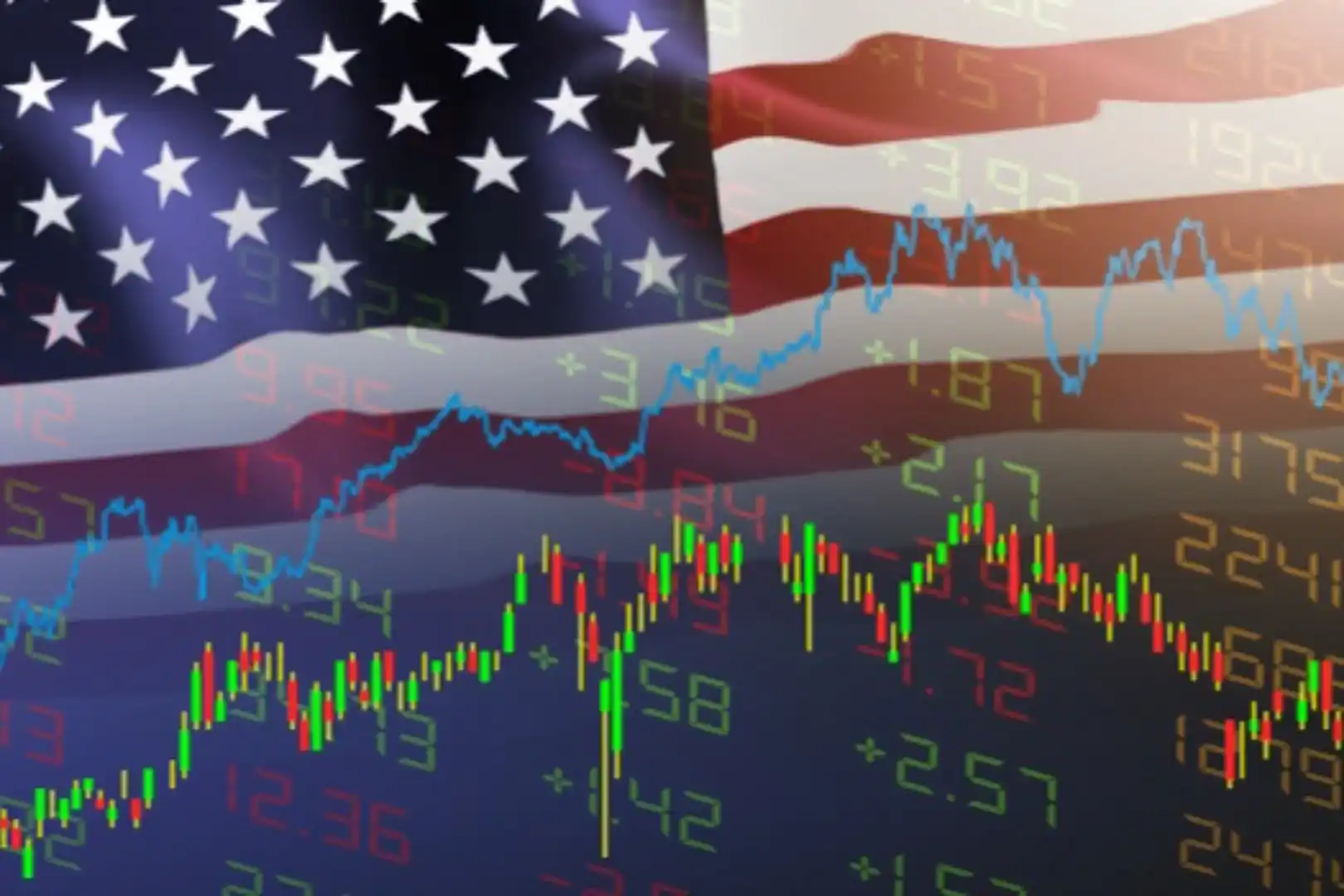
U.S. stocks closed overnight, with the Philadelphia Semiconductor Index (SOX) breaking through the 14,000-point mark for the first time, hitting a new all-time high.

Historically, there have only been two periods when the SOX rose over 230% within 14 months: from December 1998 to February 2000, and from April 2025 to the present.
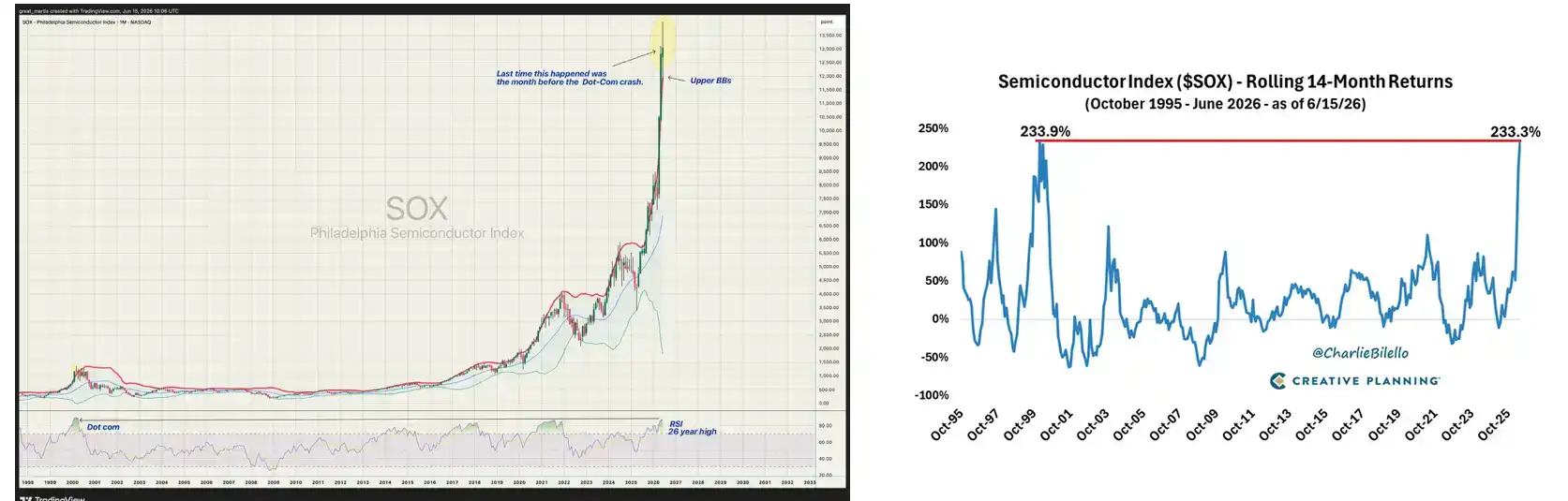
The returns in this semiconductor bull market have been highly concentrated and significant. The year-to-date gains for the memory trio—Micron, SK Hynix, and Samsung—are approximately 141%, 186%, and 114%, respectively. TSMC's U.S. ADR has gained over 50% year-to-date.

Nvidia hit a new all-time high of $235.47 on May 14. Broadcom, Marvell, and ASML have either set new records or are approaching them in their respective market segments. The 52-week low for the entire SOXX ETF is $148, with the high near $369, representing a price swing of nearly 150%.

In April, Goldman Sachs revised its 2026 DRAM supply-demand deficit forecast from 3.3% to 4.9%, calling it the most severe memory shortage in 15 years. HBM prices are even more staggering: a single HBM3E stack costs about $300, and the upcoming HBM4 is estimated at $500 per stack. SK Hynix's 2026 HBM capacity has already been fully booked by Microsoft, Google, and Nvidia, with some customers even paying deposits in full upfront to secure capacity.

Clearly, the speed of AI data center construction is far outpacing the expansion of chip production capacity.

The 'Bottleneck' Bull Market

Scarcity is the most profitable product.

Understanding this phrase essentially captures the core logic of this semiconductor bull market. Whoever controls the bottleneck in AI infrastructure holds the most powerful pricing authority. Conversely, for segments that can be substituted or face price pressure, even with high demand, stock prices won't rise.

Optical modules are a typical example of the latter. A Photon Capital report in April pointed out that while Chinese optical module companies hold seven of the top ten global spots, they aren't making much profit; the profits are still with the chip companies. Zhongji Innolight and Sunsea are at a global first-tier level in terms of shipment volume and cost control for 800G and 1.6T optical modules, directly squeezing the margins of U.S. optical module companies like Coherent and Lumentum. Demand has doubled, yet profit margins have thinned. The reason is singular: the assembly stage of optical modules is not scarce enough.

Memory, meanwhile, has become the hardest theme in this U.S. semiconductor bull market. Essentially, it's because it controls a bottleneck, and that grip is tightening.

HBM is not ordinary DRAM. 3D stacking, TSV (Through-Silicon Via), specialized packaging processes—each layer of technological barrier is the result of over a decade of heavy capital investment. Globally, only three companies can mass-produce HBM, with SK Hynix taking roughly half the market share.

Interestingly, this logic holds true even when magnified to a macro, national level.

The true winners in AI data center infrastructure are not "all semiconductor countries," but those countries and regions that, over the past few years or even decades, have built scarce industrial clusters in some irreplaceable link of the chain. Scarcity is the key.

Every Region Has Its Own Main Track

It's quite interesting to see this perspective raised in U.S. stock forums.
The United States remains at the top of the value chain.

Nvidia, AMD, Broadcom's ASIC design; Synopsys and Cadence's EDA tools; Arista's AI networking; the three major cloud providers packaging computing power as services sold worldwide. Google, Amazon, and Microsoft are all accelerating in-house ASIC development. Broadcom and Marvell collectively hold about 95% of the custom ASIC design market. Google alone spends roughly $8 billion annually on TPU development with Broadcom.

The core nodes in manufacturing are in Taiwan and South Korea, but they are eating from completely different plates.

Taiwan's story revolves around TSMC and advanced packaging. 3nm and 2nm processes can only be mass-produced by TSMC globally. TSMC's three CoWoS backend factories are fully loaded, with lead times of 52 to 78 weeks. Nvidia alone has locked up 60% to 70% of CoWoS capacity. TSMC is expanding its monthly capacity from 35,000 wafers at the end of 2024 to 130,000 wafers by the end of 2026, nearly a fourfold increase. Even with this expansion, capacity remains tight. Taiwan's server OEM system, including Foxconn, Quanta, and Wistron, is also benefiting from the surge in AI server shipments.

South Korea's story is entirely centered on memory. SK Hynix captures about 50% to 55% of the global HBM market share, Samsung holds 19% to 35%, and Micron around 5% to 20%. HBM is not the same as ordinary memory; 3D stacking, TSV, specialized packaging—each layer of technological barrier is the result of decades of continuous heavy investment by South Korean companies.

Japan and the Netherlands also play crucial roles. Tokyo Electron makes semiconductor equipment; Shin-Etsu Chemical and SUMCO produce silicon wafers; Ajinomoto makes ABF substrate materials. Japan has long been out of the competition in finished chip products, but its position in materials and precision processing remains irreplaceable today.

The Netherlands is even more direct: ASML monopolizes EUV lithography machines. In January, Morgan Stanley significantly raised its target price for ASML to 1400 euros, predicting that 2027 will be the company's year of highest profit growth, with EPS growing 57% year-over-year. They base this judgment on three drivers: better-than-expected expansion of advanced logic foundry capacity, large-scale expansion in the DRAM memory sector, and overall demand performing better than expected. Dutch packaging equipment companies like BESI are also securing large orders amid the explosion in AI chip packaging demand.

China and Europe have different entry points, but the logic is similar: they have established cost advantages or delivery capabilities in specific links of AI infrastructure.

Zhongji Innolight and Sunsea are at a global first-tier level in shipment volume and price control for 800G and 1.6T optical modules. However, Photon Capital's analysis also warns of an important time window: the current high profit margins of optical module companies come from temporary pricing power due to the short-term shortage of 800G capacity. Once 1.6T ramps up in the second half of 2026 into 2027 and second- and third-tier manufacturers also fill their capacity, price pressure on the module end will arrive quickly.

In Europe, companies like Schneider Electric, ABB, and Vertiv, which focus on power distribution and thermal management, are receiving orders far exceeding expectations against the backdrop of soaring data center power consumption. Wedbush estimates that hyperscalers' AI infrastructure spending in 2026 will be about $725 billion, a 77% year-over-year increase, with power infrastructure being one of the fastest-growing subcategories.

AI Reshapes the Semiconductor "Smile Curve"

Using the smile curve to summarize this landscape: The left end, led by the U.S., is responsible for "definition and design." The mid-to-high segment, involving Taiwan (China), South Korea, the Netherlands, and Japan, is responsible for "manufacturing advanced chips." The mid-to-low segment, involving Taiwan (China), China, and Southeast Asia, handles "large-scale assembly." The right end, with the U.S. and China, handles "cloud platforms, models, and customer access."
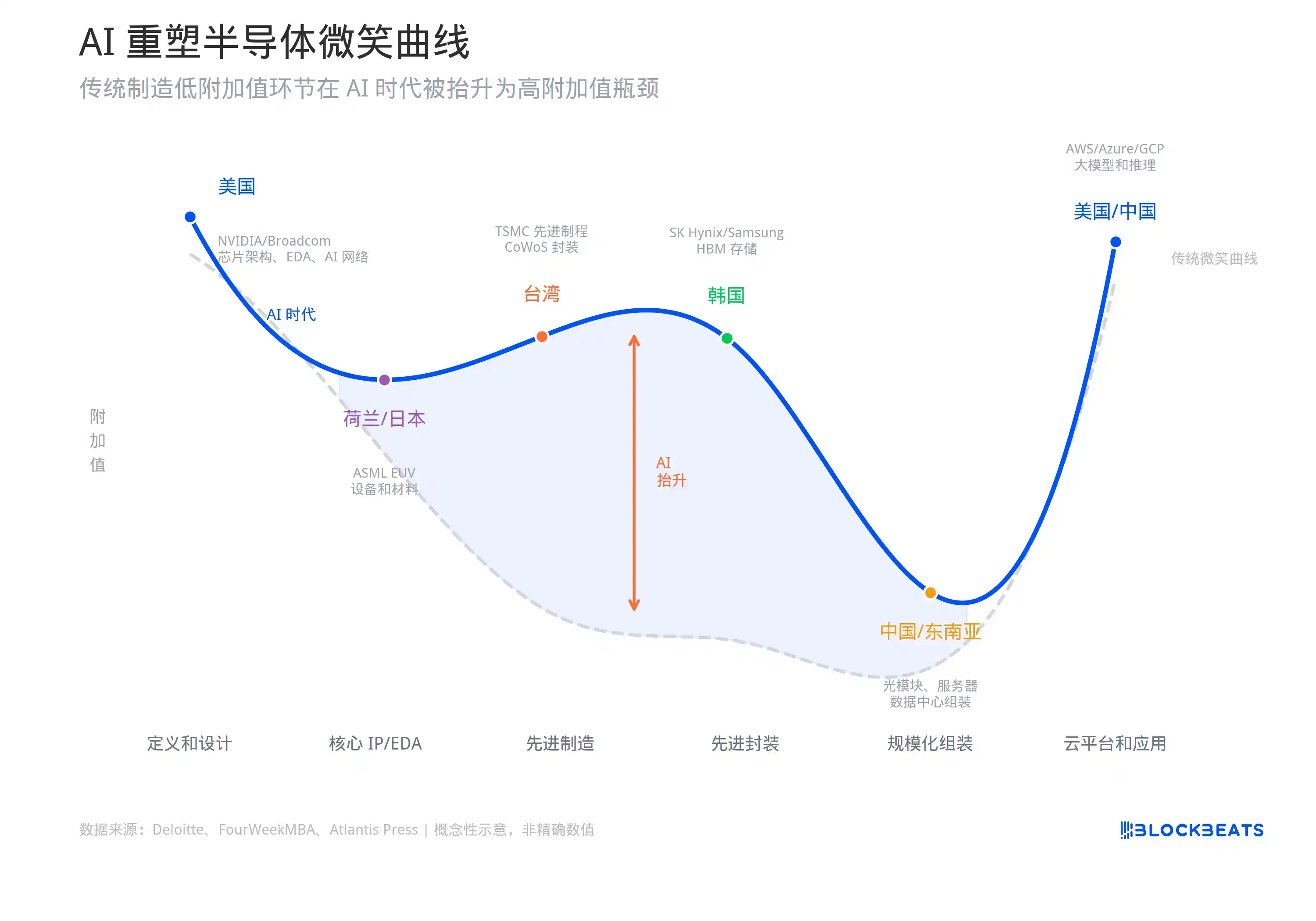
The original creator of this curve was Stan Shih, founder of Acer, who in 1992 used this model to explain why PC assembly had the thinnest profit margins.

But thirty years later, AI data centers are rewriting the shape of this curve.

Value chain analyses by FourWeekMBA and a paper published this year by Atlantis Press both point to the same conclusion: AI is re-elevating the middle segment of the traditional smile curve. TSMC's advanced CoWoS packaging, SK Hynix's HBM stacking, and ASML's EUV lithography machines—these segments, which in the traditional manufacturing smile curve belonged to the low-margin "middle manufacturing segment"—have become the most scarce resources in the AI era, with profit margins and pricing power not lower than those of the design or application ends.

Data from the paper shows that Nvidia's gross margin for 2023-2024 was 72.72%, with a net margin of 48.85%. However, TSMC's gross margin for Q1 2026 also reached 66.2%, with a net margin of 50.5%. The gap between design and manufacturing margins is narrowing, which is unprecedented in the history of the semiconductor industry.

The traditional smile curve posits that manufacturing has the thinnest margins. AI is turning the most difficult manufacturing links into the most scarce resources.

Morgan Stanley's March report on Asian semiconductors reached a similar conclusion: the 2023-2024 AI cycle was primarily focused on GPUs. From 2025 to 2026, demand is starting to diffuse across a broader industry chain, with memory, advanced packaging, custom ASICs, and data center networking taking the baton.

Every rotation of the bottleneck brings a new group of previously overlooked companies to the forefront, while those that gained the most in the previous phase enter a consolidation period.

How Much Further Can the Bull Run? Bull vs. Bear Views

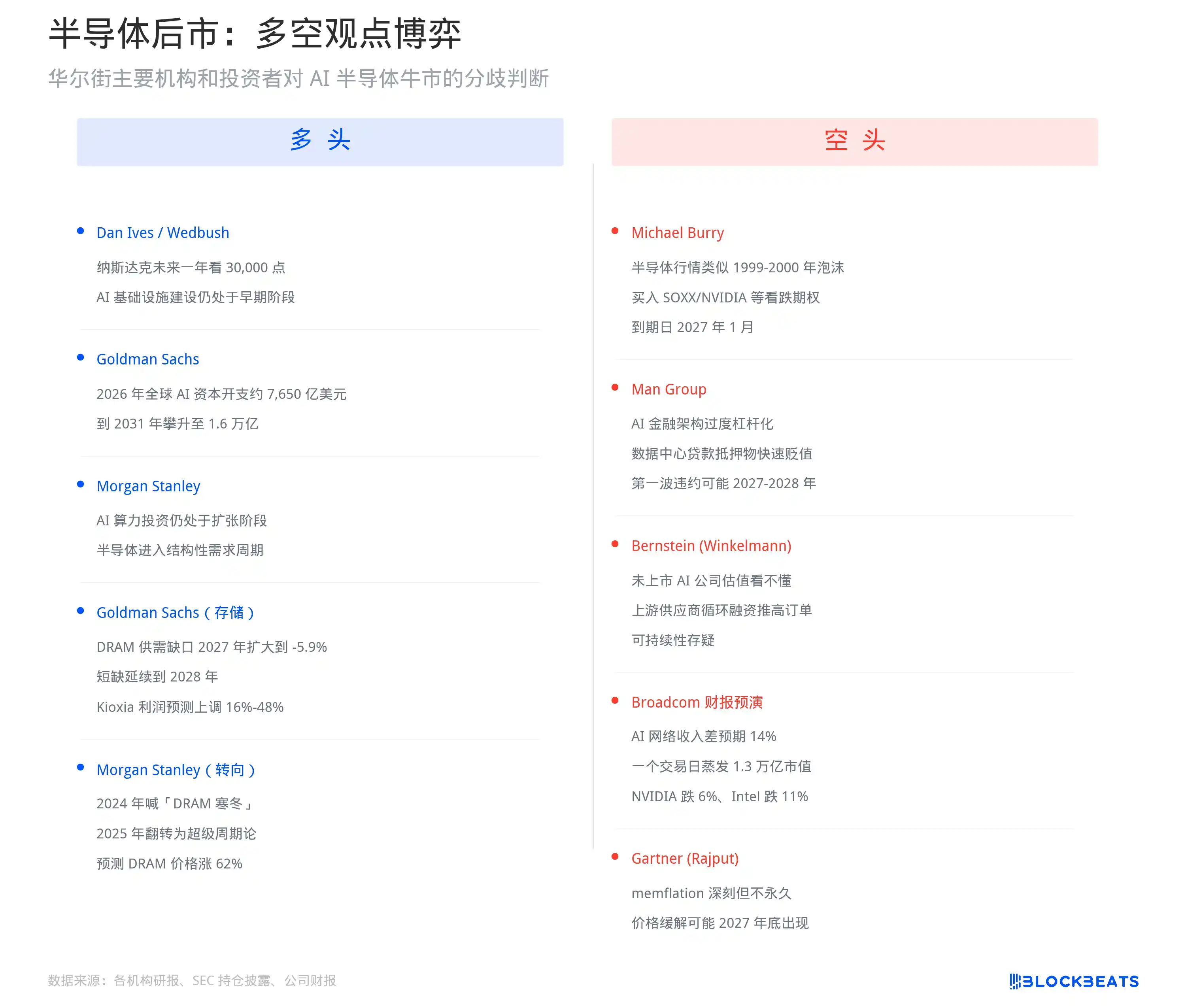
Let's first hear from the bulls. Wedbush's Dan Ives said on CNBC in May that he expects the Nasdaq to reach 30,000 points in the next year, citing that AI chip demand still far exceeds supply. Goldman Sachs provided more concrete numbers: global AI capital expenditure in 2026 is about $765 billion, climbing to $1.6 trillion by 2031.

Morgan Stanley's March report on Asian semiconductors explicitly stated: AI computing investment is still in an expansion phase, and the semiconductor industry is entering a new structural demand cycle.

Bullish calls on memory are even more aggressive. Goldman Sachs recently revised down its DRAM supply-demand deficit forecasts for 2026-2028 into deeper shortage territory, adjusting the 2027 deficit from -2.5% to -5.9%, almost double. Their judgment is that this memory cycle is different from past ones: AI server demand has higher visibility, supply growth is locked down by long-term contracts, and price increases will last longer than the market expects.

Goldman Sachs even significantly raised its operating profit forecasts for Kioxia for 2027-2029 by 16% to 48%, citing that this period of high profitability could last two to three years. For a company in the highly cyclical memory business, a "high profitability lasting three years" call is very rare on Wall Street.

Morgan Stanley's change in stance is even more interesting. In 2024, they were still calling for a "DRAM winter," predicting price declines for years starting in Q4 2024. By 2025, they completely flipped to a super-cycle thesis, forecasting a 62% DRAM price increase in 2026 and predicting that SK Hynix and Samsung's profits would exceed consensus expectations by 30% to 50%.

But the bearish voices are also loud and come from significant players.

Michael Burry publicly warned in May that this semiconductor rally closely resembles the final months of the 1999-2000 internet bubble. The SOX is up 65% year-to-date, gained 10% in a single week, and the SOXX ETF is 60% above its 200-day moving average—this level of technical stretch has rarely been sustainable historically. SEC filings show he purchased a large number of put options on SOXX, QQQ, Nvidia, Palantir, and Oracle, expiring in January 2027, with strike prices well below current levels.

Man Group (one of the world's largest listed hedge funds) published a lengthy article in June specifically dissecting AI bubble risks. Their core view is that the financial architecture built around AI has become too large, over-leveraged, and overly reliant on a few interconnected players.

They specifically mentioned that a significant portion of AI data center construction is financed through private credit, with these loans collateralized by "hardware that depreciates as quickly as mobile phones, not long-term assets like buildings." The first wave of defaults could emerge in 2027-2028, when initial leases expire and the gap between financing assumptions and reality becomes impossible to ignore.
Looking ahead, several time nodes are worth watching.

Micron's earnings report on June 24th will be crucial; forward guidance on HBM demand and capacity allocation will determine the direction of the entire memory sector for the summer. Nvidia's next earnings report is equally critical; if there is even a slight signal of deceleration in AI chip demand, the sentiment across the sector will be repriced once again.

Looking further out, the timeline for capacity ramp-up is the real watershed. SK Hynix's M15X fab is expected to ramp in mid-2027, with its Yongin new fab moved up to February 2027. Samsung's P5 fab will come online in 2028. Micron's Idaho Fab 1 is expected to contribute output in mid-2027.

Combined, industry capacity will increase by 20% to 30% in the second half of 2027 to the first half of 2028. The question is whether HBM demand, with a compound annual growth rate of over 40%, will be met. Whether supply can catch up with demand depends on whether AI capital expenditure slows down before then.

The final variable is geopolitics. The higher the concentration of the semiconductor supply chain, the greater the impact of a black swan event. TSMC alone accounts for over 90% of global advanced process foundry capacity—this number represents efficiency during a bull market but systemic risk in a conflict scenario. Factors like the Taiwan Strait situation, potential escalation of U.S. export controls on China, and the degree of cooperation from Japan and the Netherlands on equipment restrictions are topics no one wants to discuss when the market is good. But if something happens, repricing will happen faster than any fundamental change.

Crypto di tendenza

Domande pertinenti

QWhat is the core logic behind the current semiconductor bull market, according to the article?

AThe core logic is scarcity. The companies that 'choke' or control the bottleneck in AI infrastructure—the most difficult-to-replace and technologically intensive segments like HBM memory and advanced chip manufacturing—hold the hardest pricing power and reap the greatest profits.

QHow is AI reshaping the traditional semiconductor 'smile curve'?

AAI is elevating the middle segments of the traditional smile curve. Previously considered low-margin manufacturing processes, such as TSMC's CoWoS advanced packaging, SK Hynix's HBM stacking, and ASML's EUV lithography machines, have become the most scarce resources in the AI era. Their profit margins and pricing power are now comparable to, and sometimes even higher than, the design and application ends of the curve.

QWhat are the key regional strengths in the AI-driven semiconductor value chain as described in the article?

AThe key regional strengths are: The US leads in design, EDA tools, AI networks, and cloud platforms/services. Taiwan (China) and South Korea are central to manufacturing; Taiwan excels in advanced foundry/logic (TSMC) and packaging, while South Korea dominates in memory/HBM production. Japan and the Netherlands control critical materials and equipment (e.g., ASML's EUV monopoly). China has cost advantages in assembly-scale segments like optical modules. Europe is strong in power and cooling infrastructure for data centers.

QAccording to the article, what are the main bullish arguments for the semiconductor market's continued growth?

ABullish arguments include: AI chip demand still far outstrips supply (Wedbush). Global AI capital expenditure is projected to grow massively, from ~$765B in 2026 to $1.6T by 2031 (Goldman Sachs). The industry is in a new structural demand cycle (J.P. Morgan). The DRAM shortage, especially for HBM, is seen as more severe and persistent than past cycles due to high-visibility AI server demand and long-term supply lock-ins, potentially sustaining high profits for several years (Goldman Sachs, J.P. Morgan).

QWhat are the primary risks or bearish concerns cited regarding the AI/semiconductor boom?

APrimary risks include: A potential bubble, with technical indicators and rapid price appreciation reminiscent of the 1999-2000 dot-com bubble (Michael Burry). An over-leveraged financial architecture where AI data centers are financed by private credit secured against rapidly depreciating hardware, raising default risks when initial leases expire around 2027-2028 (Man Group). A potential supply-demand inflection point when major new HBM/manufacturing capacities come online in 2027-2028. Geopolitical risks, as the highly concentrated supply chain (e.g., TSMC's dominance) is vulnerable to disruptions from events like cross-strait tensions or export control escalations.

Letture associate

Unveiling the Whales of the World Cup Prediction Market: Smart Money Stumbles on the Pitch, 'Buy No' Outperforms 'Buy Yes'

**Title: Unveiling the Whales of the World Cup Prediction Market: "Smart Money" Stumbles on the Pitch as "Buying No" Outperforms "Buying Yes"** An analysis of pre-match trades over $5,000 on Polymarket for 20 completed group stage matches reveals a counterintuitive finding: large "smart money" bets were not consistently accurate. Aggregated pre-match buying volume was $89.55 million, with a weighted hit rate of only 48.5%. Holding these positions would have resulted in an estimated net loss of about $1.76 million (ROI -2.0%), challenging the notion that big money reliably predicts outcomes. The data highlights several key dynamics. Draws proved to be a major risk, significantly impacting bets on favored teams, as seen in Belgium-Egypt and Spain-Cape Verde. Markets were more efficient for clear mismatches (e.g., Germany's big win) but became prone to bias when favorites were overvalued. Notably, buying "No" shares (betting against a specific outcome) significantly outperformed buying "Yes," with hit rates of 62.4% vs. 37.5%. This suggests the market often overprices popular narratives, creating value in contrarian positions. Individual trades showed extreme volatility. One wallet (mintblade) earned an estimated $6.77 million by betting against Iran, while another (LEEEROYJENKINS) lost roughly $8.39 million on a Belgium win. The market favors high-risk, high-reward information trading rather than steady arbitrage. For sustained insight, wallets with consistent performance across multiple matches (e.g., swisstony) are more telling than one-off big bets. Ultimately, the Polymarket acts less as a crystal ball and more as a mirror, reflecting crowd bias and the inherent unpredictability of football. True "smart money" may lie not in predicting the future, but in identifying and exploiting market mispricings while respecting risk.

marsbit5 min fa

Unveiling the Whales of the World Cup Prediction Market: Smart Money Stumbles on the Pitch, 'Buy No' Outperforms 'Buy Yes'

marsbit5 min fa

Bezos' Third Startup Still Can't Avoid Musk

Jeff Bezos Returns as CEO for Third Venture, Still Can't Avoid Musk After stepping down as Amazon CEO in 2021, Jeff Bezos has returned to the front lines as co-CEO of Prometheus, an AI startup he founded. In a recent CNBC interview, Bezos described the experience as "Type 2 fun"—exhausting but ultimately rewarding. Founded less than a year ago, Prometheus has already raised over $18 billion in two funding rounds, achieving a staggering $41 billion valuation. Prometheus aims to develop a "General Engineer AI" to accelerate the entire "invention loop"—design, simulation, testing, and manufacturing—for complex physical products like jet engines, spacecraft, and medical devices. This positions the company at the intersection of Bezos's past experiences: Amazon's platform-building scale and Blue Origin's rigorous physical engineering. This marks Bezos's third major venture, following Amazon and Blue Origin. His co-CEO is Vik Bajaj, bringing expertise from life sciences and hard tech. Bezos now dedicates most of his time to Prometheus, signaling his belief in its transformative potential. The move also comes as Bezos's space company, Blue Origin, faces challenges, including a recent test explosion delaying its New Glenn rocket. Meanwhile, Elon Musk's SpaceX achieved a record-breaking IPO, surpassing Amazon's market cap. While Musk focuses on AI for executing physical tasks (like Tesla's robots and SpaceX's engineering), Bezos is betting on AI to *invent* in the physical world. Prometheus enters a crowded industrial AI field with players like OpenAI, NVIDIA, and Tesla's Optimus. Its lofty valuation bets on the unproven but massive opportunity to become the foundational platform for engineering in the AI era—a "blue ocean" Bezos hopes to define before Musk does.

marsbit8 min fa

Bezos' Third Startup Still Can't Avoid Musk

marsbit8 min fa

Won't US Stocks Ever Fall Again? The 'Great Melt-up' Trap in the Era of High Debt

The article analyzes a popular theory circulating online that the U.S. stock market may be mathematically incapable of a true, sustained decline due to the country's massive and growing national debt. The argument suggests that the government's only path to managing this debt is through inflation and money printing, which would nominally lift asset prices like stocks, creating a perpetual "melt-up." The author places this idea within the historical context of market melt-ups, such as the dot-com bubble and Japan's asset bubble, where prices detach from fundamentals driven by momentum and FOMO. While acknowledging that a high-debt environment creates incentives for inflation, which is generally favorable for assets over cash, the article refutes key claims of the online theory. It clarifies that interest payments are not about to exceed GDP, that printing money is not the only option for the government, and that stocks do not reliably rise in lockstep with hyperinflation, citing historical examples from Germany, Zimbabwe, and Venezuela. The more probable outcome, according to the author, is a prolonged period of financial repression—moderate inflation above interest rates that slowly erodes debt and cash purchasing power, leading to nominally higher asset prices but potentially lower real returns. The core warning is that while long-term market trends may be upward, this does not eliminate the risk of significant interim crashes (30%, 40%, or more) or guarantee real wealth creation during inflationary times. The conclusion advises against betting one's entire financial future on a smooth, perpetually rising market narrative. Instead, it recommends a disciplined, diversified strategy involving productive assets (stocks, real estate, some gold, short-term bonds) and an adequate cash buffer to avoid forced selling during downturns. The key takeaway is to avoid extreme concentration in expensive assets and leverage, and not to base investment decisions on the hope that every market dip will inevitably be rescued.

marsbit28 min fa

Won't US Stocks Ever Fall Again? The 'Great Melt-up' Trap in the Era of High Debt

marsbit28 min fa

The Fate of Digital Banks: No Fancy App Can Outshine a Banking License

The Fate of Digital Banks: A Flashy App is No Match for a Banking License The article argues that despite attracting billions of users with fee-free checking accounts and sleek apps, most "neobanks" struggle to be profitable because their core business—transaction fees—is inherently low-margin. The real profit engine of banking is lending (credit), which generates interest income. However, many early neobanks operated without their own banking licenses, which restricted their ability to lend at scale. Examples like Nubank, Revolut, and Chime illustrate the point. While they gained users with free accounts, their eventual profitability came from rolling out credit products. The piece highlights systemic risks for neobanks that rely on third-party infrastructure, citing the Synapse bankruptcy, which froze user funds and revealed the fragility of such models. The solution, according to the author, is obtaining a formal banking license, like the U.S. OCC's national trust charter. This provides regulatory backing, allows direct custody of funds, and eliminates dependency on intermediary partners. The trend is now evident in the crypto sector, where companies like Kraken, SoFi, and others are actively pursuing such licenses. The article concludes that while technology changes, the fundamental business logic of banking—profiting from lending—remains constant. Successful digital banks ultimately conform to this old model, just with better interfaces and fairer terms.

Foresight News37 min fa

The Fate of Digital Banks: No Fancy App Can Outshine a Banking License

Foresight News37 min fa

Trading

Spot
Futures

Articoli Popolari

Cosa è GROK AI

Grok AI: Rivoluzionare la Tecnologia Conversazionale nell'Era Web3 Introduzione Nel panorama in rapida evoluzione dell'intelligenza artificiale, Grok AI si distingue come un progetto notevole che collega i domini della tecnologia avanzata e dell'interazione con l'utente. Sviluppato da xAI, un'azienda guidata dal rinomato imprenditore Elon Musk, Grok AI cerca di ridefinire il modo in cui interagiamo con l'intelligenza artificiale. Mentre il movimento Web3 continua a prosperare, Grok AI mira a sfruttare il potere dell'IA conversazionale per rispondere a query complesse, offrendo agli utenti un'esperienza che è non solo informativa ma anche divertente. Cos'è Grok AI? Grok AI è un sofisticato chatbot di intelligenza artificiale conversazionale progettato per interagire dinamicamente con gli utenti. A differenza di molti sistemi di intelligenza artificiale tradizionali, Grok AI abbraccia un'ampia gamma di domande, comprese quelle tipicamente considerate inappropriate o al di fuori delle risposte standard. Gli obiettivi principali del progetto includono: Ragionamento Affidabile: Grok AI enfatizza il ragionamento di buon senso per fornire risposte logiche basate sulla comprensione contestuale. Supervisione Scalabile: L'integrazione dell'assistenza degli strumenti garantisce che le interazioni degli utenti siano sia monitorate che ottimizzate per la qualità. Verifica Formale: La sicurezza è fondamentale; Grok AI incorpora metodi di verifica formale per migliorare l'affidabilità delle sue uscite. Comprensione del Lungo Contesto: Il modello di IA eccelle nel trattenere e richiamare una vasta storia di conversazione, facilitando discussioni significative e consapevoli del contesto. Robustezza Adversariale: Concentrandosi sul miglioramento delle sue difese contro input manipolati o malevoli, Grok AI mira a mantenere l'integrità delle interazioni degli utenti. In sostanza, Grok AI non è solo un dispositivo di recupero informazioni; è un partner conversazionale immersivo che incoraggia un dialogo dinamico. Creatore di Grok AI Il cervello dietro Grok AI non è altri che Elon Musk, un individuo sinonimo di innovazione in vari campi, tra cui automotive, viaggi spaziali e tecnologia. Sotto l'egida di xAI, un'azienda focalizzata sull'avanzamento della tecnologia AI in modi benefici, la visione di Musk mira a rimodellare la comprensione delle interazioni con l'IA. La leadership e l'etica fondamentale sono profondamente influenzate dall'impegno di Musk nel superare i confini tecnologici. Investitori di Grok AI Sebbene i dettagli specifici riguardanti gli investitori che sostengono Grok AI rimangano limitati, è pubblicamente riconosciuto che xAI, l'incubatore del progetto, è fondato e supportato principalmente dallo stesso Elon Musk. Le precedenti imprese e partecipazioni di Musk forniscono un robusto sostegno, rafforzando ulteriormente la credibilità e il potenziale di crescita di Grok AI. Tuttavia, al momento, le informazioni riguardanti ulteriori fondazioni di investimento o organizzazioni che supportano Grok AI non sono facilmente accessibili, segnando un'area per potenziali esplorazioni future. Come Funziona Grok AI? Le meccaniche operative di Grok AI sono innovative quanto il suo framework concettuale. Il progetto integra diverse tecnologie all'avanguardia che facilitano le sue funzionalità uniche: Infrastruttura Robusta: Grok AI è costruito utilizzando Kubernetes per l'orchestrazione dei container, Rust per prestazioni e sicurezza, e JAX per il calcolo numerico ad alte prestazioni. Questo trio garantisce che il chatbot operi in modo efficiente, si scaldi efficacemente e serva gli utenti prontamente. Accesso alla Conoscenza in Tempo Reale: Una delle caratteristiche distintive di Grok AI è la sua capacità di attingere a dati in tempo reale attraverso la piattaforma X—precedentemente nota come Twitter. Questa capacità consente all'IA di accedere alle informazioni più recenti, permettendole di fornire risposte e raccomandazioni tempestive che altri modelli di IA potrebbero perdere. Due Modalità di Interazione: Grok AI offre agli utenti la scelta tra “Modalità Divertente” e “Modalità Normale”. La Modalità Divertente consente uno stile di interazione più giocoso e umoristico, mentre la Modalità Normale si concentra sulla fornitura di risposte precise e accurate. Questa versatilità garantisce un'esperienza su misura che soddisfa varie preferenze degli utenti. In sostanza, Grok AI sposa prestazioni con coinvolgimento, creando un'esperienza che è sia arricchente che divertente. Cronologia di Grok AI Il viaggio di Grok AI è segnato da traguardi fondamentali che riflettono le sue fasi di sviluppo e distribuzione: Sviluppo Iniziale: La fase fondamentale di Grok AI si è svolta in circa due mesi, durante i quali sono stati condotti l'addestramento iniziale e il perfezionamento del modello. Rilascio Beta di Grok-2: In un significativo avanzamento, è stata annunciata la beta di Grok-2. Questo rilascio ha introdotto due versioni del chatbot—Grok-2 e Grok-2 mini—ognuna dotata delle capacità per chattare, programmare e ragionare. Accesso Pubblico: Dopo lo sviluppo beta, Grok AI è diventato disponibile per gli utenti della piattaforma X. Coloro che hanno account verificati tramite un numero di telefono e attivi per almeno sette giorni possono accedere a una versione limitata, rendendo la tecnologia disponibile a un pubblico più ampio. Questa cronologia racchiude la crescita sistematica di Grok AI dall'inizio all'impegno pubblico, enfatizzando il suo impegno per il miglioramento continuo e l'interazione con gli utenti. Caratteristiche Chiave di Grok AI Grok AI comprende diverse caratteristiche chiave che contribuiscono alla sua identità innovativa: Integrazione della Conoscenza in Tempo Reale: L'accesso a informazioni attuali e rilevanti differenzia Grok AI da molti modelli statici, consentendo un'esperienza utente coinvolgente e accurata. Stili di Interazione Versatili: Offrendo modalità di interazione distinte, Grok AI soddisfa varie preferenze degli utenti, invitando alla creatività e alla personalizzazione nella conversazione con l'IA. Avanzata Struttura Tecnologica: L'utilizzo di Kubernetes, Rust e JAX fornisce al progetto un solido framework per garantire affidabilità e prestazioni ottimali. Considerazione del Discorso Etico: L'inclusione di una funzione di generazione di immagini mette in mostra lo spirito innovativo del progetto. Tuttavia, solleva anche considerazioni etiche riguardanti il copyright e la rappresentazione rispettosa di figure riconoscibili—una discussione in corso all'interno della comunità AI. Conclusione Come entità pionieristica nel campo dell'IA conversazionale, Grok AI incarna il potenziale per esperienze utente trasformative nell'era digitale. Sviluppato da xAI e guidato dall'approccio visionario di Elon Musk, Grok AI integra conoscenze in tempo reale con capacità di interazione avanzate. Si sforza di spingere i confini di ciò che l'intelligenza artificiale può realizzare, mantenendo un focus su considerazioni etiche e sicurezza degli utenti. Grok AI non solo incarna il progresso tecnologico, ma rappresenta anche un nuovo paradigma conversazionale nel panorama Web3, promettendo di coinvolgere gli utenti con sia conoscenze esperte che interazioni giocose. Man mano che il progetto continua a evolversi, si erge come testimonianza di ciò che l'incrocio tra tecnologia, creatività e interazione simile a quella umana può realizzare.

495 Totale visualizzazioniPubblicato il 2024.12.26Aggiornato il 2024.12.26

Cosa è GROK AI

Cosa è ERC AI

Euruka Tech: Una Panoramica di $erc ai e delle sue Ambizioni in Web3 Introduzione Nel panorama in rapida evoluzione della tecnologia blockchain e delle applicazioni decentralizzate, nuovi progetti emergono frequentemente, ciascuno con obiettivi e metodologie uniche. Uno di questi progetti è Euruka Tech, che opera nel vasto dominio delle criptovalute e del Web3. L'obiettivo principale di Euruka Tech, in particolare del suo token $erc ai, è presentare soluzioni innovative progettate per sfruttare le crescenti capacità della tecnologia decentralizzata. Questo articolo si propone di fornire una panoramica completa di Euruka Tech, un'esplorazione dei suoi obiettivi, della funzionalità, dell'identità del suo creatore, dei potenziali investitori e della sua importanza nel contesto più ampio del Web3. Cos'è Euruka Tech, $erc ai? Euruka Tech è caratterizzato come un progetto che sfrutta gli strumenti e le funzionalità offerte dall'ambiente Web3, concentrandosi sull'integrazione dell'intelligenza artificiale nelle sue operazioni. Sebbene i dettagli specifici sul framework del progetto siano piuttosto sfuggenti, è progettato per migliorare l'engagement degli utenti e automatizzare i processi nello spazio crypto. Il progetto mira a creare un ecosistema decentralizzato che non solo faciliti le transazioni, ma incorpori anche funzionalità predittive attraverso l'intelligenza artificiale, da cui il nome del suo token, $erc ai. L'obiettivo è fornire una piattaforma intuitiva che faciliti interazioni più intelligenti e un'elaborazione delle transazioni più efficiente all'interno della crescente sfera del Web3. Chi è il Creatore di Euruka Tech, $erc ai? Attualmente, le informazioni riguardanti il creatore o il team fondatore di Euruka Tech rimangono non specificate e piuttosto opache. Questa assenza di dati solleva preoccupazioni, poiché la conoscenza del background del team è spesso essenziale per stabilire credibilità nel settore blockchain. Pertanto, abbiamo classificato queste informazioni come sconosciute fino a quando dettagli concreti non saranno resi disponibili nel dominio pubblico. Chi sono gli Investitori di Euruka Tech, $erc ai? Allo stesso modo, l'identificazione degli investitori o delle organizzazioni di supporto per il progetto Euruka Tech non è prontamente fornita attraverso la ricerca disponibile. Un aspetto cruciale per i potenziali stakeholder o utenti che considerano di impegnarsi con Euruka Tech è la garanzia che deriva da partnership finanziarie consolidate o dal supporto di società di investimento rispettabili. Senza divulgazioni sulle affiliazioni di investimento, è difficile trarre conclusioni complete sulla sicurezza finanziaria o sulla longevità del progetto. In linea con le informazioni trovate, anche questa sezione rimane allo stato di sconosciuto. Come funziona Euruka Tech, $erc ai? Nonostante la mancanza di specifiche tecniche dettagliate per Euruka Tech, è essenziale considerare le sue ambizioni innovative. Il progetto cerca di sfruttare la potenza computazionale dell'intelligenza artificiale per automatizzare e migliorare l'esperienza dell'utente all'interno dell'ambiente delle criptovalute. Integrando l'IA con la tecnologia blockchain, Euruka Tech mira a fornire funzionalità come operazioni automatizzate, valutazioni del rischio e interfacce utente personalizzate. L'essenza innovativa di Euruka Tech risiede nel suo obiettivo di creare una connessione fluida tra gli utenti e le vaste possibilità presentate dalle reti decentralizzate. Attraverso l'utilizzo di algoritmi di apprendimento automatico e IA, mira a ridurre le sfide degli utenti alle prime armi e semplificare le esperienze transazionali all'interno del framework Web3. Questa simbiosi tra IA e blockchain sottolinea l'importanza del token $erc ai, fungendo da ponte tra le interfacce utente tradizionali e le avanzate capacità delle tecnologie decentralizzate. Cronologia di Euruka Tech, $erc ai Sfortunatamente, a causa delle limitate informazioni disponibili riguardo a Euruka Tech, non siamo in grado di presentare una cronologia dettagliata dei principali sviluppi o traguardi nel percorso del progetto. Questa cronologia, tipicamente preziosa per tracciare l'evoluzione di un progetto e comprendere la sua traiettoria di crescita, non è attualmente disponibile. Man mano che le informazioni su eventi notevoli, partnership o aggiunte funzionali diventano evidenti, gli aggiornamenti miglioreranno sicuramente la visibilità di Euruka Tech nella sfera crypto. Chiarimento su Altri Progetti “Eureka” È importante sottolineare che più progetti e aziende condividono una nomenclatura simile con “Eureka.” La ricerca ha identificato iniziative come un agente IA della NVIDIA Research, che si concentra sull'insegnamento ai robot di compiti complessi utilizzando metodi generativi, così come Eureka Labs ed Eureka AI, che migliorano l'esperienza utente nell'istruzione e nell'analisi del servizio clienti, rispettivamente. Tuttavia, questi progetti sono distinti da Euruka Tech e non dovrebbero essere confusi con i suoi obiettivi o funzionalità. Conclusione Euruka Tech, insieme al suo token $erc ai, rappresenta un attore promettente ma attualmente oscuro nel panorama del Web3. Sebbene i dettagli sul suo creatore e sugli investitori rimangano non divulgati, l'ambizione centrale di combinare intelligenza artificiale e tecnologia blockchain si erge come un punto focale di interesse. Gli approcci unici del progetto nel promuovere l'engagement degli utenti attraverso l'automazione avanzata potrebbero distinguerlo mentre l'ecosistema Web3 progredisce. Con l'evoluzione continua del mercato crypto, gli stakeholder dovrebbero tenere d'occhio gli sviluppi riguardanti Euruka Tech, poiché lo sviluppo di innovazioni documentate, partnership o una roadmap definita potrebbe presentare opportunità significative nel prossimo futuro. Così com'è, attendiamo ulteriori approfondimenti sostanziali che potrebbero svelare il potenziale di Euruka Tech e la sua posizione nel competitivo panorama crypto.

517 Totale visualizzazioniPubblicato il 2025.01.02Aggiornato il 2025.01.02

Cosa è ERC AI

Cosa è DUOLINGO AI

DUOLINGO AI: Integrare l'apprendimento delle lingue con Web3 e innovazione AI In un'era in cui la tecnologia rimodella l'istruzione, l'integrazione dell'intelligenza artificiale (AI) e delle reti blockchain annuncia una nuova frontiera per l'apprendimento delle lingue. Entra in scena DUOLINGO AI e la sua criptovaluta associata, $DUOLINGO AI. Questo progetto aspira a fondere la potenza educativa delle principali piattaforme di apprendimento delle lingue con i benefici della tecnologia decentralizzata Web3. Questo articolo esplora gli aspetti chiave di DUOLINGO AI, esaminando i suoi obiettivi, il framework tecnologico, lo sviluppo storico e il potenziale futuro, mantenendo chiarezza tra la risorsa educativa originale e questa iniziativa indipendente di criptovaluta. Panoramica di DUOLINGO AI Alla sua base, DUOLINGO AI cerca di stabilire un ambiente decentralizzato in cui gli studenti possono guadagnare ricompense crittografiche per il raggiungimento di traguardi educativi nella competenza linguistica. Applicando smart contracts, il progetto mira ad automatizzare i processi di verifica delle competenze e le allocazioni di token, aderendo ai principi di Web3 che enfatizzano la trasparenza e la proprietà da parte degli utenti. Il modello si discosta dagli approcci tradizionali all'acquisizione linguistica, facendo forte affidamento su una struttura di governance guidata dalla comunità, che consente ai detentori di token di suggerire miglioramenti ai contenuti dei corsi e alle distribuzioni delle ricompense. Alcuni degli obiettivi notevoli di DUOLINGO AI includono: Apprendimento Gamificato: Il progetto integra traguardi blockchain e token non fungibili (NFT) per rappresentare i livelli di competenza linguistica, promuovendo la motivazione attraverso ricompense digitali coinvolgenti. Creazione di Contenuti Decentralizzati: Apre opportunità per educatori e appassionati di lingue di contribuire con i propri corsi, facilitando un modello di condivisione dei ricavi che beneficia tutti i collaboratori. Personalizzazione Guidata dall'AI: Utilizzando modelli avanzati di machine learning, DUOLINGO AI personalizza le lezioni per adattarsi ai progressi individuali, simile alle funzionalità adattive presenti nelle piattaforme consolidate. Creatori del Progetto e Governance A partire da aprile 2025, il team dietro $DUOLINGO AI rimane pseudonimo, una pratica comune nel panorama decentralizzato delle criptovalute. Questa anonimato è inteso a promuovere la crescita collettiva e il coinvolgimento degli stakeholder piuttosto che concentrarsi su sviluppatori individuali. Lo smart contract distribuito sulla blockchain di Solana annota l'indirizzo del wallet dello sviluppatore, che segna l'impegno verso la trasparenza riguardo alle transazioni, nonostante l'identità dei creatori sia sconosciuta. Secondo la sua roadmap, DUOLINGO AI mira a evolversi in un'Organizzazione Autonoma Decentralizzata (DAO). Questa struttura di governance consente ai detentori di token di votare su questioni critiche come l'implementazione di funzionalità e le allocazioni del tesoro. Questo modello si allinea con l'etica dell'empowerment della comunità presente in varie applicazioni decentralizzate, enfatizzando l'importanza del processo decisionale collettivo. Investitori e Partnership Strategiche Attualmente, non ci sono investitori istituzionali o capitalisti di rischio identificabili pubblicamente legati a $DUOLINGO AI. Invece, la liquidità del progetto proviene principalmente da scambi decentralizzati (DEX), segnando un netto contrasto con le strategie di finanziamento delle aziende tradizionali di tecnologia educativa. Questo modello di base indica un approccio guidato dalla comunità, riflettendo l'impegno del progetto verso la decentralizzazione. Nel suo whitepaper, DUOLINGO AI menziona la formazione di collaborazioni con “piattaforme educative blockchain” non specificate, mirate ad arricchire la sua offerta di corsi. Sebbene partnership specifiche non siano ancora state divulgate, questi sforzi collaborativi suggeriscono una strategia per mescolare innovazione blockchain con iniziative educative, ampliando l'accesso e il coinvolgimento degli utenti attraverso diverse vie di apprendimento. Architettura Tecnologica Integrazione AI DUOLINGO AI incorpora due componenti principali guidate dall'AI per migliorare la sua offerta educativa: Motore di Apprendimento Adattivo: Questo sofisticato motore apprende dalle interazioni degli utenti, simile ai modelli proprietari delle principali piattaforme educative. Regola dinamicamente la difficoltà delle lezioni per affrontare le sfide specifiche degli studenti, rinforzando le aree deboli attraverso esercizi mirati. Agenti Conversazionali: Utilizzando chatbot alimentati da GPT-4, DUOLINGO AI offre una piattaforma per gli utenti per impegnarsi in conversazioni simulate, promuovendo un'esperienza di apprendimento linguistico più interattiva e pratica. Infrastruttura Blockchain Costruito sulla blockchain di Solana, $DUOLINGO AI utilizza un framework tecnologico completo che include: Smart Contracts per la Verifica delle Competenze: Questa funzionalità assegna automaticamente token agli utenti che superano con successo i test di competenza, rinforzando la struttura di incentivi per risultati di apprendimento genuini. Badge NFT: Questi token digitali significano vari traguardi che gli studenti raggiungono, come completare una sezione del loro corso o padroneggiare competenze specifiche, consentendo loro di scambiare o mostrare digitalmente i loro successi. Governance DAO: I membri della comunità dotati di token possono partecipare alla governance votando su proposte chiave, facilitando una cultura partecipativa che incoraggia l'innovazione nell'offerta di corsi e nelle funzionalità della piattaforma. Cronologia Storica 2022–2023: Concettualizzazione I lavori per DUOLINGO AI iniziano con la creazione di un whitepaper, evidenziando la sinergia tra i progressi dell'AI nell'apprendimento delle lingue e il potenziale decentralizzato della tecnologia blockchain. 2024: Lancio Beta Un lancio beta limitato introduce offerte in lingue popolari, premiando i primi utenti con incentivi in token come parte della strategia di coinvolgimento della comunità del progetto. 2025: Transizione DAO Ad aprile, avviene un lancio completo della mainnet con la circolazione di token, stimolando discussioni nella comunità riguardo a possibili espansioni nelle lingue asiatiche e ad altri sviluppi dei corsi. Sfide e Direzioni Future Ostacoli Tecnici Nonostante i suoi obiettivi ambiziosi, DUOLINGO AI affronta sfide significative. La scalabilità rimane una preoccupazione costante, in particolare nel bilanciare i costi associati all'elaborazione dell'AI e nel mantenere una rete decentralizzata reattiva. Inoltre, garantire la creazione e la moderazione di contenuti di qualità in un'offerta decentralizzata presenta complessità nel mantenere standard educativi. Opportunità Strategiche Guardando al futuro, DUOLINGO AI ha il potenziale per sfruttare partnership di micro-credentialing con istituzioni accademiche, fornendo validazioni verificate dalla blockchain delle competenze linguistiche. Inoltre, l'espansione cross-chain potrebbe consentire al progetto di attingere a basi utenti più ampie e a ulteriori ecosistemi blockchain, migliorando la sua interoperabilità e portata. Conclusione DUOLINGO AI rappresenta una fusione innovativa di intelligenza artificiale e tecnologia blockchain, presentando un'alternativa focalizzata sulla comunità ai sistemi tradizionali di apprendimento delle lingue. Sebbene il suo sviluppo pseudonimo e il modello economico emergente comportino alcuni rischi, l'impegno del progetto verso l'apprendimento gamificato, l'istruzione personalizzata e la governance decentralizzata illumina un percorso per la tecnologia educativa nel regno di Web3. Man mano che l'AI continua a progredire e l'ecosistema blockchain evolve, iniziative come DUOLINGO AI potrebbero ridefinire il modo in cui gli utenti interagiscono con l'istruzione linguistica, potenziando le comunità e premiando il coinvolgimento attraverso meccanismi di apprendimento innovativi.

469 Totale visualizzazioniPubblicato il 2025.04.11Aggiornato il 2025.04.11

Cosa è DUOLINGO AI

Discussioni

Benvenuto nella Community HTX. Qui puoi rimanere informato sugli ultimi sviluppi della piattaforma e accedere ad approfondimenti esperti sul mercato. Le opinioni degli utenti sul prezzo di AI AI sono presentate come di seguito.

活动图片