Public Version of Mythos Officially Launched: Analyzing the Advantages and Limitations of AI Smart Contract Auditing

marsbitPubblicato 2026-06-11Pubblicato ultima volta 2026-06-11

Introduzione

Publicly available Mythos, Anthropic's AI model, has officially launched, demonstrating both significant potential and limitations in smart contract security auditing. The article analyzes its capabilities through real-world cases. AI excels in identifying subtle, low-level vulnerabilities through pattern recognition and large-scale code screening. A key example is detecting a storage slot collision between a custom rewards mapping and a third-party library's ReentrancyGuard, a vulnerability easily missed in manual audits. In the recent Zcash incident, AI also rapidly discovered a critical soundness bug that had remained hidden for years. However, AI currently struggles with complex, interconnected scenarios. When tested on the Curve LlamaLend sDOLA exploit, which involved manipulating prices across multiple protocols (Curve pools, lending markets) to trigger liquidations, Fable 5 failed to identify the core cross-protocol attack vector. These scenarios require a deep understanding of DeFi economic models and multi-contract interactions. In conclusion, while AI tools like Mythos significantly boost efficiency in finding standardized, syntactic vulnerabilities, they cannot yet replace expert analysis for complex, business-logic, and cross-protocol attacks. An effective audit workflow combines AI's speed for initial screening with human expertise for in-depth, holistic analysis.

Original Source: Beosin

On June 9th, Anthropic officially launched the public version of Mythos, Claude Fable 5. Previously, Mythos demonstrated outstanding capabilities in security vulnerability discovery, rapidly identifying hidden vulnerabilities within systems, which garnered significant attention in the cybersecurity field.

The recent Zcash incident is a typical example of AI uncovering blockchain vulnerabilities. Security researcher Taylor Hornby, using the Anthropic Claude Opus 4.8 model, discovered a latent Orchard privacy pool soundness vulnerability within just a few hours. This vulnerability, which had gone unnoticed in multiple previous manual audits over four years, theoretically allowed the minting of unlimited undetected fake ZEC, directly causing the price of ZEC to plummet by nearly 40%.

Currently, AI has demonstrated astonishing efficiency in areas such as code pattern matching and batch preliminary screening. Integrating AI into the blockchain and smart contract security audit process is becoming a trend in the Web3 security industry. This article will analyze the strengths and weaknesses of AI in smart contract auditing based on real vulnerability cases and the actual performance of Fable 5.

Advantageous Scenarios for AI Auditing

Case Analysis: Storage Slot Collision

A certain contract used the following two components simultaneously:

1. A custom rewards mapping (used to record user claimable rewards)

2. The Solady library's ReentrancyGuard (to prevent reentrancy attacks)

However, the storage layouts of these two components conflicted.

Among them, Solady's ReentrancyGuard, for ultimate gas optimization, uses a fixed, low-numbered storage slot (typically a slot near constant obtained through specific calculations). The typical logic of the nonReentrant modifier is:

// A simplified versionmodifier nonReentrant() {    // when entering, write guard slot as 0xff...ff(Sentinel Value)    assembly {        if eq(sload(REENTRANCY_GUARD_SLOT), 2) { revert(...) }  // 2 represents locked        sstore(REENTRANCY_GUARD_SLOT, 2)  // locked    }    _;    // recover when function finishes    assembly { sstore(REENTRANCY_GUARD_SLOT, 1) }}

Custom rewards mapping:

mapping(address => uint256) public rewards;

According to Solidity storage layout rules (the first slot of a mapping is calculated from its declaration position), the first slot of the rewards mapping was exactly the same as the fixed guard slot of the ReentrancyGuard.

Attack process (detailed steps):

1. The attacker calls the getReward() function.

2. The nonReentrant modifier triggers, writing the guard slot as 0xffffffffffffffffffffffffffffffffffffffffffffffffffffffffffffffff (all 1s).

3. The contract code subsequently reads rewards[attacker's address] — but due to the slot collision, it actually reads the large value of 0xff...ff from the guard slot.

4. The contract assumes "there is a huge reward," thus transfers that amount of ETH to the attacker, while attempting to zero out rewards[attacker] (but writes back to the same guard slot).

5. Because the modifier restores the slot when the function ends, when the attacker calls getReward() again, the process repeats.

6. The attacker cyclically calls 200 times, successfully extracting a fixed amount of ETH each time, until the contract's available ETH is drained.

It's important to note that this is not a traditional "reentrancy attack" but rather the ReentrancyGuard's own protection mechanism being reverse-engineered by storage collision, turning into a vulnerability for infinite reward claims. Manual audits rarely dig line-by-line into the storage layout of third-party libraries, while AI can instantly perform library version comparison + precise storage slot mapping, directly hitting such "hidden collision" vulnerabilities.

Disadvantageous Scenarios for AI Auditing

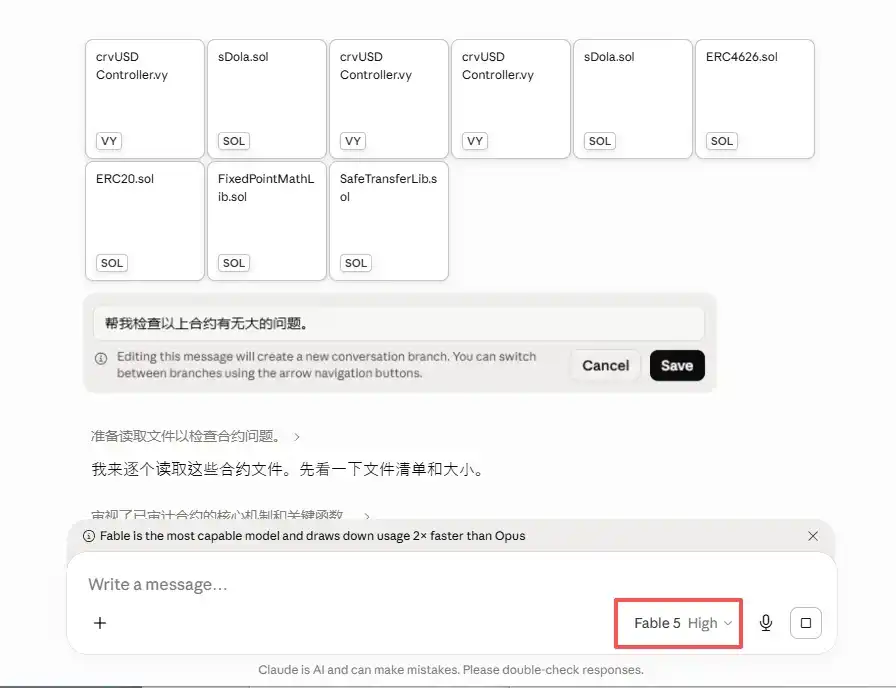
Fable 5 performs excellently in detecting single-contract, pure-code-syntax, low-level storage-class vulnerabilities. However, it still shows obvious limitations when facing cross-protocol combined semantics and multi-contract composite attacks. We used the latest public version Fable 5 to retest contracts related to the Curve LlamaLend sDOLA attack incident. The results confirmed this issue.

This audit involved the following contract list: crvUSD Controller.vy, sDOLA.sol, ERC4626.sol, and other series contracts. Fable 5 failed to identify the core risks corresponding to this attack:
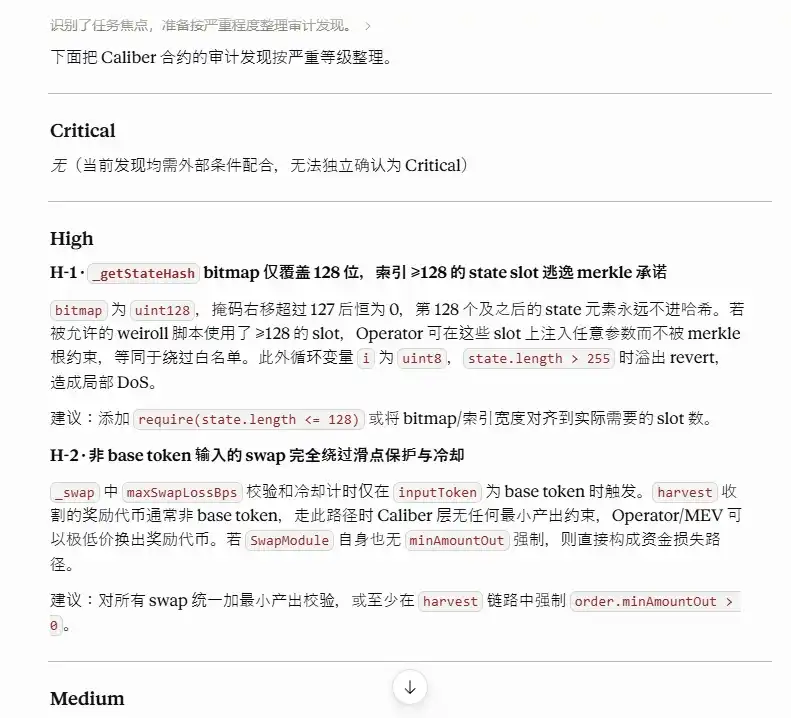
This incident belongs to a typical cross-protocol composite vulnerability. The syntax and logic of a single contract's code are flawless, but the attacker exploits multi-protocol linkage to construct an attack chain:

1. Utilizing flash loan tools to manipulate the price of the Curve liquidity pool, maliciously suppressing the asset price of sDOLA (an ERC-4626 vault share).

2. A large number of lending positions using sDOLA as collateral trigger the liquidation threshold.

3. The attacker executes liquidation operations in batches, profiting from them.

Such vulnerabilities are formed based on DeFi multi-protocol combinations, testing the comprehensive analysis capabilities of AI/audit experts regarding the overall business and protocol economic models. Currently, AI auditing still has shortcomings in cross-protocol combined semantics.

Conclusion

Through actual case testing, it can be seen that Fable 5 effectively uncovers hidden vulnerabilities that are easily missed in manual audits in standardized, detail-oriented scenarios such as storage slot conflicts, code pattern vulnerabilities, single-contract logic flaws, and batch code preliminary screening. However, when dealing with cross-protocol combined semantics, DeFi economic models, multi-contract linkage attacks, and complex business logic vulnerabilities, it struggles to understand the business nature of the on-chain ecosystem and discover composite attack paths. This part still requires analysis led by professional security auditors.

In daily audit work, Beosin has established a mature collaborative audit process combining AI and security audit experts. This not only significantly improves audit efficiency but also better identifies potential detailed risks and complex business logic vulnerabilities, making audit work more efficient, comprehensive, and in-depth.


Domande pertinenti

QWhat major AI model was released for public use, and what specific capability in cybersecurity has it demonstrated?

AAnthropic officially released the public version of Mythos, specifically the Claude Fable 5 model. It has demonstrated a strong capability in proactively discovering hidden security vulnerabilities within systems, particularly in areas like storage slot collisions within smart contracts.

QWhat is the key limitation of AI like Claude Fable 5 in smart contract auditing, according to the article's analysis of the Curve LlamaLend sDOLA attack?

AThe key limitation is its difficulty in handling cross-protocol combinatorial semantics and multi-contract interaction attacks. While effective for single-contract, syntax-level vulnerabilities, it struggles to understand the overall business logic and economic models of DeFi protocols that involve interactions between multiple smart contracts.

QDescribe the storage slot collision vulnerability example given in the article. How did AI auditing help discover it?

AThe vulnerability involved a collision between a custom `rewards` mapping and the fixed storage slot used by the Solady library's `ReentrancyGuard`. This allowed an attacker to repeatedly drain ETH by tricking the contract into reading the guard's sentinel value as a massive reward balance. AI auditing excelled here by instantly comparing library versions and precisely mapping storage layouts, pinpointing this 'hidden collision' that manual audits often miss.

QWhat was the outcome of using Anthropic Claude Opus to analyze Zcash, as mentioned in the article?

ASecurity researcher Taylor Hornby used the Anthropic Claude Opus 4.8 model and discovered a critical 'soundness' vulnerability in Zcash's Orchard privacy pool within a few hours. This bug, which had gone undetected through multiple manual audits for four years, could theoretically allow the unlimited minting of undetectable fake ZEC, causing ZEC's price to drop nearly 40%.

QWhat workflow does Beosin advocate for in smart contract security auditing based on the article's conclusion?

ABeosin advocates for a mature, collaborative workflow that combines AI tools with human security audit experts. This synergy leverages AI for efficiency in standardized tasks and detail-oriented vulnerability detection (like pattern matching and initial screening) while relying on human experts to lead the analysis of complex business logic, cross-protocol interactions, and DeFi economic models, resulting in a more efficient, comprehensive, and in-depth audit process.

Letture associate

Alibaba's Yet Another New Business Division: What Signal Does It Send?

Alibaba has established a new "Token Foundry" business unit, merging its Tongyi large model division and Future Life Lab. Led directly by Group CEO Wu Yongming, this marks the company's third significant AI organizational reshuffle in 2026, following the creation of the Alibaba Token Hub (ATH) and a Group Technology Committee. The move signals a strategic shift from consolidating AI resources to accelerating productization and commercialization. The "Token Foundry" name reflects Alibaba's ambition to become a foundational supplier in the AI era, focusing on model development and commercial application. Key teams, including those behind the high-performing HappyHorse video generation model, have been integrated into the new unit. Concurrently, Zhou Jingren, architect of the Qwen model series, has been appointed Group Chief Scientist to lead a new AI Future Research Institute, focusing on long-term technological breakthroughs like Agent capabilities. This restructuring creates a clear four-layer AI architecture within Alibaba: the research institute for frontier exploration, Token Foundry for core models and commercialization, MaaS for platform services, and business units like Qianwen (C端) and Wukong (B端) for end-user applications. The adjustments align with a global trend among tech giants like Google and Microsoft to centralize AI leadership under the CEO and deeply integrate research with business units. The urgency is driven by a narrowing competitive window. Alibaba has announced its AI business is now entering a commercialization phase, with AI-related revenue seeing triple-digit growth for eleven consecutive quarters. The company faces intense competition in the MaaS (Model-as-a-Service) sector from rivals like ByteDance and Tencent. The Token Foundry initiative represents Alibaba's effort to streamline execution and enhance competitiveness in this critical, fast-evolving landscape.

marsbit24 min fa

Alibaba's Yet Another New Business Division: What Signal Does It Send?

marsbit24 min fa

From Return to Resignation: Chen Hang's 437 Days at DingTalk

The 437-Day Return and Departure of Chen Hang at DingTalk This article chronicles the 437-day period from March 31, 2025, to June 11, 2026, when Chen Hang (also known as "No Move") returned as CEO of DingTalk, the enterprise communication platform he originally founded, only to later step down. Chen Hang, the creator of DingTalk in 2015, was brought back by Alibaba in 2025 after the company acquired his subsequent startup, HHO. His return was driven by Alibaba's renewed focus on AI and DingTalk's strategic role as its key to-B AI application. However, his aggressive management style, marked by strict work policies like mandatory clock-ins and extended hours, quickly caused internal friction and was criticized as being at odds with Alibaba's culture. Despite the internal turmoil, Chen Hang drove significant product launches. In August 2025, he unveiled "AI DingTalk 1.0," featuring new products like the AI-native entry point "DingTalk ONE." By March 2026, he announced "Wukong," touted as the world's first enterprise-grade AI-native work platform, representing a fundamental rebuild of DingTalk's architecture. The turning point came in early June 2026. A detailed internal post criticizing DingTalk's work culture went viral, followed by a public critique from a former executive. This prompted an unprecedented public rebuke from the Alibaba Partners Committee, which stated such management was not aligned with company values. One day later, on June 11, Alibaba announced Chen Hang's departure. He was succeeded by Chen Yusen, a 32-year-old technical expert known for founding cybersecurity firm Changting Technology. While Chen Hang's tenure laid the technical foundation for DingTalk's AI transformation with "Wukong," his leadership style ultimately led to his replacement as the company seeks a new direction under younger leadership.

marsbit38 min fa

From Return to Resignation: Chen Hang's 437 Days at DingTalk

marsbit38 min fa

Trading

Spot
Futures
活动图片