
Author: Block Analytics Ltd X Merkle 3s Capital
Opening: After GPUs, What's Quietly Rising in Price?
A recent report from Huaqiangbei is causing a stir: MLCCs are about to undergo a comprehensive price hike, ranging from 10% to 70%, effective July 1st. This isn't the move of a single manufacturer but a collective price adjustment by the entire industry chain. Murata's ferrite beads, chip capacitors, and chip inductors are seeing increases concentrated between 50% to 70%; Yageo's high-capacity MLCC models are even more exaggerated, with increases ranging from 5% all the way up to 275%. First-tier distributors are being blunt: It's not about whether you want to buy anymore; whoever has spot inventory is king.
The phrase "supply can't meet demand" hasn't been heard in this industry for a long time. Over the past decade, MLCCs have been perceived as "commodity-priced standard components," often priced in fractions of a cent, with prices falling endlessly and rises being ignored. Every few years, the industry goes through a cycle of "price hikes—capacity expansion—overcapacity—price collapse," leaving veterans wary. Seeing price increases, their first reaction is often not excitement but caution. But this time is different. When a low-key sector with an annual output value of $15 billion starts talking in terms of "spot is king," there must be a greater force driving it.
Moreover, the structure of this price hike is unique. The most dramatic increases aren't for the common standard parts but for high-capacity, small-size, automotive-grade, and server-grade high-end models—the higher you go up the pyramid, the harder they are to find and the more expensive they are. This is completely different from past cycles of industry-wide price surges followed by collective declines. It indicates this round's driver isn't simple inventory speculation but structural, real demand pull from the highest-end applications.
That force is AI.
The latest research reports offer a surprising judgment: in the cost structure of AI servers, MLCCs have quietly climbed to become the third-largest cost component, behind only GPUs and memory. The fact that a small capacitor costing a few cents can rank on the same cost sheet as a GPU costing tens of thousands of dollars itself shows the rules of the game are being rewritten. On this cost sheet, the GPU and memory ranked ahead of MLCCs are recognized hard assets, the stars of capital markets over the past two years. MLCCs making it to the top three isn't due to high individual unit prices but the terrifying aggregate quantity—the total cost of hundreds of thousands of these small components collectively exceeds that of many other, higher-priced components.
When a component's name starts appearing on the cost sheet of computing power, it's no longer just a component; it's a strategic material.
This article aims to clarify this story: a sector of the most inconspicuous, most overlooked electronic components is being fundamentally reshaped by AI. Demand is expanding exponentially, while the supply side struggles to keep up like an old ox pulling a cart. The gap in between is turning into a super-cycle potentially lasting until 2030. And the three companies at the top of this sector are being revalued.
Let's look at them one by one.
Demand Side: From 4.8K Units to 600K Units
To understand how drastic this change is, first look at a set of usage numbers.
A traditional general-purpose server uses about 2,000 MLCCs. This is a typical quantity, similar to a high-end smartphone. But once we enter the AI era, the numbers start going haywire. An 8-card AI training server sees MLCC usage jump directly to 25,000 to 28,000 units, over a dozen times that of a traditional server.
The exaggeration continues. Nvidia's GB300 NVL72 rack uses 440,000 units per unit. Looking further to the next generation, the Vera Rubin platform's VR200 is expected to use 600,000 units per machine. And the top-of-the-line Vera Rubin Ultra NVL576 will see usage surge to 3 to 3.5 million units. The leap from 2,000 to 3.5 million units is a thousandfold increase.
Why does it explode to this extent? The reason isn't complicated; the key lies in "electricity."
New-generation GPUs have increasingly higher power density but operate at lower and lower voltages. Taking Rubin as an example, it runs on a power rail below 1 volt but with a power consumption as high as 1,800 watts. Power equals voltage multiplied by current. With voltage pushed below 1 volt, the current must surge above 1,800 amps. What does this mean? It's like channeling the electricity consumption of a small factory into a chip the size of a palm. With such a large current, the slightest fluctuation can cause the chip to malfunction.
The job of MLCCs is to act as a "voltage-stabilizing reservoir" for this torrent of current. When the current fluctuates, they instantly supply or absorb charge to stabilize the voltage—a process called decoupling. The larger the current, the lower the voltage, and the faster the fluctuations, the more numerous and densely packed these "reservoirs" need to be. So, the more powerful the GPU, the higher the demand for MLCCs rises, and it's a non-linear increase.
Besides the explosive growth in quantity, a structural substitution is occurring. Aluminum polymer capacitors, once widely used in servers, are now being replaced by MLCCs. This switch brings another 1.5x to 2x increase in usage. Because MLCCs are smaller, more stable, and have a longer lifespan, their advantages are overwhelming on densely packed compute boards where space is precious. The space on a compute board is fixed, but the current that needs to be stabilized is growing ever larger. The only thing engineers can do is make individual components smaller and use them more densely. Hence, MLCCs, being both small and stable, naturally become the first choice. This substitution isn't a one-time event but will continue with each new platform iteration, adding a layer of structural growth on top of the quantity explosion.
There's also an easily overlooked point: MLCCs shouldn't be placed far from the GPU; on the contrary, they need to be placed as close as possible. Because current fluctuations occur on a nanosecond scale; the closer the reservoir is, the more timely the response. Therefore, in high-end solutions, a large number of MLCCs are densely packed directly under and around the GPU. This layout itself dictates that usage can only increase, not decrease.
As quantity increases, the value per unit also rises. In the GB300 rack, the MLCC value per unit is about $1,530. For Vera Rubin, this number jumps to $4,320, a 182% increase. That means, for MLCCs alone, the value per rack increases by nearly $3,000. The more intense the computing arms race, the larger this pie becomes.
The endgame of computing power is electricity, and what controls the electricity is this cheapest component.
Beyond AI, a second leg is running, and that is new energy vehicles (NEVs). A pure electric vehicle uses about 18,000 MLCCs, 6 times that of a fuel vehicle. Adding L3+ advanced driver-assistance systems pushes usage even higher, reaching the 15,000 to 20,000 unit range. Electrification plus intelligence equals another massive incremental market for MLCCs, and the unit price and gross margin for automotive-grade products are much higher than for consumer-grade ones.
The significance of the automotive leg isn't just volume, but also quality. MLCCs in vehicles must withstand repeated exposure to high temperatures, vibrations, and humidity. Reliability requirements are orders of magnitude higher than for consumer-grade, and the certification cycle is much longer. This means there are naturally fewer manufacturers capable of producing automotive-grade MLCCs, leading to cleaner competitive dynamics and more stable prices. For leading manufacturers, the two legs of AI servers and NEVs are both high-reliability, high-value, high-barrier segments. Their demand peaks also happen to be offset, perfectly filling production capacity.
Putting this all together, the trend is clear. The market size for MLCCs used in AI servers is about $1.4 billion in fiscal year 2025 and is expected to reach $6.1 billion by fiscal year 2030, representing a five-year compound annual growth rate (CAGR) of 34%. Notably, MLCCs for AI servers currently account for only about 5% of the global MLCC market. A segment comprising only 5% is the fastest-growing among all subsegments, meaning its marginal pull on the entire industry far exceeds its current size.
The demand-side story is complete—a steeply upward curve. But the crux of the matter never lies solely in demand. What truly determines how far and how strong this cycle can go is whether the supply side can keep up.
The answer is: Very difficult.
Supply Side: Why Is Capacity Expansion So Difficult?
First, explain in simple terms how MLCCs are made, and you'll understand the barriers to entry in this business.
The first step is powder production. The core dielectric material for MLCCs is barium titanate, but not just any barium titanate. It requires ultra-fine powder with particle size controlled between 50 to 300 nanometers. How small is this? A few hundred of these particles could line up across the diameter of a human hair. The quality of the powder directly determines the performance ceiling of the final product.
The second step is tape casting, where the powder is mixed into a slurry and spread into an ultra-thin film, like making a crepe. For high-end products, the single-layer thickness is only 0.4 to 0.5 micrometers, dozens of times thinner than plastic wrap, requiring uniform thickness and zero defects.
The third step is printing internal electrodes onto the tape. The fourth step involves stacking the printed electrode layers; high-end products can stack over 1,000 layers. After stacking, the structure undergoes binder burnout and sintering at 1,200 to 1,300 degrees Celsius in a reducing atmosphere, fusing the thousands of layers into a dense monolithic block. Finally, end termination, plating, and testing.
The entire process might not sound complicated, but each step is fiendishly difficult. In 2025, Murata achieved the world's first mass production of a 47 microfarad capacitor in the 0402 size. What level is this? It's equivalent to packing the capacitance that previously required a much larger component into a volume the size of a sesame seed. Only a handful of companies globally can achieve such extreme process technology.
Why is it so hard? In essence, there are six layers of barriers piled together, forming an almost insurmountable moat.
The first is the technology barrier. The material formulations for MLCCs are the result of nearly 80 years of accumulation by Japanese manufacturers. The subtle differences in formulations are incomprehensible and impossible to copy for outsiders. More critically, the core equipment—high-precision tape casters, stackers, special kilns—are built by the leading manufacturers themselves and are not available on the market. Money alone isn't enough because the key machines aren't for sale.
The second is the customer barrier. The certification cycle for MLCCs used in AI servers is 12 to 18 months; for automotive-grade, it's even harsher at 2 to 3 years. Once a manufacturer enters a major customer's supply chain, the customer is unlikely to switch easily due to the high time and risk costs of re-certification. This stickiness makes leading manufacturers' positions exceptionally solid.
The third is the capital barrier. Investing in a high-end production line costs $300 to $500 million, and it takes 4 to 5 years from construction to full capacity operation. This means money invested today yields full returns only after five years, during which time you bear the risks of technological iteration and demand fluctuations. Without substantial capital and a long-term vision, you simply can't play.
The fourth is the patent barrier. Murata holds the most patents in this industry, receiving the IEEE Milestone Award in 2024. It's extremely difficult for latecomers to produce high-end products while circumventing these patents. The fifth is the talent barrier. It takes 5 to 10 years to train a core engineer to work independently. The lifetime employment system at Japanese firms further locks these precious talents within the system, making them hard to poach. The sixth is the scale barrier. Leading manufacturers produce trillions of units annually. The cost advantages and process data accumulation from this scale are beyond the reach of new entrants.
A true moat is never a single piece of technology but something built over decades, something that can't be bought or copied.
Precisely because of these six barriers, MLCC capacity expansion is extremely slow, with overall industry capacity growing only about 10% annually. Eight intertwined reasons lie behind this: lead times for key equipment are 12 to 18 months; process debugging for a new line takes 6 to 12 months; yield ramp-up is a slow process that can't be rushed; there's a long-term shortage of high-end talent; there are bottlenecks in upstream raw materials; manufacturers remember the painful lessons from past blind capacity expansions and are hesitant to make heavy bets; technology iteration is too fast—a line invested in today may become obsolete tomorrow; and there's structural mismatch—what can be produced isn't what the market wants. These eight factors combined mean capacity simply can't grow quickly.
The most interesting reason here is the sixth one—past lessons. In the last cycle, many manufacturers expanded capacity wildly at the peak. When demand fell back, the new capacity concentratedly released, crashing prices and taking years to recover. This memory makes today's leading manufacturers exceptionally cautious about expansion. They'd rather earn a little less from capacity expansion than risk destroying the high-price cycle they've waited so long for. This collective "restraint" is essentially supply discipline, and it is precisely this discipline that makes the supply-demand gap in this round harder to fill than ever before. In other words, the slow expansion is half due to objective constraints and half due to subjective unwillingness.
So the question arises: Mainland China's electronics industry has advanced rapidly in recent years, why can't it produce high-end MLCCs yet?
The gap is real. The dielectric layer thickness for high-end products is 0.4 micrometers, while the current level in Mainland China is 1 to 2 micrometers, nearly two generations behind; the number of stacked layers for high-end products exceeds 1,000, while the mainstream in Mainland China remains at 300 to 500 layers. More critically, the high-end powder at the very upstream is a major bottleneck, heavily reliant on Japan's Sakai Chemical Industry, which alone holds about 28% of the global market share. Being constrained by formulation, equipment, and materials makes it very difficult for Mainland Chinese manufacturers to break into the high-end market in the short term; their competition remains primarily in the mid-to-low end.
So the current situation is: demand is sprinting at 34% annually, while supply can only crawl at 10% annually. The resulting scissors gap is the most solid foundation for this super-cycle. The supply-demand gap won't disappear immediately; instead, it will continue to widen. This leads to the most crucial part—who will take the biggest slice of this feast?
The Big Three: Who is the Biggest Winner?
The global high-end MLCC market is essentially a game for three companies. Each has its own character and strategy.
Murata Manufacturing — The Absolute Leader
Murata is the undisputed king of this industry. Its stock price is approximately ¥8,711, with a market capitalization of ¥17.65 trillion, roughly equivalent to $114.5 billion. It holds a commanding 40% share of the global MLCC market, and in the most valuable segment—AI server MLCCs—its share reaches 45% to 70%. In other words, at least one out of every two AI servers uses Murata's high-end capacitors.
Murata's profitability is equally formidable. Its gross margin is 42.1%, and its operating margin is 15.4%, placing it in the first tier within manufacturing. In fiscal year 2026, its capacitor business revenue is projected at ¥936.4 billion, accounting for 51.1% of total revenue, truly forming half of its business. Murata is also willing to spend on expansion, with capital expenditure planned at ¥250 billion for fiscal year 2027. Yet, even so, its MLCC capacity growth can only achieve 10% annually—even the leader can't move fast, highlighting the rigidity of the supply side. Its new 10-story factory in Izumo, with an investment of ¥47 billion, fully demonstrates its long-term commitment.
Regarding valuation, Murata's TTM P/E ratio is 68.7x, with forward P/E ranging from 40x to 55x, expected to drop to 30x-40x by fiscal year 2028. It has received positive ratings from multiple institutions. More notably, in May 2026, Murata announced a ¥150 billion share buyback. A leader willing to use real money to buy back its own stock is the most powerful endorsement of its future.
Murata's role is clear: it is the most stable one in this race, the first choice for those seeking certainty.
Samsung Electro-Mechanics (SEMCO) — The King of Growth Elasticity
If Murata is stability, then Samsung EM is elasticity. Its stock price is approximately ₩1,664,000, with a market cap of ₩125.7 trillion, about $96 billion. It holds a 20% to 25% share of the global MLCC market and a 39% to 40% share in AI server MLCCs, solidly holding the second position.
Its most attractive aspect is growth. In Q1 2026, revenue was ₩3.21 trillion, up 17% year-over-year; operating profit was ₩2,806 billion, surging 40% year-over-year. Profit growth far outpacing revenue indicates a shift toward higher-end products and improving profitability. Even more aggressive is its capacity expansion plan—capital expenditure for 2026 is set to more than double, from ₩1.15 trillion to over ₩2 trillion. It also secured a ₩1.5 trillion order for silicon capacitors for AI, to be delivered in 2027-2028, locking in future growth upfront.
Structurally, MLCCs account for about 45% of Samsung EM's revenue but contribute over half of its operating profit—they are the absolute cash cow. Backed by the broader Samsung Group ecosystem, it enjoys natural advantages in customer resources and upstream-downstream synergies.
Most enticing is its valuation elasticity. Its TTM P/E is a seemingly scary 150x+, but looking forward, it's expected to compress to 59x by fiscal year 2027 and further to 41x by fiscal year 2028—the fastest compression among the three. The underlying logic is an earnings explosion: EPS is projected to grow 4.6 times over three years, from ₩9,361 to ₩43,348. When profits grow at such a steep slope, today's seemingly high valuation may appear cheap tomorrow.
Elasticity means whose sail is fullest when the industry's wind picks up.
Samsung EM's role: those seeking maximum upside potential will keep an eye on it.
Taiyo Yuden — The Purest MLCC Play
The third company is Taiyo Yuden. Its stock price is approximately ¥15,000, with a market cap of ¥2.0 trillion, about $12.4 billion, the smallest among the three. Its global MLCC market share is 8% to 10%, smaller in scale than the first two, but it has a unique characteristic—the highest purity. MLCCs account for 70.9% of its revenue, the highest in the industry. This means it is almost the purest proxy for the MLCC theme; every ripple in the industry will be amplified in its performance.
Taiyo Yuden is at a clear inflection point of recovery. Its operating margin rebounded from a trough of 2.8% in fiscal year 2024 to 5.6% in fiscal year 2026, with targets of 7.8% for fiscal year 2027 and 15% by 2030. This is a clear path of profit recovery. The driver is explicit: its AI server MLCC sales are expected to grow 80% in fiscal year 2027. Its mid-term plan is also ambitious, aiming for cumulative capital investment of ¥270 billion over five years by 2030.
Regarding valuation, Taiyo Yuden's TTM P/E ranges from 134x to 147x, with forward P/E between 46x and 81x, expected to fall back to 30x-40x by fiscal year 2028. Being the smallest in market cap and the purest play, it also has the highest Beta among the three. Simply put, when the industry rises, it rises the most; when it falls, it falls the hardest.
Its role: those wanting the purest exposure to MLCCs will choose it.
Valuation Comparison and Investment Framework
Putting the three together for comparison paints a clearer picture.
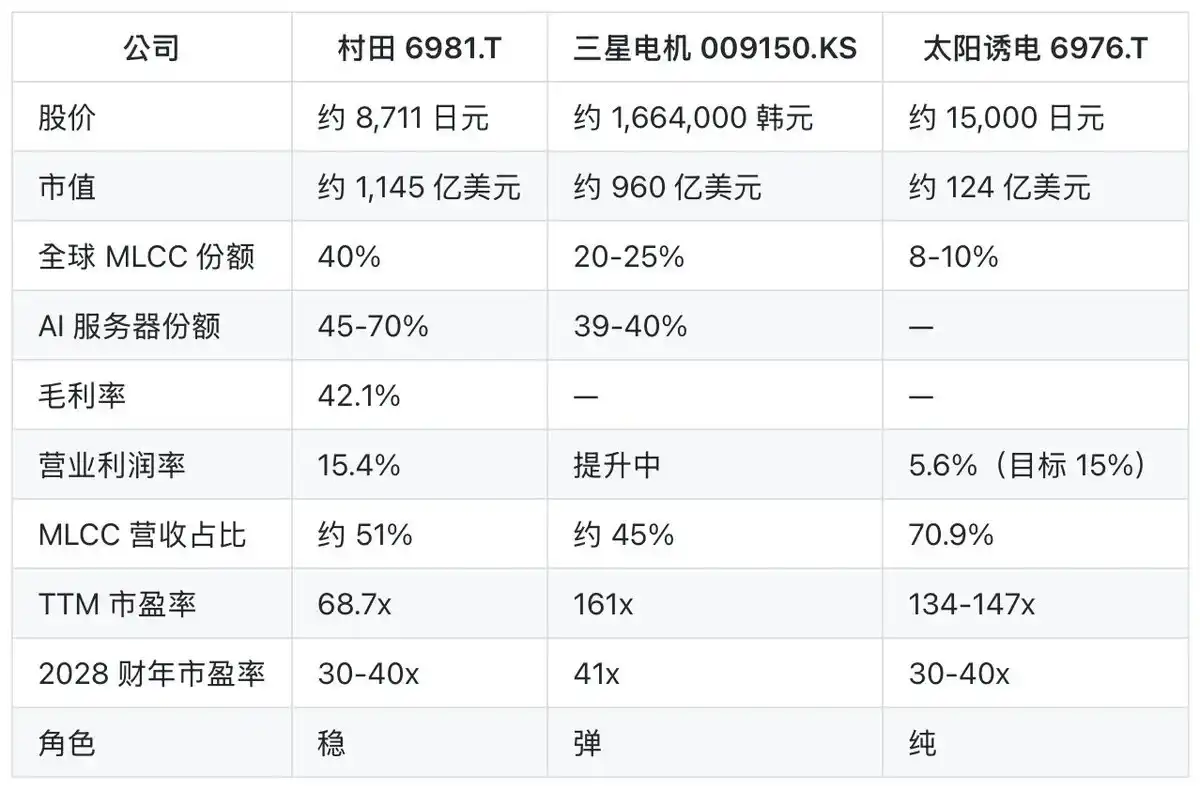
At first glance, the TTM P/E ratios of all three aren't low: Murata at 68x, Taiyo Yuden at 134x+, Samsung EM as high as 161x. Does this mean they are already too expensive and chasing is dangerous?
This judgment needs more careful dissection. A high P/E ratio has completely different meanings at different points in a cycle. If a company's earnings have already peaked, a high P/E is a danger signal. But if earnings are on the eve of an explosion, today's high P/E is precisely because the denominator (earnings) hasn't yet risen. The forward P/E ratios for all three companies are rapidly compressing downward—Murata from 68x to the 30s, Samsung EM from 161x to 41x—this compression isn't achieved through stock price decline but through profit growth. This is a classic feature of the early stage of a cycle: the market has priced in part of the AI expectation but is far from fully reflecting the impending price hike红利 (bonus).
The market has given this cycle a heavy definition: the largest, longest MLCC super-cycle in history, continuing until 2030. And the current position is merely the early stage of the upturn, comparable to the latter half of 2017 in the previous cycle—the show has just begun.
Why is the price hike so critical? Because MLCCs are a business highly dependent on capacity utilization, with fixed costs comprising a large portion. Once prices rise, the extra money almost directly translates into profit. According to estimates, for Taiyo Yuden, a 5% increase in average selling price could boost operating profit by 37%. This is the power of operating leverage—small changes in price are amplified into multiples of change in profit.
In an industry with locked-in supply, every bit of price increase almost directly becomes profit.
And the room for price hikes this round is considerable. Potential increases for high-end MLCCs could reach 100% to 150%, while even standard products have room for 30% to 50% increases. Overlaying this price elasticity onto the previously mentioned supply-demand gap—supply growing 10% annually, demand growing 34% annually, with the gap widening until 2028—you can understand why this is called a super-cycle. The ceiling on supply is firmly in place, while the floor of demand keeps rising. The space in between is where the imagination for profits and stock prices lies.
ETFs and Purchase Channels
After all this, many will ask: How to participate?
First, a slightly disappointing fact: there are no pure MLCC-themed ETFs on the market. This sector is too niche and not yet covered by specialized index products. However, indirect exposure is still possible through some relevant instruments.
In the Korean market, the most noteworthy is the SOL AI Semiconductor TOP2 Plus ETF, where Samsung EM has a 27.3% weighting, with a net asset value of about ₩5 trillion. It's a decent choice for gaining exposure to Samsung EM's elasticity. In the Japanese market, consider NEXT FUNDS' 1625.T, where Murata, TDK, and Taiyo Yuden combined account for about 8% to 12% weighting, effectively packaging the Japanese giants into a basket. In the U.S. market, MLCC-related holdings in EWJ total about 3.5%, and MKOR has a 4.85% weighting for Samsung EM; both concentrations are relatively low, making them more suitable as part of a portfolio rather than the main vehicle.
For more direct exposure, consider ADRs. Murata's ADR is MRAAY, and Taiyo Yuden's is TYOYY; both can be purchased in the U.S. market, avoiding the hassle of directly trading Japanese stocks.
Risks and Conclusion
For any investment, understanding the risks is as important as seeing the opportunities. There are five risk points to keep in mind for this sector.
First, a reduction in AI capital expenditure, a high-risk item. The entire demand-side story is built on cloud providers and compute players continuously pouring money. If industry investment slows, the demand curve flattens, directly impacting the super-cycle logic.
Second, high valuation, also high risk. As mentioned, current P/E ratios already reflect some expectations. If subsequent profit realization falls short, valuation could face downward pressure.
Third, capacity expansion in Mainland China, a medium risk. Expansion by Mainland Chinese manufacturers in the mid-to-low end could cause price disturbances but is unlikely to break into the high-end segment in the short term, thus having limited impact on the core markets of the Big Three.
Fourth, Yen appreciation, a medium risk. Both Murata and Taiyo Yuden are Japanese companies. Significant Yen appreciation would erode their overseas revenue and profits, putting pressure on their Yen-denominated stock prices.
Fifth, weakness in consumer electronics, also a medium risk. The traditional bulk of MLCC demand still comes from consumer electronics, a market experiencing a K-shaped recovery—stable high-end, weak low-end—and the overall drag cannot be ignored.
Listing these risks isn't meant to scare anyone off but to make it clear—the logic of this super-cycle is solid, but it's not a one-way street without variables. The sustainability of demand, valuation digestion, and currency fluctuations all require continuous monitoring.
Returning to the opening question: After GPUs, what's quietly rising in price? The answer is now clear. It's MLCCs, these small capacitors that were previously taken for granted. They are undergoing an identity transformation—from a commodity whose price drifted with the tides, producible by anyone, into a strategic material locked in by certification, constrained by capacity, and repriced by AI.
As computing power becomes the oil of this era, the MLCCs that control every drop of electrical current are the indispensable pipelines no one notices.