To what extent can AI enhance an individual's work efficiency?
Recently, a post about Anthropic sparked widespread sharing on social media. The poster, Ole Lehmann, claimed that Anthropic, a company valued at $380 billion, had an entire growth marketing team consisting of just one person—a non-technical marketer who independently managed paid search, paid social, app store optimization, email marketing, and SEO for nearly ten months.
Shortly after the post was published, it was questioned in the comments, but soon, the person involved confirmed it. The growth marketer, named Austin Lau, replied that he was indeed the only one handling growth marketing at the time the article was written, and he had been doing it alone for nearly ten months.
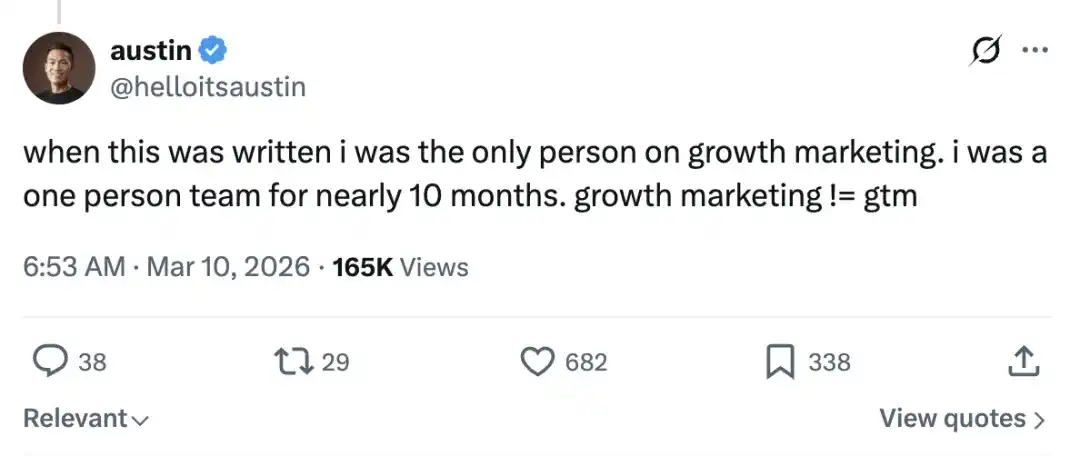
Image丨Related Tweet (Source: X)
In late January, Anthropic published an official case study detailing Austin Lau's working methods. Around the same time, Anthropic also released an internal white paper titled "How the Anthropic Team Uses Claude Code," covering use cases from ten teams, including data infrastructure and legal departments, with growth marketing being one of them.
The white paper stated: The growth marketing team focuses on channels such as paid search, paid social, mobile app stores, email marketing, and SEO. It is a "non-technical one-person team" that relies on Claude Code to automate repetitive marketing tasks and build automated workflows that traditionally require significant engineering resources.
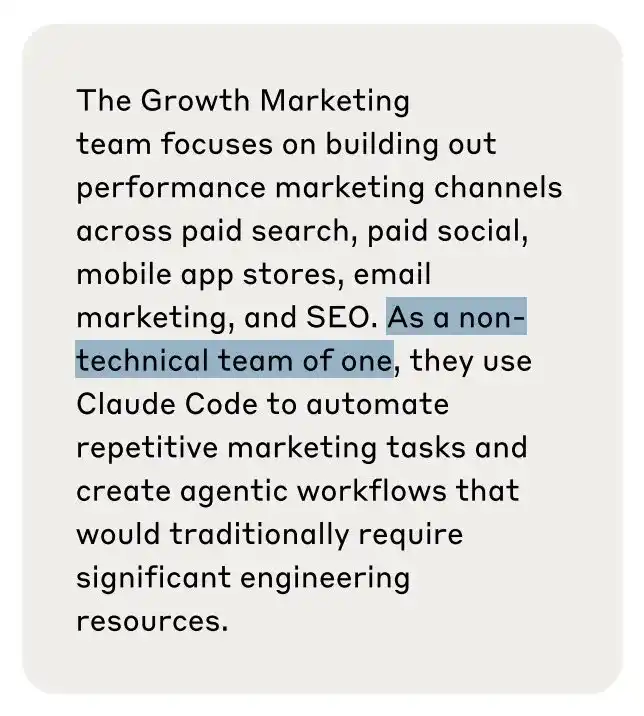
(Source: Anthropic)
Austin Lau is not an engineer. In Anthropic's official case study video, he mentioned that he had "never written a single line of code." When he first encountered Claude Code, he even had to Google "how to open Terminal on a Mac." When Claude Code was first released, his initial reaction was that he "had no idea who this product was for." as a marketer, he found its use case unclear.
The turning point came when a colleague shared a Claude Code installation guide for non-technical employees in the company's Slack group. Out of curiosity, Austin installed it, and within a week, he had built two automated workflows that completely transformed his work.
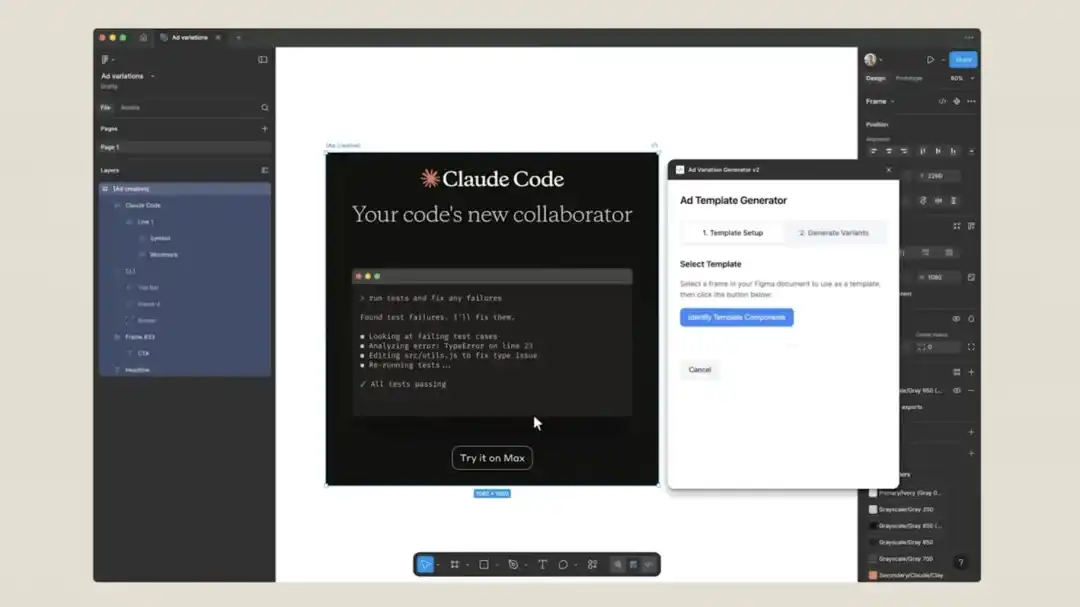
The first was a Figma plugin. For paid social ads and app store marketing, he needed to process a large amount of visual material in Figma. The old workflow was: when creating multiple variations of the same design, he had to manually duplicate frames in Figma, constantly switch between Google Docs and Figma, and copy and paste headlines one by one. If there were 10 variations of copy to adapt to 5 different aspect ratios, this mechanical labor could easily take half an hour.
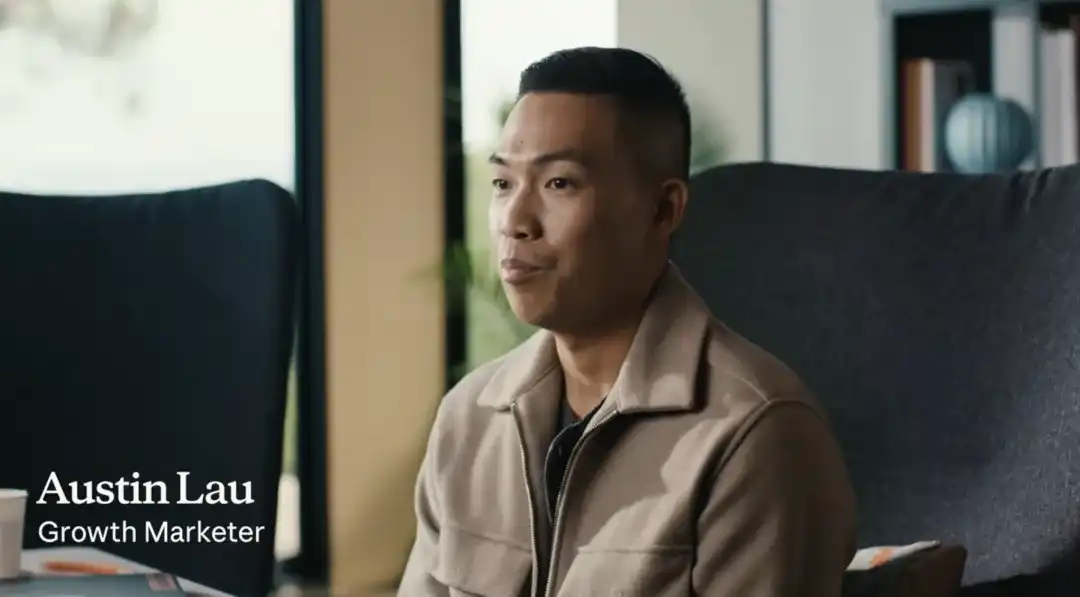
Image丨 Austin Lau (Source: Anthropic)
He described this pain point to Claude Code in natural language and asked it to help write a Figma plugin. During the process, he had Claude Code refer to Figma's API documentation, prototyping while researching. The first version of the generated prototype wasn't perfect, but it was a starting point. He continuously debugged it and eventually created a functional plugin.
(Source: Anthropic)
The plugin works as follows: select a static image frame, and the plugin automatically identifies components such as headlines, call-to-action buttons, and code blocks. It then batch-generates independent Figma frames from a prepared list of copy, with each variation corresponding to a new set of text. A single batch process can generate up to 100 ad variations, taking about half a second per batch. What used to take 30 minutes of manual work now takes 30 seconds.
The second workflow was for generating Google Ads copy. Google Ads' responsive search ads have strict character limits: 30 characters for headlines and 90 characters for descriptions. Previously, he had to draft in Google Sheets, manually check character counts, and then paste the content into the Google Ads backend one by one.
Austin created a custom slash command "/rsa" in Claude Code. When triggered, Claude Code would ask for input such as campaign data, existing ad copy, and keywords, then cross-reference his pre-defined "Agent Skills," which included Anthropic's brand tone, product accuracy guidelines, and Google Ads RSA best practices.
The system uses two specialized sub-agents: one dedicated to writing headlines and another to writing descriptions, each working within their respective character constraints. This approach yields higher quality output than trying to cram both tasks into a single prompt.
Finally, Claude Code packages 15 headlines and 4 descriptions into a CSV file ready for direct upload to Google Ads. Austin emphasizes that the generated copy is just a starting point; he evaluates each piece: Is the value proposition clear? Is the tone right? Does it stand out from competitors? But at least the tedious work of drafting and formatting is fully automated.
The efficiency gains from these two workflows are already impressive, but Austin's system goes further. He also built an MCP server (Model Context Protocol) connected to the Meta Ads API.
Through this integration, he can directly query ad performance, spending data, and the effectiveness of individual ads within the Claude desktop app, without needing to open the Meta Ads backend dashboard. Questions like "Which ads had the highest conversion rate this week?" or "Where am I waste budget?" can be asked directly to Claude, receiving answers based on real-time data.
More importantly, it's a closed loop. Austin built a memory system that records the hypotheses and experimental results from each round of ad iterations. When he starts a new round of variant generation, Claude automatically retrieves data from all previous tests—which copy performed well and which didn't—ensuring the next generation is built on historical experiments. This system becomes slightly smarter after each cycle. This kind of systematic experiment tracking across hundreds of ads typically requires a dedicated data analyst in a traditional team.
According to Anthropic's white paper, the results of this working method are: ad copy creation time reduced from 2 hours to 15 minutes, creative output increased by 10 times, and the number of ad variants he alone tested covered more channels and quantities than most full-scale marketing teams.
In that white paper, growth marketing is just one of ten cases. The data infrastructure team used Claude Code to debug Kubernetes cluster failures, solving issues that would normally require contacting network experts in minutes; members of the inference team without machine learning backgrounds used it to understand model functions and settings, reducing document lookup time from an hour to 10-20 minutes; the product design team directly used Claude Code to modify front-end code, with engineers noticing designers making "large state management changes you wouldn't typically see designers do"; the legal team had someone build a predictive text assistance app for a family member with language barriers in just one hour, despite having no prior programming experience.
The usage differs between technical and non-technical roles, but the conclusion is consistent: Claude Code is blurring the line between "can do" and "cannot do," a boundary that was almost entirely determined by technical ability in the past.
Austin Lau himself summarized in the case study, roughly: "The distance between 'I wish this existed' and 'I can build it myself' is much shorter than most people think."
Of course, it's important to note that growth marketing is not the same as the entire GTM (go-to-market). Anthropic has full brand, product marketing, and communications teams. Austin Lau is responsible for the performance marketing line—quantifiable channels like paid advertising, app store optimization, and SEO.
In February, Anthropic ran a TV ad during the Super Bowl, which was not something one person could handle. The copy and brand assets his workflows rely on were initially produced collaboratively by the product marketing and copywriting teams. Claude then generates variations and scales testing based on this foundation.
Austin Lau recently added some context on LinkedIn. He pointed out that the widely circulated article described his experience as the sole growth marketer in Q2 2025, which was nearly 8 months ago. The team has since expanded, although its size remains much smaller than outsiders might imagine. In his words, "Our combat effectiveness far exceeds our headcount."
Even so, the signal is strong enough. A company with a post-money valuation of $380 billion and annualized revenue of $14 billion, during its fastest growth phase, let a marketer with no coding experience alone manage core growth channels for ten months, with good results. This should sufficiently demonstrate that the multiplier effect of AI on knowledge workers' capabilities is likely much larger than our current organizational structures and hiring habits assume.
However, it's still unclear how widely replicable this model is. Growth marketing is highly data-driven, process-oriented, and API-friendly, making it naturally suitable for automation. In areas requiring more interpersonal judgment or creative intuition, the situation might be different.
The growth marketing chapter of Anthropic's white paper concludes with three suggestions: Look for repetitive workflows with API interfaces to automate; break down complex processes into multiple specialized sub-agents rather than trying to handle everything with a single prompt; before writing code, fully think through the overall workflow design using Claude. These three suggestions essentially illustrate that the bottleneck to efficiency often lies not in technical ability, but in whether you are willing to spend time deconstructing your workflow clearly and then handing over the parts that can be taken over by machines.