When 500 Million People Abandon ChatGPT

marsbitPubblicato 2026-06-22Pubblicato ultima volta 2026-06-22

Introduzione

ChatGPT's Global AI Assistant Market Share Drops Below 50% Three and a half years after its groundbreaking launch, ChatGPT faces a pivotal moment. While it remains the largest AI assistant globally, its market share has fallen below 50% for the first time, reaching 46.4% as of May, according to Sensor Tower's 2026 AI landscape report. Google's Gemini (27.7%) and Anthropic's Claude (10.3%) are now its main competitors, with Grok, Perplexity, and others also gaining ground. The market has evolved from awe and initial adoption into a phase of product comparison, ecosystem integration, and commercialization. User behavior has matured significantly. Loyalty is low; users readily switch between assistants for specific tasks. Gemini benefits from deep integration within Google's ecosystem (Search, Gmail, Android), while Claude has carved a niche among productivity-focused users with strong retention, nearly matching ChatGPT's. User choice is now influenced by a complex mix of capability, ecosystem, price, use case, and even brand trust. Commercialization is accelerating. AI app downloads continue but growth is slowing, while user spending is rising. Over $4.2 billion was spent in-app during H1 2026. Claude leads in premium subscription conversion rates (13%). OpenAI is expanding its revenue streams, testing ads shown to 17% of ChatGPT users daily by May. This shift highlights the immense financial pressure of model training and inference costs. Despite revenue growth, OpenAI's c...

It has been three and a half years since ChatGPT burst onto the scene.

Back then, many people realized for the first time that a dialog box might become the next-generation internet portal. Today, it has long since become the fastest application in human history to reach 1 billion monthly active users. Yet, at the same time, it has reached a symbolic turning point:

ChatGPT's global market share has dropped below 50% for the first time.
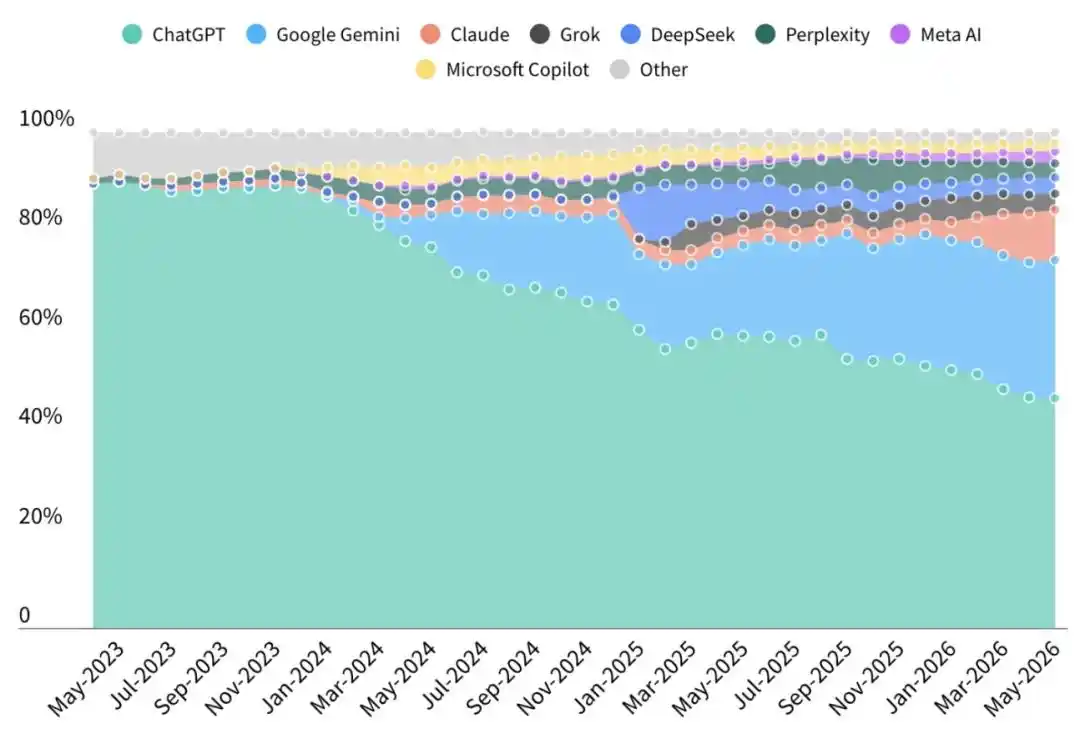
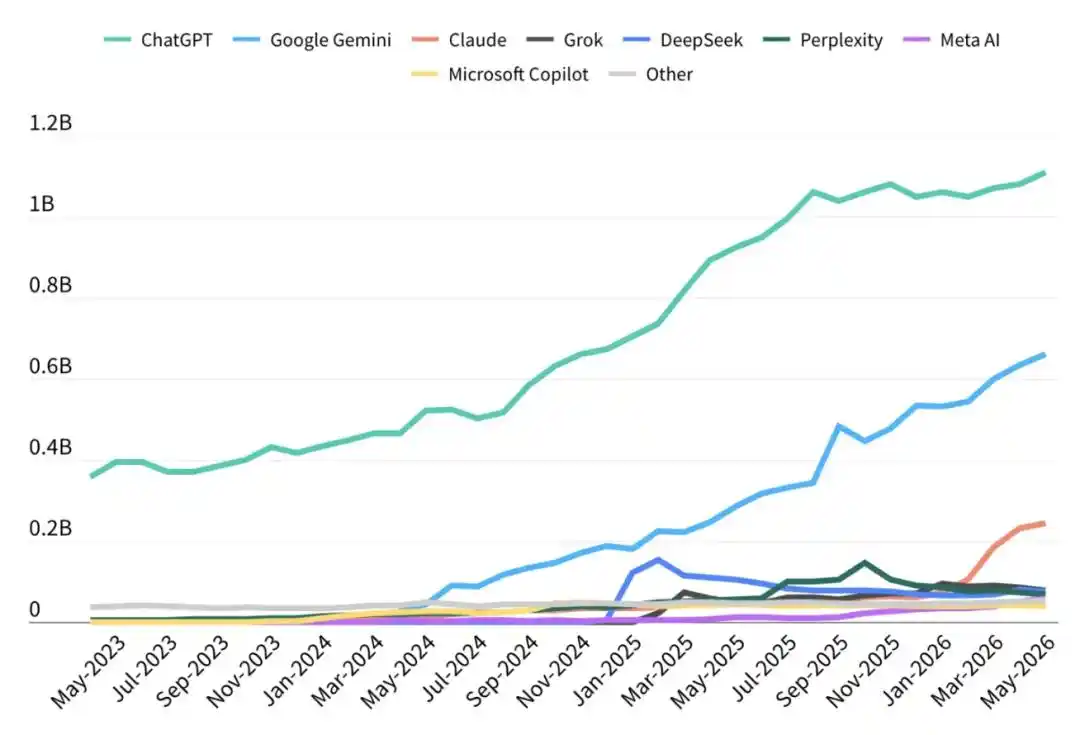
According to the analytics firm Sensor Tower in its "State of AI 2026 Report," as of the end of May this year, ChatGPT's share of the global AI assistant market fell to 46.4%. Prior to January this year, this figure was still above 50%.

ChatGPT remains the world's largest AI assistant. But leading no longer equals monopoly. The AI assistant boom ignited by OpenAI has moved from wonder, trial, and awe into the stage of product comparison, ecosystem lock-in, paid conversion, and commercialization.

Loyalty is a False Promise; Users are 'Players'

In 2023, having a ChatGPT account still carried a certain identity as an AI trendsetter. By 2026, AI assistants are increasingly becoming infrastructure in internet life, much like search, email, and office suites.

The most noteworthy change in Sensor Tower's report is not just that ChatGPT still ranks first. More importantly, users are becoming more willing to migrate. As long as another assistant is more convenient in a specific scenario, users will immediately allocate their time to that other product.

The main rivals pulling ChatGPT's share below 50% are Gemini and Claude.

As of the end of May, Gemini's global share reached 27.7%, and Claude reached 10.3%. Products like Grok, Perplexity, DeepSeek, and Meta AI each remain below 5%, but they are also continuously squeezing the remaining market.
Gemini's growth is not hard to understand.

It stands on the foundation of Google's complete ecosystem. Search, Gmail, Docs, Calendar, and Android are all natural entry points. When AI is embedded into tools users must use daily, many ordinary users don't need to specifically open another webpage to summon ChatGPT.

Especially after the release of Gemini 3.0, Google also achieved its first real major victory, officially joining the AI game table and entering the view of more mainstream users.

Claude's path is more like a victory for productivity tools.

It doesn't have a distribution system like Google's, but it has built a strong reputation in scenarios such as writing, coding, long-text processing, and complex task collaboration. Sensor Tower states that Claude is approaching ChatGPT's user retention levels. For heavy users, AI assistants have shed their toy-like attributes and are starting to genuinely impact work efficiency.
A more subtle change is that users are no longer judging AI products solely based on model capability.

As AI assistants increasingly take on personalized interactive characteristics, users are also beginning to discuss work, emotions, judgments, and decisions with them. Brand trust, value orientation, and institutional relationships may all become part of user choice.

And the slightest bit of negative publicity can trigger a wave of massive uninstalls. This is something OpenAI CEO Sam Altman has likely felt deeply over the past year.

AI companies used to believe that as long as the model was stronger, users would stay. The reality of 2026 is much more complex. Capability, ecosystem, price, scenario, and brand trust are now collectively determining whether an assistant will be used continuously.

The Free Lunch is Over; AI Apps are Starting to Talk Money

Beyond market share, another set of data from Sensor Tower's report better illustrates the stage change in the industry: AI apps are still growing, but the growth logic has changed.

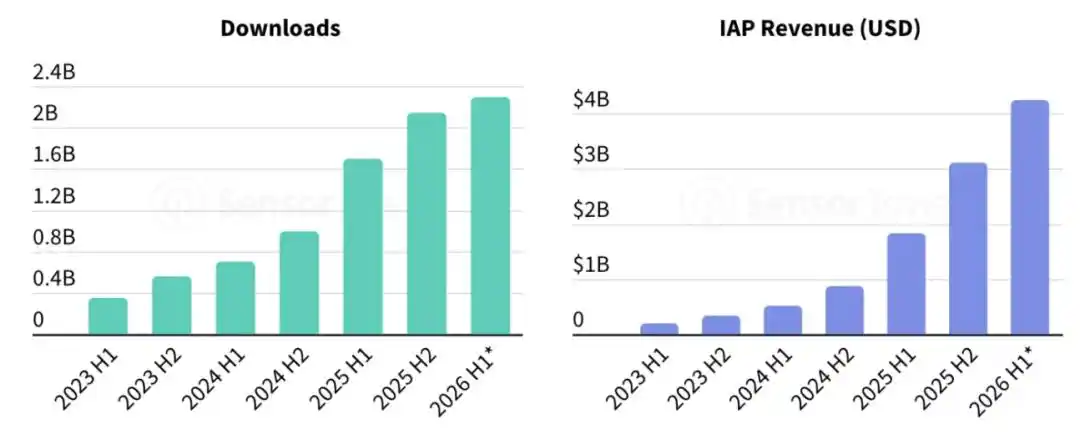
Sensor Tower estimates that in the first half of 2026, global AI app downloads will approach 2.3 billion, and in-app spending will exceed $4.2 billion. In comparison, AI app in-app spending in the first half of 2025 was $1.83 billion.

Users are still downloading AI apps and are willing to pay for AI.

But the growth rates for both downloads and spending have slowed. Meanwhile, the industry has moved from a period of rapid expansion into a more realistic competitive phase. Companies can no longer just talk about user growth; they must also prove they can turn traffic into revenue.

Regional differences are also beginning to show.

Asia remains the highest market for AI app downloads, but in Q1 2026, it saw its first-ever download decline, dropping by 3.3%, mainly influenced by markets like India.
In contrast, North America and Europe are stronger in in-app consumption. For AI companies, what truly determines the business model is often the ability to pay; installation scale can only solve part of the problem.

The trend in the US market is even more pronounced.

Users are increasingly using AI assistants for productivity tasks and are more willing to pay for advanced features. Claude performs well here. Sensor Tower states that Anthropic has 13% of its users subscribing to paid plans, with a conversion rate among the highest in the industry.

A 13% subscription conversion rate explains why Claude can continue to expand its presence amidst the squeeze from giants. As long as AI helps users save time, write code, organize documents, and handle complex tasks, a subscription fee of twenty or even two hundred dollars per month is actually within an acceptable range.

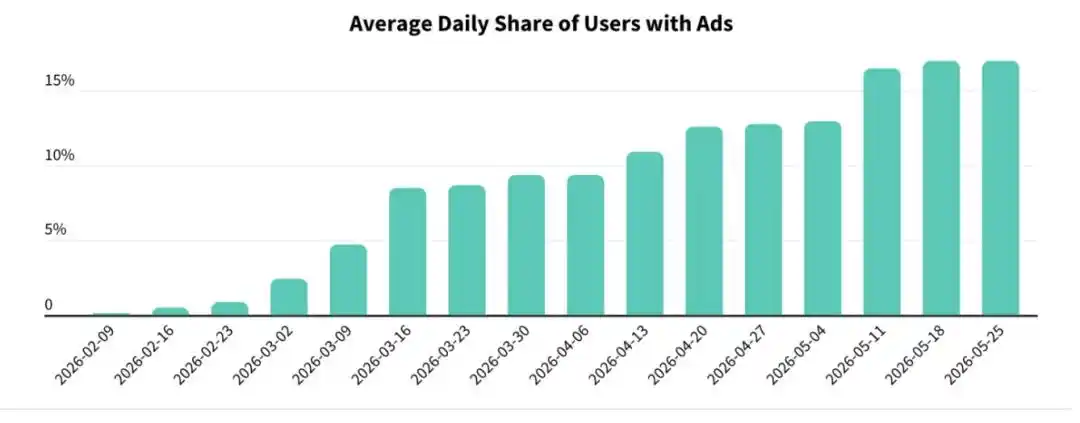
ChatGPT's commercialization path is more diverse and also more controversial. Sensor Tower states that OpenAI began testing ads in ChatGPT starting in February this year, gradually expanding ad display scale and user coverage.

By May, an average of 17% of users saw ads daily. Software and shopping are currently the largest advertiser categories, followed by media & entertainment, and food & beverage.
From subscriptions to ads, ChatGPT is moving towards a more typical internet business model. Early users were familiar with a clean dialog box, a portal imbued with the dream of Artificial General Intelligence (AGI).

Unfortunately, even the smartest AI on the planet ultimately can't escape the fate of becoming a shopping guide. For OpenAI, advertising and shopping have become experiments that must be pursued. Now, this portal is also beginning to carry ads, shopping guides, recommendations, and transaction conversions.

Model inference, training, and compute expenditures are extremely expensive; relying solely on subscription revenue can hardly cover long-term investment. Advertising and shopping are becoming the next pieces of the puzzle for ChatGPT's commercialization.

As AI begins to penetrate core scenarios like shopping, office work, and search, the imagination of AI becoming a unified super portal is also encountering increasingly realistic platform boundaries.

Sensor Tower estimates that in the first half of 2026, global AI app usage time will grow from 17.2 billion hours in the same period last year to approximately 36 billion hours. Among these, the top three AI assistants account for 89% of the total usage time of AI assistant apps.

There is still opportunity for later players, but it exists more in fragmented scenarios, such as AI companions, AI content generation, and vertical industry tools. The main battlefield for general assistants has largely been occupied by ChatGPT, Gemini, and Claude.

Farewell to the Altar; AI Moves Towards the Everyday

The decline in ChatGPT's share occurs at a somewhat paradoxical point in time: OpenAI's revenue is still growing rapidly, its user base is still expanding, and its capital reserves far exceed those of most startups.

According to a report by The Information based on documents disclosed by OpenAI to shareholders, OpenAI's cash consumption reached $3.7 billion in the first quarter, exceeding half of its $5.7 billion revenue. Both cash consumption and revenue roughly tripled year-over-year.

This is also a common challenge facing the current AI industry. Users and revenue continue to grow, yet massive capital investment is required to maintain model training, inference services, and infrastructure construction.

Furthermore, OpenAI expects its cash consumption in 2026 could reach $25 billion, rising further to $57 billion in 2027. Even though OpenAI has secretly submitted IPO filing documents, the listing timing may still be adjusted based on market conditions.

In other words, as one of the world's strongest AI brands, OpenAI still needs to answer a question: when models are getting more expensive, competition is getting fiercer, and users are becoming more willing to migrate, how high a profit margin can ChatGPT's business model ultimately generate.

However, even though ChatGPT's share has fallen below 50%, it remains the world's largest AI assistant and is still the most frequently mentioned name when people talk about AI. But this milestone is symbolic.

The AI assistant market has moved past the era where a single product defined the industry. In the past, ChatGPT was responsible for making the masses believe AI could change the internet. Now, Gemini, Claude, Grok, DeepSeek, and various vertical AI assistants are collectively dividing user time, usage scenarios, and commercial revenue.
User demands are also subtly changing.

By now, you probably are no longer satisfied with just asking AI to write a poem or tell a lame joke. Instead, you're starting to demand it writes code with fewer errors, processes documents more accurately, facilitates office collaboration more conveniently, and offers more reasonable subscription prices.

When a technology no longer elicits repeated amazement but instead begins to be scrutinized, compared, and replaced, it has truly begun to enter mainstream life.

ChatGPT has lost its dominant half of the market, but AI has truly begun to win the world. It's just that in this new world, there are no eternal kings, only us, forever ready to migrate for the sake of a more useful tool.

This article is from the WeChat public account "ifanr," author: ifanr, discovering tomorrow's products.


Crypto di tendenza

Domande pertinenti

QAccording to the article, what is the key symbolic change in the global AI assistant market share as of May 2026?

AThe key symbolic change is that ChatGPT's global market share has dropped below 50% for the first time, to 46.4%.

QWhich two main competitors are primarily responsible for reducing ChatGPT's market share below 50%?

AGemini (27.7% share) and Claude (10.3% share) are the two main competitors responsible for this reduction.

QWhat are the two main business model paths highlighted for ChatGPT's monetization beyond subscriptions?

AThe two main paths are integrating advertising and e-commerce/shopping features into the ChatGPT platform.

QWhat does the 13% subscription conversion rate for Claude's users indicate, according to the report?

AIt indicates that users are willing to pay for AI assistants that demonstrably improve productivity, such as by saving time or handling complex tasks, making Claude's premium subscription model successful.

QWhat broader industry shift does the article suggest is represented by ChatGPT's market share decline?

AIt represents a shift from a period of awe and trial with a single dominant product to a mature, competitive phase where user choice is driven by specific features, ecosystem integration, pricing, and trust, integrating AI into everyday life.

Letture associate

Financing Weekly Report | 11 Public Financing Events, Stablecoin Payment Infrastructure Company Trace Finance Completes $32 Million Series A Round Led by CoinFund

Financing Weekly Report | 11 public funding events recorded, with a total scale exceeding $264 million. The stablecoin payment infrastructure sector remains a hot spot. Key Deals: - Trace Finance, a stablecoin payment infrastructure firm, raised $32 million in a Series A round led by CoinFund to expand in Latin America and Asia-Pacific. - Galaxy Ventures co-led a $140 million Series A round for Karta, a US credit card provider for global travelers without requiring an SSN. - Instant payment platform Interchecks completed a $50 million Series C round. - Paradigm led a $9 million Series A for Latin American cross-border payment app El Dorado. - Range, a stablecoin compliance startup, raised $8.3 million in an oversubscribed Series A. - RWA infrastructure project Renaiss raised $1.5 million to expand its on-chain collectibles platform. Sector Breakdown: - Infrastructure & Tools: 6 deals, including the above-mentioned Trace Finance, Range, and Renaiss. - Centralized Finance (CeFi): 3 deals, led by Karta's $140 million round. - DeFi: 1 deal – reinsurance protocol Re secured strategic investment from Coinbase Ventures. - Prediction Markets: 1 deal – K25.ai completed a $10 million Pre-A round from NewGen. Other notable transactions include digital asset depository RDC raising $7 million, ad-tech startup EarnOS securing $6 million, and a $1 million strategic investment in LitVM, a ZK Layer 2 for Litecoin. The report highlights sustained investor interest in stablecoin payment infrastructure, compliant on-chain finance, and real-world asset (RWA) tokenization.

marsbit30 min fa

Financing Weekly Report | 11 Public Financing Events, Stablecoin Payment Infrastructure Company Trace Finance Completes $32 Million Series A Round Led by CoinFund

marsbit30 min fa

When Transfers Become Truly Frictionless: How Sui Uses 'Zero Gas' to Become the Underlying Infrastructure for Stablecoin Payments

Title: Sui Launches Zero-Gas Stablecoin Transfers to Become the Foundation for Stablecoin Payments Sui has introduced a zero-gas fee feature for peer-to-peer stablecoin transfers, eliminating the need for users or businesses to hold separate SUI tokens to pay transaction costs. This innovation, built on a new underlying account architecture called Address Balances, significantly reduces validator processing costs for eligible transactions. Currently, the feature applies to a whitelist of stablecoins for transfers meeting a minimum amount, effectively preventing spam. This development aims to unlock mainstream payment use cases for stablecoins—such as everyday purchases, remittances, and subscriptions—by removing cost and complexity barriers. It is also positioned to benefit high-frequency micro-payments for AI agents and institutional B2B payments, reducing operational friction. Major custody provider Fireblocks has already announced support. The move follows Sui processing over $1 trillion in stablecoin transfer volume since August 2025. Looking ahead, Sui plans to enhance this infrastructure with protocol-level confidential transactions later in 2026, aiming to provide scalable, free, and privacy-preserving payments. Together, these advancements strengthen Sui's goal of becoming the default settlement layer for stablecoin payments.

marsbit32 min fa

When Transfers Become Truly Frictionless: How Sui Uses 'Zero Gas' to Become the Underlying Infrastructure for Stablecoin Payments

marsbit32 min fa

Ethereum Is Retracing the Path of the Internet and Linux: No One Yields, and the Neutral Party Ultimately Prevails

This article argues that Ethereum is following the historical path of open, neutral systems like the Internet and Linux, which eventually triumphed over proprietary, centrally-controlled alternatives. Major financial institutions like JPMorgan, Stripe, and Circle are building their own proprietary blockchains or networks (e.g., Tempo, Arc), but will never agree to build on a competitor's controlled infrastructure. This creates the perfect opportunity for Ethereum as the only neutral, credibly neutral settlement layer that no single entity controls. The piece draws parallels to the 1990s, when experts like Bill Gates predicted proprietary networks (from Microsoft, Oracle) would win over the open Internet, and when Sun Microsystems' Unix lost to the open-source "bazaar" development model of Linux. This model, described in Eric Raymond's "The Cathedral and the Bazaar," thrives on permissionless innovation where countless contributors improve the system, outpacing any centralized competitor. Ethereum embodies this through its decentralized development, broad validator distribution, and credible neutrality—rules that are transparent, equally applied, hard to change, and open to all. This has attracted over a million developers and major institutions like Coinbase, BlackRock, and JPMorgan, who choose Ethereum for its security, ecosystem, and sovereignty (the inability of any single party to change the rules). While proprietary chains offer initial speed and control, they inherit the downsides of both centralization and decentralization without the long-term innovation benefits. The article concludes that, just as open systems historically win, Ethereum is poised to become the foundational, neutral settlement layer for global finance.

marsbit41 min fa

Ethereum Is Retracing the Path of the Internet and Linux: No One Yields, and the Neutral Party Ultimately Prevails

marsbit41 min fa

Kalshi's Biggest Rival is Not Polymarket

Kalshi's CEO Tarek Mansour has identified the company's primary competitors not as the crypto-based prediction market Polymarket, but as established financial and gaming giants: CME Group, Robinhood, and DraftKings. This reflects a shift in the prediction market landscape, where the 2026 FIFA World Cup is expected to bring massive new trading volume. Traditional platforms are increasingly integrating prediction markets as a feature within their existing ecosystems. Robinhood has seen rapid growth with its prediction markets, contributing significantly to its "other transaction revenue." Similarly, Interactive Brokers (IBKR) integrates contracts from Kalshi and CME Group, while DraftKings and FanDuel (via CME) have launched their own prediction products. This allows these firms to leverage their vast user bases and infrastructure at low marginal cost, turning prediction markets from standalone apps into embedded functionalities. In response, prediction market platforms are evolving along two paths. First, they are expanding into new event categories like sports (e.g., the World Cup) and financial data to reduce reliance on election cycles. Second, they are moving towards becoming infrastructure and liquidity providers for distribution platforms. Kalshi's lead over Polymarket in trading volume is partly attributed to this channel strategy, integrating with brokers like Robinhood, Coinbase, and Webull. However, this strategy faces a challenge as distributors like Robinhood begin building their own in-house prediction market capabilities (e.g., Rothera), potentially threatening the value of pure infrastructure providers. The situation parallels historical tech battles, such as Zoom competing with Microsoft Teams and Google Meet, where embedded features in larger platforms reshape market dynamics. The future of standalone prediction market leaders like Kalshi and Polymarket will depend on their ability to navigate this new competitive landscape dominated by integrated financial and gaming titans.

链捕手48 min fa

Kalshi's Biggest Rival is Not Polymarket

链捕手48 min fa

Trading

Spot
Futures

Articoli Popolari

Come comprare PEOPLE

Benvenuto in HTX.com! Abbiamo reso l'acquisto di ConstitutionDAO (PEOPLE) semplice e conveniente. Segui la nostra guida passo passo per intraprendere il tuo viaggio nel mondo delle criptovalute.Step 1: Crea il tuo Account HTXUsa la tua email o numero di telefono per registrarti il tuo account gratuito su HTX. Vivi un'esperienza facile e sblocca tutte le funzionalità,Crea il mio accountStep 2: Vai in Acquista crypto e seleziona il tuo metodo di pagamentoCarta di credito/debito: utilizza la tua Visa o Mastercard per acquistare immediatamente ConstitutionDAOPEOPLE.Bilancio: Usa i fondi dal bilancio del tuo account HTX per fare trading senza problemi.Terze parti: abbiamo aggiunto metodi di pagamento molto utilizzati come Google Pay e Apple Pay per maggiore comodità.P2P: Fai trading direttamente con altri utenti HTX.Over-the-Counter (OTC): Offriamo servizi su misura e tassi di cambio competitivi per i trader.Step 3: Conserva ConstitutionDAO (PEOPLE)Dopo aver acquistato ConstitutionDAO (PEOPLE), conserva nel tuo account HTX. In alternativa, puoi inviare tramite trasferimento blockchain o scambiare per altre criptovalute.Step 4: Scambia ConstitutionDAO (PEOPLE)Scambia facilmente ConstitutionDAO (PEOPLE) nel mercato spot di HTX. Accedi al tuo account, seleziona la tua coppia di trading, esegui le tue operazioni e monitora in tempo reale. Offriamo un'esperienza user-friendly sia per chi ha appena iniziato che per i trader più esperti.

452 Totale visualizzazioniPubblicato il 2024.12.12Aggiornato il 2026.06.02

Come comprare PEOPLE

Discussioni

Benvenuto nella Community HTX. Qui puoi rimanere informato sugli ultimi sviluppi della piattaforma e accedere ad approfondimenti esperti sul mercato. Le opinioni degli utenti sul prezzo di PEOPLE PEOPLE sono presentate come di seguito.

活动图片