Author: Flora, CryptoPulse Labs
Recently, Lido announced the launch of its largest protocol upgrade since the V2 update in 2023, migrating over 8 million stETH to a new validator architecture following the Ethereum Pectra upgrade. This ETH is valued at approximately $16.5 billion and involves structural adjustments to Lido's entire validator system.
This upgrade is not merely about expanding staking scale but focuses on optimizing validator efficiency, security mechanisms, and network load. For the first time, this Lido upgrade requires node operators to provide ETH staking collateral, meaning node service providers now bear not only technical operational responsibilities but also economic risk.
This signifies that Lido is pushing the liquid staking industry from past scale competition into a stage that prioritizes efficiency, security, and long-term sustainable development.
I. Behind the $16.5 Billion Migration: Structural Challenges from Growth in Scale
Over the past few years, the Ethereum staking market has developed rapidly. With the Shanghai upgrade enabling ETH withdrawals, more and more users have begun participating in network rewards through liquid staking protocols.
Lido, through stETH, lowered the barrier for ordinary users to participate in staking, allowing users to earn ETH staking rewards without running independent validator nodes, while maintaining asset liquidity.

First, the growth in the number of validators increases the pressure on the Ethereum consensus layer. Under the PoS mechanism, validators need to participate in block confirmation, voting, and network state synchronization. As the number of validators increases, the volume of data the consensus layer must process also rises.
More validators do not necessarily mean higher efficiency.
While an increase in the number of validators can enhance network decentralization, an excessive number of small-scale nodes may also lead to increased communication costs and greater network complexity. Therefore, Ethereum needs to find a balance between security, decentralization, and operational efficiency in the long term.
Lido's reduction of approximately one-third of its validators is essentially an optimization of the validator structure. By consolidating some validation resources and improving node operational efficiency, it can reduce the burden on the consensus layer while maintaining network security levels.
Secondly, Lido itself faces decentralization pressures. As one of the largest liquid staking protocols, Lido controls a substantial amount of ETH staked assets. The market has consistently been concerned about the potential impact large staking protocols might have on Ethereum's decentralization.
Therefore, in recent years, Lido has continuously promoted the diversification of its node operator system, aiming to reduce the risks associated with a single protocol and a single operator.
The Curated Module v2 upgrade is a significant step in this direction.
The new mechanism requires node operators to stake their own ETH as collateral, making node service providers bear more direct economic responsibility. If a node experiences severe operational issues, the operator's own interests will also be affected.
This design is similar to the risk-sharing mechanisms in traditional finance, enhancing system stability by raising the cost of participation for stakeholders.
II. Curated Module v2 Upgrade: Redefining the Liquid Staking Competition Model
The core of this upgrade is Lido's redesign of the node operation system. Previously, Lido primarily provided staking services to users by vetting professional node operators. However, with industry development, relying solely on technical capability is no longer sufficient to meet the demands of large-scale staking.
The most significant change in Curated Module v2 is the introduction of a node collateral mechanism.
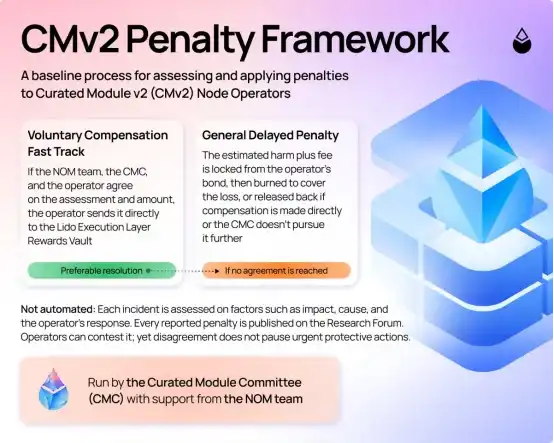
In the past, node operators relied more on reputation and technical capabilities to participate in the ecosystem. In the future, they will need to commit their own ETH capital. This means that node operators and the protocol will form a tighter interest alignment.
For the entire staking system, this can enhance node operators' motivation to maintain infrastructure, security protections, and stable operations.
At the same time, this also represents a shift in the liquid staking industry from "yield competition" to "comprehensive capability competition."
In the early days, when users chose staking services, the primary focus was on yield. However, as the market matures, security, degree of decentralization, asset liquidity, and protocol governance capabilities are becoming increasingly important competitive factors.
With this upgrade, Lido aims to establish long-term competitive advantages through infrastructure optimization.
On the other hand, this upgrade will also improve the operational efficiency of the underlying Ethereum network.
According to information released by Lido, after the migration is complete, the number of attestation messages per epoch on the Ethereum network is expected to decrease by approximately 29%.
While this change will not directly reduce gas fees or immediately increase transaction speed, it can alleviate pressure on the consensus layer, providing a more stable foundation for future Ethereum ecosystem expansion.
Simply put, the Ethereum network consists of the transaction execution layer and the consensus layer. The execution layer is responsible for processing user transactions, while the consensus layer is responsible for reaching global agreement on the network state among nodes.
With the continuous development of Layer 2, Rollup, and other ecosystems, the Ethereum mainnet requires more efficient infrastructure support. Therefore, reducing unnecessary network burden and improving the efficiency of the validation system is an important direction for future development.
Lido's current upgrade is not only an optimization of its own protocol but also part of the continuous evolution of Ethereum's infrastructure.
III. ETH Staking Enters a Mature Phase: Security, Efficiency, and Economic Models Become Core Competitiveness
Lido launching a migration at the $16.5 billion scale appears on the surface to be a technical upgrade, but at a deeper level, it reflects the changing development stage of the ETH staking market.
Over the past few years, the industry's main goal was to increase the ETH staking participation rate, enabling more users to participate in network security. In the future, the industry's focus will shift toward building a more efficient, secure, and sustainable staking system.

First, validation efficiency will become an important competitive direction.
As the Ethereum ecosystem continues to expand, the number of validators cannot grow indefinitely. How to reduce the network burden through technical optimization and improve the efficiency of individual validator nodes will become a key indicator in infrastructure competition.
Secondly, decentralization remains a long-term challenge. While large liquid staking protocols enhance user experience, they also need to avoid excessive concentration.
In the future, the staking market may develop toward a multi-protocol, multi-node, multi-module direction, achieving ecological balance through more open competition mechanisms.
Thirdly, economic incentive mechanisms will become increasingly important. A blockchain network is essentially an economic system. Whether node operators diligently maintain the network depends on whether the rewards match the risks.
Lido's requirement for node operators to provide ETH collateral leverages economic mechanisms to strengthen accountability.
It is worth noting that Lido expects this upgrade may lead to a slight decrease in the protocol's overall annualized staking yield by approximately 0.28%.
In the short term, this means a reduction in some yields.
However, in the long term, greater security and a more stable network structure may be more important than short-term yield increases. For infrastructure protocols, stability and security often hold more long-term value than maximum yield.
In the future, liquid staking protocols may no longer be merely simple yield tools but become crucial infrastructure connecting users, nodes, and the blockchain network.
The signal released by Lido's current upgrade is that the ETH staking industry is entering an era of refined operations.
Conclusion: Staking Infrastructure Competition Enters a New Cycle
Lido's launch of the $16.5 billion-scale ETH staking migration is a significant event in the development of the Ethereum staking ecosystem.
This upgrade involves the migration of 8 million stETH, structural adjustments to validators, and optimization of the node economic model. Its significance is not limited to Lido's own development but represents an ongoing infrastructure restructuring across the entire ETH staking industry.
This upgrade might be just a starting point in the long-term evolution of the ETH staking ecosystem. However, as more protocols and technical solutions enter the market, the Ethereum staking economy will also usher in a more mature stage of development.