OpenAI Post-Training Engineer Weng Jiayi Proposes a New Paradigm Hypothesis for Agentic AI

marsbitPubblicato 2026-05-11Pubblicato ultima volta 2026-05-11

Introduzione

OpenAI engineer Weng Jiayi's "Heuristic Learning" experiments propose a new paradigm for Agentic AI, suggesting that intelligent agents can improve not just by training neural networks, but also by autonomously writing and refining code based on environmental feedback. In the experiment, a coding agent (powered by Codex) was tasked with developing and maintaining a programmatic strategy for the Atari game Breakout. Starting from a basic prompt, the agent iteratively wrote code, ran the game, analyzed logs and video replays to identify failures, and then modified the code. Through this engineering loop of "code-run-debug-update," it evolved a pure Python heuristic strategy that achieved a perfect score of 864 in Breakout and performed competitively with deep reinforcement learning (RL) algorithms in MuJoCo control tasks like Ant and HalfCheetah. This approach, termed Heuristic Learning (HL), contrasts with Deep RL. In HL, experience is captured in readable, modifiable code, tests, logs, and configurations—a software system—rather than being encoded solely into opaque neural network weights. This offers potential advantages in explainability, auditability for safety-critical applications, easier integration of regression tests to combat catastrophic forgetting, and more efficient sample use in early learning stages, as demonstrated in broader tests on 57 Atari games. However, the blog acknowledges clear limitations. Programmatic strategies struggle with tasks requiring long-...

Over the past decade, the advancement of AI has primarily relied on one path: feeding more data and computing power into larger models, allowing experience to accumulate within neural network parameters. This path has led to the leap in large models after ChatGPT, but it has also left behind a persistent challenge: as models become increasingly powerful, the reasons behind their successes and failures often remain difficult to explain and correct.

Recent experiments by OpenAI engineer Weng Jiayi suggest another possibility: within a clear objective, a runnable environment, and a feedback loop, AI can improve not only by training models but also by "autonomously modifying code."

On May 8, 2026, Weng Jiayi systematically documented this set of experiments in his personal blog "Learning Beyond Gradients" and simultaneously made the code repository, CSV experiment logs, and video replays public. He has long focused on reinforcement learning and post-training infrastructure, participated in the initial launch of ChatGPT, and contributed to projects like GPT-4, GPT-4 Turbo, GPT-4o, o-series, and GPT-5. Before joining OpenAI, he earned his bachelor's degree from the Department of Computer Science at Tsinghua University and his master's degree from Carnegie Mellon University. He is also a main author of the open-source reinforcement learning library Tianshou and the high-performance parallel environment engine EnvPool.

Image generated by AI

He had Codex repeatedly write policy code, run environments, read logs, review replays, locate failures, then modify code, add tests, and continue evaluation. After multiple iterations, Codex "cultivated" a set of pure Python programmatic strategies: it achieved a theoretical perfect score of 864 points in Atari Breakout and also produced results in robot control simulation environments like MuJoCo Ant and HalfCheetah that were close to those of common deep reinforcement learning algorithms.

The truly significant aspect of these experiments lies in a core question: When the coding agent is sufficiently capable, must learning necessarily occur within neural network weights?

In this experimental setup, experience is written into code, tests, logs, and replays, becoming a software system that can be read, modified, reviewed, and audited. If this direction continues to hold, the next step for Agentic AI might not only be training larger models but also enabling models to participate in maintaining a continuously evolving engineering system.
01

From 387 Points to a Perfect Score: An Engineering Loop

Weng Jiayi wrote in his blog that the starting point for this experiment was actually an engineering need. While maintaining EnvPool in his spare time, he required a cheaper method than "running a neural network every time" to test whether the game environment was functioning correctly, as placing neural networks in CI was too expensive. The original question was: Could he write cheap, reproducible, heuristic rules that were clearly better than a random policy, to drive the environment to information-rich states?

He used Codex (base model gpt-5.4) to attempt writing a completely rule-based version. The initial prompt was very direct: "Write a strategy that can solve Breakout." The result was unsatisfactory. A low score itself provided no information—the action semantics could be wrong, state detection could be wrong, the evaluation process could be wrong, or the policy structure itself could be too weak.

Subsequently, Weng Jiayi changed the task format. He no longer asked Codex to simply deliver a policy.py file; instead, he required it to maintain a complete loop: probe actions and observations, write state detectors, write the policy, run complete episodes, record trials.jsonl and summary.csv, generate videos or curves, inspect failure modes, modify the policy, simplify code, and run regressions.

The experimental log for Breakout clearly recorded this process. In the first round, Codex confirmed the action space and observation shape, identified the colors of the ball, paddle, and bricks from the RGB frames, and then used image labels to scan the 128-byte Atari RAM. The initial baseline scored only 99 points. After adding tunnel offset logic, the score increased to 387 points.

387 points was a deceptively high local optimum. The strategy could stably hit the ball, but the ball path was trapped in a periodic loop: no lives were lost, but no new bricks could be broken, and the score was stuck. If a human were writing the code, they might continue fine-tuning the "accuracy of hitting the ball." Codex watched the video and the last few dozen steps of the trajectory, and identified the problem as a lack of disturbance in the ball's path.

Image: Atari Breakout gameplay. The player controls the bottom paddle to bounce a ball, breaking layers of colored bricks above. Codex achieved the theoretical perfect score of 864 points in this game.

Codex then added a mechanism to "break the cycle": if no reward was received for a long time, periodically add an offset to the landing point prediction to knock the ball out of the local loop. The score jumped from 387 to 507. During further iterations, a new problem emerged: for fast low balls, conventional interception would cause the paddle to "over-lead" and drift away. Codex added a `fast_low_ball_lead_steps=3` parameter, and the score jumped from 507 to 839. The final improvement from 839 to 864 resembled maintaining an already complex system: trying deadband, serve offset, stuck offset, brick balance bias, lookahead steps; many directions were ineffective. The final useful change was a late-stage condition: "After the first wall of bricks is cleared, enable the stuck offset only when the ball is far from the paddle, and gradually release it when the ball is close."

The final RAM default configuration stably output 864 / 864 / 864 points across three episodes, reaching the theoretical limit of Breakout. Codex then migrated the same geometric controller to a pure vision input version—without reading RAM, relying solely on RGB segmentation to identify the paddle, ball, and brick balance. The vision version initially scored 310 points, then 428 points, and reached 864 points after the seventh local episode, corresponding to 14,504 local policy environment steps.
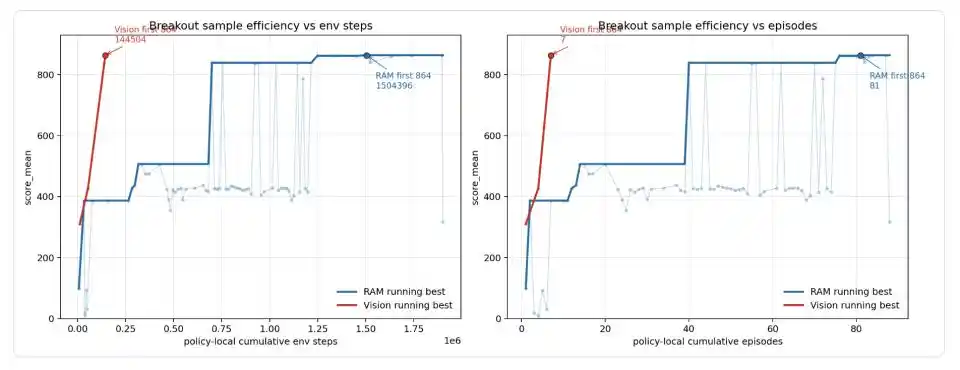
Image: Sample efficiency curve of Codex on Breakout. The blue line is the version that reads game memory (RAM), and the red line is the vision-only version (Vision). The RAM version experienced several jumps: 99 → 387 → 507 → 839 → 864, finally reaching the perfect score for the first time at episode 81, with a cumulative 1.5 million environment steps; the Vision version, migrating the mature structure from the RAM version, reached 864 points with only 7 episodes and approximately 14,500 environment steps.

Weng Jiayi specifically noted that this should not be understood as "the vision input started from scratch and reached a perfect score using only 14.5K steps." The actual process was that Codex first discovered the geometric controller, cycle-breaking mechanism, and late-stage offset release in the RAM version. Once the structure was stable, the state reading layer was switched from RAM to RGB. The 14.5K steps represent the migration budget for the vision version.

02

Defining Heuristic Learning

Finding a name for this evolving "software policy" was more difficult than writing the first version of the policy. Weng Jiayi ultimately named this process Heuristic Learning (HL) and termed the object it maintains as a Heuristic System (HS).

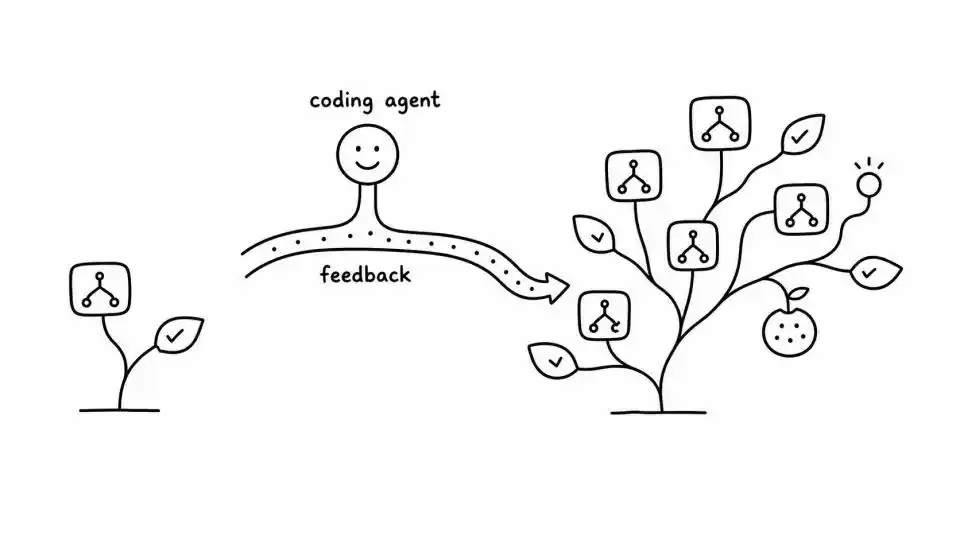
According to his blog definition, HL is composed of program code. Like today's common deep reinforcement learning, it has a loop of state, action, feedback, and update. The difference is that the object being updated is the software structure, not neural network parameters; its feedback, digested by the coding agent, can come from environmental rewards, test cases, logs, videos, replays, or human feedback; its update does not use backpropagation, but rather the coding agent directly edits the policy, state detectors, tests, configurations, or memories.

It should be added that the concept of "using programs rather than neural networks as policies" is not Weng Jiayi's original creation. Academic discussions on Programmatic RL have been ongoing for years: the PROPEL framework proposed by Rice University and Caltech in 2019 researched reinforcement learning methods representing policies as short programs in a symbolic language; the 2021 LEAPS work further learned program embedding spaces, combining differentiable program policies with RL training; the HPRL (Hierarchical Programmatic Reinforcement Learning) presented at ICML 2023 allows a meta-policy to combine multiple programs; the LLM-GS framework from National Taiwan University and Microsoft in 2024 uses LLM's programming ability and commonsense reasoning to guide the search for programmatic RL policies.

The consensus from this research is that, compared to neural policies, programmatic policies possess better interpretability, formal verifiability, and generalization ability to unseen scenarios.

Weng Jiayi's substantive contribution this time lies in treating the coding agent as the engineering channel for maintaining the heuristic system. In the past, doing programmatic RL either relied on manually designed domain-specific languages or search algorithms within restricted program spaces; Weng Jiayi, however, uses Codex to integrate code, logs, tests, video replays, and parameter adjustments into the same agent workflow, drastically reducing the iteration cost of program policies at once. In other words, he is arguing for a new engineering path: when the coding agent is sufficiently capable, those heuristic strategies once deemed "too expensive to maintain" might become cost-effective again.

Weng Jiayi provided a comparison table in his blog to clearly illustrate the differences between HL and Deep RL: in terms of policy form, the former consists of rules, state machines, controllers, model predictive control (MPC), and macro actions composed into code, while the latter consists of neural network parameters; in terms of state form, the former uses explicit variables, detectors, and caches, while the latter uses network-readable observation vectors; in terms of feedback form, the former treats tests, logs, and replays as valid signals, while the latter primarily relies on fixed reward functions; in terms of memory form, the former can explicitly store trials, summaries, failure reasons, and version diffs, while the latter has essentially none in on-policy algorithms and relies on replay buffers in off-policy algorithms.
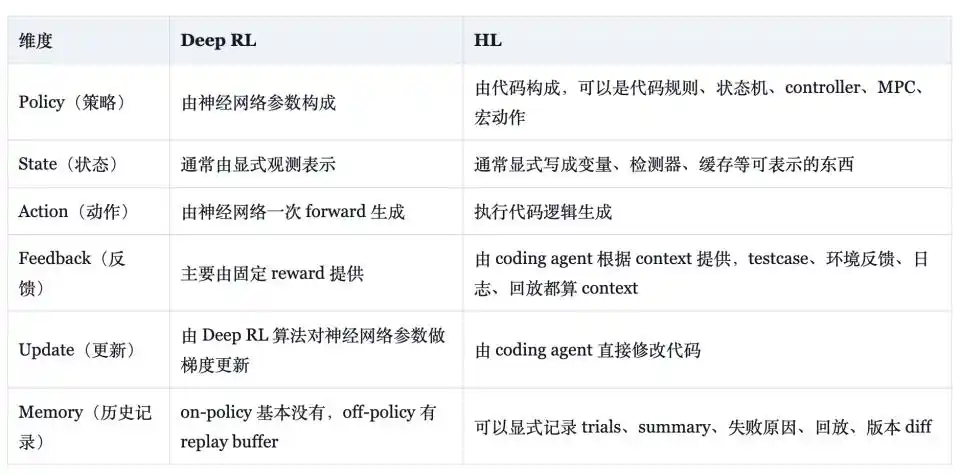
This comparison demonstrates that HL possesses some engineering attributes: the policy is interpretable and can be translated into natural language; sample efficiency is measured in units of "one effective code change," not slow gradient updates; old capabilities can become regression tests, fixed-seed replays, or golden cases; overfitting to training seeds or test loopholes can be constrained through simplification, regression checks, and multi-seed evaluation; old capabilities don't have to reside solely in weights but can also reside in rule sets and tests, which partly addresses the catastrophic forgetting problem that neural networks have long struggled to solve.

03

Bulk Validation on Atari57: Boundaries and Shortcomings

If focusing only on Breakout, the story could easily be simplified to "AI wrote a perfect strategy." But Weng Jiayi didn't stop at Breakout; he scaled this Codex workflow in bulk to Atari57, running 57 games, two observation modes, and three repetitions each, totaling 342 "unattended" search trajectories.

The experimental design was quite rigorous. Each game was tested with two input methods: one directly reading game memory, and the other viewing only the screen. Each method was independently repeated three times. This produced a total of 342 "unattended" experimental trajectories: each Codex agent received the same prompt template, explored actions on its own, wrote code on its own, ran experiments on its own, and recorded results on its own, with no human providing hints. Constraints were strictly enforced: no training neural networks, no reading game source code, no exploiting any hidden information. All steps used for debugging and trial-and-error had to be counted in the total cost. This was to prevent Codex from cheating in any "peeking at the answers" way.

When measuring results, a metric called HNS (Human-Normalized Score) is commonly used—simply put, it standardizes the score of each game relative to "average human player performance = 1" for easy cross-game comparison.
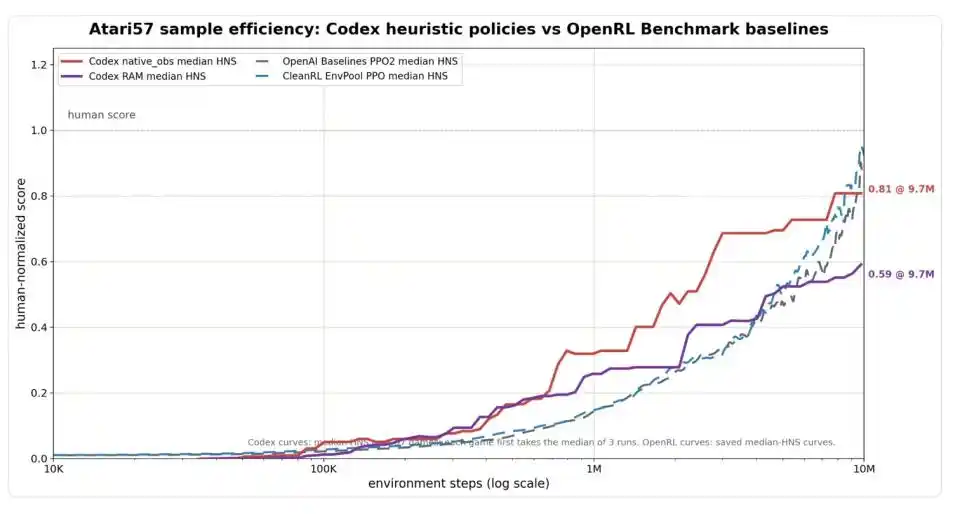
Image: Sample efficiency comparison on the full Atari57 suite. The x-axis is environment steps (log scale), and the y-axis is HNS (Human-Normalized Score, where 1.0 indicates reaching average human player level). Codex's vision input version (red line) significantly outperforms the PPO baseline (blue/gray dashed lines) in early-stage efficiency, reaching 0.81 at 9.7 million steps, comparable to PPO's level around 10 million steps; Codex's memory input version (purple line) converges at 0.59.

Measured by this standard, Codex's early-stage efficiency appears quite impressive. With only 1 million environment steps consumed, Codex's median HNS for vision input had already reached 0.32, and for memory input, 0.26, significantly higher than that of classical reinforcement learning algorithms like PPO at the same stage. By 9.7 million steps, Codex's vision version reached 0.81, already close to PPO's level of approximately 0.88 to 0.92 at 10 million steps. If allowed to aggregate by selecting the better-performing input method for each game, Codex's median HNS was 0.83, OpenAI Baselines PPO2 was 0.80, and CleanRL EnvPool PPO was 0.98—essentially a tie.

However, Weng Jiayi himself calmly drew a boundary: this is only a comparison of environment interaction efficiency, without accounting for the costs of Codex reading logs, writing code, and watching videos. "Running fast" does not equal "low total cost," and the latter remains a black box for now.

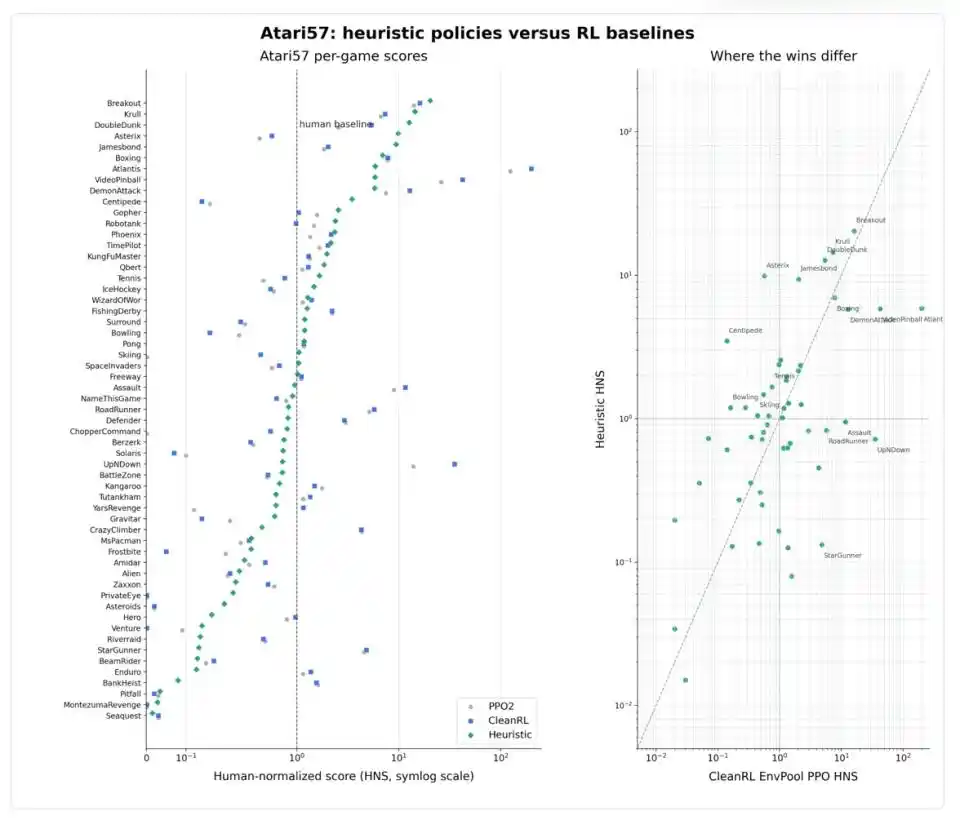
More noteworthy is that Codex's performance across the 57 games was not uniform. In games with clear geometric structures like Breakout, Boxing, and Krull, both heuristic strategies and deep reinforcement learning could significantly surpass human levels; in games with clear rules like Asterix, Jamesbond, and Tennis, heuristic strategies were even stronger; but in fast-paced, complex-pattern games like Atlantis, VideoPinball, RoadRunner, and StarGunner, PPO still dominated.
The most cautionary counterexample is Montezuma's Revenge. This is a notorious "hard nut to crack" in reinforcement learning, where the protagonist needs to find keys, avoid enemies, and open doors in a complex underground labyrinth, with extremely sparse reward signals—a classic "long-term planning + failure recovery" challenge. Codex did score 400 points in this game, but examining the policy file it generated reveals that it's not a true "strategy" but a hardcoded sequence of 86 actions corresponding to 1,769 environment steps: more like memorizing a fixed route than learning to navigate a maze. Weng Jiayi specifically noted: "This is a boundary case and should not be understood as a generic Montezuma strategy."

Montezuma exposes the expressive limits of Heuristic Learning. Ordinary programmatic strategies are essentially reactive logic of "do this action when you see that state," struggling with tasks requiring strict action sequences, resuming plans from intermediate states, and long-horizon planning. Such tasks require not just more if-else statements but program structures closer to "macro-action combination + recoverable search state + long-term memory." This tells us one thing: even if the coding agent becomes very powerful, some problems cannot be contained by ordinary code.

04

If the Paradigm Holds, What Are the Industrial Implications?

Zooming out to an industrial perspective. If the Heuristic Learning path truly holds—meaning "coding agents can stably maintain programmatic strategies surpassing handcrafted rules and approaching RL baselines"—where does its practical significance lie?

The first application point is robot control, especially in structurally stable scenarios. The framework Weng Jiayi outlined in his blog involves hierarchical division of labor: joint-level HL, limb-level HL, full-body balance HL, and task-level HL. Lower levels handle safety and low-latency control, middle levels handle gait and contact, and higher levels handle tasks and long-term memory; the coding agent doesn't need to "understand walking"—it's more like an update channel inserted into the system, sending failure videos, sensor streams, and simulation results back to the system, and rewriting feedback into code, parameters, protection rules, and memories.

Scenarios like warehouse AGVs, inspection robots, factory robotic arms, and standardized sorting, where the environment structure is relatively fixed and safety boundaries are clear—if core control strategies can be solidified into lightweight code, robots wouldn't need to run a large policy network for every action step. Deployment-end reliance on high-power GPU inference cards would decrease, with more load handled by traditional controllers and local program logic.

This doesn't mean robots don't need GPUs; perception, localization, mapping, and semantic understanding still rely on neural networks. What changes is the role of the GPU, shifting from "burning compute for end-to-end action decisions every second" to "playing a periodic role in perception, offline simulation, policy generation, and anomaly analysis."

The second application point is the auditability of safety-critical scenarios. The most troublesome engineering problem with neural policies is the inability to locate the cause after a failure. When a robotic arm suddenly fails at a certain angle, a vehicle misjudges in an edge case, or a medical robot acts abnormally in a rare posture, engineers cannot answer "which weight caused this error." Ultimately, they can only add data, retrain, run regression tests, and bet that the new model hasn't introduced new problems.

If the policy exists in code form, state variables, conditional branches, failure logs, and regression tests are all visible; a dangerous action can be hardcoded to be prohibited, a corner case can be written as a test, and an erroneous state transition can be individually patched. This doesn't make the system inherently safer, but it allows safety issues to enter normal software engineering workflows for the first time—they can be code-reviewed, intercepted by CI, and responded to by SRE on-call. In fields requiring regulation and liability division, like autonomous driving, industrial robotic arms, and medical robots, this auditability itself is of commercial value.

The third application point is the engineering of continual learning and online learning. Weng Jiayi presented this as the main argument of the entire blog post. Catastrophic forgetting in neural networks is a structural problem: learning new things washes away old capabilities. HL also experiences forgetting, but in a more engineering form: a new rule fixes one failure mode but breaks an old scenario; a new memory repeatedly leads the agent in the wrong direction; a test range is too narrow, and the policy learns to exploit it; a patch modifies a shared interface, and old calling paths silently fail.

These problems don't disappear automatically, but they are issues that software engineering has dealt with for decades, with existing toolchains—regression testing, version diffs, fixed-seed replays, golden traces, and explicitly recorded failure directions.

A healthy HS must perform two operations simultaneously: absorbing new feedback and compressing historical patches. An HS that only grows without reduction will eventually become a "code ball of mud" no one dares to touch. In other words, HL transforms the mathematical problem of "how to update parameters" into the engineering problem of "how to maintain a software system that continuously absorbs feedback."

The latter is not necessarily easier, but it is closer to the existing boundaries of human capability.

The fourth application point is capability accumulation in Agent products. What current Agent products lack most are stable tool invocation, reliable execution chains, reusable failure experiences, and auditable task records. If HL's logic holds, an Agent's memories during execution would precipitate into code assets that can be reused across sessions, users, and tasks. It can directly interface with existing DevOps processes and also means that Agents from different companies and teams can share heuristics without needing to share models—something the neural network approach cannot achieve.

However, it must be emphasized: all four application points depend on further validation of the HL path on more complex tasks. Breakout and Ant are relatively clean environments. Real robots face changes in ground friction, lighting variations, actuator delays, and sensor noise—none of which have been systematically evaluated in public materials. The Montezuma counterexample has already shown that long-horizon tasks require program forms beyond ordinary if-else. How far this vision can go depends on the next phase of experiments.

05

Technical Debt Shifts from Weights to Code

Weng Jiayi's assessment in his blog is measured. He wrote that HL cannot accomplish everything neural networks can do; it is limited by what code can express, especially in complex perception and long-horizon generalization. With today's understanding, he cannot imagine an agent using pure Python code without any neural networks to solve ImageNet. The truly worthwhile question is how to combine neural networks with HL to jointly address Online Learning and Continual Learning.

The division of labor he proposes borrows from the System 1 / System 2 framework: specialized shallow neural networks take on part of System 1, responsible for fast perception, classification, and object state estimation; HL also takes on part of System 1, responsible for processing fresh data, rules, tests, replays, memories, safety boundaries, and local recovery; the LLM agent acts as System 2, providing feedback and improvement data to HL, and periodically extracting information from data generated by HL to update itself.

If deep learning over the past decade has proven that "experience can be compressed into weights," then the hypothesis Weng Jiayi proposes this time is another proposition: in the era of coding agents, experience might once again become readable, modifiable, testable software.

This article is from the WeChat public account "Tencent Technology," author: Xiao Jing, editor: Xu Qingyang


Domande pertinenti

QWhat is Heuristic Learning (HL) as proposed by Weng Jiayi, and how does it differ from traditional deep reinforcement learning?

AHeuristic Learning (HL) is a paradigm proposed by OpenAI engineer Weng Jiayi where an AI agent, like Codex, learns by iteratively writing, running, and modifying programmatic code for a policy within an explicit goal, runnable environment, and feedback loop. The core difference from traditional deep reinforcement learning (Deep RL) is that in HL, experience and improvements are encoded directly into readable, editable software components like code, tests, logs, and configurations. This is updated via direct code edits by the AI, rather than being learned through gradient descent and embedded as inscrutable weights in a neural network. This approach aims for better interpretability, auditability, and sample efficiency in terms of 'effective code changes'.

QWhat was the specific process and final result of the Atari Breakout experiment conducted by Weng Jiayi?

AIn the Atari Breakout experiment, Weng Jiayi tasked Codex not just with writing a policy, but with maintaining a full engineering loop: probing the environment, writing state detectors, running episodes, recording logs and videos, analyzing failures, and modifying the code. Starting from a baseline score of 99, the agent iteratively improved its strategy. Key breakthroughs included adding a mechanism to break cyclical ball patterns (raising the score from 387 to 507) and adjusting parameters for intercepting fast low balls (jumping from 507 to 839). The final policy, refined with late-stage conditionals, achieved a perfect score of 864 across three episodes, which is the theoretical maximum for the game. This was achieved using both game RAM data and later migrated to a vision-only (RGB) input version.

QWhat were the key findings and limitations when scaling the Heuristic Learning approach to the full Atari57 benchmark?

AWhen scaled to the Atari57 benchmark, the Heuristic Learning approach showed promising early sample efficiency, with a median Human-Normalized Score (HNS) of 0.32 at 1 million steps for the vision-based version, outperforming PPO baselines at that stage. By 9.7 million steps, its performance (HNS ~0.81) was competitive with PPO. However, performance was uneven. It excelled in geometrically clear games (e.g., Breakout, Boxing) but struggled in fast-paced, complex games (e.g., Atlantis, RoadRunner). A key limitation was exposed in Montezuma's Revenge, where the agent merely memorized a fixed action sequence instead of learning a generalizable policy, highlighting the expressivity limits of simple programmatic strategies for tasks requiring long-term planning and state recovery.

QWhat are the potential industry applications and implications if the Heuristic Learning paradigm proves viable?

AIf proven viable, Heuristic Learning could have significant industry implications: 1) **Robotics Control**: For structured environments (e.g., warehouse AGVs, industrial arms), core control logic could be lightweight, auditable code, reducing reliance on heavy GPU inference for every action. 2) **Safety-Critical Systems**: The interpretability of code allows for auditing, debugging, and embedding safety rules directly, which is crucial for autonomous vehicles and medical robots. 3) **Continual Learning Engineering**: It transforms the 'catastrophic forgetting' problem into a software maintenance challenge, solvable with regression tests and version control. 4) **Agentic AI Products**: Agent experiences could be codified into reusable, sharable software assets integrated into DevOps workflows, enabling capability沉淀 without sharing model weights.

QAccording to Weng Jiayi, how might Neural Networks and Heuristic Learning be combined in a future AI system architecture?

AWeng Jiayi suggests a potential hybrid architecture借鉴 the System 1 / System 2 framework. Specialized, shallow neural networks would act as part of System 1, handling fast perception and state estimation. The Heuristic Learning system would also be part of System 1, responsible for rules, tests, memory, safety boundaries, and local recovery based on fresh data. A large language model (LLM) agent would serve as System 2, providing high-level feedback and improvement directions to the HL system, and periodically updating itself from the structured data and experiences generated by the HL process. This combines the perceptual strength of neural networks with the interpretability and engineering manageability of programmatic systems.

Letture associate

OpenAI's Largest Internal Wealth Creation: 600 People Cash Out a Total of $6.6 Billion, 75 Take Home the Maximum $30 Million Each

A Wall Street Journal report reveals OpenAI's unprecedented pre-IPO wealth creation. In a single employee stock sale last October, over 600 current and former employees sold shares, collectively cashing out approximately $6.6 billion. Due to high investor demand, the company tripled the individual sale cap to $30 million, with about 75 employees selling the maximum amount. This event represents the largest such transaction in tech industry history for a private company. OpenAI's valuation was $500 billion for this tender offer. Employees with over two years of tenure were eligible, allowing many post-ChatGPT hires their first liquidity event. The company's stock has reportedly grown over 100-fold in seven years. Following a restructuring, employees collectively hold about 26% of OpenAI. The scale of executive wealth is also staggering. In court testimony related to Elon Musk's lawsuit, President and co-founder Greg Brockman confirmed his OpenAI stake is worth around $30 billion. Analysis indicates about 165 current and former employees hold a combined ~$164.9 billion in equity, averaging nearly $1 billion per person in paper wealth. OpenAI's per-employee stock-based compensation is estimated to be 34 times the average of major tech firms before their IPOs. OpenAI continues its rapid ascent, closing a $122 billion funding round at an $852 billion valuation in March. With monthly revenue hitting $2 billion, over 900 million weekly ChatGPT users, and plans for a potential trillion-dollar IPO in late 2026, this wealth-creation engine shows no signs of stopping.

链捕手22 min fa

OpenAI's Largest Internal Wealth Creation: 600 People Cash Out a Total of $6.6 Billion, 75 Take Home the Maximum $30 Million Each

链捕手22 min fa

Understanding CPO (Co-Packaged Optics) in One Article: Why Nvidia Is Willing to Spend $3.2 Billion on a Fiber?

NVIDIA and Corning announced a multi-year strategic partnership on May 6, 2026, with NVIDIA committing up to $3.2 billion to support Corning's U.S. expansion. This investment will triple Corning's manufacturing plants and significantly boost its optical fiber and communications production capacity. The core driver behind this massive investment is the fundamental shift from copper to optical interconnect technology within AI data centers. As GPU clusters scale, copper wires face critical limitations: severe signal attenuation over distance, high energy consumption for signal integrity, and excessive heat generation. Optical fiber, transmitting light instead of electrical signals, solves these issues with minimal loss, near-light speed, and lower power needs. The article outlines a three-stage evolution of data center interconnect: 1. **Traditional Copper Interconnects:** The mainstream solution of the 2010s, now being phased out due to scaling bottlenecks. 2. **Pluggable Optical Modules:** The current mainstream, where modules convert electrical signals to light externally. This process still introduces energy loss and latency. 3. **CPO (Co-Packaged Optics):** The next-generation technology where the optical engine is integrated directly with the GPU chip package. This drastically reduces the electrical signal travel distance to mere millimeters, slashing power consumption and latency while boosting data density. NVIDIA CEO Jensen Huang has identified CPO as an essential core technology for AI infrastructure. NVIDIA's investment signifies a strategic shift from being a buyer to actively controlling its supply chain for critical components. With demand for specialized optical fiber far outstripping supply—evidenced by soaring prices—securing long-term manufacturing capacity has become a competitive necessity. While Corning's expansion may pressure some suppliers, a projected global fiber supply gap of 5-15% over the next few years creates a significant opportunity window, particularly for Chinese manufacturers competitive in optical preforms, chips, and modules. Ultimately, NVIDIA's move is not about chasing a trend but an engineering imperative. The transition to light-based interconnects like CPO is driven by the physical limits of copper, marking a definitive step in the ongoing AI computing revolution.

marsbit47 min fa

Understanding CPO (Co-Packaged Optics) in One Article: Why Nvidia Is Willing to Spend $3.2 Billion on a Fiber?

marsbit47 min fa

KOL's Perspective: Why Is SOL Set to Rise from This Point?

**Summary: Why SOL is Positioned for Growth at This Level** The article argues that SOL is poised for an upward move from its current price point, citing several key factors. Primarily, SOL has just broken out of a 4-month consolidation phase. This breakout signals a return of risk appetite to the broader crypto market, as SOL is seen as a key indicator of overall crypto health. The token's ownership has reportedly shifted from short-term traders and tourists to long-term accumulators, leading to low volume. Any meaningful increase in trading activity could thus trigger significant upward momentum. Fundamental strengths include strong institutional adoption, integration with DeFi and RWAs (Real-World Assets), and the potential benefits from the Clarity Act. Despite its high volatility—having dropped 70% from its all-time high but still up 12x from its bear market low—SOL is highlighted as one of the few tokens from the last cycle to reach new highs. It boasts a robust ecosystem of applications, users, and protocols. Future catalysts include the expected influx of AI developers following the Miami Accelerate conference, which focused on AI on Solana. Furthermore, Solana is positioned as the premier chain for memecoin activity, a trend expected to continue and drive network usage and fees. The article concludes that recent price action reflects a healthy transfer to long-term holders, setting the stage for growth.

marsbit1 h fa

KOL's Perspective: Why Is SOL Set to Rise from This Point?

marsbit1 h fa

Trading

Spot
Futures

Articoli Popolari

Cosa è GROK AI

Grok AI: Rivoluzionare la Tecnologia Conversazionale nell'Era Web3 Introduzione Nel panorama in rapida evoluzione dell'intelligenza artificiale, Grok AI si distingue come un progetto notevole che collega i domini della tecnologia avanzata e dell'interazione con l'utente. Sviluppato da xAI, un'azienda guidata dal rinomato imprenditore Elon Musk, Grok AI cerca di ridefinire il modo in cui interagiamo con l'intelligenza artificiale. Mentre il movimento Web3 continua a prosperare, Grok AI mira a sfruttare il potere dell'IA conversazionale per rispondere a query complesse, offrendo agli utenti un'esperienza che è non solo informativa ma anche divertente. Cos'è Grok AI? Grok AI è un sofisticato chatbot di intelligenza artificiale conversazionale progettato per interagire dinamicamente con gli utenti. A differenza di molti sistemi di intelligenza artificiale tradizionali, Grok AI abbraccia un'ampia gamma di domande, comprese quelle tipicamente considerate inappropriate o al di fuori delle risposte standard. Gli obiettivi principali del progetto includono: Ragionamento Affidabile: Grok AI enfatizza il ragionamento di buon senso per fornire risposte logiche basate sulla comprensione contestuale. Supervisione Scalabile: L'integrazione dell'assistenza degli strumenti garantisce che le interazioni degli utenti siano sia monitorate che ottimizzate per la qualità. Verifica Formale: La sicurezza è fondamentale; Grok AI incorpora metodi di verifica formale per migliorare l'affidabilità delle sue uscite. Comprensione del Lungo Contesto: Il modello di IA eccelle nel trattenere e richiamare una vasta storia di conversazione, facilitando discussioni significative e consapevoli del contesto. Robustezza Adversariale: Concentrandosi sul miglioramento delle sue difese contro input manipolati o malevoli, Grok AI mira a mantenere l'integrità delle interazioni degli utenti. In sostanza, Grok AI non è solo un dispositivo di recupero informazioni; è un partner conversazionale immersivo che incoraggia un dialogo dinamico. Creatore di Grok AI Il cervello dietro Grok AI non è altri che Elon Musk, un individuo sinonimo di innovazione in vari campi, tra cui automotive, viaggi spaziali e tecnologia. Sotto l'egida di xAI, un'azienda focalizzata sull'avanzamento della tecnologia AI in modi benefici, la visione di Musk mira a rimodellare la comprensione delle interazioni con l'IA. La leadership e l'etica fondamentale sono profondamente influenzate dall'impegno di Musk nel superare i confini tecnologici. Investitori di Grok AI Sebbene i dettagli specifici riguardanti gli investitori che sostengono Grok AI rimangano limitati, è pubblicamente riconosciuto che xAI, l'incubatore del progetto, è fondato e supportato principalmente dallo stesso Elon Musk. Le precedenti imprese e partecipazioni di Musk forniscono un robusto sostegno, rafforzando ulteriormente la credibilità e il potenziale di crescita di Grok AI. Tuttavia, al momento, le informazioni riguardanti ulteriori fondazioni di investimento o organizzazioni che supportano Grok AI non sono facilmente accessibili, segnando un'area per potenziali esplorazioni future. Come Funziona Grok AI? Le meccaniche operative di Grok AI sono innovative quanto il suo framework concettuale. Il progetto integra diverse tecnologie all'avanguardia che facilitano le sue funzionalità uniche: Infrastruttura Robusta: Grok AI è costruito utilizzando Kubernetes per l'orchestrazione dei container, Rust per prestazioni e sicurezza, e JAX per il calcolo numerico ad alte prestazioni. Questo trio garantisce che il chatbot operi in modo efficiente, si scaldi efficacemente e serva gli utenti prontamente. Accesso alla Conoscenza in Tempo Reale: Una delle caratteristiche distintive di Grok AI è la sua capacità di attingere a dati in tempo reale attraverso la piattaforma X—precedentemente nota come Twitter. Questa capacità consente all'IA di accedere alle informazioni più recenti, permettendole di fornire risposte e raccomandazioni tempestive che altri modelli di IA potrebbero perdere. Due Modalità di Interazione: Grok AI offre agli utenti la scelta tra “Modalità Divertente” e “Modalità Normale”. La Modalità Divertente consente uno stile di interazione più giocoso e umoristico, mentre la Modalità Normale si concentra sulla fornitura di risposte precise e accurate. Questa versatilità garantisce un'esperienza su misura che soddisfa varie preferenze degli utenti. In sostanza, Grok AI sposa prestazioni con coinvolgimento, creando un'esperienza che è sia arricchente che divertente. Cronologia di Grok AI Il viaggio di Grok AI è segnato da traguardi fondamentali che riflettono le sue fasi di sviluppo e distribuzione: Sviluppo Iniziale: La fase fondamentale di Grok AI si è svolta in circa due mesi, durante i quali sono stati condotti l'addestramento iniziale e il perfezionamento del modello. Rilascio Beta di Grok-2: In un significativo avanzamento, è stata annunciata la beta di Grok-2. Questo rilascio ha introdotto due versioni del chatbot—Grok-2 e Grok-2 mini—ognuna dotata delle capacità per chattare, programmare e ragionare. Accesso Pubblico: Dopo lo sviluppo beta, Grok AI è diventato disponibile per gli utenti della piattaforma X. Coloro che hanno account verificati tramite un numero di telefono e attivi per almeno sette giorni possono accedere a una versione limitata, rendendo la tecnologia disponibile a un pubblico più ampio. Questa cronologia racchiude la crescita sistematica di Grok AI dall'inizio all'impegno pubblico, enfatizzando il suo impegno per il miglioramento continuo e l'interazione con gli utenti. Caratteristiche Chiave di Grok AI Grok AI comprende diverse caratteristiche chiave che contribuiscono alla sua identità innovativa: Integrazione della Conoscenza in Tempo Reale: L'accesso a informazioni attuali e rilevanti differenzia Grok AI da molti modelli statici, consentendo un'esperienza utente coinvolgente e accurata. Stili di Interazione Versatili: Offrendo modalità di interazione distinte, Grok AI soddisfa varie preferenze degli utenti, invitando alla creatività e alla personalizzazione nella conversazione con l'IA. Avanzata Struttura Tecnologica: L'utilizzo di Kubernetes, Rust e JAX fornisce al progetto un solido framework per garantire affidabilità e prestazioni ottimali. Considerazione del Discorso Etico: L'inclusione di una funzione di generazione di immagini mette in mostra lo spirito innovativo del progetto. Tuttavia, solleva anche considerazioni etiche riguardanti il copyright e la rappresentazione rispettosa di figure riconoscibili—una discussione in corso all'interno della comunità AI. Conclusione Come entità pionieristica nel campo dell'IA conversazionale, Grok AI incarna il potenziale per esperienze utente trasformative nell'era digitale. Sviluppato da xAI e guidato dall'approccio visionario di Elon Musk, Grok AI integra conoscenze in tempo reale con capacità di interazione avanzate. Si sforza di spingere i confini di ciò che l'intelligenza artificiale può realizzare, mantenendo un focus su considerazioni etiche e sicurezza degli utenti. Grok AI non solo incarna il progresso tecnologico, ma rappresenta anche un nuovo paradigma conversazionale nel panorama Web3, promettendo di coinvolgere gli utenti con sia conoscenze esperte che interazioni giocose. Man mano che il progetto continua a evolversi, si erge come testimonianza di ciò che l'incrocio tra tecnologia, creatività e interazione simile a quella umana può realizzare.

449 Totale visualizzazioniPubblicato il 2024.12.26Aggiornato il 2024.12.26

Cosa è GROK AI

Cosa è ERC AI

Euruka Tech: Una Panoramica di $erc ai e delle sue Ambizioni in Web3 Introduzione Nel panorama in rapida evoluzione della tecnologia blockchain e delle applicazioni decentralizzate, nuovi progetti emergono frequentemente, ciascuno con obiettivi e metodologie uniche. Uno di questi progetti è Euruka Tech, che opera nel vasto dominio delle criptovalute e del Web3. L'obiettivo principale di Euruka Tech, in particolare del suo token $erc ai, è presentare soluzioni innovative progettate per sfruttare le crescenti capacità della tecnologia decentralizzata. Questo articolo si propone di fornire una panoramica completa di Euruka Tech, un'esplorazione dei suoi obiettivi, della funzionalità, dell'identità del suo creatore, dei potenziali investitori e della sua importanza nel contesto più ampio del Web3. Cos'è Euruka Tech, $erc ai? Euruka Tech è caratterizzato come un progetto che sfrutta gli strumenti e le funzionalità offerte dall'ambiente Web3, concentrandosi sull'integrazione dell'intelligenza artificiale nelle sue operazioni. Sebbene i dettagli specifici sul framework del progetto siano piuttosto sfuggenti, è progettato per migliorare l'engagement degli utenti e automatizzare i processi nello spazio crypto. Il progetto mira a creare un ecosistema decentralizzato che non solo faciliti le transazioni, ma incorpori anche funzionalità predittive attraverso l'intelligenza artificiale, da cui il nome del suo token, $erc ai. L'obiettivo è fornire una piattaforma intuitiva che faciliti interazioni più intelligenti e un'elaborazione delle transazioni più efficiente all'interno della crescente sfera del Web3. Chi è il Creatore di Euruka Tech, $erc ai? Attualmente, le informazioni riguardanti il creatore o il team fondatore di Euruka Tech rimangono non specificate e piuttosto opache. Questa assenza di dati solleva preoccupazioni, poiché la conoscenza del background del team è spesso essenziale per stabilire credibilità nel settore blockchain. Pertanto, abbiamo classificato queste informazioni come sconosciute fino a quando dettagli concreti non saranno resi disponibili nel dominio pubblico. Chi sono gli Investitori di Euruka Tech, $erc ai? Allo stesso modo, l'identificazione degli investitori o delle organizzazioni di supporto per il progetto Euruka Tech non è prontamente fornita attraverso la ricerca disponibile. Un aspetto cruciale per i potenziali stakeholder o utenti che considerano di impegnarsi con Euruka Tech è la garanzia che deriva da partnership finanziarie consolidate o dal supporto di società di investimento rispettabili. Senza divulgazioni sulle affiliazioni di investimento, è difficile trarre conclusioni complete sulla sicurezza finanziaria o sulla longevità del progetto. In linea con le informazioni trovate, anche questa sezione rimane allo stato di sconosciuto. Come funziona Euruka Tech, $erc ai? Nonostante la mancanza di specifiche tecniche dettagliate per Euruka Tech, è essenziale considerare le sue ambizioni innovative. Il progetto cerca di sfruttare la potenza computazionale dell'intelligenza artificiale per automatizzare e migliorare l'esperienza dell'utente all'interno dell'ambiente delle criptovalute. Integrando l'IA con la tecnologia blockchain, Euruka Tech mira a fornire funzionalità come operazioni automatizzate, valutazioni del rischio e interfacce utente personalizzate. L'essenza innovativa di Euruka Tech risiede nel suo obiettivo di creare una connessione fluida tra gli utenti e le vaste possibilità presentate dalle reti decentralizzate. Attraverso l'utilizzo di algoritmi di apprendimento automatico e IA, mira a ridurre le sfide degli utenti alle prime armi e semplificare le esperienze transazionali all'interno del framework Web3. Questa simbiosi tra IA e blockchain sottolinea l'importanza del token $erc ai, fungendo da ponte tra le interfacce utente tradizionali e le avanzate capacità delle tecnologie decentralizzate. Cronologia di Euruka Tech, $erc ai Sfortunatamente, a causa delle limitate informazioni disponibili riguardo a Euruka Tech, non siamo in grado di presentare una cronologia dettagliata dei principali sviluppi o traguardi nel percorso del progetto. Questa cronologia, tipicamente preziosa per tracciare l'evoluzione di un progetto e comprendere la sua traiettoria di crescita, non è attualmente disponibile. Man mano che le informazioni su eventi notevoli, partnership o aggiunte funzionali diventano evidenti, gli aggiornamenti miglioreranno sicuramente la visibilità di Euruka Tech nella sfera crypto. Chiarimento su Altri Progetti “Eureka” È importante sottolineare che più progetti e aziende condividono una nomenclatura simile con “Eureka.” La ricerca ha identificato iniziative come un agente IA della NVIDIA Research, che si concentra sull'insegnamento ai robot di compiti complessi utilizzando metodi generativi, così come Eureka Labs ed Eureka AI, che migliorano l'esperienza utente nell'istruzione e nell'analisi del servizio clienti, rispettivamente. Tuttavia, questi progetti sono distinti da Euruka Tech e non dovrebbero essere confusi con i suoi obiettivi o funzionalità. Conclusione Euruka Tech, insieme al suo token $erc ai, rappresenta un attore promettente ma attualmente oscuro nel panorama del Web3. Sebbene i dettagli sul suo creatore e sugli investitori rimangano non divulgati, l'ambizione centrale di combinare intelligenza artificiale e tecnologia blockchain si erge come un punto focale di interesse. Gli approcci unici del progetto nel promuovere l'engagement degli utenti attraverso l'automazione avanzata potrebbero distinguerlo mentre l'ecosistema Web3 progredisce. Con l'evoluzione continua del mercato crypto, gli stakeholder dovrebbero tenere d'occhio gli sviluppi riguardanti Euruka Tech, poiché lo sviluppo di innovazioni documentate, partnership o una roadmap definita potrebbe presentare opportunità significative nel prossimo futuro. Così com'è, attendiamo ulteriori approfondimenti sostanziali che potrebbero svelare il potenziale di Euruka Tech e la sua posizione nel competitivo panorama crypto.

470 Totale visualizzazioniPubblicato il 2025.01.02Aggiornato il 2025.01.02

Cosa è ERC AI

Cosa è DUOLINGO AI

DUOLINGO AI: Integrare l'apprendimento delle lingue con Web3 e innovazione AI In un'era in cui la tecnologia rimodella l'istruzione, l'integrazione dell'intelligenza artificiale (AI) e delle reti blockchain annuncia una nuova frontiera per l'apprendimento delle lingue. Entra in scena DUOLINGO AI e la sua criptovaluta associata, $DUOLINGO AI. Questo progetto aspira a fondere la potenza educativa delle principali piattaforme di apprendimento delle lingue con i benefici della tecnologia decentralizzata Web3. Questo articolo esplora gli aspetti chiave di DUOLINGO AI, esaminando i suoi obiettivi, il framework tecnologico, lo sviluppo storico e il potenziale futuro, mantenendo chiarezza tra la risorsa educativa originale e questa iniziativa indipendente di criptovaluta. Panoramica di DUOLINGO AI Alla sua base, DUOLINGO AI cerca di stabilire un ambiente decentralizzato in cui gli studenti possono guadagnare ricompense crittografiche per il raggiungimento di traguardi educativi nella competenza linguistica. Applicando smart contracts, il progetto mira ad automatizzare i processi di verifica delle competenze e le allocazioni di token, aderendo ai principi di Web3 che enfatizzano la trasparenza e la proprietà da parte degli utenti. Il modello si discosta dagli approcci tradizionali all'acquisizione linguistica, facendo forte affidamento su una struttura di governance guidata dalla comunità, che consente ai detentori di token di suggerire miglioramenti ai contenuti dei corsi e alle distribuzioni delle ricompense. Alcuni degli obiettivi notevoli di DUOLINGO AI includono: Apprendimento Gamificato: Il progetto integra traguardi blockchain e token non fungibili (NFT) per rappresentare i livelli di competenza linguistica, promuovendo la motivazione attraverso ricompense digitali coinvolgenti. Creazione di Contenuti Decentralizzati: Apre opportunità per educatori e appassionati di lingue di contribuire con i propri corsi, facilitando un modello di condivisione dei ricavi che beneficia tutti i collaboratori. Personalizzazione Guidata dall'AI: Utilizzando modelli avanzati di machine learning, DUOLINGO AI personalizza le lezioni per adattarsi ai progressi individuali, simile alle funzionalità adattive presenti nelle piattaforme consolidate. Creatori del Progetto e Governance A partire da aprile 2025, il team dietro $DUOLINGO AI rimane pseudonimo, una pratica comune nel panorama decentralizzato delle criptovalute. Questa anonimato è inteso a promuovere la crescita collettiva e il coinvolgimento degli stakeholder piuttosto che concentrarsi su sviluppatori individuali. Lo smart contract distribuito sulla blockchain di Solana annota l'indirizzo del wallet dello sviluppatore, che segna l'impegno verso la trasparenza riguardo alle transazioni, nonostante l'identità dei creatori sia sconosciuta. Secondo la sua roadmap, DUOLINGO AI mira a evolversi in un'Organizzazione Autonoma Decentralizzata (DAO). Questa struttura di governance consente ai detentori di token di votare su questioni critiche come l'implementazione di funzionalità e le allocazioni del tesoro. Questo modello si allinea con l'etica dell'empowerment della comunità presente in varie applicazioni decentralizzate, enfatizzando l'importanza del processo decisionale collettivo. Investitori e Partnership Strategiche Attualmente, non ci sono investitori istituzionali o capitalisti di rischio identificabili pubblicamente legati a $DUOLINGO AI. Invece, la liquidità del progetto proviene principalmente da scambi decentralizzati (DEX), segnando un netto contrasto con le strategie di finanziamento delle aziende tradizionali di tecnologia educativa. Questo modello di base indica un approccio guidato dalla comunità, riflettendo l'impegno del progetto verso la decentralizzazione. Nel suo whitepaper, DUOLINGO AI menziona la formazione di collaborazioni con “piattaforme educative blockchain” non specificate, mirate ad arricchire la sua offerta di corsi. Sebbene partnership specifiche non siano ancora state divulgate, questi sforzi collaborativi suggeriscono una strategia per mescolare innovazione blockchain con iniziative educative, ampliando l'accesso e il coinvolgimento degli utenti attraverso diverse vie di apprendimento. Architettura Tecnologica Integrazione AI DUOLINGO AI incorpora due componenti principali guidate dall'AI per migliorare la sua offerta educativa: Motore di Apprendimento Adattivo: Questo sofisticato motore apprende dalle interazioni degli utenti, simile ai modelli proprietari delle principali piattaforme educative. Regola dinamicamente la difficoltà delle lezioni per affrontare le sfide specifiche degli studenti, rinforzando le aree deboli attraverso esercizi mirati. Agenti Conversazionali: Utilizzando chatbot alimentati da GPT-4, DUOLINGO AI offre una piattaforma per gli utenti per impegnarsi in conversazioni simulate, promuovendo un'esperienza di apprendimento linguistico più interattiva e pratica. Infrastruttura Blockchain Costruito sulla blockchain di Solana, $DUOLINGO AI utilizza un framework tecnologico completo che include: Smart Contracts per la Verifica delle Competenze: Questa funzionalità assegna automaticamente token agli utenti che superano con successo i test di competenza, rinforzando la struttura di incentivi per risultati di apprendimento genuini. Badge NFT: Questi token digitali significano vari traguardi che gli studenti raggiungono, come completare una sezione del loro corso o padroneggiare competenze specifiche, consentendo loro di scambiare o mostrare digitalmente i loro successi. Governance DAO: I membri della comunità dotati di token possono partecipare alla governance votando su proposte chiave, facilitando una cultura partecipativa che incoraggia l'innovazione nell'offerta di corsi e nelle funzionalità della piattaforma. Cronologia Storica 2022–2023: Concettualizzazione I lavori per DUOLINGO AI iniziano con la creazione di un whitepaper, evidenziando la sinergia tra i progressi dell'AI nell'apprendimento delle lingue e il potenziale decentralizzato della tecnologia blockchain. 2024: Lancio Beta Un lancio beta limitato introduce offerte in lingue popolari, premiando i primi utenti con incentivi in token come parte della strategia di coinvolgimento della comunità del progetto. 2025: Transizione DAO Ad aprile, avviene un lancio completo della mainnet con la circolazione di token, stimolando discussioni nella comunità riguardo a possibili espansioni nelle lingue asiatiche e ad altri sviluppi dei corsi. Sfide e Direzioni Future Ostacoli Tecnici Nonostante i suoi obiettivi ambiziosi, DUOLINGO AI affronta sfide significative. La scalabilità rimane una preoccupazione costante, in particolare nel bilanciare i costi associati all'elaborazione dell'AI e nel mantenere una rete decentralizzata reattiva. Inoltre, garantire la creazione e la moderazione di contenuti di qualità in un'offerta decentralizzata presenta complessità nel mantenere standard educativi. Opportunità Strategiche Guardando al futuro, DUOLINGO AI ha il potenziale per sfruttare partnership di micro-credentialing con istituzioni accademiche, fornendo validazioni verificate dalla blockchain delle competenze linguistiche. Inoltre, l'espansione cross-chain potrebbe consentire al progetto di attingere a basi utenti più ampie e a ulteriori ecosistemi blockchain, migliorando la sua interoperabilità e portata. Conclusione DUOLINGO AI rappresenta una fusione innovativa di intelligenza artificiale e tecnologia blockchain, presentando un'alternativa focalizzata sulla comunità ai sistemi tradizionali di apprendimento delle lingue. Sebbene il suo sviluppo pseudonimo e il modello economico emergente comportino alcuni rischi, l'impegno del progetto verso l'apprendimento gamificato, l'istruzione personalizzata e la governance decentralizzata illumina un percorso per la tecnologia educativa nel regno di Web3. Man mano che l'AI continua a progredire e l'ecosistema blockchain evolve, iniziative come DUOLINGO AI potrebbero ridefinire il modo in cui gli utenti interagiscono con l'istruzione linguistica, potenziando le comunità e premiando il coinvolgimento attraverso meccanismi di apprendimento innovativi.

426 Totale visualizzazioniPubblicato il 2025.04.11Aggiornato il 2025.04.11

Cosa è DUOLINGO AI

Discussioni

Benvenuto nella Community HTX. Qui puoi rimanere informato sugli ultimi sviluppi della piattaforma e accedere ad approfondimenti esperti sul mercato. Le opinioni degli utenti sul prezzo di AI AI sono presentate come di seguito.

活动图片