Unitree Robotics' IPO Hearing Countdown! Dissecting the 'Ice and Fire' in the Prospectus of the 'First Humanoid Robot Stock'

marsbitPubblicato 2026-05-26Pubblicato ultima volta 2026-05-26

Introduzione

Unitree Robotics, poised to become China's first publicly listed humanoid robot company, is set for its IPO review on the Shanghai Stock Exchange. Its prospectus reveals a company undergoing a rapid transformation. Once primarily a quadruped robot (robodog) maker, humanoids now account for over half of its revenue as of 2025, with the company selling approximately 5,500 units in that year—reportedly the highest global volume. Current demand, however, is heavily concentrated in research and education (74% of humanoid sales), while commercial and consumer use is largely for promotional "display" purposes. Industrial applications remain limited (~9% of sales), though quadruped robots see more mature use in industrial inspections. A key strength is Unitree's vertically integrated model, self-designing and manufacturing critical components like motors and actuators. This has driven manufacturing costs down and pushed gross margins up to nearly 60%—exceptionally high for a hardware company. Financially, revenue surged 335% to about $252 million in 2025, with the company achieving profitability. Its IPO targets a valuation of $6-7 billion, planning to invest nearly half the raised capital into AI model development. This includes funding for Vision-Language-Action (VLA) and World Model + Action (WMA) models, highlighting its strategic focus on building a software "brain" to complement its hardware leadership and secure a long-term competitive edge. The prospectus showcases Unitre...

Author: Tanay Jaipuria, Partner at Wing

Compiled by: Felix, PANews

Editor's Note: On May 25th, the Shanghai Stock Exchange website showed that Unitree Robotics' IPO on the STAR Market will undergo a review on June 1st, planning to raise $620 million, aiming to become the first A-share humanoid robot company.

Unitree's prospectus is highly noteworthy because it effectively presents the true current state of the robotics market development.

As the company with the highest global shipment volume of humanoid robots, Unitree is not only profitable but also maintaining rapid growth. This article will explore:

  • Unitree Robotics' products

  • The shift in revenue structure towards humanoid robots

  • Which companies are currently buying robots (and why)

  • The vertically integrated business model

  • Financial analysis

  • Model-layer development goals

Unitree Robotics' Products

Unitree Robotics was founded in 2016 in Hangzhou. Its founder, Wang Xingxing, is a self-taught robotics expert known for building the first quadruped robot in his apartment. The company currently has 480 employees, including about 175 R&D personnel.
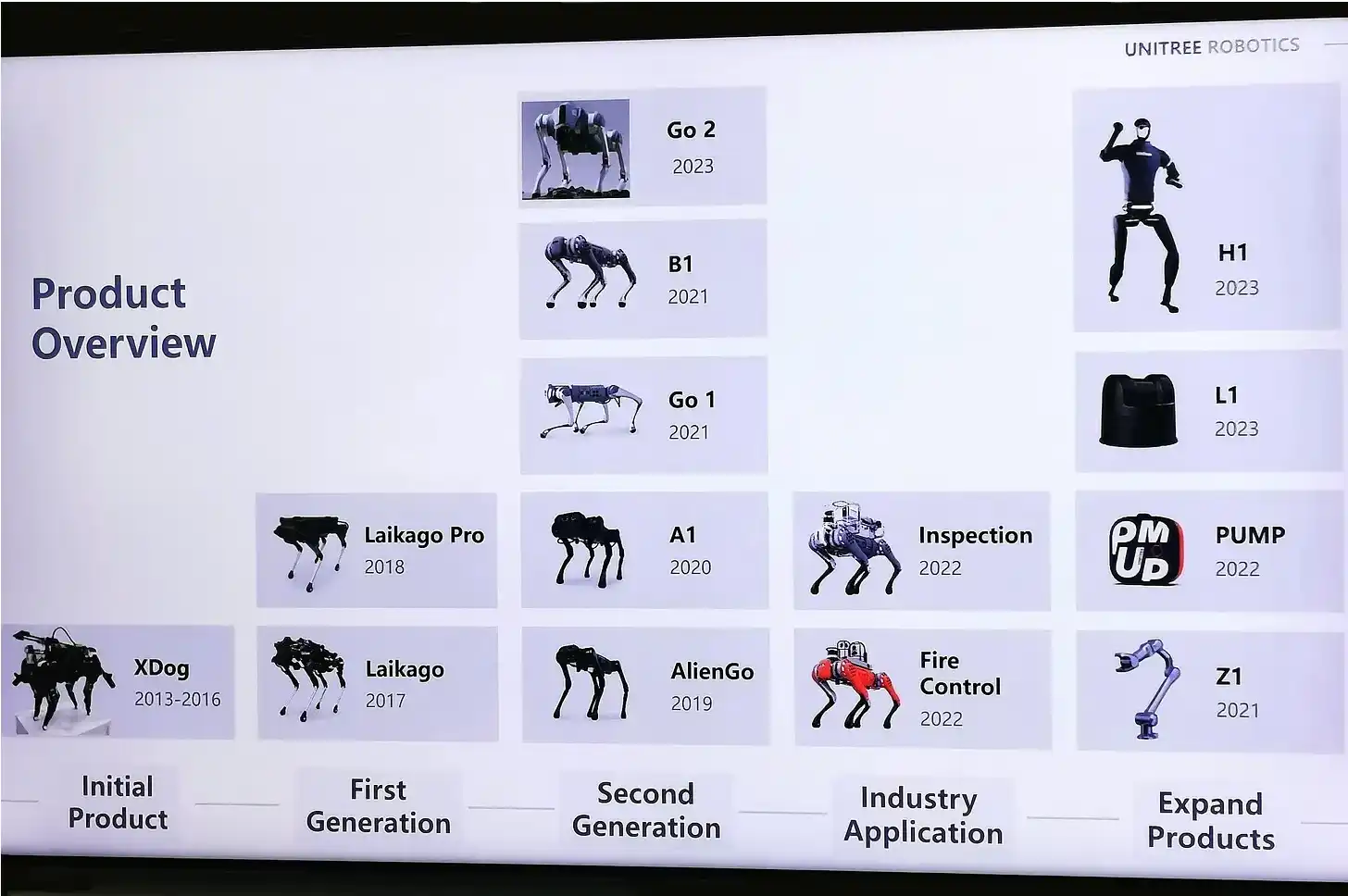
The company primarily sells two major product lines:

  • Quadruped Robots (Robotic Dogs): Go2 (consumer and research grade), B2 (industrial grade), and A2.

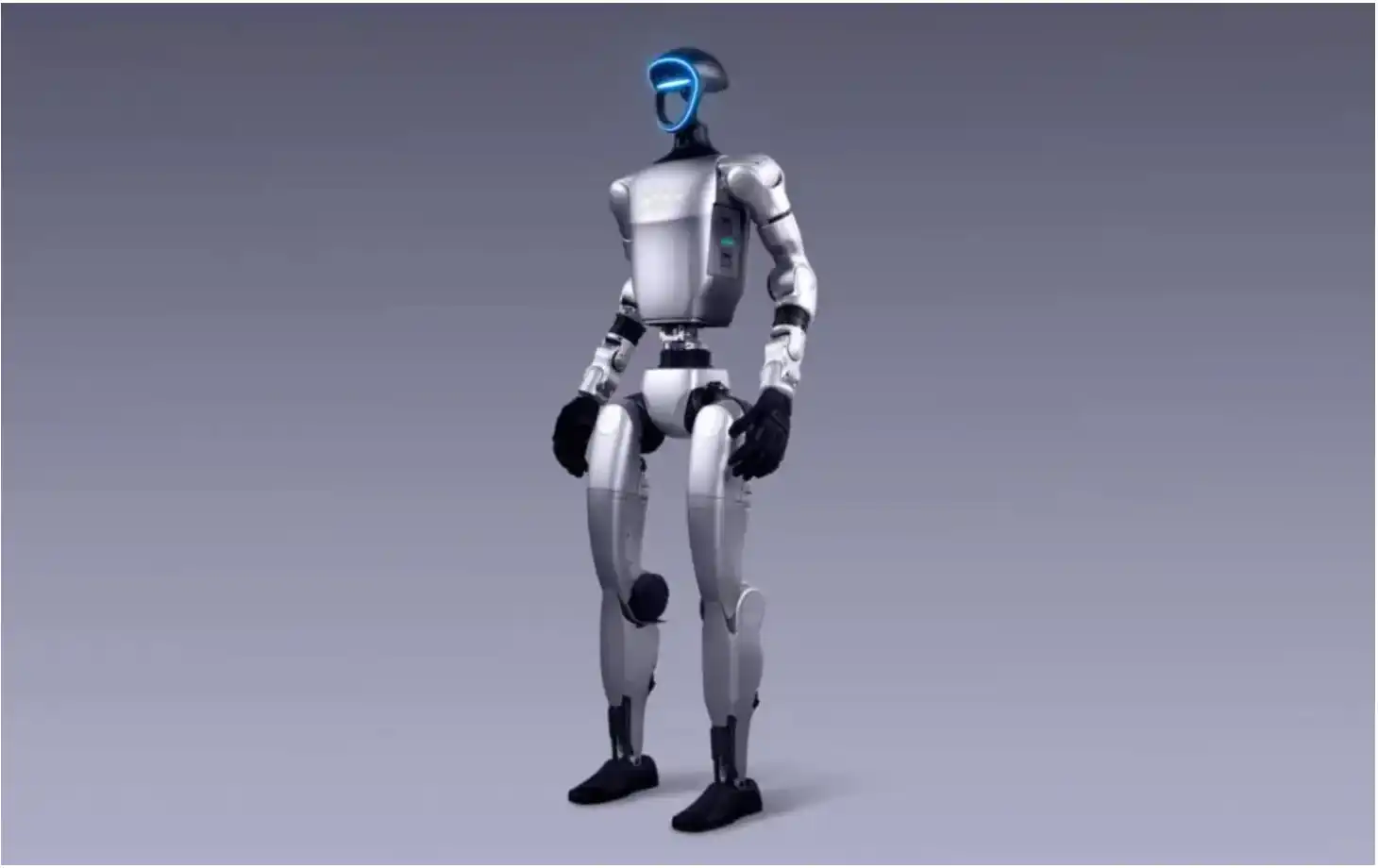
  • Humanoid Robots: H1, H2, G1, and R1. You might have seen G1 in viral videos online; it is 1.32 meters tall and weighs 35 kilograms.

The company began international operations in 2018. Over 35% of its revenue comes from outside China, including a significant customer base in the US academic sector.

Transition to Humanoid Robots

Two years ago, Unitree Robotics was essentially a robotic dog company, mainly selling quadruped robots. In 2023, humanoid robots accounted for only 1.9% of its revenue.

However, by the first three quarters of 2025, humanoid robots already made up over half of its revenue.
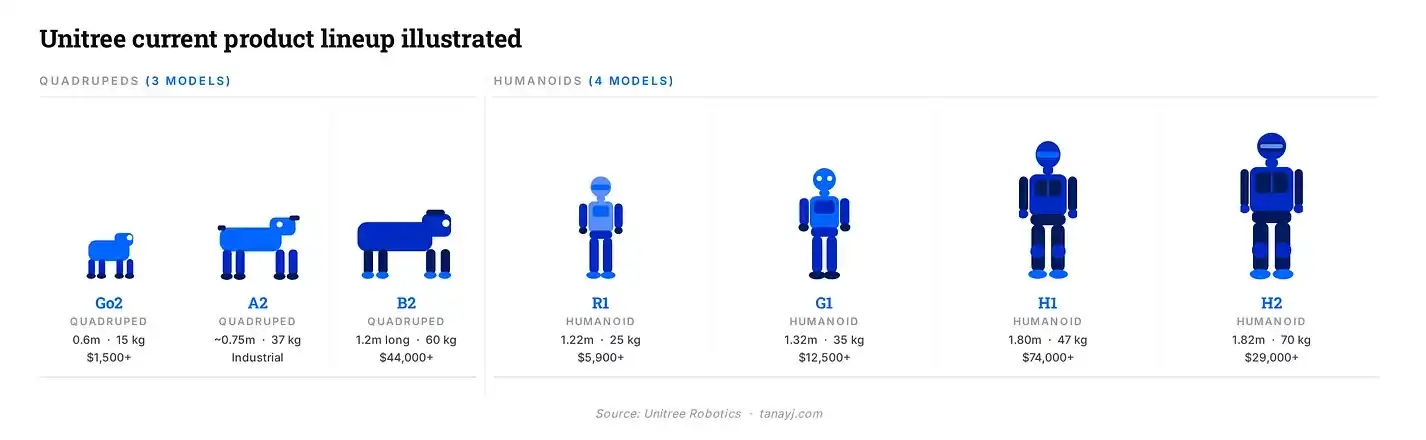
This shift was driven by product-market fit and aggressive marketing. The company's humanoid robots have appeared on CCTV's Spring Festival Gala for two consecutive years. In 2024, Jensen Huang also showcased a Unitree robot at the GTC conference.
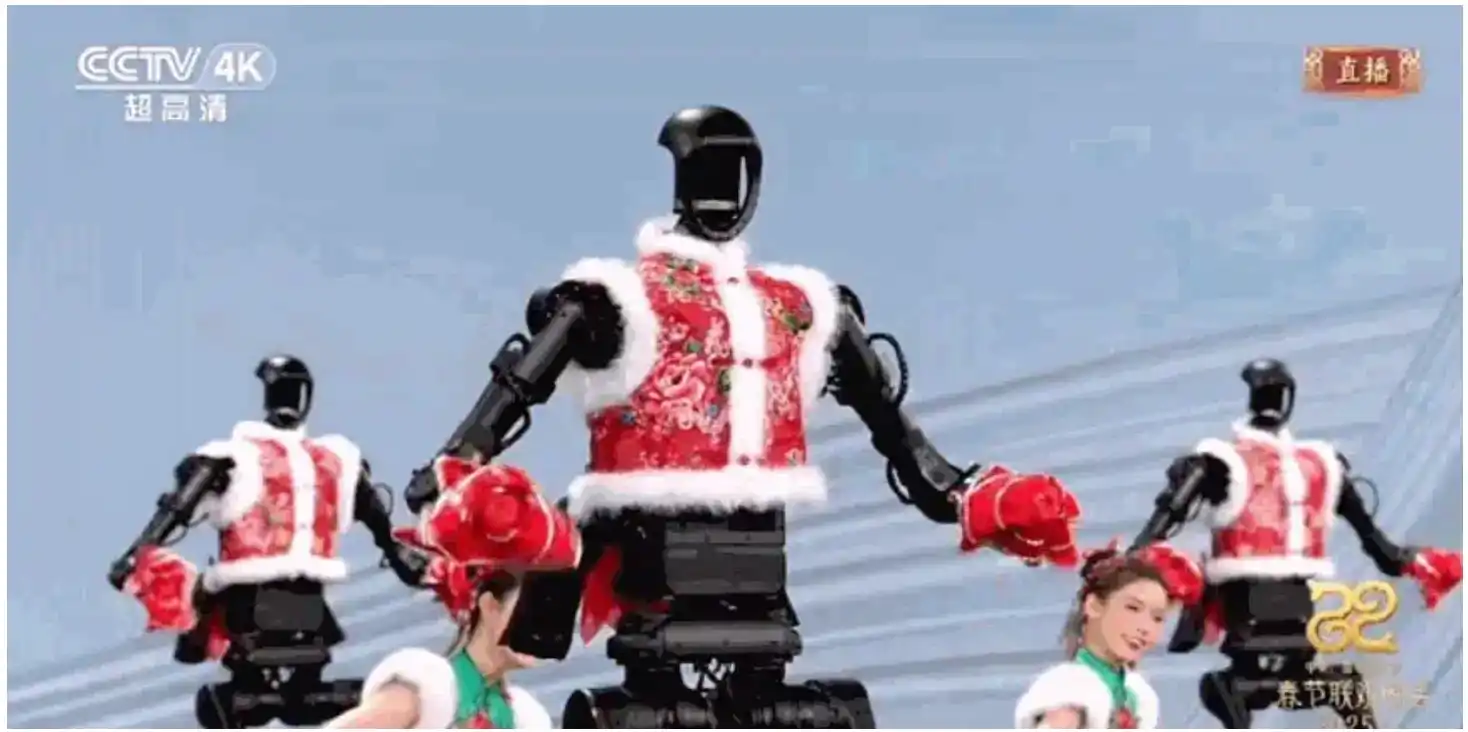
Unitree robots performing on CCTV's Spring Festival Gala

This brand exposure has successfully translated into commercial and research demand—something most Chinese hardware companies have rarely achieved.

Unitree's shipment volume for humanoid robots is particularly impressive compared to other companies. Unitree sold approximately 5,500 humanoid robots in 2025, making it the world's largest seller of bipedal humanoid robots. AGIBot from China follows closely behind. In contrast, well-known US companies like Figure AI and Agility Robotics likely only sold a few hundred units each (or even less).
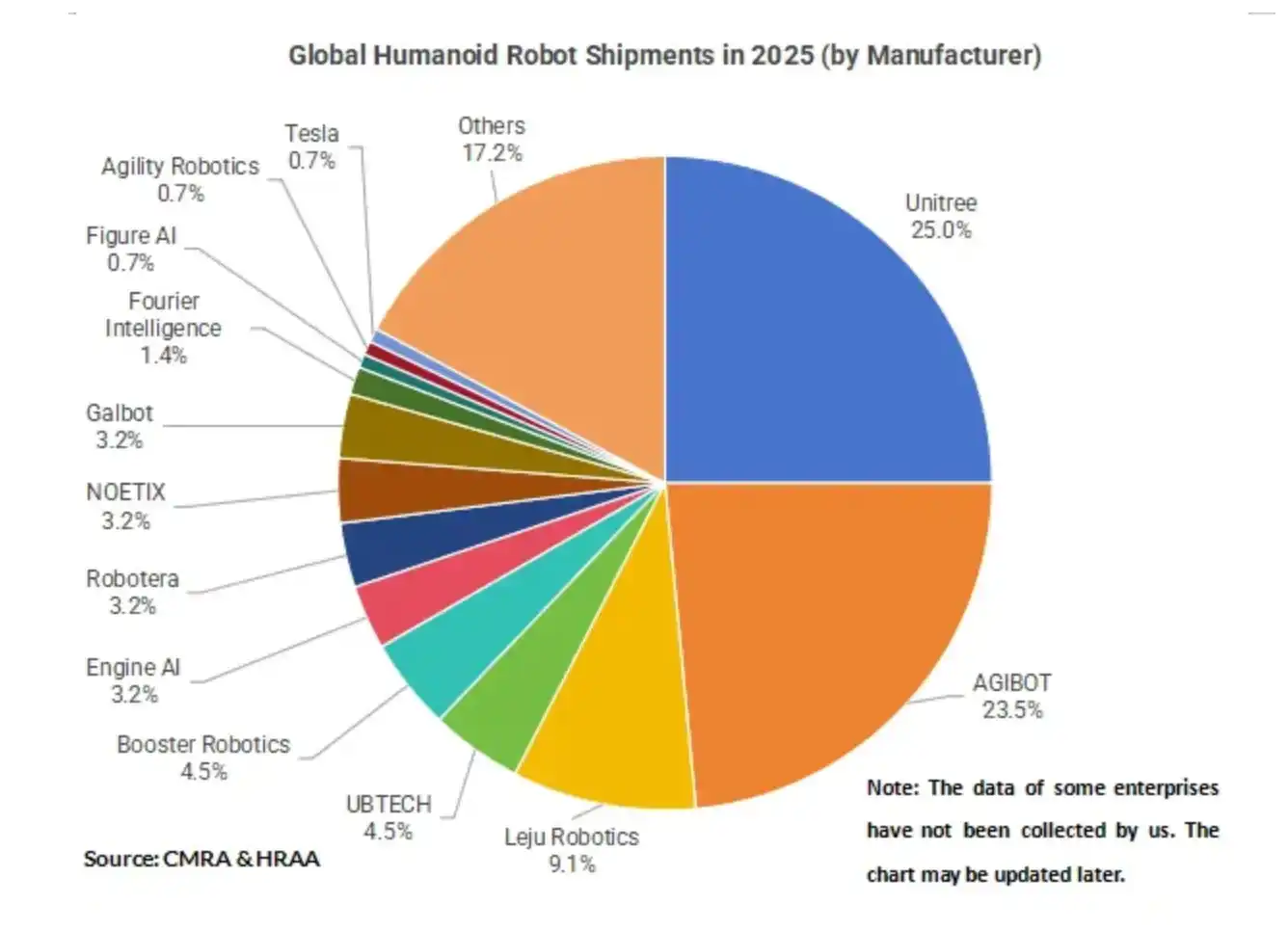
The prospectus sets a 5-year target of producing 75,000 humanoid robots and 115,000 quadruped robots annually. This is about 14 times the 2025 production volume for humanoid robots. This goal is ambitious but also highlights that the industry is still in its very early stages.

Who is Buying Robots

The prospectus categorizes buyers into three groups: Research & Education, Commercial & Consumer, and Industrial Applications.

The stark reality is that most current demand for humanoid robots is concentrated in research and education scenarios.
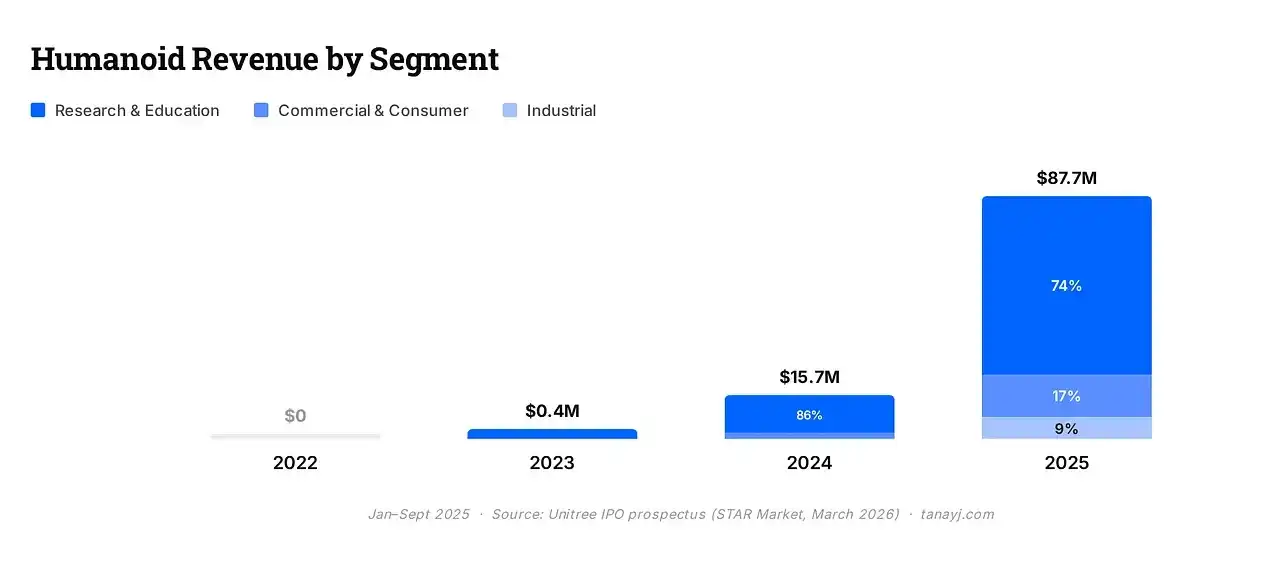
1. Research & Education: Accounts for 74% of humanoid robot revenue/unit sales. Academic buyers have been Unitree's primary customer segment since 2022 and remain the largest source of the company's total revenue.

2. Commercial & Consumer: Accounts for 17% of humanoid robot unit sales. Non-academic consumers buying these robots mostly use them for "display": acting as eye-catching promoters in retail spaces, tourist attractions, performances, and exhibitions. In the first nine months of 2025, consumer-level revenue increased nearly fourfold year-over-year, which sounds impressive but started from a very small base. Today, the most realistic application for a $25,000 humanoid robot seems to be standing at the entrance of a store in Shenzhen to attract customers.

3. Industrial Applications: Accounts for only 9% of humanoid robot unit sales. Unitree also acknowledges that industrial deployment is relatively limited due to immature technology, reflecting the current state of the art. Within this 9%, about 50%-70% is used for scenarios like corporate reception and tour guides. Therefore, comprehensively, the shipment volume of humanoid robots truly used for practical tasks like corporate reception and inspection constitutes only 3%-4%.

The prospects are more promising for quadruped robots (robotic dogs): only about one-third of sales come from research, over 40% from commercial use, and the remainder from industrial use. In this field, production application scenarios are already more mature. Its clients include State Grid, China Southern Power Grid, PetroChina, Sinopec, Baowu Group, and JD.com (JD.com is Unitree's largest customer). These companies use quadruped robots for genuine daily inspections of chemical plants, substations, coal mines, pipelines, etc.
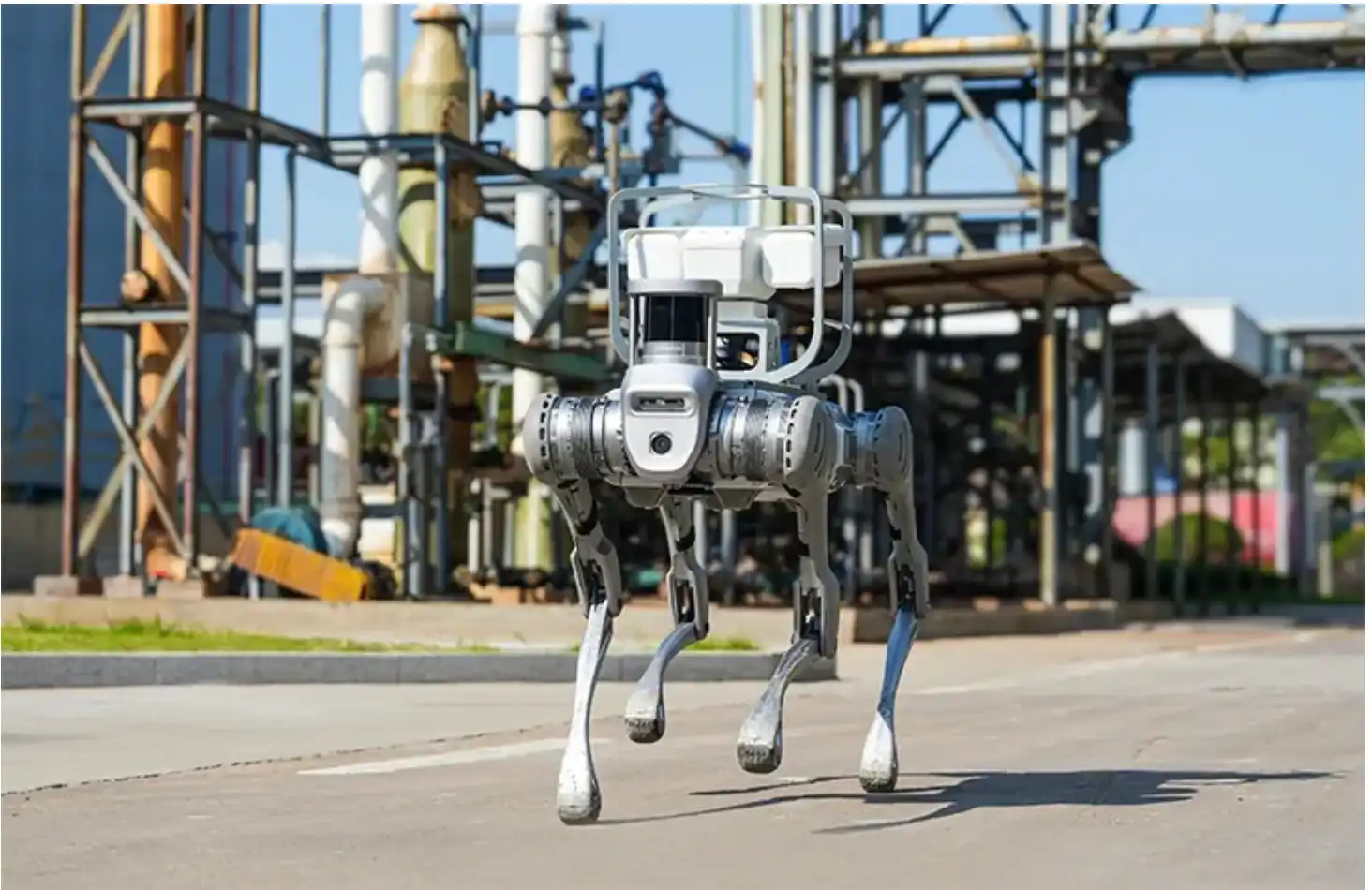
Unitree quadruped robots used for inspection tasks

Vertically Integrated Business Model

One of the unique aspects of Unitree Robotics is its ability to independently design and manufacture most core components: high-torque motors, precision reducers, encoders, joint modules, intelligent controllers, high-precision sensors, dexterous hands, LiDAR, and cameras. According to McKinsey data, actuators (i.e., motors, reducers, and joint systems that drive robot movement) typically account for 40%-60% of the total Bill of Materials (BOM) cost for a humanoid robot.

Most companies in this field rely on external sourcing, while Unitree manufactures in-house. Externally purchased components account for only about 14%-18% of its total cost. It outsources only generic parts like battery cells, flash memory, and differentiated components like core computing boards.

Thanks to this, the unit manufacturing cost for quadruped robots dropped from about $3,300 in 2022 to around $1,800 in mid-2025, a decrease of 46%. During the same period, the cost for humanoid robots also decreased from about $10,800 to $9,200.

Interestingly, as shown in the chart below, although the Average Selling Price (ASP) for both quadruped and humanoid robots has declined year by year, their gross margin has actually increased throughout the period due to their highly vertical integration strategy: soaring from around 45% in 2022-2023 to nearly 60% in 2025.
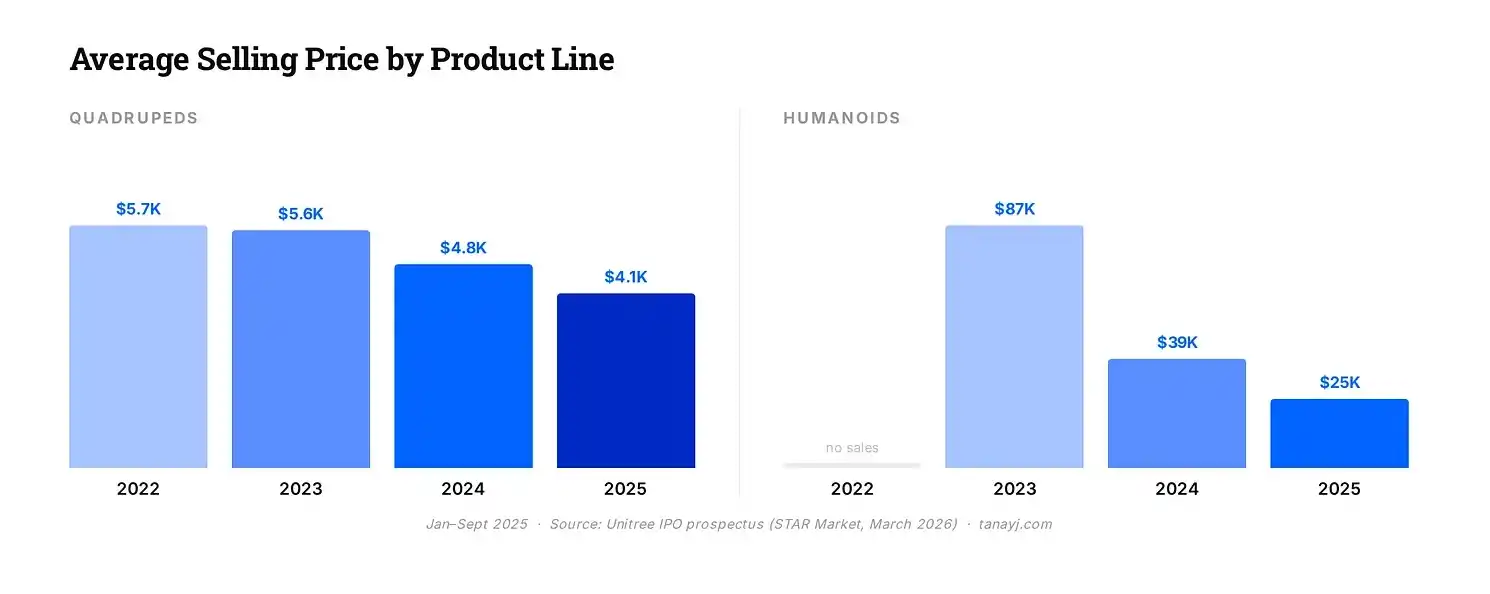
Note: Unitree sold only 5 humanoid robots in 2023, so the ASP for that year is not representative.

Financial Overview

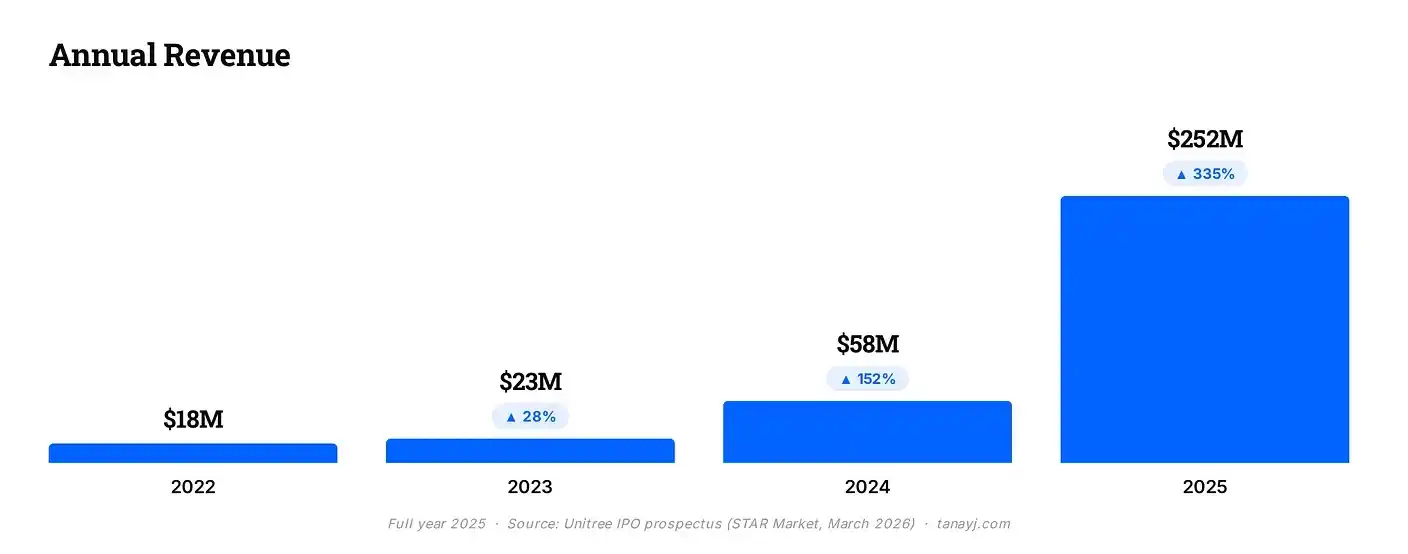
Driven by strong growth in the humanoid robot business, the company's revenue skyrocketed from $58 million in 2024 to approximately $252 million in 2025, an increase of 335%. For most of its history, international sales accounted for over 55% of revenue. In 2025, domestic Chinese market revenue surpassed exports for the first time, although overseas export revenue still doubled year-over-year in absolute terms.
The gross margin is close to 60% and has been increasing in recent years, as detailed below.
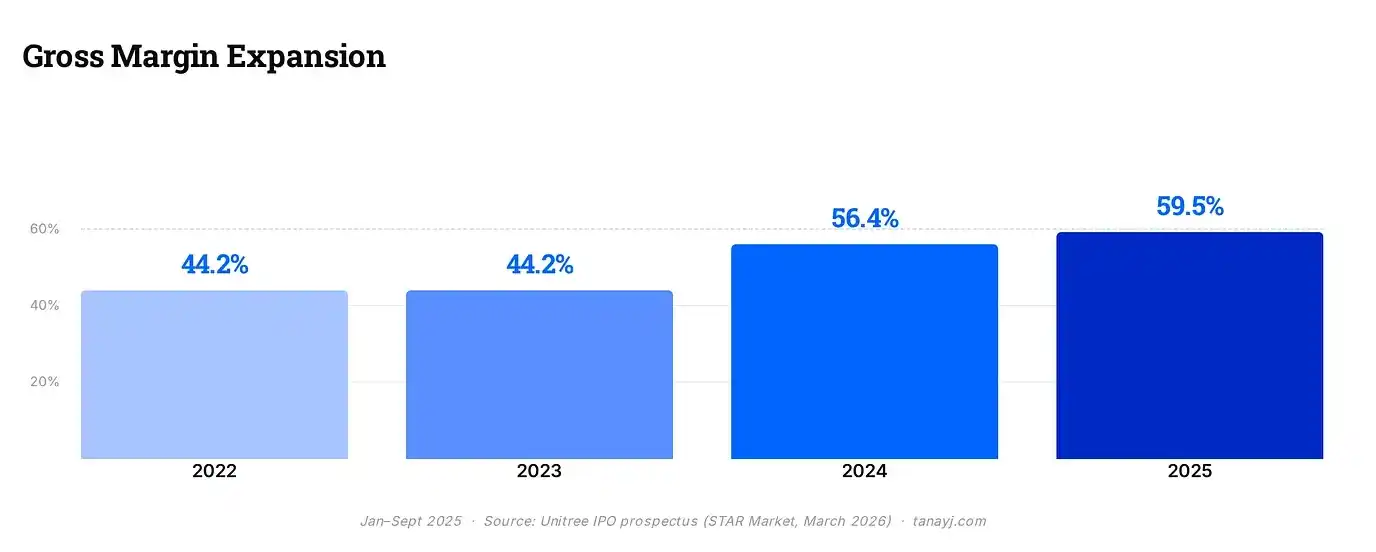
For comparison: most hardware companies have gross margins in the 30%-40% range, while software companies typically achieve 70%-80%. For a company selling physical robots, Unitree's gross margin is quite high, entirely thanks to their vertical integration model and the strong differentiation of their current products.

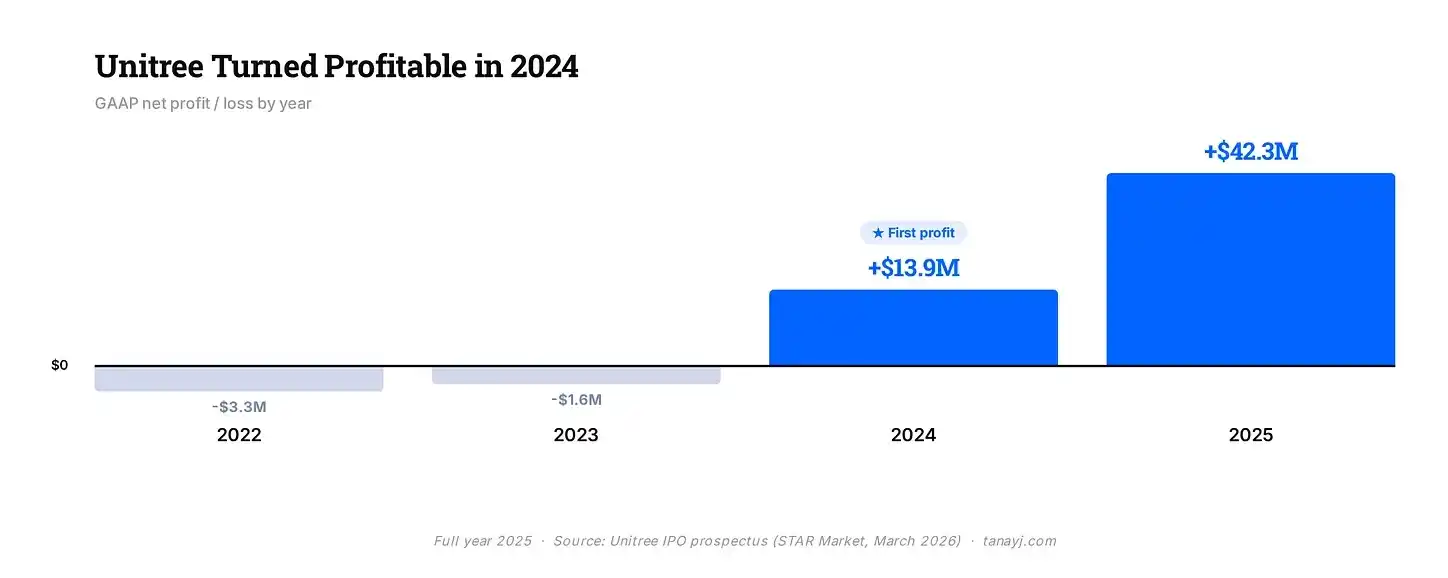
The company became profitable in 2024 (under US GAAP) with a profit margin of about 18%, and close to 35% on an adjusted basis.
Unitree Robotics' target valuation in this IPO is approximately $6 to $7 billion.

Model-Layer Vision

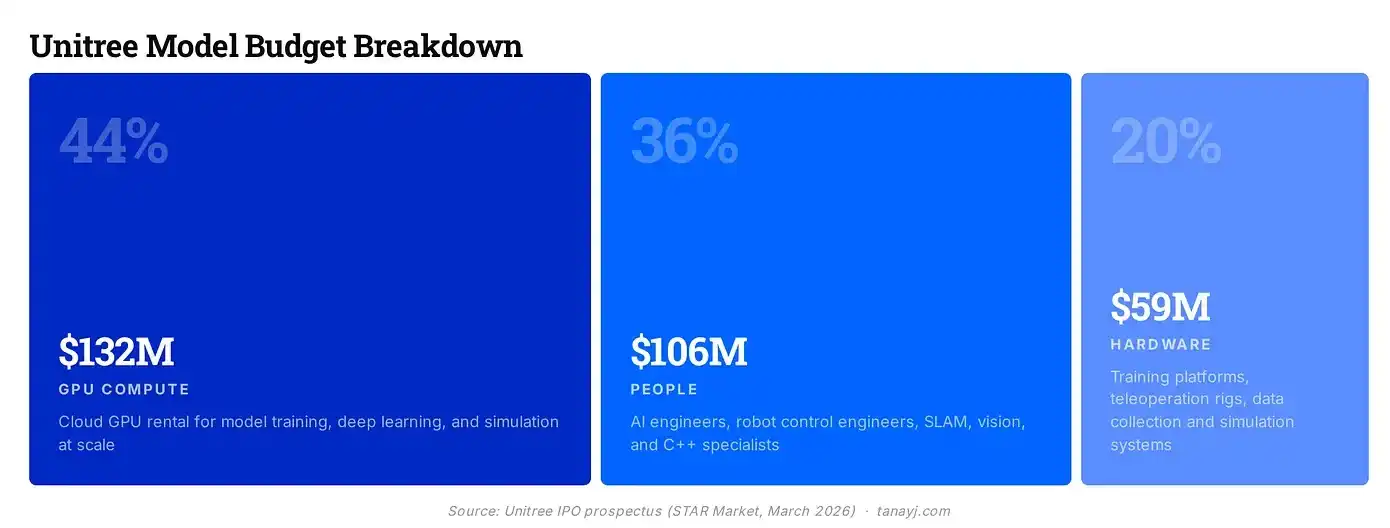
Unitree plans to invest nearly half of its IPO proceeds into software development. Of the $620 million raised, about $300 million is designated for AI model training over the next three years, equating to roughly $100 million per year for developing an "Embodied Large Model."

The prospectus describes two parallel model architectures:

  • The first is the VLA (Vision-Language-Action) Model: This model directly maps visual and language inputs to motion commands, enabling robots to generalize and handle unfamiliar tasks without manually written code instructions.

  • The second is the WMA (World Model + Action) Model: Unitree sees this as the more promising approach. The WMA model can construct internal simulations of physical reality. The robot predicts what will happen before taking action, rather than learning purely through trial and error.

Unitree has already released initial versions of these two models. In September 2025, Unitree open-sourced UnifoLM-WMA-0; in January 2026, it open-sourced UnifoLM-VLA-0.

Unitree also detailed the approximate expenditure breakdown for this model, as shown below:
Unitree's current lead in hardware is undeniable. However, the company recognizes that to maintain a lasting moat in robotics, it may be necessary to also control the model layer: the "brain" system that determines what the robot does and how it moves. Furthermore, its software ambitions serve as a hedge against hardware commoditization (low-price competition). Unitree has built a moat in hardware manufacturing.

However, if actuators and joint modules eventually become standardized components like batteries in electric vehicles, the industry's defenses and competitive barriers will inevitably shift to the model layer.

Conclusion

Unitree Robotics has a profitable hardware business, a solid manufacturing moat, and more humanoid robots than any other company, all at highly competitive prices. However, as reflected in the actual uses of humanoid robots, widespread commercial adoption is still in its infancy. "Display-type" applications dominate consumer demand, while industrial deployment remains relatively limited.

Unitree Robotics offers a glimpse into the current state of the robotics market, and more breakthroughs in models, hardware, and application scenarios are anticipated in the future.

Related Reading: An Overview of Over 30 Humanoid Robot Companies: Who Will Stand Out in 2026?

Domande pertinenti

QWhat are the two main categories of robots sold by Unitree Robotics?

AUnitree Robotics primarily sells two categories of robots: Quadruped Robots (Robotic Dogs) such as Go2, B2, and A2, and Humanoid Robots including H1, H2, G1, and R1.

QHow has Unitree's revenue composition shifted from 2023 to 2025?

AUnitree's revenue has significantly shifted from quadruped robots to humanoid robots. In 2023, humanoid robots accounted for only 1.9% of revenue. By the first three quarters of 2025, they constituted over half of the company's revenue.

QWhat is the largest customer segment for Unitree's humanoid robots currently, and what are the main use cases for other segments?

ACurrently, the largest customer segment for Unitree's humanoid robots is Scientific Research & Education, accounting for 74% of sales. The Commercial & Consumer segment (17% of sales) primarily uses robots for promotional 'display' purposes. The Industrial Application segment (9% of sales) is still limited, with a significant portion within it used for enterprise reception and tour guidance rather than core operational tasks.

QWhat key factor contributes to Unitree's exceptionally high gross margin (nearly 60%) for a hardware company?

AUnitree's high gross margin is primarily attributed to its vertically integrated business model. The company designs and manufactures most of its core components in-house, such as motors, gear reducers, joint modules, and sensors. This level of control reduces reliance on external suppliers and allows for significant cost reductions, which has led to rising margins even as average selling prices have declined.

QWhat is a primary strategic reason for Unitree planning to invest heavily in AI model development with its IPO proceeds?

AA primary strategic reason for Unitree's planned heavy investment in AI model development is to build a lasting competitive moat in the software 'brain' layer. This is intended as a hedge against the potential future commoditization of hardware components. By controlling the embodied AI models that dictate robot actions, Unitree aims to maintain its competitive edge even if hardware like actuators eventually becomes standardized.

Letture associate

From Mining Pool to Mars: Why Is Wang Chun in the SpaceX Cockpit?

Title: From Mining Pool to Mars: Why Wang Chun is in the SpaceX Cockpit? When SpaceX announced that Wang Chun, co-founder of F2Pool, would command the first commercial crewed interplanetary mission, many were shocked. Why would a Bitcoin mining pool founder be on a Mars mission roster? However, understanding Wang Chun's journey over the past decade and the deepening ties between the crypto industry and SpaceX reveals this is not accidental, but an inevitable result of a new era taking shape. Today's Mars plan is no longer just a space engineering project; it is evolving into a civilization-upgrading experiment driven by global tech capital, AI, computing power, energy, and the crypto economy. Wang Chun stands precisely at the intersection of these forces. Part 1: From F2Pool to SpaceX – Wang Chun's Leap F2Pool, founded when Bitcoin was still niche, is one of the earliest large-scale mining pools and once held a significant share of global Bitcoin hash rate. Wang Chun belongs to the first generation of Chinese Bitcoin advocates and infrastructure builders—idealists and engineers who believed in a new value network independent of traditional finance. Miners like him built the hardware, energy, and computing power foundational to decentralized networks. This aligns with the long-term, high-engineering, future-oriented vision required for space civilization. Elon Musk’s space endeavors value such long-term builders over mere capital players, which explains Wang Chun's entry into the SpaceX ecosystem. Part 2: Why Crypto and SpaceX Are Growing Closer The core of global tech competition is shifting from internet applications to next-generation infrastructure. Both crypto and SpaceX are part of this. SpaceX's goal is to drastically reduce space access costs. If successful, it could enable orbital servers, space-based energy, global satellite internet, and Martian bases. These new frontiers will require new payment systems, value networks, and global financial architectures. Cryptocurrencies, inherently global and trustless, are poised to become key to off-planet economies. Moreover, crypto and SpaceX share a high-risk, long-termist ethos—believing in ambitious, world-changing goals despite early skepticism. Part 3: Human Spaceflight Enters the Commercial Era Space exploration, long dominated by state actors, is now being transformed by commercial entities like SpaceX. Wang Chun's involvement signifies that future deep-space participants may include not just career astronauts, but also entrepreneurs, engineers, and AI researchers. This mirrors the Age of Exploration, where commercial capital eventually drove global expansion. Wang Chun has emphasized that Mars colonization must not be delayed for future generations, countering a potential over-focus on nearer-term, commercial lunar projects. His presence symbolizes how new capital, technical communities, and idealists from the crypto world are now entering the interstellar age. In summary, the true significance is not an individual's journey to Mars, but the shift in the driving force of human civilization expansion from state machinery to tech companies, AI systems, and global technology capital. Wang Chun's path—from mining pool to Mars, from the Bitcoin network to starships—may be a preview of technological civilization's evolution in the coming decades.

marsbit2 h fa

From Mining Pool to Mars: Why Is Wang Chun in the SpaceX Cockpit?

marsbit2 h fa

Trading

Spot
Futures

Articoli Popolari

Cosa è $S$

Comprendere SPERO: Una Panoramica Completa Introduzione a SPERO Mentre il panorama dell'innovazione continua a evolversi, l'emergere delle tecnologie web3 e dei progetti di criptovaluta gioca un ruolo fondamentale nel plasmare il futuro digitale. Un progetto che ha attirato l'attenzione in questo campo dinamico è SPERO, denotato come SPERO,$$s$. Questo articolo mira a raccogliere e presentare informazioni dettagliate su SPERO, per aiutare gli appassionati e gli investitori a comprendere le sue basi, obiettivi e innovazioni nei domini web3 e crypto. Che cos'è SPERO,$$s$? SPERO,$$s$ è un progetto unico all'interno dello spazio crypto che cerca di sfruttare i principi della decentralizzazione e della tecnologia blockchain per creare un ecosistema che promuove l'impegno, l'utilità e l'inclusione finanziaria. Il progetto è progettato per facilitare interazioni peer-to-peer in modi nuovi, fornendo agli utenti soluzioni e servizi finanziari innovativi. Al suo interno, SPERO,$$s$ mira a responsabilizzare gli individui fornendo strumenti e piattaforme che migliorano l'esperienza dell'utente nello spazio delle criptovalute. Questo include la possibilità di metodi di transazione più flessibili, la promozione di iniziative guidate dalla comunità e la creazione di percorsi per opportunità finanziarie attraverso applicazioni decentralizzate (dApps). La visione sottostante di SPERO,$$s$ ruota attorno all'inclusività, cercando di colmare le lacune all'interno della finanza tradizionale mentre sfrutta i vantaggi della tecnologia blockchain. Chi è il Creatore di SPERO,$$s$? L'identità del creatore di SPERO,$$s$ rimane piuttosto oscura, poiché ci sono risorse pubblicamente disponibili limitate che forniscono informazioni dettagliate sul suo fondatore o fondatori. Questa mancanza di trasparenza può derivare dall'impegno del progetto per la decentralizzazione—un ethos che molti progetti web3 condividono, dando priorità ai contributi collettivi rispetto al riconoscimento individuale. Centrando le discussioni attorno alla comunità e ai suoi obiettivi collettivi, SPERO,$$s$ incarna l'essenza dell'empowerment senza mettere in evidenza individui specifici. Pertanto, comprendere l'etica e la missione di SPERO rimane più importante che identificare un creatore singolo. Chi sono gli Investitori di SPERO,$$s$? SPERO,$$s$ è supportato da una varietà di investitori che vanno dai capitalisti di rischio agli investitori angelici dedicati a promuovere l'innovazione nel settore crypto. Il focus di questi investitori generalmente si allinea con la missione di SPERO—dando priorità a progetti che promettono avanzamenti tecnologici sociali, inclusività finanziaria e governance decentralizzata. Queste fondazioni di investitori sono tipicamente interessate a progetti che non solo offrono prodotti innovativi, ma contribuiscono anche positivamente alla comunità blockchain e ai suoi ecosistemi. Il supporto di questi investitori rafforza SPERO,$$s$ come un concorrente degno di nota nel dominio in rapida evoluzione dei progetti crypto. Come Funziona SPERO,$$s$? SPERO,$$s$ impiega un framework multifunzionale che lo distingue dai progetti di criptovaluta convenzionali. Ecco alcune delle caratteristiche chiave che sottolineano la sua unicità e innovazione: Governance Decentralizzata: SPERO,$$s$ integra modelli di governance decentralizzati, responsabilizzando gli utenti a partecipare attivamente ai processi decisionali riguardanti il futuro del progetto. Questo approccio favorisce un senso di proprietà e responsabilità tra i membri della comunità. Utilità del Token: SPERO,$$s$ utilizza il proprio token di criptovaluta, progettato per servire varie funzioni all'interno dell'ecosistema. Questi token abilitano transazioni, premi e la facilitazione dei servizi offerti sulla piattaforma, migliorando l'impegno e l'utilità complessivi. Architettura Stratificata: L'architettura tecnica di SPERO,$$s$ supporta la modularità e la scalabilità, consentendo un'integrazione fluida di funzionalità e applicazioni aggiuntive man mano che il progetto evolve. Questa adattabilità è fondamentale per mantenere la rilevanza nel panorama crypto in continua evoluzione. Coinvolgimento della Comunità: Il progetto enfatizza iniziative guidate dalla comunità, impiegando meccanismi che incentivano la collaborazione e il feedback. Nutrendo una comunità forte, SPERO,$$s$ può affrontare meglio le esigenze degli utenti e adattarsi alle tendenze di mercato. Focus sull'Inclusione: Offrendo basse commissioni di transazione e interfacce user-friendly, SPERO,$$s$ mira ad attrarre una base utenti diversificata, inclusi individui che potrebbero non aver precedentemente interagito nello spazio crypto. Questo impegno per l'inclusione si allinea con la sua missione generale di empowerment attraverso l'accessibilità. Cronologia di SPERO,$$s$ Comprendere la storia di un progetto fornisce preziose intuizioni sulla sua traiettoria di sviluppo e sui traguardi. Di seguito è riportata una cronologia suggerita che mappa eventi significativi nell'evoluzione di SPERO,$$s$: Fase di Concettualizzazione e Ideazione: Le idee iniziali che formano la base di SPERO,$$s$ sono state concepite, allineandosi strettamente con i principi di decentralizzazione e focus sulla comunità all'interno dell'industria blockchain. Lancio del Whitepaper del Progetto: Dopo la fase concettuale, è stato rilasciato un whitepaper completo che dettaglia la visione, gli obiettivi e l'infrastruttura tecnologica di SPERO,$$s$ per suscitare interesse e feedback dalla comunità. Costruzione della Comunità e Prime Interazioni: Sono stati effettuati sforzi attivi di outreach per costruire una comunità di early adopters e potenziali investitori, facilitando discussioni attorno agli obiettivi del progetto e ottenendo supporto. Evento di Generazione del Token: SPERO,$$s$ ha condotto un evento di generazione del token (TGE) per distribuire i propri token nativi ai primi sostenitori e stabilire una liquidità iniziale all'interno dell'ecosistema. Lancio della Prima dApp: La prima applicazione decentralizzata (dApp) associata a SPERO,$$s$ è stata attivata, consentendo agli utenti di interagire con le funzionalità principali della piattaforma. Sviluppo Continuo e Partnership: Aggiornamenti e miglioramenti continui alle offerte del progetto, inclusi partnership strategiche con altri attori nello spazio blockchain, hanno plasmato SPERO,$$s$ in un concorrente competitivo e in evoluzione nel mercato crypto. Conclusione SPERO,$$s$ rappresenta una testimonianza del potenziale del web3 e delle criptovalute di rivoluzionare i sistemi finanziari e responsabilizzare gli individui. Con un impegno per la governance decentralizzata, il coinvolgimento della comunità e funzionalità progettate in modo innovativo, apre la strada verso un panorama finanziario più inclusivo. Come per qualsiasi investimento nello spazio crypto in rapida evoluzione, si incoraggiano potenziali investitori e utenti a ricercare approfonditamente e a impegnarsi in modo riflessivo con gli sviluppi in corso all'interno di SPERO,$$s$. Il progetto mostra lo spirito innovativo dell'industria crypto, invitando a ulteriori esplorazioni delle sue innumerevoli possibilità. Mentre il percorso di SPERO,$$s$ è ancora in fase di sviluppo, i suoi principi fondamentali potrebbero effettivamente influenzare il futuro di come interagiamo con la tecnologia, la finanza e tra di noi in ecosistemi digitali interconnessi.

75 Totale visualizzazioniPubblicato il 2024.12.17Aggiornato il 2024.12.17

Cosa è $S$

Cosa è AGENT S

Agent S: Il Futuro dell'Interazione Autonoma in Web3 Introduzione Nel panorama in continua evoluzione di Web3 e criptovalute, le innovazioni stanno costantemente ridefinendo il modo in cui gli individui interagiscono con le piattaforme digitali. Uno di questi progetti pionieristici, Agent S, promette di rivoluzionare l'interazione uomo-computer attraverso il suo framework agentico aperto. Aprendo la strada a interazioni autonome, Agent S mira a semplificare compiti complessi, offrendo applicazioni trasformative nell'intelligenza artificiale (AI). Questa esplorazione dettagliata approfondirà le complessità del progetto, le sue caratteristiche uniche e le implicazioni per il dominio delle criptovalute. Cos'è Agent S? Agent S si presenta come un innovativo framework agentico aperto, progettato specificamente per affrontare tre sfide fondamentali nell'automazione dei compiti informatici: Acquisizione di Conoscenze Specifiche del Dominio: Il framework apprende in modo intelligente da varie fonti di conoscenza esterne ed esperienze interne. Questo approccio duale gli consente di costruire un ricco repository di conoscenze specifiche del dominio, migliorando le sue prestazioni nell'esecuzione dei compiti. Pianificazione su Lungo Orizzonte di Compiti: Agent S impiega una pianificazione gerarchica potenziata dall'esperienza, un approccio strategico che facilita la suddivisione e l'esecuzione efficiente di compiti complessi. Questa caratteristica migliora significativamente la sua capacità di gestire più sottocompiti in modo efficiente ed efficace. Gestione di Interfacce Dinamiche e Non Uniformi: Il progetto introduce l'Interfaccia Agente-Computer (ACI), una soluzione innovativa che migliora l'interazione tra agenti e utenti. Utilizzando Modelli Linguistici Multimodali di Grandi Dimensioni (MLLM), Agent S può navigare e manipolare senza sforzo diverse interfacce grafiche utente. Attraverso queste caratteristiche pionieristiche, Agent S fornisce un framework robusto che affronta le complessità coinvolte nell'automazione dell'interazione umana con le macchine, preparando il terreno per innumerevoli applicazioni nell'AI e oltre. Chi è il Creatore di Agent S? Sebbene il concetto di Agent S sia fondamentalmente innovativo, informazioni specifiche sul suo creatore rimangono elusive. Il creatore è attualmente sconosciuto, il che evidenzia sia la fase embrionale del progetto sia la scelta strategica di mantenere i membri fondatori sotto anonimato. Indipendentemente dall'anonimato, l'attenzione rimane sulle capacità e sul potenziale del framework. Chi sono gli Investitori di Agent S? Poiché Agent S è relativamente nuovo nell'ecosistema crittografico, informazioni dettagliate riguardanti i suoi investitori e sostenitori finanziari non sono documentate esplicitamente. La mancanza di approfondimenti pubblicamente disponibili sulle fondazioni di investimento o sulle organizzazioni che supportano il progetto solleva interrogativi sulla sua struttura di finanziamento e sulla roadmap di sviluppo. Comprendere il supporto è cruciale per valutare la sostenibilità del progetto e il suo potenziale impatto sul mercato. Come Funziona Agent S? Al centro di Agent S si trova una tecnologia all'avanguardia che gli consente di funzionare efficacemente in contesti diversi. Il suo modello operativo è costruito attorno a diverse caratteristiche chiave: Interazione Uomo-Computer Simile a Quella Umana: Il framework offre una pianificazione AI avanzata, cercando di rendere le interazioni con i computer più intuitive. Mimando il comportamento umano nell'esecuzione dei compiti, promette di elevare le esperienze degli utenti. Memoria Narrativa: Utilizzata per sfruttare esperienze di alto livello, Agent S utilizza la memoria narrativa per tenere traccia delle storie dei compiti, migliorando così i suoi processi decisionali. Memoria Episodica: Questa caratteristica fornisce agli utenti una guida passo-passo, consentendo al framework di offrire supporto contestuale mentre i compiti si sviluppano. Supporto per OpenACI: Con la capacità di funzionare localmente, Agent S consente agli utenti di mantenere il controllo sulle proprie interazioni e flussi di lavoro, allineandosi con l'etica decentralizzata di Web3. Facile Integrazione con API Esterne: La sua versatilità e compatibilità con varie piattaforme AI garantiscono che Agent S possa adattarsi senza problemi agli ecosistemi tecnologici esistenti, rendendolo una scelta attraente per sviluppatori e organizzazioni. Queste funzionalità contribuiscono collettivamente alla posizione unica di Agent S all'interno dello spazio crittografico, poiché automatizza compiti complessi e multi-fase con un intervento umano minimo. Man mano che il progetto evolve, le sue potenziali applicazioni in Web3 potrebbero ridefinire il modo in cui si svolgono le interazioni digitali. Cronologia di Agent S Lo sviluppo e le tappe di Agent S possono essere riassunti in una cronologia che evidenzia i suoi eventi significativi: 27 Settembre 2024: Il concetto di Agent S è stato lanciato in un documento di ricerca completo intitolato “Un Framework Agentico Aperto che Usa i Computer Come un Umano”, mostrando le basi per il progetto. 10 Ottobre 2024: Il documento di ricerca è stato reso pubblicamente disponibile su arXiv, offrendo un'esplorazione approfondita del framework e della sua valutazione delle prestazioni basata sul benchmark OSWorld. 12 Ottobre 2024: È stata rilasciata una presentazione video, fornendo un'idea visiva delle capacità e delle caratteristiche di Agent S, coinvolgendo ulteriormente potenziali utenti e investitori. Questi indicatori nella cronologia non solo illustrano i progressi di Agent S, ma indicano anche il suo impegno per la trasparenza e il coinvolgimento della comunità. Punti Chiave su Agent S Man mano che il framework Agent S continua a evolversi, diversi attributi chiave si distinguono, sottolineando la sua natura innovativa e il potenziale: Framework Innovativo: Progettato per fornire un uso intuitivo dei computer simile all'interazione umana, Agent S porta un approccio nuovo all'automazione dei compiti. Interazione Autonoma: La capacità di interagire autonomamente con i computer attraverso GUI segna un passo avanti verso soluzioni informatiche più intelligenti ed efficienti. Automazione di Compiti Complessi: Con la sua metodologia robusta, può automatizzare compiti complessi e multi-fase, rendendo i processi più veloci e meno soggetti a errori. Miglioramento Continuo: I meccanismi di apprendimento consentono ad Agent S di migliorare dalle esperienze passate, migliorando continuamente le sue prestazioni e la sua efficacia. Versatilità: La sua adattabilità attraverso diversi ambienti operativi come OSWorld e WindowsAgentArena garantisce che possa servire un'ampia gamma di applicazioni. Man mano che Agent S si posiziona nel panorama di Web3 e delle criptovalute, il suo potenziale per migliorare le capacità di interazione e automatizzare i processi segna un significativo avanzamento nelle tecnologie AI. Attraverso il suo framework innovativo, Agent S esemplifica il futuro delle interazioni digitali, promettendo un'esperienza più fluida ed efficiente per gli utenti in vari settori. Conclusione Agent S rappresenta un audace passo avanti nell'unione tra AI e Web3, con la capacità di ridefinire il modo in cui interagiamo con la tecnologia. Sebbene sia ancora nelle sue fasi iniziali, le possibilità per la sua applicazione sono vaste e coinvolgenti. Attraverso il suo framework completo che affronta sfide critiche, Agent S mira a portare le interazioni autonome al centro dell'esperienza digitale. Man mano che ci addentriamo nei regni delle criptovalute e della decentralizzazione, progetti come Agent S giocheranno senza dubbio un ruolo cruciale nel plasmare il futuro della tecnologia e della collaborazione uomo-computer.

525 Totale visualizzazioniPubblicato il 2025.01.14Aggiornato il 2025.01.14

Cosa è AGENT S

Come comprare S

Benvenuto in HTX.com! Abbiamo reso l'acquisto di Sonic (S) semplice e conveniente. Segui la nostra guida passo passo per intraprendere il tuo viaggio nel mondo delle criptovalute.Step 1: Crea il tuo Account HTXUsa la tua email o numero di telefono per registrarti il tuo account gratuito su HTX. Vivi un'esperienza facile e sblocca tutte le funzionalità,Crea il mio accountStep 2: Vai in Acquista crypto e seleziona il tuo metodo di pagamentoCarta di credito/debito: utilizza la tua Visa o Mastercard per acquistare immediatamente SonicS.Bilancio: Usa i fondi dal bilancio del tuo account HTX per fare trading senza problemi.Terze parti: abbiamo aggiunto metodi di pagamento molto utilizzati come Google Pay e Apple Pay per maggiore comodità.P2P: Fai trading direttamente con altri utenti HTX.Over-the-Counter (OTC): Offriamo servizi su misura e tassi di cambio competitivi per i trader.Step 3: Conserva Sonic (S)Dopo aver acquistato Sonic (S), conserva nel tuo account HTX. In alternativa, puoi inviare tramite trasferimento blockchain o scambiare per altre criptovalute.Step 4: Scambia Sonic (S)Scambia facilmente Sonic (S) nel mercato spot di HTX. Accedi al tuo account, seleziona la tua coppia di trading, esegui le tue operazioni e monitora in tempo reale. Offriamo un'esperienza user-friendly sia per chi ha appena iniziato che per i trader più esperti.

936 Totale visualizzazioniPubblicato il 2025.01.15Aggiornato il 2025.03.21

Come comprare S

Discussioni

Benvenuto nella Community HTX. Qui puoi rimanere informato sugli ultimi sviluppi della piattaforma e accedere ad approfondimenti esperti sul mercato. Le opinioni degli utenti sul prezzo di S S sono presentate come di seguito.

活动图片