IREN's AI Revenue Exceeds Mining Income for the First Time

cryptonews.ruPubblicato 2026-08-28Pubblicato ultima volta 2026-08-28

Introduzione

For the quarter ending June 30, 2026, IREN's revenue from AI cloud services, at $70.5 million, surpassed its Bitcoin mining revenue of $66.7 million for the first time. This shift contributed to a net loss of $684 million, partly due to $450.4 million in asset impairments from repurposing mining equipment for AI. Total quarterly revenue fell 5% to $137.2 million. While AI revenue doubled, Bitcoin mining income fell by approximately 40%. The company's adjusted EBITDA also dropped 68% to $19.2 million. Other miners showed similar diversification trends. TeraWulf reported that 71% of its $44.8 million Q2 revenue came from High-Performance Computing (HPC) leasing, surpassing its $12.8 million from digital assets. Despite this, it posted a negative adjusted EBITDA and a significant net loss. Cipher Mining's revenue remained entirely from Bitcoin mining at $24.8 million, while Riot Platforms generated $174.2 million, with data centers contributing 13% of that total. The trend highlights a strategic pivot by public Bitcoin miners towards AI infrastructure, driven by rising capital expenditures and demand for energy-secure sites for high-power computing.

For the fourth quarter of the 2026 fiscal year, which ended on June 30, IREN's revenue from cloud AI services exceeded its Bitcoin mining income for the first time — $70.5 million compared to $66.7 million. This is stated in the company's announcement.

Amid the transition, IREN reported a net loss of $684 million. The figure was impacted by a non-cash impairment of assets amounting to $450.4 million, primarily related to the decommissioning of mining equipment during the repurposing of sites for AI Cloud.

The company's total quarterly revenue was $137.2 million — approximately 5% less than the previous period. Revenue from cloud AI services doubled from $33.6 million, while revenue from mining the leading cryptocurrency decreased by about 40% — from $111.2 million.

Adjusted EBITDA fell by 68% — from $59.5 million to $19.2 million. IREN explained the decline by increased personnel expenses and investments in the platform ahead of the anticipated scaling of AI Cloud.

After the publication of the report, the company's stock declined in pre-market trading.
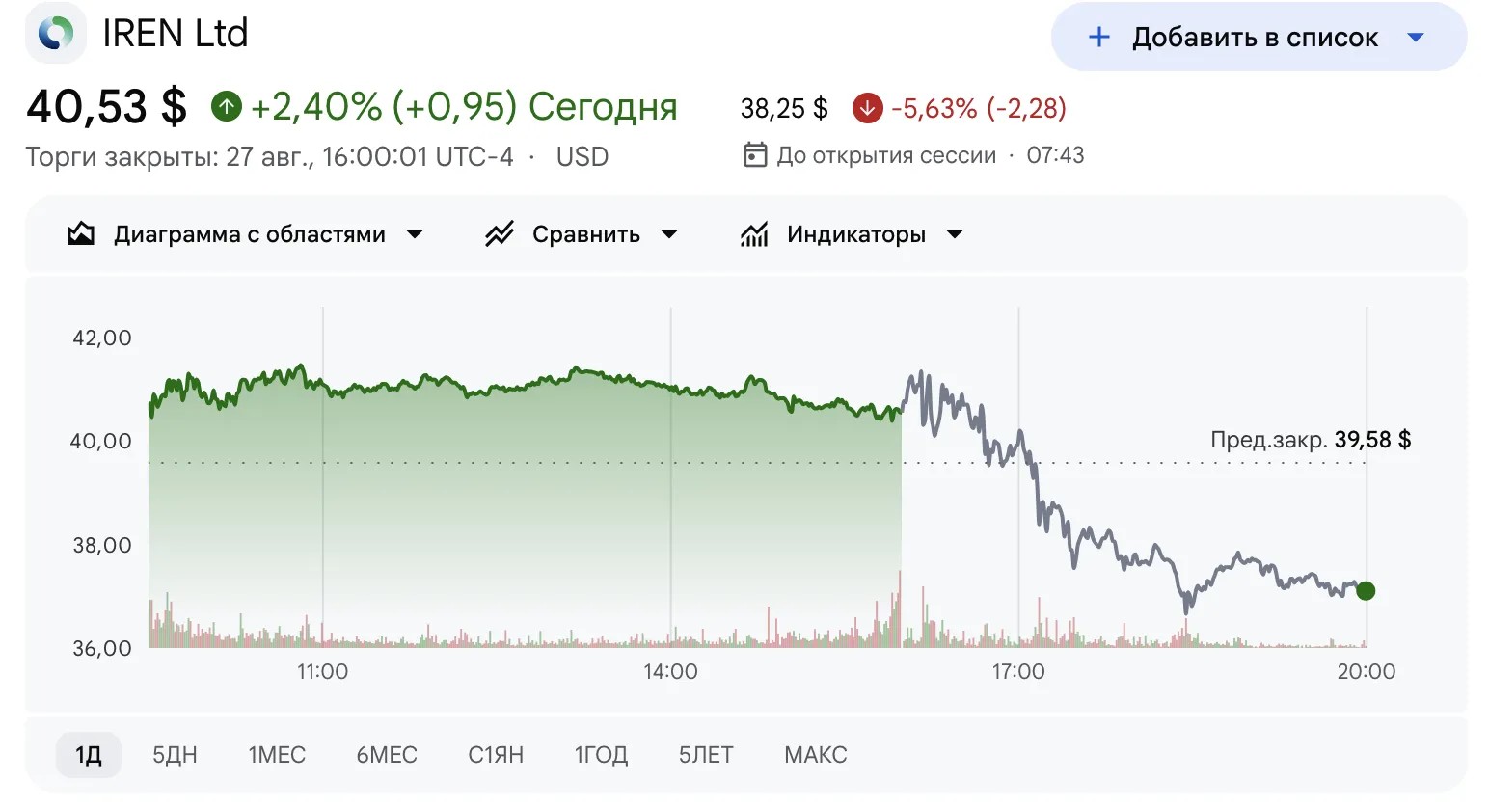
Source: Google Finance.

TeraWulf's Performance

TeraWulf generated $44.8 million in revenue in the second quarter, of which $31.9 million (about 71%) came from leasing capacity for high-performance computing (HPC). Digital assets accounted for $12.8 million; a year earlier, mining revenue reached $47.6 million.

As of the end of June, the Lake Mariner campus had 81 MW of critical IT capacity already generating revenue. Following the commissioning of the next building on July 6, this figure increased to 102 MW.

However, HPC becoming the primary source of income has not yet made TeraWulf profitable. Adjusted EBITDA was −$18.3 million compared to $14.5 million a year earlier.

The net loss attributable to TeraWulf reached $939.9 million. The main contribution came from a non-cash change in the fair value of warrants amounting to $755.7 million. An additional $56.4 million was allocated to interest expenses.

Reports from Cipher and Riot

Cipher Digital's new infrastructure did not yet generate revenue in the second quarter. The company reported $24.8 million in revenue — the entire amount came from Bitcoin mining.

Adjusted EBITDA was −$30 million, and the net loss was $267.5 million. The latter was impacted by the revaluation of warrant liabilities of $150.5 million and interest expenses of $66.7 million.

The company began handing over the first capacities of the Black Pearl data center to the customer only in August. The accrual of lease payments also started then.

Riot Platforms has already started reflecting data center revenue, but it is still significantly lower than mining income. In the second quarter, the company's total figure was $174.2 million:

  • Bitcoin mining — $113.7 million;
  • Data centers — $23.2 million;
  • Engineering — $37.3 million.

The data center segment accounted for about 13% of total revenue. However, only $4.9 million were direct lease payments, with another $18.3 million coming from services for preparing infrastructure for the lessee.
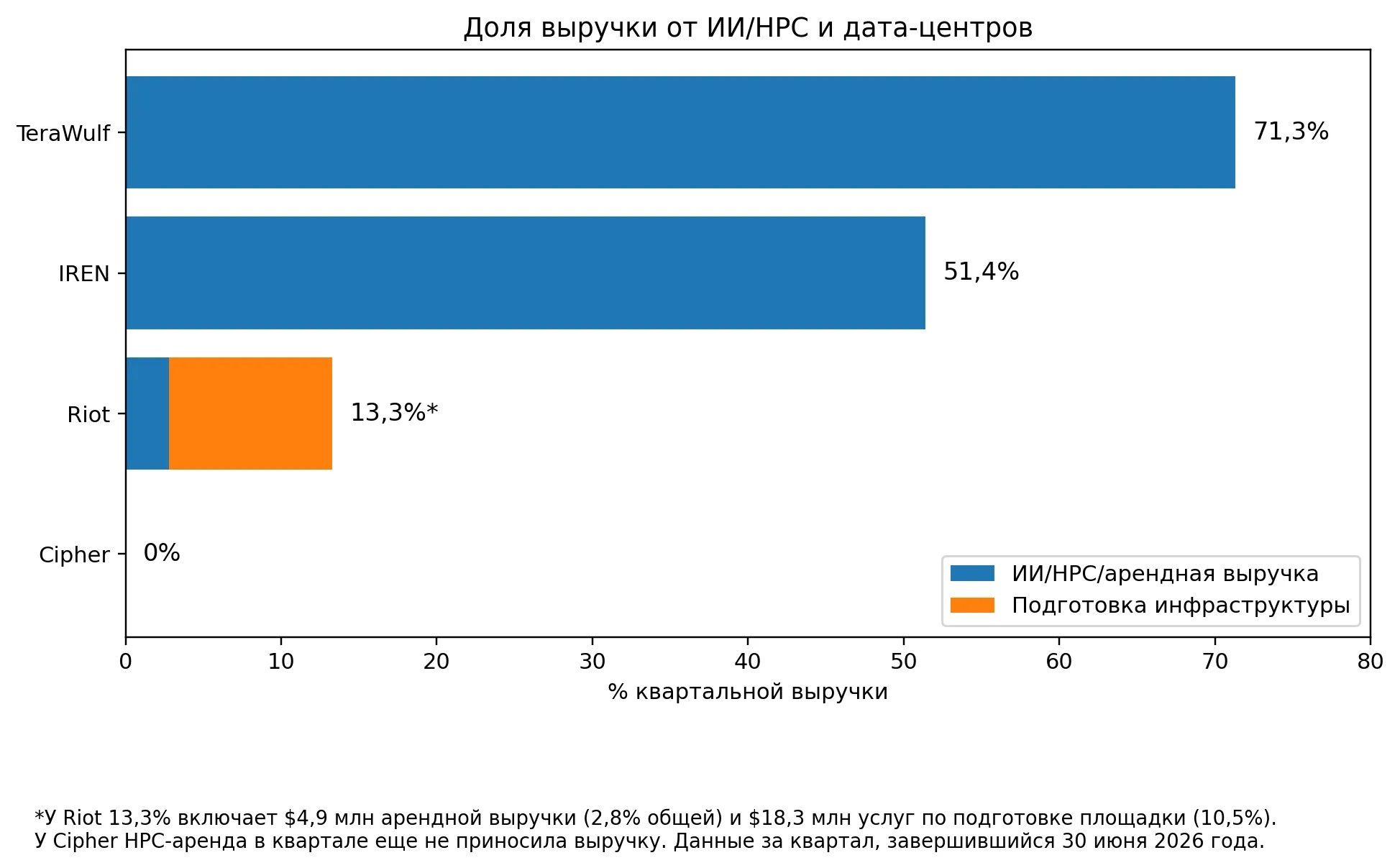
Source: IREN, TeraWulf, Cipher Digital, Riot Platforms, ForkLog.

Recall that in June, public Bitcoin miners intensified their pivot to AI infrastructure. The trend became especially noticeable against the backdrop of rising capital expenditures in the AI sector and demand for sites with access to electricity.

Miners' and AI operators' equipment costs rose to $30.7 billion
end-content

Domande pertinenti

QIn which quarter did IREN's AI cloud services revenue exceed bitcoin mining revenue for the first time?

AThe fourth quarter of the 2026 fiscal year, which ended on June 30.

QWhat were IREN's revenues from AI cloud services and bitcoin mining in that quarter?

AAI cloud services revenue was $70.5 million, while bitcoin mining revenue was $66.7 million.

QWhat major factor contributed to IREN's net loss of $684 million in the quarter?

AA non-cash asset impairment of $450.4 million, largely due to the decommissioning of mining equipment during the conversion of facilities for AI Cloud.

QWhat percentage of TeraWulf's Q2 revenue came from High-Performance Computing (HPC) power leasing?

AApproximately 71% ($31.9 million out of $44.8 million total revenue).

QHow did Riot Platforms' Q2 revenue from data centers compare to its bitcoin mining revenue?

AData center revenue ($23.2 million) was significantly lower than bitcoin mining revenue ($113.7 million), accounting for about 13% of the company's total revenue.

Letture associate

Solana's Historic First Governance Vote Concludes: Why Did SGP-003 Spark Massive Controversy?

Solana has completed its first-ever formal on-chain governance vote, marking a shift towards decentralized decision-making. Three proposals, SGP-0001, SGP-0002, and SGP-0003, were voted on. SGP-0001, establishing the foundational governance framework, and SGP-0002, accelerating the reduction of SOL's inflation rate, both passed. However, the most contentious proposal, SGP-0003, failed to reach the required supermajority. SGP-0003 proposed a significant change to Solana's fee structure, introducing a variable "Resource Fee" based on computational unit (CU) consumption, which would be entirely burned. Supporters, including some core developers, argued it would create fairer resource pricing and increase SOL's deflationary pressure. Opponents, led by major DeFi applications like Jupiter and Drift, criticized it as an effective tax on complex applications, warning it would unpredictably increase operational costs and undermine business models built on Solana's low fees. The vote outcome highlights a critical tension within Solana's growing ecosystem: balancing the interests of SOL holders (through deflationary mechanisms), validators (through rewards), and application developers (through cost predictability). As Solana evolves from a high-performance blockchain to one hosting substantial economic activity, governance is becoming central to its future development and competitiveness.

marsbit19 min fa

Solana's Historic First Governance Vote Concludes: Why Did SGP-003 Spark Massive Controversy?

marsbit19 min fa

Wash's Jackson Hole Debut: Bidding Farewell to 'Forward Guidance', Reshaping Fed Discipline Amidst the Squeeze Between AI and Inflation

In his first Jackson Hole speech, new Fed Chair Kevin Warsh signaled a significant shift in monetary policy communication. He declared that "forward guidance," a tool heavily used since the financial crisis, has outlived its usefulness in normal times and should be retired. He cautioned that over-reliance on it can distort market signals and constrain the Fed's flexibility. Instead, Warsh emphasized a return to data-dependence and decision-making discipline. Warsh outlined seven key principles to guide policy: anchoring the 2% inflation target, pursuing the employment mandate, using short-term rates as the primary tool, acknowledging the importance of money, and maintaining purposeful, restrained communication. He stressed that policy should focus on trends, not single data points. On the current economic outlook, Warsh noted that the labor market is consistent with full employment but inflation remains "far above" the Fed's target. He highlighted that over half of the PCE basket's components are still rising above 3% annually. While acknowledging AI's transformative potential for productivity and capital allocation, he admitted its full economic impact remains uncertain and is not a factor in current policy decisions. His core message was a commitment to policy discipline rather than pre-set decisions. Warsh stated the Fed's primary focus must be on restoring price stability, vowing, "We still have work to do," until there is clear evidence inflation is moving decisively toward 2%. He concluded by framing effective monetary policy as crucial for economic prosperity and U.S. global leadership.

Odaily星球日报1 h fa

Wash's Jackson Hole Debut: Bidding Farewell to 'Forward Guidance', Reshaping Fed Discipline Amidst the Squeeze Between AI and Inflation

Odaily星球日报1 h fa

Trading

Spot
活动图片